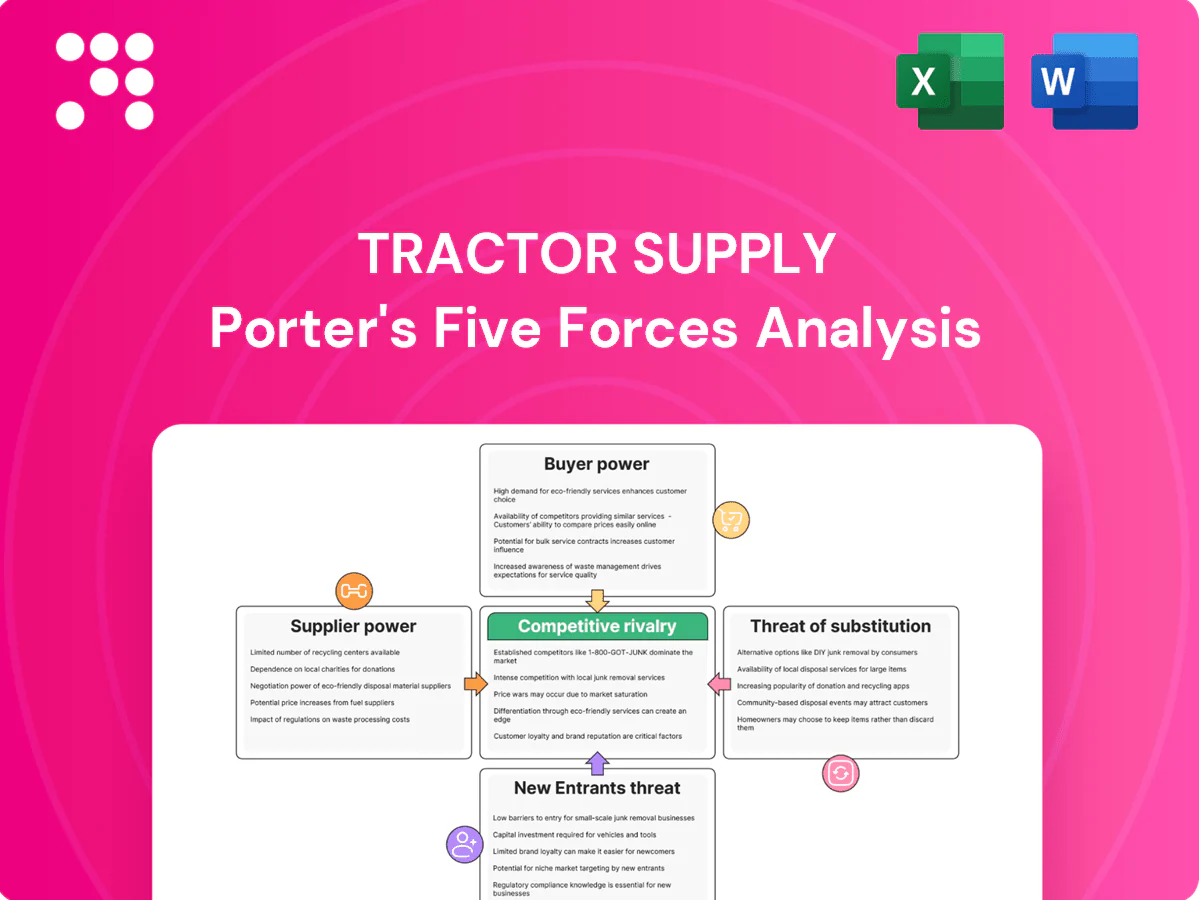
Tractor Supply Porter's Five Forces Analysis

Go Beyond the Preview—Access the Full Strategic Report
Tractor Supply navigates a competitive landscape shaped by moderate buyer power and the ever-present threat of substitutes. Understanding the intensity of these forces is crucial for any strategic decision.
The complete report reveals the real forces shaping Tractor Supply’s industry—from supplier influence to threat of new entrants. Gain actionable insights to drive smarter decision-making.
Suppliers Bargaining Power

Supplier Concentration
Tractor Supply Company (TSC) likely benefits from a diverse supplier base, which generally dilutes individual supplier bargaining power. For instance, in 2023, TSC's top suppliers represented a relatively small percentage of its total cost of goods sold, suggesting no single supplier held excessive leverage. This broad sourcing strategy allows TSC to negotiate favorable terms and switch suppliers if necessary, thereby maintaining its purchasing advantage.
Uniqueness of Inputs
The uniqueness of inputs for Tractor Supply Company (TSC) plays a significant role in the bargaining power of its suppliers. If suppliers provide highly differentiated or proprietary products that are essential for TSC's unique retail offering, these suppliers gain considerable leverage.
For instance, if a supplier offers exclusive brands of animal feed, specialized farm equipment parts, or unique pet supplies that are not readily available elsewhere, they can command higher prices and more favorable terms. This is particularly true if TSC's customer base strongly associates these unique inputs with the Tractor Supply brand.
In 2023, Tractor Supply Company reported that its cost of goods sold was approximately $9.1 billion. The degree to which these goods are sourced from a limited number of suppliers offering unique products directly impacts how much of this cost is influenced by supplier bargaining power.

Switching Costs for TSC
Tractor Supply Company (TSC) faces potential switching costs that could influence supplier bargaining power. These costs might include the expense of retooling manufacturing processes to accommodate new product specifications or the administrative burden of renegotiating contracts with alternative suppliers. For instance, if TSC relies on specialized components or proprietary technology from a current supplier, the investment required to adapt to a new vendor could be substantial, thereby strengthening the existing supplier's position.

Supplier's Ability to Forward Integrate
The ability of Tractor Supply Company's suppliers to forward integrate, meaning they could bypass Tractor Supply and sell directly to consumers or other retailers, significantly influences their bargaining power. If suppliers possess the resources, infrastructure, and desire to establish their own retail channels, they gain leverage over Tractor Supply by threatening to compete directly. This is particularly relevant for specialized or proprietary products where suppliers might have a strong incentive to capture the full retail margin.
For instance, a major manufacturer of premium animal feed or specialized farm equipment could potentially develop its own direct-to-consumer e-commerce platform or establish its own branded retail outlets. This threat is amplified if these suppliers have strong brand recognition among Tractor Supply's customer base. In 2024, the trend towards direct-to-consumer (DTC) models across various industries, including agriculture and home goods, suggests this is a growing consideration for Tractor Supply.
- Potential for Supplier Forward Integration: Suppliers may have the capacity to establish their own direct-to-consumer sales channels, thereby increasing their bargaining power.
- Impact on Tractor Supply: If suppliers can effectively bypass Tractor Supply, they can capture higher margins and potentially reduce Tractor Supply's reliance on them.
- DTC Trend Influence: The broader market trend of direct-to-consumer sales in 2024 suggests an increasing likelihood of suppliers exploring this avenue.
Importance of TSC to Suppliers
The significance of Tractor Supply Company (TSC) to its suppliers is a key factor in understanding supplier bargaining power. When TSC constitutes a substantial portion of a supplier's annual revenue, that supplier is likely to have less leverage in negotiations. This means they may be more amenable to accepting TSC's terms and pricing, effectively diminishing their ability to demand more favorable conditions. For instance, if a supplier's sales to TSC represent over 20% of their total business, TSC's importance to them is considerable.
This dynamic can be observed across various supplier categories for TSC. For smaller, specialized manufacturers or distributors, TSC might be their primary, or even sole, major retail partner. In such scenarios, the supplier's dependence on TSC is exceptionally high, granting TSC significant power to influence pricing and product specifications. Conversely, suppliers with a diversified customer base, where TSC is just one of many retail outlets, will naturally possess greater bargaining strength.
- Supplier Dependence: A supplier whose revenue heavily relies on Tractor Supply Company will have diminished bargaining power.
- Revenue Concentration: If TSC accounts for a significant percentage of a supplier's total sales, the supplier is more likely to concede on pricing and terms.
- Market Diversification: Suppliers with a broad customer base, not solely dependent on TSC, will retain more leverage.
- Impact on Negotiation: High supplier dependence translates to TSC having more influence in negotiating favorable terms, potentially lowering input costs.
Supplier Power: Retailer's Strategic Advantage
Tractor Supply Company's (TSC) suppliers generally face limited bargaining power due to TSC's diverse sourcing strategy. In 2023, TSC's cost of goods sold was around $9.1 billion, and its broad supplier network suggests no single entity held significant leverage. This allows TSC to negotiate favorable terms, as demonstrated by its ability to switch suppliers if necessary, thereby maintaining purchasing advantages.
The uniqueness of products offered by suppliers significantly influences their bargaining power. If suppliers provide exclusive or highly differentiated items, like specialized farm equipment parts or unique pet supplies, they can command higher prices. This is especially true if these items are strongly associated with the Tractor Supply brand by its customer base.
Switching costs for Tractor Supply Company also play a role. If TSC relies on specialized components or proprietary technology from a supplier, the expense and administrative effort to transition to a new vendor can be substantial, strengthening the existing supplier's negotiating position.
The threat of forward integration by suppliers, where they might sell directly to consumers, increases their bargaining power. This is a growing trend in 2024, as seen in various sectors, potentially allowing suppliers to capture higher margins and bypass TSC.
| Factor | Impact on Supplier Bargaining Power | Tractor Supply Context |
| Supplier Diversity | Lowers Power | TSC's broad sourcing dilutes individual supplier leverage. |
| Input Uniqueness | Increases Power | Exclusive or differentiated products grant suppliers more pricing control. |
| Switching Costs | Increases Power | High costs to change suppliers strengthen existing relationships. |
| Forward Integration Threat | Increases Power | DTC trends in 2024 empower suppliers to bypass retailers. |
| Supplier Dependence on TSC | Lowers Power | If TSC is a major revenue source, suppliers have less leverage. |
What is included in the product
 Detailed Word Document
This analysis dissects Tractor Supply's competitive environment by examining the bargaining power of buyers and suppliers, the threat of new entrants and substitutes, and the intensity of rivalry within the rural lifestyle retail sector.

 Customizable Excel Spreadsheet
Instantly understand competitive pressures with a clear, visual representation of Tractor Supply's Porter's Five Forces, simplifying strategic analysis.
Customers Bargaining Power

Customer Concentration
Tractor Supply Company's customer base is characterized by its fragmentation, primarily consisting of individual homeowners, farmers, and tradespeople rather than a few large, dominant buyers. This wide dispersal of customers significantly limits their collective bargaining power, as no single customer or small group can exert substantial influence over pricing or terms.
Price Sensitivity
Tractor Supply Company's customers exhibit varying degrees of price sensitivity. For essential items like animal feed and basic farm supplies, customers may be less sensitive to minor price fluctuations due to the necessity of these purchases. However, for discretionary items or seasonal goods, price becomes a more significant factor in purchasing decisions.
The availability of substitutes significantly impacts customer price sensitivity. While Tractor Supply offers a wide range of specialized products for rural lifestyles, customers can often find alternative suppliers for general hardware, clothing, or pet supplies, increasing their leverage to seek lower prices elsewhere.
In 2023, Tractor Supply reported a net sales increase of 2.5% to $14.6 billion, indicating continued customer demand despite potential price pressures. This suggests that while price is a consideration, the perceived value and unique product assortment help mitigate extreme price sensitivity for a core customer base.

Availability of Substitutes/Alternatives for Customers
The bargaining power of Tractor Supply's customers is significantly influenced by the availability of substitutes. Customers can easily find similar products, such as farm and ranch supplies, pet food, and apparel, from a variety of sources. Big-box retailers like Walmart and Home Depot, as well as online giants like Amazon, offer a wide selection of these goods, often at competitive prices.
Furthermore, specialized local feed stores and agricultural co-ops provide niche products and personalized service, presenting alternative options for certain customer segments. This broad accessibility to alternatives empowers customers, giving them leverage to negotiate for lower prices or better product quality.
For instance, in 2024, the online retail sector continued its robust growth, capturing an increasing share of consumer spending across various categories relevant to Tractor Supply. This trend amplifies customer choice and intensifies pressure on Tractor Supply to remain competitive on price and product offering.

Customer Switching Costs
Customer switching costs for Tractor Supply Company are relatively low, meaning customers can move to competitors without facing significant financial or practical hurdles. This ease of switching directly impacts their bargaining power, as they have readily available alternatives for their agricultural and rural lifestyle needs. For instance, a customer looking for animal feed or basic farm equipment can likely find comparable products at local feed stores, big-box retailers with garden centers, or even online marketplaces without incurring substantial costs or losing valuable benefits.
- Low Switching Costs: Customers can easily find similar products elsewhere, such as at local feed stores or larger retailers like Walmart or Home Depot, without significant effort or financial penalty.
- Minimal Loyalty Program Impact: While Tractor Supply has a Neighbor's Club loyalty program, the benefits are generally not so deeply integrated or exclusive that losing them would deter a customer from switching for better pricing or convenience.
- Product Availability: Many of Tractor Supply's core product categories, like pet food, basic tools, and apparel, are widely available from numerous competitors, further reducing the inconvenience of switching.
Customer Information Asymmetry
Customer information asymmetry is a key factor influencing bargaining power. In the current digital landscape, customers have unprecedented access to information regarding product pricing, quality comparisons, and competitor deals. This readily available data significantly enhances their ability to negotiate effectively with Tractor Supply.
For instance, by mid-2024, online price comparison tools and detailed product reviews are commonplace. This empowers customers to easily identify the best value, putting pressure on Tractor Supply to maintain competitive pricing and demonstrate superior product quality. The ease with which customers can research alternatives directly impacts their willingness to accept less favorable terms.
- Informed Consumers: Customers can readily access Tractor Supply's pricing and compare it against rivals like Rural King or independent farm supply stores online.
- Quality Benchmarking: Online reviews and forums allow customers to benchmark the quality of Tractor Supply's merchandise against other available options.
- Digital Transparency: The widespread availability of product specifications and customer feedback online reduces information gaps, strengthening the customer's position.
Retail Customers Wield Moderate Bargaining Power
Tractor Supply's customers possess moderate bargaining power, primarily driven by the availability of substitutes and low switching costs. While the company serves a broad base, the ease with which customers can find similar products from competitors like Walmart, Home Depot, or specialized local stores means they can often exert pressure on pricing.
In 2024, the continued expansion of e-commerce platforms and the increasing prevalence of online price comparison tools further empower consumers. This digital transparency allows customers to readily assess value and seek out the most competitive offers, intensifying the need for Tractor Supply to maintain attractive pricing and product assortments.
The company's Neighbor's Club loyalty program, while beneficial, does not create significant barriers to switching, meaning customers can readily move to alternatives if price or convenience dictates. This dynamic contributes to the overall moderate level of customer bargaining power.
| Factor | Impact on Bargaining Power | Supporting Data/Observation (as of mid-2024) |
|---|---|---|
| Customer Fragmentation | Lowers individual customer power | Tractor Supply serves millions of individual customers, not large institutional buyers. |
| Availability of Substitutes | Increases customer power | Competitors include big-box retailers (Walmart, Home Depot), online giants (Amazon), and local feed stores. |
| Switching Costs | Low, increasing customer power | Customers can easily purchase comparable goods (feed, tools, apparel) from alternative sources without significant penalty. |
| Information Asymmetry | Low, increasing customer power | Online price comparison tools and reviews provide customers with extensive pricing and quality data. |
Preview the Actual Deliverable
Tractor Supply Porter's Five Forces Analysis
This preview shows the exact Tractor Supply Porter's Five Forces Analysis document you'll receive immediately after purchase. You'll gain a comprehensive understanding of the competitive landscape, including the bargaining power of buyers and suppliers, the threat of new entrants and substitutes, and the intensity of rivalry within the industry. This professionally formatted analysis is ready for your immediate use, providing valuable strategic insights without any surprises.

Go Beyond the Preview—Access the Full Strategic Report
Tractor Supply navigates a competitive landscape shaped by moderate buyer power and the ever-present threat of substitutes. Understanding the intensity of these forces is crucial for any strategic decision.
The complete report reveals the real forces shaping Tractor Supply’s industry—from supplier influence to threat of new entrants. Gain actionable insights to drive smarter decision-making.
Suppliers Bargaining Power
Supplier Concentration
Tractor Supply Company (TSC) likely benefits from a diverse supplier base, which generally dilutes individual supplier bargaining power. For instance, in 2023, TSC's top suppliers represented a relatively small percentage of its total cost of goods sold, suggesting no single supplier held excessive leverage. This broad sourcing strategy allows TSC to negotiate favorable terms and switch suppliers if necessary, thereby maintaining its purchasing advantage.
Uniqueness of Inputs
The uniqueness of inputs for Tractor Supply Company (TSC) plays a significant role in the bargaining power of its suppliers. If suppliers provide highly differentiated or proprietary products that are essential for TSC's unique retail offering, these suppliers gain considerable leverage.
For instance, if a supplier offers exclusive brands of animal feed, specialized farm equipment parts, or unique pet supplies that are not readily available elsewhere, they can command higher prices and more favorable terms. This is particularly true if TSC's customer base strongly associates these unique inputs with the Tractor Supply brand.
In 2023, Tractor Supply Company reported that its cost of goods sold was approximately $9.1 billion. The degree to which these goods are sourced from a limited number of suppliers offering unique products directly impacts how much of this cost is influenced by supplier bargaining power.
Switching Costs for TSC
Tractor Supply Company (TSC) faces potential switching costs that could influence supplier bargaining power. These costs might include the expense of retooling manufacturing processes to accommodate new product specifications or the administrative burden of renegotiating contracts with alternative suppliers. For instance, if TSC relies on specialized components or proprietary technology from a current supplier, the investment required to adapt to a new vendor could be substantial, thereby strengthening the existing supplier's position.
Supplier's Ability to Forward Integrate
The ability of Tractor Supply Company's suppliers to forward integrate, meaning they could bypass Tractor Supply and sell directly to consumers or other retailers, significantly influences their bargaining power. If suppliers possess the resources, infrastructure, and desire to establish their own retail channels, they gain leverage over Tractor Supply by threatening to compete directly. This is particularly relevant for specialized or proprietary products where suppliers might have a strong incentive to capture the full retail margin.
For instance, a major manufacturer of premium animal feed or specialized farm equipment could potentially develop its own direct-to-consumer e-commerce platform or establish its own branded retail outlets. This threat is amplified if these suppliers have strong brand recognition among Tractor Supply's customer base. In 2024, the trend towards direct-to-consumer (DTC) models across various industries, including agriculture and home goods, suggests this is a growing consideration for Tractor Supply.
- Potential for Supplier Forward Integration: Suppliers may have the capacity to establish their own direct-to-consumer sales channels, thereby increasing their bargaining power.
- Impact on Tractor Supply: If suppliers can effectively bypass Tractor Supply, they can capture higher margins and potentially reduce Tractor Supply's reliance on them.
- DTC Trend Influence: The broader market trend of direct-to-consumer sales in 2024 suggests an increasing likelihood of suppliers exploring this avenue.
Importance of TSC to Suppliers
The significance of Tractor Supply Company (TSC) to its suppliers is a key factor in understanding supplier bargaining power. When TSC constitutes a substantial portion of a supplier's annual revenue, that supplier is likely to have less leverage in negotiations. This means they may be more amenable to accepting TSC's terms and pricing, effectively diminishing their ability to demand more favorable conditions. For instance, if a supplier's sales to TSC represent over 20% of their total business, TSC's importance to them is considerable.
This dynamic can be observed across various supplier categories for TSC. For smaller, specialized manufacturers or distributors, TSC might be their primary, or even sole, major retail partner. In such scenarios, the supplier's dependence on TSC is exceptionally high, granting TSC significant power to influence pricing and product specifications. Conversely, suppliers with a diversified customer base, where TSC is just one of many retail outlets, will naturally possess greater bargaining strength.
- Supplier Dependence: A supplier whose revenue heavily relies on Tractor Supply Company will have diminished bargaining power.
- Revenue Concentration: If TSC accounts for a significant percentage of a supplier's total sales, the supplier is more likely to concede on pricing and terms.
- Market Diversification: Suppliers with a broad customer base, not solely dependent on TSC, will retain more leverage.
- Impact on Negotiation: High supplier dependence translates to TSC having more influence in negotiating favorable terms, potentially lowering input costs.
Supplier Power: Retailer's Strategic Advantage
Tractor Supply Company's (TSC) suppliers generally face limited bargaining power due to TSC's diverse sourcing strategy. In 2023, TSC's cost of goods sold was around $9.1 billion, and its broad supplier network suggests no single entity held significant leverage. This allows TSC to negotiate favorable terms, as demonstrated by its ability to switch suppliers if necessary, thereby maintaining purchasing advantages.
The uniqueness of products offered by suppliers significantly influences their bargaining power. If suppliers provide exclusive or highly differentiated items, like specialized farm equipment parts or unique pet supplies, they can command higher prices. This is especially true if these items are strongly associated with the Tractor Supply brand by its customer base.
Switching costs for Tractor Supply Company also play a role. If TSC relies on specialized components or proprietary technology from a supplier, the expense and administrative effort to transition to a new vendor can be substantial, strengthening the existing supplier's negotiating position.
The threat of forward integration by suppliers, where they might sell directly to consumers, increases their bargaining power. This is a growing trend in 2024, as seen in various sectors, potentially allowing suppliers to capture higher margins and bypass TSC.
| Factor | Impact on Supplier Bargaining Power | Tractor Supply Context |
| Supplier Diversity | Lowers Power | TSC's broad sourcing dilutes individual supplier leverage. |
| Input Uniqueness | Increases Power | Exclusive or differentiated products grant suppliers more pricing control. |
| Switching Costs | Increases Power | High costs to change suppliers strengthen existing relationships. |
| Forward Integration Threat | Increases Power | DTC trends in 2024 empower suppliers to bypass retailers. |
| Supplier Dependence on TSC | Lowers Power | If TSC is a major revenue source, suppliers have less leverage. |
What is included in the product
Detailed Word Document
This analysis dissects Tractor Supply's competitive environment by examining the bargaining power of buyers and suppliers, the threat of new entrants and substitutes, and the intensity of rivalry within the rural lifestyle retail sector.
Customizable Excel Spreadsheet
Instantly understand competitive pressures with a clear, visual representation of Tractor Supply's Porter's Five Forces, simplifying strategic analysis.
Customers Bargaining Power
Customer Concentration
Tractor Supply Company's customer base is characterized by its fragmentation, primarily consisting of individual homeowners, farmers, and tradespeople rather than a few large, dominant buyers. This wide dispersal of customers significantly limits their collective bargaining power, as no single customer or small group can exert substantial influence over pricing or terms.
Price Sensitivity
Tractor Supply Company's customers exhibit varying degrees of price sensitivity. For essential items like animal feed and basic farm supplies, customers may be less sensitive to minor price fluctuations due to the necessity of these purchases. However, for discretionary items or seasonal goods, price becomes a more significant factor in purchasing decisions.
The availability of substitutes significantly impacts customer price sensitivity. While Tractor Supply offers a wide range of specialized products for rural lifestyles, customers can often find alternative suppliers for general hardware, clothing, or pet supplies, increasing their leverage to seek lower prices elsewhere.
In 2023, Tractor Supply reported a net sales increase of 2.5% to $14.6 billion, indicating continued customer demand despite potential price pressures. This suggests that while price is a consideration, the perceived value and unique product assortment help mitigate extreme price sensitivity for a core customer base.
Availability of Substitutes/Alternatives for Customers
The bargaining power of Tractor Supply's customers is significantly influenced by the availability of substitutes. Customers can easily find similar products, such as farm and ranch supplies, pet food, and apparel, from a variety of sources. Big-box retailers like Walmart and Home Depot, as well as online giants like Amazon, offer a wide selection of these goods, often at competitive prices.
Furthermore, specialized local feed stores and agricultural co-ops provide niche products and personalized service, presenting alternative options for certain customer segments. This broad accessibility to alternatives empowers customers, giving them leverage to negotiate for lower prices or better product quality.
For instance, in 2024, the online retail sector continued its robust growth, capturing an increasing share of consumer spending across various categories relevant to Tractor Supply. This trend amplifies customer choice and intensifies pressure on Tractor Supply to remain competitive on price and product offering.
Customer Switching Costs
Customer switching costs for Tractor Supply Company are relatively low, meaning customers can move to competitors without facing significant financial or practical hurdles. This ease of switching directly impacts their bargaining power, as they have readily available alternatives for their agricultural and rural lifestyle needs. For instance, a customer looking for animal feed or basic farm equipment can likely find comparable products at local feed stores, big-box retailers with garden centers, or even online marketplaces without incurring substantial costs or losing valuable benefits.
- Low Switching Costs: Customers can easily find similar products elsewhere, such as at local feed stores or larger retailers like Walmart or Home Depot, without significant effort or financial penalty.
- Minimal Loyalty Program Impact: While Tractor Supply has a Neighbor's Club loyalty program, the benefits are generally not so deeply integrated or exclusive that losing them would deter a customer from switching for better pricing or convenience.
- Product Availability: Many of Tractor Supply's core product categories, like pet food, basic tools, and apparel, are widely available from numerous competitors, further reducing the inconvenience of switching.
Customer Information Asymmetry
Customer information asymmetry is a key factor influencing bargaining power. In the current digital landscape, customers have unprecedented access to information regarding product pricing, quality comparisons, and competitor deals. This readily available data significantly enhances their ability to negotiate effectively with Tractor Supply.
For instance, by mid-2024, online price comparison tools and detailed product reviews are commonplace. This empowers customers to easily identify the best value, putting pressure on Tractor Supply to maintain competitive pricing and demonstrate superior product quality. The ease with which customers can research alternatives directly impacts their willingness to accept less favorable terms.
- Informed Consumers: Customers can readily access Tractor Supply's pricing and compare it against rivals like Rural King or independent farm supply stores online.
- Quality Benchmarking: Online reviews and forums allow customers to benchmark the quality of Tractor Supply's merchandise against other available options.
- Digital Transparency: The widespread availability of product specifications and customer feedback online reduces information gaps, strengthening the customer's position.
Retail Customers Wield Moderate Bargaining Power
Tractor Supply's customers possess moderate bargaining power, primarily driven by the availability of substitutes and low switching costs. While the company serves a broad base, the ease with which customers can find similar products from competitors like Walmart, Home Depot, or specialized local stores means they can often exert pressure on pricing.
In 2024, the continued expansion of e-commerce platforms and the increasing prevalence of online price comparison tools further empower consumers. This digital transparency allows customers to readily assess value and seek out the most competitive offers, intensifying the need for Tractor Supply to maintain attractive pricing and product assortments.
The company's Neighbor's Club loyalty program, while beneficial, does not create significant barriers to switching, meaning customers can readily move to alternatives if price or convenience dictates. This dynamic contributes to the overall moderate level of customer bargaining power.
| Factor | Impact on Bargaining Power | Supporting Data/Observation (as of mid-2024) |
|---|---|---|
| Customer Fragmentation | Lowers individual customer power | Tractor Supply serves millions of individual customers, not large institutional buyers. |
| Availability of Substitutes | Increases customer power | Competitors include big-box retailers (Walmart, Home Depot), online giants (Amazon), and local feed stores. |
| Switching Costs | Low, increasing customer power | Customers can easily purchase comparable goods (feed, tools, apparel) from alternative sources without significant penalty. |
| Information Asymmetry | Low, increasing customer power | Online price comparison tools and reviews provide customers with extensive pricing and quality data. |
Preview the Actual Deliverable
Tractor Supply Porter's Five Forces Analysis
This preview shows the exact Tractor Supply Porter's Five Forces Analysis document you'll receive immediately after purchase. You'll gain a comprehensive understanding of the competitive landscape, including the bargaining power of buyers and suppliers, the threat of new entrants and substitutes, and the intensity of rivalry within the industry. This professionally formatted analysis is ready for your immediate use, providing valuable strategic insights without any surprises.
Original: $10.00
-65%$10.00
$3.50Description
Go Beyond the Preview—Access the Full Strategic Report
Tractor Supply navigates a competitive landscape shaped by moderate buyer power and the ever-present threat of substitutes. Understanding the intensity of these forces is crucial for any strategic decision.
The complete report reveals the real forces shaping Tractor Supply’s industry—from supplier influence to threat of new entrants. Gain actionable insights to drive smarter decision-making.
Suppliers Bargaining Power
Supplier Concentration
Tractor Supply Company (TSC) likely benefits from a diverse supplier base, which generally dilutes individual supplier bargaining power. For instance, in 2023, TSC's top suppliers represented a relatively small percentage of its total cost of goods sold, suggesting no single supplier held excessive leverage. This broad sourcing strategy allows TSC to negotiate favorable terms and switch suppliers if necessary, thereby maintaining its purchasing advantage.
Uniqueness of Inputs
The uniqueness of inputs for Tractor Supply Company (TSC) plays a significant role in the bargaining power of its suppliers. If suppliers provide highly differentiated or proprietary products that are essential for TSC's unique retail offering, these suppliers gain considerable leverage.
For instance, if a supplier offers exclusive brands of animal feed, specialized farm equipment parts, or unique pet supplies that are not readily available elsewhere, they can command higher prices and more favorable terms. This is particularly true if TSC's customer base strongly associates these unique inputs with the Tractor Supply brand.
In 2023, Tractor Supply Company reported that its cost of goods sold was approximately $9.1 billion. The degree to which these goods are sourced from a limited number of suppliers offering unique products directly impacts how much of this cost is influenced by supplier bargaining power.
Switching Costs for TSC
Tractor Supply Company (TSC) faces potential switching costs that could influence supplier bargaining power. These costs might include the expense of retooling manufacturing processes to accommodate new product specifications or the administrative burden of renegotiating contracts with alternative suppliers. For instance, if TSC relies on specialized components or proprietary technology from a current supplier, the investment required to adapt to a new vendor could be substantial, thereby strengthening the existing supplier's position.
Supplier's Ability to Forward Integrate
The ability of Tractor Supply Company's suppliers to forward integrate, meaning they could bypass Tractor Supply and sell directly to consumers or other retailers, significantly influences their bargaining power. If suppliers possess the resources, infrastructure, and desire to establish their own retail channels, they gain leverage over Tractor Supply by threatening to compete directly. This is particularly relevant for specialized or proprietary products where suppliers might have a strong incentive to capture the full retail margin.
For instance, a major manufacturer of premium animal feed or specialized farm equipment could potentially develop its own direct-to-consumer e-commerce platform or establish its own branded retail outlets. This threat is amplified if these suppliers have strong brand recognition among Tractor Supply's customer base. In 2024, the trend towards direct-to-consumer (DTC) models across various industries, including agriculture and home goods, suggests this is a growing consideration for Tractor Supply.
- Potential for Supplier Forward Integration: Suppliers may have the capacity to establish their own direct-to-consumer sales channels, thereby increasing their bargaining power.
- Impact on Tractor Supply: If suppliers can effectively bypass Tractor Supply, they can capture higher margins and potentially reduce Tractor Supply's reliance on them.
- DTC Trend Influence: The broader market trend of direct-to-consumer sales in 2024 suggests an increasing likelihood of suppliers exploring this avenue.
Importance of TSC to Suppliers
The significance of Tractor Supply Company (TSC) to its suppliers is a key factor in understanding supplier bargaining power. When TSC constitutes a substantial portion of a supplier's annual revenue, that supplier is likely to have less leverage in negotiations. This means they may be more amenable to accepting TSC's terms and pricing, effectively diminishing their ability to demand more favorable conditions. For instance, if a supplier's sales to TSC represent over 20% of their total business, TSC's importance to them is considerable.
This dynamic can be observed across various supplier categories for TSC. For smaller, specialized manufacturers or distributors, TSC might be their primary, or even sole, major retail partner. In such scenarios, the supplier's dependence on TSC is exceptionally high, granting TSC significant power to influence pricing and product specifications. Conversely, suppliers with a diversified customer base, where TSC is just one of many retail outlets, will naturally possess greater bargaining strength.
- Supplier Dependence: A supplier whose revenue heavily relies on Tractor Supply Company will have diminished bargaining power.
- Revenue Concentration: If TSC accounts for a significant percentage of a supplier's total sales, the supplier is more likely to concede on pricing and terms.
- Market Diversification: Suppliers with a broad customer base, not solely dependent on TSC, will retain more leverage.
- Impact on Negotiation: High supplier dependence translates to TSC having more influence in negotiating favorable terms, potentially lowering input costs.
Supplier Power: Retailer's Strategic Advantage
Tractor Supply Company's (TSC) suppliers generally face limited bargaining power due to TSC's diverse sourcing strategy. In 2023, TSC's cost of goods sold was around $9.1 billion, and its broad supplier network suggests no single entity held significant leverage. This allows TSC to negotiate favorable terms, as demonstrated by its ability to switch suppliers if necessary, thereby maintaining purchasing advantages.
The uniqueness of products offered by suppliers significantly influences their bargaining power. If suppliers provide exclusive or highly differentiated items, like specialized farm equipment parts or unique pet supplies, they can command higher prices. This is especially true if these items are strongly associated with the Tractor Supply brand by its customer base.
Switching costs for Tractor Supply Company also play a role. If TSC relies on specialized components or proprietary technology from a supplier, the expense and administrative effort to transition to a new vendor can be substantial, strengthening the existing supplier's negotiating position.
The threat of forward integration by suppliers, where they might sell directly to consumers, increases their bargaining power. This is a growing trend in 2024, as seen in various sectors, potentially allowing suppliers to capture higher margins and bypass TSC.
| Factor | Impact on Supplier Bargaining Power | Tractor Supply Context |
| Supplier Diversity | Lowers Power | TSC's broad sourcing dilutes individual supplier leverage. |
| Input Uniqueness | Increases Power | Exclusive or differentiated products grant suppliers more pricing control. |
| Switching Costs | Increases Power | High costs to change suppliers strengthen existing relationships. |
| Forward Integration Threat | Increases Power | DTC trends in 2024 empower suppliers to bypass retailers. |
| Supplier Dependence on TSC | Lowers Power | If TSC is a major revenue source, suppliers have less leverage. |
What is included in the product
Detailed Word Document
This analysis dissects Tractor Supply's competitive environment by examining the bargaining power of buyers and suppliers, the threat of new entrants and substitutes, and the intensity of rivalry within the rural lifestyle retail sector.
Customizable Excel Spreadsheet
Instantly understand competitive pressures with a clear, visual representation of Tractor Supply's Porter's Five Forces, simplifying strategic analysis.
Customers Bargaining Power
Customer Concentration
Tractor Supply Company's customer base is characterized by its fragmentation, primarily consisting of individual homeowners, farmers, and tradespeople rather than a few large, dominant buyers. This wide dispersal of customers significantly limits their collective bargaining power, as no single customer or small group can exert substantial influence over pricing or terms.
Price Sensitivity
Tractor Supply Company's customers exhibit varying degrees of price sensitivity. For essential items like animal feed and basic farm supplies, customers may be less sensitive to minor price fluctuations due to the necessity of these purchases. However, for discretionary items or seasonal goods, price becomes a more significant factor in purchasing decisions.
The availability of substitutes significantly impacts customer price sensitivity. While Tractor Supply offers a wide range of specialized products for rural lifestyles, customers can often find alternative suppliers for general hardware, clothing, or pet supplies, increasing their leverage to seek lower prices elsewhere.
In 2023, Tractor Supply reported a net sales increase of 2.5% to $14.6 billion, indicating continued customer demand despite potential price pressures. This suggests that while price is a consideration, the perceived value and unique product assortment help mitigate extreme price sensitivity for a core customer base.
Availability of Substitutes/Alternatives for Customers
The bargaining power of Tractor Supply's customers is significantly influenced by the availability of substitutes. Customers can easily find similar products, such as farm and ranch supplies, pet food, and apparel, from a variety of sources. Big-box retailers like Walmart and Home Depot, as well as online giants like Amazon, offer a wide selection of these goods, often at competitive prices.
Furthermore, specialized local feed stores and agricultural co-ops provide niche products and personalized service, presenting alternative options for certain customer segments. This broad accessibility to alternatives empowers customers, giving them leverage to negotiate for lower prices or better product quality.
For instance, in 2024, the online retail sector continued its robust growth, capturing an increasing share of consumer spending across various categories relevant to Tractor Supply. This trend amplifies customer choice and intensifies pressure on Tractor Supply to remain competitive on price and product offering.
Customer Switching Costs
Customer switching costs for Tractor Supply Company are relatively low, meaning customers can move to competitors without facing significant financial or practical hurdles. This ease of switching directly impacts their bargaining power, as they have readily available alternatives for their agricultural and rural lifestyle needs. For instance, a customer looking for animal feed or basic farm equipment can likely find comparable products at local feed stores, big-box retailers with garden centers, or even online marketplaces without incurring substantial costs or losing valuable benefits.
- Low Switching Costs: Customers can easily find similar products elsewhere, such as at local feed stores or larger retailers like Walmart or Home Depot, without significant effort or financial penalty.
- Minimal Loyalty Program Impact: While Tractor Supply has a Neighbor's Club loyalty program, the benefits are generally not so deeply integrated or exclusive that losing them would deter a customer from switching for better pricing or convenience.
- Product Availability: Many of Tractor Supply's core product categories, like pet food, basic tools, and apparel, are widely available from numerous competitors, further reducing the inconvenience of switching.
Customer Information Asymmetry
Customer information asymmetry is a key factor influencing bargaining power. In the current digital landscape, customers have unprecedented access to information regarding product pricing, quality comparisons, and competitor deals. This readily available data significantly enhances their ability to negotiate effectively with Tractor Supply.
For instance, by mid-2024, online price comparison tools and detailed product reviews are commonplace. This empowers customers to easily identify the best value, putting pressure on Tractor Supply to maintain competitive pricing and demonstrate superior product quality. The ease with which customers can research alternatives directly impacts their willingness to accept less favorable terms.
- Informed Consumers: Customers can readily access Tractor Supply's pricing and compare it against rivals like Rural King or independent farm supply stores online.
- Quality Benchmarking: Online reviews and forums allow customers to benchmark the quality of Tractor Supply's merchandise against other available options.
- Digital Transparency: The widespread availability of product specifications and customer feedback online reduces information gaps, strengthening the customer's position.
Retail Customers Wield Moderate Bargaining Power
Tractor Supply's customers possess moderate bargaining power, primarily driven by the availability of substitutes and low switching costs. While the company serves a broad base, the ease with which customers can find similar products from competitors like Walmart, Home Depot, or specialized local stores means they can often exert pressure on pricing.
In 2024, the continued expansion of e-commerce platforms and the increasing prevalence of online price comparison tools further empower consumers. This digital transparency allows customers to readily assess value and seek out the most competitive offers, intensifying the need for Tractor Supply to maintain attractive pricing and product assortments.
The company's Neighbor's Club loyalty program, while beneficial, does not create significant barriers to switching, meaning customers can readily move to alternatives if price or convenience dictates. This dynamic contributes to the overall moderate level of customer bargaining power.
| Factor | Impact on Bargaining Power | Supporting Data/Observation (as of mid-2024) |
|---|---|---|
| Customer Fragmentation | Lowers individual customer power | Tractor Supply serves millions of individual customers, not large institutional buyers. |
| Availability of Substitutes | Increases customer power | Competitors include big-box retailers (Walmart, Home Depot), online giants (Amazon), and local feed stores. |
| Switching Costs | Low, increasing customer power | Customers can easily purchase comparable goods (feed, tools, apparel) from alternative sources without significant penalty. |
| Information Asymmetry | Low, increasing customer power | Online price comparison tools and reviews provide customers with extensive pricing and quality data. |
Preview the Actual Deliverable
Tractor Supply Porter's Five Forces Analysis
This preview shows the exact Tractor Supply Porter's Five Forces Analysis document you'll receive immediately after purchase. You'll gain a comprehensive understanding of the competitive landscape, including the bargaining power of buyers and suppliers, the threat of new entrants and substitutes, and the intensity of rivalry within the industry. This professionally formatted analysis is ready for your immediate use, providing valuable strategic insights without any surprises.











