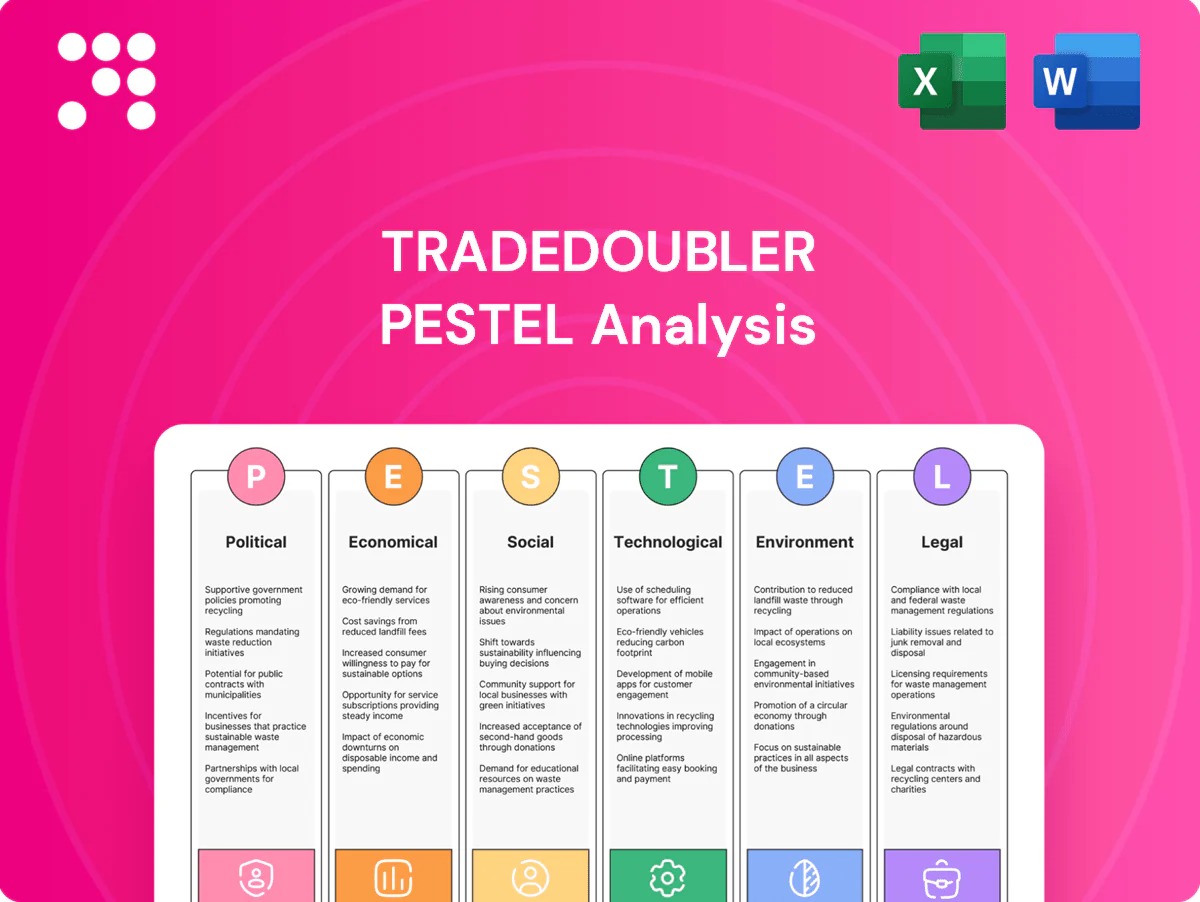
TradeDoubler PESTLE Analysis

Skip the Research. Get the Strategy.
Get a competitive edge with our focused PESTLE Analysis of TradeDoubler—revealing the political, economic, social, technological, legal, and environmental forces shaping its trajectory. Ideal for investors and strategists, this concise briefing highlights risks and growth levers you can act on immediately. Buy the full, editable report to unlock detailed, actionable insights and build winning strategies.
Political factors

Cross-border data rules
Shifts in data localization and the EU Commission's July 2023 EU–US Data Privacy Framework adequacy decision and the UK–EU adequacy (June 2021) materially affect how TradeDoubler routes tracking data across EEA, UK and US. Divergent adequacy outcomes can force regional hosting and increase infrastructure, compliance and latency costs. Policy stability improves network efficiency and client onboarding, while sudden reversals risk service fragmentation and partner churn.
Digital taxation and VAT
Expanding digital services taxes and proliferating VAT/GST rules — alongside the OECD 15% global minimum tax adopted by 136 jurisdictions as of 2024 — raise pricing complexity and can squeeze margins for performance-marketing platforms like TradeDoubler. Political appetite for taxing digital platforms increases multi-country billing and compliance overhead, raising fixed costs and administrative FTEs. Clear pass-through strategies are essential to preserve take rates; regulatory uncertainty raises market-entry costs in new geographies.

Ad transparency initiatives
Governments are pushing political ad transparency and platform accountability—EU Digital Services Act targets very large platforms with 45 million+ EU users, driving new ad-repository and tracking-disclosure norms. Spillovers mean even performance-marketing players like TradeDoubler face tighter reporting standards. Proactive transparency can be a competitive advantage; resistance risks regulatory scrutiny and cautious advertisers.

Sanctions and geopolitical risk
Sanctions since 2022 have constrained advertiser and publisher access in affected markets, with Russia's digital ad spend falling by over 60% in 2022–23 (Statista), disrupting payment flows, vendor selection and increasing fraud exposure. TradeDoubler's diversified European mix lowers concentration risk, while scenario planning preserves campaign continuity and receivables amid volatility.
- Market access: sanctions reduced ad inventory in targeted countries
- Payments: cross‑border flows and vendor choices disrupted
- Fraud: elevated exposure in rerouted markets
- Mitigation: geographic diversification and scenario planning
Public funding for digitalization
Government programs boosting SME digital adoption expand TradeDoubler’s addressable advertiser base; the EU Digital Europe Programme allocates €7.5 billion (2021–2027) to scaling digital tools for businesses, supporting affiliate marketing uptake. Subsidies and grants accelerate adoption in emerging EU regions while policy rollbacks can slow pipeline growth. Aligning with public initiatives enhances channel penetration and credibility.
- €7.5bn Digital Europe funding
- Grants widen SME advertiser pool
- Policy rollback risk to growth
Data rules, 15% global tax and ad rules squeeze platform costs and revenue
Data adequacy rulings (EU–US Jul 2023, UK Jun 2021) and rising localization drive hosting/compliance costs and latency. OECD 15% minimum tax (136 jurisdictions by 2024) plus DSTs raise billing complexity and margin pressure. DSA spillovers and ad-transparency rules increase reporting burdens for platforms. Sanctions cut market access (Russia ad spend down >60% in 2022–23), boosting diversification needs.
| Factor | Key Metric |
|---|---|
| Data rules | EU–US Jul 2023; UK Jun 2021 |
| Tax | OECD 15%—136 jurisdictions (2024) |
| Funding | €7.5bn Digital Europe (2021–27) |
| Sanctions | Russia ad spend −60% (2022–23) |
What is included in the product
 Detailed Word Document
Explores how external macro-environmental factors uniquely affect TradeDoubler across Political, Economic, Social, Technological, Environmental and Legal dimensions, with data-driven examples tied to its region and ad‑tech industry. Designed for executives and investors, it delivers forward-looking insights and ready-to-use sections for strategy, risk mitigation and funding materials.

 Customizable Excel Spreadsheet
TradeDoubler PESTLE Analysis delivers a clean, visually segmented and easily shareable summary that highlights external risks and market positioning, ideal for quick alignment in meetings, presentations, or client reports.
Economic factors

Ad spend cyclicality
Performance marketing budgets closely follow GDP — IMF estimated global growth ~3.1% in 2024 — and retail trends, with e‑commerce at roughly 20–25% of retail sales in 2024, so downturns shift spend to measurable channels, benefiting affiliates. Severe recessions still compress total ad budgets and lower payout rates. Elastic pricing and outcome‑based models (CPL/CPA) have reduced revenue volatility for affiliates.
E-commerce growth
Global e-commerce sales surpassed $6.2 trillion in 2023 and are forecast to top $7.4 trillion by 2025, boosting demand for pay-for-performance acquisition as advertisers shift spend to measurable channels.
Seasonal peaks like Black Friday and Christmas can lift network transaction volumes by 20–40%, directly increasing partner earnings and CPA opportunities.
Category mix matters: travel is cyclical and higher-ticket, essentials are resilient; a 30% travel exposure raises revenue volatility versus a staples-heavy mix.
Strong vertical diversification across travel, retail, finance and telecom historically reduces quarterly revenue swings and stabilizes margins for affiliate networks like TradeDoubler.

FX and cross-border settlements
Multi-currency payouts expose TradeDoubler to FX swings given global FX turnover of about $7.5 trillion per day (BIS 2022), increasing margin volatility. Hedging and use of local-currency rails can cut conversion costs and publisher friction; global remittance costs averaged 6.3% in Q4 2023 (World Bank). Economic instability in key markets raises collection and counterparty risk, so transparent FX policies support publisher retention.

SME digitization and budgets
SMEs—about 90% of firms and over 50% of employment globally—are moving online seeking low-CAC channels to expand client intake; tighter credit and policy rates averaging around 4–5% in 2024 constrain marketing budgets. Self-serve onboarding platforms reduce acquisition cost per client, while education and ready templates accelerate time-to-value and improve conversion.
- SME reach: ~90% firms, >50% employment
- Interest environment: policy rates ~4–5% (2024)
- Self-serve lowers CAC
- Education/templates shorten time-to-value
Inflation and cost structure
Rising wages (nominal pay growth around 5% in 2024) plus higher cloud spend and expanding compliance budgets are compressing TradeDoubler’s operating margins; public cloud costs rose roughly 20% YoY in many ad-tech firms in 2023–24, while GDPR and local advertising regulation compliance increased fixed costs. Inflation-driven higher nominal GMV (EU inflation ~2.9% in 2024) partially offsets margin pressure via percentage commissions. Efficient fraud prevention keeps net yields resilient, and pricing updates must balance competitiveness with profitability.
- Wages: ~5% nominal growth (2024)
- Cloud: ~20% YoY cost pressure
- Inflation: EU ~2.9% (2024) boosts nominal GMV
- Compliance: rising fixed costs from regulation
- Mitigation: fraud prevention preserves net yields
Data rules, 15% global tax and ad rules squeeze platform costs and revenue
Performance budgets track GDP (~3.1% global growth 2024) and e‑commerce (20–25% of retail; $7.4T forecast 2025), boosting pay‑for‑performance. FX exposure (BIS $7.5T/day) and 6.3% remittance costs raise margin risk; policy rates ~4–5% and SME credit constraints limit spend. Wage growth ~5% and +20% cloud costs compress margins though EU inflation ~2.9% lifts nominal GMV.
| Metric | Value |
|---|---|
| Global GDP (2024) | ~3.1% |
| E‑commerce (2025) | $7.4T / 20–25% retail |
| FX turnover | $7.5T/day |
What You See Is What You Get
TradeDoubler PESTLE Analysis
The preview shown here is the exact TradeDoubler PESTLE Analysis document you’ll receive after purchase—fully formatted and ready to use. It provides concise political, economic, social, technological, legal and environmental insights tailored to TradeDoubler’s operating context. No placeholders or teasers—this is the final, downloadable file delivered exactly as displayed.

Skip the Research. Get the Strategy.
Get a competitive edge with our focused PESTLE Analysis of TradeDoubler—revealing the political, economic, social, technological, legal, and environmental forces shaping its trajectory. Ideal for investors and strategists, this concise briefing highlights risks and growth levers you can act on immediately. Buy the full, editable report to unlock detailed, actionable insights and build winning strategies.
Political factors
Cross-border data rules
Shifts in data localization and the EU Commission's July 2023 EU–US Data Privacy Framework adequacy decision and the UK–EU adequacy (June 2021) materially affect how TradeDoubler routes tracking data across EEA, UK and US. Divergent adequacy outcomes can force regional hosting and increase infrastructure, compliance and latency costs. Policy stability improves network efficiency and client onboarding, while sudden reversals risk service fragmentation and partner churn.
Digital taxation and VAT
Expanding digital services taxes and proliferating VAT/GST rules — alongside the OECD 15% global minimum tax adopted by 136 jurisdictions as of 2024 — raise pricing complexity and can squeeze margins for performance-marketing platforms like TradeDoubler. Political appetite for taxing digital platforms increases multi-country billing and compliance overhead, raising fixed costs and administrative FTEs. Clear pass-through strategies are essential to preserve take rates; regulatory uncertainty raises market-entry costs in new geographies.
Ad transparency initiatives
Governments are pushing political ad transparency and platform accountability—EU Digital Services Act targets very large platforms with 45 million+ EU users, driving new ad-repository and tracking-disclosure norms. Spillovers mean even performance-marketing players like TradeDoubler face tighter reporting standards. Proactive transparency can be a competitive advantage; resistance risks regulatory scrutiny and cautious advertisers.
Sanctions and geopolitical risk
Sanctions since 2022 have constrained advertiser and publisher access in affected markets, with Russia's digital ad spend falling by over 60% in 2022–23 (Statista), disrupting payment flows, vendor selection and increasing fraud exposure. TradeDoubler's diversified European mix lowers concentration risk, while scenario planning preserves campaign continuity and receivables amid volatility.
- Market access: sanctions reduced ad inventory in targeted countries
- Payments: cross‑border flows and vendor choices disrupted
- Fraud: elevated exposure in rerouted markets
- Mitigation: geographic diversification and scenario planning
Public funding for digitalization
Government programs boosting SME digital adoption expand TradeDoubler’s addressable advertiser base; the EU Digital Europe Programme allocates €7.5 billion (2021–2027) to scaling digital tools for businesses, supporting affiliate marketing uptake. Subsidies and grants accelerate adoption in emerging EU regions while policy rollbacks can slow pipeline growth. Aligning with public initiatives enhances channel penetration and credibility.
- €7.5bn Digital Europe funding
- Grants widen SME advertiser pool
- Policy rollback risk to growth
Data rules, 15% global tax and ad rules squeeze platform costs and revenue
Data adequacy rulings (EU–US Jul 2023, UK Jun 2021) and rising localization drive hosting/compliance costs and latency. OECD 15% minimum tax (136 jurisdictions by 2024) plus DSTs raise billing complexity and margin pressure. DSA spillovers and ad-transparency rules increase reporting burdens for platforms. Sanctions cut market access (Russia ad spend down >60% in 2022–23), boosting diversification needs.
| Factor | Key Metric |
|---|---|
| Data rules | EU–US Jul 2023; UK Jun 2021 |
| Tax | OECD 15%—136 jurisdictions (2024) |
| Funding | €7.5bn Digital Europe (2021–27) |
| Sanctions | Russia ad spend −60% (2022–23) |
What is included in the product
Detailed Word Document
Explores how external macro-environmental factors uniquely affect TradeDoubler across Political, Economic, Social, Technological, Environmental and Legal dimensions, with data-driven examples tied to its region and ad‑tech industry. Designed for executives and investors, it delivers forward-looking insights and ready-to-use sections for strategy, risk mitigation and funding materials.
Customizable Excel Spreadsheet
TradeDoubler PESTLE Analysis delivers a clean, visually segmented and easily shareable summary that highlights external risks and market positioning, ideal for quick alignment in meetings, presentations, or client reports.
Economic factors
Ad spend cyclicality
Performance marketing budgets closely follow GDP — IMF estimated global growth ~3.1% in 2024 — and retail trends, with e‑commerce at roughly 20–25% of retail sales in 2024, so downturns shift spend to measurable channels, benefiting affiliates. Severe recessions still compress total ad budgets and lower payout rates. Elastic pricing and outcome‑based models (CPL/CPA) have reduced revenue volatility for affiliates.
E-commerce growth
Global e-commerce sales surpassed $6.2 trillion in 2023 and are forecast to top $7.4 trillion by 2025, boosting demand for pay-for-performance acquisition as advertisers shift spend to measurable channels.
Seasonal peaks like Black Friday and Christmas can lift network transaction volumes by 20–40%, directly increasing partner earnings and CPA opportunities.
Category mix matters: travel is cyclical and higher-ticket, essentials are resilient; a 30% travel exposure raises revenue volatility versus a staples-heavy mix.
Strong vertical diversification across travel, retail, finance and telecom historically reduces quarterly revenue swings and stabilizes margins for affiliate networks like TradeDoubler.
FX and cross-border settlements
Multi-currency payouts expose TradeDoubler to FX swings given global FX turnover of about $7.5 trillion per day (BIS 2022), increasing margin volatility. Hedging and use of local-currency rails can cut conversion costs and publisher friction; global remittance costs averaged 6.3% in Q4 2023 (World Bank). Economic instability in key markets raises collection and counterparty risk, so transparent FX policies support publisher retention.
SME digitization and budgets
SMEs—about 90% of firms and over 50% of employment globally—are moving online seeking low-CAC channels to expand client intake; tighter credit and policy rates averaging around 4–5% in 2024 constrain marketing budgets. Self-serve onboarding platforms reduce acquisition cost per client, while education and ready templates accelerate time-to-value and improve conversion.
- SME reach: ~90% firms, >50% employment
- Interest environment: policy rates ~4–5% (2024)
- Self-serve lowers CAC
- Education/templates shorten time-to-value
Inflation and cost structure
Rising wages (nominal pay growth around 5% in 2024) plus higher cloud spend and expanding compliance budgets are compressing TradeDoubler’s operating margins; public cloud costs rose roughly 20% YoY in many ad-tech firms in 2023–24, while GDPR and local advertising regulation compliance increased fixed costs. Inflation-driven higher nominal GMV (EU inflation ~2.9% in 2024) partially offsets margin pressure via percentage commissions. Efficient fraud prevention keeps net yields resilient, and pricing updates must balance competitiveness with profitability.
- Wages: ~5% nominal growth (2024)
- Cloud: ~20% YoY cost pressure
- Inflation: EU ~2.9% (2024) boosts nominal GMV
- Compliance: rising fixed costs from regulation
- Mitigation: fraud prevention preserves net yields
Data rules, 15% global tax and ad rules squeeze platform costs and revenue
Performance budgets track GDP (~3.1% global growth 2024) and e‑commerce (20–25% of retail; $7.4T forecast 2025), boosting pay‑for‑performance. FX exposure (BIS $7.5T/day) and 6.3% remittance costs raise margin risk; policy rates ~4–5% and SME credit constraints limit spend. Wage growth ~5% and +20% cloud costs compress margins though EU inflation ~2.9% lifts nominal GMV.
| Metric | Value |
|---|---|
| Global GDP (2024) | ~3.1% |
| E‑commerce (2025) | $7.4T / 20–25% retail |
| FX turnover | $7.5T/day |
What You See Is What You Get
TradeDoubler PESTLE Analysis
The preview shown here is the exact TradeDoubler PESTLE Analysis document you’ll receive after purchase—fully formatted and ready to use. It provides concise political, economic, social, technological, legal and environmental insights tailored to TradeDoubler’s operating context. No placeholders or teasers—this is the final, downloadable file delivered exactly as displayed.
Description
Skip the Research. Get the Strategy.
Get a competitive edge with our focused PESTLE Analysis of TradeDoubler—revealing the political, economic, social, technological, legal, and environmental forces shaping its trajectory. Ideal for investors and strategists, this concise briefing highlights risks and growth levers you can act on immediately. Buy the full, editable report to unlock detailed, actionable insights and build winning strategies.
Political factors
Cross-border data rules
Shifts in data localization and the EU Commission's July 2023 EU–US Data Privacy Framework adequacy decision and the UK–EU adequacy (June 2021) materially affect how TradeDoubler routes tracking data across EEA, UK and US. Divergent adequacy outcomes can force regional hosting and increase infrastructure, compliance and latency costs. Policy stability improves network efficiency and client onboarding, while sudden reversals risk service fragmentation and partner churn.
Digital taxation and VAT
Expanding digital services taxes and proliferating VAT/GST rules — alongside the OECD 15% global minimum tax adopted by 136 jurisdictions as of 2024 — raise pricing complexity and can squeeze margins for performance-marketing platforms like TradeDoubler. Political appetite for taxing digital platforms increases multi-country billing and compliance overhead, raising fixed costs and administrative FTEs. Clear pass-through strategies are essential to preserve take rates; regulatory uncertainty raises market-entry costs in new geographies.
Ad transparency initiatives
Governments are pushing political ad transparency and platform accountability—EU Digital Services Act targets very large platforms with 45 million+ EU users, driving new ad-repository and tracking-disclosure norms. Spillovers mean even performance-marketing players like TradeDoubler face tighter reporting standards. Proactive transparency can be a competitive advantage; resistance risks regulatory scrutiny and cautious advertisers.
Sanctions and geopolitical risk
Sanctions since 2022 have constrained advertiser and publisher access in affected markets, with Russia's digital ad spend falling by over 60% in 2022–23 (Statista), disrupting payment flows, vendor selection and increasing fraud exposure. TradeDoubler's diversified European mix lowers concentration risk, while scenario planning preserves campaign continuity and receivables amid volatility.
- Market access: sanctions reduced ad inventory in targeted countries
- Payments: cross‑border flows and vendor choices disrupted
- Fraud: elevated exposure in rerouted markets
- Mitigation: geographic diversification and scenario planning
Public funding for digitalization
Government programs boosting SME digital adoption expand TradeDoubler’s addressable advertiser base; the EU Digital Europe Programme allocates €7.5 billion (2021–2027) to scaling digital tools for businesses, supporting affiliate marketing uptake. Subsidies and grants accelerate adoption in emerging EU regions while policy rollbacks can slow pipeline growth. Aligning with public initiatives enhances channel penetration and credibility.
- €7.5bn Digital Europe funding
- Grants widen SME advertiser pool
- Policy rollback risk to growth
Data rules, 15% global tax and ad rules squeeze platform costs and revenue
Data adequacy rulings (EU–US Jul 2023, UK Jun 2021) and rising localization drive hosting/compliance costs and latency. OECD 15% minimum tax (136 jurisdictions by 2024) plus DSTs raise billing complexity and margin pressure. DSA spillovers and ad-transparency rules increase reporting burdens for platforms. Sanctions cut market access (Russia ad spend down >60% in 2022–23), boosting diversification needs.
| Factor | Key Metric |
|---|---|
| Data rules | EU–US Jul 2023; UK Jun 2021 |
| Tax | OECD 15%—136 jurisdictions (2024) |
| Funding | €7.5bn Digital Europe (2021–27) |
| Sanctions | Russia ad spend −60% (2022–23) |
What is included in the product
Detailed Word Document
Explores how external macro-environmental factors uniquely affect TradeDoubler across Political, Economic, Social, Technological, Environmental and Legal dimensions, with data-driven examples tied to its region and ad‑tech industry. Designed for executives and investors, it delivers forward-looking insights and ready-to-use sections for strategy, risk mitigation and funding materials.
Customizable Excel Spreadsheet
TradeDoubler PESTLE Analysis delivers a clean, visually segmented and easily shareable summary that highlights external risks and market positioning, ideal for quick alignment in meetings, presentations, or client reports.
Economic factors
Ad spend cyclicality
Performance marketing budgets closely follow GDP — IMF estimated global growth ~3.1% in 2024 — and retail trends, with e‑commerce at roughly 20–25% of retail sales in 2024, so downturns shift spend to measurable channels, benefiting affiliates. Severe recessions still compress total ad budgets and lower payout rates. Elastic pricing and outcome‑based models (CPL/CPA) have reduced revenue volatility for affiliates.
E-commerce growth
Global e-commerce sales surpassed $6.2 trillion in 2023 and are forecast to top $7.4 trillion by 2025, boosting demand for pay-for-performance acquisition as advertisers shift spend to measurable channels.
Seasonal peaks like Black Friday and Christmas can lift network transaction volumes by 20–40%, directly increasing partner earnings and CPA opportunities.
Category mix matters: travel is cyclical and higher-ticket, essentials are resilient; a 30% travel exposure raises revenue volatility versus a staples-heavy mix.
Strong vertical diversification across travel, retail, finance and telecom historically reduces quarterly revenue swings and stabilizes margins for affiliate networks like TradeDoubler.
FX and cross-border settlements
Multi-currency payouts expose TradeDoubler to FX swings given global FX turnover of about $7.5 trillion per day (BIS 2022), increasing margin volatility. Hedging and use of local-currency rails can cut conversion costs and publisher friction; global remittance costs averaged 6.3% in Q4 2023 (World Bank). Economic instability in key markets raises collection and counterparty risk, so transparent FX policies support publisher retention.
SME digitization and budgets
SMEs—about 90% of firms and over 50% of employment globally—are moving online seeking low-CAC channels to expand client intake; tighter credit and policy rates averaging around 4–5% in 2024 constrain marketing budgets. Self-serve onboarding platforms reduce acquisition cost per client, while education and ready templates accelerate time-to-value and improve conversion.
- SME reach: ~90% firms, >50% employment
- Interest environment: policy rates ~4–5% (2024)
- Self-serve lowers CAC
- Education/templates shorten time-to-value
Inflation and cost structure
Rising wages (nominal pay growth around 5% in 2024) plus higher cloud spend and expanding compliance budgets are compressing TradeDoubler’s operating margins; public cloud costs rose roughly 20% YoY in many ad-tech firms in 2023–24, while GDPR and local advertising regulation compliance increased fixed costs. Inflation-driven higher nominal GMV (EU inflation ~2.9% in 2024) partially offsets margin pressure via percentage commissions. Efficient fraud prevention keeps net yields resilient, and pricing updates must balance competitiveness with profitability.
- Wages: ~5% nominal growth (2024)
- Cloud: ~20% YoY cost pressure
- Inflation: EU ~2.9% (2024) boosts nominal GMV
- Compliance: rising fixed costs from regulation
- Mitigation: fraud prevention preserves net yields
Data rules, 15% global tax and ad rules squeeze platform costs and revenue
Performance budgets track GDP (~3.1% global growth 2024) and e‑commerce (20–25% of retail; $7.4T forecast 2025), boosting pay‑for‑performance. FX exposure (BIS $7.5T/day) and 6.3% remittance costs raise margin risk; policy rates ~4–5% and SME credit constraints limit spend. Wage growth ~5% and +20% cloud costs compress margins though EU inflation ~2.9% lifts nominal GMV.
| Metric | Value |
|---|---|
| Global GDP (2024) | ~3.1% |
| E‑commerce (2025) | $7.4T / 20–25% retail |
| FX turnover | $7.5T/day |
What You See Is What You Get
TradeDoubler PESTLE Analysis
The preview shown here is the exact TradeDoubler PESTLE Analysis document you’ll receive after purchase—fully formatted and ready to use. It provides concise political, economic, social, technological, legal and environmental insights tailored to TradeDoubler’s operating context. No placeholders or teasers—this is the final, downloadable file delivered exactly as displayed.











