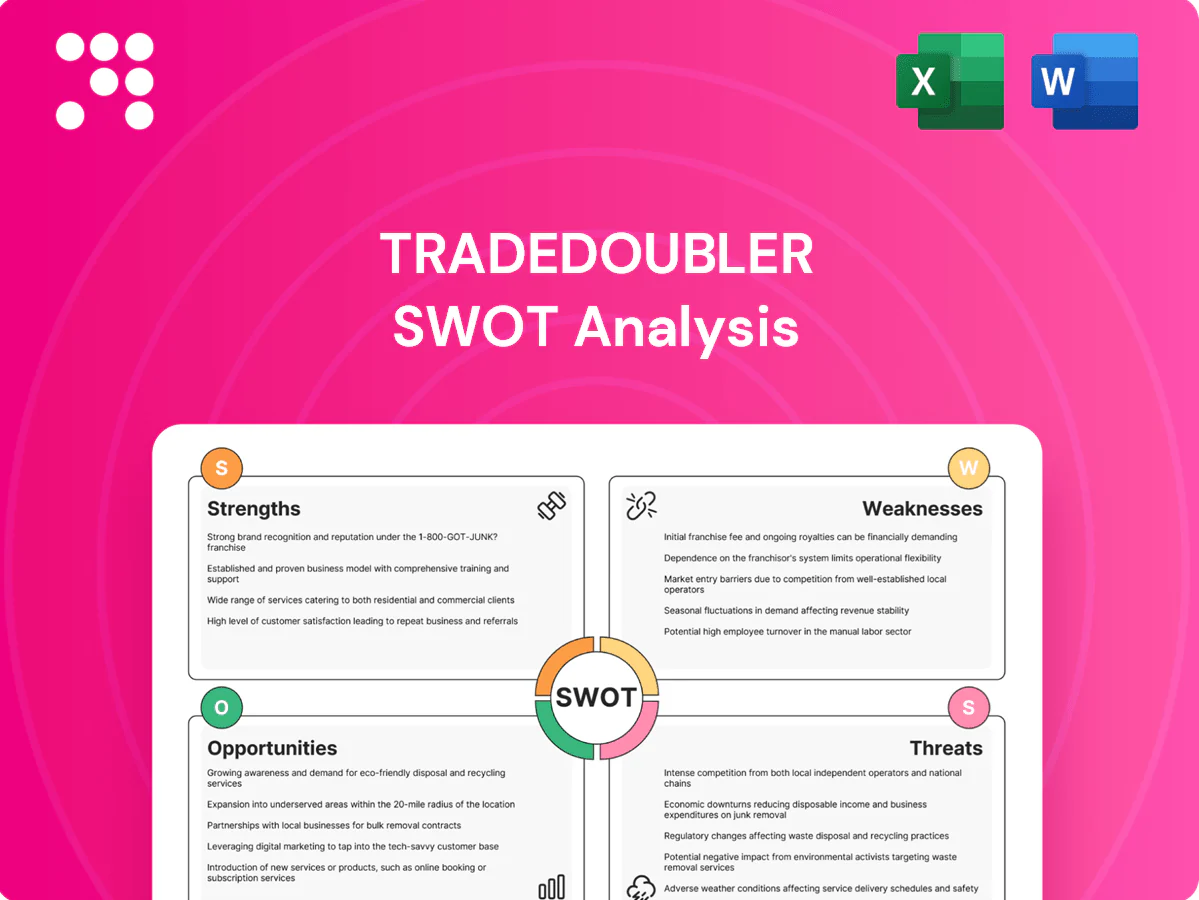
TradeDoubler SWOT Analysis

Your Strategic Toolkit Starts Here
Explore TradeDoubler’s competitive edge, digital ad strengths, and key risks in this concise SWOT preview—perfect for investors and strategists seeking a quick read. Want the full strategic picture? Purchase the complete SWOT analysis to receive a research-backed, editable Word report and Excel matrix with actionable recommendations and financial context. Take the next step to plan, pitch, or invest with confidence.
Strengths

Global publisher network
TradeDoubler operates a broad, diversified affiliate and partner base across markets, giving advertisers extended reach and volume. A sizeable network improves match quality between offers and audiences and reduces reliance on any single publisher. Scale enhances data feedback loops for continuous campaign optimization.
Performance-first model
The pay-for-performance model, used by TradeDoubler since its 1999 founding, aligns incentives with advertiser outcomes like sales and leads, cutting upfront budget risk and simplifying ROI justification. That structure helps sustain demand in tighter ad markets and, supported by strong case studies, drives repeat business and upsell opportunities.

Robust tracking & reporting
TradeDoubler, founded in 1999, delivers tracking, attribution and near-real-time reporting for campaign optimisation, enabling faster decision cycles. Transparent analytics support dynamic budget reallocation to high-ROI partners, while reliable payments and automated reconciliation strengthen publisher trust. Deep, granular data feeds and multi-touch attribution capabilities differentiate service quality and campaign performance visibility.

Enterprise-to-SMB coverage
TradeDoubler’s Enterprise-to-SMB coverage lets it address large brands and the SME segment—SMEs represent 99% of EU businesses and ~66% of EU employment—expanding TAM; enterprise contracts deliver volume and stability, while SMBs drive growth and diversification; tiered service and tech packaging enable flexible pricing and smoother revenue volatility.
- Enterprise: stability, volume
- SMB: growth, diversification
- Tiered pricing: flexibility
- SMEs = 99% EU firms; ~66% employment
Multi-channel expertise
TradeDoubler’s experience across display, content, coupon, influencer and email affiliates enables holistic program design, aligning channel roles to client funnels and optimising acquisition costs and retention rates. Cross-channel measurement and attribution drive incremental lift and longer customer lifetime value by identifying high-return touchpoints. Continuous A/B and partner-mix testing improves ROI and refines partner portfolios to meet complex client objectives.
- Multi-channel alignment
- Cross-channel lift & LTV focus
- Testing-driven partner optimisation
- Supports complex client KPIs
Pay-for-performance affiliate platform: real-time tracking, multi-touch ROI
TradeDoubler (founded 1999) leverages a broad affiliate base and pay-for-performance model to align spend with outcomes, reducing advertiser risk and driving repeat business. Its real-time tracking and multi-touch attribution enable fast optimisation and transparent ROI. Enterprise-to-SMB coverage captures scale and growth (SMEs = 99% EU firms; ~66% EU employment), while multi-channel capabilities lift LTV.
| Metric | Value |
|---|---|
| Founded | 1999 |
| Business model | Pay-for-performance |
| EU SME impact | 99% firms; ~66% employment |
| Capabilities | Real-time tracking, multi-touch attribution, multi-channel |
What is included in the product
 Detailed Word Document
Provides a concise SWOT analysis of TradeDoubler, highlighting internal strengths and weaknesses and external opportunities and threats to assess its competitive position, growth drivers, and strategic risks.

 Customizable Excel Spreadsheet
Provides a concise TradeDoubler SWOT matrix for fast strategic alignment and stakeholder-ready summaries, relieving time pressure in strategy sessions. Editable format enables quick updates to reflect partner or market changes for agile decision-making.
Weaknesses

Tracking dependence
Tracking dependence: browser privacy shifts and third-party cookie deprecation have strained affiliate attribution; Chrome holds about 65% global browser share (StatCounter, 2025), so loss of third-party cookies hits reach. Incomplete tracking can under-credit affiliates and depress commission spend, while implementing robust cookieless solutions (server-to-server, deterministic IDs) adds measurable engineering cost and operational complexity. Persistent gaps risk eroding client confidence and advertiser retention.
Commoditized margins
Affiliate network margins are increasingly commoditized: competition from hundreds of networks and platforms pushes pricing down, with industry take rates commonly under 10%, limiting TradeDoubler’s pricing power. Standardized tracking and reporting make differentiation hard beyond service levels, and large advertisers/aggregators can squeeze fees and rebates, capping operating leverage and compressing EBITDA margins.

Fraud and quality risk
Click spam, cookie stuffing and low-quality traffic can infiltrate affiliate networks without rigorous controls, contributing to industry-wide losses measured in the tens of billions of dollars annually from ad fraud. Fraud remediation increases operating costs and slows partner onboarding, while advertiser disputes erode retention and reputation. Constant, real-time monitoring is required to protect ROI and limit chargebacks.

Client churn exposure
Client churn exposure is acute as marketing budgets reallocate rapidly across channels; industry surveys in 2024 found up to 30% of digital spend is shifted annually, making affiliate revenue volatile. Seasonality and short-term performance dips commonly trigger program pauses, and losing a few large accounts can materially dent revenue when top clients drive a disproportionate share. Lengthened replacement cycles have pushed CAC payback beyond prior norms, raising short-term margin pressure.
- Budget mobility: up to 30% annual reallocation (2024 industry surveys)
- Seasonal pauses: immediate performance dips halt programs
- Client concentration: loss of top clients materially impacts revenue
- CAC payback: replacement cycles lengthen, increasing payback time
Legacy tech constraints
Legacy platform components at TradeDoubler can lag best-in-class UX, APIs and AI capabilities, creating friction that deters sophisticated advertisers and premium publishers. Integration complexity increases onboarding time and raises technical support costs. Modernization requires sustained R&D funding and multi-quarter engineering roadmaps. Any delays open room for newer, more agile entrants to capture market share.
- UX/API/AI gaps
- Integration friction
- High R&D needs
- Risk of newer entrants
Cookieless attribution strain: Chrome ~65%, take rates under 10%, churn ~30%
Tracking reliance on third-party cookies (Chrome ~65% global share, StatCounter 2025) weakens attribution and raises engineering costs for cookieless solutions. Network take rates under 10% compress margins amid intense competition. Fraud (ad-fraud losses in the tens of billions, 2024) and ~30% annual marketing budget mobility (2024 surveys) drive churn, raise remediation/CAC and pressure EBITDA.
| Metric | Figure | Impact |
|---|---|---|
| Chrome share | ~65% (StatCounter, 2025) | Attribution loss |
| Take rates | <10% industry | Margin compression |
| Budget mobility | ~30% (2024) | Revenue volatility |
| Ad fraud | Tens of billions (2024) | Remediation cost |
Full Version Awaits
TradeDoubler SWOT Analysis
This is a live preview of the actual TradeDoubler SWOT analysis document you’ll receive upon purchase—no placeholders, just the real file. The excerpt below is taken directly from the full report, and buying unlocks the complete, editable version. Professional, structured, and ready to use immediately after checkout.

Your Strategic Toolkit Starts Here
Explore TradeDoubler’s competitive edge, digital ad strengths, and key risks in this concise SWOT preview—perfect for investors and strategists seeking a quick read. Want the full strategic picture? Purchase the complete SWOT analysis to receive a research-backed, editable Word report and Excel matrix with actionable recommendations and financial context. Take the next step to plan, pitch, or invest with confidence.
Strengths
Global publisher network
TradeDoubler operates a broad, diversified affiliate and partner base across markets, giving advertisers extended reach and volume. A sizeable network improves match quality between offers and audiences and reduces reliance on any single publisher. Scale enhances data feedback loops for continuous campaign optimization.
Performance-first model
The pay-for-performance model, used by TradeDoubler since its 1999 founding, aligns incentives with advertiser outcomes like sales and leads, cutting upfront budget risk and simplifying ROI justification. That structure helps sustain demand in tighter ad markets and, supported by strong case studies, drives repeat business and upsell opportunities.
Robust tracking & reporting
TradeDoubler, founded in 1999, delivers tracking, attribution and near-real-time reporting for campaign optimisation, enabling faster decision cycles. Transparent analytics support dynamic budget reallocation to high-ROI partners, while reliable payments and automated reconciliation strengthen publisher trust. Deep, granular data feeds and multi-touch attribution capabilities differentiate service quality and campaign performance visibility.
Enterprise-to-SMB coverage
TradeDoubler’s Enterprise-to-SMB coverage lets it address large brands and the SME segment—SMEs represent 99% of EU businesses and ~66% of EU employment—expanding TAM; enterprise contracts deliver volume and stability, while SMBs drive growth and diversification; tiered service and tech packaging enable flexible pricing and smoother revenue volatility.
- Enterprise: stability, volume
- SMB: growth, diversification
- Tiered pricing: flexibility
- SMEs = 99% EU firms; ~66% employment
Multi-channel expertise
TradeDoubler’s experience across display, content, coupon, influencer and email affiliates enables holistic program design, aligning channel roles to client funnels and optimising acquisition costs and retention rates. Cross-channel measurement and attribution drive incremental lift and longer customer lifetime value by identifying high-return touchpoints. Continuous A/B and partner-mix testing improves ROI and refines partner portfolios to meet complex client objectives.
- Multi-channel alignment
- Cross-channel lift & LTV focus
- Testing-driven partner optimisation
- Supports complex client KPIs
Pay-for-performance affiliate platform: real-time tracking, multi-touch ROI
TradeDoubler (founded 1999) leverages a broad affiliate base and pay-for-performance model to align spend with outcomes, reducing advertiser risk and driving repeat business. Its real-time tracking and multi-touch attribution enable fast optimisation and transparent ROI. Enterprise-to-SMB coverage captures scale and growth (SMEs = 99% EU firms; ~66% EU employment), while multi-channel capabilities lift LTV.
| Metric | Value |
|---|---|
| Founded | 1999 |
| Business model | Pay-for-performance |
| EU SME impact | 99% firms; ~66% employment |
| Capabilities | Real-time tracking, multi-touch attribution, multi-channel |
What is included in the product
Detailed Word Document
Provides a concise SWOT analysis of TradeDoubler, highlighting internal strengths and weaknesses and external opportunities and threats to assess its competitive position, growth drivers, and strategic risks.
Customizable Excel Spreadsheet
Provides a concise TradeDoubler SWOT matrix for fast strategic alignment and stakeholder-ready summaries, relieving time pressure in strategy sessions. Editable format enables quick updates to reflect partner or market changes for agile decision-making.
Weaknesses
Tracking dependence
Tracking dependence: browser privacy shifts and third-party cookie deprecation have strained affiliate attribution; Chrome holds about 65% global browser share (StatCounter, 2025), so loss of third-party cookies hits reach. Incomplete tracking can under-credit affiliates and depress commission spend, while implementing robust cookieless solutions (server-to-server, deterministic IDs) adds measurable engineering cost and operational complexity. Persistent gaps risk eroding client confidence and advertiser retention.
Commoditized margins
Affiliate network margins are increasingly commoditized: competition from hundreds of networks and platforms pushes pricing down, with industry take rates commonly under 10%, limiting TradeDoubler’s pricing power. Standardized tracking and reporting make differentiation hard beyond service levels, and large advertisers/aggregators can squeeze fees and rebates, capping operating leverage and compressing EBITDA margins.
Fraud and quality risk
Click spam, cookie stuffing and low-quality traffic can infiltrate affiliate networks without rigorous controls, contributing to industry-wide losses measured in the tens of billions of dollars annually from ad fraud. Fraud remediation increases operating costs and slows partner onboarding, while advertiser disputes erode retention and reputation. Constant, real-time monitoring is required to protect ROI and limit chargebacks.
Client churn exposure
Client churn exposure is acute as marketing budgets reallocate rapidly across channels; industry surveys in 2024 found up to 30% of digital spend is shifted annually, making affiliate revenue volatile. Seasonality and short-term performance dips commonly trigger program pauses, and losing a few large accounts can materially dent revenue when top clients drive a disproportionate share. Lengthened replacement cycles have pushed CAC payback beyond prior norms, raising short-term margin pressure.
- Budget mobility: up to 30% annual reallocation (2024 industry surveys)
- Seasonal pauses: immediate performance dips halt programs
- Client concentration: loss of top clients materially impacts revenue
- CAC payback: replacement cycles lengthen, increasing payback time
Legacy tech constraints
Legacy platform components at TradeDoubler can lag best-in-class UX, APIs and AI capabilities, creating friction that deters sophisticated advertisers and premium publishers. Integration complexity increases onboarding time and raises technical support costs. Modernization requires sustained R&D funding and multi-quarter engineering roadmaps. Any delays open room for newer, more agile entrants to capture market share.
- UX/API/AI gaps
- Integration friction
- High R&D needs
- Risk of newer entrants
Cookieless attribution strain: Chrome ~65%, take rates under 10%, churn ~30%
Tracking reliance on third-party cookies (Chrome ~65% global share, StatCounter 2025) weakens attribution and raises engineering costs for cookieless solutions. Network take rates under 10% compress margins amid intense competition. Fraud (ad-fraud losses in the tens of billions, 2024) and ~30% annual marketing budget mobility (2024 surveys) drive churn, raise remediation/CAC and pressure EBITDA.
| Metric | Figure | Impact |
|---|---|---|
| Chrome share | ~65% (StatCounter, 2025) | Attribution loss |
| Take rates | <10% industry | Margin compression |
| Budget mobility | ~30% (2024) | Revenue volatility |
| Ad fraud | Tens of billions (2024) | Remediation cost |
Full Version Awaits
TradeDoubler SWOT Analysis
This is a live preview of the actual TradeDoubler SWOT analysis document you’ll receive upon purchase—no placeholders, just the real file. The excerpt below is taken directly from the full report, and buying unlocks the complete, editable version. Professional, structured, and ready to use immediately after checkout.
Description
Your Strategic Toolkit Starts Here
Explore TradeDoubler’s competitive edge, digital ad strengths, and key risks in this concise SWOT preview—perfect for investors and strategists seeking a quick read. Want the full strategic picture? Purchase the complete SWOT analysis to receive a research-backed, editable Word report and Excel matrix with actionable recommendations and financial context. Take the next step to plan, pitch, or invest with confidence.
Strengths
Global publisher network
TradeDoubler operates a broad, diversified affiliate and partner base across markets, giving advertisers extended reach and volume. A sizeable network improves match quality between offers and audiences and reduces reliance on any single publisher. Scale enhances data feedback loops for continuous campaign optimization.
Performance-first model
The pay-for-performance model, used by TradeDoubler since its 1999 founding, aligns incentives with advertiser outcomes like sales and leads, cutting upfront budget risk and simplifying ROI justification. That structure helps sustain demand in tighter ad markets and, supported by strong case studies, drives repeat business and upsell opportunities.
Robust tracking & reporting
TradeDoubler, founded in 1999, delivers tracking, attribution and near-real-time reporting for campaign optimisation, enabling faster decision cycles. Transparent analytics support dynamic budget reallocation to high-ROI partners, while reliable payments and automated reconciliation strengthen publisher trust. Deep, granular data feeds and multi-touch attribution capabilities differentiate service quality and campaign performance visibility.
Enterprise-to-SMB coverage
TradeDoubler’s Enterprise-to-SMB coverage lets it address large brands and the SME segment—SMEs represent 99% of EU businesses and ~66% of EU employment—expanding TAM; enterprise contracts deliver volume and stability, while SMBs drive growth and diversification; tiered service and tech packaging enable flexible pricing and smoother revenue volatility.
- Enterprise: stability, volume
- SMB: growth, diversification
- Tiered pricing: flexibility
- SMEs = 99% EU firms; ~66% employment
Multi-channel expertise
TradeDoubler’s experience across display, content, coupon, influencer and email affiliates enables holistic program design, aligning channel roles to client funnels and optimising acquisition costs and retention rates. Cross-channel measurement and attribution drive incremental lift and longer customer lifetime value by identifying high-return touchpoints. Continuous A/B and partner-mix testing improves ROI and refines partner portfolios to meet complex client objectives.
- Multi-channel alignment
- Cross-channel lift & LTV focus
- Testing-driven partner optimisation
- Supports complex client KPIs
Pay-for-performance affiliate platform: real-time tracking, multi-touch ROI
TradeDoubler (founded 1999) leverages a broad affiliate base and pay-for-performance model to align spend with outcomes, reducing advertiser risk and driving repeat business. Its real-time tracking and multi-touch attribution enable fast optimisation and transparent ROI. Enterprise-to-SMB coverage captures scale and growth (SMEs = 99% EU firms; ~66% EU employment), while multi-channel capabilities lift LTV.
| Metric | Value |
|---|---|
| Founded | 1999 |
| Business model | Pay-for-performance |
| EU SME impact | 99% firms; ~66% employment |
| Capabilities | Real-time tracking, multi-touch attribution, multi-channel |
What is included in the product
Detailed Word Document
Provides a concise SWOT analysis of TradeDoubler, highlighting internal strengths and weaknesses and external opportunities and threats to assess its competitive position, growth drivers, and strategic risks.
Customizable Excel Spreadsheet
Provides a concise TradeDoubler SWOT matrix for fast strategic alignment and stakeholder-ready summaries, relieving time pressure in strategy sessions. Editable format enables quick updates to reflect partner or market changes for agile decision-making.
Weaknesses
Tracking dependence
Tracking dependence: browser privacy shifts and third-party cookie deprecation have strained affiliate attribution; Chrome holds about 65% global browser share (StatCounter, 2025), so loss of third-party cookies hits reach. Incomplete tracking can under-credit affiliates and depress commission spend, while implementing robust cookieless solutions (server-to-server, deterministic IDs) adds measurable engineering cost and operational complexity. Persistent gaps risk eroding client confidence and advertiser retention.
Commoditized margins
Affiliate network margins are increasingly commoditized: competition from hundreds of networks and platforms pushes pricing down, with industry take rates commonly under 10%, limiting TradeDoubler’s pricing power. Standardized tracking and reporting make differentiation hard beyond service levels, and large advertisers/aggregators can squeeze fees and rebates, capping operating leverage and compressing EBITDA margins.
Fraud and quality risk
Click spam, cookie stuffing and low-quality traffic can infiltrate affiliate networks without rigorous controls, contributing to industry-wide losses measured in the tens of billions of dollars annually from ad fraud. Fraud remediation increases operating costs and slows partner onboarding, while advertiser disputes erode retention and reputation. Constant, real-time monitoring is required to protect ROI and limit chargebacks.
Client churn exposure
Client churn exposure is acute as marketing budgets reallocate rapidly across channels; industry surveys in 2024 found up to 30% of digital spend is shifted annually, making affiliate revenue volatile. Seasonality and short-term performance dips commonly trigger program pauses, and losing a few large accounts can materially dent revenue when top clients drive a disproportionate share. Lengthened replacement cycles have pushed CAC payback beyond prior norms, raising short-term margin pressure.
- Budget mobility: up to 30% annual reallocation (2024 industry surveys)
- Seasonal pauses: immediate performance dips halt programs
- Client concentration: loss of top clients materially impacts revenue
- CAC payback: replacement cycles lengthen, increasing payback time
Legacy tech constraints
Legacy platform components at TradeDoubler can lag best-in-class UX, APIs and AI capabilities, creating friction that deters sophisticated advertisers and premium publishers. Integration complexity increases onboarding time and raises technical support costs. Modernization requires sustained R&D funding and multi-quarter engineering roadmaps. Any delays open room for newer, more agile entrants to capture market share.
- UX/API/AI gaps
- Integration friction
- High R&D needs
- Risk of newer entrants
Cookieless attribution strain: Chrome ~65%, take rates under 10%, churn ~30%
Tracking reliance on third-party cookies (Chrome ~65% global share, StatCounter 2025) weakens attribution and raises engineering costs for cookieless solutions. Network take rates under 10% compress margins amid intense competition. Fraud (ad-fraud losses in the tens of billions, 2024) and ~30% annual marketing budget mobility (2024 surveys) drive churn, raise remediation/CAC and pressure EBITDA.
| Metric | Figure | Impact |
|---|---|---|
| Chrome share | ~65% (StatCounter, 2025) | Attribution loss |
| Take rates | <10% industry | Margin compression |
| Budget mobility | ~30% (2024) | Revenue volatility |
| Ad fraud | Tens of billions (2024) | Remediation cost |
Full Version Awaits
TradeDoubler SWOT Analysis
This is a live preview of the actual TradeDoubler SWOT analysis document you’ll receive upon purchase—no placeholders, just the real file. The excerpt below is taken directly from the full report, and buying unlocks the complete, editable version. Professional, structured, and ready to use immediately after checkout.











