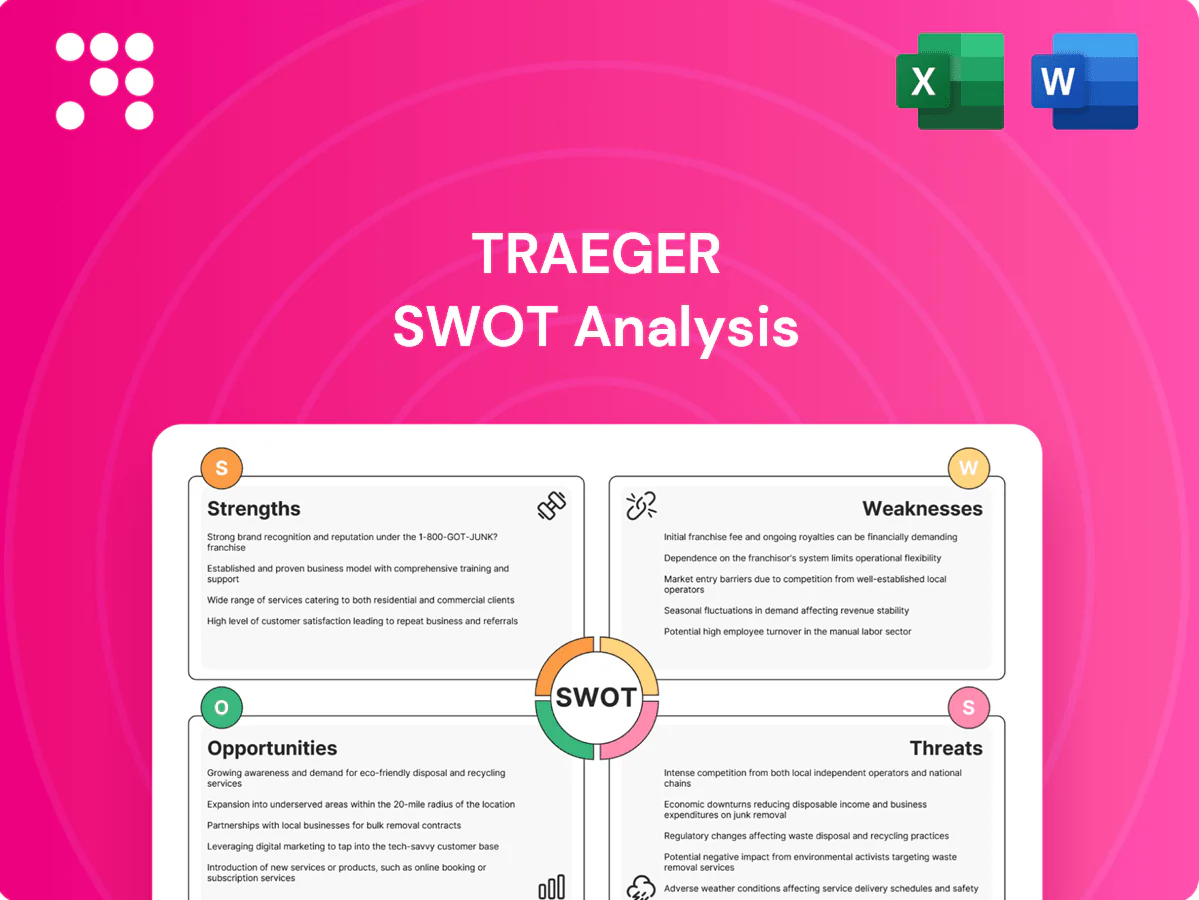
Traeger SWOT Analysis

Go Beyond the Preview—Access the Full Strategic Report
Explore Traeger’s competitive edge, market risks, and growth levers in this concise SWOT snapshot—perfect for investors and strategists evaluating the outdoor cooking category. Want the full picture with actionable recommendations and editable deliverables? Purchase the complete SWOT analysis for a professionally formatted Word report and Excel model to plan, pitch, and invest with confidence.
Strengths

Iconic pellet-grill brand
Traeger, pioneer of wood-pellet grilling since 1985, delivers 40 years of brand heritage and strong recall. This positioning supports premium pricing (2025 MSRP range roughly $399–$1,999) and robust community engagement across official clubs and social channels. Deep brand equity lowers customer acquisition costs, amplifies word-of-mouth and creates barriers for lesser-known entrants.
Differentiated flavor profile
Pellet-fueled, wood-smoke cooking delivers a distinct flavor profile versus gas or electric grills, reinforcing Traeger’s position since it popularized consumer pellet grills in 1985. The sensory edge drives product preference and repeat usage, supporting higher lifetime engagement and brand loyalty. That authentic smoke narrative enhances marketing and is hard for competitors to replicate at scale due to pellet supply and control systems.

Ecosystem of accessories
Traeger's broad pellet, rub, sauce and tool lineup raises average order value by bundling consumables with grills; consumables—pellets and rubs—create predictable replenishment cycles that smooth seasonality and boost lifetime value. Industry data shows the U.S. grilling accessories and consumables segment was roughly $7–9 billion in 2023, supporting recurring spend and deeper brand stickiness beyond the initial grill purchase.

Connected features and software
App-enabled controls and guided recipes improve cook consistency and customer satisfaction, while WiFIRE connectivity drives repeat engagement and higher accessory attach rates.
Data-driven features create switching costs and enable targeted promotions, in-app cross-sell and community content that boost lifetime value.
- App control
- Data engagement
- Switching costs
- Targeted promotions
Multichannel distribution
Traeger sells through major retailers such as Home Depot and Lowe’s, a network of specialty dealers, and direct-to-consumer channels including Traeger.com, giving the brand wide market access and visibility. This multichannel reach supports scale, reduces dependence on any single partner, and enables segmented pricing and targeted merchandising across channels. Channel diversity also improves resilience against retail disruptions and boosts customer acquisition via online and in-store touchpoints.
- Channels: major retailers, specialty dealers, direct-to-consumer
- Benefit: broader brand visibility and scale
- Risk mitigation: lowers single-partner dependency
- Strategy: supports segmented pricing and merchandising
40yr pellet grill heritage premium MSRP $399–$1,999; $7–$9B consumables
Traeger’s 40-year brand heritage (founded 1985) and 2025 MSRP range roughly $399–$1,999 support premium pricing, strong recall and community-driven CAC advantages. Pellet wood-smoke differentiation drives repeat usage and loyalty; consumables attach leverages a U.S. grilling accessories/consumables market of roughly $7–$9B in 2023. App/WiFIRE features create switching costs and higher accessory attach rates; multichannel distribution (Home Depot, Lowe’s, DTC) boosts reach.
| Metric | Value |
|---|---|
| Brand age | 40 years (est. 1985) |
| 2025 MSRP range | $399–$1,999 |
| Consumables market (US) | $7–$9B (2023) |
| Key channels | Home Depot, Lowe’s, DTC, specialty dealers |
What is included in the product
 Detailed Word Document
Provides a concise SWOT overview of Traeger, highlighting internal strengths and weaknesses in product innovation and brand positioning, and external opportunities and threats from market expansion, competition, and supply-chain or regulatory risks.

 Customizable Excel Spreadsheet
Provides a focused SWOT matrix to quickly identify Traeger's strengths, weaknesses, opportunities, and threats, easing strategic alignment across teams; editable format lets stakeholders update priorities and integrate findings into reports and presentations.
Weaknesses

Premium price point
Traeger’s premium price point limits addressable demand in value segments, constraining growth among price‑sensitive buyers and mass‑market retailers.
Price sensitivity intensifies during economic slowdowns, often forcing promotions to sustain volumes and compress gross margins.
Lower‑priced competitors can undercut Traeger with acceptable performance, eroding market share in mainstream channels.
Reliance on discretionary spending
Reliance on discretionary spending leaves Traeger vulnerable as grills and accessories are non-essential purchases tied to consumer confidence, making demand volatile under adverse macro conditions; seasonal Q2–Q3 spikes intensify inventory planning risks and amplify working capital swings, complicating forecasting and pressuring cash flows during off-peak months.

Hardware complexity and service
Pellet feed systems and electronic controllers introduce more mechanical and electronic failure points than simple charcoal or gas grills, increasing warranty and repair volume. Higher cost-to-serve arises from parts, diagnostics, and technician labor, while recurring negative reliability reviews on retail sites can dent brand perception. Gaps in authorized service networks further reduce owner satisfaction and repeat-purchase intent.

Pellet supply and logistics
Traeger relies on steady pellet sourcing, consistent quality and stable pricing; the average 20-lb grilling pellet bag retailed around $18–22 in 2024, exposing gross margins to raw-material swings.
Supply disruptions or freight inflation (adding roughly 10–20% to inbound costs in 2022–24) can compress margins, while regional availability limits usage frequency and inventory misalignments risk stockouts or write-downs.
- Supply dependence: steady sourcing required
- Price exposure: 20-lb bag ~$18–22 (2024)
- Freight risk: +10–20% inbound cost impact (2022–24)
- Inventory risk: stockouts or write-downs
Narrow product focus
Narrow product focus on pellet grills concentrates Traeger revenue risk: pellet products drove the majority of sales, with company reported net revenue of about $596M in fiscal 2023, so category downturns disproportionately hit results. Expanding into adjacent outdoor cooking segments has proven slower and could require significant marketing and R&D spend. Dependence on single core pellet technology raises exposure to supply, regulatory or fuel-cost shocks.
- Concentration: pellet-centric revenue mix
- Vulnerability: 2023 net revenue ~$596M
- Expansion cost: adjacent-category entry barriers
- Technology risk: single-core dependence
Premium grill maker faces margin squeeze, warranty exposure and $596M revenue risk
Traeger’s premium pricing limits reach into value segments, forcing promotions that compress margins in downturns. Complex pellet/electronic systems raise warranty, repair and service-cost exposure and hurt repeat purchase if networks lag. Heavy reliance on pellet category concentrates revenue risk; company reported ~ $596M net revenue in FY2023. Pellet input cost ~ $18–22 per 20-lb bag (2024); freight inflation +10–20% (2022–24).
| Metric | Value |
|---|---|
| FY2023 net revenue | $596M |
| 20-lb pellet price (2024) | $18–22 |
| Freight inflation (2022–24) | +10–20% |
Preview the Actual Deliverable
Traeger SWOT Analysis
This is the actual Traeger SWOT analysis document you’ll receive upon purchase—no surprises, just professional quality. The preview below is taken directly from the full SWOT report you'll get; buy now to unlock the complete, editable version with detailed strengths, weaknesses, opportunities, and threats. The file shown is the real analysis you'll download after checkout.

Go Beyond the Preview—Access the Full Strategic Report
Explore Traeger’s competitive edge, market risks, and growth levers in this concise SWOT snapshot—perfect for investors and strategists evaluating the outdoor cooking category. Want the full picture with actionable recommendations and editable deliverables? Purchase the complete SWOT analysis for a professionally formatted Word report and Excel model to plan, pitch, and invest with confidence.
Strengths
Iconic pellet-grill brand
Traeger, pioneer of wood-pellet grilling since 1985, delivers 40 years of brand heritage and strong recall. This positioning supports premium pricing (2025 MSRP range roughly $399–$1,999) and robust community engagement across official clubs and social channels. Deep brand equity lowers customer acquisition costs, amplifies word-of-mouth and creates barriers for lesser-known entrants.
Differentiated flavor profile
Pellet-fueled, wood-smoke cooking delivers a distinct flavor profile versus gas or electric grills, reinforcing Traeger’s position since it popularized consumer pellet grills in 1985. The sensory edge drives product preference and repeat usage, supporting higher lifetime engagement and brand loyalty. That authentic smoke narrative enhances marketing and is hard for competitors to replicate at scale due to pellet supply and control systems.
Ecosystem of accessories
Traeger's broad pellet, rub, sauce and tool lineup raises average order value by bundling consumables with grills; consumables—pellets and rubs—create predictable replenishment cycles that smooth seasonality and boost lifetime value. Industry data shows the U.S. grilling accessories and consumables segment was roughly $7–9 billion in 2023, supporting recurring spend and deeper brand stickiness beyond the initial grill purchase.
Connected features and software
App-enabled controls and guided recipes improve cook consistency and customer satisfaction, while WiFIRE connectivity drives repeat engagement and higher accessory attach rates.
Data-driven features create switching costs and enable targeted promotions, in-app cross-sell and community content that boost lifetime value.
- App control
- Data engagement
- Switching costs
- Targeted promotions
Multichannel distribution
Traeger sells through major retailers such as Home Depot and Lowe’s, a network of specialty dealers, and direct-to-consumer channels including Traeger.com, giving the brand wide market access and visibility. This multichannel reach supports scale, reduces dependence on any single partner, and enables segmented pricing and targeted merchandising across channels. Channel diversity also improves resilience against retail disruptions and boosts customer acquisition via online and in-store touchpoints.
- Channels: major retailers, specialty dealers, direct-to-consumer
- Benefit: broader brand visibility and scale
- Risk mitigation: lowers single-partner dependency
- Strategy: supports segmented pricing and merchandising
40yr pellet grill heritage premium MSRP $399–$1,999; $7–$9B consumables
Traeger’s 40-year brand heritage (founded 1985) and 2025 MSRP range roughly $399–$1,999 support premium pricing, strong recall and community-driven CAC advantages. Pellet wood-smoke differentiation drives repeat usage and loyalty; consumables attach leverages a U.S. grilling accessories/consumables market of roughly $7–$9B in 2023. App/WiFIRE features create switching costs and higher accessory attach rates; multichannel distribution (Home Depot, Lowe’s, DTC) boosts reach.
| Metric | Value |
|---|---|
| Brand age | 40 years (est. 1985) |
| 2025 MSRP range | $399–$1,999 |
| Consumables market (US) | $7–$9B (2023) |
| Key channels | Home Depot, Lowe’s, DTC, specialty dealers |
What is included in the product
Detailed Word Document
Provides a concise SWOT overview of Traeger, highlighting internal strengths and weaknesses in product innovation and brand positioning, and external opportunities and threats from market expansion, competition, and supply-chain or regulatory risks.
Customizable Excel Spreadsheet
Provides a focused SWOT matrix to quickly identify Traeger's strengths, weaknesses, opportunities, and threats, easing strategic alignment across teams; editable format lets stakeholders update priorities and integrate findings into reports and presentations.
Weaknesses
Premium price point
Traeger’s premium price point limits addressable demand in value segments, constraining growth among price‑sensitive buyers and mass‑market retailers.
Price sensitivity intensifies during economic slowdowns, often forcing promotions to sustain volumes and compress gross margins.
Lower‑priced competitors can undercut Traeger with acceptable performance, eroding market share in mainstream channels.
Reliance on discretionary spending
Reliance on discretionary spending leaves Traeger vulnerable as grills and accessories are non-essential purchases tied to consumer confidence, making demand volatile under adverse macro conditions; seasonal Q2–Q3 spikes intensify inventory planning risks and amplify working capital swings, complicating forecasting and pressuring cash flows during off-peak months.
Hardware complexity and service
Pellet feed systems and electronic controllers introduce more mechanical and electronic failure points than simple charcoal or gas grills, increasing warranty and repair volume. Higher cost-to-serve arises from parts, diagnostics, and technician labor, while recurring negative reliability reviews on retail sites can dent brand perception. Gaps in authorized service networks further reduce owner satisfaction and repeat-purchase intent.
Pellet supply and logistics
Traeger relies on steady pellet sourcing, consistent quality and stable pricing; the average 20-lb grilling pellet bag retailed around $18–22 in 2024, exposing gross margins to raw-material swings.
Supply disruptions or freight inflation (adding roughly 10–20% to inbound costs in 2022–24) can compress margins, while regional availability limits usage frequency and inventory misalignments risk stockouts or write-downs.
- Supply dependence: steady sourcing required
- Price exposure: 20-lb bag ~$18–22 (2024)
- Freight risk: +10–20% inbound cost impact (2022–24)
- Inventory risk: stockouts or write-downs
Narrow product focus
Narrow product focus on pellet grills concentrates Traeger revenue risk: pellet products drove the majority of sales, with company reported net revenue of about $596M in fiscal 2023, so category downturns disproportionately hit results. Expanding into adjacent outdoor cooking segments has proven slower and could require significant marketing and R&D spend. Dependence on single core pellet technology raises exposure to supply, regulatory or fuel-cost shocks.
- Concentration: pellet-centric revenue mix
- Vulnerability: 2023 net revenue ~$596M
- Expansion cost: adjacent-category entry barriers
- Technology risk: single-core dependence
Premium grill maker faces margin squeeze, warranty exposure and $596M revenue risk
Traeger’s premium pricing limits reach into value segments, forcing promotions that compress margins in downturns. Complex pellet/electronic systems raise warranty, repair and service-cost exposure and hurt repeat purchase if networks lag. Heavy reliance on pellet category concentrates revenue risk; company reported ~ $596M net revenue in FY2023. Pellet input cost ~ $18–22 per 20-lb bag (2024); freight inflation +10–20% (2022–24).
| Metric | Value |
|---|---|
| FY2023 net revenue | $596M |
| 20-lb pellet price (2024) | $18–22 |
| Freight inflation (2022–24) | +10–20% |
Preview the Actual Deliverable
Traeger SWOT Analysis
This is the actual Traeger SWOT analysis document you’ll receive upon purchase—no surprises, just professional quality. The preview below is taken directly from the full SWOT report you'll get; buy now to unlock the complete, editable version with detailed strengths, weaknesses, opportunities, and threats. The file shown is the real analysis you'll download after checkout.
Original: $10.00
-65%$10.00
$3.50Description
Go Beyond the Preview—Access the Full Strategic Report
Explore Traeger’s competitive edge, market risks, and growth levers in this concise SWOT snapshot—perfect for investors and strategists evaluating the outdoor cooking category. Want the full picture with actionable recommendations and editable deliverables? Purchase the complete SWOT analysis for a professionally formatted Word report and Excel model to plan, pitch, and invest with confidence.
Strengths
Iconic pellet-grill brand
Traeger, pioneer of wood-pellet grilling since 1985, delivers 40 years of brand heritage and strong recall. This positioning supports premium pricing (2025 MSRP range roughly $399–$1,999) and robust community engagement across official clubs and social channels. Deep brand equity lowers customer acquisition costs, amplifies word-of-mouth and creates barriers for lesser-known entrants.
Differentiated flavor profile
Pellet-fueled, wood-smoke cooking delivers a distinct flavor profile versus gas or electric grills, reinforcing Traeger’s position since it popularized consumer pellet grills in 1985. The sensory edge drives product preference and repeat usage, supporting higher lifetime engagement and brand loyalty. That authentic smoke narrative enhances marketing and is hard for competitors to replicate at scale due to pellet supply and control systems.
Ecosystem of accessories
Traeger's broad pellet, rub, sauce and tool lineup raises average order value by bundling consumables with grills; consumables—pellets and rubs—create predictable replenishment cycles that smooth seasonality and boost lifetime value. Industry data shows the U.S. grilling accessories and consumables segment was roughly $7–9 billion in 2023, supporting recurring spend and deeper brand stickiness beyond the initial grill purchase.
Connected features and software
App-enabled controls and guided recipes improve cook consistency and customer satisfaction, while WiFIRE connectivity drives repeat engagement and higher accessory attach rates.
Data-driven features create switching costs and enable targeted promotions, in-app cross-sell and community content that boost lifetime value.
- App control
- Data engagement
- Switching costs
- Targeted promotions
Multichannel distribution
Traeger sells through major retailers such as Home Depot and Lowe’s, a network of specialty dealers, and direct-to-consumer channels including Traeger.com, giving the brand wide market access and visibility. This multichannel reach supports scale, reduces dependence on any single partner, and enables segmented pricing and targeted merchandising across channels. Channel diversity also improves resilience against retail disruptions and boosts customer acquisition via online and in-store touchpoints.
- Channels: major retailers, specialty dealers, direct-to-consumer
- Benefit: broader brand visibility and scale
- Risk mitigation: lowers single-partner dependency
- Strategy: supports segmented pricing and merchandising
40yr pellet grill heritage premium MSRP $399–$1,999; $7–$9B consumables
Traeger’s 40-year brand heritage (founded 1985) and 2025 MSRP range roughly $399–$1,999 support premium pricing, strong recall and community-driven CAC advantages. Pellet wood-smoke differentiation drives repeat usage and loyalty; consumables attach leverages a U.S. grilling accessories/consumables market of roughly $7–$9B in 2023. App/WiFIRE features create switching costs and higher accessory attach rates; multichannel distribution (Home Depot, Lowe’s, DTC) boosts reach.
| Metric | Value |
|---|---|
| Brand age | 40 years (est. 1985) |
| 2025 MSRP range | $399–$1,999 |
| Consumables market (US) | $7–$9B (2023) |
| Key channels | Home Depot, Lowe’s, DTC, specialty dealers |
What is included in the product
Detailed Word Document
Provides a concise SWOT overview of Traeger, highlighting internal strengths and weaknesses in product innovation and brand positioning, and external opportunities and threats from market expansion, competition, and supply-chain or regulatory risks.
Customizable Excel Spreadsheet
Provides a focused SWOT matrix to quickly identify Traeger's strengths, weaknesses, opportunities, and threats, easing strategic alignment across teams; editable format lets stakeholders update priorities and integrate findings into reports and presentations.
Weaknesses
Premium price point
Traeger’s premium price point limits addressable demand in value segments, constraining growth among price‑sensitive buyers and mass‑market retailers.
Price sensitivity intensifies during economic slowdowns, often forcing promotions to sustain volumes and compress gross margins.
Lower‑priced competitors can undercut Traeger with acceptable performance, eroding market share in mainstream channels.
Reliance on discretionary spending
Reliance on discretionary spending leaves Traeger vulnerable as grills and accessories are non-essential purchases tied to consumer confidence, making demand volatile under adverse macro conditions; seasonal Q2–Q3 spikes intensify inventory planning risks and amplify working capital swings, complicating forecasting and pressuring cash flows during off-peak months.
Hardware complexity and service
Pellet feed systems and electronic controllers introduce more mechanical and electronic failure points than simple charcoal or gas grills, increasing warranty and repair volume. Higher cost-to-serve arises from parts, diagnostics, and technician labor, while recurring negative reliability reviews on retail sites can dent brand perception. Gaps in authorized service networks further reduce owner satisfaction and repeat-purchase intent.
Pellet supply and logistics
Traeger relies on steady pellet sourcing, consistent quality and stable pricing; the average 20-lb grilling pellet bag retailed around $18–22 in 2024, exposing gross margins to raw-material swings.
Supply disruptions or freight inflation (adding roughly 10–20% to inbound costs in 2022–24) can compress margins, while regional availability limits usage frequency and inventory misalignments risk stockouts or write-downs.
- Supply dependence: steady sourcing required
- Price exposure: 20-lb bag ~$18–22 (2024)
- Freight risk: +10–20% inbound cost impact (2022–24)
- Inventory risk: stockouts or write-downs
Narrow product focus
Narrow product focus on pellet grills concentrates Traeger revenue risk: pellet products drove the majority of sales, with company reported net revenue of about $596M in fiscal 2023, so category downturns disproportionately hit results. Expanding into adjacent outdoor cooking segments has proven slower and could require significant marketing and R&D spend. Dependence on single core pellet technology raises exposure to supply, regulatory or fuel-cost shocks.
- Concentration: pellet-centric revenue mix
- Vulnerability: 2023 net revenue ~$596M
- Expansion cost: adjacent-category entry barriers
- Technology risk: single-core dependence
Premium grill maker faces margin squeeze, warranty exposure and $596M revenue risk
Traeger’s premium pricing limits reach into value segments, forcing promotions that compress margins in downturns. Complex pellet/electronic systems raise warranty, repair and service-cost exposure and hurt repeat purchase if networks lag. Heavy reliance on pellet category concentrates revenue risk; company reported ~ $596M net revenue in FY2023. Pellet input cost ~ $18–22 per 20-lb bag (2024); freight inflation +10–20% (2022–24).
| Metric | Value |
|---|---|
| FY2023 net revenue | $596M |
| 20-lb pellet price (2024) | $18–22 |
| Freight inflation (2022–24) | +10–20% |
Preview the Actual Deliverable
Traeger SWOT Analysis
This is the actual Traeger SWOT analysis document you’ll receive upon purchase—no surprises, just professional quality. The preview below is taken directly from the full SWOT report you'll get; buy now to unlock the complete, editable version with detailed strengths, weaknesses, opportunities, and threats. The file shown is the real analysis you'll download after checkout.











