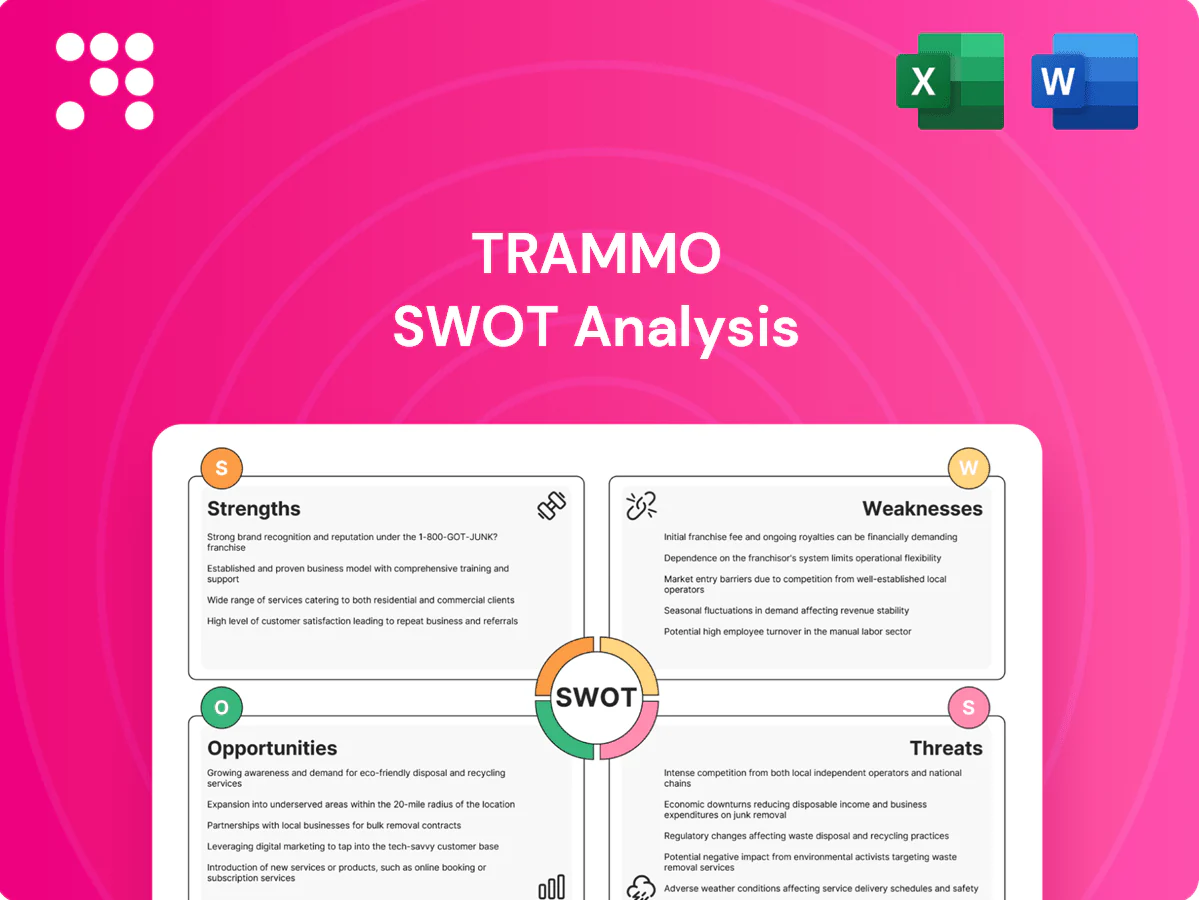
Trammo SWOT Analysis

Go Beyond the Preview—Access the Full Strategic Report
Trammo's global trading reach, diversified commodity mix, and integrated logistics give it resilient market positioning, while exposure to commodity cycles, regulatory shifts, and geopolitical risk create material downside. Want the full strategic picture? Purchase the complete SWOT analysis—editable Word and Excel deliverables with research-backed insights to inform investment, strategy, or due diligence.
Strengths

Global trading footprint
Trammo’s worldwide presence connects producers and consumers across fertilizer, petrochemical and energy markets, enabling seamless cross-border placement. A broad origin-to-destination map provides arbitrage opportunities and diversified flow optionality, while scale enhances market intelligence and execution speed. This reach underpins resilient sourcing and placement during regional disruptions.
Integrated logistics expertise
In-house logistics planning across shipping, storage and distribution underpins reliable delivery, reducing demurrage and handling costs by industry-standard ranges of about 10–15% while smoothing bottlenecks. Operational control drives on-time performance often above 95% and elevates service quality. This end-to-end coordination creates stickier client relationships and higher repeat flow.

Risk management capabilities
Active hedging, tight credit risk controls and structured solutions stabilize Trammo’s trading income, enabling consistent margins across cycles. The firm’s ability to manage price, basis and freight risks is a core differentiator that supports complex cross-commodity flows. Tailored risk products deepen customer engagement while improved risk systems enable scalable growth across volatile commodities.

Diversified commodity portfolio
Trammo’s diversified portfolio across fertilizers, petrochemicals and energy spreads mitigates cyclical exposure by tying revenue to distinct demand drivers, smoothing earnings through commodity-specific cycles. Cross-commodity insights from breadth create operational synergies and efficiency gains, while integrated product lines enable targeted cross-selling to key accounts.
- Exposure: fertilizers, petrochemicals, energy
- Risk: reduced cyclicality via varied demand drivers
- Advantage: cross-commodity insights & synergies
- Growth: cross-selling to strategic accounts
Strong producer and customer ties
Long-standing relationships (Trammo founded 1965) secure offtake and reliable demand, while trust-based partnerships improve allocation in tight markets. Deep counterparty insight enables bespoke logistics and financing solutions, and relationship depth helps defend margins against pure price competition.
- Offtake stability
- Priority allocation
- Bespoke solutions
- Margin defense
Global scale, resilient sourcing, 95%+ on-time delivery
Global presence and scale enable cross-border placement and arbitrage across fertilizers, petrochemicals and energy, supporting resilient sourcing. In-house logistics deliver on-time performance above 95% and reduce demurrage/handling by ~10–15%, strengthening client retention. Active hedging, tight credit controls and long-standing relationships (since 1965) stabilize margins and secure priority allocation.
| Metric | Value |
|---|---|
| On-time delivery | >95% |
| Demurrage/handling reduction | ~10–15% |
| Business segments | 3 (fertilizers, petrochemicals, energy) |
| Founded | 1965 |
What is included in the product
 Detailed Word Document
Provides a concise SWOT overview of Trammo’s strategic position, highlighting its operational strengths, structural weaknesses, market opportunities, and external threats shaping future growth.

 Customizable Excel Spreadsheet
Provides a concise Trammo SWOT matrix for fast, visual strategy alignment and quick stakeholder presentations, allowing easy edits to reflect changing market priorities.
Weaknesses

Thin trading margins
Commodity intermediation yields thin unit margins—industry figures show trading/net margins often around 1–3%. Profitability therefore hinges on high volume scale and disciplined cost control to convert small spreads into meaningful earnings. Margins compress quickly during competitive surges, and small execution errors or logistics mishaps can materially erode results.
Exposure to commodity cycles
Earnings are highly sensitive to fertilizer, petrochemical and energy price swings—U.S. Henry Hub gas averaged about $2.80/MMBtu in 2024, materially affecting input costs for ammonia and urea producers. Demand shocks or inventory swings can cut throughput and margins, while freight and storage costs (BDI volatility) may outpace Trammo’s pricing power. Mistimed cycle positioning has previously impaired returns and raises execution risk.

Counterparty and credit risk
Global trade exposes Trammo to emerging-market counterparties with varied credit quality; the ICC estimated a global trade finance gap near 1.7 trillion USD, highlighting constrained access for many buyers and sellers. Defaults or delayed payments — S&P pegged the 2023 global speculative-grade corporate default rate around 2.6% — can sharply strain liquidity and working capital. Hedging reduces but does not eliminate exposure, while enhanced KYC and collateralization raise operational complexity and cost.

Regulatory complexity
Regulatory complexity hits Trammo as sanctions, export controls and environmental rules vary by jurisdiction; global sanctions filings rose ~22% in 2024 and export-control penalties exceeded $1.2bn in 2023. Compliance costs and reporting burdens climbed ~12% year‑on‑year, while errors can trigger fines, shipment delays and reputational damage. Continuous monitoring and training are essential.
- Sanctions/export variance — 22% rise in filings (2024)
- Compliance cost increase — ~12% YoY
- Penalties/delays — $1.2bn+ enforcement (2023)
- Requires ongoing monitoring & training
Reliance on third-party assets
An asset-light model relies on chartered vessels, leased storage and external terminals, leaving Trammo with limited owned infrastructure and reduced operational control during peak congestion. Service disruptions or sudden rate spikes compress margins and expose the company to third-party pricing volatility. Contract renegotiations for charters or terminals can introduce timing and cost uncertainty that affects cash flow.
- Dependence on charters and leases
- Reduced control in congestion
- Margin pressure from rate spikes
- Contract renegotiation risk
Thin commodity margins (1–3%) heighten exposure to gas, freight and sanctions shocks
Thin commodity margins (1–3% trading/net) force scale and tight cost control; execution, logistics or rate spikes can quickly erase profits. Earnings are gas-price sensitive (Henry Hub ~2.80 USD/MMBtu in 2024) and vulnerable to freight/storage volatility and demand swings. Global trade credit gaps (~1.7T USD) plus rising sanctions ( filings +22% in 2024) and compliance costs (+12% YoY) raise liquidity and operational risks.
| Metric | Value |
|---|---|
| Trading/net margins | 1–3% |
| Henry Hub (2024) | ~2.80 USD/MMBtu |
| Global trade finance gap | ~1.7T USD |
| Sanctions filings (2024) | +22% |
| Compliance cost change | +12% YoY |
| Enforcement penalties (2023) | >1.2B USD |
What You See Is What You Get
Trammo SWOT Analysis
This is the actual SWOT analysis document you’ll receive upon purchase—no surprises, just professional quality. The preview below is taken directly from the full SWOT report you'll get, and the complete, editable version is unlocked after checkout. You're viewing a live, real excerpt of Trammo's full analysis; buy now to download the entire detailed file.

Go Beyond the Preview—Access the Full Strategic Report
Trammo's global trading reach, diversified commodity mix, and integrated logistics give it resilient market positioning, while exposure to commodity cycles, regulatory shifts, and geopolitical risk create material downside. Want the full strategic picture? Purchase the complete SWOT analysis—editable Word and Excel deliverables with research-backed insights to inform investment, strategy, or due diligence.
Strengths
Global trading footprint
Trammo’s worldwide presence connects producers and consumers across fertilizer, petrochemical and energy markets, enabling seamless cross-border placement. A broad origin-to-destination map provides arbitrage opportunities and diversified flow optionality, while scale enhances market intelligence and execution speed. This reach underpins resilient sourcing and placement during regional disruptions.
Integrated logistics expertise
In-house logistics planning across shipping, storage and distribution underpins reliable delivery, reducing demurrage and handling costs by industry-standard ranges of about 10–15% while smoothing bottlenecks. Operational control drives on-time performance often above 95% and elevates service quality. This end-to-end coordination creates stickier client relationships and higher repeat flow.
Risk management capabilities
Active hedging, tight credit risk controls and structured solutions stabilize Trammo’s trading income, enabling consistent margins across cycles. The firm’s ability to manage price, basis and freight risks is a core differentiator that supports complex cross-commodity flows. Tailored risk products deepen customer engagement while improved risk systems enable scalable growth across volatile commodities.
Diversified commodity portfolio
Trammo’s diversified portfolio across fertilizers, petrochemicals and energy spreads mitigates cyclical exposure by tying revenue to distinct demand drivers, smoothing earnings through commodity-specific cycles. Cross-commodity insights from breadth create operational synergies and efficiency gains, while integrated product lines enable targeted cross-selling to key accounts.
- Exposure: fertilizers, petrochemicals, energy
- Risk: reduced cyclicality via varied demand drivers
- Advantage: cross-commodity insights & synergies
- Growth: cross-selling to strategic accounts
Strong producer and customer ties
Long-standing relationships (Trammo founded 1965) secure offtake and reliable demand, while trust-based partnerships improve allocation in tight markets. Deep counterparty insight enables bespoke logistics and financing solutions, and relationship depth helps defend margins against pure price competition.
- Offtake stability
- Priority allocation
- Bespoke solutions
- Margin defense
Global scale, resilient sourcing, 95%+ on-time delivery
Global presence and scale enable cross-border placement and arbitrage across fertilizers, petrochemicals and energy, supporting resilient sourcing. In-house logistics deliver on-time performance above 95% and reduce demurrage/handling by ~10–15%, strengthening client retention. Active hedging, tight credit controls and long-standing relationships (since 1965) stabilize margins and secure priority allocation.
| Metric | Value |
|---|---|
| On-time delivery | >95% |
| Demurrage/handling reduction | ~10–15% |
| Business segments | 3 (fertilizers, petrochemicals, energy) |
| Founded | 1965 |
What is included in the product
Detailed Word Document
Provides a concise SWOT overview of Trammo’s strategic position, highlighting its operational strengths, structural weaknesses, market opportunities, and external threats shaping future growth.
Customizable Excel Spreadsheet
Provides a concise Trammo SWOT matrix for fast, visual strategy alignment and quick stakeholder presentations, allowing easy edits to reflect changing market priorities.
Weaknesses
Thin trading margins
Commodity intermediation yields thin unit margins—industry figures show trading/net margins often around 1–3%. Profitability therefore hinges on high volume scale and disciplined cost control to convert small spreads into meaningful earnings. Margins compress quickly during competitive surges, and small execution errors or logistics mishaps can materially erode results.
Exposure to commodity cycles
Earnings are highly sensitive to fertilizer, petrochemical and energy price swings—U.S. Henry Hub gas averaged about $2.80/MMBtu in 2024, materially affecting input costs for ammonia and urea producers. Demand shocks or inventory swings can cut throughput and margins, while freight and storage costs (BDI volatility) may outpace Trammo’s pricing power. Mistimed cycle positioning has previously impaired returns and raises execution risk.
Counterparty and credit risk
Global trade exposes Trammo to emerging-market counterparties with varied credit quality; the ICC estimated a global trade finance gap near 1.7 trillion USD, highlighting constrained access for many buyers and sellers. Defaults or delayed payments — S&P pegged the 2023 global speculative-grade corporate default rate around 2.6% — can sharply strain liquidity and working capital. Hedging reduces but does not eliminate exposure, while enhanced KYC and collateralization raise operational complexity and cost.
Regulatory complexity
Regulatory complexity hits Trammo as sanctions, export controls and environmental rules vary by jurisdiction; global sanctions filings rose ~22% in 2024 and export-control penalties exceeded $1.2bn in 2023. Compliance costs and reporting burdens climbed ~12% year‑on‑year, while errors can trigger fines, shipment delays and reputational damage. Continuous monitoring and training are essential.
- Sanctions/export variance — 22% rise in filings (2024)
- Compliance cost increase — ~12% YoY
- Penalties/delays — $1.2bn+ enforcement (2023)
- Requires ongoing monitoring & training
Reliance on third-party assets
An asset-light model relies on chartered vessels, leased storage and external terminals, leaving Trammo with limited owned infrastructure and reduced operational control during peak congestion. Service disruptions or sudden rate spikes compress margins and expose the company to third-party pricing volatility. Contract renegotiations for charters or terminals can introduce timing and cost uncertainty that affects cash flow.
- Dependence on charters and leases
- Reduced control in congestion
- Margin pressure from rate spikes
- Contract renegotiation risk
Thin commodity margins (1–3%) heighten exposure to gas, freight and sanctions shocks
Thin commodity margins (1–3% trading/net) force scale and tight cost control; execution, logistics or rate spikes can quickly erase profits. Earnings are gas-price sensitive (Henry Hub ~2.80 USD/MMBtu in 2024) and vulnerable to freight/storage volatility and demand swings. Global trade credit gaps (~1.7T USD) plus rising sanctions ( filings +22% in 2024) and compliance costs (+12% YoY) raise liquidity and operational risks.
| Metric | Value |
|---|---|
| Trading/net margins | 1–3% |
| Henry Hub (2024) | ~2.80 USD/MMBtu |
| Global trade finance gap | ~1.7T USD |
| Sanctions filings (2024) | +22% |
| Compliance cost change | +12% YoY |
| Enforcement penalties (2023) | >1.2B USD |
What You See Is What You Get
Trammo SWOT Analysis
This is the actual SWOT analysis document you’ll receive upon purchase—no surprises, just professional quality. The preview below is taken directly from the full SWOT report you'll get, and the complete, editable version is unlocked after checkout. You're viewing a live, real excerpt of Trammo's full analysis; buy now to download the entire detailed file.
Description
Go Beyond the Preview—Access the Full Strategic Report
Trammo's global trading reach, diversified commodity mix, and integrated logistics give it resilient market positioning, while exposure to commodity cycles, regulatory shifts, and geopolitical risk create material downside. Want the full strategic picture? Purchase the complete SWOT analysis—editable Word and Excel deliverables with research-backed insights to inform investment, strategy, or due diligence.
Strengths
Global trading footprint
Trammo’s worldwide presence connects producers and consumers across fertilizer, petrochemical and energy markets, enabling seamless cross-border placement. A broad origin-to-destination map provides arbitrage opportunities and diversified flow optionality, while scale enhances market intelligence and execution speed. This reach underpins resilient sourcing and placement during regional disruptions.
Integrated logistics expertise
In-house logistics planning across shipping, storage and distribution underpins reliable delivery, reducing demurrage and handling costs by industry-standard ranges of about 10–15% while smoothing bottlenecks. Operational control drives on-time performance often above 95% and elevates service quality. This end-to-end coordination creates stickier client relationships and higher repeat flow.
Risk management capabilities
Active hedging, tight credit risk controls and structured solutions stabilize Trammo’s trading income, enabling consistent margins across cycles. The firm’s ability to manage price, basis and freight risks is a core differentiator that supports complex cross-commodity flows. Tailored risk products deepen customer engagement while improved risk systems enable scalable growth across volatile commodities.
Diversified commodity portfolio
Trammo’s diversified portfolio across fertilizers, petrochemicals and energy spreads mitigates cyclical exposure by tying revenue to distinct demand drivers, smoothing earnings through commodity-specific cycles. Cross-commodity insights from breadth create operational synergies and efficiency gains, while integrated product lines enable targeted cross-selling to key accounts.
- Exposure: fertilizers, petrochemicals, energy
- Risk: reduced cyclicality via varied demand drivers
- Advantage: cross-commodity insights & synergies
- Growth: cross-selling to strategic accounts
Strong producer and customer ties
Long-standing relationships (Trammo founded 1965) secure offtake and reliable demand, while trust-based partnerships improve allocation in tight markets. Deep counterparty insight enables bespoke logistics and financing solutions, and relationship depth helps defend margins against pure price competition.
- Offtake stability
- Priority allocation
- Bespoke solutions
- Margin defense
Global scale, resilient sourcing, 95%+ on-time delivery
Global presence and scale enable cross-border placement and arbitrage across fertilizers, petrochemicals and energy, supporting resilient sourcing. In-house logistics deliver on-time performance above 95% and reduce demurrage/handling by ~10–15%, strengthening client retention. Active hedging, tight credit controls and long-standing relationships (since 1965) stabilize margins and secure priority allocation.
| Metric | Value |
|---|---|
| On-time delivery | >95% |
| Demurrage/handling reduction | ~10–15% |
| Business segments | 3 (fertilizers, petrochemicals, energy) |
| Founded | 1965 |
What is included in the product
Detailed Word Document
Provides a concise SWOT overview of Trammo’s strategic position, highlighting its operational strengths, structural weaknesses, market opportunities, and external threats shaping future growth.
Customizable Excel Spreadsheet
Provides a concise Trammo SWOT matrix for fast, visual strategy alignment and quick stakeholder presentations, allowing easy edits to reflect changing market priorities.
Weaknesses
Thin trading margins
Commodity intermediation yields thin unit margins—industry figures show trading/net margins often around 1–3%. Profitability therefore hinges on high volume scale and disciplined cost control to convert small spreads into meaningful earnings. Margins compress quickly during competitive surges, and small execution errors or logistics mishaps can materially erode results.
Exposure to commodity cycles
Earnings are highly sensitive to fertilizer, petrochemical and energy price swings—U.S. Henry Hub gas averaged about $2.80/MMBtu in 2024, materially affecting input costs for ammonia and urea producers. Demand shocks or inventory swings can cut throughput and margins, while freight and storage costs (BDI volatility) may outpace Trammo’s pricing power. Mistimed cycle positioning has previously impaired returns and raises execution risk.
Counterparty and credit risk
Global trade exposes Trammo to emerging-market counterparties with varied credit quality; the ICC estimated a global trade finance gap near 1.7 trillion USD, highlighting constrained access for many buyers and sellers. Defaults or delayed payments — S&P pegged the 2023 global speculative-grade corporate default rate around 2.6% — can sharply strain liquidity and working capital. Hedging reduces but does not eliminate exposure, while enhanced KYC and collateralization raise operational complexity and cost.
Regulatory complexity
Regulatory complexity hits Trammo as sanctions, export controls and environmental rules vary by jurisdiction; global sanctions filings rose ~22% in 2024 and export-control penalties exceeded $1.2bn in 2023. Compliance costs and reporting burdens climbed ~12% year‑on‑year, while errors can trigger fines, shipment delays and reputational damage. Continuous monitoring and training are essential.
- Sanctions/export variance — 22% rise in filings (2024)
- Compliance cost increase — ~12% YoY
- Penalties/delays — $1.2bn+ enforcement (2023)
- Requires ongoing monitoring & training
Reliance on third-party assets
An asset-light model relies on chartered vessels, leased storage and external terminals, leaving Trammo with limited owned infrastructure and reduced operational control during peak congestion. Service disruptions or sudden rate spikes compress margins and expose the company to third-party pricing volatility. Contract renegotiations for charters or terminals can introduce timing and cost uncertainty that affects cash flow.
- Dependence on charters and leases
- Reduced control in congestion
- Margin pressure from rate spikes
- Contract renegotiation risk
Thin commodity margins (1–3%) heighten exposure to gas, freight and sanctions shocks
Thin commodity margins (1–3% trading/net) force scale and tight cost control; execution, logistics or rate spikes can quickly erase profits. Earnings are gas-price sensitive (Henry Hub ~2.80 USD/MMBtu in 2024) and vulnerable to freight/storage volatility and demand swings. Global trade credit gaps (~1.7T USD) plus rising sanctions ( filings +22% in 2024) and compliance costs (+12% YoY) raise liquidity and operational risks.
| Metric | Value |
|---|---|
| Trading/net margins | 1–3% |
| Henry Hub (2024) | ~2.80 USD/MMBtu |
| Global trade finance gap | ~1.7T USD |
| Sanctions filings (2024) | +22% |
| Compliance cost change | +12% YoY |
| Enforcement penalties (2023) | >1.2B USD |
What You See Is What You Get
Trammo SWOT Analysis
This is the actual SWOT analysis document you’ll receive upon purchase—no surprises, just professional quality. The preview below is taken directly from the full SWOT report you'll get, and the complete, editable version is unlocked after checkout. You're viewing a live, real excerpt of Trammo's full analysis; buy now to download the entire detailed file.











