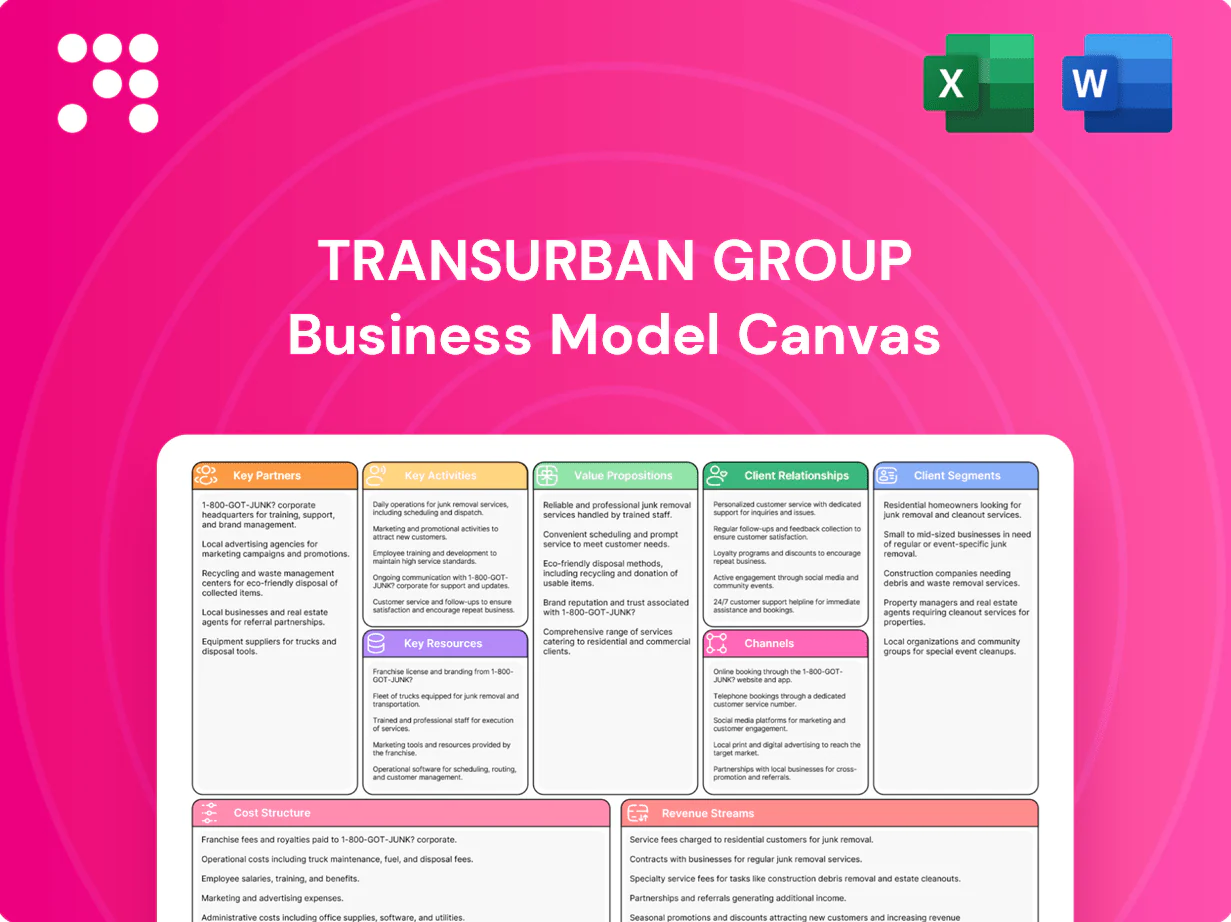
Transurban Group Business Model Canvas

Business Model Canvas for Tolling and Infrastructure Asset Strategies
Unlock the full strategic blueprint behind Transurban Group's business model. This concise Business Model Canvas maps value propositions, revenue streams, key partnerships and cost structure to show how Transurban scales tolling and infrastructure assets. Download the full editable Word & Excel canvas to benchmark, strategize and act.
Partnerships

Government concession grantors
Public authorities award long-term concessions that enable Transurban to build and operate 20+ toll roads across Australia and North America, with concession terms commonly extending up to 99 years.
These partnerships set tolling frameworks, performance standards and extension options, underpinning revenue models and capital planning for each asset.
Collaborative planning with transport departments aligns projects with city mobility goals, while ongoing compliance and regular reporting (quarterly/annual) maintain licence certainty.
Construction and engineering contractors
EPC and design partners deliver complex tunnels, bridges and interchanges to specification, enabling Transurban to operate assets within its A$43 billion portfolio as reported in 2024. Risk-sharing contracts allocate schedule, cost and interface risks to contractors, aligning incentives across project lifecycles. Innovation in precast, modular and TBM methods accelerates delivery and minimizes disruption. A deep contractor ecosystem supports 30–50 year asset refresh cycles.

Financial institutions and investors
Banks, bondholders and co-investors supply project finance and refinancing capacity for Transurban, supporting syndicated loans and bond issuances that underpinned 2024 capital programs. Structured debt and equity arrangements enable staged capex and optimize capital structure, with institutional partners co-funding mega-projects under PPPs. Treasury partners facilitate interest-rate hedging and liquidity management across the portfolio, which stood at about A$35 billion of managed toll assets in 2024.

Tolling, ITS, and data technology providers
Vendors supply gantries, sensors, tags, cameras and back-office platforms to ensure lane-level tolling, ANPR and real-time payments; interoperable partners enable multi-network tolling and cross-billing across jurisdictions. AI and analytics providers deliver demand forecasting and incident detection, while cybersecurity partners protect critical infrastructure and customer data.
- Vendors: gantries, ANPR, tags, back-office
- Interoperability: cross-network tolling & billing
- Analytics: demand forecasting, incident detection
- Cybersecurity: infrastructure & data protection
Community, safety, and emergency services
Coordination with police, EMS and tow operators shortens incident clearance times, improving corridor throughput and reducing secondary crashes by up to 30% in targeted programs in 2024. Community groups informed design choices across multiple projects, mitigating construction impacts through 50+ engagement sessions. Road safety organisations co-delivered campaigns and standards; councils and utilities aligned works and access arrangements to minimise lane closures.
- incident-response: up to 30% faster
- community-engagement: 50+ sessions (2024)
- safety-campaigns: joint standards
- works-coordination: fewer lane closures
Public-private toll concessions underpin A$43bn portfolios; incident clearance 30% faster
Public authorities grant long-term concessions (20+ roads; up to 99 years) underpinning revenue and capex; Transurban reported ~A$43bn portfolio and ~A$35bn managed toll assets in 2024. EPCs, vendors and finance partners deliver/finance projects and enable tolling interoperability; contractors support 30–50y refresh cycles. Emergency, community and safety partners cut incident clearance up to 30% and ran 50+ engagement sessions in 2024.
| Partner | Role | 2024 metric |
|---|---|---|
| Public authorities | Concessions/regulation | 20+ roads; ≤99y |
| Finance | Debt/equity | Portfolio A$43bn |
| Vendors/EPC | Toll tech/construction | 30–50y refresh |
| Emergency/Community | Ops & engagement | 30% faster; 50+ sessions |
What is included in the product
 Detailed Word Document
A focused Business Model Canvas for Transurban Group detailing toll-paying commuters, government partners and investors as key customers; value from reliable road access, traffic management and long-term concession cashflows, delivered via road networks, digital tolling and government partnerships, supported by asset management, capital markets funding and regulatory compliance—useful for strategic planning and investor presentations.

 Customizable Excel Spreadsheet
High-level view of Transurban’s business model with editable cells to quickly map tolling, asset management, project development and stakeholder flows—ideal for clarifying revenue drivers and operational pain points for boardrooms or teams.
Activities

Design, build, finance, operate, maintain
Design, build, finance, operate and maintain delivers end-to-end delivery of urban toll corridors under concession terms across Transurban's 19 corridors in Australia, US and Canada, typically spanning 30–99 years. Integrated lifecycle planning balances capex and opex across decades to optimise returns. Reliability and availability targets (multi-year KPIs) drive proactive maintenance regimes and continuous improvement extends asset life and customer value.
Traffic and incident management
Real-time monitoring optimizes flow and safety via 24/7 control rooms that coordinate variable speed limits, lane use and ramp metering across thousands of sensors and cameras. Rapid response protocols seek to minimize congestion after incidents by reducing clearance and recovery times. Continuous data feedback loops iterate algorithms and operations using live vehicle and incident data to improve performance.

Tolling, billing, and revenue assurance
Transurban scales account setup, tag issuance and account-based tolling to support millions of transactions daily in 2024, enabling automated vehicle identification and dynamic pricing across corridors. Accurate detection, pricing and reconciliation across interconnected networks ensure correct billing and minimize disputes. Collections, dispute resolution and proactive leakage-reduction measures protect cashflows while maintaining privacy controls and payments compliance (PCI DSS and local data laws).

Capital management and project development
Capital management and project development at Transurban centers on origination of new corridors, extensions and upgrades across its Australia and North America networks as of 2024. The team leads PPP financial modeling, competitive bidding and stakeholder negotiations, alongside debt issuance, refinancing and hedging programs to manage interest-rate and FX risk. Active portfolio recycling funds growth and optimizes returns.
- Origination and upgrades — network expansion
- PPPs — modeling, bidding, negotiations
- Capital markets — debt, refinancing, hedging
- Portfolio recycling — fund growth, optimize returns
Stakeholder and regulatory engagement
Transurban maintains transparent FY2024 reporting to governments, investors and communities, linking toll revenue disclosures and project updates to ESG targets and resilience planning.
Tariff reviews and policy consultations in FY2024 supported fair pricing while proactive stakeholder engagement sustained social licence and community trust.
- FY2024 reporting
- ESG-aligned initiatives
- Tariff review & policy input
- Proactive social licence work
Operate and finance 19 toll corridors with account-based tolling
Design, build, finance, operate and maintain 19 toll corridors (concessions 30–99 years) with integrated lifecycle planning to optimise returns. 24/7 control rooms and sensor networks manage flow, safety and incident clearance, feeding live-data continuous improvement. Account-based tolling supports millions of transactions daily in 2024 while capital origination, PPPs, debt programs and portfolio recycling fund growth.
| Metric | 2024 | Notes |
|---|---|---|
| Corridors | 19 | AU, US, CA |
| Concession length | 30–99 years | Typical range |
| Daily transactions | millions | 2024 automated tolling scale |
Full Version Awaits
Business Model Canvas
This preview shows the actual Transurban Group Business Model Canvas—not a mockup—and contains the same content you’ll receive after purchase. When you buy, you’ll download the identical, fully formatted document ready for editing and presentation. Delivered in Word and Excel, no surprises, just the complete canvas as shown.

Business Model Canvas for Tolling and Infrastructure Asset Strategies
Unlock the full strategic blueprint behind Transurban Group's business model. This concise Business Model Canvas maps value propositions, revenue streams, key partnerships and cost structure to show how Transurban scales tolling and infrastructure assets. Download the full editable Word & Excel canvas to benchmark, strategize and act.
Partnerships
Government concession grantors
Public authorities award long-term concessions that enable Transurban to build and operate 20+ toll roads across Australia and North America, with concession terms commonly extending up to 99 years.
These partnerships set tolling frameworks, performance standards and extension options, underpinning revenue models and capital planning for each asset.
Collaborative planning with transport departments aligns projects with city mobility goals, while ongoing compliance and regular reporting (quarterly/annual) maintain licence certainty.
Construction and engineering contractors
EPC and design partners deliver complex tunnels, bridges and interchanges to specification, enabling Transurban to operate assets within its A$43 billion portfolio as reported in 2024. Risk-sharing contracts allocate schedule, cost and interface risks to contractors, aligning incentives across project lifecycles. Innovation in precast, modular and TBM methods accelerates delivery and minimizes disruption. A deep contractor ecosystem supports 30–50 year asset refresh cycles.
Financial institutions and investors
Banks, bondholders and co-investors supply project finance and refinancing capacity for Transurban, supporting syndicated loans and bond issuances that underpinned 2024 capital programs. Structured debt and equity arrangements enable staged capex and optimize capital structure, with institutional partners co-funding mega-projects under PPPs. Treasury partners facilitate interest-rate hedging and liquidity management across the portfolio, which stood at about A$35 billion of managed toll assets in 2024.
Tolling, ITS, and data technology providers
Vendors supply gantries, sensors, tags, cameras and back-office platforms to ensure lane-level tolling, ANPR and real-time payments; interoperable partners enable multi-network tolling and cross-billing across jurisdictions. AI and analytics providers deliver demand forecasting and incident detection, while cybersecurity partners protect critical infrastructure and customer data.
- Vendors: gantries, ANPR, tags, back-office
- Interoperability: cross-network tolling & billing
- Analytics: demand forecasting, incident detection
- Cybersecurity: infrastructure & data protection
Community, safety, and emergency services
Coordination with police, EMS and tow operators shortens incident clearance times, improving corridor throughput and reducing secondary crashes by up to 30% in targeted programs in 2024. Community groups informed design choices across multiple projects, mitigating construction impacts through 50+ engagement sessions. Road safety organisations co-delivered campaigns and standards; councils and utilities aligned works and access arrangements to minimise lane closures.
- incident-response: up to 30% faster
- community-engagement: 50+ sessions (2024)
- safety-campaigns: joint standards
- works-coordination: fewer lane closures
Public-private toll concessions underpin A$43bn portfolios; incident clearance 30% faster
Public authorities grant long-term concessions (20+ roads; up to 99 years) underpinning revenue and capex; Transurban reported ~A$43bn portfolio and ~A$35bn managed toll assets in 2024. EPCs, vendors and finance partners deliver/finance projects and enable tolling interoperability; contractors support 30–50y refresh cycles. Emergency, community and safety partners cut incident clearance up to 30% and ran 50+ engagement sessions in 2024.
| Partner | Role | 2024 metric |
|---|---|---|
| Public authorities | Concessions/regulation | 20+ roads; ≤99y |
| Finance | Debt/equity | Portfolio A$43bn |
| Vendors/EPC | Toll tech/construction | 30–50y refresh |
| Emergency/Community | Ops & engagement | 30% faster; 50+ sessions |
What is included in the product
Detailed Word Document
A focused Business Model Canvas for Transurban Group detailing toll-paying commuters, government partners and investors as key customers; value from reliable road access, traffic management and long-term concession cashflows, delivered via road networks, digital tolling and government partnerships, supported by asset management, capital markets funding and regulatory compliance—useful for strategic planning and investor presentations.
Customizable Excel Spreadsheet
High-level view of Transurban’s business model with editable cells to quickly map tolling, asset management, project development and stakeholder flows—ideal for clarifying revenue drivers and operational pain points for boardrooms or teams.
Activities
Design, build, finance, operate, maintain
Design, build, finance, operate and maintain delivers end-to-end delivery of urban toll corridors under concession terms across Transurban's 19 corridors in Australia, US and Canada, typically spanning 30–99 years. Integrated lifecycle planning balances capex and opex across decades to optimise returns. Reliability and availability targets (multi-year KPIs) drive proactive maintenance regimes and continuous improvement extends asset life and customer value.
Traffic and incident management
Real-time monitoring optimizes flow and safety via 24/7 control rooms that coordinate variable speed limits, lane use and ramp metering across thousands of sensors and cameras. Rapid response protocols seek to minimize congestion after incidents by reducing clearance and recovery times. Continuous data feedback loops iterate algorithms and operations using live vehicle and incident data to improve performance.
Tolling, billing, and revenue assurance
Transurban scales account setup, tag issuance and account-based tolling to support millions of transactions daily in 2024, enabling automated vehicle identification and dynamic pricing across corridors. Accurate detection, pricing and reconciliation across interconnected networks ensure correct billing and minimize disputes. Collections, dispute resolution and proactive leakage-reduction measures protect cashflows while maintaining privacy controls and payments compliance (PCI DSS and local data laws).
Capital management and project development
Capital management and project development at Transurban centers on origination of new corridors, extensions and upgrades across its Australia and North America networks as of 2024. The team leads PPP financial modeling, competitive bidding and stakeholder negotiations, alongside debt issuance, refinancing and hedging programs to manage interest-rate and FX risk. Active portfolio recycling funds growth and optimizes returns.
- Origination and upgrades — network expansion
- PPPs — modeling, bidding, negotiations
- Capital markets — debt, refinancing, hedging
- Portfolio recycling — fund growth, optimize returns
Stakeholder and regulatory engagement
Transurban maintains transparent FY2024 reporting to governments, investors and communities, linking toll revenue disclosures and project updates to ESG targets and resilience planning.
Tariff reviews and policy consultations in FY2024 supported fair pricing while proactive stakeholder engagement sustained social licence and community trust.
- FY2024 reporting
- ESG-aligned initiatives
- Tariff review & policy input
- Proactive social licence work
Operate and finance 19 toll corridors with account-based tolling
Design, build, finance, operate and maintain 19 toll corridors (concessions 30–99 years) with integrated lifecycle planning to optimise returns. 24/7 control rooms and sensor networks manage flow, safety and incident clearance, feeding live-data continuous improvement. Account-based tolling supports millions of transactions daily in 2024 while capital origination, PPPs, debt programs and portfolio recycling fund growth.
| Metric | 2024 | Notes |
|---|---|---|
| Corridors | 19 | AU, US, CA |
| Concession length | 30–99 years | Typical range |
| Daily transactions | millions | 2024 automated tolling scale |
Full Version Awaits
Business Model Canvas
This preview shows the actual Transurban Group Business Model Canvas—not a mockup—and contains the same content you’ll receive after purchase. When you buy, you’ll download the identical, fully formatted document ready for editing and presentation. Delivered in Word and Excel, no surprises, just the complete canvas as shown.
Original: $10.00
-65%$10.00
$3.50Description
Business Model Canvas for Tolling and Infrastructure Asset Strategies
Unlock the full strategic blueprint behind Transurban Group's business model. This concise Business Model Canvas maps value propositions, revenue streams, key partnerships and cost structure to show how Transurban scales tolling and infrastructure assets. Download the full editable Word & Excel canvas to benchmark, strategize and act.
Partnerships
Government concession grantors
Public authorities award long-term concessions that enable Transurban to build and operate 20+ toll roads across Australia and North America, with concession terms commonly extending up to 99 years.
These partnerships set tolling frameworks, performance standards and extension options, underpinning revenue models and capital planning for each asset.
Collaborative planning with transport departments aligns projects with city mobility goals, while ongoing compliance and regular reporting (quarterly/annual) maintain licence certainty.
Construction and engineering contractors
EPC and design partners deliver complex tunnels, bridges and interchanges to specification, enabling Transurban to operate assets within its A$43 billion portfolio as reported in 2024. Risk-sharing contracts allocate schedule, cost and interface risks to contractors, aligning incentives across project lifecycles. Innovation in precast, modular and TBM methods accelerates delivery and minimizes disruption. A deep contractor ecosystem supports 30–50 year asset refresh cycles.
Financial institutions and investors
Banks, bondholders and co-investors supply project finance and refinancing capacity for Transurban, supporting syndicated loans and bond issuances that underpinned 2024 capital programs. Structured debt and equity arrangements enable staged capex and optimize capital structure, with institutional partners co-funding mega-projects under PPPs. Treasury partners facilitate interest-rate hedging and liquidity management across the portfolio, which stood at about A$35 billion of managed toll assets in 2024.
Tolling, ITS, and data technology providers
Vendors supply gantries, sensors, tags, cameras and back-office platforms to ensure lane-level tolling, ANPR and real-time payments; interoperable partners enable multi-network tolling and cross-billing across jurisdictions. AI and analytics providers deliver demand forecasting and incident detection, while cybersecurity partners protect critical infrastructure and customer data.
- Vendors: gantries, ANPR, tags, back-office
- Interoperability: cross-network tolling & billing
- Analytics: demand forecasting, incident detection
- Cybersecurity: infrastructure & data protection
Community, safety, and emergency services
Coordination with police, EMS and tow operators shortens incident clearance times, improving corridor throughput and reducing secondary crashes by up to 30% in targeted programs in 2024. Community groups informed design choices across multiple projects, mitigating construction impacts through 50+ engagement sessions. Road safety organisations co-delivered campaigns and standards; councils and utilities aligned works and access arrangements to minimise lane closures.
- incident-response: up to 30% faster
- community-engagement: 50+ sessions (2024)
- safety-campaigns: joint standards
- works-coordination: fewer lane closures
Public-private toll concessions underpin A$43bn portfolios; incident clearance 30% faster
Public authorities grant long-term concessions (20+ roads; up to 99 years) underpinning revenue and capex; Transurban reported ~A$43bn portfolio and ~A$35bn managed toll assets in 2024. EPCs, vendors and finance partners deliver/finance projects and enable tolling interoperability; contractors support 30–50y refresh cycles. Emergency, community and safety partners cut incident clearance up to 30% and ran 50+ engagement sessions in 2024.
| Partner | Role | 2024 metric |
|---|---|---|
| Public authorities | Concessions/regulation | 20+ roads; ≤99y |
| Finance | Debt/equity | Portfolio A$43bn |
| Vendors/EPC | Toll tech/construction | 30–50y refresh |
| Emergency/Community | Ops & engagement | 30% faster; 50+ sessions |
What is included in the product
Detailed Word Document
A focused Business Model Canvas for Transurban Group detailing toll-paying commuters, government partners and investors as key customers; value from reliable road access, traffic management and long-term concession cashflows, delivered via road networks, digital tolling and government partnerships, supported by asset management, capital markets funding and regulatory compliance—useful for strategic planning and investor presentations.
Customizable Excel Spreadsheet
High-level view of Transurban’s business model with editable cells to quickly map tolling, asset management, project development and stakeholder flows—ideal for clarifying revenue drivers and operational pain points for boardrooms or teams.
Activities
Design, build, finance, operate, maintain
Design, build, finance, operate and maintain delivers end-to-end delivery of urban toll corridors under concession terms across Transurban's 19 corridors in Australia, US and Canada, typically spanning 30–99 years. Integrated lifecycle planning balances capex and opex across decades to optimise returns. Reliability and availability targets (multi-year KPIs) drive proactive maintenance regimes and continuous improvement extends asset life and customer value.
Traffic and incident management
Real-time monitoring optimizes flow and safety via 24/7 control rooms that coordinate variable speed limits, lane use and ramp metering across thousands of sensors and cameras. Rapid response protocols seek to minimize congestion after incidents by reducing clearance and recovery times. Continuous data feedback loops iterate algorithms and operations using live vehicle and incident data to improve performance.
Tolling, billing, and revenue assurance
Transurban scales account setup, tag issuance and account-based tolling to support millions of transactions daily in 2024, enabling automated vehicle identification and dynamic pricing across corridors. Accurate detection, pricing and reconciliation across interconnected networks ensure correct billing and minimize disputes. Collections, dispute resolution and proactive leakage-reduction measures protect cashflows while maintaining privacy controls and payments compliance (PCI DSS and local data laws).
Capital management and project development
Capital management and project development at Transurban centers on origination of new corridors, extensions and upgrades across its Australia and North America networks as of 2024. The team leads PPP financial modeling, competitive bidding and stakeholder negotiations, alongside debt issuance, refinancing and hedging programs to manage interest-rate and FX risk. Active portfolio recycling funds growth and optimizes returns.
- Origination and upgrades — network expansion
- PPPs — modeling, bidding, negotiations
- Capital markets — debt, refinancing, hedging
- Portfolio recycling — fund growth, optimize returns
Stakeholder and regulatory engagement
Transurban maintains transparent FY2024 reporting to governments, investors and communities, linking toll revenue disclosures and project updates to ESG targets and resilience planning.
Tariff reviews and policy consultations in FY2024 supported fair pricing while proactive stakeholder engagement sustained social licence and community trust.
- FY2024 reporting
- ESG-aligned initiatives
- Tariff review & policy input
- Proactive social licence work
Operate and finance 19 toll corridors with account-based tolling
Design, build, finance, operate and maintain 19 toll corridors (concessions 30–99 years) with integrated lifecycle planning to optimise returns. 24/7 control rooms and sensor networks manage flow, safety and incident clearance, feeding live-data continuous improvement. Account-based tolling supports millions of transactions daily in 2024 while capital origination, PPPs, debt programs and portfolio recycling fund growth.
| Metric | 2024 | Notes |
|---|---|---|
| Corridors | 19 | AU, US, CA |
| Concession length | 30–99 years | Typical range |
| Daily transactions | millions | 2024 automated tolling scale |
Full Version Awaits
Business Model Canvas
This preview shows the actual Transurban Group Business Model Canvas—not a mockup—and contains the same content you’ll receive after purchase. When you buy, you’ll download the identical, fully formatted document ready for editing and presentation. Delivered in Word and Excel, no surprises, just the complete canvas as shown.











