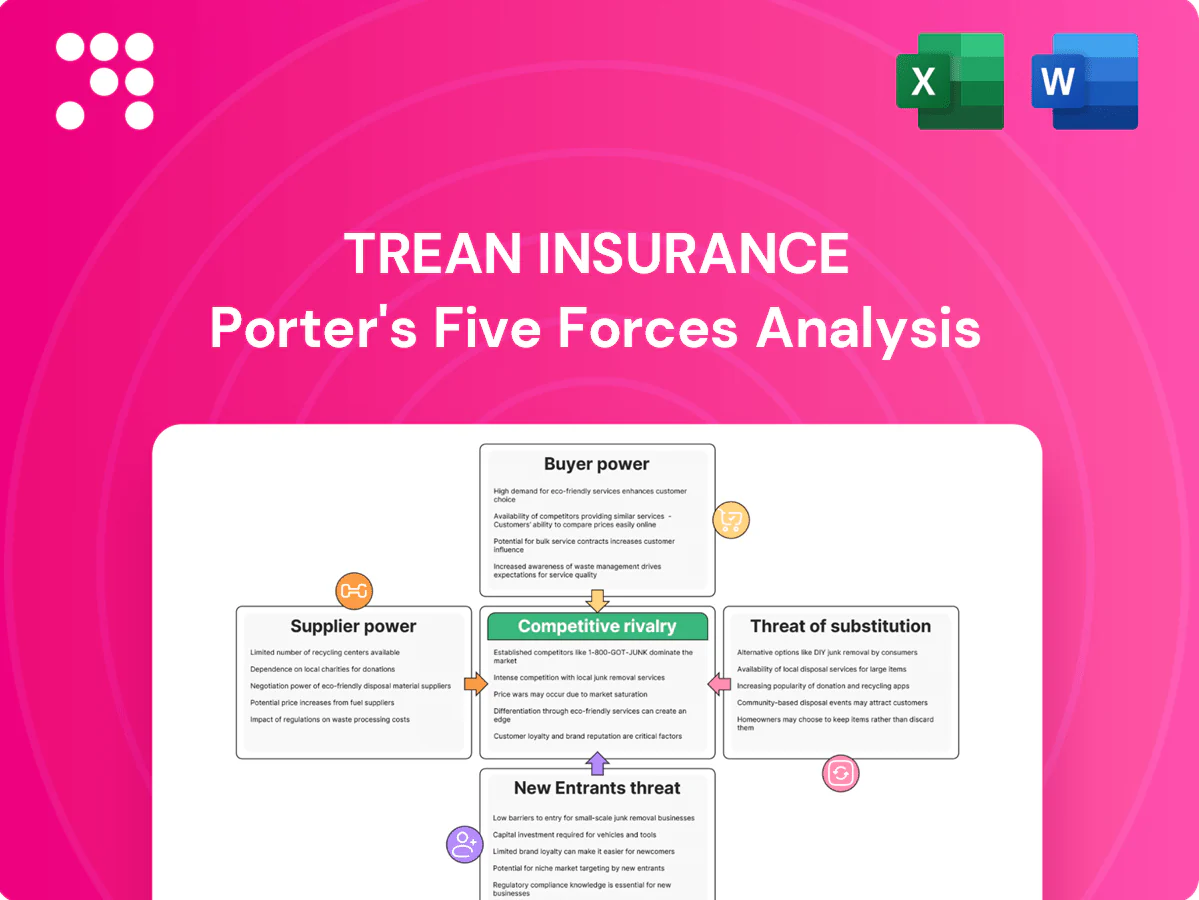
Trean Insurance Porter's Five Forces Analysis

A Must-Have Tool for Decision-Makers
Trean Insurance faces moderate buyer power, rising regulatory scrutiny, and evolving substitute risks as digital distribution compresses margins. Supplier leverage is limited but niche reinsurance capacity can bite in stress scenarios. Barriers to entry are significant for scale but fintech entrants raise long-term threats. This snapshot only scratches the surface—unlock the full Porter's Five Forces Analysis for detailed ratings, visuals, and actionable strategy.
Suppliers Bargaining Power

Reinsurers’ capacity leverage
Reinsurers supply risk capital and can tighten terms, pushing ceding commissions down and treaty rates up; global reinsurance pricing hardened about 15% in 2024 per industry reports, amplifying cost pressure on cedants. In hard-market pockets fewer panels left insurers more dependent on dominant reinsurers, increasing their pricing power and leverage. Tightened collateral and A.M. Best/S&P rating demands further concentrate influence; Trean should diversify treaties and cement multi-year relationships to moderate this power.
MGAs/program admins control deal flow
MGAs own niche distribution and underwriting expertise, gating access to profitable programs and giving suppliers leverage over carriers by controlling deal flow. They can switch paper to alternative carriers or fronting markets, raising switching costs for insurers. Their performance fees and growing data demands compress carriers margins, so aligning incentives and strict performance SLAs materially reduces churn risk.

Data/tech vendors set switching costs
Loss analytics, policy administration and claims systems are mission-critical, with core platform replacements typically taking 18–36 months and costing tens of millions, creating high switching costs that strengthen vendor bargaining power. Vendor lock-in and integration expenses let suppliers enforce pricing uplifts or gate features that compress insurer margins. Multi-vendor strategies and open APIs can reduce dependency and lower migration risk.

Claims services and medical networks
Independent adjusters, nurse case managers, and PPO networks materially influence workers’ comp loss costs; 2024 industry surveys report median PPO discounts around 30%, directly lowering medical severity while adjuster turnaround times drive indemnity duration. Local scarcity in key jurisdictions raises supplier leverage and vendor rate-card rigidity increases expense volatility. Building in-house TPA scale has been shown to reduce claim admin spend and improve cycle times.
- Independent adjusters: limited local supply raises rates
- Nurse case managers: impact return-to-work, cost containment
- PPO networks: ~30% median discounts (2024)
- In-house TPA: lowers admin spend, shortens turnaround
Ratings, compliance, and capital providers
AM Best ratings (A++ to D) and capital backers often require at least A-; AM Best/market pressure pushed global reinsurance pricing up about 20% in 2023–2024, raising capital costs and cascading into tighter underwriting and capacity limits. Compliance consultants and filings vendors exert timing/cost leverage; a strong balance sheet and proactive regulator engagement reduce this exposure.
- AM Best scale: A++ to D; A- common threshold
- Reinsurance pricing: +20% (2023–2024)
- Consultants/filings add timing and cost power
- Strong balance sheet + proactive regulatory management mitigate risk
Reinsurance +15–20%; PPO discounts ~30%; core replacements $10m+, 18–36 months — diversify treaties
Reinsurers and capital providers tightened terms in 2024, raising reinsurance costs ~15%–20% and concentrating leverage with top panels. MGAs, TPAs and core-platform vendors exert strong switching costs; core replacements take 18–36 months and cost tens of millions. PPO discounts ~30% (2024) and local adjuster scarcity increase supplier bargaining power; diversify treaties and build selective in-house capabilities.
| Supplier | 2024 metric |
|---|---|
| Reinsurance | +15%–20% pricing |
| PPOs | ~30% median discount |
| Core systems | 18–36 months; $10m+ |
What is included in the product
 Detailed Word Document
Tailored Porter's Five Forces analysis for Trean Insurance uncovering competitive drivers, buyer and supplier power, threats from substitutes and new entrants, and strategic barriers protecting incumbents to inform pricing, risk mitigation, and growth strategies.

 Customizable Excel Spreadsheet
Trean Insurance Porter's Five Forces delivers a one-sheet, customizable assessment of competitive pressures—with instant spider chart visualization and editable inputs—so teams can quickly quantify threats, tailor scenarios (pre/post regulation, new entrants) and drop clean slides into decks without macros or finance expertise.
Customers Bargaining Power

Employers’ price sensitivity
Workers compensation buyers in 2024 remain highly price-sensitive, routinely benchmarking rates and dividend programs when soliciting quotes. Low differentiation across standard classes heightens switching, making experience mods and deductible structures key negotiation levers. Trean must sell on total cost of risk—claims trend, safety programs and dividend yield—not premium alone.
Brokers as channel gatekeepers
Retail and wholesale brokers bundle market access and steer placements; the top 4 global brokers account for about 50% of commercial brokerage volumes in 2024, giving them leverage to demand faster service, competitive commissions and flexibility. Consolidated broker groups exert higher bargaining power, while insurers that deliver consistent underwriting appetite and 24–48 hour quoting retain critical shelf space.

Self-insureds buying TPA services
Large self-insured buyers (often accounts >5,000 lives) regularly rebid TPA services, benchmarking fee schedules, litigation outcomes, and medical cost management. Data transparency and PMPM reporting are must-haves for procurement teams. Performance guarantees and outcome-based pricing are increasingly required to secure renewals and demonstrate measurable savings.

Program administrators’ portfolio clout
Program administrators aggregate premiums allowing negotiation of enhanced profit shares and fee structures, increasing their bargaining power with carriers in 2024.
They demand broad binding authorities and strict bordereaux terms to control placement and reporting; multi-carrier program options amplify leverage.
Trean’s disciplined underwriting oversight and performance gates preserve carrier economics and prevent adverse selection.
- Aggregated premium leverage
- Broad authorities & bordereaux
- Multi-carrier options boost power
- Underwriting oversight maintains balance
Demand elasticity in niche casualty
Specialty casualty segments have few carriers, but 2024 broker surveys show buyers still prioritize service quality over price; poor claims handling triggers rapid account moves and aggressive shopping at renewal, especially for loss-driven accounts. Delivering superior claims outcomes materially reduces price pressure and churn.
- claims-first
- renewal-shopping
- service-premium
Buyers price-sensitive; Top 4 brokers hold ≈50%; large groups demand PMPM
Buyers remain highly price-sensitive; top 4 brokers hold ~50% of commercial volumes in 2024, increasing broker leverage. Large self-insured groups (>5,000 lives) demand PMPM transparency and outcome-based pricing. Program administrators and multi-carrier programs extract enhanced profit shares; superior claims handling reduces churn in loss-driven accounts.
| Segment | Leverage | Key metric |
|---|---|---|
| Brokers | High | Top 4 ≈50% share (2024) |
| Self-insured | High | Accounts >5,000 lives |
| Program admins | Medium-High | Aggregated premium/profit share |
| Loss-driven buyers | Variable | Service/claims outcomes |
Preview the Actual Deliverable
Trean Insurance Porter's Five Forces Analysis
This preview is the Trean Insurance Porter’s Five Forces Analysis and contains the complete, professionally written assessment you’ll receive immediately after purchase. It includes the same structured evaluation of competitive rivalry, supplier and buyer power, threat of new entrants, and substitutes—fully formatted and ready to use. No placeholders or samples: what you see here is the exact downloadable file available upon payment.

A Must-Have Tool for Decision-Makers
Trean Insurance faces moderate buyer power, rising regulatory scrutiny, and evolving substitute risks as digital distribution compresses margins. Supplier leverage is limited but niche reinsurance capacity can bite in stress scenarios. Barriers to entry are significant for scale but fintech entrants raise long-term threats. This snapshot only scratches the surface—unlock the full Porter's Five Forces Analysis for detailed ratings, visuals, and actionable strategy.
Suppliers Bargaining Power
Reinsurers’ capacity leverage
Reinsurers supply risk capital and can tighten terms, pushing ceding commissions down and treaty rates up; global reinsurance pricing hardened about 15% in 2024 per industry reports, amplifying cost pressure on cedants. In hard-market pockets fewer panels left insurers more dependent on dominant reinsurers, increasing their pricing power and leverage. Tightened collateral and A.M. Best/S&P rating demands further concentrate influence; Trean should diversify treaties and cement multi-year relationships to moderate this power.
MGAs/program admins control deal flow
MGAs own niche distribution and underwriting expertise, gating access to profitable programs and giving suppliers leverage over carriers by controlling deal flow. They can switch paper to alternative carriers or fronting markets, raising switching costs for insurers. Their performance fees and growing data demands compress carriers margins, so aligning incentives and strict performance SLAs materially reduces churn risk.
Data/tech vendors set switching costs
Loss analytics, policy administration and claims systems are mission-critical, with core platform replacements typically taking 18–36 months and costing tens of millions, creating high switching costs that strengthen vendor bargaining power. Vendor lock-in and integration expenses let suppliers enforce pricing uplifts or gate features that compress insurer margins. Multi-vendor strategies and open APIs can reduce dependency and lower migration risk.
Claims services and medical networks
Independent adjusters, nurse case managers, and PPO networks materially influence workers’ comp loss costs; 2024 industry surveys report median PPO discounts around 30%, directly lowering medical severity while adjuster turnaround times drive indemnity duration. Local scarcity in key jurisdictions raises supplier leverage and vendor rate-card rigidity increases expense volatility. Building in-house TPA scale has been shown to reduce claim admin spend and improve cycle times.
- Independent adjusters: limited local supply raises rates
- Nurse case managers: impact return-to-work, cost containment
- PPO networks: ~30% median discounts (2024)
- In-house TPA: lowers admin spend, shortens turnaround
Ratings, compliance, and capital providers
AM Best ratings (A++ to D) and capital backers often require at least A-; AM Best/market pressure pushed global reinsurance pricing up about 20% in 2023–2024, raising capital costs and cascading into tighter underwriting and capacity limits. Compliance consultants and filings vendors exert timing/cost leverage; a strong balance sheet and proactive regulator engagement reduce this exposure.
- AM Best scale: A++ to D; A- common threshold
- Reinsurance pricing: +20% (2023–2024)
- Consultants/filings add timing and cost power
- Strong balance sheet + proactive regulatory management mitigate risk
Reinsurance +15–20%; PPO discounts ~30%; core replacements $10m+, 18–36 months — diversify treaties
Reinsurers and capital providers tightened terms in 2024, raising reinsurance costs ~15%–20% and concentrating leverage with top panels. MGAs, TPAs and core-platform vendors exert strong switching costs; core replacements take 18–36 months and cost tens of millions. PPO discounts ~30% (2024) and local adjuster scarcity increase supplier bargaining power; diversify treaties and build selective in-house capabilities.
| Supplier | 2024 metric |
|---|---|
| Reinsurance | +15%–20% pricing |
| PPOs | ~30% median discount |
| Core systems | 18–36 months; $10m+ |
What is included in the product
Detailed Word Document
Tailored Porter's Five Forces analysis for Trean Insurance uncovering competitive drivers, buyer and supplier power, threats from substitutes and new entrants, and strategic barriers protecting incumbents to inform pricing, risk mitigation, and growth strategies.
Customizable Excel Spreadsheet
Trean Insurance Porter's Five Forces delivers a one-sheet, customizable assessment of competitive pressures—with instant spider chart visualization and editable inputs—so teams can quickly quantify threats, tailor scenarios (pre/post regulation, new entrants) and drop clean slides into decks without macros or finance expertise.
Customers Bargaining Power
Employers’ price sensitivity
Workers compensation buyers in 2024 remain highly price-sensitive, routinely benchmarking rates and dividend programs when soliciting quotes. Low differentiation across standard classes heightens switching, making experience mods and deductible structures key negotiation levers. Trean must sell on total cost of risk—claims trend, safety programs and dividend yield—not premium alone.
Brokers as channel gatekeepers
Retail and wholesale brokers bundle market access and steer placements; the top 4 global brokers account for about 50% of commercial brokerage volumes in 2024, giving them leverage to demand faster service, competitive commissions and flexibility. Consolidated broker groups exert higher bargaining power, while insurers that deliver consistent underwriting appetite and 24–48 hour quoting retain critical shelf space.
Self-insureds buying TPA services
Large self-insured buyers (often accounts >5,000 lives) regularly rebid TPA services, benchmarking fee schedules, litigation outcomes, and medical cost management. Data transparency and PMPM reporting are must-haves for procurement teams. Performance guarantees and outcome-based pricing are increasingly required to secure renewals and demonstrate measurable savings.
Program administrators’ portfolio clout
Program administrators aggregate premiums allowing negotiation of enhanced profit shares and fee structures, increasing their bargaining power with carriers in 2024.
They demand broad binding authorities and strict bordereaux terms to control placement and reporting; multi-carrier program options amplify leverage.
Trean’s disciplined underwriting oversight and performance gates preserve carrier economics and prevent adverse selection.
- Aggregated premium leverage
- Broad authorities & bordereaux
- Multi-carrier options boost power
- Underwriting oversight maintains balance
Demand elasticity in niche casualty
Specialty casualty segments have few carriers, but 2024 broker surveys show buyers still prioritize service quality over price; poor claims handling triggers rapid account moves and aggressive shopping at renewal, especially for loss-driven accounts. Delivering superior claims outcomes materially reduces price pressure and churn.
- claims-first
- renewal-shopping
- service-premium
Buyers price-sensitive; Top 4 brokers hold ≈50%; large groups demand PMPM
Buyers remain highly price-sensitive; top 4 brokers hold ~50% of commercial volumes in 2024, increasing broker leverage. Large self-insured groups (>5,000 lives) demand PMPM transparency and outcome-based pricing. Program administrators and multi-carrier programs extract enhanced profit shares; superior claims handling reduces churn in loss-driven accounts.
| Segment | Leverage | Key metric |
|---|---|---|
| Brokers | High | Top 4 ≈50% share (2024) |
| Self-insured | High | Accounts >5,000 lives |
| Program admins | Medium-High | Aggregated premium/profit share |
| Loss-driven buyers | Variable | Service/claims outcomes |
Preview the Actual Deliverable
Trean Insurance Porter's Five Forces Analysis
This preview is the Trean Insurance Porter’s Five Forces Analysis and contains the complete, professionally written assessment you’ll receive immediately after purchase. It includes the same structured evaluation of competitive rivalry, supplier and buyer power, threat of new entrants, and substitutes—fully formatted and ready to use. No placeholders or samples: what you see here is the exact downloadable file available upon payment.
Original: $10.00
-65%$10.00
$3.50Description
A Must-Have Tool for Decision-Makers
Trean Insurance faces moderate buyer power, rising regulatory scrutiny, and evolving substitute risks as digital distribution compresses margins. Supplier leverage is limited but niche reinsurance capacity can bite in stress scenarios. Barriers to entry are significant for scale but fintech entrants raise long-term threats. This snapshot only scratches the surface—unlock the full Porter's Five Forces Analysis for detailed ratings, visuals, and actionable strategy.
Suppliers Bargaining Power
Reinsurers’ capacity leverage
Reinsurers supply risk capital and can tighten terms, pushing ceding commissions down and treaty rates up; global reinsurance pricing hardened about 15% in 2024 per industry reports, amplifying cost pressure on cedants. In hard-market pockets fewer panels left insurers more dependent on dominant reinsurers, increasing their pricing power and leverage. Tightened collateral and A.M. Best/S&P rating demands further concentrate influence; Trean should diversify treaties and cement multi-year relationships to moderate this power.
MGAs/program admins control deal flow
MGAs own niche distribution and underwriting expertise, gating access to profitable programs and giving suppliers leverage over carriers by controlling deal flow. They can switch paper to alternative carriers or fronting markets, raising switching costs for insurers. Their performance fees and growing data demands compress carriers margins, so aligning incentives and strict performance SLAs materially reduces churn risk.
Data/tech vendors set switching costs
Loss analytics, policy administration and claims systems are mission-critical, with core platform replacements typically taking 18–36 months and costing tens of millions, creating high switching costs that strengthen vendor bargaining power. Vendor lock-in and integration expenses let suppliers enforce pricing uplifts or gate features that compress insurer margins. Multi-vendor strategies and open APIs can reduce dependency and lower migration risk.
Claims services and medical networks
Independent adjusters, nurse case managers, and PPO networks materially influence workers’ comp loss costs; 2024 industry surveys report median PPO discounts around 30%, directly lowering medical severity while adjuster turnaround times drive indemnity duration. Local scarcity in key jurisdictions raises supplier leverage and vendor rate-card rigidity increases expense volatility. Building in-house TPA scale has been shown to reduce claim admin spend and improve cycle times.
- Independent adjusters: limited local supply raises rates
- Nurse case managers: impact return-to-work, cost containment
- PPO networks: ~30% median discounts (2024)
- In-house TPA: lowers admin spend, shortens turnaround
Ratings, compliance, and capital providers
AM Best ratings (A++ to D) and capital backers often require at least A-; AM Best/market pressure pushed global reinsurance pricing up about 20% in 2023–2024, raising capital costs and cascading into tighter underwriting and capacity limits. Compliance consultants and filings vendors exert timing/cost leverage; a strong balance sheet and proactive regulator engagement reduce this exposure.
- AM Best scale: A++ to D; A- common threshold
- Reinsurance pricing: +20% (2023–2024)
- Consultants/filings add timing and cost power
- Strong balance sheet + proactive regulatory management mitigate risk
Reinsurance +15–20%; PPO discounts ~30%; core replacements $10m+, 18–36 months — diversify treaties
Reinsurers and capital providers tightened terms in 2024, raising reinsurance costs ~15%–20% and concentrating leverage with top panels. MGAs, TPAs and core-platform vendors exert strong switching costs; core replacements take 18–36 months and cost tens of millions. PPO discounts ~30% (2024) and local adjuster scarcity increase supplier bargaining power; diversify treaties and build selective in-house capabilities.
| Supplier | 2024 metric |
|---|---|
| Reinsurance | +15%–20% pricing |
| PPOs | ~30% median discount |
| Core systems | 18–36 months; $10m+ |
What is included in the product
Detailed Word Document
Tailored Porter's Five Forces analysis for Trean Insurance uncovering competitive drivers, buyer and supplier power, threats from substitutes and new entrants, and strategic barriers protecting incumbents to inform pricing, risk mitigation, and growth strategies.
Customizable Excel Spreadsheet
Trean Insurance Porter's Five Forces delivers a one-sheet, customizable assessment of competitive pressures—with instant spider chart visualization and editable inputs—so teams can quickly quantify threats, tailor scenarios (pre/post regulation, new entrants) and drop clean slides into decks without macros or finance expertise.
Customers Bargaining Power
Employers’ price sensitivity
Workers compensation buyers in 2024 remain highly price-sensitive, routinely benchmarking rates and dividend programs when soliciting quotes. Low differentiation across standard classes heightens switching, making experience mods and deductible structures key negotiation levers. Trean must sell on total cost of risk—claims trend, safety programs and dividend yield—not premium alone.
Brokers as channel gatekeepers
Retail and wholesale brokers bundle market access and steer placements; the top 4 global brokers account for about 50% of commercial brokerage volumes in 2024, giving them leverage to demand faster service, competitive commissions and flexibility. Consolidated broker groups exert higher bargaining power, while insurers that deliver consistent underwriting appetite and 24–48 hour quoting retain critical shelf space.
Self-insureds buying TPA services
Large self-insured buyers (often accounts >5,000 lives) regularly rebid TPA services, benchmarking fee schedules, litigation outcomes, and medical cost management. Data transparency and PMPM reporting are must-haves for procurement teams. Performance guarantees and outcome-based pricing are increasingly required to secure renewals and demonstrate measurable savings.
Program administrators’ portfolio clout
Program administrators aggregate premiums allowing negotiation of enhanced profit shares and fee structures, increasing their bargaining power with carriers in 2024.
They demand broad binding authorities and strict bordereaux terms to control placement and reporting; multi-carrier program options amplify leverage.
Trean’s disciplined underwriting oversight and performance gates preserve carrier economics and prevent adverse selection.
- Aggregated premium leverage
- Broad authorities & bordereaux
- Multi-carrier options boost power
- Underwriting oversight maintains balance
Demand elasticity in niche casualty
Specialty casualty segments have few carriers, but 2024 broker surveys show buyers still prioritize service quality over price; poor claims handling triggers rapid account moves and aggressive shopping at renewal, especially for loss-driven accounts. Delivering superior claims outcomes materially reduces price pressure and churn.
- claims-first
- renewal-shopping
- service-premium
Buyers price-sensitive; Top 4 brokers hold ≈50%; large groups demand PMPM
Buyers remain highly price-sensitive; top 4 brokers hold ~50% of commercial volumes in 2024, increasing broker leverage. Large self-insured groups (>5,000 lives) demand PMPM transparency and outcome-based pricing. Program administrators and multi-carrier programs extract enhanced profit shares; superior claims handling reduces churn in loss-driven accounts.
| Segment | Leverage | Key metric |
|---|---|---|
| Brokers | High | Top 4 ≈50% share (2024) |
| Self-insured | High | Accounts >5,000 lives |
| Program admins | Medium-High | Aggregated premium/profit share |
| Loss-driven buyers | Variable | Service/claims outcomes |
Preview the Actual Deliverable
Trean Insurance Porter's Five Forces Analysis
This preview is the Trean Insurance Porter’s Five Forces Analysis and contains the complete, professionally written assessment you’ll receive immediately after purchase. It includes the same structured evaluation of competitive rivalry, supplier and buyer power, threat of new entrants, and substitutes—fully formatted and ready to use. No placeholders or samples: what you see here is the exact downloadable file available upon payment.











