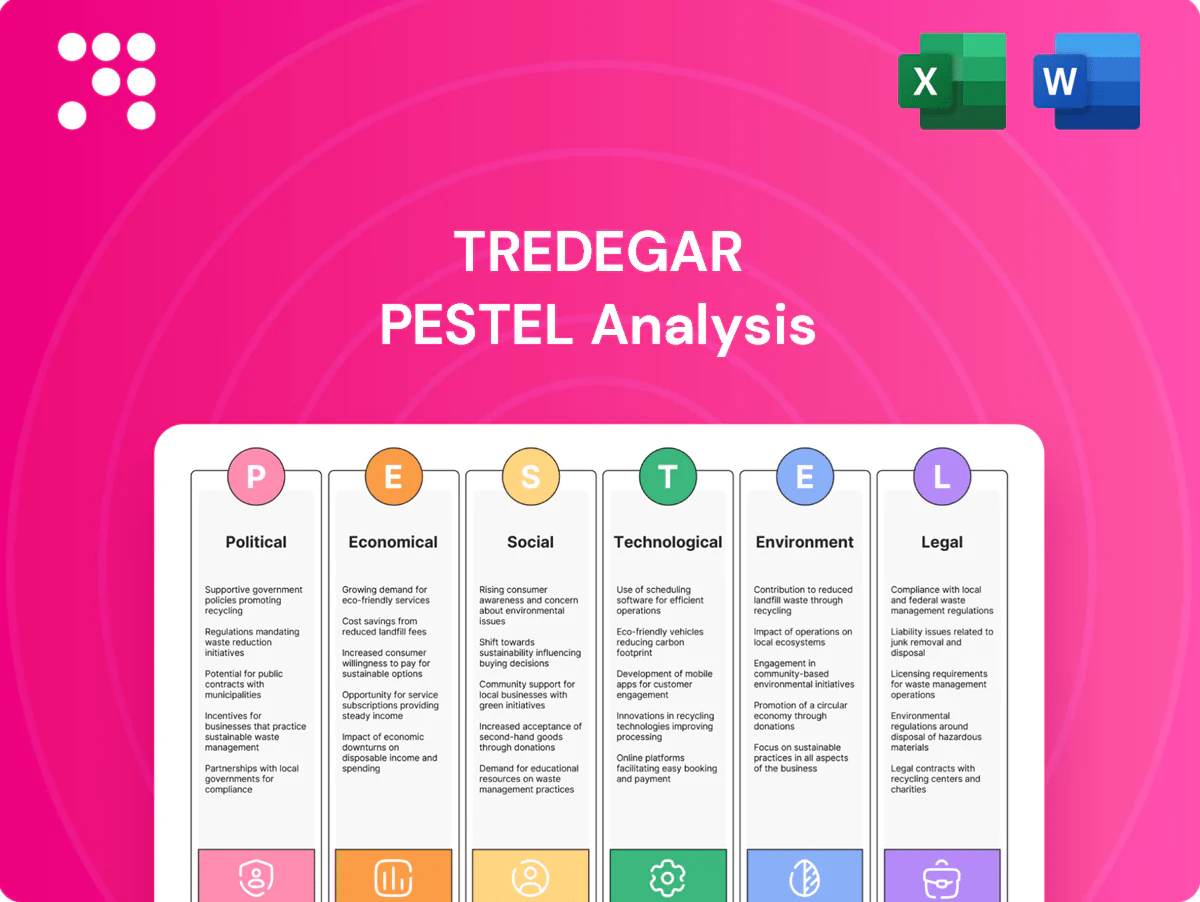
Tredegar PESTLE Analysis

Your Competitive Advantage Starts with This Report
Discover how political, economic, social, technological, legal, and environmental forces are shaping Tredegar’s strategic outlook. This concise PESTLE snapshot highlights risks and opportunities investors and planners can act on today. Buy the full PESTLE analysis to access detailed, actionable insights and downloadable templates.
Political factors

Trade policy and tariffs
Aluminum extrusions and films face shifting tariffs, quotas and anti-dumping duties across the US, EU and Asia; notably the US Section 232 aluminum tariff remains at 10%, which can lift input costs by double-digit percentages versus tariff-free competitors. Changes erode price parity and margins; Tredegar must diversify sourcing and markets, increase supply-chain flexibility and pursue active lobbying as hedges.
Industrial subsidies and incentives
Government incentives such as the Inflation Reduction Act’s roughly $369 billion clean-energy package and the CHIPS Act’s $52 billion reshoring support can lower capex for manufacturing upgrades. Competing states and countries offer grants and tax credits that shift plant-location economics. Tredegar can target eligible federal and state programs for project alignment. Transparent compliance and rigorous documentation are essential to secure and retain benefits.

Geopolitical supply-chain risk
Political tensions can disrupt flows of resin, aluminum billet and specialty chemicals; Russia supplied roughly 6% of global primary aluminum in 2023, illustrating single-source risk. Sanctions and export controls since 2022 have constrained access to advanced materials. Multisourcing and regionalization reduce single-country exposure, while scenario planning enables rapid order reallocation and 30–90 day inventory buffers.

Public procurement and standards
Public procurement—estimated at roughly 12% of OECD GDP—ties building and transport projects to local‑content rules, making municipal and federal contracts a major channel for Tredegar’s films and components. Policy-driven standards such as the EU packaging recyclability target of 50% for plastics by 2025 reshape specifications and raise demand for compliant materials. Early engagement with regulators and standards bodies can lock Tredegar’s solutions into specs, turning regulatory compliance into a durable competitive moat.
- Local-content rules: secure public contracts
- Recyclability targets: EU 50% plastic packaging by 2025
- Early regulator engagement: product spec lock-in
- Compliance: barrier to entry, competitive moat
Political stability and labor policy
Tariffs, anti-dumping and supply concentration squeeze margins; IRA/CHIPS aid capex
Section 232 aluminum tariff (10%) and global anti‑dumping duties raise input costs and pressure margins, requiring sourcing diversification and lobbying. Federal incentives (IRA ~$369bn, CHIPS ~$52bn) and state grants can offset capex; public procurement (~12% OECD GDP) and EU packaging recyclability target (50% by 2025) shape demand. Supply risk from concentrated suppliers (Russia ~6% primary aluminum 2023), US minimum wage $7.25, union rate 10.1% (BLS 2023) and H‑1B cap ~85,000 affect operations and staffing resilience.
What is included in the product
 Detailed Word Document
Explores how Political, Economic, Social, Technological, Environmental and Legal forces uniquely affect Tredegar, with data-backed subpoints and region‑specific examples to reveal threats and opportunities. Designed for executives and investors, it offers forward‑looking insights, clean formatting for reports, and guidance for strategy and funding decisions.

 Customizable Excel Spreadsheet
A concise, visually segmented PESTLE summary for Tredegar that simplifies external risk assessment, is editable for regional or business-line notes, easily dropped into presentations or strategy packs, and shareable across teams to speed alignment and decision-making.
Economic factors

End-market cyclicality
Building, transportation, and electronics demand cycles drive volatility in Tredegar extrusion and film orders, with these end-markets historically swinging revenues by up to 15% year-over-year; personal care remained more defensive, representing about 28% of film shipments in 2024 and smoothing quarterly swings. A balanced portfolio helped limit downside in 2023–24, and forecasting models should embed sector-specific leading indicators (housing starts, auto production, electronics PMIs).
Commodity price volatility
Commodity prices for aluminum billet, polymers and additives move with energy and global supply-demand; global primary aluminum production was about 68 million tonnes in 2023, underpinning market swings. Price pass-through clauses and hedging mitigate exposure but timing lags can compress margins during spikes. Inventory strategy must track price trends to avoid write-downs, and strategic supplier partnerships improve availability and resilience.

Interest rates and capex
Higher rates raise financing costs for capacity upgrades and automation; the federal funds target stood at 5.25–5.50% as of June 2025, lifting borrowing costs for corporates. Tight credit and stretched supplier financing can delay customer projects and reduce near-term order intake. Prioritizing high-ROI debottlenecking preserves margins and sustains returns. Flexible capex gates maintain optionality amid macro uncertainty.

FX exposure and globalization
Multi-currency sales and inputs expose Tredegar to translation and transaction risk; EM currency volatility has averaged double-digit annual swings in recent years, amplifying margin noise across regions.
Currency swings can distort competitiveness—periods of USD strength (notably 2022–24) compressed export pricing in dollar-linked markets.
Natural hedging via local sourcing and pricing reduces net exposure; treasury should align hedging tenors with cash-flow timing and review quarterly.
- translation/transaction risk
- USD strength 2022–24 affected competitiveness
- local sourcing = natural hedge
- hedge tenor = cash-flow matched
Customer consolidation
Customer consolidation concentrates buying power among large CPGs and OEMs (P&G reported roughly $82 billion sales in FY2024), increasing pricing pressure and demands for service-level guarantees; vendor rationalization favors suppliers with scale, quality, and innovation. Tredegar can win share through reliability, technical service, and co-development, but concentration risk necessitates strict credit and contract management.
- Pricing pressure: large buyers demand lower margins
- Vendor rationalization: scale, quality, innovation prioritized
- Win factors: reliability, technical service, co-development
- Risk control: strict credit checks and contract terms
Tariffs, anti-dumping and supply concentration squeeze margins; IRA/CHIPS aid capex
Building, transport and electronics-driven demand swings can move extrusion/film revenue ±15% YoY; personal care was ~28% of film shipments in 2024, damping volatility. Commodity inputs (global primary aluminum ~68 mt in 2023) and polymers create margin swings; pass-throughs and hedges lag. Fed funds 5.25–5.50% (Jun 2025) raises capex cost, while customer consolidation (P&G ~$82bn FY2024) increases pricing pressure.
| Metric | Value |
|---|---|
| Personal care share | 28% (2024) |
| Global aluminum | 68 mt (2023) |
| Fed funds | 5.25–5.50% (Jun 2025) |
| P&G sales | $82bn (FY2024) |
Full Version Awaits
Tredegar PESTLE Analysis
The preview shown here is the exact Tredegar PESTLE Analysis document you’ll receive after purchase—fully formatted and ready to use. No placeholders or teasers; the content, layout and structure are identical to the downloadable file. After payment you’ll instantly get this same professional document.

Your Competitive Advantage Starts with This Report
Discover how political, economic, social, technological, legal, and environmental forces are shaping Tredegar’s strategic outlook. This concise PESTLE snapshot highlights risks and opportunities investors and planners can act on today. Buy the full PESTLE analysis to access detailed, actionable insights and downloadable templates.
Political factors
Trade policy and tariffs
Aluminum extrusions and films face shifting tariffs, quotas and anti-dumping duties across the US, EU and Asia; notably the US Section 232 aluminum tariff remains at 10%, which can lift input costs by double-digit percentages versus tariff-free competitors. Changes erode price parity and margins; Tredegar must diversify sourcing and markets, increase supply-chain flexibility and pursue active lobbying as hedges.
Industrial subsidies and incentives
Government incentives such as the Inflation Reduction Act’s roughly $369 billion clean-energy package and the CHIPS Act’s $52 billion reshoring support can lower capex for manufacturing upgrades. Competing states and countries offer grants and tax credits that shift plant-location economics. Tredegar can target eligible federal and state programs for project alignment. Transparent compliance and rigorous documentation are essential to secure and retain benefits.
Geopolitical supply-chain risk
Political tensions can disrupt flows of resin, aluminum billet and specialty chemicals; Russia supplied roughly 6% of global primary aluminum in 2023, illustrating single-source risk. Sanctions and export controls since 2022 have constrained access to advanced materials. Multisourcing and regionalization reduce single-country exposure, while scenario planning enables rapid order reallocation and 30–90 day inventory buffers.
Public procurement and standards
Public procurement—estimated at roughly 12% of OECD GDP—ties building and transport projects to local‑content rules, making municipal and federal contracts a major channel for Tredegar’s films and components. Policy-driven standards such as the EU packaging recyclability target of 50% for plastics by 2025 reshape specifications and raise demand for compliant materials. Early engagement with regulators and standards bodies can lock Tredegar’s solutions into specs, turning regulatory compliance into a durable competitive moat.
- Local-content rules: secure public contracts
- Recyclability targets: EU 50% plastic packaging by 2025
- Early regulator engagement: product spec lock-in
- Compliance: barrier to entry, competitive moat
Political stability and labor policy
Tariffs, anti-dumping and supply concentration squeeze margins; IRA/CHIPS aid capex
Section 232 aluminum tariff (10%) and global anti‑dumping duties raise input costs and pressure margins, requiring sourcing diversification and lobbying. Federal incentives (IRA ~$369bn, CHIPS ~$52bn) and state grants can offset capex; public procurement (~12% OECD GDP) and EU packaging recyclability target (50% by 2025) shape demand. Supply risk from concentrated suppliers (Russia ~6% primary aluminum 2023), US minimum wage $7.25, union rate 10.1% (BLS 2023) and H‑1B cap ~85,000 affect operations and staffing resilience.
What is included in the product
Detailed Word Document
Explores how Political, Economic, Social, Technological, Environmental and Legal forces uniquely affect Tredegar, with data-backed subpoints and region‑specific examples to reveal threats and opportunities. Designed for executives and investors, it offers forward‑looking insights, clean formatting for reports, and guidance for strategy and funding decisions.
Customizable Excel Spreadsheet
A concise, visually segmented PESTLE summary for Tredegar that simplifies external risk assessment, is editable for regional or business-line notes, easily dropped into presentations or strategy packs, and shareable across teams to speed alignment and decision-making.
Economic factors
End-market cyclicality
Building, transportation, and electronics demand cycles drive volatility in Tredegar extrusion and film orders, with these end-markets historically swinging revenues by up to 15% year-over-year; personal care remained more defensive, representing about 28% of film shipments in 2024 and smoothing quarterly swings. A balanced portfolio helped limit downside in 2023–24, and forecasting models should embed sector-specific leading indicators (housing starts, auto production, electronics PMIs).
Commodity price volatility
Commodity prices for aluminum billet, polymers and additives move with energy and global supply-demand; global primary aluminum production was about 68 million tonnes in 2023, underpinning market swings. Price pass-through clauses and hedging mitigate exposure but timing lags can compress margins during spikes. Inventory strategy must track price trends to avoid write-downs, and strategic supplier partnerships improve availability and resilience.
Interest rates and capex
Higher rates raise financing costs for capacity upgrades and automation; the federal funds target stood at 5.25–5.50% as of June 2025, lifting borrowing costs for corporates. Tight credit and stretched supplier financing can delay customer projects and reduce near-term order intake. Prioritizing high-ROI debottlenecking preserves margins and sustains returns. Flexible capex gates maintain optionality amid macro uncertainty.
FX exposure and globalization
Multi-currency sales and inputs expose Tredegar to translation and transaction risk; EM currency volatility has averaged double-digit annual swings in recent years, amplifying margin noise across regions.
Currency swings can distort competitiveness—periods of USD strength (notably 2022–24) compressed export pricing in dollar-linked markets.
Natural hedging via local sourcing and pricing reduces net exposure; treasury should align hedging tenors with cash-flow timing and review quarterly.
- translation/transaction risk
- USD strength 2022–24 affected competitiveness
- local sourcing = natural hedge
- hedge tenor = cash-flow matched
Customer consolidation
Customer consolidation concentrates buying power among large CPGs and OEMs (P&G reported roughly $82 billion sales in FY2024), increasing pricing pressure and demands for service-level guarantees; vendor rationalization favors suppliers with scale, quality, and innovation. Tredegar can win share through reliability, technical service, and co-development, but concentration risk necessitates strict credit and contract management.
- Pricing pressure: large buyers demand lower margins
- Vendor rationalization: scale, quality, innovation prioritized
- Win factors: reliability, technical service, co-development
- Risk control: strict credit checks and contract terms
Tariffs, anti-dumping and supply concentration squeeze margins; IRA/CHIPS aid capex
Building, transport and electronics-driven demand swings can move extrusion/film revenue ±15% YoY; personal care was ~28% of film shipments in 2024, damping volatility. Commodity inputs (global primary aluminum ~68 mt in 2023) and polymers create margin swings; pass-throughs and hedges lag. Fed funds 5.25–5.50% (Jun 2025) raises capex cost, while customer consolidation (P&G ~$82bn FY2024) increases pricing pressure.
| Metric | Value |
|---|---|
| Personal care share | 28% (2024) |
| Global aluminum | 68 mt (2023) |
| Fed funds | 5.25–5.50% (Jun 2025) |
| P&G sales | $82bn (FY2024) |
Full Version Awaits
Tredegar PESTLE Analysis
The preview shown here is the exact Tredegar PESTLE Analysis document you’ll receive after purchase—fully formatted and ready to use. No placeholders or teasers; the content, layout and structure are identical to the downloadable file. After payment you’ll instantly get this same professional document.
Description
Your Competitive Advantage Starts with This Report
Discover how political, economic, social, technological, legal, and environmental forces are shaping Tredegar’s strategic outlook. This concise PESTLE snapshot highlights risks and opportunities investors and planners can act on today. Buy the full PESTLE analysis to access detailed, actionable insights and downloadable templates.
Political factors
Trade policy and tariffs
Aluminum extrusions and films face shifting tariffs, quotas and anti-dumping duties across the US, EU and Asia; notably the US Section 232 aluminum tariff remains at 10%, which can lift input costs by double-digit percentages versus tariff-free competitors. Changes erode price parity and margins; Tredegar must diversify sourcing and markets, increase supply-chain flexibility and pursue active lobbying as hedges.
Industrial subsidies and incentives
Government incentives such as the Inflation Reduction Act’s roughly $369 billion clean-energy package and the CHIPS Act’s $52 billion reshoring support can lower capex for manufacturing upgrades. Competing states and countries offer grants and tax credits that shift plant-location economics. Tredegar can target eligible federal and state programs for project alignment. Transparent compliance and rigorous documentation are essential to secure and retain benefits.
Geopolitical supply-chain risk
Political tensions can disrupt flows of resin, aluminum billet and specialty chemicals; Russia supplied roughly 6% of global primary aluminum in 2023, illustrating single-source risk. Sanctions and export controls since 2022 have constrained access to advanced materials. Multisourcing and regionalization reduce single-country exposure, while scenario planning enables rapid order reallocation and 30–90 day inventory buffers.
Public procurement and standards
Public procurement—estimated at roughly 12% of OECD GDP—ties building and transport projects to local‑content rules, making municipal and federal contracts a major channel for Tredegar’s films and components. Policy-driven standards such as the EU packaging recyclability target of 50% for plastics by 2025 reshape specifications and raise demand for compliant materials. Early engagement with regulators and standards bodies can lock Tredegar’s solutions into specs, turning regulatory compliance into a durable competitive moat.
- Local-content rules: secure public contracts
- Recyclability targets: EU 50% plastic packaging by 2025
- Early regulator engagement: product spec lock-in
- Compliance: barrier to entry, competitive moat
Political stability and labor policy
Tariffs, anti-dumping and supply concentration squeeze margins; IRA/CHIPS aid capex
Section 232 aluminum tariff (10%) and global anti‑dumping duties raise input costs and pressure margins, requiring sourcing diversification and lobbying. Federal incentives (IRA ~$369bn, CHIPS ~$52bn) and state grants can offset capex; public procurement (~12% OECD GDP) and EU packaging recyclability target (50% by 2025) shape demand. Supply risk from concentrated suppliers (Russia ~6% primary aluminum 2023), US minimum wage $7.25, union rate 10.1% (BLS 2023) and H‑1B cap ~85,000 affect operations and staffing resilience.
What is included in the product
Detailed Word Document
Explores how Political, Economic, Social, Technological, Environmental and Legal forces uniquely affect Tredegar, with data-backed subpoints and region‑specific examples to reveal threats and opportunities. Designed for executives and investors, it offers forward‑looking insights, clean formatting for reports, and guidance for strategy and funding decisions.
Customizable Excel Spreadsheet
A concise, visually segmented PESTLE summary for Tredegar that simplifies external risk assessment, is editable for regional or business-line notes, easily dropped into presentations or strategy packs, and shareable across teams to speed alignment and decision-making.
Economic factors
End-market cyclicality
Building, transportation, and electronics demand cycles drive volatility in Tredegar extrusion and film orders, with these end-markets historically swinging revenues by up to 15% year-over-year; personal care remained more defensive, representing about 28% of film shipments in 2024 and smoothing quarterly swings. A balanced portfolio helped limit downside in 2023–24, and forecasting models should embed sector-specific leading indicators (housing starts, auto production, electronics PMIs).
Commodity price volatility
Commodity prices for aluminum billet, polymers and additives move with energy and global supply-demand; global primary aluminum production was about 68 million tonnes in 2023, underpinning market swings. Price pass-through clauses and hedging mitigate exposure but timing lags can compress margins during spikes. Inventory strategy must track price trends to avoid write-downs, and strategic supplier partnerships improve availability and resilience.
Interest rates and capex
Higher rates raise financing costs for capacity upgrades and automation; the federal funds target stood at 5.25–5.50% as of June 2025, lifting borrowing costs for corporates. Tight credit and stretched supplier financing can delay customer projects and reduce near-term order intake. Prioritizing high-ROI debottlenecking preserves margins and sustains returns. Flexible capex gates maintain optionality amid macro uncertainty.
FX exposure and globalization
Multi-currency sales and inputs expose Tredegar to translation and transaction risk; EM currency volatility has averaged double-digit annual swings in recent years, amplifying margin noise across regions.
Currency swings can distort competitiveness—periods of USD strength (notably 2022–24) compressed export pricing in dollar-linked markets.
Natural hedging via local sourcing and pricing reduces net exposure; treasury should align hedging tenors with cash-flow timing and review quarterly.
- translation/transaction risk
- USD strength 2022–24 affected competitiveness
- local sourcing = natural hedge
- hedge tenor = cash-flow matched
Customer consolidation
Customer consolidation concentrates buying power among large CPGs and OEMs (P&G reported roughly $82 billion sales in FY2024), increasing pricing pressure and demands for service-level guarantees; vendor rationalization favors suppliers with scale, quality, and innovation. Tredegar can win share through reliability, technical service, and co-development, but concentration risk necessitates strict credit and contract management.
- Pricing pressure: large buyers demand lower margins
- Vendor rationalization: scale, quality, innovation prioritized
- Win factors: reliability, technical service, co-development
- Risk control: strict credit checks and contract terms
Tariffs, anti-dumping and supply concentration squeeze margins; IRA/CHIPS aid capex
Building, transport and electronics-driven demand swings can move extrusion/film revenue ±15% YoY; personal care was ~28% of film shipments in 2024, damping volatility. Commodity inputs (global primary aluminum ~68 mt in 2023) and polymers create margin swings; pass-throughs and hedges lag. Fed funds 5.25–5.50% (Jun 2025) raises capex cost, while customer consolidation (P&G ~$82bn FY2024) increases pricing pressure.
| Metric | Value |
|---|---|
| Personal care share | 28% (2024) |
| Global aluminum | 68 mt (2023) |
| Fed funds | 5.25–5.50% (Jun 2025) |
| P&G sales | $82bn (FY2024) |
Full Version Awaits
Tredegar PESTLE Analysis
The preview shown here is the exact Tredegar PESTLE Analysis document you’ll receive after purchase—fully formatted and ready to use. No placeholders or teasers; the content, layout and structure are identical to the downloadable file. After payment you’ll instantly get this same professional document.











