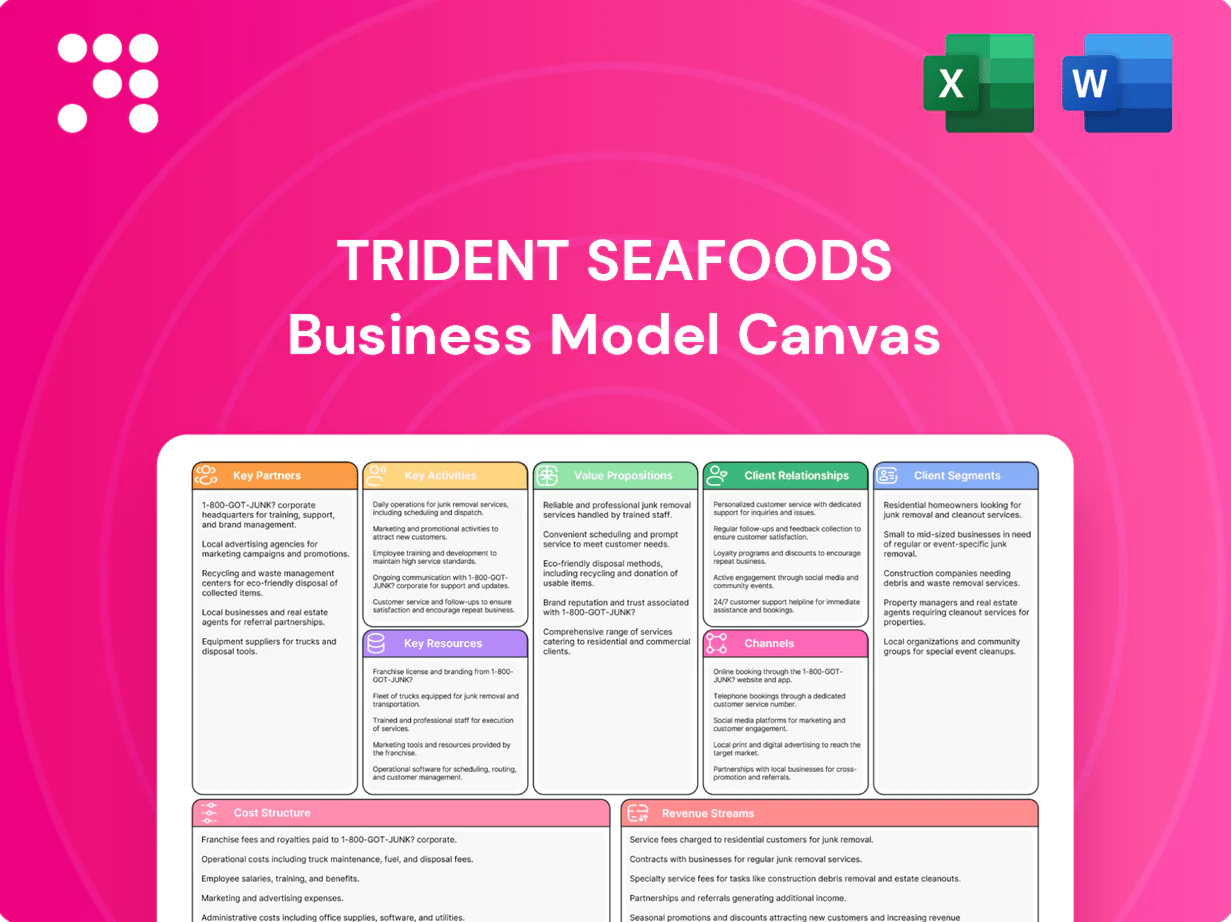
Trident Seafoods Business Model Canvas

Unlock seafood leader Business Model Canvas: 4 pillars from catch to consumer
Unlock Trident Seafoods’ strategic blueprint with our Business Model Canvas: four essential pillars reveal how it creates value from catch to consumer, scales operations, and protects margins amid supply volatility. Ideal for investors, strategists, and entrepreneurs seeking actionable, company-specific insights—download the full Canvas in Word & Excel for a section-by-section playbook.
Partnerships

Fishing cooperatives and quota holders
Partnerships with independent harvesters and quota holders ensure Trident Seafoods, the largest privately held seafood company in the US, secures access to key species and stabilizes raw-material supply.
Joint planning with cooperatives aligns catch timing to plant capacity, reducing seasonal bottlenecks and improving throughput.
Long-term agreements, often spanning 3–5 years, reduce price volatility and enhance forecasting for procurement and production.
Cooperative relationships support meeting sustainability and traceability standards required by major buyers and certification bodies.
Regulators and sustainability certifiers
Close ties with NOAA and state agencies plus certifications from MSC and RFM ensure Trident maintains legal compliance and eco-certifications, supporting science-based harvests and transparent reporting. MSC lists 460+ certified fisheries representing about 17% of wild catch in 2024, and certification often unlocks retailer access and documented 10–20% price premiums. Ongoing audits drive continuous improvement in fisheries management.

Cold-chain logistics and port services
Port operators, reefer carriers, and 3PLs preserve Trident Seafoods product integrity from sea to shelf by maintaining continuous refrigeration and handling protocols. Coordinated schedules between vessels and terminals minimize dwell time and temperature excursions, improving freshness and reducing spoilage. Strategic partners provide flexible seasonal capacity to match fishing cycles. Integrated tracking and temperature telemetry boost OTIF performance and traceability.

Retailers, foodservice distributors, and brokers
Channel partners—retailers, national foodservice distributors and brokers—enable Trident Seafoods to reach 50+ national chains and roughly 10,000 foodservice accounts, supporting category growth and national distribution in 2024; joint business planning aligns assortment, promotions and service levels while brokers extend coverage in regional markets.
- Data sharing tightens demand forecasting, cutting waste and supporting traceability
- Joint business planning drives SKU rationalization and promotional ROI
- Brokers expand regional penetration and fill service gaps
Processing, packaging, and technology suppliers
OEMs, packaging innovators, and software vendors drive yield, safety, and throughput—advanced packaging commonly cuts spoilage 15–25% and automation raises line throughput ~20%, while equipment partners deliver uptime targets above 95% and fund incremental line upgrades in 2024 investment cycles.
- OEMs: uptime >95%
- Packaging: spoilage −15–25%
- Software: EDI, traceability, inventory visibility
- Sustainable materials: compliance and brand uplift
Partnerships, MSC certification and logistics cut spoilage 15–25%
Partnerships with independent harvesters and quota holders secure species access and stabilize supply for Trident Seafoods, supporting year-round operations.
Long-term contracts (3–5 years), MSC/RFM certifications (460+ MSC fisheries; 17% wild catch in 2024) and NOAA collaboration reduce price/rego risk and unlock 10–20% retail premiums.
Logistics, OEMs and channel partners boost freshness, cut spoilage 15–25% and enable distribution to 50+ national chains and ~10,000 accounts.
| Metric | 2024 Value |
|---|---|
| MSC-certified fisheries | 460+ |
| Share of wild catch | 17% |
| Retail premium | 10–20% |
| Retail reach | 50+ chains |
| Foodservice accounts | ~10,000 |
What is included in the product
 Detailed Word Document
A comprehensive Business Model Canvas for Trident Seafoods covering customer segments, channels, value propositions, revenue streams, key activities, resources, partners, cost structure and customer relationships, reflecting real-world seafood harvesting, processing and distribution operations with SWOT and competitive-advantage analysis for investors and strategists.

 Customizable Excel Spreadsheet
Condenses Trident Seafoods’ complex vertically integrated seafood operations into an editable one-page canvas that quickly identifies supply-chain, sustainability, and market-channel bottlenecks. Ideal for teams needing a fast, shareable framework to align strategy, reduce operational friction, and accelerate decision-making.
Activities

Wild-capture harvesting operations
Trident deploys a mixed fleet targeting salmon, pollock, cod and crab under NOAA-managed quotas (2024 fisheries plans for Alaska groundfish and shellfish), with vessels enrolled in mandatory VMS and e-log programs. Rigorous skipper training and safety protocols reduce operational risk and downtime. Real-time catch and fuel telemetry optimize fishing effort and fuel use. Onboard cold-chain handling meets HACCP standards to preserve quality from first touch.
Processing and value-added production
Trident Seafoods' processing plants handle heading, gutting, filleting, freezing and cooked products across more than 20 facilities; the company reported roughly $2.8 billion in annual revenue in 2023 and maintained high-volume output into 2024. Lean workflows focus on yield and throughput improvements, targeting mid-single-digit yield gains. HACCP systems and onsite QA labs ensure food safety and traceability. Product customization meets retailer and foodservice specifications.

Supply chain and cold-chain management
Integrated planning coordinates Trident Seafoods vessels, shore plants and refrigerated transport across Alaska and the Pacific Northwest, aligning harvest schedules with processing capacity to reduce downtime. Temperature control is monitored from deck to delivery with continuous loggers and HACCP protocols to protect product integrity. Inventory optimization balances freshness and service levels through FIFO and cold storage staging. Seasonal capacity shifts in Alaska fisheries are managed proactively via contract fleets and temporary staffing.

Sales, category management, and marketing
Account teams build retailer and distributor programs that align merchandising, promotions and supply; Trident, the largest vertically integrated seafood company in the US with over 4,000 employees, leverages these relationships to scale launches.
Insights on category, pricing and promotions drive assortments; brand and private-label strategies run in parallel while trade marketing supports new-product rollouts and menu adoption.
- account-programs
- assortment-insights
- brand+private-label
- trade-marketing
Sustainability, compliance, and certifications
Trident Seafoods maintains chain-of-custody and third-party certifications (MSC, BAP, ASC) through rigorous documentation, regular audits, and electronic traceability systems to ensure compliant sourcing and processing. Bycatch-reduction technologies and waste-to-value initiatives reduce environmental impact while improving product yields. Transparent stakeholder reporting via annual sustainability disclosures builds buyer trust and supports market access as standards evolve.
- Documentation: certified chain-of-custody (MSC, BAP, ASC)
- Audits: regular third-party and internal reviews
- Bycatch & waste: reduction and valorization programs
- Reporting: annual sustainability disclosures
- Continuous improvement: alignment with evolving standards
Alaska seafood operator — $2.8B 2023, 20+ plants, MSC/BAP/ASC-certified
Trident operates a mixed Alaska fleet and 20+ processing plants, aligning NOAA-quota harvests with shore capacity via VMS/e-log telemetry and HACCP cold-chain controls to protect quality. 2023 revenue was about $2.8B and the company employed ~4,000; lean yield programs target mid-single-digit gains. Certifications include MSC, BAP and ASC with regular audits and sustainability reporting into 2024.
| Metric | Value |
|---|---|
| 2023 Revenue | $2.8B |
| Employees | ~4,000 |
| Processing sites | 20+ |
| Yield target | mid-single-digit % |
Full Version Awaits
Business Model Canvas
The preview you see is the actual Trident Seafoods Business Model Canvas, not a mockup or sample. When you complete your purchase, you’ll receive this exact file with all content and pages included. The final deliverable is ready-to-edit and formatted the same way for immediate use.

Unlock seafood leader Business Model Canvas: 4 pillars from catch to consumer
Unlock Trident Seafoods’ strategic blueprint with our Business Model Canvas: four essential pillars reveal how it creates value from catch to consumer, scales operations, and protects margins amid supply volatility. Ideal for investors, strategists, and entrepreneurs seeking actionable, company-specific insights—download the full Canvas in Word & Excel for a section-by-section playbook.
Partnerships
Fishing cooperatives and quota holders
Partnerships with independent harvesters and quota holders ensure Trident Seafoods, the largest privately held seafood company in the US, secures access to key species and stabilizes raw-material supply.
Joint planning with cooperatives aligns catch timing to plant capacity, reducing seasonal bottlenecks and improving throughput.
Long-term agreements, often spanning 3–5 years, reduce price volatility and enhance forecasting for procurement and production.
Cooperative relationships support meeting sustainability and traceability standards required by major buyers and certification bodies.
Regulators and sustainability certifiers
Close ties with NOAA and state agencies plus certifications from MSC and RFM ensure Trident maintains legal compliance and eco-certifications, supporting science-based harvests and transparent reporting. MSC lists 460+ certified fisheries representing about 17% of wild catch in 2024, and certification often unlocks retailer access and documented 10–20% price premiums. Ongoing audits drive continuous improvement in fisheries management.
Cold-chain logistics and port services
Port operators, reefer carriers, and 3PLs preserve Trident Seafoods product integrity from sea to shelf by maintaining continuous refrigeration and handling protocols. Coordinated schedules between vessels and terminals minimize dwell time and temperature excursions, improving freshness and reducing spoilage. Strategic partners provide flexible seasonal capacity to match fishing cycles. Integrated tracking and temperature telemetry boost OTIF performance and traceability.
Retailers, foodservice distributors, and brokers
Channel partners—retailers, national foodservice distributors and brokers—enable Trident Seafoods to reach 50+ national chains and roughly 10,000 foodservice accounts, supporting category growth and national distribution in 2024; joint business planning aligns assortment, promotions and service levels while brokers extend coverage in regional markets.
- Data sharing tightens demand forecasting, cutting waste and supporting traceability
- Joint business planning drives SKU rationalization and promotional ROI
- Brokers expand regional penetration and fill service gaps
Processing, packaging, and technology suppliers
OEMs, packaging innovators, and software vendors drive yield, safety, and throughput—advanced packaging commonly cuts spoilage 15–25% and automation raises line throughput ~20%, while equipment partners deliver uptime targets above 95% and fund incremental line upgrades in 2024 investment cycles.
- OEMs: uptime >95%
- Packaging: spoilage −15–25%
- Software: EDI, traceability, inventory visibility
- Sustainable materials: compliance and brand uplift
Partnerships, MSC certification and logistics cut spoilage 15–25%
Partnerships with independent harvesters and quota holders secure species access and stabilize supply for Trident Seafoods, supporting year-round operations.
Long-term contracts (3–5 years), MSC/RFM certifications (460+ MSC fisheries; 17% wild catch in 2024) and NOAA collaboration reduce price/rego risk and unlock 10–20% retail premiums.
Logistics, OEMs and channel partners boost freshness, cut spoilage 15–25% and enable distribution to 50+ national chains and ~10,000 accounts.
| Metric | 2024 Value |
|---|---|
| MSC-certified fisheries | 460+ |
| Share of wild catch | 17% |
| Retail premium | 10–20% |
| Retail reach | 50+ chains |
| Foodservice accounts | ~10,000 |
What is included in the product
Detailed Word Document
A comprehensive Business Model Canvas for Trident Seafoods covering customer segments, channels, value propositions, revenue streams, key activities, resources, partners, cost structure and customer relationships, reflecting real-world seafood harvesting, processing and distribution operations with SWOT and competitive-advantage analysis for investors and strategists.
Customizable Excel Spreadsheet
Condenses Trident Seafoods’ complex vertically integrated seafood operations into an editable one-page canvas that quickly identifies supply-chain, sustainability, and market-channel bottlenecks. Ideal for teams needing a fast, shareable framework to align strategy, reduce operational friction, and accelerate decision-making.
Activities
Wild-capture harvesting operations
Trident deploys a mixed fleet targeting salmon, pollock, cod and crab under NOAA-managed quotas (2024 fisheries plans for Alaska groundfish and shellfish), with vessels enrolled in mandatory VMS and e-log programs. Rigorous skipper training and safety protocols reduce operational risk and downtime. Real-time catch and fuel telemetry optimize fishing effort and fuel use. Onboard cold-chain handling meets HACCP standards to preserve quality from first touch.
Processing and value-added production
Trident Seafoods' processing plants handle heading, gutting, filleting, freezing and cooked products across more than 20 facilities; the company reported roughly $2.8 billion in annual revenue in 2023 and maintained high-volume output into 2024. Lean workflows focus on yield and throughput improvements, targeting mid-single-digit yield gains. HACCP systems and onsite QA labs ensure food safety and traceability. Product customization meets retailer and foodservice specifications.
Supply chain and cold-chain management
Integrated planning coordinates Trident Seafoods vessels, shore plants and refrigerated transport across Alaska and the Pacific Northwest, aligning harvest schedules with processing capacity to reduce downtime. Temperature control is monitored from deck to delivery with continuous loggers and HACCP protocols to protect product integrity. Inventory optimization balances freshness and service levels through FIFO and cold storage staging. Seasonal capacity shifts in Alaska fisheries are managed proactively via contract fleets and temporary staffing.
Sales, category management, and marketing
Account teams build retailer and distributor programs that align merchandising, promotions and supply; Trident, the largest vertically integrated seafood company in the US with over 4,000 employees, leverages these relationships to scale launches.
Insights on category, pricing and promotions drive assortments; brand and private-label strategies run in parallel while trade marketing supports new-product rollouts and menu adoption.
- account-programs
- assortment-insights
- brand+private-label
- trade-marketing
Sustainability, compliance, and certifications
Trident Seafoods maintains chain-of-custody and third-party certifications (MSC, BAP, ASC) through rigorous documentation, regular audits, and electronic traceability systems to ensure compliant sourcing and processing. Bycatch-reduction technologies and waste-to-value initiatives reduce environmental impact while improving product yields. Transparent stakeholder reporting via annual sustainability disclosures builds buyer trust and supports market access as standards evolve.
- Documentation: certified chain-of-custody (MSC, BAP, ASC)
- Audits: regular third-party and internal reviews
- Bycatch & waste: reduction and valorization programs
- Reporting: annual sustainability disclosures
- Continuous improvement: alignment with evolving standards
Alaska seafood operator — $2.8B 2023, 20+ plants, MSC/BAP/ASC-certified
Trident operates a mixed Alaska fleet and 20+ processing plants, aligning NOAA-quota harvests with shore capacity via VMS/e-log telemetry and HACCP cold-chain controls to protect quality. 2023 revenue was about $2.8B and the company employed ~4,000; lean yield programs target mid-single-digit gains. Certifications include MSC, BAP and ASC with regular audits and sustainability reporting into 2024.
| Metric | Value |
|---|---|
| 2023 Revenue | $2.8B |
| Employees | ~4,000 |
| Processing sites | 20+ |
| Yield target | mid-single-digit % |
Full Version Awaits
Business Model Canvas
The preview you see is the actual Trident Seafoods Business Model Canvas, not a mockup or sample. When you complete your purchase, you’ll receive this exact file with all content and pages included. The final deliverable is ready-to-edit and formatted the same way for immediate use.
Original: $10.00
-65%$10.00
$3.50Description
Unlock seafood leader Business Model Canvas: 4 pillars from catch to consumer
Unlock Trident Seafoods’ strategic blueprint with our Business Model Canvas: four essential pillars reveal how it creates value from catch to consumer, scales operations, and protects margins amid supply volatility. Ideal for investors, strategists, and entrepreneurs seeking actionable, company-specific insights—download the full Canvas in Word & Excel for a section-by-section playbook.
Partnerships
Fishing cooperatives and quota holders
Partnerships with independent harvesters and quota holders ensure Trident Seafoods, the largest privately held seafood company in the US, secures access to key species and stabilizes raw-material supply.
Joint planning with cooperatives aligns catch timing to plant capacity, reducing seasonal bottlenecks and improving throughput.
Long-term agreements, often spanning 3–5 years, reduce price volatility and enhance forecasting for procurement and production.
Cooperative relationships support meeting sustainability and traceability standards required by major buyers and certification bodies.
Regulators and sustainability certifiers
Close ties with NOAA and state agencies plus certifications from MSC and RFM ensure Trident maintains legal compliance and eco-certifications, supporting science-based harvests and transparent reporting. MSC lists 460+ certified fisheries representing about 17% of wild catch in 2024, and certification often unlocks retailer access and documented 10–20% price premiums. Ongoing audits drive continuous improvement in fisheries management.
Cold-chain logistics and port services
Port operators, reefer carriers, and 3PLs preserve Trident Seafoods product integrity from sea to shelf by maintaining continuous refrigeration and handling protocols. Coordinated schedules between vessels and terminals minimize dwell time and temperature excursions, improving freshness and reducing spoilage. Strategic partners provide flexible seasonal capacity to match fishing cycles. Integrated tracking and temperature telemetry boost OTIF performance and traceability.
Retailers, foodservice distributors, and brokers
Channel partners—retailers, national foodservice distributors and brokers—enable Trident Seafoods to reach 50+ national chains and roughly 10,000 foodservice accounts, supporting category growth and national distribution in 2024; joint business planning aligns assortment, promotions and service levels while brokers extend coverage in regional markets.
- Data sharing tightens demand forecasting, cutting waste and supporting traceability
- Joint business planning drives SKU rationalization and promotional ROI
- Brokers expand regional penetration and fill service gaps
Processing, packaging, and technology suppliers
OEMs, packaging innovators, and software vendors drive yield, safety, and throughput—advanced packaging commonly cuts spoilage 15–25% and automation raises line throughput ~20%, while equipment partners deliver uptime targets above 95% and fund incremental line upgrades in 2024 investment cycles.
- OEMs: uptime >95%
- Packaging: spoilage −15–25%
- Software: EDI, traceability, inventory visibility
- Sustainable materials: compliance and brand uplift
Partnerships, MSC certification and logistics cut spoilage 15–25%
Partnerships with independent harvesters and quota holders secure species access and stabilize supply for Trident Seafoods, supporting year-round operations.
Long-term contracts (3–5 years), MSC/RFM certifications (460+ MSC fisheries; 17% wild catch in 2024) and NOAA collaboration reduce price/rego risk and unlock 10–20% retail premiums.
Logistics, OEMs and channel partners boost freshness, cut spoilage 15–25% and enable distribution to 50+ national chains and ~10,000 accounts.
| Metric | 2024 Value |
|---|---|
| MSC-certified fisheries | 460+ |
| Share of wild catch | 17% |
| Retail premium | 10–20% |
| Retail reach | 50+ chains |
| Foodservice accounts | ~10,000 |
What is included in the product
Detailed Word Document
A comprehensive Business Model Canvas for Trident Seafoods covering customer segments, channels, value propositions, revenue streams, key activities, resources, partners, cost structure and customer relationships, reflecting real-world seafood harvesting, processing and distribution operations with SWOT and competitive-advantage analysis for investors and strategists.
Customizable Excel Spreadsheet
Condenses Trident Seafoods’ complex vertically integrated seafood operations into an editable one-page canvas that quickly identifies supply-chain, sustainability, and market-channel bottlenecks. Ideal for teams needing a fast, shareable framework to align strategy, reduce operational friction, and accelerate decision-making.
Activities
Wild-capture harvesting operations
Trident deploys a mixed fleet targeting salmon, pollock, cod and crab under NOAA-managed quotas (2024 fisheries plans for Alaska groundfish and shellfish), with vessels enrolled in mandatory VMS and e-log programs. Rigorous skipper training and safety protocols reduce operational risk and downtime. Real-time catch and fuel telemetry optimize fishing effort and fuel use. Onboard cold-chain handling meets HACCP standards to preserve quality from first touch.
Processing and value-added production
Trident Seafoods' processing plants handle heading, gutting, filleting, freezing and cooked products across more than 20 facilities; the company reported roughly $2.8 billion in annual revenue in 2023 and maintained high-volume output into 2024. Lean workflows focus on yield and throughput improvements, targeting mid-single-digit yield gains. HACCP systems and onsite QA labs ensure food safety and traceability. Product customization meets retailer and foodservice specifications.
Supply chain and cold-chain management
Integrated planning coordinates Trident Seafoods vessels, shore plants and refrigerated transport across Alaska and the Pacific Northwest, aligning harvest schedules with processing capacity to reduce downtime. Temperature control is monitored from deck to delivery with continuous loggers and HACCP protocols to protect product integrity. Inventory optimization balances freshness and service levels through FIFO and cold storage staging. Seasonal capacity shifts in Alaska fisheries are managed proactively via contract fleets and temporary staffing.
Sales, category management, and marketing
Account teams build retailer and distributor programs that align merchandising, promotions and supply; Trident, the largest vertically integrated seafood company in the US with over 4,000 employees, leverages these relationships to scale launches.
Insights on category, pricing and promotions drive assortments; brand and private-label strategies run in parallel while trade marketing supports new-product rollouts and menu adoption.
- account-programs
- assortment-insights
- brand+private-label
- trade-marketing
Sustainability, compliance, and certifications
Trident Seafoods maintains chain-of-custody and third-party certifications (MSC, BAP, ASC) through rigorous documentation, regular audits, and electronic traceability systems to ensure compliant sourcing and processing. Bycatch-reduction technologies and waste-to-value initiatives reduce environmental impact while improving product yields. Transparent stakeholder reporting via annual sustainability disclosures builds buyer trust and supports market access as standards evolve.
- Documentation: certified chain-of-custody (MSC, BAP, ASC)
- Audits: regular third-party and internal reviews
- Bycatch & waste: reduction and valorization programs
- Reporting: annual sustainability disclosures
- Continuous improvement: alignment with evolving standards
Alaska seafood operator — $2.8B 2023, 20+ plants, MSC/BAP/ASC-certified
Trident operates a mixed Alaska fleet and 20+ processing plants, aligning NOAA-quota harvests with shore capacity via VMS/e-log telemetry and HACCP cold-chain controls to protect quality. 2023 revenue was about $2.8B and the company employed ~4,000; lean yield programs target mid-single-digit gains. Certifications include MSC, BAP and ASC with regular audits and sustainability reporting into 2024.
| Metric | Value |
|---|---|
| 2023 Revenue | $2.8B |
| Employees | ~4,000 |
| Processing sites | 20+ |
| Yield target | mid-single-digit % |
Full Version Awaits
Business Model Canvas
The preview you see is the actual Trident Seafoods Business Model Canvas, not a mockup or sample. When you complete your purchase, you’ll receive this exact file with all content and pages included. The final deliverable is ready-to-edit and formatted the same way for immediate use.











