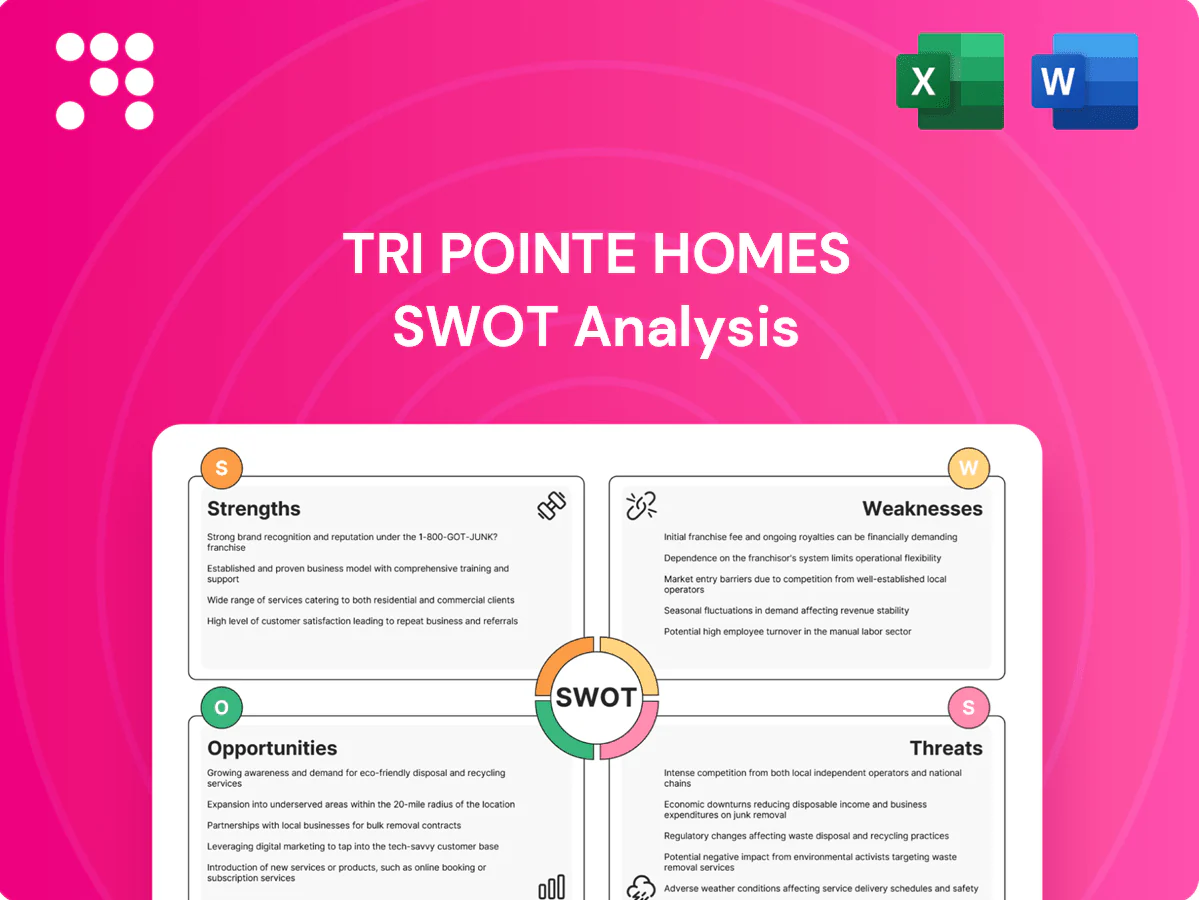
Tri Pointe Homes SWOT Analysis

Make Insightful Decisions Backed by Expert Research
Tri Pointe Homes benefits from regional demand and a diversified product mix but faces margin pressure from rising construction costs and interest-rate sensitivity. Opportunities in urban infill, energy-efficient homes, and strategic land buys contrast with risks from supply-chain volatility and competitive pricing. Execution on land strategy and cost control will determine growth. Discover the complete picture behind the company’s market position with our full SWOT analysis.
Strengths

Diverse product mix
Tri Pointe offers single-family and townhomes across multiple price points, typically ranging from the low-300s to over 1 million in select markets, attracting first-time, move-up and luxury buyers. This product diversity smooths demand across cycles and lets the company pivot toward faster-selling segments. Broader appeal supports stronger absorption rates and pricing leverage in varied geographies.
Geographic footprint
Tri Pointe Homes operates across multiple high-growth U.S. metros (as of 2024), reducing reliance on any single market and supporting geographic diversification. Its presence in job-rich, supply-constrained regions sustains steady demand and price resiliency. Market diversity helps offset localized regulatory or economic shocks. The company’s land strategy is tailored to local cycles, enabling phased acquisitions and community-specific pricing.

Mortgage JV advantage
Tri Pointe Connect streamlines buyer financing and improves conversion by offering coordinated incentives and rate buydowns, helping sustain sales pace; the JV structure limits balance-sheet mortgage exposure while enhancing customer experience and supporting higher capture rates that improve backlog quality and revenue visibility.

Scale and sourcing
Tri Pointe leverages meaningful purchasing scale with trade partners to lower direct construction costs, while standardized plans and options shorten build cycles, improving cash turns and ROIC and reinforcing marketing reach and brand recognition.
- Scale lowers construction unit costs
- Standardization speeds cycle times
- Faster cycles boost cash turns
- Scale amplifies brand reach
Brand and design focus
Tri Pointe Homes' reputation for contemporary design and build quality supports pricing power and higher ASPs, while high customer satisfaction fuels referrals and faster community velocity. Distinctive elevations and option packages limit direct price competition and improve margin retention. Strong brand equity consistently strengthens community launches and pre-sale absorption.
- Design-driven premiums
- Referral-led velocity
- Lower price competition
- Stronger presales
From 300s to 1,000,000, multi-metro reach boosts sales
Tri Pointe offers homes from the low-300s to over 1 million, diversifying demand across first-time to luxury buyers and improving absorption and pricing power. Geographic footprint across multiple high-growth U.S. metros (as of 2024) reduces market concentration and supports resilience. Tri Pointe Connect and standardized plans accelerate sales conversion, shorten build cycles and enhance cash turns and margins.
| Metric | Detail |
|---|---|
| Price range | low-300s to >1,000,000 |
| Geography | Multiple high-growth U.S. metros (as of 2024) |
| Sales platform | Tri Pointe Connect (JV) |
| Operational edge | Standardized plans, purchasing scale |
What is included in the product
 Detailed Word Document
Delivers a strategic overview of Tri Pointe Homes’s internal and external business factors, outlining strengths, weaknesses, opportunities, and threats to assess its competitive position, growth drivers, operational gaps, and market risks shaping the company's future.

 Customizable Excel Spreadsheet
Provides a concise SWOT matrix tailored to Tri Pointe Homes to quickly surface strengths, weaknesses, opportunities, and threats for faster risk mitigation and strategic alignment. Editable format lets teams update assumptions (land costs, supply chain, demand) rapidly to relieve planning bottlenecks.
Weaknesses

Rate sensitivity
High dependence on mortgage affordability leaves Tri Pointe sales vulnerable as Freddie Mac 30-year fixed rates hovered around 6.5–7% in 2024–25, where even small rate moves shrink qualified buyer pools and force incentives. Financing-sensitive first-time buyers are likelier to cancel deposits at higher rates, raising cancellation risk. Volatile rates pressure gross margins and slow backlog conversions, increasing carrying costs and unit-level risk.
Land intensity
Land intensity ties up capital for Tri Pointe Homes (NYSE: TPH), increasing impairment risk if a downturn reduces lot values. Timing errors on entitlements or takedowns compress returns and magnify exposure. Holding costs erode margins when absorption slows, and market turns can strand lots or force discounting to maintain cash flow.

Subcontractor reliance
Heavy reliance on subcontractors leaves Tri Pointe Homes' build schedules vulnerable to labor availability; construction employment was about 7.6 million in 2024 per BLS, highlighting tight supply. Ongoing tight labor markets drive cost inflation and variability in workmanship, increasing unit build costs and quality risk. Limited control over subs raises warranty claims exposure and schedule slippage harms customer satisfaction and cash flow.

Regional concentration
Despite a multi-market footprint, Tri Pointe remains regionally concentrated versus mega-cap builders, leaving it vulnerable to local economic shocks or policy shifts that can materially affect results; smaller scale in several metros limits bargaining power with suppliers and land sellers, and its diversification benefits can be uneven across housing cycles.
- Concentration vs peers
- Localized policy risk
- Weaker procurement leverage
- Uneven cycle diversification
Margin volatility
Incentives, repricing and input-cost swings can sharply compress Tri Pointe Homes gross margins, with community mix shifts diluting average selling prices and amplifying sensitivity to market promotions. Fixed overhead burdens magnify the impact of volume declines, so profitability varies significantly by phase of the housing cycle.
- Incentives pressure margins
- Community mix dilutes ASP
- Input-cost volatility
- Fixed overhead amplifies downturns
High mortgage rates 6.5–7% shrink buyer pools; land-heavy builds raise carrying and schedule risk
High mortgage rates (Freddie Mac 30-yr ~6.5–7% in 2024–25) shrink buyer pools, force incentives and pressure cancellations. Land-intense model ties capital to lot values, raising impairment and carrying-cost risk if absorption slows. Heavy subcontractor reliance amid 2024 construction employment ~7.6M (BLS) drives cost/quality variability and schedule risk.
| Metric | 2024/25 |
|---|---|
| 30-yr mortgage | ~6.5–7% |
| Construction employment (BLS) | ~7.6M |
| Ticker | TPH |
Full Version Awaits
Tri Pointe Homes SWOT Analysis
This is the actual Tri Pointe Homes SWOT analysis document you’ll receive upon purchase—no surprises, just professional quality. The preview below is taken directly from the full report you'll get. Buy now to unlock the complete, editable version.

Make Insightful Decisions Backed by Expert Research
Tri Pointe Homes benefits from regional demand and a diversified product mix but faces margin pressure from rising construction costs and interest-rate sensitivity. Opportunities in urban infill, energy-efficient homes, and strategic land buys contrast with risks from supply-chain volatility and competitive pricing. Execution on land strategy and cost control will determine growth. Discover the complete picture behind the company’s market position with our full SWOT analysis.
Strengths
Diverse product mix
Tri Pointe offers single-family and townhomes across multiple price points, typically ranging from the low-300s to over 1 million in select markets, attracting first-time, move-up and luxury buyers. This product diversity smooths demand across cycles and lets the company pivot toward faster-selling segments. Broader appeal supports stronger absorption rates and pricing leverage in varied geographies.
Geographic footprint
Tri Pointe Homes operates across multiple high-growth U.S. metros (as of 2024), reducing reliance on any single market and supporting geographic diversification. Its presence in job-rich, supply-constrained regions sustains steady demand and price resiliency. Market diversity helps offset localized regulatory or economic shocks. The company’s land strategy is tailored to local cycles, enabling phased acquisitions and community-specific pricing.
Mortgage JV advantage
Tri Pointe Connect streamlines buyer financing and improves conversion by offering coordinated incentives and rate buydowns, helping sustain sales pace; the JV structure limits balance-sheet mortgage exposure while enhancing customer experience and supporting higher capture rates that improve backlog quality and revenue visibility.
Scale and sourcing
Tri Pointe leverages meaningful purchasing scale with trade partners to lower direct construction costs, while standardized plans and options shorten build cycles, improving cash turns and ROIC and reinforcing marketing reach and brand recognition.
- Scale lowers construction unit costs
- Standardization speeds cycle times
- Faster cycles boost cash turns
- Scale amplifies brand reach
Brand and design focus
Tri Pointe Homes' reputation for contemporary design and build quality supports pricing power and higher ASPs, while high customer satisfaction fuels referrals and faster community velocity. Distinctive elevations and option packages limit direct price competition and improve margin retention. Strong brand equity consistently strengthens community launches and pre-sale absorption.
- Design-driven premiums
- Referral-led velocity
- Lower price competition
- Stronger presales
From 300s to 1,000,000, multi-metro reach boosts sales
Tri Pointe offers homes from the low-300s to over 1 million, diversifying demand across first-time to luxury buyers and improving absorption and pricing power. Geographic footprint across multiple high-growth U.S. metros (as of 2024) reduces market concentration and supports resilience. Tri Pointe Connect and standardized plans accelerate sales conversion, shorten build cycles and enhance cash turns and margins.
| Metric | Detail |
|---|---|
| Price range | low-300s to >1,000,000 |
| Geography | Multiple high-growth U.S. metros (as of 2024) |
| Sales platform | Tri Pointe Connect (JV) |
| Operational edge | Standardized plans, purchasing scale |
What is included in the product
Detailed Word Document
Delivers a strategic overview of Tri Pointe Homes’s internal and external business factors, outlining strengths, weaknesses, opportunities, and threats to assess its competitive position, growth drivers, operational gaps, and market risks shaping the company's future.
Customizable Excel Spreadsheet
Provides a concise SWOT matrix tailored to Tri Pointe Homes to quickly surface strengths, weaknesses, opportunities, and threats for faster risk mitigation and strategic alignment. Editable format lets teams update assumptions (land costs, supply chain, demand) rapidly to relieve planning bottlenecks.
Weaknesses
Rate sensitivity
High dependence on mortgage affordability leaves Tri Pointe sales vulnerable as Freddie Mac 30-year fixed rates hovered around 6.5–7% in 2024–25, where even small rate moves shrink qualified buyer pools and force incentives. Financing-sensitive first-time buyers are likelier to cancel deposits at higher rates, raising cancellation risk. Volatile rates pressure gross margins and slow backlog conversions, increasing carrying costs and unit-level risk.
Land intensity
Land intensity ties up capital for Tri Pointe Homes (NYSE: TPH), increasing impairment risk if a downturn reduces lot values. Timing errors on entitlements or takedowns compress returns and magnify exposure. Holding costs erode margins when absorption slows, and market turns can strand lots or force discounting to maintain cash flow.
Subcontractor reliance
Heavy reliance on subcontractors leaves Tri Pointe Homes' build schedules vulnerable to labor availability; construction employment was about 7.6 million in 2024 per BLS, highlighting tight supply. Ongoing tight labor markets drive cost inflation and variability in workmanship, increasing unit build costs and quality risk. Limited control over subs raises warranty claims exposure and schedule slippage harms customer satisfaction and cash flow.
Regional concentration
Despite a multi-market footprint, Tri Pointe remains regionally concentrated versus mega-cap builders, leaving it vulnerable to local economic shocks or policy shifts that can materially affect results; smaller scale in several metros limits bargaining power with suppliers and land sellers, and its diversification benefits can be uneven across housing cycles.
- Concentration vs peers
- Localized policy risk
- Weaker procurement leverage
- Uneven cycle diversification
Margin volatility
Incentives, repricing and input-cost swings can sharply compress Tri Pointe Homes gross margins, with community mix shifts diluting average selling prices and amplifying sensitivity to market promotions. Fixed overhead burdens magnify the impact of volume declines, so profitability varies significantly by phase of the housing cycle.
- Incentives pressure margins
- Community mix dilutes ASP
- Input-cost volatility
- Fixed overhead amplifies downturns
High mortgage rates 6.5–7% shrink buyer pools; land-heavy builds raise carrying and schedule risk
High mortgage rates (Freddie Mac 30-yr ~6.5–7% in 2024–25) shrink buyer pools, force incentives and pressure cancellations. Land-intense model ties capital to lot values, raising impairment and carrying-cost risk if absorption slows. Heavy subcontractor reliance amid 2024 construction employment ~7.6M (BLS) drives cost/quality variability and schedule risk.
| Metric | 2024/25 |
|---|---|
| 30-yr mortgage | ~6.5–7% |
| Construction employment (BLS) | ~7.6M |
| Ticker | TPH |
Full Version Awaits
Tri Pointe Homes SWOT Analysis
This is the actual Tri Pointe Homes SWOT analysis document you’ll receive upon purchase—no surprises, just professional quality. The preview below is taken directly from the full report you'll get. Buy now to unlock the complete, editable version.
Original: $10.00
-65%$10.00
$3.50Description
Make Insightful Decisions Backed by Expert Research
Tri Pointe Homes benefits from regional demand and a diversified product mix but faces margin pressure from rising construction costs and interest-rate sensitivity. Opportunities in urban infill, energy-efficient homes, and strategic land buys contrast with risks from supply-chain volatility and competitive pricing. Execution on land strategy and cost control will determine growth. Discover the complete picture behind the company’s market position with our full SWOT analysis.
Strengths
Diverse product mix
Tri Pointe offers single-family and townhomes across multiple price points, typically ranging from the low-300s to over 1 million in select markets, attracting first-time, move-up and luxury buyers. This product diversity smooths demand across cycles and lets the company pivot toward faster-selling segments. Broader appeal supports stronger absorption rates and pricing leverage in varied geographies.
Geographic footprint
Tri Pointe Homes operates across multiple high-growth U.S. metros (as of 2024), reducing reliance on any single market and supporting geographic diversification. Its presence in job-rich, supply-constrained regions sustains steady demand and price resiliency. Market diversity helps offset localized regulatory or economic shocks. The company’s land strategy is tailored to local cycles, enabling phased acquisitions and community-specific pricing.
Mortgage JV advantage
Tri Pointe Connect streamlines buyer financing and improves conversion by offering coordinated incentives and rate buydowns, helping sustain sales pace; the JV structure limits balance-sheet mortgage exposure while enhancing customer experience and supporting higher capture rates that improve backlog quality and revenue visibility.
Scale and sourcing
Tri Pointe leverages meaningful purchasing scale with trade partners to lower direct construction costs, while standardized plans and options shorten build cycles, improving cash turns and ROIC and reinforcing marketing reach and brand recognition.
- Scale lowers construction unit costs
- Standardization speeds cycle times
- Faster cycles boost cash turns
- Scale amplifies brand reach
Brand and design focus
Tri Pointe Homes' reputation for contemporary design and build quality supports pricing power and higher ASPs, while high customer satisfaction fuels referrals and faster community velocity. Distinctive elevations and option packages limit direct price competition and improve margin retention. Strong brand equity consistently strengthens community launches and pre-sale absorption.
- Design-driven premiums
- Referral-led velocity
- Lower price competition
- Stronger presales
From 300s to 1,000,000, multi-metro reach boosts sales
Tri Pointe offers homes from the low-300s to over 1 million, diversifying demand across first-time to luxury buyers and improving absorption and pricing power. Geographic footprint across multiple high-growth U.S. metros (as of 2024) reduces market concentration and supports resilience. Tri Pointe Connect and standardized plans accelerate sales conversion, shorten build cycles and enhance cash turns and margins.
| Metric | Detail |
|---|---|
| Price range | low-300s to >1,000,000 |
| Geography | Multiple high-growth U.S. metros (as of 2024) |
| Sales platform | Tri Pointe Connect (JV) |
| Operational edge | Standardized plans, purchasing scale |
What is included in the product
Detailed Word Document
Delivers a strategic overview of Tri Pointe Homes’s internal and external business factors, outlining strengths, weaknesses, opportunities, and threats to assess its competitive position, growth drivers, operational gaps, and market risks shaping the company's future.
Customizable Excel Spreadsheet
Provides a concise SWOT matrix tailored to Tri Pointe Homes to quickly surface strengths, weaknesses, opportunities, and threats for faster risk mitigation and strategic alignment. Editable format lets teams update assumptions (land costs, supply chain, demand) rapidly to relieve planning bottlenecks.
Weaknesses
Rate sensitivity
High dependence on mortgage affordability leaves Tri Pointe sales vulnerable as Freddie Mac 30-year fixed rates hovered around 6.5–7% in 2024–25, where even small rate moves shrink qualified buyer pools and force incentives. Financing-sensitive first-time buyers are likelier to cancel deposits at higher rates, raising cancellation risk. Volatile rates pressure gross margins and slow backlog conversions, increasing carrying costs and unit-level risk.
Land intensity
Land intensity ties up capital for Tri Pointe Homes (NYSE: TPH), increasing impairment risk if a downturn reduces lot values. Timing errors on entitlements or takedowns compress returns and magnify exposure. Holding costs erode margins when absorption slows, and market turns can strand lots or force discounting to maintain cash flow.
Subcontractor reliance
Heavy reliance on subcontractors leaves Tri Pointe Homes' build schedules vulnerable to labor availability; construction employment was about 7.6 million in 2024 per BLS, highlighting tight supply. Ongoing tight labor markets drive cost inflation and variability in workmanship, increasing unit build costs and quality risk. Limited control over subs raises warranty claims exposure and schedule slippage harms customer satisfaction and cash flow.
Regional concentration
Despite a multi-market footprint, Tri Pointe remains regionally concentrated versus mega-cap builders, leaving it vulnerable to local economic shocks or policy shifts that can materially affect results; smaller scale in several metros limits bargaining power with suppliers and land sellers, and its diversification benefits can be uneven across housing cycles.
- Concentration vs peers
- Localized policy risk
- Weaker procurement leverage
- Uneven cycle diversification
Margin volatility
Incentives, repricing and input-cost swings can sharply compress Tri Pointe Homes gross margins, with community mix shifts diluting average selling prices and amplifying sensitivity to market promotions. Fixed overhead burdens magnify the impact of volume declines, so profitability varies significantly by phase of the housing cycle.
- Incentives pressure margins
- Community mix dilutes ASP
- Input-cost volatility
- Fixed overhead amplifies downturns
High mortgage rates 6.5–7% shrink buyer pools; land-heavy builds raise carrying and schedule risk
High mortgage rates (Freddie Mac 30-yr ~6.5–7% in 2024–25) shrink buyer pools, force incentives and pressure cancellations. Land-intense model ties capital to lot values, raising impairment and carrying-cost risk if absorption slows. Heavy subcontractor reliance amid 2024 construction employment ~7.6M (BLS) drives cost/quality variability and schedule risk.
| Metric | 2024/25 |
|---|---|
| 30-yr mortgage | ~6.5–7% |
| Construction employment (BLS) | ~7.6M |
| Ticker | TPH |
Full Version Awaits
Tri Pointe Homes SWOT Analysis
This is the actual Tri Pointe Homes SWOT analysis document you’ll receive upon purchase—no surprises, just professional quality. The preview below is taken directly from the full report you'll get. Buy now to unlock the complete, editable version.











