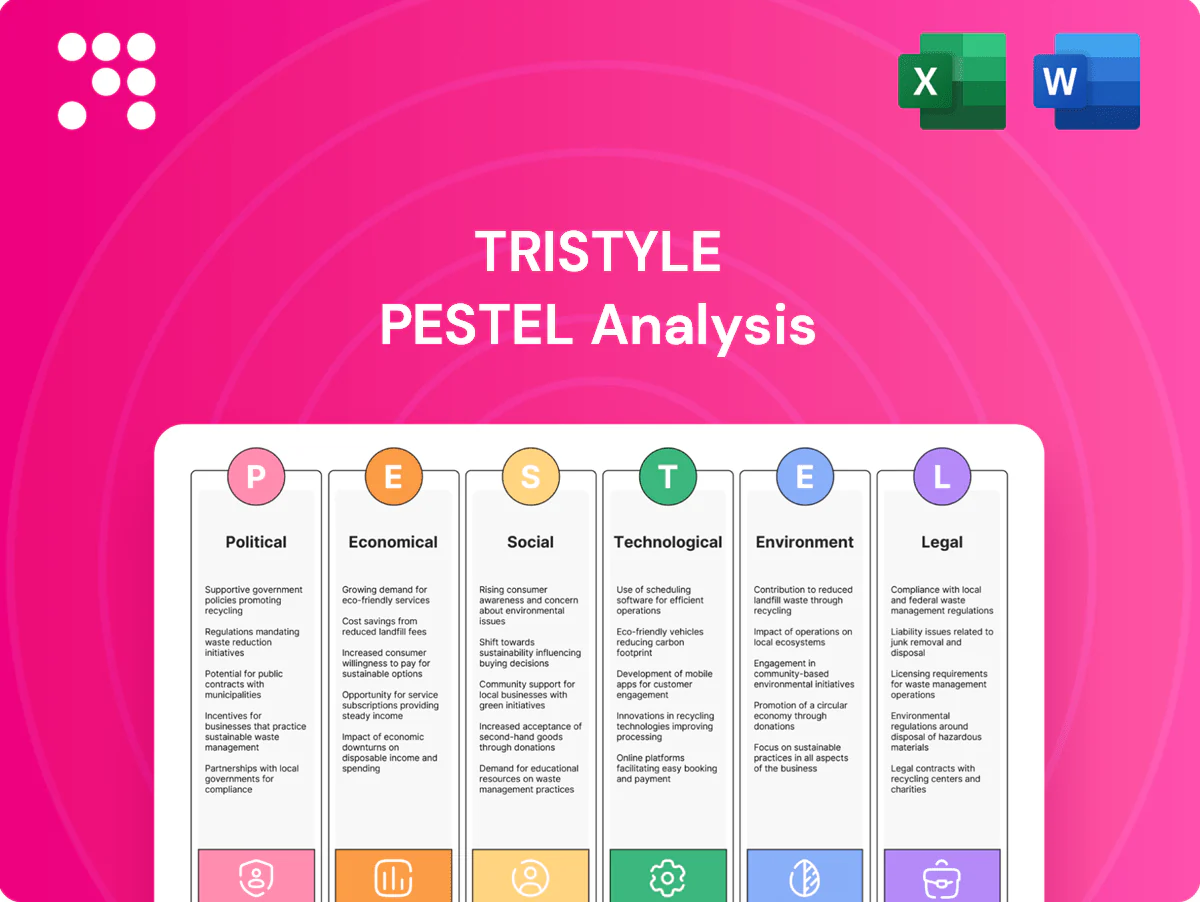
TriStyle PESTLE Analysis

Make Smarter Strategic Decisions with a Complete PESTEL View
Unlock how political, economic, social, technological, legal, and environmental forces are shaping TriStyle’s trajectory with our concise PESTLE summary—perfect for investors and strategists. Download the full analysis for detailed risks, growth levers, and ready-to-use insights to inform your next decision.
Political factors

EU trade and tariff stability
As an EU-based retailer TriStyle benefits from single market low-tariff frictions for intra-EU sourcing and sales, with intra-EU trade ~two-thirds of EU goods trade in 2024. Political shifts in non-EU trade deals can change landed costs—tariffs on apparel can reach ~12%—and post-Brexit customs changes continue to affect UK flows, so monitoring EU trade policy protects margin planning and lead times.
Postal and catalog mailing policies
Catalog distribution for TriStyle is sensitive to postal pricing, service levels and cross-border rules, with many national operators applying mid-single-digit tariff increases in 2024 that raise unit mailing costs. Political pressure and green mandates (packaging/carbon levies) have pushed mail costs higher and disrupted service levels. Tighter data-sharing rules post-GDPR and cross-border privacy enforcement have reduced addressable reach in some markets. Maintaining a 3–5% contingency in mailing budgets helps protect channel ROI.

Energy and industrial policy
EU energy policy drives store, warehouse and logistics costs — EU industrial power averages about €0.15/kWh in 2024, raising baseline OpEx for TriStyle distribution and stores. Subsidies and grants under NextGenerationEU (€806.9bn) and sector schemes often cover up to 50% of efficiency retrofit CAPEX, cutting DC OpEx. Political backing for digitalization via the Digital Europe Programme (€7.5bn) provides grants for omnichannel investments, while sudden policy shifts keep cost baselines volatile.

Labor market and immigration stance
Geopolitical supply chain exposure
Geopolitical instability in key sourcing regions threatens premium inputs: China produces about 80% of global silk, Mongolia supplies ~30% of raw cashmere and Australia/China dominate wool exports, so sanctions or export controls can quickly constrain suppliers; shipping reroutes have raised transit times by up to 20–30% in recent disruptions, while dual-sourcing and nearshoring can cut lead-time volatility by roughly 25%.
- Silk: ~80% production concentrated in China
- Cashmere: ~30% raw supply from Mongolia
- Wool: Australia/China dominant exporters
- Transit delays: +20–30% in disrupted lanes
- Mitigation: dual-sourcing/nearshoring ≈ -25% volatility
EU apparel: use single-market gains, hedge China/Mongolia supply risk with nearshoring
TriStyle benefits from EU single-market trade (≈ two-thirds of EU goods trade, 2024) but faces non-EU apparel tariffs up to ~12% and post-Brexit frictions. Labor cost floors rose (UK NLW £11.44 Apr 2024; Germany €12) while EU industrial power averages ~€0.15/kWh. Geopolitical sourcing risks (China silk ~80%, Mongolia cashmere ~30%) drive dual-sourcing/nearshoring mitigation.
| Factor | Key data |
|---|---|
| Intra-EU trade | ~66% of EU goods trade (2024) |
| Tariffs | Apparel up to ~12% |
| Wages | UK £11.44; DE €12 (2024) |
| Energy | €0.15/kWh (industrial avg 2024) |
| Sourcing risk | Silk 80% CN; Cashmere 30% MN |
What is included in the product
 Detailed Word Document
Provides a data-backed PESTLE assessment of how Political, Economic, Social, Technological, Environmental and Legal forces uniquely impact TriStyle, with detailed sub-points and real-market examples; designed for executives, consultants and investors to identify risks, opportunities and forward-looking scenarios ready for plans, decks or reports.

 Customizable Excel Spreadsheet
TriStyle PESTLE offers a clean, visually segmented summary of external factors that’s editable for local context and easily dropped into presentations, enabling quick team alignment and focused risk discussions during planning sessions.
Economic factors

Consumer confidence and discretionary spend
Premium fashion is highly sentiment-sensitive for discretionary purchases; Bain & Company 2024 reports the global personal luxury goods market at €322 billion in 2023, underscoring scale and vulnerability to sentiment shifts. The Best Ager cohort is relatively resilient but still reacts to macro shocks. Tactical promotions and flexible payment options help smooth downcycles. Monitoring consumer confidence indices guides inventory and pricing cadence.
Inflation and input cost pressures
Material, labor and freight inflation directly push COGS and retail prices — US CPI averaged ~3.4% in 2024 and average hourly earnings rose ~4.1% (BLS), while global container rates normalized near $1,500 per FEU in 2024 (Drewry). Older, value-conscious customers often trade trends for longevity, enabling price architecture and category mix shifts to protect gross margin. Tactical hedging and multi‑year supplier agreements reduce exposure to input volatility.

FX dynamics on sourcing
Currency swings versus the USD and Asian currencies shift imported goods costs materially: EUR/USD averaged about 1.09 in 2024 and CNY traded near 7.2/USD in 2024–25, so a 5% move can change COGS by similar magnitudes. Euro strength redirects sourcing toward non-euro markets while euro weakness makes EU sourcing more competitive. FX hedging timed to buy cycles and seasonal calendars reduces margin volatility, and transparent price communication preserves trust with Best Agers.

Omnichannel sales mix economics
- online: 18% retail share (2024)
- returns: ~25% (apparel, 2024)
- last-mile: ~$7/order (2024 US)
- stores: ~30% higher AOV
- attribution: ~15% ROI uplift
Demographic purchasing power
Aging populations in DACH and the EU (65+ share ~20.6% EU, Germany ~22.4% in 2023) expand TriStyle’s core adult market, while pension outlays in the EU near 12% of GDP constrain disposable income and shape average order value. Elevated household saving tendencies support selective spend on premium basics and inclusive sizing, sustaining repeat purchases. Economic cycles modulate wardrobe refresh cadence and AOV volatility.
- Demographics: 65+ ≈20.6% EU, Germany ≈22.4% (2023)
- Pensions: pension expenditure ≈12% of EU GDP
- Product: inclusive sizing + premium basics → higher repeat rate
- Macro: cycles drive wardrobe refresh frequency and AOV swings
EU apparel: use single-market gains, hedge China/Mongolia supply risk with nearshoring
Premium demand is sentiment-sensitive (personal luxury €322bn 2023) so TriStyle must flex pricing, promos and inventory with consumer confidence. Input inflation and wages (US CPI ~3.4% 2024; AHE +4.1%) compress margins; hedging and supplier contracts mitigate. FX (EUR/USD ~1.09; CNY ~7.2) and channel mix (online 18%, returns ~25%, stores +30% AOV) drive cost-to-serve and pricing.
| Metric | Value |
|---|---|
| Luxury market | €322bn (2023) |
| US CPI | ~3.4% (2024) |
| EUR/USD | ~1.09 (2024) |
| Online share | 18% (2024) |
Full Version Awaits
TriStyle PESTLE Analysis
The preview shown here is the exact TriStyle PESTLE Analysis you’ll receive after purchase—fully formatted and ready to use. The content, layout, and insights visible are part of the final file with no placeholders or surprises. After checkout you can download this exact document immediately.

Make Smarter Strategic Decisions with a Complete PESTEL View
Unlock how political, economic, social, technological, legal, and environmental forces are shaping TriStyle’s trajectory with our concise PESTLE summary—perfect for investors and strategists. Download the full analysis for detailed risks, growth levers, and ready-to-use insights to inform your next decision.
Political factors
EU trade and tariff stability
As an EU-based retailer TriStyle benefits from single market low-tariff frictions for intra-EU sourcing and sales, with intra-EU trade ~two-thirds of EU goods trade in 2024. Political shifts in non-EU trade deals can change landed costs—tariffs on apparel can reach ~12%—and post-Brexit customs changes continue to affect UK flows, so monitoring EU trade policy protects margin planning and lead times.
Postal and catalog mailing policies
Catalog distribution for TriStyle is sensitive to postal pricing, service levels and cross-border rules, with many national operators applying mid-single-digit tariff increases in 2024 that raise unit mailing costs. Political pressure and green mandates (packaging/carbon levies) have pushed mail costs higher and disrupted service levels. Tighter data-sharing rules post-GDPR and cross-border privacy enforcement have reduced addressable reach in some markets. Maintaining a 3–5% contingency in mailing budgets helps protect channel ROI.
Energy and industrial policy
EU energy policy drives store, warehouse and logistics costs — EU industrial power averages about €0.15/kWh in 2024, raising baseline OpEx for TriStyle distribution and stores. Subsidies and grants under NextGenerationEU (€806.9bn) and sector schemes often cover up to 50% of efficiency retrofit CAPEX, cutting DC OpEx. Political backing for digitalization via the Digital Europe Programme (€7.5bn) provides grants for omnichannel investments, while sudden policy shifts keep cost baselines volatile.
Labor market and immigration stance
Geopolitical supply chain exposure
Geopolitical instability in key sourcing regions threatens premium inputs: China produces about 80% of global silk, Mongolia supplies ~30% of raw cashmere and Australia/China dominate wool exports, so sanctions or export controls can quickly constrain suppliers; shipping reroutes have raised transit times by up to 20–30% in recent disruptions, while dual-sourcing and nearshoring can cut lead-time volatility by roughly 25%.
- Silk: ~80% production concentrated in China
- Cashmere: ~30% raw supply from Mongolia
- Wool: Australia/China dominant exporters
- Transit delays: +20–30% in disrupted lanes
- Mitigation: dual-sourcing/nearshoring ≈ -25% volatility
EU apparel: use single-market gains, hedge China/Mongolia supply risk with nearshoring
TriStyle benefits from EU single-market trade (≈ two-thirds of EU goods trade, 2024) but faces non-EU apparel tariffs up to ~12% and post-Brexit frictions. Labor cost floors rose (UK NLW £11.44 Apr 2024; Germany €12) while EU industrial power averages ~€0.15/kWh. Geopolitical sourcing risks (China silk ~80%, Mongolia cashmere ~30%) drive dual-sourcing/nearshoring mitigation.
| Factor | Key data |
|---|---|
| Intra-EU trade | ~66% of EU goods trade (2024) |
| Tariffs | Apparel up to ~12% |
| Wages | UK £11.44; DE €12 (2024) |
| Energy | €0.15/kWh (industrial avg 2024) |
| Sourcing risk | Silk 80% CN; Cashmere 30% MN |
What is included in the product
Detailed Word Document
Provides a data-backed PESTLE assessment of how Political, Economic, Social, Technological, Environmental and Legal forces uniquely impact TriStyle, with detailed sub-points and real-market examples; designed for executives, consultants and investors to identify risks, opportunities and forward-looking scenarios ready for plans, decks or reports.
Customizable Excel Spreadsheet
TriStyle PESTLE offers a clean, visually segmented summary of external factors that’s editable for local context and easily dropped into presentations, enabling quick team alignment and focused risk discussions during planning sessions.
Economic factors
Consumer confidence and discretionary spend
Premium fashion is highly sentiment-sensitive for discretionary purchases; Bain & Company 2024 reports the global personal luxury goods market at €322 billion in 2023, underscoring scale and vulnerability to sentiment shifts. The Best Ager cohort is relatively resilient but still reacts to macro shocks. Tactical promotions and flexible payment options help smooth downcycles. Monitoring consumer confidence indices guides inventory and pricing cadence.
Inflation and input cost pressures
Material, labor and freight inflation directly push COGS and retail prices — US CPI averaged ~3.4% in 2024 and average hourly earnings rose ~4.1% (BLS), while global container rates normalized near $1,500 per FEU in 2024 (Drewry). Older, value-conscious customers often trade trends for longevity, enabling price architecture and category mix shifts to protect gross margin. Tactical hedging and multi‑year supplier agreements reduce exposure to input volatility.
FX dynamics on sourcing
Currency swings versus the USD and Asian currencies shift imported goods costs materially: EUR/USD averaged about 1.09 in 2024 and CNY traded near 7.2/USD in 2024–25, so a 5% move can change COGS by similar magnitudes. Euro strength redirects sourcing toward non-euro markets while euro weakness makes EU sourcing more competitive. FX hedging timed to buy cycles and seasonal calendars reduces margin volatility, and transparent price communication preserves trust with Best Agers.
Omnichannel sales mix economics
- online: 18% retail share (2024)
- returns: ~25% (apparel, 2024)
- last-mile: ~$7/order (2024 US)
- stores: ~30% higher AOV
- attribution: ~15% ROI uplift
Demographic purchasing power
Aging populations in DACH and the EU (65+ share ~20.6% EU, Germany ~22.4% in 2023) expand TriStyle’s core adult market, while pension outlays in the EU near 12% of GDP constrain disposable income and shape average order value. Elevated household saving tendencies support selective spend on premium basics and inclusive sizing, sustaining repeat purchases. Economic cycles modulate wardrobe refresh cadence and AOV volatility.
- Demographics: 65+ ≈20.6% EU, Germany ≈22.4% (2023)
- Pensions: pension expenditure ≈12% of EU GDP
- Product: inclusive sizing + premium basics → higher repeat rate
- Macro: cycles drive wardrobe refresh frequency and AOV swings
EU apparel: use single-market gains, hedge China/Mongolia supply risk with nearshoring
Premium demand is sentiment-sensitive (personal luxury €322bn 2023) so TriStyle must flex pricing, promos and inventory with consumer confidence. Input inflation and wages (US CPI ~3.4% 2024; AHE +4.1%) compress margins; hedging and supplier contracts mitigate. FX (EUR/USD ~1.09; CNY ~7.2) and channel mix (online 18%, returns ~25%, stores +30% AOV) drive cost-to-serve and pricing.
| Metric | Value |
|---|---|
| Luxury market | €322bn (2023) |
| US CPI | ~3.4% (2024) |
| EUR/USD | ~1.09 (2024) |
| Online share | 18% (2024) |
Full Version Awaits
TriStyle PESTLE Analysis
The preview shown here is the exact TriStyle PESTLE Analysis you’ll receive after purchase—fully formatted and ready to use. The content, layout, and insights visible are part of the final file with no placeholders or surprises. After checkout you can download this exact document immediately.
Description
Make Smarter Strategic Decisions with a Complete PESTEL View
Unlock how political, economic, social, technological, legal, and environmental forces are shaping TriStyle’s trajectory with our concise PESTLE summary—perfect for investors and strategists. Download the full analysis for detailed risks, growth levers, and ready-to-use insights to inform your next decision.
Political factors
EU trade and tariff stability
As an EU-based retailer TriStyle benefits from single market low-tariff frictions for intra-EU sourcing and sales, with intra-EU trade ~two-thirds of EU goods trade in 2024. Political shifts in non-EU trade deals can change landed costs—tariffs on apparel can reach ~12%—and post-Brexit customs changes continue to affect UK flows, so monitoring EU trade policy protects margin planning and lead times.
Postal and catalog mailing policies
Catalog distribution for TriStyle is sensitive to postal pricing, service levels and cross-border rules, with many national operators applying mid-single-digit tariff increases in 2024 that raise unit mailing costs. Political pressure and green mandates (packaging/carbon levies) have pushed mail costs higher and disrupted service levels. Tighter data-sharing rules post-GDPR and cross-border privacy enforcement have reduced addressable reach in some markets. Maintaining a 3–5% contingency in mailing budgets helps protect channel ROI.
Energy and industrial policy
EU energy policy drives store, warehouse and logistics costs — EU industrial power averages about €0.15/kWh in 2024, raising baseline OpEx for TriStyle distribution and stores. Subsidies and grants under NextGenerationEU (€806.9bn) and sector schemes often cover up to 50% of efficiency retrofit CAPEX, cutting DC OpEx. Political backing for digitalization via the Digital Europe Programme (€7.5bn) provides grants for omnichannel investments, while sudden policy shifts keep cost baselines volatile.
Labor market and immigration stance
Geopolitical supply chain exposure
Geopolitical instability in key sourcing regions threatens premium inputs: China produces about 80% of global silk, Mongolia supplies ~30% of raw cashmere and Australia/China dominate wool exports, so sanctions or export controls can quickly constrain suppliers; shipping reroutes have raised transit times by up to 20–30% in recent disruptions, while dual-sourcing and nearshoring can cut lead-time volatility by roughly 25%.
- Silk: ~80% production concentrated in China
- Cashmere: ~30% raw supply from Mongolia
- Wool: Australia/China dominant exporters
- Transit delays: +20–30% in disrupted lanes
- Mitigation: dual-sourcing/nearshoring ≈ -25% volatility
EU apparel: use single-market gains, hedge China/Mongolia supply risk with nearshoring
TriStyle benefits from EU single-market trade (≈ two-thirds of EU goods trade, 2024) but faces non-EU apparel tariffs up to ~12% and post-Brexit frictions. Labor cost floors rose (UK NLW £11.44 Apr 2024; Germany €12) while EU industrial power averages ~€0.15/kWh. Geopolitical sourcing risks (China silk ~80%, Mongolia cashmere ~30%) drive dual-sourcing/nearshoring mitigation.
| Factor | Key data |
|---|---|
| Intra-EU trade | ~66% of EU goods trade (2024) |
| Tariffs | Apparel up to ~12% |
| Wages | UK £11.44; DE €12 (2024) |
| Energy | €0.15/kWh (industrial avg 2024) |
| Sourcing risk | Silk 80% CN; Cashmere 30% MN |
What is included in the product
Detailed Word Document
Provides a data-backed PESTLE assessment of how Political, Economic, Social, Technological, Environmental and Legal forces uniquely impact TriStyle, with detailed sub-points and real-market examples; designed for executives, consultants and investors to identify risks, opportunities and forward-looking scenarios ready for plans, decks or reports.
Customizable Excel Spreadsheet
TriStyle PESTLE offers a clean, visually segmented summary of external factors that’s editable for local context and easily dropped into presentations, enabling quick team alignment and focused risk discussions during planning sessions.
Economic factors
Consumer confidence and discretionary spend
Premium fashion is highly sentiment-sensitive for discretionary purchases; Bain & Company 2024 reports the global personal luxury goods market at €322 billion in 2023, underscoring scale and vulnerability to sentiment shifts. The Best Ager cohort is relatively resilient but still reacts to macro shocks. Tactical promotions and flexible payment options help smooth downcycles. Monitoring consumer confidence indices guides inventory and pricing cadence.
Inflation and input cost pressures
Material, labor and freight inflation directly push COGS and retail prices — US CPI averaged ~3.4% in 2024 and average hourly earnings rose ~4.1% (BLS), while global container rates normalized near $1,500 per FEU in 2024 (Drewry). Older, value-conscious customers often trade trends for longevity, enabling price architecture and category mix shifts to protect gross margin. Tactical hedging and multi‑year supplier agreements reduce exposure to input volatility.
FX dynamics on sourcing
Currency swings versus the USD and Asian currencies shift imported goods costs materially: EUR/USD averaged about 1.09 in 2024 and CNY traded near 7.2/USD in 2024–25, so a 5% move can change COGS by similar magnitudes. Euro strength redirects sourcing toward non-euro markets while euro weakness makes EU sourcing more competitive. FX hedging timed to buy cycles and seasonal calendars reduces margin volatility, and transparent price communication preserves trust with Best Agers.
Omnichannel sales mix economics
- online: 18% retail share (2024)
- returns: ~25% (apparel, 2024)
- last-mile: ~$7/order (2024 US)
- stores: ~30% higher AOV
- attribution: ~15% ROI uplift
Demographic purchasing power
Aging populations in DACH and the EU (65+ share ~20.6% EU, Germany ~22.4% in 2023) expand TriStyle’s core adult market, while pension outlays in the EU near 12% of GDP constrain disposable income and shape average order value. Elevated household saving tendencies support selective spend on premium basics and inclusive sizing, sustaining repeat purchases. Economic cycles modulate wardrobe refresh cadence and AOV volatility.
- Demographics: 65+ ≈20.6% EU, Germany ≈22.4% (2023)
- Pensions: pension expenditure ≈12% of EU GDP
- Product: inclusive sizing + premium basics → higher repeat rate
- Macro: cycles drive wardrobe refresh frequency and AOV swings
EU apparel: use single-market gains, hedge China/Mongolia supply risk with nearshoring
Premium demand is sentiment-sensitive (personal luxury €322bn 2023) so TriStyle must flex pricing, promos and inventory with consumer confidence. Input inflation and wages (US CPI ~3.4% 2024; AHE +4.1%) compress margins; hedging and supplier contracts mitigate. FX (EUR/USD ~1.09; CNY ~7.2) and channel mix (online 18%, returns ~25%, stores +30% AOV) drive cost-to-serve and pricing.
| Metric | Value |
|---|---|
| Luxury market | €322bn (2023) |
| US CPI | ~3.4% (2024) |
| EUR/USD | ~1.09 (2024) |
| Online share | 18% (2024) |
Full Version Awaits
TriStyle PESTLE Analysis
The preview shown here is the exact TriStyle PESTLE Analysis you’ll receive after purchase—fully formatted and ready to use. The content, layout, and insights visible are part of the final file with no placeholders or surprises. After checkout you can download this exact document immediately.











