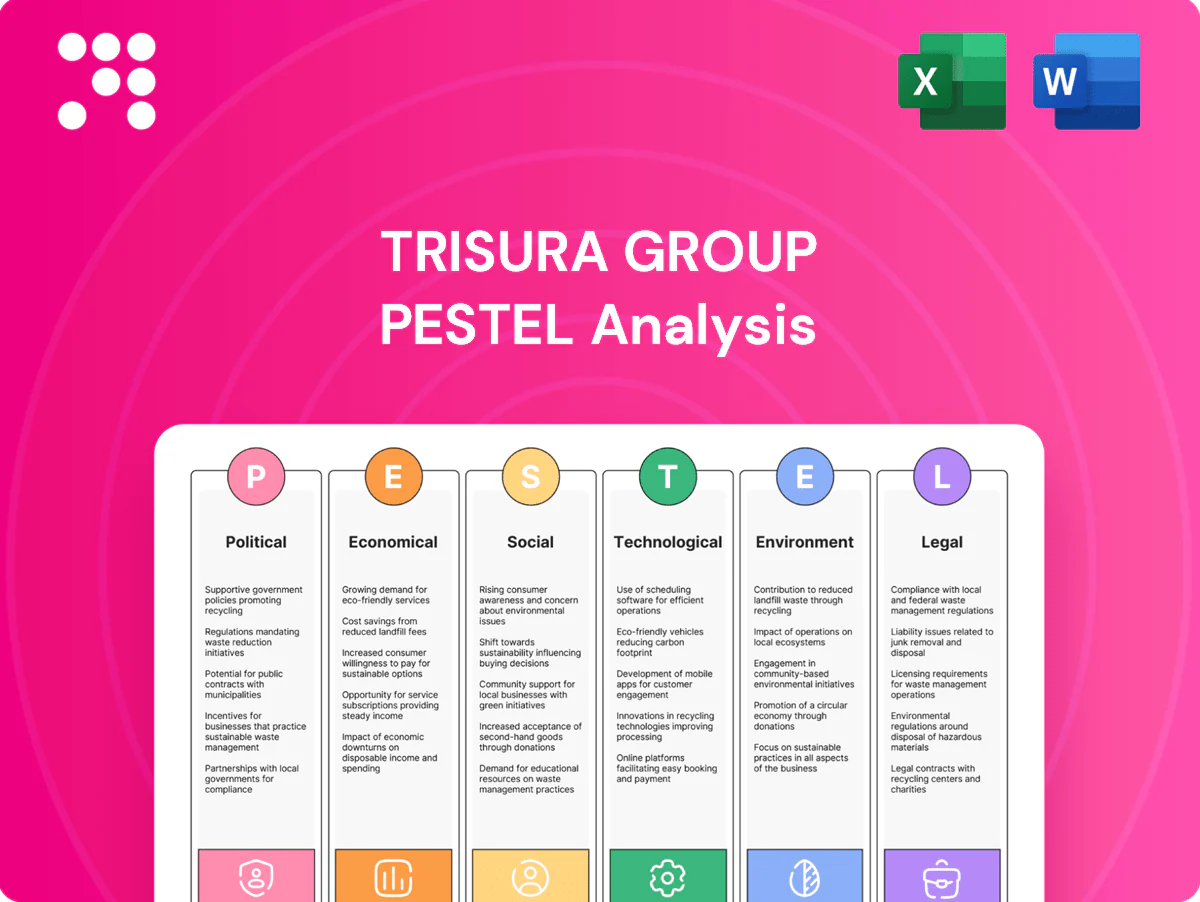
Trisura Group PESTLE Analysis

Skip the Research. Get the Strategy.
Unlock how regulatory shifts, economic cycles, and evolving risk appetites shape Trisura Group’s outlook—our concise PESTLE highlights critical external drivers and strategic risks. For a full, actionable breakdown ready for investment and planning, purchase the complete PESTLE analysis and gain immediate, boardroom-ready insights.
Political factors

Regulatory stability in Canada/US
Trisura’s growth depends on predictable insurance supervision in Canada and the United States, with oversight from OSFI in Canada and state insurance regulators in the US shaping capital, rate-filings, and market conduct.
Policy shifts on capital requirements or rate approval processes can materially alter product economics and speed-to-market, compressing margins if changes are abrupt.
Stable oversight supports niche expansion; continuous monitoring of OSFI and state-level agendas is essential for planning.
Cross-border policy and trade relations
As a Canada-headquartered group operating in the U.S., Trisura faces cross-border political dynamics that affect licensing, capital mobility and reinsurance flows; US‑Canada two‑way trade exceeded US$1.1 trillion in 2023, underscoring economic integration. Tariffs or protectionist measures could complicate fronting and reinsurance arrangements and raise costs. Harmonized regulatory standards ease compliance and lower frictional costs, while diplomatic stability supports market growth in both countries.

Public infrastructure and PPP priorities
Government infrastructure programs and public–private partnerships are primary drivers of surety demand for Trisura; the federal Investing in Canada Plan commits 180 billion CAD through 2028, expanding potential bond volumes. Political commitment to capital projects raises multi-year pipelines, while austerity or project delays shrink them. Stimulus packages accelerate tendering and bonding opportunities. Budget cycles and elections, held at most every four years federally, directly affect backlog visibility.

Disaster policy and government backstops
National and state catastrophe policies, notably the US NFIP which covers about 5 million policies, shape pricing and private transfer options for Trisura’s specialty lines.
Government backstops can crowd in capacity after major events or crowd out private reinsurers, while post-event political responses accelerate claim timing and drive social inflation.
Aligning products with public programs opens niche opportunities in flood and residual markets for Trisura.
Geopolitics, sanctions, and reinsurance access
Sanctions regimes and geopolitical tensions can restrict counterparties and cedents, increasing underwriting and settlement risk and driving compliance complexity for Trisura. Global reinsurer appetite and capacity are highly sensitive to political risk and capital flows, which can tighten reinsurance terms in stressed regions. Maintaining a diversified panel mitigates concentration and political disruption while rising enforcement widens compliance burdens.
- Sanctions restrict counterparty pools
- Reinsurer appetite tied to political risk
- Compliance workload rising with enforcement
- Diversified panels reduce concentration risk
Regulatory oversight, trade and flood risk tighten surety margins; US$1.1T
Trisura’s growth depends on predictable oversight (OSFI in Canada, state regulators in the US); rate/capital rule changes can compress margins. US‑Canada trade was US$1.1T in 2023 and Investing in Canada commits CAD180B to 2028, supporting surety demand; NFIP covers ~5M policies affecting flood pricing. Sanctions and geopolitical risk tighten reinsurance and compliance.
| Metric | Value |
|---|---|
| US‑Canada trade (2023) | US$1.1T |
| Investing in Canada | CAD180B to 2028 |
| NFIP policies | ~5M |
What is included in the product
 Detailed Word Document
Explores how Political, Economic, Social, Technological, Environmental and Legal forces uniquely affect Trisura Group, with data-driven sub-points and industry-specific examples. Designed to inform executives, advisors and investors with forward-looking insights for strategy, risk mitigation and capital-raising decisions.

 Customizable Excel Spreadsheet
A concise, PESTLE-segmented summary of Trisura Group highlighting external risks and opportunities for quick alignment in meetings or slide decks, with editable notes for region- or product-specific context to speed decision-making and risk mitigation.
Economic factors

Interest rates and investment income
Higher policy rates (Bank of Canada ~5.00% in 2025) have lifted investment yields, boosting Trisura Group’s investment income and enabling greater pricing flexibility. Rate volatility, however, creates mark-to-market swings that depress fixed-income valuations and can tighten capital ratios. Active duration management is critical to match liabilities, with earnings and ROE notably sensitive to rate cycles.
Inflation and claims severity
Sustained inflation elevates loss costs, legal fees and reinsurance prices, with Canadian CPI easing to about 3% in 2024 but real claim severity still rising in 2024–25. Specialty lines and surety face cost pass-through challenges if underwriting rates lag market inflation, while reinsurance market firming since 2023 has pushed premium rates materially higher. Indexation of premiums and tighter policy terms help preserve margins. Prudential reserving and loss development monitoring counter adverse reserve deterioration.

Credit cycle and default risk
Surety exposure closely tracks contractor and corporate credit health, and with the Bank of Canada policy rate at 5.00% (July 2025) tighter liquidity can stress balance sheets and raise claim frequency. Economic slowdowns and bankruptcies historically drive more surety claims, while robust underwriting, strict collateral and indemnity structures materially mitigate loss severity. Diversification across construction, transportation and specialty lines smooths cyclical volatility.

GDP growth and construction activity
GDP growth and construction cycles materially affect Trisura’s surety and risk solutions: IMF projected global GDP growth of 3.1% in 2025, supporting stronger infrastructure spend and higher surety premiums, while recessions compress project starts and bonding demand. Regional dispersion (Canada, US, APAC) cushions localized downturns and lengthens revenue visibility; backlog analytics guide portfolio tilt toward lower-risk sectors.
- IMF global GDP 2025: 3.1%
- Stronger growth = higher backlogs & premiums
- Recessions = delayed projects, lower bonding
- Backlog analytics = portfolio tilt decisioning
Reinsurance pricing and capacity
Hard reinsurance markets raise ceded costs and force higher retentions, squeezing Trisura’s underwriting margins and reducing profitability. Capacity constraints limit fronting scale and specialty placements, slowing growth in niche product lines. Long-term reinsurance partnerships and data-rich portfolios improve resilience and negotiating leverage across cycles.
- Higher ceded costs
- Increased retentions
- Restricted capacity
- Value of long-term partners
- Data-driven leverage
Regulatory oversight, trade and flood risk tighten surety margins; US$1.1T
Higher policy rates (Bank of Canada 5.00% July 2025) lifted investment yields but increase duration risk and capital volatility, while Canadian CPI ~3% in 2024 and rising claim severity pressure loss costs and reinsurance premiums. Surety claims rise with strained corporate liquidity in tighter-rate environments; IMF projects global GDP 3.1% in 2025 supporting infrastructure demand. Active duration, stricter underwriting and data-driven reinsurance partnerships preserve margins.
| Metric | Value |
|---|---|
| BoC policy rate (Jul 2025) | 5.00% |
| Canadian CPI (2024) | ~3% |
| IMF global GDP (2025) | 3.1% |
| Reinsurance market | Firm since 2023 |
Same Document Delivered
Trisura Group PESTLE Analysis
This Trisura Group PESTLE Analysis delivers concise political, economic, social, technological, legal and environmental insights tailored to strategic decision-making. The preview shown here is the exact document you’ll receive after purchase—fully formatted and ready to use. It’s the final, downloadable file with no placeholders.

Skip the Research. Get the Strategy.
Unlock how regulatory shifts, economic cycles, and evolving risk appetites shape Trisura Group’s outlook—our concise PESTLE highlights critical external drivers and strategic risks. For a full, actionable breakdown ready for investment and planning, purchase the complete PESTLE analysis and gain immediate, boardroom-ready insights.
Political factors
Regulatory stability in Canada/US
Trisura’s growth depends on predictable insurance supervision in Canada and the United States, with oversight from OSFI in Canada and state insurance regulators in the US shaping capital, rate-filings, and market conduct.
Policy shifts on capital requirements or rate approval processes can materially alter product economics and speed-to-market, compressing margins if changes are abrupt.
Stable oversight supports niche expansion; continuous monitoring of OSFI and state-level agendas is essential for planning.
Cross-border policy and trade relations
As a Canada-headquartered group operating in the U.S., Trisura faces cross-border political dynamics that affect licensing, capital mobility and reinsurance flows; US‑Canada two‑way trade exceeded US$1.1 trillion in 2023, underscoring economic integration. Tariffs or protectionist measures could complicate fronting and reinsurance arrangements and raise costs. Harmonized regulatory standards ease compliance and lower frictional costs, while diplomatic stability supports market growth in both countries.
Public infrastructure and PPP priorities
Government infrastructure programs and public–private partnerships are primary drivers of surety demand for Trisura; the federal Investing in Canada Plan commits 180 billion CAD through 2028, expanding potential bond volumes. Political commitment to capital projects raises multi-year pipelines, while austerity or project delays shrink them. Stimulus packages accelerate tendering and bonding opportunities. Budget cycles and elections, held at most every four years federally, directly affect backlog visibility.
Disaster policy and government backstops
National and state catastrophe policies, notably the US NFIP which covers about 5 million policies, shape pricing and private transfer options for Trisura’s specialty lines.
Government backstops can crowd in capacity after major events or crowd out private reinsurers, while post-event political responses accelerate claim timing and drive social inflation.
Aligning products with public programs opens niche opportunities in flood and residual markets for Trisura.
Geopolitics, sanctions, and reinsurance access
Sanctions regimes and geopolitical tensions can restrict counterparties and cedents, increasing underwriting and settlement risk and driving compliance complexity for Trisura. Global reinsurer appetite and capacity are highly sensitive to political risk and capital flows, which can tighten reinsurance terms in stressed regions. Maintaining a diversified panel mitigates concentration and political disruption while rising enforcement widens compliance burdens.
- Sanctions restrict counterparty pools
- Reinsurer appetite tied to political risk
- Compliance workload rising with enforcement
- Diversified panels reduce concentration risk
Regulatory oversight, trade and flood risk tighten surety margins; US$1.1T
Trisura’s growth depends on predictable oversight (OSFI in Canada, state regulators in the US); rate/capital rule changes can compress margins. US‑Canada trade was US$1.1T in 2023 and Investing in Canada commits CAD180B to 2028, supporting surety demand; NFIP covers ~5M policies affecting flood pricing. Sanctions and geopolitical risk tighten reinsurance and compliance.
| Metric | Value |
|---|---|
| US‑Canada trade (2023) | US$1.1T |
| Investing in Canada | CAD180B to 2028 |
| NFIP policies | ~5M |
What is included in the product
Detailed Word Document
Explores how Political, Economic, Social, Technological, Environmental and Legal forces uniquely affect Trisura Group, with data-driven sub-points and industry-specific examples. Designed to inform executives, advisors and investors with forward-looking insights for strategy, risk mitigation and capital-raising decisions.
Customizable Excel Spreadsheet
A concise, PESTLE-segmented summary of Trisura Group highlighting external risks and opportunities for quick alignment in meetings or slide decks, with editable notes for region- or product-specific context to speed decision-making and risk mitigation.
Economic factors
Interest rates and investment income
Higher policy rates (Bank of Canada ~5.00% in 2025) have lifted investment yields, boosting Trisura Group’s investment income and enabling greater pricing flexibility. Rate volatility, however, creates mark-to-market swings that depress fixed-income valuations and can tighten capital ratios. Active duration management is critical to match liabilities, with earnings and ROE notably sensitive to rate cycles.
Inflation and claims severity
Sustained inflation elevates loss costs, legal fees and reinsurance prices, with Canadian CPI easing to about 3% in 2024 but real claim severity still rising in 2024–25. Specialty lines and surety face cost pass-through challenges if underwriting rates lag market inflation, while reinsurance market firming since 2023 has pushed premium rates materially higher. Indexation of premiums and tighter policy terms help preserve margins. Prudential reserving and loss development monitoring counter adverse reserve deterioration.
Credit cycle and default risk
Surety exposure closely tracks contractor and corporate credit health, and with the Bank of Canada policy rate at 5.00% (July 2025) tighter liquidity can stress balance sheets and raise claim frequency. Economic slowdowns and bankruptcies historically drive more surety claims, while robust underwriting, strict collateral and indemnity structures materially mitigate loss severity. Diversification across construction, transportation and specialty lines smooths cyclical volatility.
GDP growth and construction activity
GDP growth and construction cycles materially affect Trisura’s surety and risk solutions: IMF projected global GDP growth of 3.1% in 2025, supporting stronger infrastructure spend and higher surety premiums, while recessions compress project starts and bonding demand. Regional dispersion (Canada, US, APAC) cushions localized downturns and lengthens revenue visibility; backlog analytics guide portfolio tilt toward lower-risk sectors.
- IMF global GDP 2025: 3.1%
- Stronger growth = higher backlogs & premiums
- Recessions = delayed projects, lower bonding
- Backlog analytics = portfolio tilt decisioning
Reinsurance pricing and capacity
Hard reinsurance markets raise ceded costs and force higher retentions, squeezing Trisura’s underwriting margins and reducing profitability. Capacity constraints limit fronting scale and specialty placements, slowing growth in niche product lines. Long-term reinsurance partnerships and data-rich portfolios improve resilience and negotiating leverage across cycles.
- Higher ceded costs
- Increased retentions
- Restricted capacity
- Value of long-term partners
- Data-driven leverage
Regulatory oversight, trade and flood risk tighten surety margins; US$1.1T
Higher policy rates (Bank of Canada 5.00% July 2025) lifted investment yields but increase duration risk and capital volatility, while Canadian CPI ~3% in 2024 and rising claim severity pressure loss costs and reinsurance premiums. Surety claims rise with strained corporate liquidity in tighter-rate environments; IMF projects global GDP 3.1% in 2025 supporting infrastructure demand. Active duration, stricter underwriting and data-driven reinsurance partnerships preserve margins.
| Metric | Value |
|---|---|
| BoC policy rate (Jul 2025) | 5.00% |
| Canadian CPI (2024) | ~3% |
| IMF global GDP (2025) | 3.1% |
| Reinsurance market | Firm since 2023 |
Same Document Delivered
Trisura Group PESTLE Analysis
This Trisura Group PESTLE Analysis delivers concise political, economic, social, technological, legal and environmental insights tailored to strategic decision-making. The preview shown here is the exact document you’ll receive after purchase—fully formatted and ready to use. It’s the final, downloadable file with no placeholders.
Original: $10.00
-65%$10.00
$3.50Description
Skip the Research. Get the Strategy.
Unlock how regulatory shifts, economic cycles, and evolving risk appetites shape Trisura Group’s outlook—our concise PESTLE highlights critical external drivers and strategic risks. For a full, actionable breakdown ready for investment and planning, purchase the complete PESTLE analysis and gain immediate, boardroom-ready insights.
Political factors
Regulatory stability in Canada/US
Trisura’s growth depends on predictable insurance supervision in Canada and the United States, with oversight from OSFI in Canada and state insurance regulators in the US shaping capital, rate-filings, and market conduct.
Policy shifts on capital requirements or rate approval processes can materially alter product economics and speed-to-market, compressing margins if changes are abrupt.
Stable oversight supports niche expansion; continuous monitoring of OSFI and state-level agendas is essential for planning.
Cross-border policy and trade relations
As a Canada-headquartered group operating in the U.S., Trisura faces cross-border political dynamics that affect licensing, capital mobility and reinsurance flows; US‑Canada two‑way trade exceeded US$1.1 trillion in 2023, underscoring economic integration. Tariffs or protectionist measures could complicate fronting and reinsurance arrangements and raise costs. Harmonized regulatory standards ease compliance and lower frictional costs, while diplomatic stability supports market growth in both countries.
Public infrastructure and PPP priorities
Government infrastructure programs and public–private partnerships are primary drivers of surety demand for Trisura; the federal Investing in Canada Plan commits 180 billion CAD through 2028, expanding potential bond volumes. Political commitment to capital projects raises multi-year pipelines, while austerity or project delays shrink them. Stimulus packages accelerate tendering and bonding opportunities. Budget cycles and elections, held at most every four years federally, directly affect backlog visibility.
Disaster policy and government backstops
National and state catastrophe policies, notably the US NFIP which covers about 5 million policies, shape pricing and private transfer options for Trisura’s specialty lines.
Government backstops can crowd in capacity after major events or crowd out private reinsurers, while post-event political responses accelerate claim timing and drive social inflation.
Aligning products with public programs opens niche opportunities in flood and residual markets for Trisura.
Geopolitics, sanctions, and reinsurance access
Sanctions regimes and geopolitical tensions can restrict counterparties and cedents, increasing underwriting and settlement risk and driving compliance complexity for Trisura. Global reinsurer appetite and capacity are highly sensitive to political risk and capital flows, which can tighten reinsurance terms in stressed regions. Maintaining a diversified panel mitigates concentration and political disruption while rising enforcement widens compliance burdens.
- Sanctions restrict counterparty pools
- Reinsurer appetite tied to political risk
- Compliance workload rising with enforcement
- Diversified panels reduce concentration risk
Regulatory oversight, trade and flood risk tighten surety margins; US$1.1T
Trisura’s growth depends on predictable oversight (OSFI in Canada, state regulators in the US); rate/capital rule changes can compress margins. US‑Canada trade was US$1.1T in 2023 and Investing in Canada commits CAD180B to 2028, supporting surety demand; NFIP covers ~5M policies affecting flood pricing. Sanctions and geopolitical risk tighten reinsurance and compliance.
| Metric | Value |
|---|---|
| US‑Canada trade (2023) | US$1.1T |
| Investing in Canada | CAD180B to 2028 |
| NFIP policies | ~5M |
What is included in the product
Detailed Word Document
Explores how Political, Economic, Social, Technological, Environmental and Legal forces uniquely affect Trisura Group, with data-driven sub-points and industry-specific examples. Designed to inform executives, advisors and investors with forward-looking insights for strategy, risk mitigation and capital-raising decisions.
Customizable Excel Spreadsheet
A concise, PESTLE-segmented summary of Trisura Group highlighting external risks and opportunities for quick alignment in meetings or slide decks, with editable notes for region- or product-specific context to speed decision-making and risk mitigation.
Economic factors
Interest rates and investment income
Higher policy rates (Bank of Canada ~5.00% in 2025) have lifted investment yields, boosting Trisura Group’s investment income and enabling greater pricing flexibility. Rate volatility, however, creates mark-to-market swings that depress fixed-income valuations and can tighten capital ratios. Active duration management is critical to match liabilities, with earnings and ROE notably sensitive to rate cycles.
Inflation and claims severity
Sustained inflation elevates loss costs, legal fees and reinsurance prices, with Canadian CPI easing to about 3% in 2024 but real claim severity still rising in 2024–25. Specialty lines and surety face cost pass-through challenges if underwriting rates lag market inflation, while reinsurance market firming since 2023 has pushed premium rates materially higher. Indexation of premiums and tighter policy terms help preserve margins. Prudential reserving and loss development monitoring counter adverse reserve deterioration.
Credit cycle and default risk
Surety exposure closely tracks contractor and corporate credit health, and with the Bank of Canada policy rate at 5.00% (July 2025) tighter liquidity can stress balance sheets and raise claim frequency. Economic slowdowns and bankruptcies historically drive more surety claims, while robust underwriting, strict collateral and indemnity structures materially mitigate loss severity. Diversification across construction, transportation and specialty lines smooths cyclical volatility.
GDP growth and construction activity
GDP growth and construction cycles materially affect Trisura’s surety and risk solutions: IMF projected global GDP growth of 3.1% in 2025, supporting stronger infrastructure spend and higher surety premiums, while recessions compress project starts and bonding demand. Regional dispersion (Canada, US, APAC) cushions localized downturns and lengthens revenue visibility; backlog analytics guide portfolio tilt toward lower-risk sectors.
- IMF global GDP 2025: 3.1%
- Stronger growth = higher backlogs & premiums
- Recessions = delayed projects, lower bonding
- Backlog analytics = portfolio tilt decisioning
Reinsurance pricing and capacity
Hard reinsurance markets raise ceded costs and force higher retentions, squeezing Trisura’s underwriting margins and reducing profitability. Capacity constraints limit fronting scale and specialty placements, slowing growth in niche product lines. Long-term reinsurance partnerships and data-rich portfolios improve resilience and negotiating leverage across cycles.
- Higher ceded costs
- Increased retentions
- Restricted capacity
- Value of long-term partners
- Data-driven leverage
Regulatory oversight, trade and flood risk tighten surety margins; US$1.1T
Higher policy rates (Bank of Canada 5.00% July 2025) lifted investment yields but increase duration risk and capital volatility, while Canadian CPI ~3% in 2024 and rising claim severity pressure loss costs and reinsurance premiums. Surety claims rise with strained corporate liquidity in tighter-rate environments; IMF projects global GDP 3.1% in 2025 supporting infrastructure demand. Active duration, stricter underwriting and data-driven reinsurance partnerships preserve margins.
| Metric | Value |
|---|---|
| BoC policy rate (Jul 2025) | 5.00% |
| Canadian CPI (2024) | ~3% |
| IMF global GDP (2025) | 3.1% |
| Reinsurance market | Firm since 2023 |
Same Document Delivered
Trisura Group PESTLE Analysis
This Trisura Group PESTLE Analysis delivers concise political, economic, social, technological, legal and environmental insights tailored to strategic decision-making. The preview shown here is the exact document you’ll receive after purchase—fully formatted and ready to use. It’s the final, downloadable file with no placeholders.











