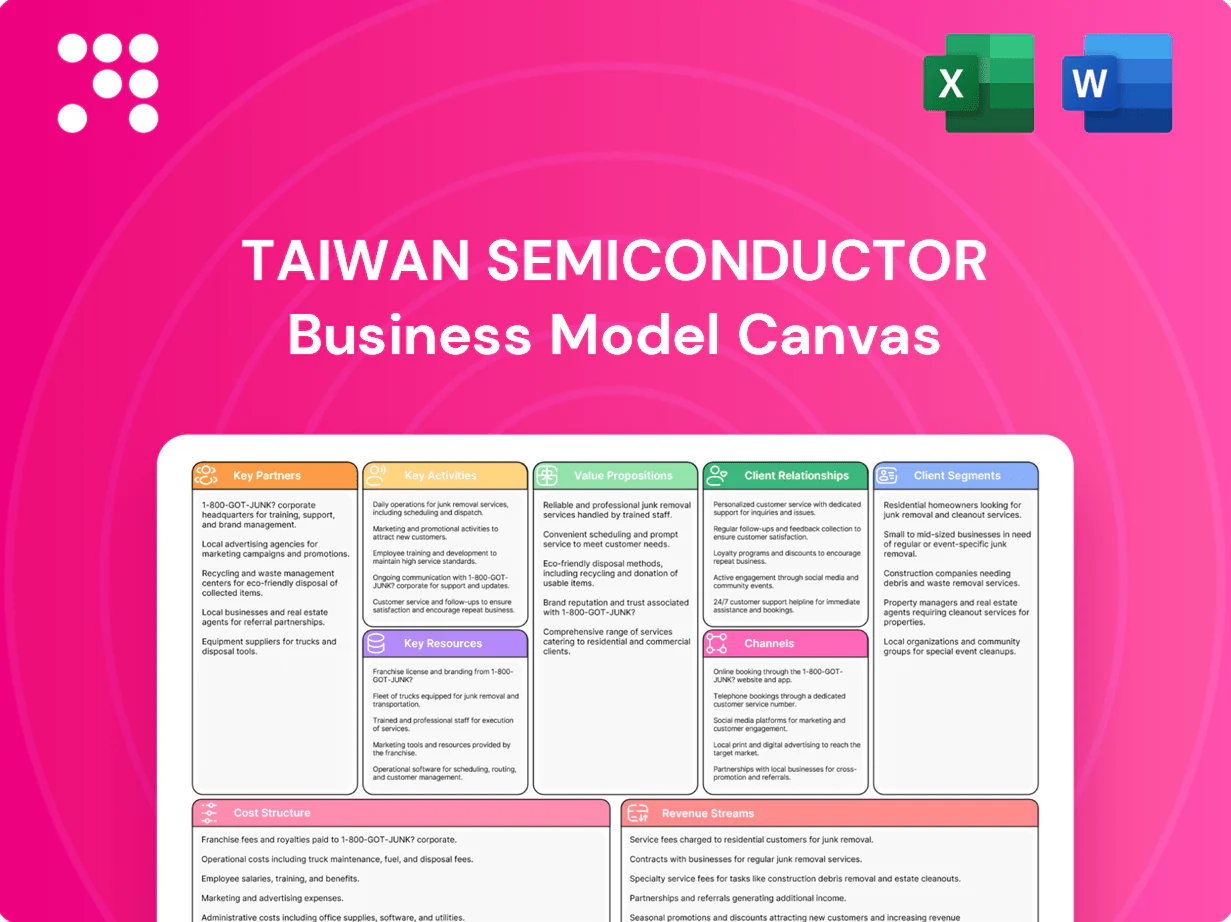
Taiwan Semiconductor Business Model Canvas

Unlock the strategic blueprint of a leading semiconductor firm with our Business Model Canvas
Unlock the strategic blueprint behind Taiwan Semiconductor’s business model with our Business Model Canvas. This concise, company-specific canvas maps value propositions, key partners, revenue streams and cost structure to reveal how the firm scales and sustains leadership. Download the full Word & Excel files for detailed insights, benchmarking, and investor-ready analysis.
Partnerships

Equipment suppliers
Partnerships with lithography, deposition and metrology vendors secure cutting-edge tools, with ASML supplying over 90% of EUV systems. Close alignment gives TSMC early access to EUV/High-NA roadmaps and process-specific enhancements. Joint development accelerates yield ramps and trims cycle time. Long-term contracts stabilize supply and pricing amid TSMC's 2024 capex plan of about US$32–36 billion.
EDA and IP ecosystem
Alliances with EDA vendors such as Cadence, Synopsys and Siemens EDA underpin TSMC PDKs and reference flows, enabling validated design kits and IP libraries tuned to TSMC nodes. TSMC Open Innovation Platform early access programs synchronize tool qualification with node readiness, reducing time-to-tape-out and design risk. TSMC held roughly 60% of the global foundry market in 2024, amplifying ecosystem scale.

Materials and wafer suppliers
Securing high-purity gases, chemicals, photoresists and specialty wafers is vital for TSMC, which maintained a 2024 capex plan of roughly 36–40 billion USD to expand capacity and supplier engagement. Multi-sourcing and close quality collaboration reduce variability and defects across process nodes. Joint quality programs standardize specs across global fabs. Long-term agreements with key suppliers bolster resilience during supply shocks.

Customer co-development
Customer co-development at TSMC aligns device architectures with process capabilities through early engagement on design rules, yield learning and process features; this model supports TSMC’s leading-edge dominance (over 90% share of sub-7nm wafer starts) and feeds into its 2024 capex program of roughly $32–36 billion to de-risk ramps. Confidential collaboration frameworks protect IP while shortening time-to-volume for both parties.
- Strategic design-rule alignment
- Shared yield-learning cycles
- Joint roadmaps de-risk ramps
- Confidential IP frameworks
Government and academia
TSMC leverages government R&D incentives and academia ties to fund advanced manufacturing and workforce development, with 2024 capex guidance around US$40 billion supporting fabs and training programs.
Collaboration with Academia Sinica and NTU advances materials science and EUV lithography research; proactive policy engagement helps navigate export controls and regional compliance while local government links speed site selection and infrastructure build-out.
- 2024 capex ~US$40bn
- Partnerships: Academia Sinica, National Taiwan University
- Focus: EUV lithography, materials R&D, workforce training
- Policy: export-control engagement, regional compliance
Leading foundry secures >90% EUV access, ~60% share; US$32–40bn capex
TSMC's key partnerships secure ASML EUV access (>90% EUV share), EDA tool alignment (Cadence/Synopsys), materials multi-sourcing and customer co-development, all supporting ~60% foundry share and >90% of sub-7nm wafer starts in 2024 while backing a 2024 capex program of roughly US$32–40bn.
| Partner | Role | 2024 metric |
|---|---|---|
| ASML | EUV tools | >90% EUV supply |
| EDA vendors | PDKs/IP | Cadence/Synopsys/Siemens |
| Materials suppliers | Chemicals/wafers | Long-term contracts |
| Customers | Co-dev | >90% sub-7nm wafer starts |
| Govt/academia | R&D/workforce | Supports US$32–40bn capex |
What is included in the product
 Detailed Word Document
A concise, investor-ready Business Model Canvas for Taiwan Semiconductor that maps nine BMC blocks—customer segments, value propositions, channels, customer relationships, revenue streams, key resources, activities, partners, and cost structure—highlighting competitive advantages, operational strengths, risks, and strategic opportunities for presentations and decision-making.

 Customizable Excel Spreadsheet
High-level view of Taiwan Semiconductor’s business model with editable cells to quickly relieve strategic uncertainty and align R&D, manufacturing, and customer segmentation. Shareable, concise, and ready for boardrooms or teams to save hours of structuring and enable fast, collaborative decision-making.
Activities

Wafer fabrication
High-volume wafer fabrication across multiple nodes supports TSMC’s ~55% foundry market share, backed by 2024 capex guidance of $32–36 billion to expand capacity. Strict process control and advanced metrology sustain nanometer-scale variability management as TSMC moved 3nm into volume production in 2023–24. Continuous yield improvement lowers cost per die and stabilizes supply, while advanced packaging (InFO, CoWoS) integrates with front-end lines to raise chip-level performance.
Process R&D
Process R&D drives competitiveness through advanced nodes (N3, N2) and specialty processes. Device architecture, materials and patterning innovations are iterated rapidly while design enablement and PDK releases are synchronized with process maturity. Pilot lines validate manufacturability before volume ramps. TSMC targeted $28–36 billion capex in 2024 to support node development and pilot ramps.

Capacity and yield ramp
Phased equipment installs and line balancing optimize throughput and support TSMC’s >50% global foundry share in 2024. Statistical process control and defect reduction boost yields and sustain fab utilization above 90%. Cross-fab learning transfers recipes and best practices quickly, shortening ramp time. Customer priorities guide tool dedication and lot scheduling, aligned with 2024 capex of about $26–28 billion.

Supply chain orchestration
Procurement, inventory and logistics are coordinated to ensure uninterrupted production at TSMC, supporting its ~56% global foundry share in 2024; company capex guidance for 2024 was roughly $32–36 billion to bolster capacity. Dual-sourcing and buffer strategies reduce disruption risk, supplier audits enforce quality and ESG, and real-time systems track materials from inbound to finished goods.
- Procurement optimization
- Dual-sourcing & buffer stock
- Supplier audits (quality/ESG)
- Real-time traceability
Customer enablement
TSMC leverages PDKs, design services and tape-out support to cut design risk and time-to-market, underpinning its >50% global foundry share in 2024. Joint problem-solving with customers accelerates debug and yield learning across nodes. Secure data exchange and FA labs enable rapid iteration cycles while account management aligns delivery to customer production ramps.
- PDKs reduce integration risk
- Design services speed validation
- Tape-out support lowers failure rates
- Joint debug boosts yield learning
- Secure FA labs enable fast iterations
- Account teams align capacity to ramps
3nm volume production and advanced packaging secure ~55–56% foundry share
High-volume wafer fabrication (3nm volume production 2023–24) and advanced packaging sustain TSMC’s ~55–56% foundry share with 2024 capex $32–36B. Continuous R&D (N3/N2), PDKs and tape-out support shorten time-to-market; cross-fab learning and yield ops keep fab utilization >90%. Procurement (dual-sourcing, buffer stock) and supplier audits secure supply and quality.
| Key Activity | 2024 Metric |
|---|---|
| Capex | $32–36B |
| Foundry share | ~55–56% |
| Fab utilization | >90% |
| Node in volume | 3nm (2023–24) |
Preview Before You Purchase
Business Model Canvas
The Taiwan Semiconductor Business Model Canvas shown here is the actual deliverable, not a mockup. It’s a direct extract from the full file you’ll receive after purchase. Upon ordering, you’ll download this exact document—complete, editable, and formatted for immediate use in Word and Excel.

Unlock the strategic blueprint of a leading semiconductor firm with our Business Model Canvas
Unlock the strategic blueprint behind Taiwan Semiconductor’s business model with our Business Model Canvas. This concise, company-specific canvas maps value propositions, key partners, revenue streams and cost structure to reveal how the firm scales and sustains leadership. Download the full Word & Excel files for detailed insights, benchmarking, and investor-ready analysis.
Partnerships
Equipment suppliers
Partnerships with lithography, deposition and metrology vendors secure cutting-edge tools, with ASML supplying over 90% of EUV systems. Close alignment gives TSMC early access to EUV/High-NA roadmaps and process-specific enhancements. Joint development accelerates yield ramps and trims cycle time. Long-term contracts stabilize supply and pricing amid TSMC's 2024 capex plan of about US$32–36 billion.
EDA and IP ecosystem
Alliances with EDA vendors such as Cadence, Synopsys and Siemens EDA underpin TSMC PDKs and reference flows, enabling validated design kits and IP libraries tuned to TSMC nodes. TSMC Open Innovation Platform early access programs synchronize tool qualification with node readiness, reducing time-to-tape-out and design risk. TSMC held roughly 60% of the global foundry market in 2024, amplifying ecosystem scale.
Materials and wafer suppliers
Securing high-purity gases, chemicals, photoresists and specialty wafers is vital for TSMC, which maintained a 2024 capex plan of roughly 36–40 billion USD to expand capacity and supplier engagement. Multi-sourcing and close quality collaboration reduce variability and defects across process nodes. Joint quality programs standardize specs across global fabs. Long-term agreements with key suppliers bolster resilience during supply shocks.
Customer co-development
Customer co-development at TSMC aligns device architectures with process capabilities through early engagement on design rules, yield learning and process features; this model supports TSMC’s leading-edge dominance (over 90% share of sub-7nm wafer starts) and feeds into its 2024 capex program of roughly $32–36 billion to de-risk ramps. Confidential collaboration frameworks protect IP while shortening time-to-volume for both parties.
- Strategic design-rule alignment
- Shared yield-learning cycles
- Joint roadmaps de-risk ramps
- Confidential IP frameworks
Government and academia
TSMC leverages government R&D incentives and academia ties to fund advanced manufacturing and workforce development, with 2024 capex guidance around US$40 billion supporting fabs and training programs.
Collaboration with Academia Sinica and NTU advances materials science and EUV lithography research; proactive policy engagement helps navigate export controls and regional compliance while local government links speed site selection and infrastructure build-out.
- 2024 capex ~US$40bn
- Partnerships: Academia Sinica, National Taiwan University
- Focus: EUV lithography, materials R&D, workforce training
- Policy: export-control engagement, regional compliance
Leading foundry secures >90% EUV access, ~60% share; US$32–40bn capex
TSMC's key partnerships secure ASML EUV access (>90% EUV share), EDA tool alignment (Cadence/Synopsys), materials multi-sourcing and customer co-development, all supporting ~60% foundry share and >90% of sub-7nm wafer starts in 2024 while backing a 2024 capex program of roughly US$32–40bn.
| Partner | Role | 2024 metric |
|---|---|---|
| ASML | EUV tools | >90% EUV supply |
| EDA vendors | PDKs/IP | Cadence/Synopsys/Siemens |
| Materials suppliers | Chemicals/wafers | Long-term contracts |
| Customers | Co-dev | >90% sub-7nm wafer starts |
| Govt/academia | R&D/workforce | Supports US$32–40bn capex |
What is included in the product
Detailed Word Document
A concise, investor-ready Business Model Canvas for Taiwan Semiconductor that maps nine BMC blocks—customer segments, value propositions, channels, customer relationships, revenue streams, key resources, activities, partners, and cost structure—highlighting competitive advantages, operational strengths, risks, and strategic opportunities for presentations and decision-making.
Customizable Excel Spreadsheet
High-level view of Taiwan Semiconductor’s business model with editable cells to quickly relieve strategic uncertainty and align R&D, manufacturing, and customer segmentation. Shareable, concise, and ready for boardrooms or teams to save hours of structuring and enable fast, collaborative decision-making.
Activities
Wafer fabrication
High-volume wafer fabrication across multiple nodes supports TSMC’s ~55% foundry market share, backed by 2024 capex guidance of $32–36 billion to expand capacity. Strict process control and advanced metrology sustain nanometer-scale variability management as TSMC moved 3nm into volume production in 2023–24. Continuous yield improvement lowers cost per die and stabilizes supply, while advanced packaging (InFO, CoWoS) integrates with front-end lines to raise chip-level performance.
Process R&D
Process R&D drives competitiveness through advanced nodes (N3, N2) and specialty processes. Device architecture, materials and patterning innovations are iterated rapidly while design enablement and PDK releases are synchronized with process maturity. Pilot lines validate manufacturability before volume ramps. TSMC targeted $28–36 billion capex in 2024 to support node development and pilot ramps.
Capacity and yield ramp
Phased equipment installs and line balancing optimize throughput and support TSMC’s >50% global foundry share in 2024. Statistical process control and defect reduction boost yields and sustain fab utilization above 90%. Cross-fab learning transfers recipes and best practices quickly, shortening ramp time. Customer priorities guide tool dedication and lot scheduling, aligned with 2024 capex of about $26–28 billion.
Supply chain orchestration
Procurement, inventory and logistics are coordinated to ensure uninterrupted production at TSMC, supporting its ~56% global foundry share in 2024; company capex guidance for 2024 was roughly $32–36 billion to bolster capacity. Dual-sourcing and buffer strategies reduce disruption risk, supplier audits enforce quality and ESG, and real-time systems track materials from inbound to finished goods.
- Procurement optimization
- Dual-sourcing & buffer stock
- Supplier audits (quality/ESG)
- Real-time traceability
Customer enablement
TSMC leverages PDKs, design services and tape-out support to cut design risk and time-to-market, underpinning its >50% global foundry share in 2024. Joint problem-solving with customers accelerates debug and yield learning across nodes. Secure data exchange and FA labs enable rapid iteration cycles while account management aligns delivery to customer production ramps.
- PDKs reduce integration risk
- Design services speed validation
- Tape-out support lowers failure rates
- Joint debug boosts yield learning
- Secure FA labs enable fast iterations
- Account teams align capacity to ramps
3nm volume production and advanced packaging secure ~55–56% foundry share
High-volume wafer fabrication (3nm volume production 2023–24) and advanced packaging sustain TSMC’s ~55–56% foundry share with 2024 capex $32–36B. Continuous R&D (N3/N2), PDKs and tape-out support shorten time-to-market; cross-fab learning and yield ops keep fab utilization >90%. Procurement (dual-sourcing, buffer stock) and supplier audits secure supply and quality.
| Key Activity | 2024 Metric |
|---|---|
| Capex | $32–36B |
| Foundry share | ~55–56% |
| Fab utilization | >90% |
| Node in volume | 3nm (2023–24) |
Preview Before You Purchase
Business Model Canvas
The Taiwan Semiconductor Business Model Canvas shown here is the actual deliverable, not a mockup. It’s a direct extract from the full file you’ll receive after purchase. Upon ordering, you’ll download this exact document—complete, editable, and formatted for immediate use in Word and Excel.
Description
Unlock the strategic blueprint of a leading semiconductor firm with our Business Model Canvas
Unlock the strategic blueprint behind Taiwan Semiconductor’s business model with our Business Model Canvas. This concise, company-specific canvas maps value propositions, key partners, revenue streams and cost structure to reveal how the firm scales and sustains leadership. Download the full Word & Excel files for detailed insights, benchmarking, and investor-ready analysis.
Partnerships
Equipment suppliers
Partnerships with lithography, deposition and metrology vendors secure cutting-edge tools, with ASML supplying over 90% of EUV systems. Close alignment gives TSMC early access to EUV/High-NA roadmaps and process-specific enhancements. Joint development accelerates yield ramps and trims cycle time. Long-term contracts stabilize supply and pricing amid TSMC's 2024 capex plan of about US$32–36 billion.
EDA and IP ecosystem
Alliances with EDA vendors such as Cadence, Synopsys and Siemens EDA underpin TSMC PDKs and reference flows, enabling validated design kits and IP libraries tuned to TSMC nodes. TSMC Open Innovation Platform early access programs synchronize tool qualification with node readiness, reducing time-to-tape-out and design risk. TSMC held roughly 60% of the global foundry market in 2024, amplifying ecosystem scale.
Materials and wafer suppliers
Securing high-purity gases, chemicals, photoresists and specialty wafers is vital for TSMC, which maintained a 2024 capex plan of roughly 36–40 billion USD to expand capacity and supplier engagement. Multi-sourcing and close quality collaboration reduce variability and defects across process nodes. Joint quality programs standardize specs across global fabs. Long-term agreements with key suppliers bolster resilience during supply shocks.
Customer co-development
Customer co-development at TSMC aligns device architectures with process capabilities through early engagement on design rules, yield learning and process features; this model supports TSMC’s leading-edge dominance (over 90% share of sub-7nm wafer starts) and feeds into its 2024 capex program of roughly $32–36 billion to de-risk ramps. Confidential collaboration frameworks protect IP while shortening time-to-volume for both parties.
- Strategic design-rule alignment
- Shared yield-learning cycles
- Joint roadmaps de-risk ramps
- Confidential IP frameworks
Government and academia
TSMC leverages government R&D incentives and academia ties to fund advanced manufacturing and workforce development, with 2024 capex guidance around US$40 billion supporting fabs and training programs.
Collaboration with Academia Sinica and NTU advances materials science and EUV lithography research; proactive policy engagement helps navigate export controls and regional compliance while local government links speed site selection and infrastructure build-out.
- 2024 capex ~US$40bn
- Partnerships: Academia Sinica, National Taiwan University
- Focus: EUV lithography, materials R&D, workforce training
- Policy: export-control engagement, regional compliance
Leading foundry secures >90% EUV access, ~60% share; US$32–40bn capex
TSMC's key partnerships secure ASML EUV access (>90% EUV share), EDA tool alignment (Cadence/Synopsys), materials multi-sourcing and customer co-development, all supporting ~60% foundry share and >90% of sub-7nm wafer starts in 2024 while backing a 2024 capex program of roughly US$32–40bn.
| Partner | Role | 2024 metric |
|---|---|---|
| ASML | EUV tools | >90% EUV supply |
| EDA vendors | PDKs/IP | Cadence/Synopsys/Siemens |
| Materials suppliers | Chemicals/wafers | Long-term contracts |
| Customers | Co-dev | >90% sub-7nm wafer starts |
| Govt/academia | R&D/workforce | Supports US$32–40bn capex |
What is included in the product
Detailed Word Document
A concise, investor-ready Business Model Canvas for Taiwan Semiconductor that maps nine BMC blocks—customer segments, value propositions, channels, customer relationships, revenue streams, key resources, activities, partners, and cost structure—highlighting competitive advantages, operational strengths, risks, and strategic opportunities for presentations and decision-making.
Customizable Excel Spreadsheet
High-level view of Taiwan Semiconductor’s business model with editable cells to quickly relieve strategic uncertainty and align R&D, manufacturing, and customer segmentation. Shareable, concise, and ready for boardrooms or teams to save hours of structuring and enable fast, collaborative decision-making.
Activities
Wafer fabrication
High-volume wafer fabrication across multiple nodes supports TSMC’s ~55% foundry market share, backed by 2024 capex guidance of $32–36 billion to expand capacity. Strict process control and advanced metrology sustain nanometer-scale variability management as TSMC moved 3nm into volume production in 2023–24. Continuous yield improvement lowers cost per die and stabilizes supply, while advanced packaging (InFO, CoWoS) integrates with front-end lines to raise chip-level performance.
Process R&D
Process R&D drives competitiveness through advanced nodes (N3, N2) and specialty processes. Device architecture, materials and patterning innovations are iterated rapidly while design enablement and PDK releases are synchronized with process maturity. Pilot lines validate manufacturability before volume ramps. TSMC targeted $28–36 billion capex in 2024 to support node development and pilot ramps.
Capacity and yield ramp
Phased equipment installs and line balancing optimize throughput and support TSMC’s >50% global foundry share in 2024. Statistical process control and defect reduction boost yields and sustain fab utilization above 90%. Cross-fab learning transfers recipes and best practices quickly, shortening ramp time. Customer priorities guide tool dedication and lot scheduling, aligned with 2024 capex of about $26–28 billion.
Supply chain orchestration
Procurement, inventory and logistics are coordinated to ensure uninterrupted production at TSMC, supporting its ~56% global foundry share in 2024; company capex guidance for 2024 was roughly $32–36 billion to bolster capacity. Dual-sourcing and buffer strategies reduce disruption risk, supplier audits enforce quality and ESG, and real-time systems track materials from inbound to finished goods.
- Procurement optimization
- Dual-sourcing & buffer stock
- Supplier audits (quality/ESG)
- Real-time traceability
Customer enablement
TSMC leverages PDKs, design services and tape-out support to cut design risk and time-to-market, underpinning its >50% global foundry share in 2024. Joint problem-solving with customers accelerates debug and yield learning across nodes. Secure data exchange and FA labs enable rapid iteration cycles while account management aligns delivery to customer production ramps.
- PDKs reduce integration risk
- Design services speed validation
- Tape-out support lowers failure rates
- Joint debug boosts yield learning
- Secure FA labs enable fast iterations
- Account teams align capacity to ramps
3nm volume production and advanced packaging secure ~55–56% foundry share
High-volume wafer fabrication (3nm volume production 2023–24) and advanced packaging sustain TSMC’s ~55–56% foundry share with 2024 capex $32–36B. Continuous R&D (N3/N2), PDKs and tape-out support shorten time-to-market; cross-fab learning and yield ops keep fab utilization >90%. Procurement (dual-sourcing, buffer stock) and supplier audits secure supply and quality.
| Key Activity | 2024 Metric |
|---|---|
| Capex | $32–36B |
| Foundry share | ~55–56% |
| Fab utilization | >90% |
| Node in volume | 3nm (2023–24) |
Preview Before You Purchase
Business Model Canvas
The Taiwan Semiconductor Business Model Canvas shown here is the actual deliverable, not a mockup. It’s a direct extract from the full file you’ll receive after purchase. Upon ordering, you’ll download this exact document—complete, editable, and formatted for immediate use in Word and Excel.











