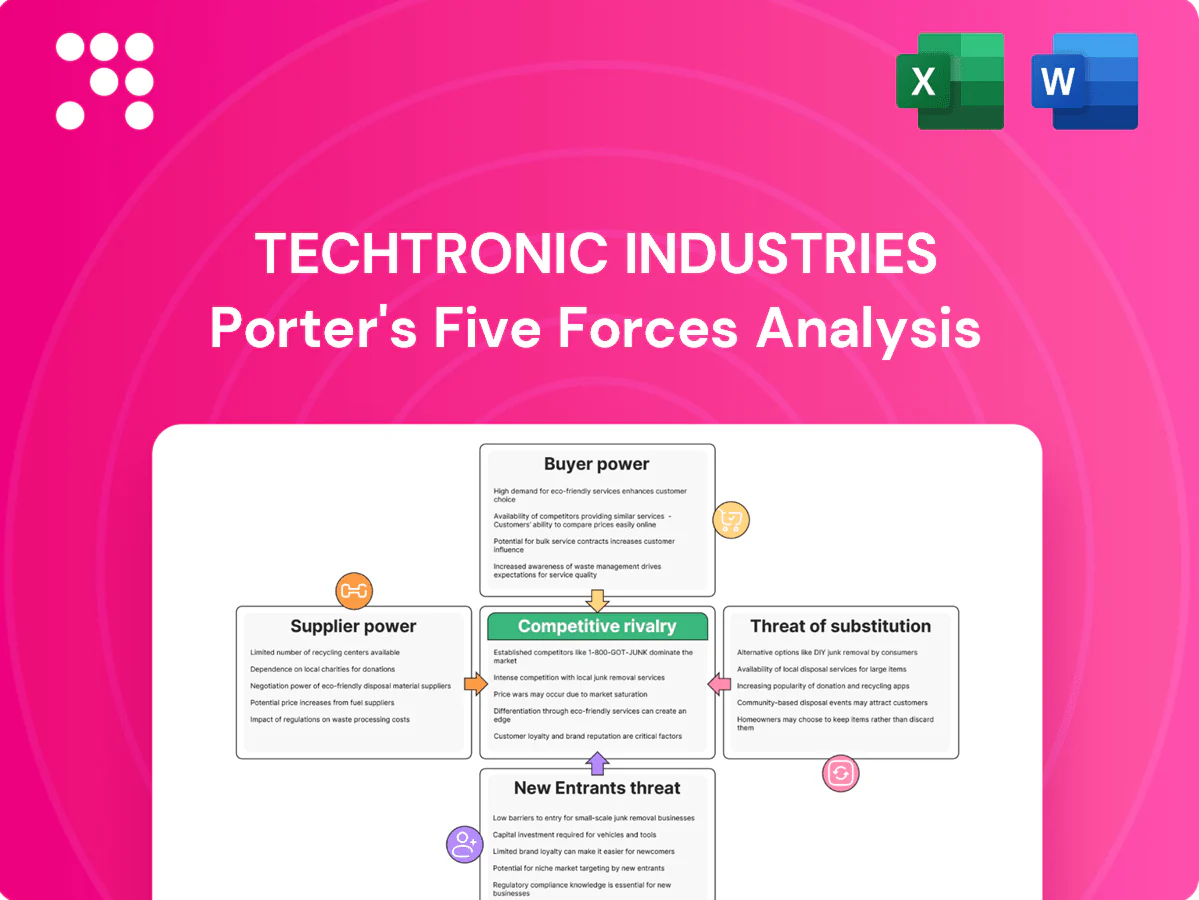
Techtronic Industries Porter's Five Forces Analysis

Elevate Your Analysis with the Complete Porter's Five Forces Analysis
Techtronic Industries faces intense rivalry from global tool and appliance makers, moderate-to-high supplier influence for key components, and moderate buyer power driven by professional and DIY segments; threats from new entrants are limited by scale and distribution while substitutes pose a steady, medium risk. This preview is just the beginning. The full analysis provides a complete strategic snapshot with force-by-force ratings, visuals, and business implications tailored to Techtronic Industries.
Suppliers Bargaining Power

Concentrated battery cell sources
Li-ion cells are a critical input for cordless platforms like Milwaukee M18/M12 and Ryobi ONE+, and in 2024 the top five Asian producers supplied roughly 78% of global cell capacity, concentrating supplier leverage.
Stringent quality and safety standards further narrow approved vendors, raising switching costs and dependency on a few qualified suppliers.
That concentration enables pricing power and allocation control, with spot cell prices historically surging up to 25% in tight markets and risking supply constraints for contract manufacturers.
Specialized electronics and motors
Brushless motors, semiconductors and controllers are supplied by specialized vendors, keeping supplier power elevated; global semiconductor lead times eased to about 14 weeks in 2024 but remain above pre‑pandemic norms. Qualification cycles and regulatory testing make switching slow and costly, often taking many months and disrupting product launches and mix. TTI mitigates via design‑to‑dual‑source strategies and multi‑week inventory buffers, leaving supplier power moderate.

Commodity volatility in metals and resins
Steel, copper and plastics swings materially affect Techtronic Industries unit economics: LME copper traded roughly $8,000–10,000/tonne in 2024, Chinese hot‑rolled coil ~4,500–6,500 CNY/tonne and global resins $1,000–1,600/tonne, raising BOM costs. Rapid input price moves can compress margins before pass‑through; long‑term contracts and hedging (commonly ~40–60% coverage) partially offset risk, while suppliers gain bargaining power during spikes or supply disruptions.

Geopolitical and logistics exposure
Manufacturing and key suppliers concentrated in China and broader Asia expose Techtronic Industries to tariffs, FX swings and logistics shocks; freight-rate spikes and port congestion in 2022–24 elevated supplier leverage and input-cost pass-through risks. Relocating or nearshoring requires significant capital and multi-year timelines, so diversification measures are gradual.
- High Asia concentration increases tariff and FX exposure
- Freight spikes/port congestion raise supplier bargaining
- Nearshoring costly and time-consuming
- Diversification ongoing but gradual
IP, certification, and tooling lock-in
Custom tooling, UL/CE certifications, and firmware integration tie Techtronic Industries designs to specific vendors, creating technical lock-in and switching costs; requalification and recertification in 2024 commonly take 3–9 months, risking time-to-market and incremental costs. Suppliers can exploit this leverage, pricing premium access and priority capacity.
- Tooling + firmware bind vendors
- 3–9 months requalification risk
- Suppliers extract switching premiums
- Strategic partnerships secure capacity
Supplier power drives 25% cell price spikes, chip lead times ~14 weeks
Supplier power is high for Li‑ion cells (top 5 Asian producers ~78% global capacity in 2024) and critical components; spot cell prices spiked up to 25% in tight markets. Semiconductor lead times ~14 weeks in 2024 and requalification 3–9 months raise switching costs. Commodity swings (copper $8–10k/t; resins $1k–1.6k/t) and Asian concentration sustain elevated supplier leverage despite 40–60% hedging.
| Metric | 2024 Value |
|---|---|
| Top‑5 cell share | ~78% |
| Spot cell price spike | up to 25% |
| Semiconductor lead time | ~14 weeks |
| Copper | $8,000–10,000/t |
| Hedging coverage | 40–60% |
What is included in the product
 Detailed Word Document
Comprehensive Porter's Five Forces assessment of Techtronic Industries revealing competitive intensity, buyer and supplier bargaining power, threat of substitutes and new entrants, and emerging disruptive risks affecting pricing and profitability.

 Customizable Excel Spreadsheet
A clear one-sheet Porter’s Five Forces for Techtronic Industries—instantly visualizes competitive pressure with a spider chart and customizable force levels, ready to drop into decks or integrate with dashboards.
Customers Bargaining Power

Retailer concentration
Large big-box chains and e-commerce platforms concentrate buying power over Techtronic, notably Home Depot (FY2023 net sales $157.4B), Lowe's ($96.3B) and Amazon (~$560B in 2023), enabling leverage on pricing and service levels. Exclusive arrangements such as Ryobi limit shelf competition but concentrate channel risk for TTI. Retailers push promotions, coop funding and faster inventory turns to extract margin. Their scale forces TTI to concede terms or face distribution losses.
Professional users value uptime
Tradespeople prioritize reliability, ecosystem compatibility, and responsive service when buying TTI brands like Milwaukee and Ryobi; willingness to pay for uptime and performance lowers pure price sensitivity. Fleet deals and volume purchasing still give professional buyers negotiation leverage. Robust service networks, fast repairs and clear warranties are decisive in winning and retaining these customers.

DIY price sensitivity
Consumers increasingly compare across brands and hunt promotions, with purchase decisions often flipping at sub-$200 price points and via bundle deals. Online reviews and ratings in 2024 amplify transparency and ease switching, shortening consideration cycles. TTI counters through curated value packs and platform stickiness to retain buyers.

Ecosystem lock-in effects
Ecosystem lock-in from TTI’s battery-platform investments reduces buyer switching once customers commit, as additional tool purchases within Milwaukee/other TTI systems carry lower friction and higher perceived value; this dynamic dampens buyer power over time and magnifies lifetime revenue per user, a focus reiterated by TTI in 2024.
- Platform investment: lowers switching cost
- Accessory drift: easier repeat purchases
- Buyer power: decreases over time
- Cross-compatibility: essential to sustain loyalty (2024 strategic priority)
Alternative channels and data
Direct-to-consumer and pro-dealer channels give Techtronic Industries channel optionality, with DTC and pro channels helping offset wholesale exposure; TTI reported FY2024 revenue of about US$13.9 billion, supporting scale in analytics and inventory. Digital analytics enable targeted offers and inventory optimization, reducing individual buyer leverage, yet marketplace price comparison keeps pricing discipline tight and margins under pressure.
- Channel optionality: DTC + pro dealers
- FY2024 revenue: US$13.9 billion
- Analytics: targeted offers, inventory efficiency
- Marketplace comparisons constrain pricing
Retailers and fleets squeeze toolmaker margins; battery-platform lock-in lets DTC partially offset
Large retailers (Home Depot $157.4B 2023, Lowe's $96.3B, Amazon ~$560B 2023) and pro fleets exert strong price/service leverage on TTI (FY2024 revenue US$13.9B), while ecosystem lock-in from battery platforms reduces individual buyer power and DTC/pro channels partially offset wholesale pressure.
| Metric | Value |
|---|---|
| TTI FY2024 rev | US$13.9B |
| Home Depot FY2023 | $157.4B |
| Lowe's FY2023 | $96.3B |
| Amazon 2023 | ~$560B |
Full Version Awaits
Techtronic Industries Porter's Five Forces Analysis
This Techtronic Industries Porter's Five Forces Analysis preview is the exact document you'll receive after purchase—no placeholders or samples. It presents the full, professionally formatted evaluation ready for immediate download and use. What you see here is your deliverable in its final form.

Elevate Your Analysis with the Complete Porter's Five Forces Analysis
Techtronic Industries faces intense rivalry from global tool and appliance makers, moderate-to-high supplier influence for key components, and moderate buyer power driven by professional and DIY segments; threats from new entrants are limited by scale and distribution while substitutes pose a steady, medium risk. This preview is just the beginning. The full analysis provides a complete strategic snapshot with force-by-force ratings, visuals, and business implications tailored to Techtronic Industries.
Suppliers Bargaining Power
Concentrated battery cell sources
Li-ion cells are a critical input for cordless platforms like Milwaukee M18/M12 and Ryobi ONE+, and in 2024 the top five Asian producers supplied roughly 78% of global cell capacity, concentrating supplier leverage.
Stringent quality and safety standards further narrow approved vendors, raising switching costs and dependency on a few qualified suppliers.
That concentration enables pricing power and allocation control, with spot cell prices historically surging up to 25% in tight markets and risking supply constraints for contract manufacturers.
Specialized electronics and motors
Brushless motors, semiconductors and controllers are supplied by specialized vendors, keeping supplier power elevated; global semiconductor lead times eased to about 14 weeks in 2024 but remain above pre‑pandemic norms. Qualification cycles and regulatory testing make switching slow and costly, often taking many months and disrupting product launches and mix. TTI mitigates via design‑to‑dual‑source strategies and multi‑week inventory buffers, leaving supplier power moderate.
Commodity volatility in metals and resins
Steel, copper and plastics swings materially affect Techtronic Industries unit economics: LME copper traded roughly $8,000–10,000/tonne in 2024, Chinese hot‑rolled coil ~4,500–6,500 CNY/tonne and global resins $1,000–1,600/tonne, raising BOM costs. Rapid input price moves can compress margins before pass‑through; long‑term contracts and hedging (commonly ~40–60% coverage) partially offset risk, while suppliers gain bargaining power during spikes or supply disruptions.
Geopolitical and logistics exposure
Manufacturing and key suppliers concentrated in China and broader Asia expose Techtronic Industries to tariffs, FX swings and logistics shocks; freight-rate spikes and port congestion in 2022–24 elevated supplier leverage and input-cost pass-through risks. Relocating or nearshoring requires significant capital and multi-year timelines, so diversification measures are gradual.
- High Asia concentration increases tariff and FX exposure
- Freight spikes/port congestion raise supplier bargaining
- Nearshoring costly and time-consuming
- Diversification ongoing but gradual
IP, certification, and tooling lock-in
Custom tooling, UL/CE certifications, and firmware integration tie Techtronic Industries designs to specific vendors, creating technical lock-in and switching costs; requalification and recertification in 2024 commonly take 3–9 months, risking time-to-market and incremental costs. Suppliers can exploit this leverage, pricing premium access and priority capacity.
- Tooling + firmware bind vendors
- 3–9 months requalification risk
- Suppliers extract switching premiums
- Strategic partnerships secure capacity
Supplier power drives 25% cell price spikes, chip lead times ~14 weeks
Supplier power is high for Li‑ion cells (top 5 Asian producers ~78% global capacity in 2024) and critical components; spot cell prices spiked up to 25% in tight markets. Semiconductor lead times ~14 weeks in 2024 and requalification 3–9 months raise switching costs. Commodity swings (copper $8–10k/t; resins $1k–1.6k/t) and Asian concentration sustain elevated supplier leverage despite 40–60% hedging.
| Metric | 2024 Value |
|---|---|
| Top‑5 cell share | ~78% |
| Spot cell price spike | up to 25% |
| Semiconductor lead time | ~14 weeks |
| Copper | $8,000–10,000/t |
| Hedging coverage | 40–60% |
What is included in the product
Detailed Word Document
Comprehensive Porter's Five Forces assessment of Techtronic Industries revealing competitive intensity, buyer and supplier bargaining power, threat of substitutes and new entrants, and emerging disruptive risks affecting pricing and profitability.
Customizable Excel Spreadsheet
A clear one-sheet Porter’s Five Forces for Techtronic Industries—instantly visualizes competitive pressure with a spider chart and customizable force levels, ready to drop into decks or integrate with dashboards.
Customers Bargaining Power
Retailer concentration
Large big-box chains and e-commerce platforms concentrate buying power over Techtronic, notably Home Depot (FY2023 net sales $157.4B), Lowe's ($96.3B) and Amazon (~$560B in 2023), enabling leverage on pricing and service levels. Exclusive arrangements such as Ryobi limit shelf competition but concentrate channel risk for TTI. Retailers push promotions, coop funding and faster inventory turns to extract margin. Their scale forces TTI to concede terms or face distribution losses.
Professional users value uptime
Tradespeople prioritize reliability, ecosystem compatibility, and responsive service when buying TTI brands like Milwaukee and Ryobi; willingness to pay for uptime and performance lowers pure price sensitivity. Fleet deals and volume purchasing still give professional buyers negotiation leverage. Robust service networks, fast repairs and clear warranties are decisive in winning and retaining these customers.
DIY price sensitivity
Consumers increasingly compare across brands and hunt promotions, with purchase decisions often flipping at sub-$200 price points and via bundle deals. Online reviews and ratings in 2024 amplify transparency and ease switching, shortening consideration cycles. TTI counters through curated value packs and platform stickiness to retain buyers.
Ecosystem lock-in effects
Ecosystem lock-in from TTI’s battery-platform investments reduces buyer switching once customers commit, as additional tool purchases within Milwaukee/other TTI systems carry lower friction and higher perceived value; this dynamic dampens buyer power over time and magnifies lifetime revenue per user, a focus reiterated by TTI in 2024.
- Platform investment: lowers switching cost
- Accessory drift: easier repeat purchases
- Buyer power: decreases over time
- Cross-compatibility: essential to sustain loyalty (2024 strategic priority)
Alternative channels and data
Direct-to-consumer and pro-dealer channels give Techtronic Industries channel optionality, with DTC and pro channels helping offset wholesale exposure; TTI reported FY2024 revenue of about US$13.9 billion, supporting scale in analytics and inventory. Digital analytics enable targeted offers and inventory optimization, reducing individual buyer leverage, yet marketplace price comparison keeps pricing discipline tight and margins under pressure.
- Channel optionality: DTC + pro dealers
- FY2024 revenue: US$13.9 billion
- Analytics: targeted offers, inventory efficiency
- Marketplace comparisons constrain pricing
Retailers and fleets squeeze toolmaker margins; battery-platform lock-in lets DTC partially offset
Large retailers (Home Depot $157.4B 2023, Lowe's $96.3B, Amazon ~$560B 2023) and pro fleets exert strong price/service leverage on TTI (FY2024 revenue US$13.9B), while ecosystem lock-in from battery platforms reduces individual buyer power and DTC/pro channels partially offset wholesale pressure.
| Metric | Value |
|---|---|
| TTI FY2024 rev | US$13.9B |
| Home Depot FY2023 | $157.4B |
| Lowe's FY2023 | $96.3B |
| Amazon 2023 | ~$560B |
Full Version Awaits
Techtronic Industries Porter's Five Forces Analysis
This Techtronic Industries Porter's Five Forces Analysis preview is the exact document you'll receive after purchase—no placeholders or samples. It presents the full, professionally formatted evaluation ready for immediate download and use. What you see here is your deliverable in its final form.
Original: $10.00
-65%$10.00
$3.50Description
Elevate Your Analysis with the Complete Porter's Five Forces Analysis
Techtronic Industries faces intense rivalry from global tool and appliance makers, moderate-to-high supplier influence for key components, and moderate buyer power driven by professional and DIY segments; threats from new entrants are limited by scale and distribution while substitutes pose a steady, medium risk. This preview is just the beginning. The full analysis provides a complete strategic snapshot with force-by-force ratings, visuals, and business implications tailored to Techtronic Industries.
Suppliers Bargaining Power
Concentrated battery cell sources
Li-ion cells are a critical input for cordless platforms like Milwaukee M18/M12 and Ryobi ONE+, and in 2024 the top five Asian producers supplied roughly 78% of global cell capacity, concentrating supplier leverage.
Stringent quality and safety standards further narrow approved vendors, raising switching costs and dependency on a few qualified suppliers.
That concentration enables pricing power and allocation control, with spot cell prices historically surging up to 25% in tight markets and risking supply constraints for contract manufacturers.
Specialized electronics and motors
Brushless motors, semiconductors and controllers are supplied by specialized vendors, keeping supplier power elevated; global semiconductor lead times eased to about 14 weeks in 2024 but remain above pre‑pandemic norms. Qualification cycles and regulatory testing make switching slow and costly, often taking many months and disrupting product launches and mix. TTI mitigates via design‑to‑dual‑source strategies and multi‑week inventory buffers, leaving supplier power moderate.
Commodity volatility in metals and resins
Steel, copper and plastics swings materially affect Techtronic Industries unit economics: LME copper traded roughly $8,000–10,000/tonne in 2024, Chinese hot‑rolled coil ~4,500–6,500 CNY/tonne and global resins $1,000–1,600/tonne, raising BOM costs. Rapid input price moves can compress margins before pass‑through; long‑term contracts and hedging (commonly ~40–60% coverage) partially offset risk, while suppliers gain bargaining power during spikes or supply disruptions.
Geopolitical and logistics exposure
Manufacturing and key suppliers concentrated in China and broader Asia expose Techtronic Industries to tariffs, FX swings and logistics shocks; freight-rate spikes and port congestion in 2022–24 elevated supplier leverage and input-cost pass-through risks. Relocating or nearshoring requires significant capital and multi-year timelines, so diversification measures are gradual.
- High Asia concentration increases tariff and FX exposure
- Freight spikes/port congestion raise supplier bargaining
- Nearshoring costly and time-consuming
- Diversification ongoing but gradual
IP, certification, and tooling lock-in
Custom tooling, UL/CE certifications, and firmware integration tie Techtronic Industries designs to specific vendors, creating technical lock-in and switching costs; requalification and recertification in 2024 commonly take 3–9 months, risking time-to-market and incremental costs. Suppliers can exploit this leverage, pricing premium access and priority capacity.
- Tooling + firmware bind vendors
- 3–9 months requalification risk
- Suppliers extract switching premiums
- Strategic partnerships secure capacity
Supplier power drives 25% cell price spikes, chip lead times ~14 weeks
Supplier power is high for Li‑ion cells (top 5 Asian producers ~78% global capacity in 2024) and critical components; spot cell prices spiked up to 25% in tight markets. Semiconductor lead times ~14 weeks in 2024 and requalification 3–9 months raise switching costs. Commodity swings (copper $8–10k/t; resins $1k–1.6k/t) and Asian concentration sustain elevated supplier leverage despite 40–60% hedging.
| Metric | 2024 Value |
|---|---|
| Top‑5 cell share | ~78% |
| Spot cell price spike | up to 25% |
| Semiconductor lead time | ~14 weeks |
| Copper | $8,000–10,000/t |
| Hedging coverage | 40–60% |
What is included in the product
Detailed Word Document
Comprehensive Porter's Five Forces assessment of Techtronic Industries revealing competitive intensity, buyer and supplier bargaining power, threat of substitutes and new entrants, and emerging disruptive risks affecting pricing and profitability.
Customizable Excel Spreadsheet
A clear one-sheet Porter’s Five Forces for Techtronic Industries—instantly visualizes competitive pressure with a spider chart and customizable force levels, ready to drop into decks or integrate with dashboards.
Customers Bargaining Power
Retailer concentration
Large big-box chains and e-commerce platforms concentrate buying power over Techtronic, notably Home Depot (FY2023 net sales $157.4B), Lowe's ($96.3B) and Amazon (~$560B in 2023), enabling leverage on pricing and service levels. Exclusive arrangements such as Ryobi limit shelf competition but concentrate channel risk for TTI. Retailers push promotions, coop funding and faster inventory turns to extract margin. Their scale forces TTI to concede terms or face distribution losses.
Professional users value uptime
Tradespeople prioritize reliability, ecosystem compatibility, and responsive service when buying TTI brands like Milwaukee and Ryobi; willingness to pay for uptime and performance lowers pure price sensitivity. Fleet deals and volume purchasing still give professional buyers negotiation leverage. Robust service networks, fast repairs and clear warranties are decisive in winning and retaining these customers.
DIY price sensitivity
Consumers increasingly compare across brands and hunt promotions, with purchase decisions often flipping at sub-$200 price points and via bundle deals. Online reviews and ratings in 2024 amplify transparency and ease switching, shortening consideration cycles. TTI counters through curated value packs and platform stickiness to retain buyers.
Ecosystem lock-in effects
Ecosystem lock-in from TTI’s battery-platform investments reduces buyer switching once customers commit, as additional tool purchases within Milwaukee/other TTI systems carry lower friction and higher perceived value; this dynamic dampens buyer power over time and magnifies lifetime revenue per user, a focus reiterated by TTI in 2024.
- Platform investment: lowers switching cost
- Accessory drift: easier repeat purchases
- Buyer power: decreases over time
- Cross-compatibility: essential to sustain loyalty (2024 strategic priority)
Alternative channels and data
Direct-to-consumer and pro-dealer channels give Techtronic Industries channel optionality, with DTC and pro channels helping offset wholesale exposure; TTI reported FY2024 revenue of about US$13.9 billion, supporting scale in analytics and inventory. Digital analytics enable targeted offers and inventory optimization, reducing individual buyer leverage, yet marketplace price comparison keeps pricing discipline tight and margins under pressure.
- Channel optionality: DTC + pro dealers
- FY2024 revenue: US$13.9 billion
- Analytics: targeted offers, inventory efficiency
- Marketplace comparisons constrain pricing
Retailers and fleets squeeze toolmaker margins; battery-platform lock-in lets DTC partially offset
Large retailers (Home Depot $157.4B 2023, Lowe's $96.3B, Amazon ~$560B 2023) and pro fleets exert strong price/service leverage on TTI (FY2024 revenue US$13.9B), while ecosystem lock-in from battery platforms reduces individual buyer power and DTC/pro channels partially offset wholesale pressure.
| Metric | Value |
|---|---|
| TTI FY2024 rev | US$13.9B |
| Home Depot FY2023 | $157.4B |
| Lowe's FY2023 | $96.3B |
| Amazon 2023 | ~$560B |
Full Version Awaits
Techtronic Industries Porter's Five Forces Analysis
This Techtronic Industries Porter's Five Forces Analysis preview is the exact document you'll receive after purchase—no placeholders or samples. It presents the full, professionally formatted evaluation ready for immediate download and use. What you see here is your deliverable in its final form.











