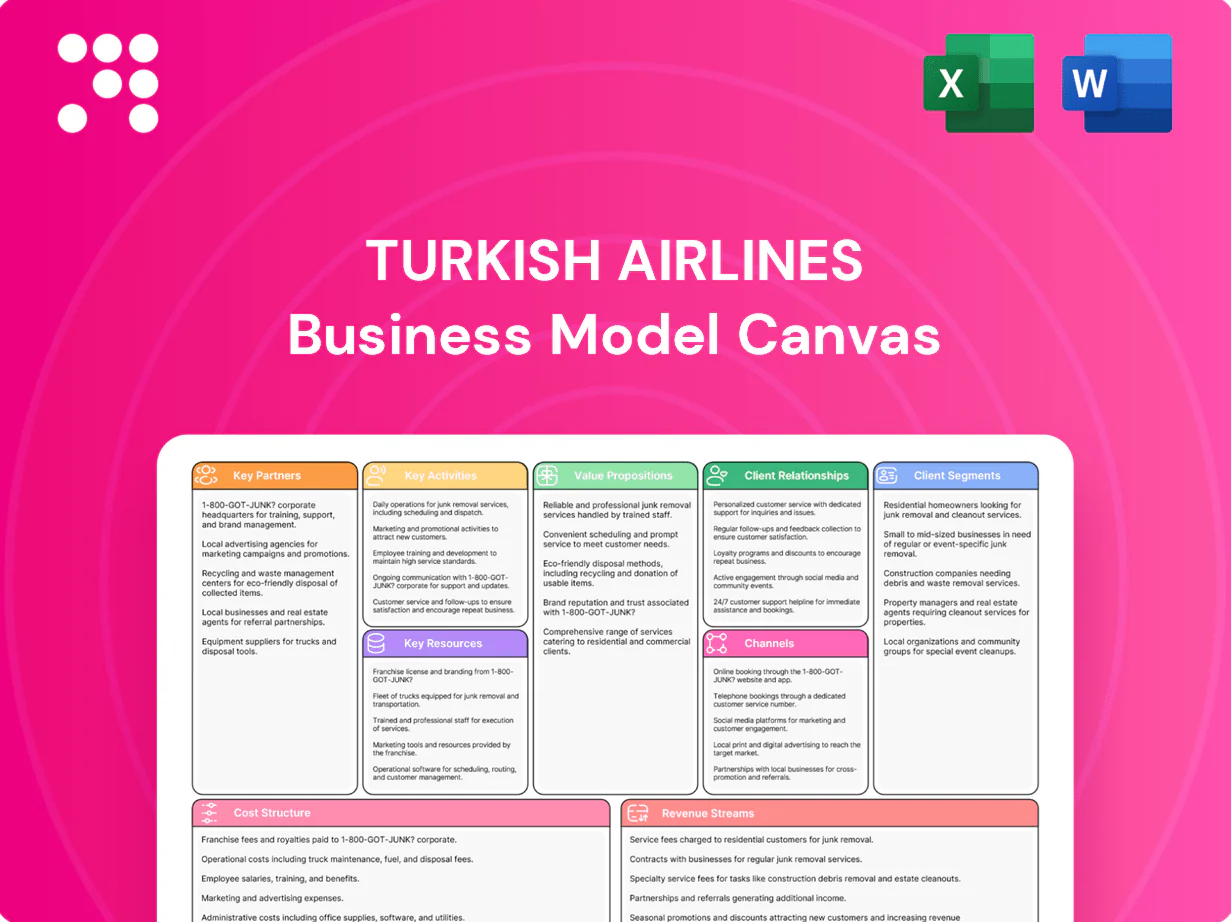
Turkish Airlines Business Model Canvas

Explore an airline Business Model Canvas: route network, partnerships and unit-cost levers
Explore Turkish Airlines’ Business Model Canvas to see how route network, partnerships and low unit costs drive competitive advantage. This preview highlights core value propositions and revenue levers. Download the full, editable Word & Excel canvas for a detailed, investor-ready, section-by-section analysis.
Partnerships

Star Alliance & Codeshare Partners
As a Star Alliance member since 2008, Turkish Airlines links its own network of over 340 destinations with the alliance’s 26 carriers and 1,300+ destinations across 195 countries, boosting reach and schedule density. Codeshares deliver seamless itineraries and reciprocal passenger benefits via through-ticketing, while joint marketing and alliance sales lift load factors and yield. Interline agreements enable checked-baggage transfer and coordinated disruption recovery across partners.
Aircraft OEMs, Lessors & MRO Providers
Partnerships with Airbus and Boeing secure access to a global backlog exceeding 12,000 aircraft in 2024, enabling deliveries, crew training and performance upgrades. Lessors—who owned roughly 50% of the global commercial fleet in 2024—provide flexible capacity and balance-sheet efficiency. OEM/MRO support and long-term service agreements reduce unscheduled downtime, improve safety and stabilize maintenance costs and turnaround times.

Airports, Ground Handlers & Slot Coordinators
Strategic cooperation at the Istanbul hub optimizes gates, slots and connections by leveraging Istanbul Airport's 200 million annual design capacity and Turkish Airlines' network of over 340 destinations. Ground handling partners drive on-time performance and service quality across over 300 global outstations. Joint capacity planning smooths peak-wave operations by aligning slot allocation and ground resources.

Fuel Suppliers & Hedging Counterparties
Multi-sourcing of jet fuel ensures regional availability and uplift flexibility, supporting continuous ops while jet fuel represented roughly 25–30% of airline operating costs (IATA 2023). Contractual pricing formulas plus coordinated logistics optimize uplift efficiency and turnaround. Hedging counterparties (forwards, swaps) limit price volatility to protect margins, and sustainability partners accelerate SAF procurement and blend trials.
- Multi-source supply
- Pricing formulas & logistics
- Hedging to cap volatility
- SAF partnerships for decarbonization
Government, Regulators & Tourism Boards
Alignment with aviation authorities ensures compliance and traffic rights and supports bilateral air service agreements that enable route access and frequency growth. Turkish Airlines serves over 340 destinations in more than 120 countries, leveraging these agreements to scale networks and hubs. Partnerships with tourism boards co-fund campaigns to stimulate demand, while security and customs coordination with government agencies streamlines passenger flow and ground turnaround.
- Regulatory compliance & traffic rights
- Bilateral agreements → route/frequency growth
- Tourism boards co-funding marketing
- Security & customs coordination for faster flow
Star Alliance hub linking 340+ destinations with fleet flexibility and 200M-capacity Istanbul hub
As Star Alliance member (26 carriers, 1,300+ destinations) Turkish Airlines connects 340+ destinations, boosting network reach and yields. OEMs/backlog ~12,000 aircraft (2024) and lessors (~50% global fleet) underpin fleet flexibility; jet fuel 25–30% of costs (IATA 2023) with hedging and SAF partnerships. Istanbul Airport capacity 200M supports hub efficiency and slot coordination.
| Metric | Value |
|---|---|
| Destinations | 340+ |
| Star Alliance | 26 carriers / 1,300+ dest. |
| Airport capacity | 200M (Istanbul) |
| Fuel share | 25–30% (IATA 2023) |
| OEM backlog | ~12,000 (2024) |
| Leased fleet share | ~50% |
What is included in the product
 Detailed Word Document
A concise Business Model Canvas for Turkish Airlines mapping nine blocks—customer segments, value propositions, channels, customer relationships, revenue streams, key resources, key activities, key partnerships, and cost structure—aligned to its global hub-and-spoke network, fleet strategy, loyalty program, and ancillary revenues to support strategic decision-making and investor discussions.

 Customizable Excel Spreadsheet
High-level view of Turkish Airlines' business model with editable cells, condensing route network, fleet, partnerships and revenue streams into a single, shareable page—perfect for quick strategic reviews, stakeholder briefings or team collaboration.
Activities

Network Planning & Scheduling
Designs hub-and-spoke waves through Istanbul to maximize connectivity, linking 340+ destinations in over 120 countries (2024). Adjusts capacity by route, season and demand elasticity, reallocating aircraft between short-haul and long-haul markets. Manages slots and aircraft rotations to sustain average daily utilization near 11 hours per aircraft. Continuously evaluates new destinations and frequency changes to capture yield opportunities.
Flight Operations & Safety Management
Executes daily flying across 340+ destinations in 129 countries with a fleet of over 400 aircraft, maintaining IOSA and regulatory compliance. Implements recurrent training and strict SOP adherence through centralized training centers. Monitors performance via real-time operations control in Istanbul and advanced dispatch tools. Coordinates with ATC and fuel-optimization procedures to reduce delays and fuel — fuel typically represents 20–30% of airline operating costs.

Fleet Management & Maintenance
Plans acquisitions, retirements and cabin configurations to align with long-haul expansion and regional frequency needs, targeting higher seat-density on key routes.
Performs line and base maintenance across its hubs to ensure airworthiness, complying with EASA and DGCA standards and OEM maintenance programs.
Optimizes fleet mix for range and cost per seat through narrow- and widebody deployment decisions and uses predictive analytics to reduce AOG events and improve dispatch reliability.

Sales, Marketing & Revenue Management
Turkish Airlines prices dynamically using revenue management and O&D optimization across a 340+ destination network (2024), running targeted multi-channel campaigns to stimulate demand and fill key flows. It manages GDS, OTA and direct distribution economics to protect yield and negotiates corporate and agency contracts to secure volume and ancillary revenue.
- RM + O&D optimization
- Multi-channel demand stimulation
- GDS/OTA/direct distribution economics
- Corporate & agency contracting
Cargo Operations & Belly Optimization
Turkish Airlines allocates belly space and deploys freighter capacity where yields justify, integrating cargo flows with its passenger network of over 340 destinations (2024) to optimize wave connections; it coordinates with forwarders for time-sensitive shipments and maintains regulatory and security compliance with IATA and national aviation authorities.
- Belly/freighter mix optimization
- Forwarder coordination for express cargo
- Wave-integrated routing across 340+ destinations (2024)
- Regulatory & security compliance (IATA, national)
Istanbul hub: 340+ destinations, 400+ fleet, ~11h/day utilization
Operates hub-and-spoke waves via Istanbul to 340+ destinations in 129 countries (2024), reallocating 400+ aircraft to match demand and keeping ~11h avg daily utilization. Ensures IOSA/EASA compliance, recurrent training and real-time ops control for high dispatch reliability. Runs RM/O&D, multi-channel distribution and belly/freighter cargo optimization to protect yield.
| Metric | 2024 |
|---|---|
| Destinations/countries | 340+/129 |
| Fleet | 400+ |
| Avg utilization | ~11h/day |
| Fuel % op.costs | 20–30% |
Preview Before You Purchase
Business Model Canvas
The Turkish Airlines Business Model Canvas you see here is the actual deliverable, not a mockup or sample—it's a direct snapshot of the file you will receive after purchase. When you complete your order, you’ll get this same professional, ready-to-use document instantly, formatted exactly as shown and suitable for editing, presenting, or sharing. No fillers, no surprises—what you preview is what you’ll own.

Explore an airline Business Model Canvas: route network, partnerships and unit-cost levers
Explore Turkish Airlines’ Business Model Canvas to see how route network, partnerships and low unit costs drive competitive advantage. This preview highlights core value propositions and revenue levers. Download the full, editable Word & Excel canvas for a detailed, investor-ready, section-by-section analysis.
Partnerships
Star Alliance & Codeshare Partners
As a Star Alliance member since 2008, Turkish Airlines links its own network of over 340 destinations with the alliance’s 26 carriers and 1,300+ destinations across 195 countries, boosting reach and schedule density. Codeshares deliver seamless itineraries and reciprocal passenger benefits via through-ticketing, while joint marketing and alliance sales lift load factors and yield. Interline agreements enable checked-baggage transfer and coordinated disruption recovery across partners.
Aircraft OEMs, Lessors & MRO Providers
Partnerships with Airbus and Boeing secure access to a global backlog exceeding 12,000 aircraft in 2024, enabling deliveries, crew training and performance upgrades. Lessors—who owned roughly 50% of the global commercial fleet in 2024—provide flexible capacity and balance-sheet efficiency. OEM/MRO support and long-term service agreements reduce unscheduled downtime, improve safety and stabilize maintenance costs and turnaround times.
Airports, Ground Handlers & Slot Coordinators
Strategic cooperation at the Istanbul hub optimizes gates, slots and connections by leveraging Istanbul Airport's 200 million annual design capacity and Turkish Airlines' network of over 340 destinations. Ground handling partners drive on-time performance and service quality across over 300 global outstations. Joint capacity planning smooths peak-wave operations by aligning slot allocation and ground resources.
Fuel Suppliers & Hedging Counterparties
Multi-sourcing of jet fuel ensures regional availability and uplift flexibility, supporting continuous ops while jet fuel represented roughly 25–30% of airline operating costs (IATA 2023). Contractual pricing formulas plus coordinated logistics optimize uplift efficiency and turnaround. Hedging counterparties (forwards, swaps) limit price volatility to protect margins, and sustainability partners accelerate SAF procurement and blend trials.
- Multi-source supply
- Pricing formulas & logistics
- Hedging to cap volatility
- SAF partnerships for decarbonization
Government, Regulators & Tourism Boards
Alignment with aviation authorities ensures compliance and traffic rights and supports bilateral air service agreements that enable route access and frequency growth. Turkish Airlines serves over 340 destinations in more than 120 countries, leveraging these agreements to scale networks and hubs. Partnerships with tourism boards co-fund campaigns to stimulate demand, while security and customs coordination with government agencies streamlines passenger flow and ground turnaround.
- Regulatory compliance & traffic rights
- Bilateral agreements → route/frequency growth
- Tourism boards co-funding marketing
- Security & customs coordination for faster flow
Star Alliance hub linking 340+ destinations with fleet flexibility and 200M-capacity Istanbul hub
As Star Alliance member (26 carriers, 1,300+ destinations) Turkish Airlines connects 340+ destinations, boosting network reach and yields. OEMs/backlog ~12,000 aircraft (2024) and lessors (~50% global fleet) underpin fleet flexibility; jet fuel 25–30% of costs (IATA 2023) with hedging and SAF partnerships. Istanbul Airport capacity 200M supports hub efficiency and slot coordination.
| Metric | Value |
|---|---|
| Destinations | 340+ |
| Star Alliance | 26 carriers / 1,300+ dest. |
| Airport capacity | 200M (Istanbul) |
| Fuel share | 25–30% (IATA 2023) |
| OEM backlog | ~12,000 (2024) |
| Leased fleet share | ~50% |
What is included in the product
Detailed Word Document
A concise Business Model Canvas for Turkish Airlines mapping nine blocks—customer segments, value propositions, channels, customer relationships, revenue streams, key resources, key activities, key partnerships, and cost structure—aligned to its global hub-and-spoke network, fleet strategy, loyalty program, and ancillary revenues to support strategic decision-making and investor discussions.
Customizable Excel Spreadsheet
High-level view of Turkish Airlines' business model with editable cells, condensing route network, fleet, partnerships and revenue streams into a single, shareable page—perfect for quick strategic reviews, stakeholder briefings or team collaboration.
Activities
Network Planning & Scheduling
Designs hub-and-spoke waves through Istanbul to maximize connectivity, linking 340+ destinations in over 120 countries (2024). Adjusts capacity by route, season and demand elasticity, reallocating aircraft between short-haul and long-haul markets. Manages slots and aircraft rotations to sustain average daily utilization near 11 hours per aircraft. Continuously evaluates new destinations and frequency changes to capture yield opportunities.
Flight Operations & Safety Management
Executes daily flying across 340+ destinations in 129 countries with a fleet of over 400 aircraft, maintaining IOSA and regulatory compliance. Implements recurrent training and strict SOP adherence through centralized training centers. Monitors performance via real-time operations control in Istanbul and advanced dispatch tools. Coordinates with ATC and fuel-optimization procedures to reduce delays and fuel — fuel typically represents 20–30% of airline operating costs.
Fleet Management & Maintenance
Plans acquisitions, retirements and cabin configurations to align with long-haul expansion and regional frequency needs, targeting higher seat-density on key routes.
Performs line and base maintenance across its hubs to ensure airworthiness, complying with EASA and DGCA standards and OEM maintenance programs.
Optimizes fleet mix for range and cost per seat through narrow- and widebody deployment decisions and uses predictive analytics to reduce AOG events and improve dispatch reliability.
Sales, Marketing & Revenue Management
Turkish Airlines prices dynamically using revenue management and O&D optimization across a 340+ destination network (2024), running targeted multi-channel campaigns to stimulate demand and fill key flows. It manages GDS, OTA and direct distribution economics to protect yield and negotiates corporate and agency contracts to secure volume and ancillary revenue.
- RM + O&D optimization
- Multi-channel demand stimulation
- GDS/OTA/direct distribution economics
- Corporate & agency contracting
Cargo Operations & Belly Optimization
Turkish Airlines allocates belly space and deploys freighter capacity where yields justify, integrating cargo flows with its passenger network of over 340 destinations (2024) to optimize wave connections; it coordinates with forwarders for time-sensitive shipments and maintains regulatory and security compliance with IATA and national aviation authorities.
- Belly/freighter mix optimization
- Forwarder coordination for express cargo
- Wave-integrated routing across 340+ destinations (2024)
- Regulatory & security compliance (IATA, national)
Istanbul hub: 340+ destinations, 400+ fleet, ~11h/day utilization
Operates hub-and-spoke waves via Istanbul to 340+ destinations in 129 countries (2024), reallocating 400+ aircraft to match demand and keeping ~11h avg daily utilization. Ensures IOSA/EASA compliance, recurrent training and real-time ops control for high dispatch reliability. Runs RM/O&D, multi-channel distribution and belly/freighter cargo optimization to protect yield.
| Metric | 2024 |
|---|---|
| Destinations/countries | 340+/129 |
| Fleet | 400+ |
| Avg utilization | ~11h/day |
| Fuel % op.costs | 20–30% |
Preview Before You Purchase
Business Model Canvas
The Turkish Airlines Business Model Canvas you see here is the actual deliverable, not a mockup or sample—it's a direct snapshot of the file you will receive after purchase. When you complete your order, you’ll get this same professional, ready-to-use document instantly, formatted exactly as shown and suitable for editing, presenting, or sharing. No fillers, no surprises—what you preview is what you’ll own.
Original: $10.00
-65%$10.00
$3.50Description
Explore an airline Business Model Canvas: route network, partnerships and unit-cost levers
Explore Turkish Airlines’ Business Model Canvas to see how route network, partnerships and low unit costs drive competitive advantage. This preview highlights core value propositions and revenue levers. Download the full, editable Word & Excel canvas for a detailed, investor-ready, section-by-section analysis.
Partnerships
Star Alliance & Codeshare Partners
As a Star Alliance member since 2008, Turkish Airlines links its own network of over 340 destinations with the alliance’s 26 carriers and 1,300+ destinations across 195 countries, boosting reach and schedule density. Codeshares deliver seamless itineraries and reciprocal passenger benefits via through-ticketing, while joint marketing and alliance sales lift load factors and yield. Interline agreements enable checked-baggage transfer and coordinated disruption recovery across partners.
Aircraft OEMs, Lessors & MRO Providers
Partnerships with Airbus and Boeing secure access to a global backlog exceeding 12,000 aircraft in 2024, enabling deliveries, crew training and performance upgrades. Lessors—who owned roughly 50% of the global commercial fleet in 2024—provide flexible capacity and balance-sheet efficiency. OEM/MRO support and long-term service agreements reduce unscheduled downtime, improve safety and stabilize maintenance costs and turnaround times.
Airports, Ground Handlers & Slot Coordinators
Strategic cooperation at the Istanbul hub optimizes gates, slots and connections by leveraging Istanbul Airport's 200 million annual design capacity and Turkish Airlines' network of over 340 destinations. Ground handling partners drive on-time performance and service quality across over 300 global outstations. Joint capacity planning smooths peak-wave operations by aligning slot allocation and ground resources.
Fuel Suppliers & Hedging Counterparties
Multi-sourcing of jet fuel ensures regional availability and uplift flexibility, supporting continuous ops while jet fuel represented roughly 25–30% of airline operating costs (IATA 2023). Contractual pricing formulas plus coordinated logistics optimize uplift efficiency and turnaround. Hedging counterparties (forwards, swaps) limit price volatility to protect margins, and sustainability partners accelerate SAF procurement and blend trials.
- Multi-source supply
- Pricing formulas & logistics
- Hedging to cap volatility
- SAF partnerships for decarbonization
Government, Regulators & Tourism Boards
Alignment with aviation authorities ensures compliance and traffic rights and supports bilateral air service agreements that enable route access and frequency growth. Turkish Airlines serves over 340 destinations in more than 120 countries, leveraging these agreements to scale networks and hubs. Partnerships with tourism boards co-fund campaigns to stimulate demand, while security and customs coordination with government agencies streamlines passenger flow and ground turnaround.
- Regulatory compliance & traffic rights
- Bilateral agreements → route/frequency growth
- Tourism boards co-funding marketing
- Security & customs coordination for faster flow
Star Alliance hub linking 340+ destinations with fleet flexibility and 200M-capacity Istanbul hub
As Star Alliance member (26 carriers, 1,300+ destinations) Turkish Airlines connects 340+ destinations, boosting network reach and yields. OEMs/backlog ~12,000 aircraft (2024) and lessors (~50% global fleet) underpin fleet flexibility; jet fuel 25–30% of costs (IATA 2023) with hedging and SAF partnerships. Istanbul Airport capacity 200M supports hub efficiency and slot coordination.
| Metric | Value |
|---|---|
| Destinations | 340+ |
| Star Alliance | 26 carriers / 1,300+ dest. |
| Airport capacity | 200M (Istanbul) |
| Fuel share | 25–30% (IATA 2023) |
| OEM backlog | ~12,000 (2024) |
| Leased fleet share | ~50% |
What is included in the product
Detailed Word Document
A concise Business Model Canvas for Turkish Airlines mapping nine blocks—customer segments, value propositions, channels, customer relationships, revenue streams, key resources, key activities, key partnerships, and cost structure—aligned to its global hub-and-spoke network, fleet strategy, loyalty program, and ancillary revenues to support strategic decision-making and investor discussions.
Customizable Excel Spreadsheet
High-level view of Turkish Airlines' business model with editable cells, condensing route network, fleet, partnerships and revenue streams into a single, shareable page—perfect for quick strategic reviews, stakeholder briefings or team collaboration.
Activities
Network Planning & Scheduling
Designs hub-and-spoke waves through Istanbul to maximize connectivity, linking 340+ destinations in over 120 countries (2024). Adjusts capacity by route, season and demand elasticity, reallocating aircraft between short-haul and long-haul markets. Manages slots and aircraft rotations to sustain average daily utilization near 11 hours per aircraft. Continuously evaluates new destinations and frequency changes to capture yield opportunities.
Flight Operations & Safety Management
Executes daily flying across 340+ destinations in 129 countries with a fleet of over 400 aircraft, maintaining IOSA and regulatory compliance. Implements recurrent training and strict SOP adherence through centralized training centers. Monitors performance via real-time operations control in Istanbul and advanced dispatch tools. Coordinates with ATC and fuel-optimization procedures to reduce delays and fuel — fuel typically represents 20–30% of airline operating costs.
Fleet Management & Maintenance
Plans acquisitions, retirements and cabin configurations to align with long-haul expansion and regional frequency needs, targeting higher seat-density on key routes.
Performs line and base maintenance across its hubs to ensure airworthiness, complying with EASA and DGCA standards and OEM maintenance programs.
Optimizes fleet mix for range and cost per seat through narrow- and widebody deployment decisions and uses predictive analytics to reduce AOG events and improve dispatch reliability.
Sales, Marketing & Revenue Management
Turkish Airlines prices dynamically using revenue management and O&D optimization across a 340+ destination network (2024), running targeted multi-channel campaigns to stimulate demand and fill key flows. It manages GDS, OTA and direct distribution economics to protect yield and negotiates corporate and agency contracts to secure volume and ancillary revenue.
- RM + O&D optimization
- Multi-channel demand stimulation
- GDS/OTA/direct distribution economics
- Corporate & agency contracting
Cargo Operations & Belly Optimization
Turkish Airlines allocates belly space and deploys freighter capacity where yields justify, integrating cargo flows with its passenger network of over 340 destinations (2024) to optimize wave connections; it coordinates with forwarders for time-sensitive shipments and maintains regulatory and security compliance with IATA and national aviation authorities.
- Belly/freighter mix optimization
- Forwarder coordination for express cargo
- Wave-integrated routing across 340+ destinations (2024)
- Regulatory & security compliance (IATA, national)
Istanbul hub: 340+ destinations, 400+ fleet, ~11h/day utilization
Operates hub-and-spoke waves via Istanbul to 340+ destinations in 129 countries (2024), reallocating 400+ aircraft to match demand and keeping ~11h avg daily utilization. Ensures IOSA/EASA compliance, recurrent training and real-time ops control for high dispatch reliability. Runs RM/O&D, multi-channel distribution and belly/freighter cargo optimization to protect yield.
| Metric | 2024 |
|---|---|
| Destinations/countries | 340+/129 |
| Fleet | 400+ |
| Avg utilization | ~11h/day |
| Fuel % op.costs | 20–30% |
Preview Before You Purchase
Business Model Canvas
The Turkish Airlines Business Model Canvas you see here is the actual deliverable, not a mockup or sample—it's a direct snapshot of the file you will receive after purchase. When you complete your order, you’ll get this same professional, ready-to-use document instantly, formatted exactly as shown and suitable for editing, presenting, or sharing. No fillers, no surprises—what you preview is what you’ll own.











