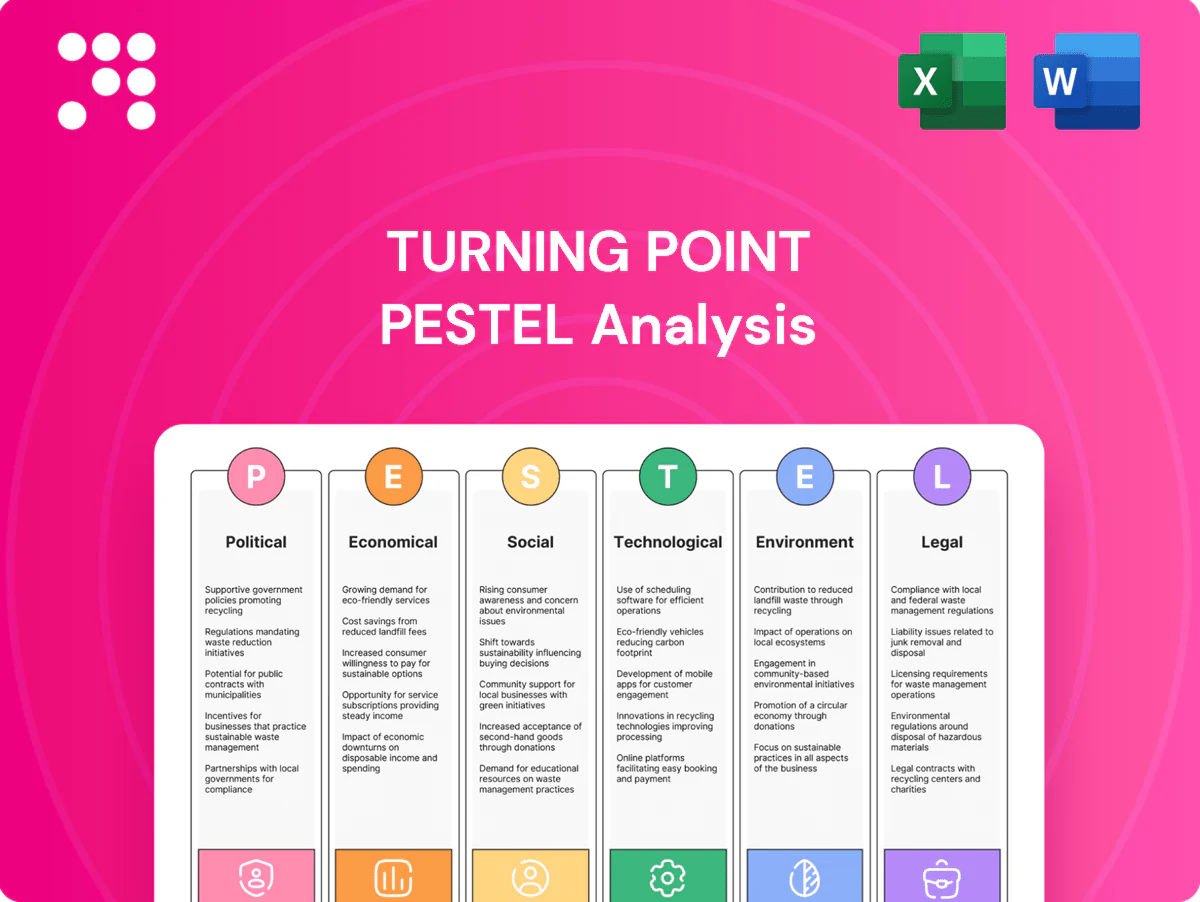
Turning Point PESTLE Analysis

Make Smarter Strategic Decisions with a Complete PESTEL View
Unlock decisive insights with our Turning Point PESTLE Analysis—three concise sections reveal how political, economic, social, technological, legal, and environmental forces will shape the company's trajectory. Ideal for investors and strategists seeking actionable intelligence. Purchase the full report for the complete, editable breakdown and immediate download.
Political factors

Shifting tobacco and nicotine control agendas
Federal shifts between harm reduction and prohibition determine category viability; CDC reports adult smoking at 12.5% (2022) while 2.55 million US youth used e-cigarettes (2022), keeping regulators focused on youth access. Administration changes can rapidly alter FDA review timelines and enforcement intensity. Turning Point must scenario-plan for rapid federal priority pivots to protect market access and compliance.
Excise tax policy and fiscal pressures
States and localities may broaden or raise excise taxes on alternative nicotine products to backfill budgets, with over 30 states taxing e-cigarettes as of 2024. Tax parity debates with combustible cigarettes (federal tax $1.01/pack; state rates range roughly $0.17–$4.35/pack in 2024) directly affect pricing power and margins. Differential tax regimes shape product mix and regional distribution strategies.

State-by-state policy fragmentation
State-by-state policy fragmentation means flavor bans, retail licensing and point-of-sale rules vary widely across states and municipalities, creating a patchwork of compliance requirements. Dozens of localities now restrict flavors, raising logistics complexity and driving legal and staffing costs higher. These fragmented rules push operators to adopt targeted advocacy and tailored market playbooks to protect access and margins.

Trade policy and component sourcing
China held roughly 70% of global lithium‑ion battery manufacturing capacity in 2024, so geopolitical tensions can disrupt cartridges, coils and packaging; diversified suppliers and nearshoring, supported by the 2022 Inflation Reduction Act (≈369 billion USD in clean energy measures), reduce exposure.
- Tariffs up to 25% increase COGS
- China ≈70% of global Li‑ion capacity (2024)
- Diversify suppliers and nearshore; IRA incentives (≈369bn) boost domestic resilience
Lobbying, public health stakeholders, and coalition-building
Engagement with policymakers and public health groups shapes whether Turning Point is framed as harm-reduction or youth-risk; active advocacy influenced regulatory language in 2023–24. Peer-reviewed meta-analyses through 2024 strengthened adult switching evidence, boosting credibility with regulators and clinicians. Coalition-building with retailers and industry groups stabilizes policy by aligning commercial and public-health incentives amid a global e-cigarette market valued at $22.9B in 2023.
- Policy framing: targeted lobbying with public-health allies
- Evidence: 2024 meta-analyses bolster adult-switching credibility
- Coalitions: retail/industry alignment reduces regulatory volatility
Policy swings, youth vaping & taxes; adult smoking 12.5%, youth 2.55M
Federal swings between harm‑reduction and prohibition drive FDA timelines and enforcement; adult smoking 12.5% (2022) and 2.55M US youth vaped (2022) keep youth access central. Over 30 states taxed e‑cigs by 2024; state cigarette tax range $0.17–$4.35/pack (2024) alters pricing power. China ≈70% of global Li‑ion capacity (2024); tariffs up to 25% raise COGS—IRA ≈369bn aids domestic resilience.
| Metric | Value/Year |
|---|---|
| Adult smoking | 12.5% (2022) |
| Youth e‑cig users | 2.55M (2022) |
| States taxing e‑cigs | >30 (2024) |
| China Li‑ion share | ≈70% (2024) |
| IRA value | ≈$369bn (2022) |
What is included in the product
 Detailed Word Document
Provides a data-driven PESTLE overview of how Political, Economic, Social, Technological, Environmental and Legal forces shape Turning Point, with sector- and region-specific examples. Designed for executives and investors, it offers forward-looking insights and ready-to-use formatting for plans and pitches.

 Customizable Excel Spreadsheet
Turning Point's compact, visually segmented PESTLE summary is editable and easily shareable, letting teams quickly align on external risks and strategic implications and drop concise slides into presentations.
Economic factors

Consumer disposable income sensitivity
Alternative nicotine products show mixed elasticity by format and price tier; Euromonitor projects the global market to grow at roughly 6–8% CAGR through 2028, reflecting varied sensitivity. Recessionary downtrading favored value brands and bulk accessories, with value/share gains of a few percentage points in 2022–23. Premium innovations must deliver clear performance and satisfaction benefits to justify higher prices.
Input cost inflation and supply volatility
Costs for nicotine, flavors, batteries and packaging were highly volatile in 2024, squeezing gross margins and contributing swings in unit cost that in some firms translated to 200–300 basis points of margin pressure. Freight and labor pressures—with global spot container rates and wage growth remaining above pre‑pandemic baselines—raised landed costs and disrupted service levels. Long‑term supply contracts and dual‑sourcing have been adopted to stabilize unit economics and reduce input volatility.

Channel mix and retailer consolidation
Convenience and specialty channels boost velocity but require hefty trade spend, with NielsenIQ estimating trade promotion at roughly 18–20% of CPG revenue. Large retailers (top 4 grocery chains hold about 50%+ of US market) wield bargaining power that compresses margins and enforces strict shelf and packaging standards. E-commerce/DTC, now ~22% of global retail sales, can offset gaps but face tightening marketing rules such as the EU Digital Services Act and sector-specific ad restrictions.

Category growth in new generation products
Smokeless and vapor-adjacent segments can outgrow combustibles when regulation allows; the global e-cigarette market was about $22.5 billion in 2023 and continued high growth into 2024. Innovation cadence (product refresh cycles often 6–12 months) sustains pricing and repeat purchase. Portfolio balancing across combustibles, HNB and vaping helps manage cyclical and regulatory risk.
- Market size: ~$22.5bn (2023)
- Refresh cycle: 6–12 months
- Risk tool: portfolio balancing across categories
FX and international optionality
Currency swings materially affect landed costs for international sourcing; the US dollar index closed 2024 around 103.5, amplifying import price variability and margin pressure. Select export markets (India, Vietnam) offer above-average demand, but require upfront local compliance investment. Active FX hedging and localized supply chains have cut reported earnings volatility for many exporters, supported by IMF 2025 world growth ~3.0%.
- DXY ~103.5 (end-2024)
- IMF world growth ~3.0% (2025)
- Hedging lowers earnings volatility
- Local compliance raises upfront capex
Policy swings, youth vaping & taxes; adult smoking 12.5%, youth 2.55M
Alternative nicotine markets growing ~6–8% CAGR to 2028, with 2023 market ~$22.5bn; recessionary downtrading lifted value-share in 2022–23 while premium requires clear performance to hold price. 2024 input volatility cut gross margins by ~200–300bp for some firms; firms respond with dual‑sourcing, hedging and local capex. Large retailers compress margins; trade spend ~18–20% of revenue; e‑commerce ~22% of retail.
| Metric | Value |
|---|---|
| Global e‑cig market (2023) | $22.5bn |
| CAGR to 2028 | 6–8% |
| DXY (end‑2024) | ~103.5 |
| IMF world growth (2025) | ~3.0% |
| Trade spend | 18–20% rev |
| E‑commerce share | ~22% |
What You See Is What You Get
Turning Point PESTLE Analysis
The Turning Point PESTLE Analysis preview shown here is the exact document you’ll receive after purchase—fully formatted and ready to use. It contains the same content, structure, and professional layout visible now, with no placeholders or surprises. After checkout you’ll instantly be able to download this final, ready-to-use file.

Make Smarter Strategic Decisions with a Complete PESTEL View
Unlock decisive insights with our Turning Point PESTLE Analysis—three concise sections reveal how political, economic, social, technological, legal, and environmental forces will shape the company's trajectory. Ideal for investors and strategists seeking actionable intelligence. Purchase the full report for the complete, editable breakdown and immediate download.
Political factors
Shifting tobacco and nicotine control agendas
Federal shifts between harm reduction and prohibition determine category viability; CDC reports adult smoking at 12.5% (2022) while 2.55 million US youth used e-cigarettes (2022), keeping regulators focused on youth access. Administration changes can rapidly alter FDA review timelines and enforcement intensity. Turning Point must scenario-plan for rapid federal priority pivots to protect market access and compliance.
Excise tax policy and fiscal pressures
States and localities may broaden or raise excise taxes on alternative nicotine products to backfill budgets, with over 30 states taxing e-cigarettes as of 2024. Tax parity debates with combustible cigarettes (federal tax $1.01/pack; state rates range roughly $0.17–$4.35/pack in 2024) directly affect pricing power and margins. Differential tax regimes shape product mix and regional distribution strategies.
State-by-state policy fragmentation
State-by-state policy fragmentation means flavor bans, retail licensing and point-of-sale rules vary widely across states and municipalities, creating a patchwork of compliance requirements. Dozens of localities now restrict flavors, raising logistics complexity and driving legal and staffing costs higher. These fragmented rules push operators to adopt targeted advocacy and tailored market playbooks to protect access and margins.
Trade policy and component sourcing
China held roughly 70% of global lithium‑ion battery manufacturing capacity in 2024, so geopolitical tensions can disrupt cartridges, coils and packaging; diversified suppliers and nearshoring, supported by the 2022 Inflation Reduction Act (≈369 billion USD in clean energy measures), reduce exposure.
- Tariffs up to 25% increase COGS
- China ≈70% of global Li‑ion capacity (2024)
- Diversify suppliers and nearshore; IRA incentives (≈369bn) boost domestic resilience
Lobbying, public health stakeholders, and coalition-building
Engagement with policymakers and public health groups shapes whether Turning Point is framed as harm-reduction or youth-risk; active advocacy influenced regulatory language in 2023–24. Peer-reviewed meta-analyses through 2024 strengthened adult switching evidence, boosting credibility with regulators and clinicians. Coalition-building with retailers and industry groups stabilizes policy by aligning commercial and public-health incentives amid a global e-cigarette market valued at $22.9B in 2023.
- Policy framing: targeted lobbying with public-health allies
- Evidence: 2024 meta-analyses bolster adult-switching credibility
- Coalitions: retail/industry alignment reduces regulatory volatility
Policy swings, youth vaping & taxes; adult smoking 12.5%, youth 2.55M
Federal swings between harm‑reduction and prohibition drive FDA timelines and enforcement; adult smoking 12.5% (2022) and 2.55M US youth vaped (2022) keep youth access central. Over 30 states taxed e‑cigs by 2024; state cigarette tax range $0.17–$4.35/pack (2024) alters pricing power. China ≈70% of global Li‑ion capacity (2024); tariffs up to 25% raise COGS—IRA ≈369bn aids domestic resilience.
| Metric | Value/Year |
|---|---|
| Adult smoking | 12.5% (2022) |
| Youth e‑cig users | 2.55M (2022) |
| States taxing e‑cigs | >30 (2024) |
| China Li‑ion share | ≈70% (2024) |
| IRA value | ≈$369bn (2022) |
What is included in the product
Detailed Word Document
Provides a data-driven PESTLE overview of how Political, Economic, Social, Technological, Environmental and Legal forces shape Turning Point, with sector- and region-specific examples. Designed for executives and investors, it offers forward-looking insights and ready-to-use formatting for plans and pitches.
Customizable Excel Spreadsheet
Turning Point's compact, visually segmented PESTLE summary is editable and easily shareable, letting teams quickly align on external risks and strategic implications and drop concise slides into presentations.
Economic factors
Consumer disposable income sensitivity
Alternative nicotine products show mixed elasticity by format and price tier; Euromonitor projects the global market to grow at roughly 6–8% CAGR through 2028, reflecting varied sensitivity. Recessionary downtrading favored value brands and bulk accessories, with value/share gains of a few percentage points in 2022–23. Premium innovations must deliver clear performance and satisfaction benefits to justify higher prices.
Input cost inflation and supply volatility
Costs for nicotine, flavors, batteries and packaging were highly volatile in 2024, squeezing gross margins and contributing swings in unit cost that in some firms translated to 200–300 basis points of margin pressure. Freight and labor pressures—with global spot container rates and wage growth remaining above pre‑pandemic baselines—raised landed costs and disrupted service levels. Long‑term supply contracts and dual‑sourcing have been adopted to stabilize unit economics and reduce input volatility.
Channel mix and retailer consolidation
Convenience and specialty channels boost velocity but require hefty trade spend, with NielsenIQ estimating trade promotion at roughly 18–20% of CPG revenue. Large retailers (top 4 grocery chains hold about 50%+ of US market) wield bargaining power that compresses margins and enforces strict shelf and packaging standards. E-commerce/DTC, now ~22% of global retail sales, can offset gaps but face tightening marketing rules such as the EU Digital Services Act and sector-specific ad restrictions.
Category growth in new generation products
Smokeless and vapor-adjacent segments can outgrow combustibles when regulation allows; the global e-cigarette market was about $22.5 billion in 2023 and continued high growth into 2024. Innovation cadence (product refresh cycles often 6–12 months) sustains pricing and repeat purchase. Portfolio balancing across combustibles, HNB and vaping helps manage cyclical and regulatory risk.
- Market size: ~$22.5bn (2023)
- Refresh cycle: 6–12 months
- Risk tool: portfolio balancing across categories
FX and international optionality
Currency swings materially affect landed costs for international sourcing; the US dollar index closed 2024 around 103.5, amplifying import price variability and margin pressure. Select export markets (India, Vietnam) offer above-average demand, but require upfront local compliance investment. Active FX hedging and localized supply chains have cut reported earnings volatility for many exporters, supported by IMF 2025 world growth ~3.0%.
- DXY ~103.5 (end-2024)
- IMF world growth ~3.0% (2025)
- Hedging lowers earnings volatility
- Local compliance raises upfront capex
Policy swings, youth vaping & taxes; adult smoking 12.5%, youth 2.55M
Alternative nicotine markets growing ~6–8% CAGR to 2028, with 2023 market ~$22.5bn; recessionary downtrading lifted value-share in 2022–23 while premium requires clear performance to hold price. 2024 input volatility cut gross margins by ~200–300bp for some firms; firms respond with dual‑sourcing, hedging and local capex. Large retailers compress margins; trade spend ~18–20% of revenue; e‑commerce ~22% of retail.
| Metric | Value |
|---|---|
| Global e‑cig market (2023) | $22.5bn |
| CAGR to 2028 | 6–8% |
| DXY (end‑2024) | ~103.5 |
| IMF world growth (2025) | ~3.0% |
| Trade spend | 18–20% rev |
| E‑commerce share | ~22% |
What You See Is What You Get
Turning Point PESTLE Analysis
The Turning Point PESTLE Analysis preview shown here is the exact document you’ll receive after purchase—fully formatted and ready to use. It contains the same content, structure, and professional layout visible now, with no placeholders or surprises. After checkout you’ll instantly be able to download this final, ready-to-use file.
Description
Make Smarter Strategic Decisions with a Complete PESTEL View
Unlock decisive insights with our Turning Point PESTLE Analysis—three concise sections reveal how political, economic, social, technological, legal, and environmental forces will shape the company's trajectory. Ideal for investors and strategists seeking actionable intelligence. Purchase the full report for the complete, editable breakdown and immediate download.
Political factors
Shifting tobacco and nicotine control agendas
Federal shifts between harm reduction and prohibition determine category viability; CDC reports adult smoking at 12.5% (2022) while 2.55 million US youth used e-cigarettes (2022), keeping regulators focused on youth access. Administration changes can rapidly alter FDA review timelines and enforcement intensity. Turning Point must scenario-plan for rapid federal priority pivots to protect market access and compliance.
Excise tax policy and fiscal pressures
States and localities may broaden or raise excise taxes on alternative nicotine products to backfill budgets, with over 30 states taxing e-cigarettes as of 2024. Tax parity debates with combustible cigarettes (federal tax $1.01/pack; state rates range roughly $0.17–$4.35/pack in 2024) directly affect pricing power and margins. Differential tax regimes shape product mix and regional distribution strategies.
State-by-state policy fragmentation
State-by-state policy fragmentation means flavor bans, retail licensing and point-of-sale rules vary widely across states and municipalities, creating a patchwork of compliance requirements. Dozens of localities now restrict flavors, raising logistics complexity and driving legal and staffing costs higher. These fragmented rules push operators to adopt targeted advocacy and tailored market playbooks to protect access and margins.
Trade policy and component sourcing
China held roughly 70% of global lithium‑ion battery manufacturing capacity in 2024, so geopolitical tensions can disrupt cartridges, coils and packaging; diversified suppliers and nearshoring, supported by the 2022 Inflation Reduction Act (≈369 billion USD in clean energy measures), reduce exposure.
- Tariffs up to 25% increase COGS
- China ≈70% of global Li‑ion capacity (2024)
- Diversify suppliers and nearshore; IRA incentives (≈369bn) boost domestic resilience
Lobbying, public health stakeholders, and coalition-building
Engagement with policymakers and public health groups shapes whether Turning Point is framed as harm-reduction or youth-risk; active advocacy influenced regulatory language in 2023–24. Peer-reviewed meta-analyses through 2024 strengthened adult switching evidence, boosting credibility with regulators and clinicians. Coalition-building with retailers and industry groups stabilizes policy by aligning commercial and public-health incentives amid a global e-cigarette market valued at $22.9B in 2023.
- Policy framing: targeted lobbying with public-health allies
- Evidence: 2024 meta-analyses bolster adult-switching credibility
- Coalitions: retail/industry alignment reduces regulatory volatility
Policy swings, youth vaping & taxes; adult smoking 12.5%, youth 2.55M
Federal swings between harm‑reduction and prohibition drive FDA timelines and enforcement; adult smoking 12.5% (2022) and 2.55M US youth vaped (2022) keep youth access central. Over 30 states taxed e‑cigs by 2024; state cigarette tax range $0.17–$4.35/pack (2024) alters pricing power. China ≈70% of global Li‑ion capacity (2024); tariffs up to 25% raise COGS—IRA ≈369bn aids domestic resilience.
| Metric | Value/Year |
|---|---|
| Adult smoking | 12.5% (2022) |
| Youth e‑cig users | 2.55M (2022) |
| States taxing e‑cigs | >30 (2024) |
| China Li‑ion share | ≈70% (2024) |
| IRA value | ≈$369bn (2022) |
What is included in the product
Detailed Word Document
Provides a data-driven PESTLE overview of how Political, Economic, Social, Technological, Environmental and Legal forces shape Turning Point, with sector- and region-specific examples. Designed for executives and investors, it offers forward-looking insights and ready-to-use formatting for plans and pitches.
Customizable Excel Spreadsheet
Turning Point's compact, visually segmented PESTLE summary is editable and easily shareable, letting teams quickly align on external risks and strategic implications and drop concise slides into presentations.
Economic factors
Consumer disposable income sensitivity
Alternative nicotine products show mixed elasticity by format and price tier; Euromonitor projects the global market to grow at roughly 6–8% CAGR through 2028, reflecting varied sensitivity. Recessionary downtrading favored value brands and bulk accessories, with value/share gains of a few percentage points in 2022–23. Premium innovations must deliver clear performance and satisfaction benefits to justify higher prices.
Input cost inflation and supply volatility
Costs for nicotine, flavors, batteries and packaging were highly volatile in 2024, squeezing gross margins and contributing swings in unit cost that in some firms translated to 200–300 basis points of margin pressure. Freight and labor pressures—with global spot container rates and wage growth remaining above pre‑pandemic baselines—raised landed costs and disrupted service levels. Long‑term supply contracts and dual‑sourcing have been adopted to stabilize unit economics and reduce input volatility.
Channel mix and retailer consolidation
Convenience and specialty channels boost velocity but require hefty trade spend, with NielsenIQ estimating trade promotion at roughly 18–20% of CPG revenue. Large retailers (top 4 grocery chains hold about 50%+ of US market) wield bargaining power that compresses margins and enforces strict shelf and packaging standards. E-commerce/DTC, now ~22% of global retail sales, can offset gaps but face tightening marketing rules such as the EU Digital Services Act and sector-specific ad restrictions.
Category growth in new generation products
Smokeless and vapor-adjacent segments can outgrow combustibles when regulation allows; the global e-cigarette market was about $22.5 billion in 2023 and continued high growth into 2024. Innovation cadence (product refresh cycles often 6–12 months) sustains pricing and repeat purchase. Portfolio balancing across combustibles, HNB and vaping helps manage cyclical and regulatory risk.
- Market size: ~$22.5bn (2023)
- Refresh cycle: 6–12 months
- Risk tool: portfolio balancing across categories
FX and international optionality
Currency swings materially affect landed costs for international sourcing; the US dollar index closed 2024 around 103.5, amplifying import price variability and margin pressure. Select export markets (India, Vietnam) offer above-average demand, but require upfront local compliance investment. Active FX hedging and localized supply chains have cut reported earnings volatility for many exporters, supported by IMF 2025 world growth ~3.0%.
- DXY ~103.5 (end-2024)
- IMF world growth ~3.0% (2025)
- Hedging lowers earnings volatility
- Local compliance raises upfront capex
Policy swings, youth vaping & taxes; adult smoking 12.5%, youth 2.55M
Alternative nicotine markets growing ~6–8% CAGR to 2028, with 2023 market ~$22.5bn; recessionary downtrading lifted value-share in 2022–23 while premium requires clear performance to hold price. 2024 input volatility cut gross margins by ~200–300bp for some firms; firms respond with dual‑sourcing, hedging and local capex. Large retailers compress margins; trade spend ~18–20% of revenue; e‑commerce ~22% of retail.
| Metric | Value |
|---|---|
| Global e‑cig market (2023) | $22.5bn |
| CAGR to 2028 | 6–8% |
| DXY (end‑2024) | ~103.5 |
| IMF world growth (2025) | ~3.0% |
| Trade spend | 18–20% rev |
| E‑commerce share | ~22% |
What You See Is What You Get
Turning Point PESTLE Analysis
The Turning Point PESTLE Analysis preview shown here is the exact document you’ll receive after purchase—fully formatted and ready to use. It contains the same content, structure, and professional layout visible now, with no placeholders or surprises. After checkout you’ll instantly be able to download this final, ready-to-use file.











