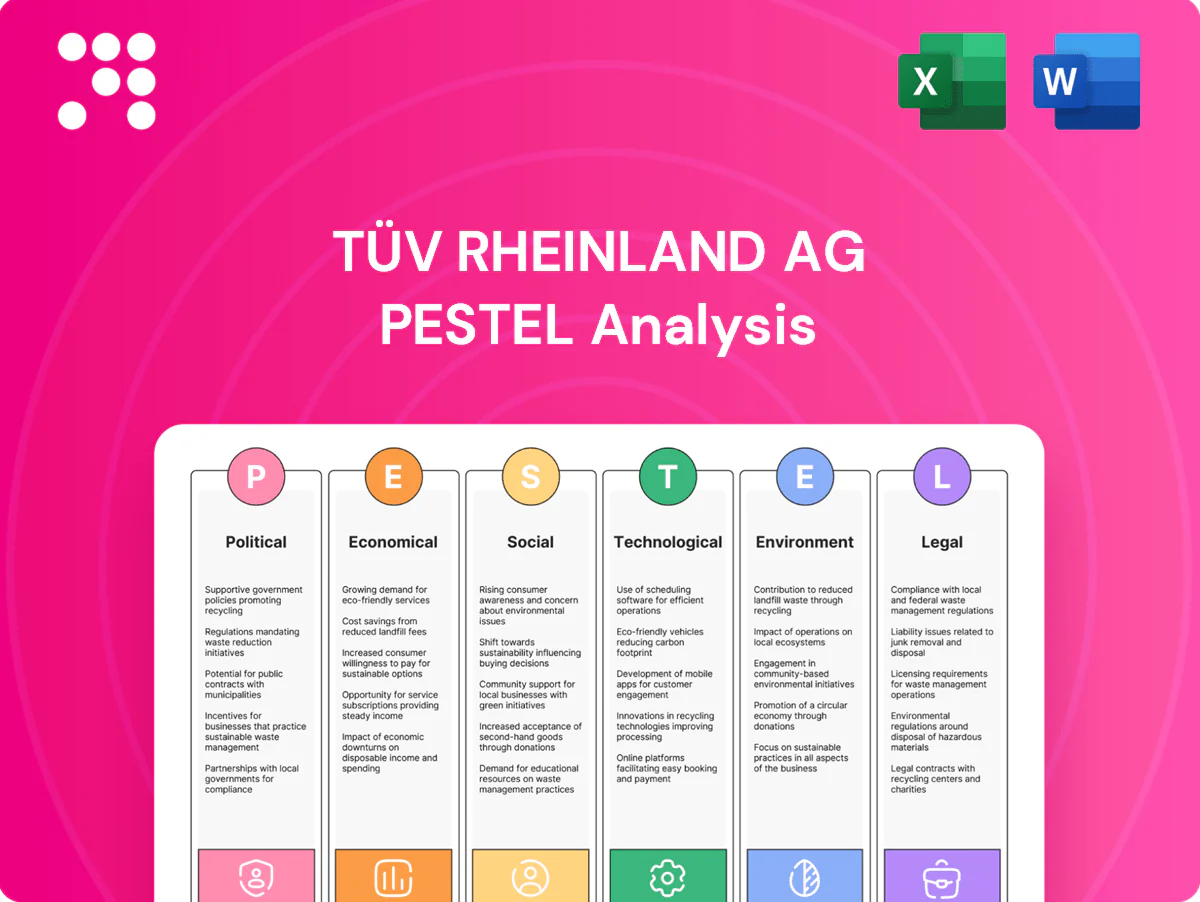
TÜV Rheinland AG PESTLE Analysis

Your Shortcut to Market Insight Starts Here
Unlock how political regulations, economic shifts, and rapid technological change shape TÜV Rheinland AG’s prospects with our concise PESTLE overview. Tailored for investors and strategists, it pinpoints actionable risks and growth opportunities you can act on today. Purchase the full analysis for an in-depth, downloadable report with ready-to-use insights and templates.
Political factors

Regulatory harmonization and divergence
Global markets oscillate between harmonized standards (ISO/IEC, present in 167 member bodies) and region-specific rules (EU, US, China); TÜV Rheinland, with about 20,000 employees in 60+ countries, must align services to shifting conformity assessment schemes and mutual recognition agreements. Divergence raises testing complexity but creates advisory and localization revenue upside. Proactive engagement in standards reduces market access friction.
Trade policy and market access
Tariffs, local-content rules and sanctions are reshaping client supply chains and certification routes, increasing demand for retesting and documentation updates. TÜV Rheinland, with over 500 locations in 69 countries, can capture value by guiding rerouting, retesting and updated certification processes. Changes such as UKCA implementation from Jan 1 2021 and evolving China CCC requirements alter demand patterns and make project pipelines sensitive to political stability in key hubs.

Public-sector investment priorities
Government spending on infrastructure, energy transition and digitalization—underpinned by the EU Recovery and Resilience Facility (€723.8bn) and the US Inflation Reduction Act (~$369bn)—boosts inspection and certification demand, increasing TÜV Rheinland service volumes. Public-private partnerships and stimulus-driven framework contracts expand large-scale inspection pipelines. EU Chips Act funding (~€43bn) and health sovereignty moves create niche testing opportunities in semiconductors and medical devices. Cyclical budget austerity, however, can postpone public inspections and training programs.

Geopolitical risk and sanctions compliance
Heightened geopolitical tensions increase export controls and end-use verification, raising compliance costs for TÜV Rheinland; EU adopted 11 sanction packages on Russia by 2024, intensifying screening and logistics checks. TÜV Rheinland must manage cross-border project risk, client screening and site-access across 60+ countries, while sanctions disrupt testing logistics for industrial equipment and telecoms. Its neutral, trusted status supports continued multinational engagements.
- Export controls: more end-use checks
- Sanctions: 11 EU packages vs Russia (2024)
- Operations: presence in 60+ countries
- Competitive edge: perceived neutrality
Governmental push for safety and resilience
Policy responses to accidents, cyber incidents and critical‑infrastructure threats have tightened oversight; EU NIS2 transposition deadline was 17 Oct 2024, expanding supervisory scope across transport, energy and buildings. TÜV Rheinland, reporting €2.9bn revenue and ~20,000 employees (2023), participates in 100+ standards/technical committees and can shape codes, boosting the brand value of independent assurance under strong public scrutiny.
- Policy impact: NIS2 transposition 17 Oct 2024
- Scope: expanded periodic inspections — transport, energy, buildings
- Influence: 100+ standards/technical committees
- Market signal: €2.9bn revenue (2023) — trust premium for independent assurance
Regulatory divergence, sanctions and NIS2 drive retesting demand and inspection opportunities
Regulatory divergence (ISO/IEC vs EU/US/China) raises testing complexity but creates localization revenue for TÜV Rheinland; EU/UK/China conformity shifts drive retesting demand. Sanctions/export controls (11 EU Russia packages by 2024) and NIS2 (transposed by 17 Oct 2024) increase compliance and site-access costs. Public stimulus (EU RRF €723.8bn; IRA ~$369bn) and Chips Act (~€43bn) expand inspection pipelines.
| Metric | Value | Relevance |
|---|---|---|
| Revenue (2023) | €2.9bn | scale of assurance |
| Employees/Locations | ~20,000/69 | global delivery |
What is included in the product
 Detailed Word Document
Provides a concise PESTLE assessment of TÜV Rheinland AG, exploring Political, Economic, Social, Technological, Environmental and Legal drivers with data-backed insights and trend context. Tailored for executives and advisors, it highlights region- and industry-specific risks, opportunities and forward-looking implications for strategy and scenario planning.

 Customizable Excel Spreadsheet
Visually segmented by PESTLE categories, the TÜV Rheinland AG analysis provides a clear, at-a-glance overview of regulatory, technological, and market risks—ideal for rapid decision-making, presentations, and cross-team alignment.
Economic factors

Industrial capex cycles
Upturns in manufacturing, chemicals and utilities drive higher demand for commissioning, NDT and asset integrity services, while downturns shift the mix toward maintenance, compliance and risk‑reduction work; TÜV Rheinland’s diversified sector footprint helps smooth revenue volatility. Backlog visibility remains tightly linked to clients’ investment pipelines, making orderbook trends a leading indicator of near‑term service demand.
Inflation, labor costs, and pricing power
Skilled auditor and engineer scarcity is driving upward wage pressure for TÜV Rheinland, squeezing margins despite index-linked contracts and value-based pricing that help preserve revenue per engagement. Investment in digital workflows and automation is improving efficiency and partly offsets cost inflation. Large clients increasingly demand bundled assurance services to lower total cost of compliance and simplify procurement.

Currency fluctuations
Euro-centric cost base while generating multi-currency revenues across 60+ countries and over 20,000 employees exposes TÜV Rheinland to FX swings; currency movements have shifted reported growth by several percentage points in recent years. Active hedging and natural offsets are essential, and pricing in local currencies preserves competitiveness. FX-driven revaluation of cross-border contracts materially affects reported top-line and margins.

Emerging market growth
Industrialization and regulatory maturation across Asia, Middle East, Africa and LATAM are expanding testing volumes for TÜV Rheinland, with emerging markets accounting for about 60% of global GDP (PPP) per IMF 2024, boosting demand for localized services.
Localization of labs and national accreditation unlocks public tenders, and partnering with governments and SOEs accelerates scale, while elevated credit risk and longer payment cycles in many EMs require disciplined contract management.
- Market growth: emerging markets ~60% global GDP (PPP) IMF 2024
- Localization: accreditation often prerequisite for tenders
- Partnerships: SOE/government deals drive volume
- Risk: credit/payment cycles demand strict contracts
Client consolidation and procurement dynamics
Larger multinationals are centralizing procurement and demanding global frameworks and uniform SLAs; TÜV Rheinland, with a global network in about 69 countries and group revenue of roughly €2.7bn (2023), can differentiate via multi-country delivery and integrated digital portals. Price competition intensifies for commoditized testing, favoring specialization, while cross-selling certification, training and cyber services increases wallet share.
- Centralized procurement: global SLAs
- Strength: multi-country delivery + digital portals
- Risk: price pressure on commoditized tests
- Opportunity: cross-sell cert., training, cyber
Regulatory divergence, sanctions and NIS2 drive retesting demand and inspection opportunities
Demand tied to manufacturing capex cycles shifts mix between commissioning and maintenance; orderbook trends are leading indicators. Wage inflation and engineer scarcity raise costs despite digital automation; margin pressure persists. Euro‑centric costs vs 69‑country revenues expose TÜV Rheinland to FX swings that moved reported growth by several percentage points.
| Metric | Value |
|---|---|
| Revenue (2023) | €2.7bn |
| Employees | ~20,000 |
| Countries | 69 |
| EM share GDP (PPP) | ~60% (IMF 2024) |
Preview Before You Purchase
TÜV Rheinland AG PESTLE Analysis
The preview of the TÜV Rheinland AG PESTLE Analysis shown here is the exact document you’ll receive after purchase—fully formatted and ready to use. The layout, content, and structure visible are identical to the downloadable file you’ll get immediately after payment. No placeholders or teasers—this is the final, professionally structured report.

Your Shortcut to Market Insight Starts Here
Unlock how political regulations, economic shifts, and rapid technological change shape TÜV Rheinland AG’s prospects with our concise PESTLE overview. Tailored for investors and strategists, it pinpoints actionable risks and growth opportunities you can act on today. Purchase the full analysis for an in-depth, downloadable report with ready-to-use insights and templates.
Political factors
Regulatory harmonization and divergence
Global markets oscillate between harmonized standards (ISO/IEC, present in 167 member bodies) and region-specific rules (EU, US, China); TÜV Rheinland, with about 20,000 employees in 60+ countries, must align services to shifting conformity assessment schemes and mutual recognition agreements. Divergence raises testing complexity but creates advisory and localization revenue upside. Proactive engagement in standards reduces market access friction.
Trade policy and market access
Tariffs, local-content rules and sanctions are reshaping client supply chains and certification routes, increasing demand for retesting and documentation updates. TÜV Rheinland, with over 500 locations in 69 countries, can capture value by guiding rerouting, retesting and updated certification processes. Changes such as UKCA implementation from Jan 1 2021 and evolving China CCC requirements alter demand patterns and make project pipelines sensitive to political stability in key hubs.
Public-sector investment priorities
Government spending on infrastructure, energy transition and digitalization—underpinned by the EU Recovery and Resilience Facility (€723.8bn) and the US Inflation Reduction Act (~$369bn)—boosts inspection and certification demand, increasing TÜV Rheinland service volumes. Public-private partnerships and stimulus-driven framework contracts expand large-scale inspection pipelines. EU Chips Act funding (~€43bn) and health sovereignty moves create niche testing opportunities in semiconductors and medical devices. Cyclical budget austerity, however, can postpone public inspections and training programs.
Geopolitical risk and sanctions compliance
Heightened geopolitical tensions increase export controls and end-use verification, raising compliance costs for TÜV Rheinland; EU adopted 11 sanction packages on Russia by 2024, intensifying screening and logistics checks. TÜV Rheinland must manage cross-border project risk, client screening and site-access across 60+ countries, while sanctions disrupt testing logistics for industrial equipment and telecoms. Its neutral, trusted status supports continued multinational engagements.
- Export controls: more end-use checks
- Sanctions: 11 EU packages vs Russia (2024)
- Operations: presence in 60+ countries
- Competitive edge: perceived neutrality
Governmental push for safety and resilience
Policy responses to accidents, cyber incidents and critical‑infrastructure threats have tightened oversight; EU NIS2 transposition deadline was 17 Oct 2024, expanding supervisory scope across transport, energy and buildings. TÜV Rheinland, reporting €2.9bn revenue and ~20,000 employees (2023), participates in 100+ standards/technical committees and can shape codes, boosting the brand value of independent assurance under strong public scrutiny.
- Policy impact: NIS2 transposition 17 Oct 2024
- Scope: expanded periodic inspections — transport, energy, buildings
- Influence: 100+ standards/technical committees
- Market signal: €2.9bn revenue (2023) — trust premium for independent assurance
Regulatory divergence, sanctions and NIS2 drive retesting demand and inspection opportunities
Regulatory divergence (ISO/IEC vs EU/US/China) raises testing complexity but creates localization revenue for TÜV Rheinland; EU/UK/China conformity shifts drive retesting demand. Sanctions/export controls (11 EU Russia packages by 2024) and NIS2 (transposed by 17 Oct 2024) increase compliance and site-access costs. Public stimulus (EU RRF €723.8bn; IRA ~$369bn) and Chips Act (~€43bn) expand inspection pipelines.
| Metric | Value | Relevance |
|---|---|---|
| Revenue (2023) | €2.9bn | scale of assurance |
| Employees/Locations | ~20,000/69 | global delivery |
What is included in the product
Detailed Word Document
Provides a concise PESTLE assessment of TÜV Rheinland AG, exploring Political, Economic, Social, Technological, Environmental and Legal drivers with data-backed insights and trend context. Tailored for executives and advisors, it highlights region- and industry-specific risks, opportunities and forward-looking implications for strategy and scenario planning.
Customizable Excel Spreadsheet
Visually segmented by PESTLE categories, the TÜV Rheinland AG analysis provides a clear, at-a-glance overview of regulatory, technological, and market risks—ideal for rapid decision-making, presentations, and cross-team alignment.
Economic factors
Industrial capex cycles
Upturns in manufacturing, chemicals and utilities drive higher demand for commissioning, NDT and asset integrity services, while downturns shift the mix toward maintenance, compliance and risk‑reduction work; TÜV Rheinland’s diversified sector footprint helps smooth revenue volatility. Backlog visibility remains tightly linked to clients’ investment pipelines, making orderbook trends a leading indicator of near‑term service demand.
Inflation, labor costs, and pricing power
Skilled auditor and engineer scarcity is driving upward wage pressure for TÜV Rheinland, squeezing margins despite index-linked contracts and value-based pricing that help preserve revenue per engagement. Investment in digital workflows and automation is improving efficiency and partly offsets cost inflation. Large clients increasingly demand bundled assurance services to lower total cost of compliance and simplify procurement.
Currency fluctuations
Euro-centric cost base while generating multi-currency revenues across 60+ countries and over 20,000 employees exposes TÜV Rheinland to FX swings; currency movements have shifted reported growth by several percentage points in recent years. Active hedging and natural offsets are essential, and pricing in local currencies preserves competitiveness. FX-driven revaluation of cross-border contracts materially affects reported top-line and margins.
Emerging market growth
Industrialization and regulatory maturation across Asia, Middle East, Africa and LATAM are expanding testing volumes for TÜV Rheinland, with emerging markets accounting for about 60% of global GDP (PPP) per IMF 2024, boosting demand for localized services.
Localization of labs and national accreditation unlocks public tenders, and partnering with governments and SOEs accelerates scale, while elevated credit risk and longer payment cycles in many EMs require disciplined contract management.
- Market growth: emerging markets ~60% global GDP (PPP) IMF 2024
- Localization: accreditation often prerequisite for tenders
- Partnerships: SOE/government deals drive volume
- Risk: credit/payment cycles demand strict contracts
Client consolidation and procurement dynamics
Larger multinationals are centralizing procurement and demanding global frameworks and uniform SLAs; TÜV Rheinland, with a global network in about 69 countries and group revenue of roughly €2.7bn (2023), can differentiate via multi-country delivery and integrated digital portals. Price competition intensifies for commoditized testing, favoring specialization, while cross-selling certification, training and cyber services increases wallet share.
- Centralized procurement: global SLAs
- Strength: multi-country delivery + digital portals
- Risk: price pressure on commoditized tests
- Opportunity: cross-sell cert., training, cyber
Regulatory divergence, sanctions and NIS2 drive retesting demand and inspection opportunities
Demand tied to manufacturing capex cycles shifts mix between commissioning and maintenance; orderbook trends are leading indicators. Wage inflation and engineer scarcity raise costs despite digital automation; margin pressure persists. Euro‑centric costs vs 69‑country revenues expose TÜV Rheinland to FX swings that moved reported growth by several percentage points.
| Metric | Value |
|---|---|
| Revenue (2023) | €2.7bn |
| Employees | ~20,000 |
| Countries | 69 |
| EM share GDP (PPP) | ~60% (IMF 2024) |
Preview Before You Purchase
TÜV Rheinland AG PESTLE Analysis
The preview of the TÜV Rheinland AG PESTLE Analysis shown here is the exact document you’ll receive after purchase—fully formatted and ready to use. The layout, content, and structure visible are identical to the downloadable file you’ll get immediately after payment. No placeholders or teasers—this is the final, professionally structured report.
Description
Your Shortcut to Market Insight Starts Here
Unlock how political regulations, economic shifts, and rapid technological change shape TÜV Rheinland AG’s prospects with our concise PESTLE overview. Tailored for investors and strategists, it pinpoints actionable risks and growth opportunities you can act on today. Purchase the full analysis for an in-depth, downloadable report with ready-to-use insights and templates.
Political factors
Regulatory harmonization and divergence
Global markets oscillate between harmonized standards (ISO/IEC, present in 167 member bodies) and region-specific rules (EU, US, China); TÜV Rheinland, with about 20,000 employees in 60+ countries, must align services to shifting conformity assessment schemes and mutual recognition agreements. Divergence raises testing complexity but creates advisory and localization revenue upside. Proactive engagement in standards reduces market access friction.
Trade policy and market access
Tariffs, local-content rules and sanctions are reshaping client supply chains and certification routes, increasing demand for retesting and documentation updates. TÜV Rheinland, with over 500 locations in 69 countries, can capture value by guiding rerouting, retesting and updated certification processes. Changes such as UKCA implementation from Jan 1 2021 and evolving China CCC requirements alter demand patterns and make project pipelines sensitive to political stability in key hubs.
Public-sector investment priorities
Government spending on infrastructure, energy transition and digitalization—underpinned by the EU Recovery and Resilience Facility (€723.8bn) and the US Inflation Reduction Act (~$369bn)—boosts inspection and certification demand, increasing TÜV Rheinland service volumes. Public-private partnerships and stimulus-driven framework contracts expand large-scale inspection pipelines. EU Chips Act funding (~€43bn) and health sovereignty moves create niche testing opportunities in semiconductors and medical devices. Cyclical budget austerity, however, can postpone public inspections and training programs.
Geopolitical risk and sanctions compliance
Heightened geopolitical tensions increase export controls and end-use verification, raising compliance costs for TÜV Rheinland; EU adopted 11 sanction packages on Russia by 2024, intensifying screening and logistics checks. TÜV Rheinland must manage cross-border project risk, client screening and site-access across 60+ countries, while sanctions disrupt testing logistics for industrial equipment and telecoms. Its neutral, trusted status supports continued multinational engagements.
- Export controls: more end-use checks
- Sanctions: 11 EU packages vs Russia (2024)
- Operations: presence in 60+ countries
- Competitive edge: perceived neutrality
Governmental push for safety and resilience
Policy responses to accidents, cyber incidents and critical‑infrastructure threats have tightened oversight; EU NIS2 transposition deadline was 17 Oct 2024, expanding supervisory scope across transport, energy and buildings. TÜV Rheinland, reporting €2.9bn revenue and ~20,000 employees (2023), participates in 100+ standards/technical committees and can shape codes, boosting the brand value of independent assurance under strong public scrutiny.
- Policy impact: NIS2 transposition 17 Oct 2024
- Scope: expanded periodic inspections — transport, energy, buildings
- Influence: 100+ standards/technical committees
- Market signal: €2.9bn revenue (2023) — trust premium for independent assurance
Regulatory divergence, sanctions and NIS2 drive retesting demand and inspection opportunities
Regulatory divergence (ISO/IEC vs EU/US/China) raises testing complexity but creates localization revenue for TÜV Rheinland; EU/UK/China conformity shifts drive retesting demand. Sanctions/export controls (11 EU Russia packages by 2024) and NIS2 (transposed by 17 Oct 2024) increase compliance and site-access costs. Public stimulus (EU RRF €723.8bn; IRA ~$369bn) and Chips Act (~€43bn) expand inspection pipelines.
| Metric | Value | Relevance |
|---|---|---|
| Revenue (2023) | €2.9bn | scale of assurance |
| Employees/Locations | ~20,000/69 | global delivery |
What is included in the product
Detailed Word Document
Provides a concise PESTLE assessment of TÜV Rheinland AG, exploring Political, Economic, Social, Technological, Environmental and Legal drivers with data-backed insights and trend context. Tailored for executives and advisors, it highlights region- and industry-specific risks, opportunities and forward-looking implications for strategy and scenario planning.
Customizable Excel Spreadsheet
Visually segmented by PESTLE categories, the TÜV Rheinland AG analysis provides a clear, at-a-glance overview of regulatory, technological, and market risks—ideal for rapid decision-making, presentations, and cross-team alignment.
Economic factors
Industrial capex cycles
Upturns in manufacturing, chemicals and utilities drive higher demand for commissioning, NDT and asset integrity services, while downturns shift the mix toward maintenance, compliance and risk‑reduction work; TÜV Rheinland’s diversified sector footprint helps smooth revenue volatility. Backlog visibility remains tightly linked to clients’ investment pipelines, making orderbook trends a leading indicator of near‑term service demand.
Inflation, labor costs, and pricing power
Skilled auditor and engineer scarcity is driving upward wage pressure for TÜV Rheinland, squeezing margins despite index-linked contracts and value-based pricing that help preserve revenue per engagement. Investment in digital workflows and automation is improving efficiency and partly offsets cost inflation. Large clients increasingly demand bundled assurance services to lower total cost of compliance and simplify procurement.
Currency fluctuations
Euro-centric cost base while generating multi-currency revenues across 60+ countries and over 20,000 employees exposes TÜV Rheinland to FX swings; currency movements have shifted reported growth by several percentage points in recent years. Active hedging and natural offsets are essential, and pricing in local currencies preserves competitiveness. FX-driven revaluation of cross-border contracts materially affects reported top-line and margins.
Emerging market growth
Industrialization and regulatory maturation across Asia, Middle East, Africa and LATAM are expanding testing volumes for TÜV Rheinland, with emerging markets accounting for about 60% of global GDP (PPP) per IMF 2024, boosting demand for localized services.
Localization of labs and national accreditation unlocks public tenders, and partnering with governments and SOEs accelerates scale, while elevated credit risk and longer payment cycles in many EMs require disciplined contract management.
- Market growth: emerging markets ~60% global GDP (PPP) IMF 2024
- Localization: accreditation often prerequisite for tenders
- Partnerships: SOE/government deals drive volume
- Risk: credit/payment cycles demand strict contracts
Client consolidation and procurement dynamics
Larger multinationals are centralizing procurement and demanding global frameworks and uniform SLAs; TÜV Rheinland, with a global network in about 69 countries and group revenue of roughly €2.7bn (2023), can differentiate via multi-country delivery and integrated digital portals. Price competition intensifies for commoditized testing, favoring specialization, while cross-selling certification, training and cyber services increases wallet share.
- Centralized procurement: global SLAs
- Strength: multi-country delivery + digital portals
- Risk: price pressure on commoditized tests
- Opportunity: cross-sell cert., training, cyber
Regulatory divergence, sanctions and NIS2 drive retesting demand and inspection opportunities
Demand tied to manufacturing capex cycles shifts mix between commissioning and maintenance; orderbook trends are leading indicators. Wage inflation and engineer scarcity raise costs despite digital automation; margin pressure persists. Euro‑centric costs vs 69‑country revenues expose TÜV Rheinland to FX swings that moved reported growth by several percentage points.
| Metric | Value |
|---|---|
| Revenue (2023) | €2.7bn |
| Employees | ~20,000 |
| Countries | 69 |
| EM share GDP (PPP) | ~60% (IMF 2024) |
Preview Before You Purchase
TÜV Rheinland AG PESTLE Analysis
The preview of the TÜV Rheinland AG PESTLE Analysis shown here is the exact document you’ll receive after purchase—fully formatted and ready to use. The layout, content, and structure visible are identical to the downloadable file you’ll get immediately after payment. No placeholders or teasers—this is the final, professionally structured report.











