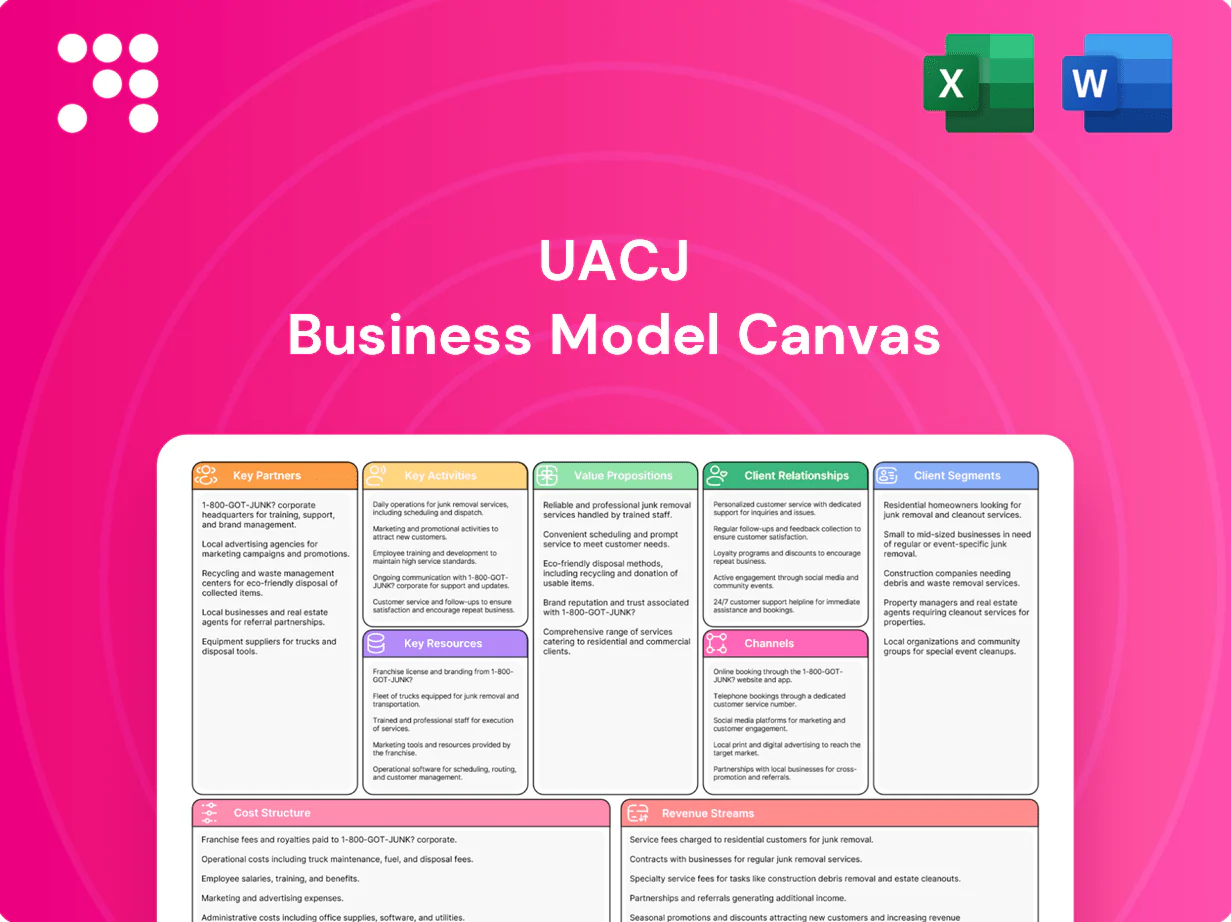
UACJ Business Model Canvas

3-Page Business Model Canvas: Strategic Blueprint for Investors, Consultants, Founders
Unlock UACJ’s strategic blueprint with our Business Model Canvas—three concise pages revealing value propositions, key partners, and revenue dynamics. Ideal for investors, consultants, and founders, this editable Word/Excel file lets you benchmark, adapt, and act. Purchase the full Canvas to map opportunities and sharpen strategy.
Partnerships

Bauxite, alumina, alloy suppliers
Secure upstream feedstock is critical for consistent alloy quality and cost control, with UACJ relying on multi-year bauxite and alumina contracts to smooth input-price volatility. Multi-year agreements (typically 3–7 years) stabilize pricing and availability, supporting margin predictability. Diversified suppliers across regions reduce geopolitical and supply risk, while joint QA programs verify metallurgical specs and traceability across the value chain.
Energy and utility providers
Electricity and gas contracts secure continuous hot and cold rolling, with energy representing roughly 15–20% of flat‑rolled aluminium production costs in 2024. Hedging and demand‑response programs have cut price volatility and peak charges by about 10–30% in industrial users. Onsite co‑generation and renewables can lower Scope 1/2 emissions up to ~40% and reduce grid exposure. Rigorous SLAs target 99.9% availability to minimize downtime.

OEMs and Tier-1 co-development
OEMs and Tier-1 partners co-design aluminum alloys and sheet/coil forms to achieve targeted weight reductions and performance gains for automotive and aerospace applications. Early engineering engagement secures specifications and forecasted volumes, aligning production capacity with program ramps. Qualification cycles typically span 18–36 months for automotive and 3–7 years for aerospace, locking in long-term programs. Joint testing and validation can accelerate certification and time-to-market by up to 30%.

Recyclers and scrap handlers
Recyclers and scrap handlers form closed-loop returns that lower input costs and cut lifecycle emissions, with aluminum recycling saving up to 95% of the energy versus primary production and reducing CO2 emissions by as much as 92%. Certified partners provide alloy segregation and traceability critical for high-quality feedstock, while strong reclamation rates boost UACJ sustainability metrics and circularity. Integrated logistics shortens scrap turnaround, improving working capital and production continuity.
- Energy saved: up to 95%
- Emissions cut: up to 92%
- Traceable alloy segregation via certified partners
- Faster turnaround = better working capital
Equipment and technology vendors
Equipment and technology vendors supplying advanced mills, presses and automation improve yield consistency (typical yield uplift 5–15%) and enable scale. Predictive maintenance and sensors can cut unplanned downtime 30–50% and lower maintenance costs 10–40%. Software partners provide process control and quality analytics; joint pilots de-risk capex and shorten scale-up timelines.
- Yield uplift 5–15%
- Downtime -30–50%
- Maintenance cost -10–40%
- Pilots reduce scale-up time
Contracts + co-design lock programs; recyclers cut energy 95%
Long‑term feedstock contracts (3–7 yrs) and diversified suppliers stabilize alloy quality and margins; energy costs ≈15–20% of production in 2024. OEMs and Tier‑1 co‑designs lock multi‑year programs (18–36m auto, 3–7y aero) and volume forecasts. Recyclers cut energy use up to 95% and CO2 up to 92%; equipment partners lift yield 5–15% and cut downtime 30–50%.
| Partner | Role | Impact | KPI (2024) |
|---|---|---|---|
| Feedstock | Supply | Cost/quality stability | 3–7 yr contracts |
| Energy | Supply/hedge | Availability/cost | 15–20% cost |
| OEMs | Co‑design | Program lock | 18–36m qual. |
| Recyclers | Closed‑loop | Lower emissions | −95% energy |
| Vendors | Equip/tech | Yield/downtime | +5–15% yield |
What is included in the product
 Detailed Word Document
A comprehensive, pre-written Business Model Canvas for UACJ detailing customer segments, channels, value propositions, revenue streams, key activities, resources and partners, plus cost structure and SWOT-linked insights for investors and strategists.

 Customizable Excel Spreadsheet
Condenses UACJ’s strategy into a clean, editable Business Model Canvas that saves hours of formatting, enables quick comparison of segments, and provides a one-page, shareable snapshot for fast team alignment and decision-making.
Activities

Rolling and extrusion operations
Hot and cold rolling, extrusion and drawing produce sheets, plates and profiles with industry-standard gauge control often within ±0.05 mm to meet automotive and packaging specs. Tight tolerances drive customer value; UACJ 2024 operations targeted a 12% scrap reduction via continuous improvement and lean projects. Flexible scheduling across mills balances product mix and improved yield by about 3% in 2024 pilot lines.
Alloy R&D and qualification
Developing high-strength, corrosion-resistant alloys targets sector-specific needs such as automotive crash performance and marine durability, with tensile strengths often exceeding 400 MPa in 2024 material benchmarks. OEM and regulator certification typically requires 12–24 months and is essential for market access. Lab-to-line scaling focuses on manufacturability and >95% first-pass yield targets. Active IP filing (dozens of patents annually) protects differentiation.

Heat treatment and finishing
Heat treatment and finishing combine annealing, aging, surface treatment and coating to tailor properties and appearance; process windows are optimized for mechanical performance and corrosion resistance. Inline inspection ensures consistency and traceability, supporting industry-scale production (global primary aluminium 2023: 67.8 Mt, International Aluminium Institute). Post-processing adds margin and delivers ready-to-use parts.

Quality assurance and testing
Mechanical, chemical and non-destructive tests (ultrasonic, eddy current, radiography) verify compliance with specifications; AS9100D and IATF 16949 remained the aerospace and automotive standards in 2024. Statistical process control reduces variability and supports process capability improvements. Traceability systems record batch-to-part lineage to meet audit requirements, and robust documentation supports customer audits.
- Tests: mechanical, chemical, NDT (ultrasonic, eddy current, radiography)
- Standards: AS9100D, IATF 16949 (2024)
- SPC: reduces variability, improves Cp/Cpk
- Traceability: full batch-to-part lineage for audits
Supply chain and recycling management
Inbound raw materials and outbound logistics are coordinated across UACJ s global network to meet 95% OTIF delivery targets, with inventory optimization and JIT lanes reducing lead times and working capital.
Closed-loop scrap programs recovered significant aluminium volumes in 2024, lowering material costs and cutting scope 1–2 emissions through increased recycling and process scrap reuse.
Digital tools—real-time tracking, AI forecasting and integrated SCM dashboards—improved visibility and demand forecasting across plants and shipping hubs.
- Global coordination: 95% OTIF target
- Inventory: JIT and optimization reduce WIP
- Closed-loop recycling: higher scrap recovery in 2024
- Digital: real-time visibility and AI forecasting
Hot/cold rolling cuts scrap 12%, yields +3% pilot gain; 95% OTIF target
Hot/cold rolling, extrusion, finishing and NDT ensure gauge control and traceability; 2024 programs targeted 12% scrap reduction and pilot lines improved yield ~3%. Alloy R&D delivers >400 MPa grades for automotive/marine; certifications AS9100D and IATF 16949 maintained. Logistics and digital SCM pursue 95% OTIF with closed-loop recycling and real-time AI forecasting.
| Metric | 2024 |
|---|---|
| OTIF target | 95% |
| Scrap reduction target | 12% |
| Pilot yield improvement | ~3% |
| Alloy strength | >400 MPa |
| Certifications | AS9100D, IATF 16949 |
Preview Before You Purchase
Business Model Canvas
The UACJ Business Model Canvas you see here is the actual deliverable, not a mockup, and exactly represents the file you'll receive after purchase. Upon completing your order, you'll get this same professional document in editable formats. No placeholders, no surprises—ready to edit, present, and implement.

3-Page Business Model Canvas: Strategic Blueprint for Investors, Consultants, Founders
Unlock UACJ’s strategic blueprint with our Business Model Canvas—three concise pages revealing value propositions, key partners, and revenue dynamics. Ideal for investors, consultants, and founders, this editable Word/Excel file lets you benchmark, adapt, and act. Purchase the full Canvas to map opportunities and sharpen strategy.
Partnerships
Bauxite, alumina, alloy suppliers
Secure upstream feedstock is critical for consistent alloy quality and cost control, with UACJ relying on multi-year bauxite and alumina contracts to smooth input-price volatility. Multi-year agreements (typically 3–7 years) stabilize pricing and availability, supporting margin predictability. Diversified suppliers across regions reduce geopolitical and supply risk, while joint QA programs verify metallurgical specs and traceability across the value chain.
Energy and utility providers
Electricity and gas contracts secure continuous hot and cold rolling, with energy representing roughly 15–20% of flat‑rolled aluminium production costs in 2024. Hedging and demand‑response programs have cut price volatility and peak charges by about 10–30% in industrial users. Onsite co‑generation and renewables can lower Scope 1/2 emissions up to ~40% and reduce grid exposure. Rigorous SLAs target 99.9% availability to minimize downtime.
OEMs and Tier-1 co-development
OEMs and Tier-1 partners co-design aluminum alloys and sheet/coil forms to achieve targeted weight reductions and performance gains for automotive and aerospace applications. Early engineering engagement secures specifications and forecasted volumes, aligning production capacity with program ramps. Qualification cycles typically span 18–36 months for automotive and 3–7 years for aerospace, locking in long-term programs. Joint testing and validation can accelerate certification and time-to-market by up to 30%.
Recyclers and scrap handlers
Recyclers and scrap handlers form closed-loop returns that lower input costs and cut lifecycle emissions, with aluminum recycling saving up to 95% of the energy versus primary production and reducing CO2 emissions by as much as 92%. Certified partners provide alloy segregation and traceability critical for high-quality feedstock, while strong reclamation rates boost UACJ sustainability metrics and circularity. Integrated logistics shortens scrap turnaround, improving working capital and production continuity.
- Energy saved: up to 95%
- Emissions cut: up to 92%
- Traceable alloy segregation via certified partners
- Faster turnaround = better working capital
Equipment and technology vendors
Equipment and technology vendors supplying advanced mills, presses and automation improve yield consistency (typical yield uplift 5–15%) and enable scale. Predictive maintenance and sensors can cut unplanned downtime 30–50% and lower maintenance costs 10–40%. Software partners provide process control and quality analytics; joint pilots de-risk capex and shorten scale-up timelines.
- Yield uplift 5–15%
- Downtime -30–50%
- Maintenance cost -10–40%
- Pilots reduce scale-up time
Contracts + co-design lock programs; recyclers cut energy 95%
Long‑term feedstock contracts (3–7 yrs) and diversified suppliers stabilize alloy quality and margins; energy costs ≈15–20% of production in 2024. OEMs and Tier‑1 co‑designs lock multi‑year programs (18–36m auto, 3–7y aero) and volume forecasts. Recyclers cut energy use up to 95% and CO2 up to 92%; equipment partners lift yield 5–15% and cut downtime 30–50%.
| Partner | Role | Impact | KPI (2024) |
|---|---|---|---|
| Feedstock | Supply | Cost/quality stability | 3–7 yr contracts |
| Energy | Supply/hedge | Availability/cost | 15–20% cost |
| OEMs | Co‑design | Program lock | 18–36m qual. |
| Recyclers | Closed‑loop | Lower emissions | −95% energy |
| Vendors | Equip/tech | Yield/downtime | +5–15% yield |
What is included in the product
Detailed Word Document
A comprehensive, pre-written Business Model Canvas for UACJ detailing customer segments, channels, value propositions, revenue streams, key activities, resources and partners, plus cost structure and SWOT-linked insights for investors and strategists.
Customizable Excel Spreadsheet
Condenses UACJ’s strategy into a clean, editable Business Model Canvas that saves hours of formatting, enables quick comparison of segments, and provides a one-page, shareable snapshot for fast team alignment and decision-making.
Activities
Rolling and extrusion operations
Hot and cold rolling, extrusion and drawing produce sheets, plates and profiles with industry-standard gauge control often within ±0.05 mm to meet automotive and packaging specs. Tight tolerances drive customer value; UACJ 2024 operations targeted a 12% scrap reduction via continuous improvement and lean projects. Flexible scheduling across mills balances product mix and improved yield by about 3% in 2024 pilot lines.
Alloy R&D and qualification
Developing high-strength, corrosion-resistant alloys targets sector-specific needs such as automotive crash performance and marine durability, with tensile strengths often exceeding 400 MPa in 2024 material benchmarks. OEM and regulator certification typically requires 12–24 months and is essential for market access. Lab-to-line scaling focuses on manufacturability and >95% first-pass yield targets. Active IP filing (dozens of patents annually) protects differentiation.
Heat treatment and finishing
Heat treatment and finishing combine annealing, aging, surface treatment and coating to tailor properties and appearance; process windows are optimized for mechanical performance and corrosion resistance. Inline inspection ensures consistency and traceability, supporting industry-scale production (global primary aluminium 2023: 67.8 Mt, International Aluminium Institute). Post-processing adds margin and delivers ready-to-use parts.
Quality assurance and testing
Mechanical, chemical and non-destructive tests (ultrasonic, eddy current, radiography) verify compliance with specifications; AS9100D and IATF 16949 remained the aerospace and automotive standards in 2024. Statistical process control reduces variability and supports process capability improvements. Traceability systems record batch-to-part lineage to meet audit requirements, and robust documentation supports customer audits.
- Tests: mechanical, chemical, NDT (ultrasonic, eddy current, radiography)
- Standards: AS9100D, IATF 16949 (2024)
- SPC: reduces variability, improves Cp/Cpk
- Traceability: full batch-to-part lineage for audits
Supply chain and recycling management
Inbound raw materials and outbound logistics are coordinated across UACJ s global network to meet 95% OTIF delivery targets, with inventory optimization and JIT lanes reducing lead times and working capital.
Closed-loop scrap programs recovered significant aluminium volumes in 2024, lowering material costs and cutting scope 1–2 emissions through increased recycling and process scrap reuse.
Digital tools—real-time tracking, AI forecasting and integrated SCM dashboards—improved visibility and demand forecasting across plants and shipping hubs.
- Global coordination: 95% OTIF target
- Inventory: JIT and optimization reduce WIP
- Closed-loop recycling: higher scrap recovery in 2024
- Digital: real-time visibility and AI forecasting
Hot/cold rolling cuts scrap 12%, yields +3% pilot gain; 95% OTIF target
Hot/cold rolling, extrusion, finishing and NDT ensure gauge control and traceability; 2024 programs targeted 12% scrap reduction and pilot lines improved yield ~3%. Alloy R&D delivers >400 MPa grades for automotive/marine; certifications AS9100D and IATF 16949 maintained. Logistics and digital SCM pursue 95% OTIF with closed-loop recycling and real-time AI forecasting.
| Metric | 2024 |
|---|---|
| OTIF target | 95% |
| Scrap reduction target | 12% |
| Pilot yield improvement | ~3% |
| Alloy strength | >400 MPa |
| Certifications | AS9100D, IATF 16949 |
Preview Before You Purchase
Business Model Canvas
The UACJ Business Model Canvas you see here is the actual deliverable, not a mockup, and exactly represents the file you'll receive after purchase. Upon completing your order, you'll get this same professional document in editable formats. No placeholders, no surprises—ready to edit, present, and implement.
Original: $10.00
-65%$10.00
$3.50Description
3-Page Business Model Canvas: Strategic Blueprint for Investors, Consultants, Founders
Unlock UACJ’s strategic blueprint with our Business Model Canvas—three concise pages revealing value propositions, key partners, and revenue dynamics. Ideal for investors, consultants, and founders, this editable Word/Excel file lets you benchmark, adapt, and act. Purchase the full Canvas to map opportunities and sharpen strategy.
Partnerships
Bauxite, alumina, alloy suppliers
Secure upstream feedstock is critical for consistent alloy quality and cost control, with UACJ relying on multi-year bauxite and alumina contracts to smooth input-price volatility. Multi-year agreements (typically 3–7 years) stabilize pricing and availability, supporting margin predictability. Diversified suppliers across regions reduce geopolitical and supply risk, while joint QA programs verify metallurgical specs and traceability across the value chain.
Energy and utility providers
Electricity and gas contracts secure continuous hot and cold rolling, with energy representing roughly 15–20% of flat‑rolled aluminium production costs in 2024. Hedging and demand‑response programs have cut price volatility and peak charges by about 10–30% in industrial users. Onsite co‑generation and renewables can lower Scope 1/2 emissions up to ~40% and reduce grid exposure. Rigorous SLAs target 99.9% availability to minimize downtime.
OEMs and Tier-1 co-development
OEMs and Tier-1 partners co-design aluminum alloys and sheet/coil forms to achieve targeted weight reductions and performance gains for automotive and aerospace applications. Early engineering engagement secures specifications and forecasted volumes, aligning production capacity with program ramps. Qualification cycles typically span 18–36 months for automotive and 3–7 years for aerospace, locking in long-term programs. Joint testing and validation can accelerate certification and time-to-market by up to 30%.
Recyclers and scrap handlers
Recyclers and scrap handlers form closed-loop returns that lower input costs and cut lifecycle emissions, with aluminum recycling saving up to 95% of the energy versus primary production and reducing CO2 emissions by as much as 92%. Certified partners provide alloy segregation and traceability critical for high-quality feedstock, while strong reclamation rates boost UACJ sustainability metrics and circularity. Integrated logistics shortens scrap turnaround, improving working capital and production continuity.
- Energy saved: up to 95%
- Emissions cut: up to 92%
- Traceable alloy segregation via certified partners
- Faster turnaround = better working capital
Equipment and technology vendors
Equipment and technology vendors supplying advanced mills, presses and automation improve yield consistency (typical yield uplift 5–15%) and enable scale. Predictive maintenance and sensors can cut unplanned downtime 30–50% and lower maintenance costs 10–40%. Software partners provide process control and quality analytics; joint pilots de-risk capex and shorten scale-up timelines.
- Yield uplift 5–15%
- Downtime -30–50%
- Maintenance cost -10–40%
- Pilots reduce scale-up time
Contracts + co-design lock programs; recyclers cut energy 95%
Long‑term feedstock contracts (3–7 yrs) and diversified suppliers stabilize alloy quality and margins; energy costs ≈15–20% of production in 2024. OEMs and Tier‑1 co‑designs lock multi‑year programs (18–36m auto, 3–7y aero) and volume forecasts. Recyclers cut energy use up to 95% and CO2 up to 92%; equipment partners lift yield 5–15% and cut downtime 30–50%.
| Partner | Role | Impact | KPI (2024) |
|---|---|---|---|
| Feedstock | Supply | Cost/quality stability | 3–7 yr contracts |
| Energy | Supply/hedge | Availability/cost | 15–20% cost |
| OEMs | Co‑design | Program lock | 18–36m qual. |
| Recyclers | Closed‑loop | Lower emissions | −95% energy |
| Vendors | Equip/tech | Yield/downtime | +5–15% yield |
What is included in the product
Detailed Word Document
A comprehensive, pre-written Business Model Canvas for UACJ detailing customer segments, channels, value propositions, revenue streams, key activities, resources and partners, plus cost structure and SWOT-linked insights for investors and strategists.
Customizable Excel Spreadsheet
Condenses UACJ’s strategy into a clean, editable Business Model Canvas that saves hours of formatting, enables quick comparison of segments, and provides a one-page, shareable snapshot for fast team alignment and decision-making.
Activities
Rolling and extrusion operations
Hot and cold rolling, extrusion and drawing produce sheets, plates and profiles with industry-standard gauge control often within ±0.05 mm to meet automotive and packaging specs. Tight tolerances drive customer value; UACJ 2024 operations targeted a 12% scrap reduction via continuous improvement and lean projects. Flexible scheduling across mills balances product mix and improved yield by about 3% in 2024 pilot lines.
Alloy R&D and qualification
Developing high-strength, corrosion-resistant alloys targets sector-specific needs such as automotive crash performance and marine durability, with tensile strengths often exceeding 400 MPa in 2024 material benchmarks. OEM and regulator certification typically requires 12–24 months and is essential for market access. Lab-to-line scaling focuses on manufacturability and >95% first-pass yield targets. Active IP filing (dozens of patents annually) protects differentiation.
Heat treatment and finishing
Heat treatment and finishing combine annealing, aging, surface treatment and coating to tailor properties and appearance; process windows are optimized for mechanical performance and corrosion resistance. Inline inspection ensures consistency and traceability, supporting industry-scale production (global primary aluminium 2023: 67.8 Mt, International Aluminium Institute). Post-processing adds margin and delivers ready-to-use parts.
Quality assurance and testing
Mechanical, chemical and non-destructive tests (ultrasonic, eddy current, radiography) verify compliance with specifications; AS9100D and IATF 16949 remained the aerospace and automotive standards in 2024. Statistical process control reduces variability and supports process capability improvements. Traceability systems record batch-to-part lineage to meet audit requirements, and robust documentation supports customer audits.
- Tests: mechanical, chemical, NDT (ultrasonic, eddy current, radiography)
- Standards: AS9100D, IATF 16949 (2024)
- SPC: reduces variability, improves Cp/Cpk
- Traceability: full batch-to-part lineage for audits
Supply chain and recycling management
Inbound raw materials and outbound logistics are coordinated across UACJ s global network to meet 95% OTIF delivery targets, with inventory optimization and JIT lanes reducing lead times and working capital.
Closed-loop scrap programs recovered significant aluminium volumes in 2024, lowering material costs and cutting scope 1–2 emissions through increased recycling and process scrap reuse.
Digital tools—real-time tracking, AI forecasting and integrated SCM dashboards—improved visibility and demand forecasting across plants and shipping hubs.
- Global coordination: 95% OTIF target
- Inventory: JIT and optimization reduce WIP
- Closed-loop recycling: higher scrap recovery in 2024
- Digital: real-time visibility and AI forecasting
Hot/cold rolling cuts scrap 12%, yields +3% pilot gain; 95% OTIF target
Hot/cold rolling, extrusion, finishing and NDT ensure gauge control and traceability; 2024 programs targeted 12% scrap reduction and pilot lines improved yield ~3%. Alloy R&D delivers >400 MPa grades for automotive/marine; certifications AS9100D and IATF 16949 maintained. Logistics and digital SCM pursue 95% OTIF with closed-loop recycling and real-time AI forecasting.
| Metric | 2024 |
|---|---|
| OTIF target | 95% |
| Scrap reduction target | 12% |
| Pilot yield improvement | ~3% |
| Alloy strength | >400 MPa |
| Certifications | AS9100D, IATF 16949 |
Preview Before You Purchase
Business Model Canvas
The UACJ Business Model Canvas you see here is the actual deliverable, not a mockup, and exactly represents the file you'll receive after purchase. Upon completing your order, you'll get this same professional document in editable formats. No placeholders, no surprises—ready to edit, present, and implement.











