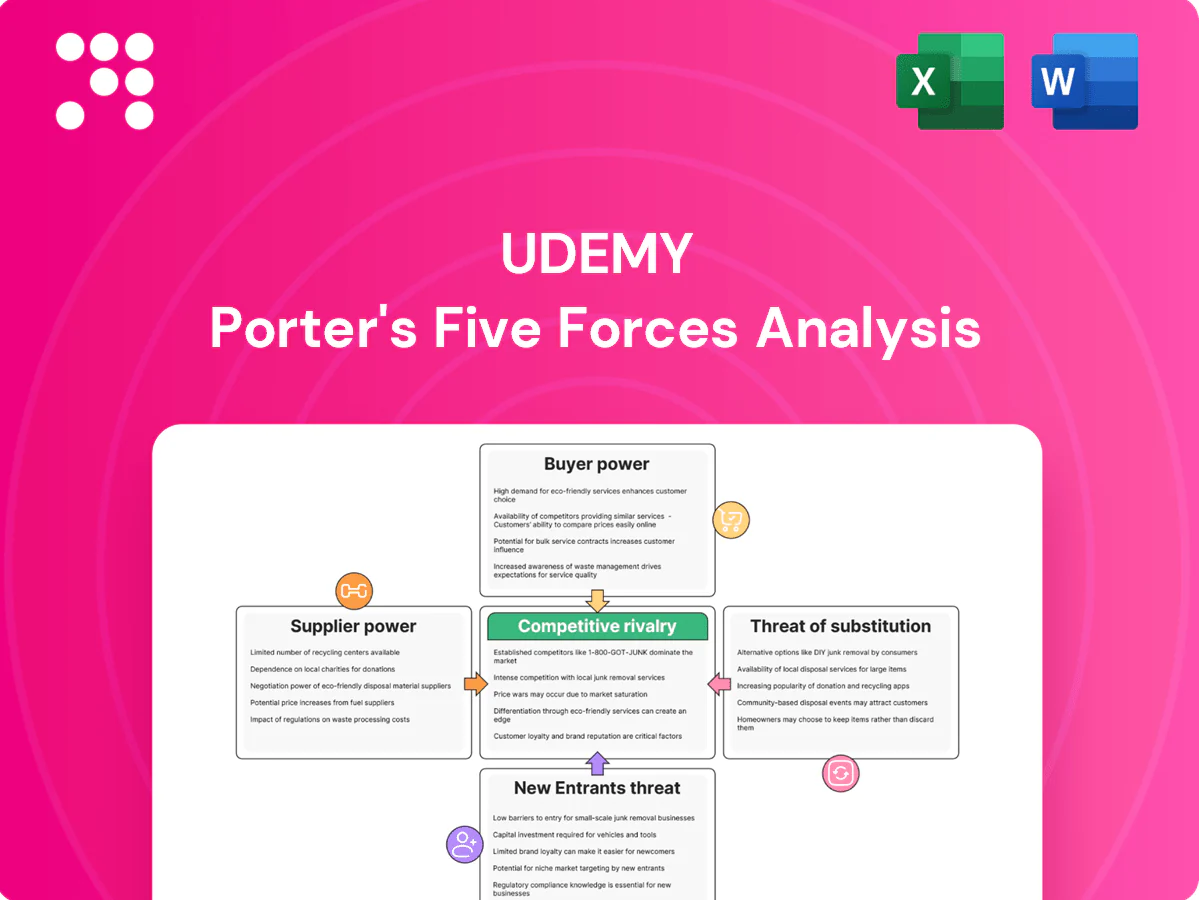
Udemy Porter's Five Forces Analysis

Elevate Your Analysis with the Complete Porter's Five Forces Analysis
Udemy faces moderate buyer power, intense rivalry from global MOOCs and niche specialists, and evolving substitute threats as employers and creators shift learning channels. Supplier and platform dynamics influence margins and content quality, while regulatory and tech shifts shape growth prospects. This brief snapshot only scratches the surface. Unlock the full Porter's Five Forces Analysis to explore Udemy’s competitive dynamics, market pressures, and strategic advantages in detail.
Suppliers Bargaining Power

Fragmented instructor base
Most Udemy suppliers are individual instructors or small teams—Udemy hosts over 70,000 instructors across roughly 240,000 courses and 64 million learners (2024)—which limits coordinated bargaining and preserves platform-friendly commission structures. Niche experts with unique content can still negotiate better terms or direct-sales arrangements. Emergent aggregation platforms or instructor collectives could modestly increase supplier leverage over time.
Top creators’ leverage
High-earning, brand-name instructors can threaten multi-homing or exit, giving them outsized leverage over Udemy’s marketplace; as of 2024 Udemy hosts over 70,000 instructors and 57M+ learners, concentrating revenue in top creators. Udemy counters with featured placement, favorable revenue shares and marketing support to retain them, but retention packages heighten top-tier supplier power and risk demand spillovers if they depart.

Platform dependency
Instructors rely heavily on Udemy’s discovery engine, payment processing, and traffic—Udemy served over 64 million learners with roughly 244,000 courses and about 70,000 instructors in 2024, concentrating leverage with the platform.
This dependency reduces negotiating power for the long tail, as promotion and pricing policies (platform-set discounts and revenue splits) further limit instructor autonomy.
Multi-homing to rivals like Coursera or Teachable partly offsets dependence but introduces operational friction and customer acquisition costs for instructors.

Content exclusivity and IP
Exclusive, up-to-date courses in fast-moving fields raise supplier leverage for Udemy because instructors controlling niche, current content can command higher revenue shares and faster enrollments; proprietary labs, datasets and project-based assets further strengthen differentiation and stickiness. Where courses are easily replicated or aggregated, supplier leverage declines; robust IP enforcement and anti-piracy support from the platform directly affect perceived supplier power.
- Exclusive content: higher supplier leverage
- Proprietary assets: increased differentiation
- Replicable content: lower leverage
- IP enforcement: moderates supplier power
Creator tools and data access
Advanced authoring, analytics, and monetization tools increase instructor lock-in by enabling higher lifetime earnings and better course performance tracking.
If Udemy restricts learner-data sharing, suppliers’ leverage weakens because creators cannot independently replicate cohort insights and conversion funnels.
When instructors gain cohort-level analytics and tooling parity across platforms, bargaining power shifts back to creators as they can more easily migrate and monetize elsewhere.
- tooling-lock-in
- data-access-controls
- cohort-insights
- platform-parity
Top creators vs long-tail instructors: platform tools boost lock-in, collectives fight back
Most Udemy suppliers are long-tail instructors (≈70,000 instructors, ≈244,000 courses, 64M learners in 2024), which limits coordinated bargaining; top creators concentrate revenue and hold outsized leverage. Platform discovery, analytics and monetization tools reduce long-tail power but increase lock-in; exclusive, up-to-date courses raise supplier leverage. Multi-homing and instructor collectives are rising counterforces.
| Metric | 2024 value | Implication |
|---|---|---|
| Instructors | ≈70,000 | Fragmented supply, low collective bargaining |
| Courses | ≈244,000 | High variety, replicability lowers leverage |
| Learners | 64,000,000 | Platform dependence increases instructor lock-in |
What is included in the product
 Detailed Word Document
Comprehensive Porter’s Five Forces analysis tailored to Udemy, revealing competitive drivers, buyer and supplier power, threats from substitutes and new entrants, and disruptive market forces; strategic commentary and industry data highlight implications for pricing, profitability, and defensive positioning.

 Customizable Excel Spreadsheet
A concise, one-sheet Porter's Five Forces for Udemy that lets you quickly adjust force intensities, plug in current data, and produce a clean spider chart or slide-ready summary—no macros or finance expertise required.
Customers Bargaining Power

Abundant alternatives
Learners can choose among Udemy, Coursera, edX, Skillshare, LinkedIn Learning and free resources, collectively serving hundreds of millions of users worldwide; Udemy alone reported about 68 million learners by 2023. This abundance intensifies price and feature comparisons, and non-contractual, on-demand access makes switching trivial. The result: elevated buyer power that compresses pricing flexibility and margins for providers.
Low switching costs
Courses on Udemy are typically one-off purchases with no subscription lock-in, contributing to low switching costs; the platform reported about 57 million learners and roughly 213,000 courses in 2024, enabling easy comparison shopping across alternatives. Users can cherry-pick deals across marketplaces where many courses sell for single-digit to low-double-digit prices during promotions, reducing sunk costs from limited cross-course progression. This minimal friction strengthens buyer negotiating power and price sensitivity.

Price sensitivity and discounts
Frequent promotions on Udemy, with coupons often reducing course prices by up to 90%, train users to wait for sales and lower perceived reference prices, amplifying price elasticity. Buyers exert power by timing purchases around major sales, shifting demand peaks. Reliance on heavy discounts pressures margins and can erode average revenue per user over time.

Social proof and reviews
- platform-scale: 61M learners, 255K courses (2024)
- quality-signal: star ratings drive discoverability
- weak-review impact: ~50% faster enrollment decline for <4.0 courses
- platform response: stricter vetting, refund policies
Enterprise and institutional clients
Enterprise and institutional clients negotiate volume discounts and SLAs, and larger contracts materially increase their bargaining leverage with Udemy for Business. High churn risk among corporate accounts gives buyers pricing and feature influence, pressing Udemy to offer tailored content libraries and platform integrations as negotiation levers. Buyers also demand analytics and single-sign-on, shifting power toward customers.
- Volume discounts
- SLAs & churn leverage
- Tailored content
- Integrations & analytics
Buyers wield power: 61M learners, discounts up to 90%
High buyer power: 61M learners and 255K courses (2024) enable easy switching and price comparison. Deep discounts (up to 90%) and frequent promotions increase price sensitivity. Rich ratings drive discoverability and penalize sub‑4.0 courses. Enterprise buyers extract volume discounts, SLAs and integration demands.
| Metric | Value |
|---|---|
| Learners (2024) | 61M |
| Courses (2024) | 255K |
| Max discounts | ≈90% |
Full Version Awaits
Udemy Porter's Five Forces Analysis
This preview shows the exact Udemy Porter's Five Forces Analysis you'll receive immediately after purchase—no placeholders or mockups. The full document is professionally written, fully formatted and ready to download and use the moment you buy, with comprehensive insights and actionable findings.

Elevate Your Analysis with the Complete Porter's Five Forces Analysis
Udemy faces moderate buyer power, intense rivalry from global MOOCs and niche specialists, and evolving substitute threats as employers and creators shift learning channels. Supplier and platform dynamics influence margins and content quality, while regulatory and tech shifts shape growth prospects. This brief snapshot only scratches the surface. Unlock the full Porter's Five Forces Analysis to explore Udemy’s competitive dynamics, market pressures, and strategic advantages in detail.
Suppliers Bargaining Power
Fragmented instructor base
Most Udemy suppliers are individual instructors or small teams—Udemy hosts over 70,000 instructors across roughly 240,000 courses and 64 million learners (2024)—which limits coordinated bargaining and preserves platform-friendly commission structures. Niche experts with unique content can still negotiate better terms or direct-sales arrangements. Emergent aggregation platforms or instructor collectives could modestly increase supplier leverage over time.
Top creators’ leverage
High-earning, brand-name instructors can threaten multi-homing or exit, giving them outsized leverage over Udemy’s marketplace; as of 2024 Udemy hosts over 70,000 instructors and 57M+ learners, concentrating revenue in top creators. Udemy counters with featured placement, favorable revenue shares and marketing support to retain them, but retention packages heighten top-tier supplier power and risk demand spillovers if they depart.
Platform dependency
Instructors rely heavily on Udemy’s discovery engine, payment processing, and traffic—Udemy served over 64 million learners with roughly 244,000 courses and about 70,000 instructors in 2024, concentrating leverage with the platform.
This dependency reduces negotiating power for the long tail, as promotion and pricing policies (platform-set discounts and revenue splits) further limit instructor autonomy.
Multi-homing to rivals like Coursera or Teachable partly offsets dependence but introduces operational friction and customer acquisition costs for instructors.
Content exclusivity and IP
Exclusive, up-to-date courses in fast-moving fields raise supplier leverage for Udemy because instructors controlling niche, current content can command higher revenue shares and faster enrollments; proprietary labs, datasets and project-based assets further strengthen differentiation and stickiness. Where courses are easily replicated or aggregated, supplier leverage declines; robust IP enforcement and anti-piracy support from the platform directly affect perceived supplier power.
- Exclusive content: higher supplier leverage
- Proprietary assets: increased differentiation
- Replicable content: lower leverage
- IP enforcement: moderates supplier power
Creator tools and data access
Advanced authoring, analytics, and monetization tools increase instructor lock-in by enabling higher lifetime earnings and better course performance tracking.
If Udemy restricts learner-data sharing, suppliers’ leverage weakens because creators cannot independently replicate cohort insights and conversion funnels.
When instructors gain cohort-level analytics and tooling parity across platforms, bargaining power shifts back to creators as they can more easily migrate and monetize elsewhere.
- tooling-lock-in
- data-access-controls
- cohort-insights
- platform-parity
Top creators vs long-tail instructors: platform tools boost lock-in, collectives fight back
Most Udemy suppliers are long-tail instructors (≈70,000 instructors, ≈244,000 courses, 64M learners in 2024), which limits coordinated bargaining; top creators concentrate revenue and hold outsized leverage. Platform discovery, analytics and monetization tools reduce long-tail power but increase lock-in; exclusive, up-to-date courses raise supplier leverage. Multi-homing and instructor collectives are rising counterforces.
| Metric | 2024 value | Implication |
|---|---|---|
| Instructors | ≈70,000 | Fragmented supply, low collective bargaining |
| Courses | ≈244,000 | High variety, replicability lowers leverage |
| Learners | 64,000,000 | Platform dependence increases instructor lock-in |
What is included in the product
Detailed Word Document
Comprehensive Porter’s Five Forces analysis tailored to Udemy, revealing competitive drivers, buyer and supplier power, threats from substitutes and new entrants, and disruptive market forces; strategic commentary and industry data highlight implications for pricing, profitability, and defensive positioning.
Customizable Excel Spreadsheet
A concise, one-sheet Porter's Five Forces for Udemy that lets you quickly adjust force intensities, plug in current data, and produce a clean spider chart or slide-ready summary—no macros or finance expertise required.
Customers Bargaining Power
Abundant alternatives
Learners can choose among Udemy, Coursera, edX, Skillshare, LinkedIn Learning and free resources, collectively serving hundreds of millions of users worldwide; Udemy alone reported about 68 million learners by 2023. This abundance intensifies price and feature comparisons, and non-contractual, on-demand access makes switching trivial. The result: elevated buyer power that compresses pricing flexibility and margins for providers.
Low switching costs
Courses on Udemy are typically one-off purchases with no subscription lock-in, contributing to low switching costs; the platform reported about 57 million learners and roughly 213,000 courses in 2024, enabling easy comparison shopping across alternatives. Users can cherry-pick deals across marketplaces where many courses sell for single-digit to low-double-digit prices during promotions, reducing sunk costs from limited cross-course progression. This minimal friction strengthens buyer negotiating power and price sensitivity.
Price sensitivity and discounts
Frequent promotions on Udemy, with coupons often reducing course prices by up to 90%, train users to wait for sales and lower perceived reference prices, amplifying price elasticity. Buyers exert power by timing purchases around major sales, shifting demand peaks. Reliance on heavy discounts pressures margins and can erode average revenue per user over time.
Social proof and reviews
- platform-scale: 61M learners, 255K courses (2024)
- quality-signal: star ratings drive discoverability
- weak-review impact: ~50% faster enrollment decline for <4.0 courses
- platform response: stricter vetting, refund policies
Enterprise and institutional clients
Enterprise and institutional clients negotiate volume discounts and SLAs, and larger contracts materially increase their bargaining leverage with Udemy for Business. High churn risk among corporate accounts gives buyers pricing and feature influence, pressing Udemy to offer tailored content libraries and platform integrations as negotiation levers. Buyers also demand analytics and single-sign-on, shifting power toward customers.
- Volume discounts
- SLAs & churn leverage
- Tailored content
- Integrations & analytics
Buyers wield power: 61M learners, discounts up to 90%
High buyer power: 61M learners and 255K courses (2024) enable easy switching and price comparison. Deep discounts (up to 90%) and frequent promotions increase price sensitivity. Rich ratings drive discoverability and penalize sub‑4.0 courses. Enterprise buyers extract volume discounts, SLAs and integration demands.
| Metric | Value |
|---|---|
| Learners (2024) | 61M |
| Courses (2024) | 255K |
| Max discounts | ≈90% |
Full Version Awaits
Udemy Porter's Five Forces Analysis
This preview shows the exact Udemy Porter's Five Forces Analysis you'll receive immediately after purchase—no placeholders or mockups. The full document is professionally written, fully formatted and ready to download and use the moment you buy, with comprehensive insights and actionable findings.
Description
Elevate Your Analysis with the Complete Porter's Five Forces Analysis
Udemy faces moderate buyer power, intense rivalry from global MOOCs and niche specialists, and evolving substitute threats as employers and creators shift learning channels. Supplier and platform dynamics influence margins and content quality, while regulatory and tech shifts shape growth prospects. This brief snapshot only scratches the surface. Unlock the full Porter's Five Forces Analysis to explore Udemy’s competitive dynamics, market pressures, and strategic advantages in detail.
Suppliers Bargaining Power
Fragmented instructor base
Most Udemy suppliers are individual instructors or small teams—Udemy hosts over 70,000 instructors across roughly 240,000 courses and 64 million learners (2024)—which limits coordinated bargaining and preserves platform-friendly commission structures. Niche experts with unique content can still negotiate better terms or direct-sales arrangements. Emergent aggregation platforms or instructor collectives could modestly increase supplier leverage over time.
Top creators’ leverage
High-earning, brand-name instructors can threaten multi-homing or exit, giving them outsized leverage over Udemy’s marketplace; as of 2024 Udemy hosts over 70,000 instructors and 57M+ learners, concentrating revenue in top creators. Udemy counters with featured placement, favorable revenue shares and marketing support to retain them, but retention packages heighten top-tier supplier power and risk demand spillovers if they depart.
Platform dependency
Instructors rely heavily on Udemy’s discovery engine, payment processing, and traffic—Udemy served over 64 million learners with roughly 244,000 courses and about 70,000 instructors in 2024, concentrating leverage with the platform.
This dependency reduces negotiating power for the long tail, as promotion and pricing policies (platform-set discounts and revenue splits) further limit instructor autonomy.
Multi-homing to rivals like Coursera or Teachable partly offsets dependence but introduces operational friction and customer acquisition costs for instructors.
Content exclusivity and IP
Exclusive, up-to-date courses in fast-moving fields raise supplier leverage for Udemy because instructors controlling niche, current content can command higher revenue shares and faster enrollments; proprietary labs, datasets and project-based assets further strengthen differentiation and stickiness. Where courses are easily replicated or aggregated, supplier leverage declines; robust IP enforcement and anti-piracy support from the platform directly affect perceived supplier power.
- Exclusive content: higher supplier leverage
- Proprietary assets: increased differentiation
- Replicable content: lower leverage
- IP enforcement: moderates supplier power
Creator tools and data access
Advanced authoring, analytics, and monetization tools increase instructor lock-in by enabling higher lifetime earnings and better course performance tracking.
If Udemy restricts learner-data sharing, suppliers’ leverage weakens because creators cannot independently replicate cohort insights and conversion funnels.
When instructors gain cohort-level analytics and tooling parity across platforms, bargaining power shifts back to creators as they can more easily migrate and monetize elsewhere.
- tooling-lock-in
- data-access-controls
- cohort-insights
- platform-parity
Top creators vs long-tail instructors: platform tools boost lock-in, collectives fight back
Most Udemy suppliers are long-tail instructors (≈70,000 instructors, ≈244,000 courses, 64M learners in 2024), which limits coordinated bargaining; top creators concentrate revenue and hold outsized leverage. Platform discovery, analytics and monetization tools reduce long-tail power but increase lock-in; exclusive, up-to-date courses raise supplier leverage. Multi-homing and instructor collectives are rising counterforces.
| Metric | 2024 value | Implication |
|---|---|---|
| Instructors | ≈70,000 | Fragmented supply, low collective bargaining |
| Courses | ≈244,000 | High variety, replicability lowers leverage |
| Learners | 64,000,000 | Platform dependence increases instructor lock-in |
What is included in the product
Detailed Word Document
Comprehensive Porter’s Five Forces analysis tailored to Udemy, revealing competitive drivers, buyer and supplier power, threats from substitutes and new entrants, and disruptive market forces; strategic commentary and industry data highlight implications for pricing, profitability, and defensive positioning.
Customizable Excel Spreadsheet
A concise, one-sheet Porter's Five Forces for Udemy that lets you quickly adjust force intensities, plug in current data, and produce a clean spider chart or slide-ready summary—no macros or finance expertise required.
Customers Bargaining Power
Abundant alternatives
Learners can choose among Udemy, Coursera, edX, Skillshare, LinkedIn Learning and free resources, collectively serving hundreds of millions of users worldwide; Udemy alone reported about 68 million learners by 2023. This abundance intensifies price and feature comparisons, and non-contractual, on-demand access makes switching trivial. The result: elevated buyer power that compresses pricing flexibility and margins for providers.
Low switching costs
Courses on Udemy are typically one-off purchases with no subscription lock-in, contributing to low switching costs; the platform reported about 57 million learners and roughly 213,000 courses in 2024, enabling easy comparison shopping across alternatives. Users can cherry-pick deals across marketplaces where many courses sell for single-digit to low-double-digit prices during promotions, reducing sunk costs from limited cross-course progression. This minimal friction strengthens buyer negotiating power and price sensitivity.
Price sensitivity and discounts
Frequent promotions on Udemy, with coupons often reducing course prices by up to 90%, train users to wait for sales and lower perceived reference prices, amplifying price elasticity. Buyers exert power by timing purchases around major sales, shifting demand peaks. Reliance on heavy discounts pressures margins and can erode average revenue per user over time.
Social proof and reviews
- platform-scale: 61M learners, 255K courses (2024)
- quality-signal: star ratings drive discoverability
- weak-review impact: ~50% faster enrollment decline for <4.0 courses
- platform response: stricter vetting, refund policies
Enterprise and institutional clients
Enterprise and institutional clients negotiate volume discounts and SLAs, and larger contracts materially increase their bargaining leverage with Udemy for Business. High churn risk among corporate accounts gives buyers pricing and feature influence, pressing Udemy to offer tailored content libraries and platform integrations as negotiation levers. Buyers also demand analytics and single-sign-on, shifting power toward customers.
- Volume discounts
- SLAs & churn leverage
- Tailored content
- Integrations & analytics
Buyers wield power: 61M learners, discounts up to 90%
High buyer power: 61M learners and 255K courses (2024) enable easy switching and price comparison. Deep discounts (up to 90%) and frequent promotions increase price sensitivity. Rich ratings drive discoverability and penalize sub‑4.0 courses. Enterprise buyers extract volume discounts, SLAs and integration demands.
| Metric | Value |
|---|---|
| Learners (2024) | 61M |
| Courses (2024) | 255K |
| Max discounts | ≈90% |
Full Version Awaits
Udemy Porter's Five Forces Analysis
This preview shows the exact Udemy Porter's Five Forces Analysis you'll receive immediately after purchase—no placeholders or mockups. The full document is professionally written, fully formatted and ready to download and use the moment you buy, with comprehensive insights and actionable findings.











