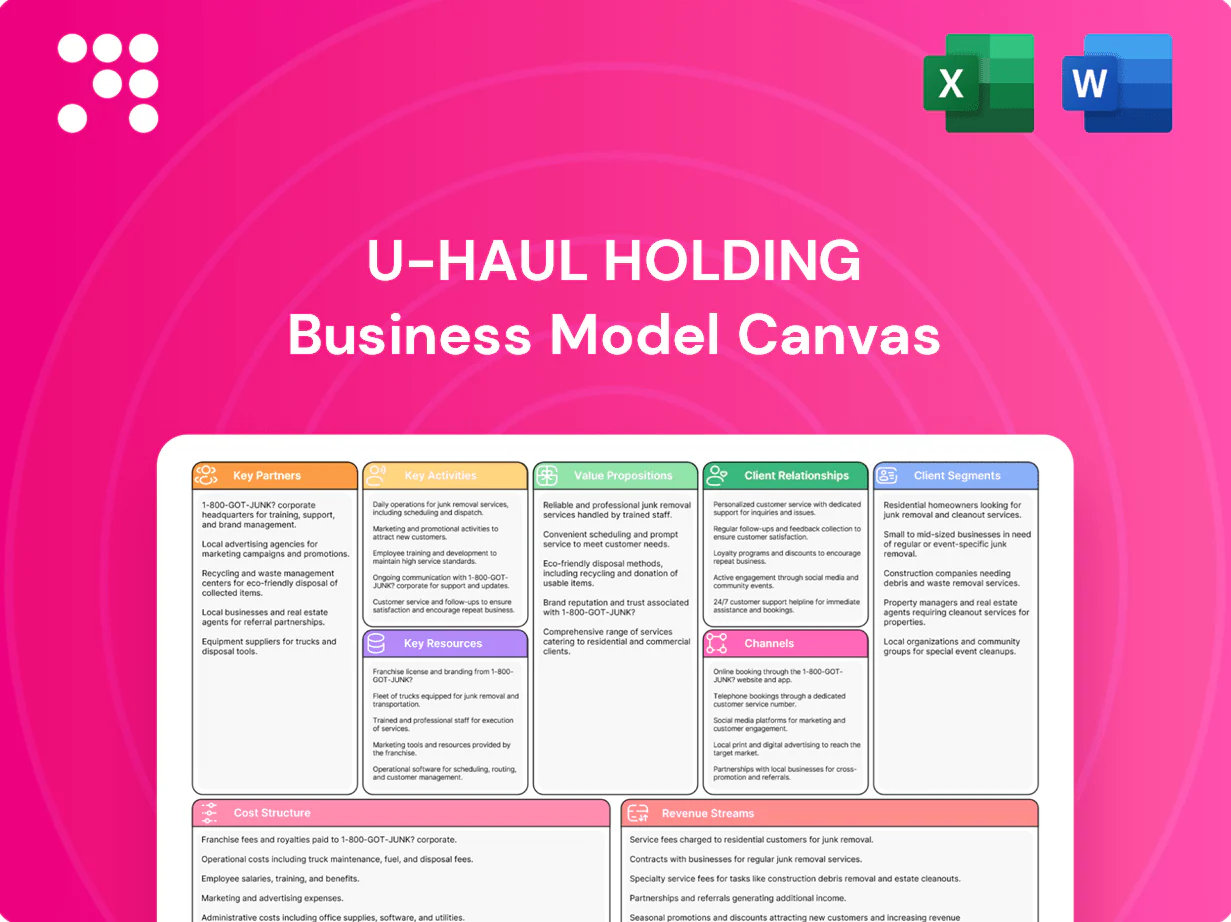
U-Haul Holding Business Model Canvas

Unlock strategic blueprint with Business Model Canvas - value props, segments, partners, revenue.
Unlock U-Haul Holding’s strategic blueprint with our Business Model Canvas—3–5 concise sections covering value propositions, customer segments, key partners, revenue streams and cost structure. Download the full Word/Excel canvas for actionable insights, benchmarking and investor-ready analysis to replicate or challenge their market model.
Partnerships

Independent dealer network
Local retailers and service stations serve as over 20,000 independent U-Haul dealers as of 2024, expanding national footprint without company-owned locations. They handle pickup/return, basic customer service, and upsell boxes and supplies while U-Haul provides inventory, reservation systems and training and shares commissions. This low-capex model speeds market coverage and flexes capacity for seasonal peaks.
OEMs & fleet suppliers
OEMs and fleet suppliers deliver purpose-built trucks, vans and trailers to U-Haul, supporting telematics and advanced safety features; U-Haul’s roughly 176,000-vehicle fleet (2024) relies on long-term OEM contracts to lock volumes, specs and pricing across replacement cycles (typically multi-year), ensuring reliable supply and standardization fleetwide.

Real estate owners & developers
Landlords and developers enable U-Haul rapid expansion of self-storage through JVs, leases, or purchases, powering deployments in high-demand corridors and leveraging over 20,000 independent dealer locations. Municipal partnerships streamline zoning and permits to accelerate site openings. This pipeline sustains capacity growth and mixed-use location rollouts amid a 2024 U.S. self-storage market exceeding $40 billion.

Propane & fuel providers
Wholesale propane and fuel partners secure continuous supply for U-Haul retail sales and fleet operations, leveraging a network of over 1,900 company-owned locations and 21,000 dealers as of 2024. Integrated logistics with these partners reduce fleet downtime and mitigate pricing volatility. Partner-led safety compliance training and certifications standardize handling. Propane/fuel services drive ancillary revenue and enhance customer convenience.
- Network scale: 1,900+ locations, 21,000 dealers (2024)
- Benefits: steady supply, lower downtime
- Compliance: partner training/certifications
- Revenue: ancillary sales, improved convenience
Technology & insurance partners
Technology and insurance partners — payment processors, telematics providers, and reservation platforms — enable seamless digital bookings and real-time fleet visibility, while insurance carriers underwrite damage waivers and supplemental coverage to monetize rentals and control losses. Cybersecurity and data vendors protect customer and fleet data, improving reliability and regulatory compliance; AMERCO (NASDAQ: UHAL) anchors the network.
- Payment processors: faster settlements, lower fraud
- Telematics: live tracking, utilization insights
- Reservation platforms: higher conversion, digital upsells
- Insurance carriers: risk transfer, revenue from waivers
- Cybersecurity vendors: data protection, compliance
Nationwide dealer network and 176k-vehicle fleet power low-capex storage expansion
Local dealers (21,000) and 1,900+ U-Haul locations enable low-capex expansion and seasonal capacity. Fleet (~176,000 vehicles, 2024) secured via multi-year OEM contracts; tech/insurance partners drive digital bookings, telematics and waiver revenue. Propane/fuel and real-estate partners support operations and storage growth in a $40B+ US self-storage market (2024).
| Partner | Role | 2024 metric |
|---|---|---|
| Independent dealers | Retail/service/returns | 21,000 |
| OEMs | Fleet supply | ~176,000 vehicles |
| Locations/landlords | Storage/site expansion | 1,900+ owned |
| Fuel/propane | Ancillary sales/logistics | Integrated network |
| Tech & insurance | Bookings/waivers/telematics | Revenue drivers |
What is included in the product
 Detailed Word Document
A comprehensive, pre-written Business Model Canvas for U-Haul Holdings detailing customer segments, channels, value propositions, key resources (fleet, retail network, digital platform), revenue streams, cost structure, partner ecosystem, and operational processes; includes competitive advantages, SWOT-linked insights, and investor-ready narrative for strategic planning and funding discussions.

 Customizable Excel Spreadsheet
Condenses U-Haul’s rental, storage, and logistics strategy into a digestible one-page snapshot, relieving planning and alignment pain points for operations, franchisees, and teams.
Activities

Fleet acquisition & lifecycle management
Sourcing, upfitting, maintaining and retiring trucks, vans and trailers is core to U-Haul’s operations, enabling standardized parts and service protocols. Data-driven replacement cycles optimize capex and maximize uptime through condition monitoring and utilization analytics. Remarketing retired units recovers residual value via auction and dealer channels. Consistent specs across a fleet of over 170,000 units reduce maintenance complexity and spare-parts inventory.
Self-storage development & operations
Site selection, permitting, build-outs and proactive unit leasing drive U-Haul storage expansion, targeting high-demand corridors where the US self-storage market reached roughly $48 billion in 2024. Daily operations focus on 24/7 security, electronic access control and preventative maintenance to protect occupancy. Dynamic pricing tools adjust rates to maximize occupancy and yield. On-site ancillary sales such as boxes, locks and insurance increase average transaction value.

Reservation, dispatch & logistics
Balancing inventory across U-Haul’s network of more than 21,000 dealer locations ensures pickup and drop-off availability; targeted rebalancing minimizes relocation gaps. Forecasting models account for weekend and summer move peaks to allocate fleet capacity. Optimized routing and reduced turn times cut idle assets, while real-time reservation and dispatch systems coordinate dealers and company stores.

Customer support & self-service enablement
Online booking, mobile check-in, and 24/7 support reduce friction for U-Haul customers, speeding rentals and lowering on-site wait times; self-service adoption aligns with 2024 industry data showing about 68% of consumers prefer digital self-service channels. Tutorials and moving guides empower DIY users, cutting instructional calls and improving first-time success. Fast issue resolution minimizes downtime and claims while feedback loops refine processes and policies.
- Online booking adoption: digital-first convenience
- Mobile check-in: faster turnovers, fewer counters
- 24/7 support: reduces downtime and escalations
- Tutorials/guides: empower DIY, lower calls
- Feedback loops: continuous policy/process improvement
Sales of moving supplies & services
Retail sales of boxes, packing materials and hitches complement rentals and drive accessory revenue; U-Haul’s dealer network of roughly 22,000 locations in 2024 ensures broad product reach.
Propane refills and hitch installations at many sites add convenience and incremental service income, while bundling increases conversion rates and margin.
Robust inventory management prioritizes availability during peak summer moves to protect sales and prevent stockouts.
- bundling boosts AOV
- propane + installations = recurring spend
- 22,000 dealer footprint (2024)
- inventory planning for peak season
170,000+ fleet and 22,000 dealers maximize uptime, utilization, and AOV
Sourcing, upfitting, maintaining and retiring a standardized fleet of >170,000 units optimizes uptime and capex. Network ops across ~22,000 dealer locations and dynamic pricing maximize utilization; forecasting manages summer peaks. Digital channels (68% prefer self-service) and retail bundles (boxes, propane, hitches) increase AOV; remarketing recovers residual value.
| Metric | 2024 Value |
|---|---|
| Fleet size | >170,000 units |
| Dealer locations | ~22,000 |
| Self-service preference | 68% |
| US self-storage market | $48B |
Full Version Awaits
Business Model Canvas
The U-Haul Holding Business Model Canvas shown here is a live preview of the exact deliverable you’ll receive after purchase. It’s not a mockup—this same fully formatted document, with all content and structure intact, will be available for download and ready for editing and presentation.

Unlock strategic blueprint with Business Model Canvas - value props, segments, partners, revenue.
Unlock U-Haul Holding’s strategic blueprint with our Business Model Canvas—3–5 concise sections covering value propositions, customer segments, key partners, revenue streams and cost structure. Download the full Word/Excel canvas for actionable insights, benchmarking and investor-ready analysis to replicate or challenge their market model.
Partnerships
Independent dealer network
Local retailers and service stations serve as over 20,000 independent U-Haul dealers as of 2024, expanding national footprint without company-owned locations. They handle pickup/return, basic customer service, and upsell boxes and supplies while U-Haul provides inventory, reservation systems and training and shares commissions. This low-capex model speeds market coverage and flexes capacity for seasonal peaks.
OEMs & fleet suppliers
OEMs and fleet suppliers deliver purpose-built trucks, vans and trailers to U-Haul, supporting telematics and advanced safety features; U-Haul’s roughly 176,000-vehicle fleet (2024) relies on long-term OEM contracts to lock volumes, specs and pricing across replacement cycles (typically multi-year), ensuring reliable supply and standardization fleetwide.
Real estate owners & developers
Landlords and developers enable U-Haul rapid expansion of self-storage through JVs, leases, or purchases, powering deployments in high-demand corridors and leveraging over 20,000 independent dealer locations. Municipal partnerships streamline zoning and permits to accelerate site openings. This pipeline sustains capacity growth and mixed-use location rollouts amid a 2024 U.S. self-storage market exceeding $40 billion.
Propane & fuel providers
Wholesale propane and fuel partners secure continuous supply for U-Haul retail sales and fleet operations, leveraging a network of over 1,900 company-owned locations and 21,000 dealers as of 2024. Integrated logistics with these partners reduce fleet downtime and mitigate pricing volatility. Partner-led safety compliance training and certifications standardize handling. Propane/fuel services drive ancillary revenue and enhance customer convenience.
- Network scale: 1,900+ locations, 21,000 dealers (2024)
- Benefits: steady supply, lower downtime
- Compliance: partner training/certifications
- Revenue: ancillary sales, improved convenience
Technology & insurance partners
Technology and insurance partners — payment processors, telematics providers, and reservation platforms — enable seamless digital bookings and real-time fleet visibility, while insurance carriers underwrite damage waivers and supplemental coverage to monetize rentals and control losses. Cybersecurity and data vendors protect customer and fleet data, improving reliability and regulatory compliance; AMERCO (NASDAQ: UHAL) anchors the network.
- Payment processors: faster settlements, lower fraud
- Telematics: live tracking, utilization insights
- Reservation platforms: higher conversion, digital upsells
- Insurance carriers: risk transfer, revenue from waivers
- Cybersecurity vendors: data protection, compliance
Nationwide dealer network and 176k-vehicle fleet power low-capex storage expansion
Local dealers (21,000) and 1,900+ U-Haul locations enable low-capex expansion and seasonal capacity. Fleet (~176,000 vehicles, 2024) secured via multi-year OEM contracts; tech/insurance partners drive digital bookings, telematics and waiver revenue. Propane/fuel and real-estate partners support operations and storage growth in a $40B+ US self-storage market (2024).
| Partner | Role | 2024 metric |
|---|---|---|
| Independent dealers | Retail/service/returns | 21,000 |
| OEMs | Fleet supply | ~176,000 vehicles |
| Locations/landlords | Storage/site expansion | 1,900+ owned |
| Fuel/propane | Ancillary sales/logistics | Integrated network |
| Tech & insurance | Bookings/waivers/telematics | Revenue drivers |
What is included in the product
Detailed Word Document
A comprehensive, pre-written Business Model Canvas for U-Haul Holdings detailing customer segments, channels, value propositions, key resources (fleet, retail network, digital platform), revenue streams, cost structure, partner ecosystem, and operational processes; includes competitive advantages, SWOT-linked insights, and investor-ready narrative for strategic planning and funding discussions.
Customizable Excel Spreadsheet
Condenses U-Haul’s rental, storage, and logistics strategy into a digestible one-page snapshot, relieving planning and alignment pain points for operations, franchisees, and teams.
Activities
Fleet acquisition & lifecycle management
Sourcing, upfitting, maintaining and retiring trucks, vans and trailers is core to U-Haul’s operations, enabling standardized parts and service protocols. Data-driven replacement cycles optimize capex and maximize uptime through condition monitoring and utilization analytics. Remarketing retired units recovers residual value via auction and dealer channels. Consistent specs across a fleet of over 170,000 units reduce maintenance complexity and spare-parts inventory.
Self-storage development & operations
Site selection, permitting, build-outs and proactive unit leasing drive U-Haul storage expansion, targeting high-demand corridors where the US self-storage market reached roughly $48 billion in 2024. Daily operations focus on 24/7 security, electronic access control and preventative maintenance to protect occupancy. Dynamic pricing tools adjust rates to maximize occupancy and yield. On-site ancillary sales such as boxes, locks and insurance increase average transaction value.
Reservation, dispatch & logistics
Balancing inventory across U-Haul’s network of more than 21,000 dealer locations ensures pickup and drop-off availability; targeted rebalancing minimizes relocation gaps. Forecasting models account for weekend and summer move peaks to allocate fleet capacity. Optimized routing and reduced turn times cut idle assets, while real-time reservation and dispatch systems coordinate dealers and company stores.
Customer support & self-service enablement
Online booking, mobile check-in, and 24/7 support reduce friction for U-Haul customers, speeding rentals and lowering on-site wait times; self-service adoption aligns with 2024 industry data showing about 68% of consumers prefer digital self-service channels. Tutorials and moving guides empower DIY users, cutting instructional calls and improving first-time success. Fast issue resolution minimizes downtime and claims while feedback loops refine processes and policies.
- Online booking adoption: digital-first convenience
- Mobile check-in: faster turnovers, fewer counters
- 24/7 support: reduces downtime and escalations
- Tutorials/guides: empower DIY, lower calls
- Feedback loops: continuous policy/process improvement
Sales of moving supplies & services
Retail sales of boxes, packing materials and hitches complement rentals and drive accessory revenue; U-Haul’s dealer network of roughly 22,000 locations in 2024 ensures broad product reach.
Propane refills and hitch installations at many sites add convenience and incremental service income, while bundling increases conversion rates and margin.
Robust inventory management prioritizes availability during peak summer moves to protect sales and prevent stockouts.
- bundling boosts AOV
- propane + installations = recurring spend
- 22,000 dealer footprint (2024)
- inventory planning for peak season
170,000+ fleet and 22,000 dealers maximize uptime, utilization, and AOV
Sourcing, upfitting, maintaining and retiring a standardized fleet of >170,000 units optimizes uptime and capex. Network ops across ~22,000 dealer locations and dynamic pricing maximize utilization; forecasting manages summer peaks. Digital channels (68% prefer self-service) and retail bundles (boxes, propane, hitches) increase AOV; remarketing recovers residual value.
| Metric | 2024 Value |
|---|---|
| Fleet size | >170,000 units |
| Dealer locations | ~22,000 |
| Self-service preference | 68% |
| US self-storage market | $48B |
Full Version Awaits
Business Model Canvas
The U-Haul Holding Business Model Canvas shown here is a live preview of the exact deliverable you’ll receive after purchase. It’s not a mockup—this same fully formatted document, with all content and structure intact, will be available for download and ready for editing and presentation.
Description
Unlock strategic blueprint with Business Model Canvas - value props, segments, partners, revenue.
Unlock U-Haul Holding’s strategic blueprint with our Business Model Canvas—3–5 concise sections covering value propositions, customer segments, key partners, revenue streams and cost structure. Download the full Word/Excel canvas for actionable insights, benchmarking and investor-ready analysis to replicate or challenge their market model.
Partnerships
Independent dealer network
Local retailers and service stations serve as over 20,000 independent U-Haul dealers as of 2024, expanding national footprint without company-owned locations. They handle pickup/return, basic customer service, and upsell boxes and supplies while U-Haul provides inventory, reservation systems and training and shares commissions. This low-capex model speeds market coverage and flexes capacity for seasonal peaks.
OEMs & fleet suppliers
OEMs and fleet suppliers deliver purpose-built trucks, vans and trailers to U-Haul, supporting telematics and advanced safety features; U-Haul’s roughly 176,000-vehicle fleet (2024) relies on long-term OEM contracts to lock volumes, specs and pricing across replacement cycles (typically multi-year), ensuring reliable supply and standardization fleetwide.
Real estate owners & developers
Landlords and developers enable U-Haul rapid expansion of self-storage through JVs, leases, or purchases, powering deployments in high-demand corridors and leveraging over 20,000 independent dealer locations. Municipal partnerships streamline zoning and permits to accelerate site openings. This pipeline sustains capacity growth and mixed-use location rollouts amid a 2024 U.S. self-storage market exceeding $40 billion.
Propane & fuel providers
Wholesale propane and fuel partners secure continuous supply for U-Haul retail sales and fleet operations, leveraging a network of over 1,900 company-owned locations and 21,000 dealers as of 2024. Integrated logistics with these partners reduce fleet downtime and mitigate pricing volatility. Partner-led safety compliance training and certifications standardize handling. Propane/fuel services drive ancillary revenue and enhance customer convenience.
- Network scale: 1,900+ locations, 21,000 dealers (2024)
- Benefits: steady supply, lower downtime
- Compliance: partner training/certifications
- Revenue: ancillary sales, improved convenience
Technology & insurance partners
Technology and insurance partners — payment processors, telematics providers, and reservation platforms — enable seamless digital bookings and real-time fleet visibility, while insurance carriers underwrite damage waivers and supplemental coverage to monetize rentals and control losses. Cybersecurity and data vendors protect customer and fleet data, improving reliability and regulatory compliance; AMERCO (NASDAQ: UHAL) anchors the network.
- Payment processors: faster settlements, lower fraud
- Telematics: live tracking, utilization insights
- Reservation platforms: higher conversion, digital upsells
- Insurance carriers: risk transfer, revenue from waivers
- Cybersecurity vendors: data protection, compliance
Nationwide dealer network and 176k-vehicle fleet power low-capex storage expansion
Local dealers (21,000) and 1,900+ U-Haul locations enable low-capex expansion and seasonal capacity. Fleet (~176,000 vehicles, 2024) secured via multi-year OEM contracts; tech/insurance partners drive digital bookings, telematics and waiver revenue. Propane/fuel and real-estate partners support operations and storage growth in a $40B+ US self-storage market (2024).
| Partner | Role | 2024 metric |
|---|---|---|
| Independent dealers | Retail/service/returns | 21,000 |
| OEMs | Fleet supply | ~176,000 vehicles |
| Locations/landlords | Storage/site expansion | 1,900+ owned |
| Fuel/propane | Ancillary sales/logistics | Integrated network |
| Tech & insurance | Bookings/waivers/telematics | Revenue drivers |
What is included in the product
Detailed Word Document
A comprehensive, pre-written Business Model Canvas for U-Haul Holdings detailing customer segments, channels, value propositions, key resources (fleet, retail network, digital platform), revenue streams, cost structure, partner ecosystem, and operational processes; includes competitive advantages, SWOT-linked insights, and investor-ready narrative for strategic planning and funding discussions.
Customizable Excel Spreadsheet
Condenses U-Haul’s rental, storage, and logistics strategy into a digestible one-page snapshot, relieving planning and alignment pain points for operations, franchisees, and teams.
Activities
Fleet acquisition & lifecycle management
Sourcing, upfitting, maintaining and retiring trucks, vans and trailers is core to U-Haul’s operations, enabling standardized parts and service protocols. Data-driven replacement cycles optimize capex and maximize uptime through condition monitoring and utilization analytics. Remarketing retired units recovers residual value via auction and dealer channels. Consistent specs across a fleet of over 170,000 units reduce maintenance complexity and spare-parts inventory.
Self-storage development & operations
Site selection, permitting, build-outs and proactive unit leasing drive U-Haul storage expansion, targeting high-demand corridors where the US self-storage market reached roughly $48 billion in 2024. Daily operations focus on 24/7 security, electronic access control and preventative maintenance to protect occupancy. Dynamic pricing tools adjust rates to maximize occupancy and yield. On-site ancillary sales such as boxes, locks and insurance increase average transaction value.
Reservation, dispatch & logistics
Balancing inventory across U-Haul’s network of more than 21,000 dealer locations ensures pickup and drop-off availability; targeted rebalancing minimizes relocation gaps. Forecasting models account for weekend and summer move peaks to allocate fleet capacity. Optimized routing and reduced turn times cut idle assets, while real-time reservation and dispatch systems coordinate dealers and company stores.
Customer support & self-service enablement
Online booking, mobile check-in, and 24/7 support reduce friction for U-Haul customers, speeding rentals and lowering on-site wait times; self-service adoption aligns with 2024 industry data showing about 68% of consumers prefer digital self-service channels. Tutorials and moving guides empower DIY users, cutting instructional calls and improving first-time success. Fast issue resolution minimizes downtime and claims while feedback loops refine processes and policies.
- Online booking adoption: digital-first convenience
- Mobile check-in: faster turnovers, fewer counters
- 24/7 support: reduces downtime and escalations
- Tutorials/guides: empower DIY, lower calls
- Feedback loops: continuous policy/process improvement
Sales of moving supplies & services
Retail sales of boxes, packing materials and hitches complement rentals and drive accessory revenue; U-Haul’s dealer network of roughly 22,000 locations in 2024 ensures broad product reach.
Propane refills and hitch installations at many sites add convenience and incremental service income, while bundling increases conversion rates and margin.
Robust inventory management prioritizes availability during peak summer moves to protect sales and prevent stockouts.
- bundling boosts AOV
- propane + installations = recurring spend
- 22,000 dealer footprint (2024)
- inventory planning for peak season
170,000+ fleet and 22,000 dealers maximize uptime, utilization, and AOV
Sourcing, upfitting, maintaining and retiring a standardized fleet of >170,000 units optimizes uptime and capex. Network ops across ~22,000 dealer locations and dynamic pricing maximize utilization; forecasting manages summer peaks. Digital channels (68% prefer self-service) and retail bundles (boxes, propane, hitches) increase AOV; remarketing recovers residual value.
| Metric | 2024 Value |
|---|---|
| Fleet size | >170,000 units |
| Dealer locations | ~22,000 |
| Self-service preference | 68% |
| US self-storage market | $48B |
Full Version Awaits
Business Model Canvas
The U-Haul Holding Business Model Canvas shown here is a live preview of the exact deliverable you’ll receive after purchase. It’s not a mockup—this same fully formatted document, with all content and structure intact, will be available for download and ready for editing and presentation.











