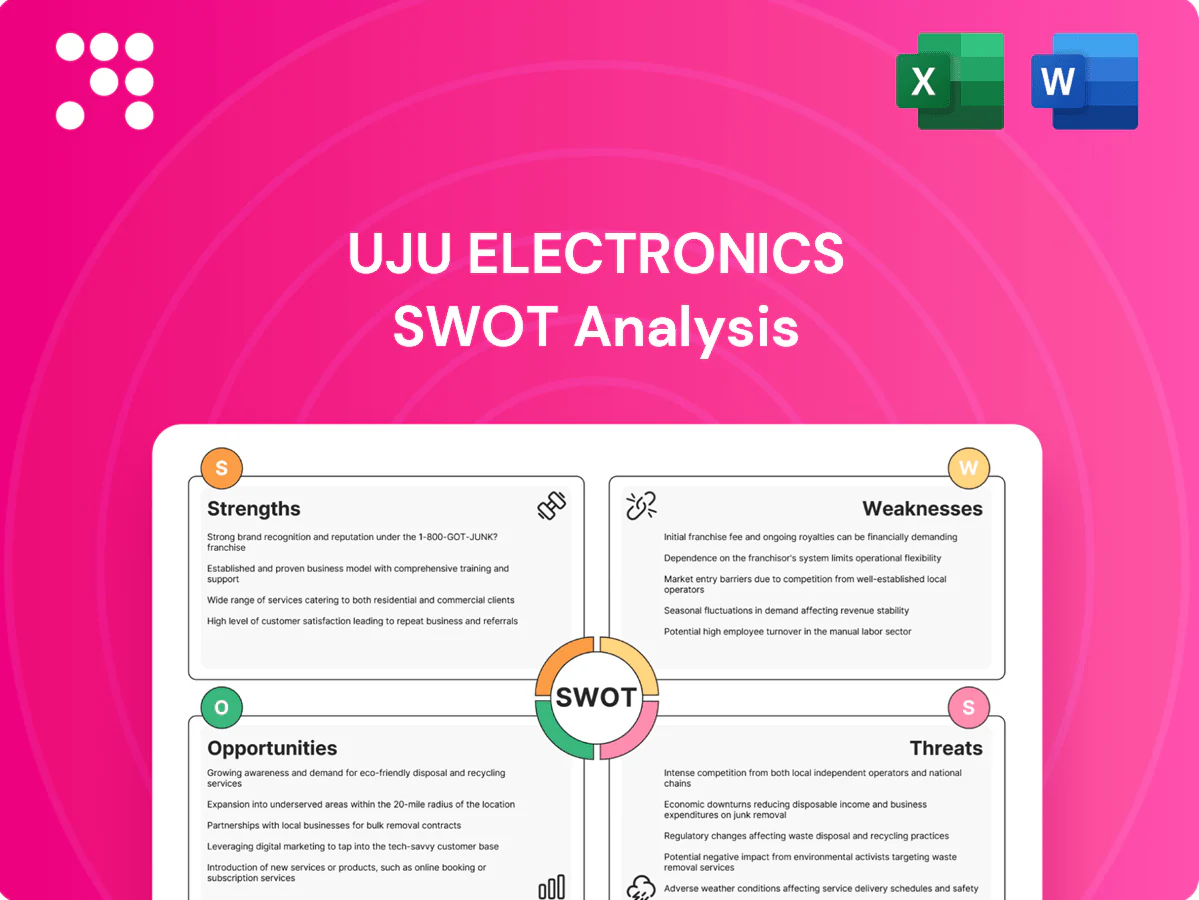
Uju Electronics SWOT Analysis

Dive Deeper Into the Company’s Strategic Blueprint
Uju Electronics SWOT preview highlights core strengths, market threats, and growth levers investors and strategists must know. Our full SWOT delivers a research-backed, investor-ready report with expert commentary. Purchase to access the complete Word analysis and editable Excel matrix. Use it to plan, pitch, and act with confidence.
Strengths

Diverse connector portfolio
Coverage across board-to-board, wire-to-board and I/O widens Uju Electronics’ addressable use-cases, spanning industrial, automotive and consumer applications. A broad catalog reduces dependency on any single specification cycle and enables effective cross-selling to existing OEMs and tier suppliers. This product diversity cushions demand volatility across end-markets.
Multi-industry end-market mix
Serving automotive, telecom and consumer electronics balances cyclical swings; automotive delivers volume and durability credentials while consumer and telecom drive rapid innovation cadence. This mix sustains stable tooling utilization across product cycles and reduces downtime. It also strengthens bargaining power with distributors and OEMs by diversifying revenue streams and negotiating leverage.

Quality and reliability positioning
Emphasis on high-reliability components aligns with safety and uptime needs, matching automotive OEMs' typical target of ~1 ppm field failure rates. Such positioning supports premium pricing and higher margins versus commodity interconnects and strengthens qualification with tier-1s and ODMs. Over time this raises switching costs for incumbents by locking designs and supply chains.

Engineering and customization capability
Engineering and customization drive connector wins where tailored footprints and latching features matter; strong application engineering reduces design-in cycles and supports faster time-to-market, critical in a global connector market exceeding $70 billion (2023).
Customization deepens customer lock-in via mechanical and electrical fit and creates follow-on revenue through platform extensions and variants.
- Tailored footprints: higher win rate
- Shorter design-in: faster adoption
- Lock-in: increased CLTV
- Platform extensions: recurring revenue
Korean manufacturing base
Korean manufacturing base places Uju near advanced electronics and automotive ecosystems, enabling collaboration with Samsung, LG and tier-1 suppliers. South Korean firms held about 70% of the global memory market in 2024, enhancing credibility and supplier leverage. Regional networks shorten lead times and support just-in-time logistics to Asian OEM hubs.
- Proximity to Samsung/LG and tier-1 suppliers
- ~70% global memory market share (2024)
- Shorter lead times via regional supply chains
- Supports JIT delivery to Asian OEM hubs
Connectors: automotive ~1 ppm, Korean memory ~70%, $70B+ market
Coverage across board-to-board, wire-to-board and I/O expands addressable markets (industrial, automotive, consumer), reducing specification risk and enabling cross-sell. Mix of automotive, telecom and consumer stabilizes revenue; automotive supports premium pricing via ~1 ppm target reliability. Engineering-led customization shortens design-in and increases CLTV. Korean base leverages ~70% global memory share (2024) and >$70B connector market (2023).
| Metric | Value |
|---|---|
| Global connector market (2023) | $70B+ |
| Korean memory share (2024) | ~70% |
| Automotive field target | ~1 ppm |
What is included in the product
 Detailed Word Document
Examines the strengths, weaknesses, opportunities, and threats shaping Uju Electronics’s competitive position, highlighting internal capabilities, market challenges, and strategic risks to inform growth and mitigation strategies.

 Customizable Excel Spreadsheet
Provides a concise, visual SWOT matrix for Uju Electronics to quickly identify strategic gaps and prioritize fixes, while an editable format enables fast updates as priorities shift to ease stakeholder alignment.
Weaknesses

Brand visibility outside Asia
Limited brand visibility outside Asia hurts Uju Electronics because global connector procurement often favors incumbents such as TE Connectivity, Amphenol and Molex, slowing entry into OEM supply chains. Reduced recognition lengthens qualification and RFI-to-award timelines, forcing extended distributor vetting and higher onboarding costs. To win business Uju may need elevated distributor incentives or pricing concessions and to scale regional marketing and FAE coverage rapidly.
Exposure to price competition
Many connector families face commoditization pressures; the global electronic connector market (~$40B in 2024) drives high-volume SKUs toward price competition. Large rivals such as TE Connectivity and Amphenol can undercut on scale, squeezing gross margins on commodity lines. Without clear differentiation, Uju's connector margins risk falling below industry averages. Sustained pricing power requires IP, unique features, or service moats.

Capex and tooling intensity
Precision stamping, electroplating and injection molding require continual capital investment—industrial tooling and presses commonly represent multi‑hundred‑thousand to multi‑million dollar outlays and recurring upgrades. Tooling lead times of 8–12 weeks routinely constrain rapid scale‑ups and new product introductions. High fixed costs push breakeven volumes significantly higher during downturns, while scheduled maintenance and requalification cycles add ongoing overhead and downtime risk.

Customer concentration risk
Design-ins cluster around a few anchor programs, so program sunsets or platform delays can materially cut revenue; 2024 supply-chain disruptions intensified these swings. Automotive SOP/EOP cycles further exacerbate lumpiness, concentrating cashflow into narrow windows. Diversifying accounts and platforms is essential to smooth revenue and reduce program risk.
- Design-ins concentrated
- Program sunset sensitivity
- Automotive SOP/EOP lumpiness
- Need diversification
Standards and certification burden
Automotive (IATF 16949, functional safety ISO 26262) and telecom (3GPP/ETSI) demand rigorous compliance, pushing Uju Electronics to fund extensive test, traceability and documentation programs; third-party test fees and validation often run from tens to hundreds of thousands USD and add 2–5% to product cost.
Certification lead times commonly range 3–9 months, risking missed design windows and delayed revenue; continuous spec updates (annual or multi‑year cycles) force recurring compliance spend and engineering cycles.
- Compliance regimes: IATF 16949, ISO 26262, 3GPP/ETSI
- Testing cost: tens–hundreds kUSD; adds ~2–5% BOM
- Lead time: 3–9 months
- Updates: annual/multi‑year spec revisions
Weak brand and commoditization in 40B connector market raise costs, delay wins
Limited global brand recognition lengthens OEM qualification, raising onboarding costs and forcing price or incentive concessions. Commoditization in a ~40B USD connector market (2024) pressures margins vs TE/Amphenol scale. High tooling, compliance and certification (tests tens–hundreds kUSD; lead times 3–9 months) raise fixed costs and revenue lumpiness.
| Weakness | Impact | Key metric |
|---|---|---|
| Brand/qualification | Slower wins, higher costs | RFI→award ↑ weeks |
| Commoditization | Margin squeeze | Market size 40B (2024) |
| Capex & compliance | High fixed cost, delays | Tests 10–300k USD; 3–9m lead |
Full Version Awaits
Uju Electronics SWOT Analysis
This is the actual SWOT analysis document you’ll receive upon purchase—no surprises, just professional quality. The preview below is taken directly from the full SWOT report you'll get, showing strengths, weaknesses, opportunities and threats for Uju Electronics. Buy to unlock the complete, editable file immediately after checkout.

Dive Deeper Into the Company’s Strategic Blueprint
Uju Electronics SWOT preview highlights core strengths, market threats, and growth levers investors and strategists must know. Our full SWOT delivers a research-backed, investor-ready report with expert commentary. Purchase to access the complete Word analysis and editable Excel matrix. Use it to plan, pitch, and act with confidence.
Strengths
Diverse connector portfolio
Coverage across board-to-board, wire-to-board and I/O widens Uju Electronics’ addressable use-cases, spanning industrial, automotive and consumer applications. A broad catalog reduces dependency on any single specification cycle and enables effective cross-selling to existing OEMs and tier suppliers. This product diversity cushions demand volatility across end-markets.
Multi-industry end-market mix
Serving automotive, telecom and consumer electronics balances cyclical swings; automotive delivers volume and durability credentials while consumer and telecom drive rapid innovation cadence. This mix sustains stable tooling utilization across product cycles and reduces downtime. It also strengthens bargaining power with distributors and OEMs by diversifying revenue streams and negotiating leverage.
Quality and reliability positioning
Emphasis on high-reliability components aligns with safety and uptime needs, matching automotive OEMs' typical target of ~1 ppm field failure rates. Such positioning supports premium pricing and higher margins versus commodity interconnects and strengthens qualification with tier-1s and ODMs. Over time this raises switching costs for incumbents by locking designs and supply chains.
Engineering and customization capability
Engineering and customization drive connector wins where tailored footprints and latching features matter; strong application engineering reduces design-in cycles and supports faster time-to-market, critical in a global connector market exceeding $70 billion (2023).
Customization deepens customer lock-in via mechanical and electrical fit and creates follow-on revenue through platform extensions and variants.
- Tailored footprints: higher win rate
- Shorter design-in: faster adoption
- Lock-in: increased CLTV
- Platform extensions: recurring revenue
Korean manufacturing base
Korean manufacturing base places Uju near advanced electronics and automotive ecosystems, enabling collaboration with Samsung, LG and tier-1 suppliers. South Korean firms held about 70% of the global memory market in 2024, enhancing credibility and supplier leverage. Regional networks shorten lead times and support just-in-time logistics to Asian OEM hubs.
- Proximity to Samsung/LG and tier-1 suppliers
- ~70% global memory market share (2024)
- Shorter lead times via regional supply chains
- Supports JIT delivery to Asian OEM hubs
Connectors: automotive ~1 ppm, Korean memory ~70%, $70B+ market
Coverage across board-to-board, wire-to-board and I/O expands addressable markets (industrial, automotive, consumer), reducing specification risk and enabling cross-sell. Mix of automotive, telecom and consumer stabilizes revenue; automotive supports premium pricing via ~1 ppm target reliability. Engineering-led customization shortens design-in and increases CLTV. Korean base leverages ~70% global memory share (2024) and >$70B connector market (2023).
| Metric | Value |
|---|---|
| Global connector market (2023) | $70B+ |
| Korean memory share (2024) | ~70% |
| Automotive field target | ~1 ppm |
What is included in the product
Detailed Word Document
Examines the strengths, weaknesses, opportunities, and threats shaping Uju Electronics’s competitive position, highlighting internal capabilities, market challenges, and strategic risks to inform growth and mitigation strategies.
Customizable Excel Spreadsheet
Provides a concise, visual SWOT matrix for Uju Electronics to quickly identify strategic gaps and prioritize fixes, while an editable format enables fast updates as priorities shift to ease stakeholder alignment.
Weaknesses
Brand visibility outside Asia
Limited brand visibility outside Asia hurts Uju Electronics because global connector procurement often favors incumbents such as TE Connectivity, Amphenol and Molex, slowing entry into OEM supply chains. Reduced recognition lengthens qualification and RFI-to-award timelines, forcing extended distributor vetting and higher onboarding costs. To win business Uju may need elevated distributor incentives or pricing concessions and to scale regional marketing and FAE coverage rapidly.
Exposure to price competition
Many connector families face commoditization pressures; the global electronic connector market (~$40B in 2024) drives high-volume SKUs toward price competition. Large rivals such as TE Connectivity and Amphenol can undercut on scale, squeezing gross margins on commodity lines. Without clear differentiation, Uju's connector margins risk falling below industry averages. Sustained pricing power requires IP, unique features, or service moats.
Capex and tooling intensity
Precision stamping, electroplating and injection molding require continual capital investment—industrial tooling and presses commonly represent multi‑hundred‑thousand to multi‑million dollar outlays and recurring upgrades. Tooling lead times of 8–12 weeks routinely constrain rapid scale‑ups and new product introductions. High fixed costs push breakeven volumes significantly higher during downturns, while scheduled maintenance and requalification cycles add ongoing overhead and downtime risk.
Customer concentration risk
Design-ins cluster around a few anchor programs, so program sunsets or platform delays can materially cut revenue; 2024 supply-chain disruptions intensified these swings. Automotive SOP/EOP cycles further exacerbate lumpiness, concentrating cashflow into narrow windows. Diversifying accounts and platforms is essential to smooth revenue and reduce program risk.
- Design-ins concentrated
- Program sunset sensitivity
- Automotive SOP/EOP lumpiness
- Need diversification
Standards and certification burden
Automotive (IATF 16949, functional safety ISO 26262) and telecom (3GPP/ETSI) demand rigorous compliance, pushing Uju Electronics to fund extensive test, traceability and documentation programs; third-party test fees and validation often run from tens to hundreds of thousands USD and add 2–5% to product cost.
Certification lead times commonly range 3–9 months, risking missed design windows and delayed revenue; continuous spec updates (annual or multi‑year cycles) force recurring compliance spend and engineering cycles.
- Compliance regimes: IATF 16949, ISO 26262, 3GPP/ETSI
- Testing cost: tens–hundreds kUSD; adds ~2–5% BOM
- Lead time: 3–9 months
- Updates: annual/multi‑year spec revisions
Weak brand and commoditization in 40B connector market raise costs, delay wins
Limited global brand recognition lengthens OEM qualification, raising onboarding costs and forcing price or incentive concessions. Commoditization in a ~40B USD connector market (2024) pressures margins vs TE/Amphenol scale. High tooling, compliance and certification (tests tens–hundreds kUSD; lead times 3–9 months) raise fixed costs and revenue lumpiness.
| Weakness | Impact | Key metric |
|---|---|---|
| Brand/qualification | Slower wins, higher costs | RFI→award ↑ weeks |
| Commoditization | Margin squeeze | Market size 40B (2024) |
| Capex & compliance | High fixed cost, delays | Tests 10–300k USD; 3–9m lead |
Full Version Awaits
Uju Electronics SWOT Analysis
This is the actual SWOT analysis document you’ll receive upon purchase—no surprises, just professional quality. The preview below is taken directly from the full SWOT report you'll get, showing strengths, weaknesses, opportunities and threats for Uju Electronics. Buy to unlock the complete, editable file immediately after checkout.
Original: $10.00
-65%$10.00
$3.50Description
Dive Deeper Into the Company’s Strategic Blueprint
Uju Electronics SWOT preview highlights core strengths, market threats, and growth levers investors and strategists must know. Our full SWOT delivers a research-backed, investor-ready report with expert commentary. Purchase to access the complete Word analysis and editable Excel matrix. Use it to plan, pitch, and act with confidence.
Strengths
Diverse connector portfolio
Coverage across board-to-board, wire-to-board and I/O widens Uju Electronics’ addressable use-cases, spanning industrial, automotive and consumer applications. A broad catalog reduces dependency on any single specification cycle and enables effective cross-selling to existing OEMs and tier suppliers. This product diversity cushions demand volatility across end-markets.
Multi-industry end-market mix
Serving automotive, telecom and consumer electronics balances cyclical swings; automotive delivers volume and durability credentials while consumer and telecom drive rapid innovation cadence. This mix sustains stable tooling utilization across product cycles and reduces downtime. It also strengthens bargaining power with distributors and OEMs by diversifying revenue streams and negotiating leverage.
Quality and reliability positioning
Emphasis on high-reliability components aligns with safety and uptime needs, matching automotive OEMs' typical target of ~1 ppm field failure rates. Such positioning supports premium pricing and higher margins versus commodity interconnects and strengthens qualification with tier-1s and ODMs. Over time this raises switching costs for incumbents by locking designs and supply chains.
Engineering and customization capability
Engineering and customization drive connector wins where tailored footprints and latching features matter; strong application engineering reduces design-in cycles and supports faster time-to-market, critical in a global connector market exceeding $70 billion (2023).
Customization deepens customer lock-in via mechanical and electrical fit and creates follow-on revenue through platform extensions and variants.
- Tailored footprints: higher win rate
- Shorter design-in: faster adoption
- Lock-in: increased CLTV
- Platform extensions: recurring revenue
Korean manufacturing base
Korean manufacturing base places Uju near advanced electronics and automotive ecosystems, enabling collaboration with Samsung, LG and tier-1 suppliers. South Korean firms held about 70% of the global memory market in 2024, enhancing credibility and supplier leverage. Regional networks shorten lead times and support just-in-time logistics to Asian OEM hubs.
- Proximity to Samsung/LG and tier-1 suppliers
- ~70% global memory market share (2024)
- Shorter lead times via regional supply chains
- Supports JIT delivery to Asian OEM hubs
Connectors: automotive ~1 ppm, Korean memory ~70%, $70B+ market
Coverage across board-to-board, wire-to-board and I/O expands addressable markets (industrial, automotive, consumer), reducing specification risk and enabling cross-sell. Mix of automotive, telecom and consumer stabilizes revenue; automotive supports premium pricing via ~1 ppm target reliability. Engineering-led customization shortens design-in and increases CLTV. Korean base leverages ~70% global memory share (2024) and >$70B connector market (2023).
| Metric | Value |
|---|---|
| Global connector market (2023) | $70B+ |
| Korean memory share (2024) | ~70% |
| Automotive field target | ~1 ppm |
What is included in the product
Detailed Word Document
Examines the strengths, weaknesses, opportunities, and threats shaping Uju Electronics’s competitive position, highlighting internal capabilities, market challenges, and strategic risks to inform growth and mitigation strategies.
Customizable Excel Spreadsheet
Provides a concise, visual SWOT matrix for Uju Electronics to quickly identify strategic gaps and prioritize fixes, while an editable format enables fast updates as priorities shift to ease stakeholder alignment.
Weaknesses
Brand visibility outside Asia
Limited brand visibility outside Asia hurts Uju Electronics because global connector procurement often favors incumbents such as TE Connectivity, Amphenol and Molex, slowing entry into OEM supply chains. Reduced recognition lengthens qualification and RFI-to-award timelines, forcing extended distributor vetting and higher onboarding costs. To win business Uju may need elevated distributor incentives or pricing concessions and to scale regional marketing and FAE coverage rapidly.
Exposure to price competition
Many connector families face commoditization pressures; the global electronic connector market (~$40B in 2024) drives high-volume SKUs toward price competition. Large rivals such as TE Connectivity and Amphenol can undercut on scale, squeezing gross margins on commodity lines. Without clear differentiation, Uju's connector margins risk falling below industry averages. Sustained pricing power requires IP, unique features, or service moats.
Capex and tooling intensity
Precision stamping, electroplating and injection molding require continual capital investment—industrial tooling and presses commonly represent multi‑hundred‑thousand to multi‑million dollar outlays and recurring upgrades. Tooling lead times of 8–12 weeks routinely constrain rapid scale‑ups and new product introductions. High fixed costs push breakeven volumes significantly higher during downturns, while scheduled maintenance and requalification cycles add ongoing overhead and downtime risk.
Customer concentration risk
Design-ins cluster around a few anchor programs, so program sunsets or platform delays can materially cut revenue; 2024 supply-chain disruptions intensified these swings. Automotive SOP/EOP cycles further exacerbate lumpiness, concentrating cashflow into narrow windows. Diversifying accounts and platforms is essential to smooth revenue and reduce program risk.
- Design-ins concentrated
- Program sunset sensitivity
- Automotive SOP/EOP lumpiness
- Need diversification
Standards and certification burden
Automotive (IATF 16949, functional safety ISO 26262) and telecom (3GPP/ETSI) demand rigorous compliance, pushing Uju Electronics to fund extensive test, traceability and documentation programs; third-party test fees and validation often run from tens to hundreds of thousands USD and add 2–5% to product cost.
Certification lead times commonly range 3–9 months, risking missed design windows and delayed revenue; continuous spec updates (annual or multi‑year cycles) force recurring compliance spend and engineering cycles.
- Compliance regimes: IATF 16949, ISO 26262, 3GPP/ETSI
- Testing cost: tens–hundreds kUSD; adds ~2–5% BOM
- Lead time: 3–9 months
- Updates: annual/multi‑year spec revisions
Weak brand and commoditization in 40B connector market raise costs, delay wins
Limited global brand recognition lengthens OEM qualification, raising onboarding costs and forcing price or incentive concessions. Commoditization in a ~40B USD connector market (2024) pressures margins vs TE/Amphenol scale. High tooling, compliance and certification (tests tens–hundreds kUSD; lead times 3–9 months) raise fixed costs and revenue lumpiness.
| Weakness | Impact | Key metric |
|---|---|---|
| Brand/qualification | Slower wins, higher costs | RFI→award ↑ weeks |
| Commoditization | Margin squeeze | Market size 40B (2024) |
| Capex & compliance | High fixed cost, delays | Tests 10–300k USD; 3–9m lead |
Full Version Awaits
Uju Electronics SWOT Analysis
This is the actual SWOT analysis document you’ll receive upon purchase—no surprises, just professional quality. The preview below is taken directly from the full SWOT report you'll get, showing strengths, weaknesses, opportunities and threats for Uju Electronics. Buy to unlock the complete, editable file immediately after checkout.











