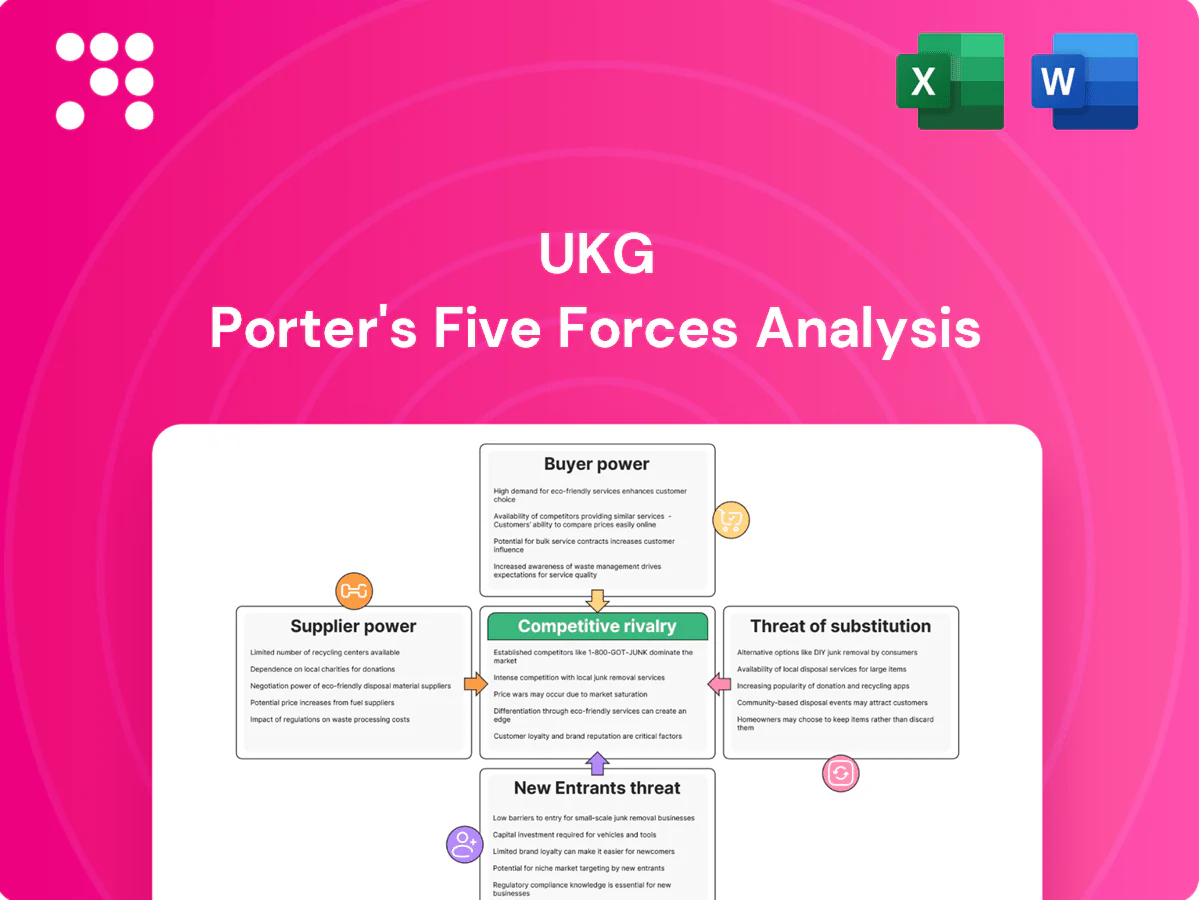
UKG Porter's Five Forces Analysis

A Must-Have Tool for Decision-Makers
UKG faces intense competitive rivalry from legacy HCM providers and agile SaaS challengers, while buyer bargaining power grows as enterprises demand integrated workforce solutions and predictable pricing. Supplier and vendor pressures remain moderate, but substitutes and new entrants could disrupt niche segments. This brief snapshot only scratches the surface—unlock the full Porter's Five Forces Analysis to explore UKG’s competitive dynamics, market pressures, and strategic advantages in detail.
Suppliers Bargaining Power

Dependence on cloud hyperscalers
UKG depends on hyperscalers for compute, storage and AI, and in 2024 AWS (~32%) and Azure (~23%) together controlled roughly 55% of the IaaS/PaaS market, concentrating supplier power. Long-term contracts and volume discounts reduce pricing risk but create material switching frictions and sunk migration costs. Hyperscaler outages or policy shifts can cascade into UKG service levels and SLAs, while diversification and multi-cloud architectures partially mitigate this exposure.
Regulatory content and payroll data feeds
Accurate tax tables, compliance updates, and country-specific payroll rules come from specialized content suppliers whose proprietary feeds are critical and unique, giving them leverage over vendors like UKG. Multiple reputable suppliers and UKG’s internal compliance team limit pricing power, while regulatory changes—often requiring near-real-time updates—increase operational dependence and switching costs.

Third-party integrations and ISV ecosystem
UKG integrates with benefits, identity, ERP and recruiting vendors, and popular ISVs can shape roadmap priorities by demanding compatibility and technical concessions. In 2024 the UKG partner ecosystem includes hundreds of certified integrations and open APIs that lower unilateral supplier leverage. Certification programs and documented APIs shift power toward UKG, while deep, long-standing integrations reduce ISV renegotiation leverage over time.

Implementation and consulting partners
Implementation and consulting partners’ delivery capacity directly affects time-to-value in large UKG deployments, with scarce specialist talent raising rates and elongating timelines, increasing supplier power. Robust partner enablement and standardized playbooks lessen dependence on any single firm, while UKG’s internal professional services acts as a counterbalance.
- Delivery capacity
- Talent scarcity raises rates
- Enablement reduces dependency
- UKG PS offsets risk
Specialized AI/analytics components
Use of third-party NLP, ML, and analytics accelerators creates reliance on specific models and tools; a 2024 industry survey found 64% of enterprises depend on external AI stacks, while restrictive licensing and data residency terms reduce deployment flexibility. Building proprietary models where feasible lowers supplier leverage, and UKG’s growing customer data network effects over time shift bargaining power back to the firm.
- Dependence: 64% enterprises use external AI stacks (2024)
- Risk: licensing and residency constrain flexibility
- Mitigation: invest in proprietary models
- Advantage: data network effects increase UKG leverage
Workforce SaaS hit by hyperscaler concentration ~55% and AI reliance 64%
UKG faces concentrated supplier power from hyperscalers (AWS ~32%, Azure ~23% = ~55% IaaS/PaaS 2024), creating switching frictions despite discounts. Proprietary payroll/compliance feeds and scarce implementation talent raise leverage and costs. External AI reliance (64% enterprises, 2024) and broad ISV integrations moderate but do not eliminate supplier influence.
| Metric | Value (2024) |
|---|---|
| Hyperscaler share | AWS 32% / Azure 23% (~55%) |
| External AI reliance | 64% |
| Certified integrations | Hundreds |
What is included in the product
 Detailed Word Document
Concise Porter’s Five Forces analysis tailored for UKG, uncovering competitive intensity, buyer and supplier power, threat of substitutes, and barriers to entry that shape profitability. Includes strategic insights on disruptive technologies, emerging competitors, and defenses that protect UKG’s market position.

 Customizable Excel Spreadsheet
A concise UKG Porter's Five Forces one‑sheet that clarifies competitive pressures and accelerates strategic decisions. Easily customize force intensities and swap in your own data for instant, slide‑ready insights.
Customers Bargaining Power

Enterprise RFP leverage
Large enterprises run competitive RFPs among top HCM vendors, extracting discounts often in the 15–25% range and favorable contract terms. Multi-year, multi-module deals commonly exceed $1M ARR, increasing buyer negotiating power. Referenceability and security assurances such as SOC2/ISO27001 are table stakes, and procurement frequently bundles implementation, support and professional services to secure concessions.
High switching costs but credible alternatives
High switching costs from data migration, change management, and compliance retesting—with enterprise HCM contracts commonly spanning 3–5 years (industry standard 2024)—moderate buyer power for UKG.
Yet Workday, SAP SuccessFactors, Oracle HCM, ADP, and Ceridian remain credible alternatives, pushing buyers to trade price against product breadth, UX, and global coverage.
Contract renewal cycles are key leverage moments where buyers can extract concessions or threaten migration despite high upfront switching costs.

Modular purchasing behavior
As of 2024, customers increasingly mix-and-match timekeeping, payroll and talent modules, negotiating line-item pricing and boosting buyer leverage. Best-of-breed adoption elevates pressure on specific components, while UKG’s unified suite and single data model blunt pure price comparisons by enabling cross-module workflows. Focusing discussions on outcome-based metrics — retention, time-to-fill, payroll error rates — shifts bargaining toward demonstrated value.

Service quality and SLA sensitivity
HR/payroll uptime and accuracy are mission-critical for UKG buyers, making credits and penalties in SLAs highly consequential; transparent incident reporting and recovery plans are routinely demanded to limit business disruption. Strong CSAT and successful implementations materially reduce churn risk, while poor service quickly amplifies buyer leverage and escalation pressure.
- Uptime/accuracy: mission-critical
- SLAs: meaningful credits/penalties
- Transparency: incident reporting + recovery plans
- CSAT/implementations: lower churn
- Poor service: increases buyer power
Vertical and global requirements
Complex scheduling in healthcare and retail plus multi-country payroll in 2024 raise solution specificity, empowering sophisticated buyers to demand niche customizations and integrations. Buyers with industry-specific requirements use these needs to negotiate tailored features, lowering price sensitivity. Deep vertical expertise and robust local compliance support retain value and limit substitutability, constraining buyer power.
- vertical-specific scheduling reduces substitutability
- sophisticated buyers drive customization
- local compliance support is decisive
Buyers secure 15–25% discounts on >$1M ARR, 3–5yr contracts; renewals become leverage
Buyers extract 15–25% discounts in competitive RFPs and push favorable terms on >$1M ARR multi-year, multi-module deals. Enterprise contracts commonly span 3–5 years (industry standard 2024), raising switching costs but making renewals key leverage points. Best-of-breed mix-and-match adoption rose in 2024, increasing line-item negotiation on modules.
| Metric | 2024 |
|---|---|
| Avg discount | 15–25% |
| Deal size | >$1M ARR |
| Contract length | 3–5 yrs |
| Mix-and-match | Increasing |
What You See Is What You Get
UKG Porter's Five Forces Analysis
This preview shows the exact UKG Porter's Five Forces Analysis you'll receive immediately after purchase—no surprises, no placeholders. The document displayed is the final, professionally formatted file and includes competitive intensity, supplier and buyer power, threat of substitutes, and entry barriers. You'll get instant access to this same ready-to-use document upon payment.

A Must-Have Tool for Decision-Makers
UKG faces intense competitive rivalry from legacy HCM providers and agile SaaS challengers, while buyer bargaining power grows as enterprises demand integrated workforce solutions and predictable pricing. Supplier and vendor pressures remain moderate, but substitutes and new entrants could disrupt niche segments. This brief snapshot only scratches the surface—unlock the full Porter's Five Forces Analysis to explore UKG’s competitive dynamics, market pressures, and strategic advantages in detail.
Suppliers Bargaining Power
Dependence on cloud hyperscalers
UKG depends on hyperscalers for compute, storage and AI, and in 2024 AWS (~32%) and Azure (~23%) together controlled roughly 55% of the IaaS/PaaS market, concentrating supplier power. Long-term contracts and volume discounts reduce pricing risk but create material switching frictions and sunk migration costs. Hyperscaler outages or policy shifts can cascade into UKG service levels and SLAs, while diversification and multi-cloud architectures partially mitigate this exposure.
Regulatory content and payroll data feeds
Accurate tax tables, compliance updates, and country-specific payroll rules come from specialized content suppliers whose proprietary feeds are critical and unique, giving them leverage over vendors like UKG. Multiple reputable suppliers and UKG’s internal compliance team limit pricing power, while regulatory changes—often requiring near-real-time updates—increase operational dependence and switching costs.
Third-party integrations and ISV ecosystem
UKG integrates with benefits, identity, ERP and recruiting vendors, and popular ISVs can shape roadmap priorities by demanding compatibility and technical concessions. In 2024 the UKG partner ecosystem includes hundreds of certified integrations and open APIs that lower unilateral supplier leverage. Certification programs and documented APIs shift power toward UKG, while deep, long-standing integrations reduce ISV renegotiation leverage over time.
Implementation and consulting partners
Implementation and consulting partners’ delivery capacity directly affects time-to-value in large UKG deployments, with scarce specialist talent raising rates and elongating timelines, increasing supplier power. Robust partner enablement and standardized playbooks lessen dependence on any single firm, while UKG’s internal professional services acts as a counterbalance.
- Delivery capacity
- Talent scarcity raises rates
- Enablement reduces dependency
- UKG PS offsets risk
Specialized AI/analytics components
Use of third-party NLP, ML, and analytics accelerators creates reliance on specific models and tools; a 2024 industry survey found 64% of enterprises depend on external AI stacks, while restrictive licensing and data residency terms reduce deployment flexibility. Building proprietary models where feasible lowers supplier leverage, and UKG’s growing customer data network effects over time shift bargaining power back to the firm.
- Dependence: 64% enterprises use external AI stacks (2024)
- Risk: licensing and residency constrain flexibility
- Mitigation: invest in proprietary models
- Advantage: data network effects increase UKG leverage
Workforce SaaS hit by hyperscaler concentration ~55% and AI reliance 64%
UKG faces concentrated supplier power from hyperscalers (AWS ~32%, Azure ~23% = ~55% IaaS/PaaS 2024), creating switching frictions despite discounts. Proprietary payroll/compliance feeds and scarce implementation talent raise leverage and costs. External AI reliance (64% enterprises, 2024) and broad ISV integrations moderate but do not eliminate supplier influence.
| Metric | Value (2024) |
|---|---|
| Hyperscaler share | AWS 32% / Azure 23% (~55%) |
| External AI reliance | 64% |
| Certified integrations | Hundreds |
What is included in the product
Detailed Word Document
Concise Porter’s Five Forces analysis tailored for UKG, uncovering competitive intensity, buyer and supplier power, threat of substitutes, and barriers to entry that shape profitability. Includes strategic insights on disruptive technologies, emerging competitors, and defenses that protect UKG’s market position.
Customizable Excel Spreadsheet
A concise UKG Porter's Five Forces one‑sheet that clarifies competitive pressures and accelerates strategic decisions. Easily customize force intensities and swap in your own data for instant, slide‑ready insights.
Customers Bargaining Power
Enterprise RFP leverage
Large enterprises run competitive RFPs among top HCM vendors, extracting discounts often in the 15–25% range and favorable contract terms. Multi-year, multi-module deals commonly exceed $1M ARR, increasing buyer negotiating power. Referenceability and security assurances such as SOC2/ISO27001 are table stakes, and procurement frequently bundles implementation, support and professional services to secure concessions.
High switching costs but credible alternatives
High switching costs from data migration, change management, and compliance retesting—with enterprise HCM contracts commonly spanning 3–5 years (industry standard 2024)—moderate buyer power for UKG.
Yet Workday, SAP SuccessFactors, Oracle HCM, ADP, and Ceridian remain credible alternatives, pushing buyers to trade price against product breadth, UX, and global coverage.
Contract renewal cycles are key leverage moments where buyers can extract concessions or threaten migration despite high upfront switching costs.
Modular purchasing behavior
As of 2024, customers increasingly mix-and-match timekeeping, payroll and talent modules, negotiating line-item pricing and boosting buyer leverage. Best-of-breed adoption elevates pressure on specific components, while UKG’s unified suite and single data model blunt pure price comparisons by enabling cross-module workflows. Focusing discussions on outcome-based metrics — retention, time-to-fill, payroll error rates — shifts bargaining toward demonstrated value.
Service quality and SLA sensitivity
HR/payroll uptime and accuracy are mission-critical for UKG buyers, making credits and penalties in SLAs highly consequential; transparent incident reporting and recovery plans are routinely demanded to limit business disruption. Strong CSAT and successful implementations materially reduce churn risk, while poor service quickly amplifies buyer leverage and escalation pressure.
- Uptime/accuracy: mission-critical
- SLAs: meaningful credits/penalties
- Transparency: incident reporting + recovery plans
- CSAT/implementations: lower churn
- Poor service: increases buyer power
Vertical and global requirements
Complex scheduling in healthcare and retail plus multi-country payroll in 2024 raise solution specificity, empowering sophisticated buyers to demand niche customizations and integrations. Buyers with industry-specific requirements use these needs to negotiate tailored features, lowering price sensitivity. Deep vertical expertise and robust local compliance support retain value and limit substitutability, constraining buyer power.
- vertical-specific scheduling reduces substitutability
- sophisticated buyers drive customization
- local compliance support is decisive
Buyers secure 15–25% discounts on >$1M ARR, 3–5yr contracts; renewals become leverage
Buyers extract 15–25% discounts in competitive RFPs and push favorable terms on >$1M ARR multi-year, multi-module deals. Enterprise contracts commonly span 3–5 years (industry standard 2024), raising switching costs but making renewals key leverage points. Best-of-breed mix-and-match adoption rose in 2024, increasing line-item negotiation on modules.
| Metric | 2024 |
|---|---|
| Avg discount | 15–25% |
| Deal size | >$1M ARR |
| Contract length | 3–5 yrs |
| Mix-and-match | Increasing |
What You See Is What You Get
UKG Porter's Five Forces Analysis
This preview shows the exact UKG Porter's Five Forces Analysis you'll receive immediately after purchase—no surprises, no placeholders. The document displayed is the final, professionally formatted file and includes competitive intensity, supplier and buyer power, threat of substitutes, and entry barriers. You'll get instant access to this same ready-to-use document upon payment.
Original: $10.00
-65%$10.00
$3.50Description
A Must-Have Tool for Decision-Makers
UKG faces intense competitive rivalry from legacy HCM providers and agile SaaS challengers, while buyer bargaining power grows as enterprises demand integrated workforce solutions and predictable pricing. Supplier and vendor pressures remain moderate, but substitutes and new entrants could disrupt niche segments. This brief snapshot only scratches the surface—unlock the full Porter's Five Forces Analysis to explore UKG’s competitive dynamics, market pressures, and strategic advantages in detail.
Suppliers Bargaining Power
Dependence on cloud hyperscalers
UKG depends on hyperscalers for compute, storage and AI, and in 2024 AWS (~32%) and Azure (~23%) together controlled roughly 55% of the IaaS/PaaS market, concentrating supplier power. Long-term contracts and volume discounts reduce pricing risk but create material switching frictions and sunk migration costs. Hyperscaler outages or policy shifts can cascade into UKG service levels and SLAs, while diversification and multi-cloud architectures partially mitigate this exposure.
Regulatory content and payroll data feeds
Accurate tax tables, compliance updates, and country-specific payroll rules come from specialized content suppliers whose proprietary feeds are critical and unique, giving them leverage over vendors like UKG. Multiple reputable suppliers and UKG’s internal compliance team limit pricing power, while regulatory changes—often requiring near-real-time updates—increase operational dependence and switching costs.
Third-party integrations and ISV ecosystem
UKG integrates with benefits, identity, ERP and recruiting vendors, and popular ISVs can shape roadmap priorities by demanding compatibility and technical concessions. In 2024 the UKG partner ecosystem includes hundreds of certified integrations and open APIs that lower unilateral supplier leverage. Certification programs and documented APIs shift power toward UKG, while deep, long-standing integrations reduce ISV renegotiation leverage over time.
Implementation and consulting partners
Implementation and consulting partners’ delivery capacity directly affects time-to-value in large UKG deployments, with scarce specialist talent raising rates and elongating timelines, increasing supplier power. Robust partner enablement and standardized playbooks lessen dependence on any single firm, while UKG’s internal professional services acts as a counterbalance.
- Delivery capacity
- Talent scarcity raises rates
- Enablement reduces dependency
- UKG PS offsets risk
Specialized AI/analytics components
Use of third-party NLP, ML, and analytics accelerators creates reliance on specific models and tools; a 2024 industry survey found 64% of enterprises depend on external AI stacks, while restrictive licensing and data residency terms reduce deployment flexibility. Building proprietary models where feasible lowers supplier leverage, and UKG’s growing customer data network effects over time shift bargaining power back to the firm.
- Dependence: 64% enterprises use external AI stacks (2024)
- Risk: licensing and residency constrain flexibility
- Mitigation: invest in proprietary models
- Advantage: data network effects increase UKG leverage
Workforce SaaS hit by hyperscaler concentration ~55% and AI reliance 64%
UKG faces concentrated supplier power from hyperscalers (AWS ~32%, Azure ~23% = ~55% IaaS/PaaS 2024), creating switching frictions despite discounts. Proprietary payroll/compliance feeds and scarce implementation talent raise leverage and costs. External AI reliance (64% enterprises, 2024) and broad ISV integrations moderate but do not eliminate supplier influence.
| Metric | Value (2024) |
|---|---|
| Hyperscaler share | AWS 32% / Azure 23% (~55%) |
| External AI reliance | 64% |
| Certified integrations | Hundreds |
What is included in the product
Detailed Word Document
Concise Porter’s Five Forces analysis tailored for UKG, uncovering competitive intensity, buyer and supplier power, threat of substitutes, and barriers to entry that shape profitability. Includes strategic insights on disruptive technologies, emerging competitors, and defenses that protect UKG’s market position.
Customizable Excel Spreadsheet
A concise UKG Porter's Five Forces one‑sheet that clarifies competitive pressures and accelerates strategic decisions. Easily customize force intensities and swap in your own data for instant, slide‑ready insights.
Customers Bargaining Power
Enterprise RFP leverage
Large enterprises run competitive RFPs among top HCM vendors, extracting discounts often in the 15–25% range and favorable contract terms. Multi-year, multi-module deals commonly exceed $1M ARR, increasing buyer negotiating power. Referenceability and security assurances such as SOC2/ISO27001 are table stakes, and procurement frequently bundles implementation, support and professional services to secure concessions.
High switching costs but credible alternatives
High switching costs from data migration, change management, and compliance retesting—with enterprise HCM contracts commonly spanning 3–5 years (industry standard 2024)—moderate buyer power for UKG.
Yet Workday, SAP SuccessFactors, Oracle HCM, ADP, and Ceridian remain credible alternatives, pushing buyers to trade price against product breadth, UX, and global coverage.
Contract renewal cycles are key leverage moments where buyers can extract concessions or threaten migration despite high upfront switching costs.
Modular purchasing behavior
As of 2024, customers increasingly mix-and-match timekeeping, payroll and talent modules, negotiating line-item pricing and boosting buyer leverage. Best-of-breed adoption elevates pressure on specific components, while UKG’s unified suite and single data model blunt pure price comparisons by enabling cross-module workflows. Focusing discussions on outcome-based metrics — retention, time-to-fill, payroll error rates — shifts bargaining toward demonstrated value.
Service quality and SLA sensitivity
HR/payroll uptime and accuracy are mission-critical for UKG buyers, making credits and penalties in SLAs highly consequential; transparent incident reporting and recovery plans are routinely demanded to limit business disruption. Strong CSAT and successful implementations materially reduce churn risk, while poor service quickly amplifies buyer leverage and escalation pressure.
- Uptime/accuracy: mission-critical
- SLAs: meaningful credits/penalties
- Transparency: incident reporting + recovery plans
- CSAT/implementations: lower churn
- Poor service: increases buyer power
Vertical and global requirements
Complex scheduling in healthcare and retail plus multi-country payroll in 2024 raise solution specificity, empowering sophisticated buyers to demand niche customizations and integrations. Buyers with industry-specific requirements use these needs to negotiate tailored features, lowering price sensitivity. Deep vertical expertise and robust local compliance support retain value and limit substitutability, constraining buyer power.
- vertical-specific scheduling reduces substitutability
- sophisticated buyers drive customization
- local compliance support is decisive
Buyers secure 15–25% discounts on >$1M ARR, 3–5yr contracts; renewals become leverage
Buyers extract 15–25% discounts in competitive RFPs and push favorable terms on >$1M ARR multi-year, multi-module deals. Enterprise contracts commonly span 3–5 years (industry standard 2024), raising switching costs but making renewals key leverage points. Best-of-breed mix-and-match adoption rose in 2024, increasing line-item negotiation on modules.
| Metric | 2024 |
|---|---|
| Avg discount | 15–25% |
| Deal size | >$1M ARR |
| Contract length | 3–5 yrs |
| Mix-and-match | Increasing |
What You See Is What You Get
UKG Porter's Five Forces Analysis
This preview shows the exact UKG Porter's Five Forces Analysis you'll receive immediately after purchase—no surprises, no placeholders. The document displayed is the final, professionally formatted file and includes competitive intensity, supplier and buyer power, threat of substitutes, and entry barriers. You'll get instant access to this same ready-to-use document upon payment.











