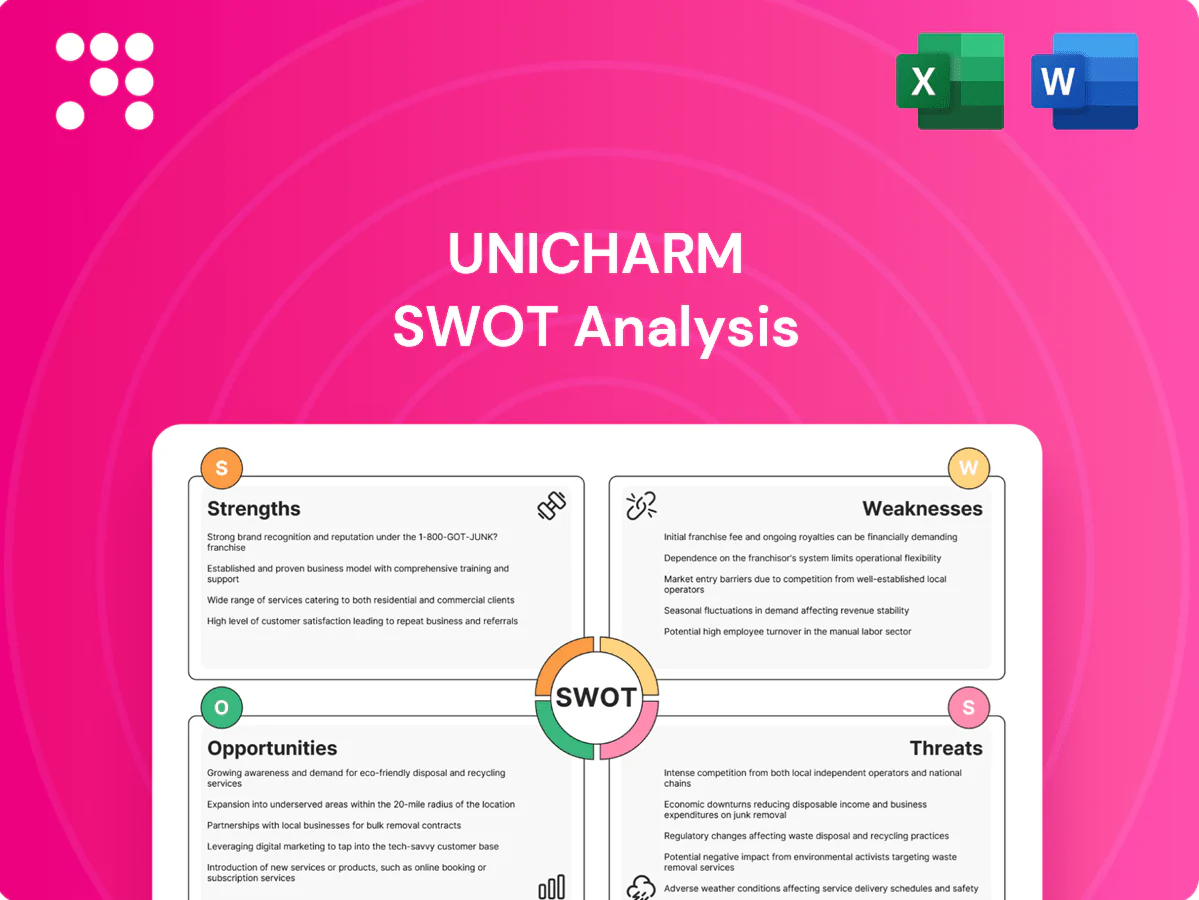
Unicharm SWOT Analysis

Make Insightful Decisions Backed by Expert Research
Unicharm’s SWOT highlights its dominant Asia-Pacific market share, trusted brand and innovation in hygiene products, alongside risks from currency exposure, raw material costs and intensifying competition; growth drivers include premiumization and emerging-market expansion. Want the full story behind Unicharm’s strengths, risks, and growth drivers? Purchase the complete SWOT analysis to get a professionally written, editable Word report plus an Excel matrix for strategy and investment use.
Strengths

Asian market leader
Unicharm dominates baby, feminine and adult-care segments across Japan and emerging Asia, leveraging operations in about 80 countries and reported FY2024 consolidated sales of roughly ¥1.18 trillion. Deep local consumer insights and tight distributor partnerships create high entry barriers in key markets. Pan-Asian scale delivers cost leverage, faster rollouts and brand familiarity that supports pricing power in core categories.
Diversified hygiene portfolio
Unicharm's diversified portfolio spans five core categories—baby diapers, feminine care, adult incontinence, wipes and pet care—across 80+ countries. This breadth smooths cyclical demand and mitigates single-segment shocks, while cross-category R&D and centralized procurement deliver scale advantages that lower unit costs. Portfolio depth strengthens retail negotiation power, supporting distribution in leading chains across Asia.

Trusted brands
Brands like Moony, Sofy and Lifree are widely recognized for quality and comfort, supporting Unicharm’s consumer loyalty in highly sensitive hygiene categories. Unicharm operates in over 80 countries and reported consolidated sales exceeding JPY 1 trillion, reinforcing brand equity that enables premium pricing and faster adoption of innovations. The strong brand halo eases entry into adjacent subsegments.

Innovation in absorbents
Unicharm invests heavily in materials science to drive thinner, better-fitting and skin-friendly absorbents, translating into measurable premium SKUs and repeat purchase; the company reports over 5,000 patents globally (2024) that underpin proprietary thinness and skin-care technologies. Continuous product upgrades keep Unicharm differentiated from private labels and sustain higher ASPs, while rapid innovation cycles drive trade-up behavior and defend shelf space.
Omnichannel distribution
Unicharm's omnichannel distribution leverages extensive relationships with modern trade, pharmacies and e-commerce to broaden reach across roughly 80 countries and territories. Strong in-store execution complements digital marketing and D2C pilots, improving conversion and product trial. Robust logistics support high service levels in fast-moving categories and lower dependence on any single channel.
- Modern trade, pharmacies, e-commerce breadth
- In-store + digital/D2C synergy
- Logistics enable high service levels
- Broad coverage reduces channel concentration risk
Pan-Asian hygiene leader: ¥1.18T sales, 80+ markets, >5,000 patents
Unicharm leads baby, feminine and adult-care across 80+ countries with FY2024 sales ≈¥1.18 trillion, strong brands (Moony, Sofy, Lifree) and >5,000 patents (2024). Pan-Asian scale, diversified five-category portfolio and omnichannel distribution drive pricing power, margin protection and rapid rollouts.
| Metric | 2024 |
|---|---|
| Sales | ¥1.18T |
| Markets | 80+ |
| Patents | >5,000 |
What is included in the product
 Detailed Word Document
Provides a concise SWOT overview of Unicharm, highlighting core strengths (brand recognition, product innovation, strong Asian market share), weaknesses (dependence on Japan/Asia, raw material cost sensitivity), opportunities (aging populations, emerging markets, product diversification) and threats (intense competition, regulatory shifts, currency volatility) to assess strategic positioning and growth risks.

 Customizable Excel Spreadsheet
Provides a concise, visually clear SWOT matrix tailored to Unicharm for quick alignment across product lines and markets, easing strategic decision-making and stakeholder communication.
Weaknesses

Asia-heavy exposure
Unicharm's Asia-heavy exposure—roughly 70% of group sales concentrated in Greater China and Southeast Asia—raises sensitivity to regional downturns or regulatory shifts that could materially affect top-line growth. Geopolitical tensions and supply-chain disruptions in the region can quickly hit both supply and demand. Underweight positions in North America and Europe limit global balance, and diversification into developed markets remains a work in progress.
Input cost sensitivity
Reliance on pulp, SAP, nonwovens and packaging exposes Unicharm’s margins to commodity price swings, with hedging programs mitigating but not eliminating volatility. Hedging reduces short-term exposure yet cannot fully offset sudden spikes, leaving residual cost risk. Pricing pass-throughs to consumers often lag, risking market share loss in price-sensitive segments. Sudden input-cost shocks can quickly compress profitability, especially in value-tier products.

Demographic headwinds
Declining birth rates in Japan and parts of East Asia, with total fertility rates below 1.4 and a 65+ population near 29% in Japan, are pressuring baby diaper volumes and shrinking core demand.
Unicharm must reallocate capacity and R&D toward adult incontinence and pet care, where demand is growing, but the transition timing can create operational inefficiencies and excess infant-sku capacity.
Market-by-market portfolio optimization will take time, impacting margins and requiring capex and supply-chain retooling to realign product mix.

ESG and waste concerns
Disposable plastics and landfill impact draw growing regulatory and consumer scrutiny, pressuring Unicharm’s core single-use products and raising potential delisting risks from sustainability-focused retailers.
Recycling and biodegradable solutions remain nascent at commercial scale, limiting immediate substitution and keeping product lifecycle footprints high.
ESG gaps can damp investor sentiment and access to ESG-linked financing, while compliance and transition costs may rise faster than realized revenue benefits.
- Regulatory scrutiny: risk to listings
- Technology gap: recycling/biodegradable scale
- Investor impact: ESG-driven sentiment
- Cost timing: rising compliance vs delayed revenue
FX and localization risks
Unicharm’s multi-currency operations create earnings volatility versus the yen as revenues and costs fluctuate with FX moves; local production reduces but does not eliminate repatriation and input-purchase exposures.
Sudden devaluations in host currencies can distort pricing ladders and margin comparatives, while deep localization efforts add operational overhead and complexity across supply chains and IT systems.
- FX exposure: revenue and cost mismatches
- Repatriation risk: remittance and tax frictions
- Pricing distortion: sudden currency shocks
- Operational burden: complex localization costs
Asia-heavy sales and ageing Japan cut diaper volumes; commodity, FX and recycling risks rise
Unicharms ~70% sales concentrated in Greater China/SE Asia raises regional risk; Japan 65+ ~29% and fertility <1.4 pressure diaper volumes. Commodity exposure (pulp, SAP, nonwovens) and FX volatility compress margins despite hedging. Sustainability/recycling scale gaps risk retailer delistings and higher compliance costs.
| Metric | Value |
|---|---|
| Asia sales % | ~70% |
| Japan 65+ | ~29% |
| Total fertility rate | <1.4 |
Full Version Awaits
Unicharm SWOT Analysis
This is the actual Unicharm SWOT analysis document you’ll receive upon purchase—no surprises, just professional quality. The preview below is taken directly from the full report you'll get; purchase unlocks the complete, editable version. You’re viewing a live excerpt of the exact file available for download after checkout.

Make Insightful Decisions Backed by Expert Research
Unicharm’s SWOT highlights its dominant Asia-Pacific market share, trusted brand and innovation in hygiene products, alongside risks from currency exposure, raw material costs and intensifying competition; growth drivers include premiumization and emerging-market expansion. Want the full story behind Unicharm’s strengths, risks, and growth drivers? Purchase the complete SWOT analysis to get a professionally written, editable Word report plus an Excel matrix for strategy and investment use.
Strengths
Asian market leader
Unicharm dominates baby, feminine and adult-care segments across Japan and emerging Asia, leveraging operations in about 80 countries and reported FY2024 consolidated sales of roughly ¥1.18 trillion. Deep local consumer insights and tight distributor partnerships create high entry barriers in key markets. Pan-Asian scale delivers cost leverage, faster rollouts and brand familiarity that supports pricing power in core categories.
Diversified hygiene portfolio
Unicharm's diversified portfolio spans five core categories—baby diapers, feminine care, adult incontinence, wipes and pet care—across 80+ countries. This breadth smooths cyclical demand and mitigates single-segment shocks, while cross-category R&D and centralized procurement deliver scale advantages that lower unit costs. Portfolio depth strengthens retail negotiation power, supporting distribution in leading chains across Asia.
Trusted brands
Brands like Moony, Sofy and Lifree are widely recognized for quality and comfort, supporting Unicharm’s consumer loyalty in highly sensitive hygiene categories. Unicharm operates in over 80 countries and reported consolidated sales exceeding JPY 1 trillion, reinforcing brand equity that enables premium pricing and faster adoption of innovations. The strong brand halo eases entry into adjacent subsegments.
Innovation in absorbents
Unicharm invests heavily in materials science to drive thinner, better-fitting and skin-friendly absorbents, translating into measurable premium SKUs and repeat purchase; the company reports over 5,000 patents globally (2024) that underpin proprietary thinness and skin-care technologies. Continuous product upgrades keep Unicharm differentiated from private labels and sustain higher ASPs, while rapid innovation cycles drive trade-up behavior and defend shelf space.
Omnichannel distribution
Unicharm's omnichannel distribution leverages extensive relationships with modern trade, pharmacies and e-commerce to broaden reach across roughly 80 countries and territories. Strong in-store execution complements digital marketing and D2C pilots, improving conversion and product trial. Robust logistics support high service levels in fast-moving categories and lower dependence on any single channel.
- Modern trade, pharmacies, e-commerce breadth
- In-store + digital/D2C synergy
- Logistics enable high service levels
- Broad coverage reduces channel concentration risk
Pan-Asian hygiene leader: ¥1.18T sales, 80+ markets, >5,000 patents
Unicharm leads baby, feminine and adult-care across 80+ countries with FY2024 sales ≈¥1.18 trillion, strong brands (Moony, Sofy, Lifree) and >5,000 patents (2024). Pan-Asian scale, diversified five-category portfolio and omnichannel distribution drive pricing power, margin protection and rapid rollouts.
| Metric | 2024 |
|---|---|
| Sales | ¥1.18T |
| Markets | 80+ |
| Patents | >5,000 |
What is included in the product
Detailed Word Document
Provides a concise SWOT overview of Unicharm, highlighting core strengths (brand recognition, product innovation, strong Asian market share), weaknesses (dependence on Japan/Asia, raw material cost sensitivity), opportunities (aging populations, emerging markets, product diversification) and threats (intense competition, regulatory shifts, currency volatility) to assess strategic positioning and growth risks.
Customizable Excel Spreadsheet
Provides a concise, visually clear SWOT matrix tailored to Unicharm for quick alignment across product lines and markets, easing strategic decision-making and stakeholder communication.
Weaknesses
Asia-heavy exposure
Unicharm's Asia-heavy exposure—roughly 70% of group sales concentrated in Greater China and Southeast Asia—raises sensitivity to regional downturns or regulatory shifts that could materially affect top-line growth. Geopolitical tensions and supply-chain disruptions in the region can quickly hit both supply and demand. Underweight positions in North America and Europe limit global balance, and diversification into developed markets remains a work in progress.
Input cost sensitivity
Reliance on pulp, SAP, nonwovens and packaging exposes Unicharm’s margins to commodity price swings, with hedging programs mitigating but not eliminating volatility. Hedging reduces short-term exposure yet cannot fully offset sudden spikes, leaving residual cost risk. Pricing pass-throughs to consumers often lag, risking market share loss in price-sensitive segments. Sudden input-cost shocks can quickly compress profitability, especially in value-tier products.
Demographic headwinds
Declining birth rates in Japan and parts of East Asia, with total fertility rates below 1.4 and a 65+ population near 29% in Japan, are pressuring baby diaper volumes and shrinking core demand.
Unicharm must reallocate capacity and R&D toward adult incontinence and pet care, where demand is growing, but the transition timing can create operational inefficiencies and excess infant-sku capacity.
Market-by-market portfolio optimization will take time, impacting margins and requiring capex and supply-chain retooling to realign product mix.
ESG and waste concerns
Disposable plastics and landfill impact draw growing regulatory and consumer scrutiny, pressuring Unicharm’s core single-use products and raising potential delisting risks from sustainability-focused retailers.
Recycling and biodegradable solutions remain nascent at commercial scale, limiting immediate substitution and keeping product lifecycle footprints high.
ESG gaps can damp investor sentiment and access to ESG-linked financing, while compliance and transition costs may rise faster than realized revenue benefits.
- Regulatory scrutiny: risk to listings
- Technology gap: recycling/biodegradable scale
- Investor impact: ESG-driven sentiment
- Cost timing: rising compliance vs delayed revenue
FX and localization risks
Unicharm’s multi-currency operations create earnings volatility versus the yen as revenues and costs fluctuate with FX moves; local production reduces but does not eliminate repatriation and input-purchase exposures.
Sudden devaluations in host currencies can distort pricing ladders and margin comparatives, while deep localization efforts add operational overhead and complexity across supply chains and IT systems.
- FX exposure: revenue and cost mismatches
- Repatriation risk: remittance and tax frictions
- Pricing distortion: sudden currency shocks
- Operational burden: complex localization costs
Asia-heavy sales and ageing Japan cut diaper volumes; commodity, FX and recycling risks rise
Unicharms ~70% sales concentrated in Greater China/SE Asia raises regional risk; Japan 65+ ~29% and fertility <1.4 pressure diaper volumes. Commodity exposure (pulp, SAP, nonwovens) and FX volatility compress margins despite hedging. Sustainability/recycling scale gaps risk retailer delistings and higher compliance costs.
| Metric | Value |
|---|---|
| Asia sales % | ~70% |
| Japan 65+ | ~29% |
| Total fertility rate | <1.4 |
Full Version Awaits
Unicharm SWOT Analysis
This is the actual Unicharm SWOT analysis document you’ll receive upon purchase—no surprises, just professional quality. The preview below is taken directly from the full report you'll get; purchase unlocks the complete, editable version. You’re viewing a live excerpt of the exact file available for download after checkout.
Original: $10.00
-65%$10.00
$3.50Description
Make Insightful Decisions Backed by Expert Research
Unicharm’s SWOT highlights its dominant Asia-Pacific market share, trusted brand and innovation in hygiene products, alongside risks from currency exposure, raw material costs and intensifying competition; growth drivers include premiumization and emerging-market expansion. Want the full story behind Unicharm’s strengths, risks, and growth drivers? Purchase the complete SWOT analysis to get a professionally written, editable Word report plus an Excel matrix for strategy and investment use.
Strengths
Asian market leader
Unicharm dominates baby, feminine and adult-care segments across Japan and emerging Asia, leveraging operations in about 80 countries and reported FY2024 consolidated sales of roughly ¥1.18 trillion. Deep local consumer insights and tight distributor partnerships create high entry barriers in key markets. Pan-Asian scale delivers cost leverage, faster rollouts and brand familiarity that supports pricing power in core categories.
Diversified hygiene portfolio
Unicharm's diversified portfolio spans five core categories—baby diapers, feminine care, adult incontinence, wipes and pet care—across 80+ countries. This breadth smooths cyclical demand and mitigates single-segment shocks, while cross-category R&D and centralized procurement deliver scale advantages that lower unit costs. Portfolio depth strengthens retail negotiation power, supporting distribution in leading chains across Asia.
Trusted brands
Brands like Moony, Sofy and Lifree are widely recognized for quality and comfort, supporting Unicharm’s consumer loyalty in highly sensitive hygiene categories. Unicharm operates in over 80 countries and reported consolidated sales exceeding JPY 1 trillion, reinforcing brand equity that enables premium pricing and faster adoption of innovations. The strong brand halo eases entry into adjacent subsegments.
Innovation in absorbents
Unicharm invests heavily in materials science to drive thinner, better-fitting and skin-friendly absorbents, translating into measurable premium SKUs and repeat purchase; the company reports over 5,000 patents globally (2024) that underpin proprietary thinness and skin-care technologies. Continuous product upgrades keep Unicharm differentiated from private labels and sustain higher ASPs, while rapid innovation cycles drive trade-up behavior and defend shelf space.
Omnichannel distribution
Unicharm's omnichannel distribution leverages extensive relationships with modern trade, pharmacies and e-commerce to broaden reach across roughly 80 countries and territories. Strong in-store execution complements digital marketing and D2C pilots, improving conversion and product trial. Robust logistics support high service levels in fast-moving categories and lower dependence on any single channel.
- Modern trade, pharmacies, e-commerce breadth
- In-store + digital/D2C synergy
- Logistics enable high service levels
- Broad coverage reduces channel concentration risk
Pan-Asian hygiene leader: ¥1.18T sales, 80+ markets, >5,000 patents
Unicharm leads baby, feminine and adult-care across 80+ countries with FY2024 sales ≈¥1.18 trillion, strong brands (Moony, Sofy, Lifree) and >5,000 patents (2024). Pan-Asian scale, diversified five-category portfolio and omnichannel distribution drive pricing power, margin protection and rapid rollouts.
| Metric | 2024 |
|---|---|
| Sales | ¥1.18T |
| Markets | 80+ |
| Patents | >5,000 |
What is included in the product
Detailed Word Document
Provides a concise SWOT overview of Unicharm, highlighting core strengths (brand recognition, product innovation, strong Asian market share), weaknesses (dependence on Japan/Asia, raw material cost sensitivity), opportunities (aging populations, emerging markets, product diversification) and threats (intense competition, regulatory shifts, currency volatility) to assess strategic positioning and growth risks.
Customizable Excel Spreadsheet
Provides a concise, visually clear SWOT matrix tailored to Unicharm for quick alignment across product lines and markets, easing strategic decision-making and stakeholder communication.
Weaknesses
Asia-heavy exposure
Unicharm's Asia-heavy exposure—roughly 70% of group sales concentrated in Greater China and Southeast Asia—raises sensitivity to regional downturns or regulatory shifts that could materially affect top-line growth. Geopolitical tensions and supply-chain disruptions in the region can quickly hit both supply and demand. Underweight positions in North America and Europe limit global balance, and diversification into developed markets remains a work in progress.
Input cost sensitivity
Reliance on pulp, SAP, nonwovens and packaging exposes Unicharm’s margins to commodity price swings, with hedging programs mitigating but not eliminating volatility. Hedging reduces short-term exposure yet cannot fully offset sudden spikes, leaving residual cost risk. Pricing pass-throughs to consumers often lag, risking market share loss in price-sensitive segments. Sudden input-cost shocks can quickly compress profitability, especially in value-tier products.
Demographic headwinds
Declining birth rates in Japan and parts of East Asia, with total fertility rates below 1.4 and a 65+ population near 29% in Japan, are pressuring baby diaper volumes and shrinking core demand.
Unicharm must reallocate capacity and R&D toward adult incontinence and pet care, where demand is growing, but the transition timing can create operational inefficiencies and excess infant-sku capacity.
Market-by-market portfolio optimization will take time, impacting margins and requiring capex and supply-chain retooling to realign product mix.
ESG and waste concerns
Disposable plastics and landfill impact draw growing regulatory and consumer scrutiny, pressuring Unicharm’s core single-use products and raising potential delisting risks from sustainability-focused retailers.
Recycling and biodegradable solutions remain nascent at commercial scale, limiting immediate substitution and keeping product lifecycle footprints high.
ESG gaps can damp investor sentiment and access to ESG-linked financing, while compliance and transition costs may rise faster than realized revenue benefits.
- Regulatory scrutiny: risk to listings
- Technology gap: recycling/biodegradable scale
- Investor impact: ESG-driven sentiment
- Cost timing: rising compliance vs delayed revenue
FX and localization risks
Unicharm’s multi-currency operations create earnings volatility versus the yen as revenues and costs fluctuate with FX moves; local production reduces but does not eliminate repatriation and input-purchase exposures.
Sudden devaluations in host currencies can distort pricing ladders and margin comparatives, while deep localization efforts add operational overhead and complexity across supply chains and IT systems.
- FX exposure: revenue and cost mismatches
- Repatriation risk: remittance and tax frictions
- Pricing distortion: sudden currency shocks
- Operational burden: complex localization costs
Asia-heavy sales and ageing Japan cut diaper volumes; commodity, FX and recycling risks rise
Unicharms ~70% sales concentrated in Greater China/SE Asia raises regional risk; Japan 65+ ~29% and fertility <1.4 pressure diaper volumes. Commodity exposure (pulp, SAP, nonwovens) and FX volatility compress margins despite hedging. Sustainability/recycling scale gaps risk retailer delistings and higher compliance costs.
| Metric | Value |
|---|---|
| Asia sales % | ~70% |
| Japan 65+ | ~29% |
| Total fertility rate | <1.4 |
Full Version Awaits
Unicharm SWOT Analysis
This is the actual Unicharm SWOT analysis document you’ll receive upon purchase—no surprises, just professional quality. The preview below is taken directly from the full report you'll get; purchase unlocks the complete, editable version. You’re viewing a live excerpt of the exact file available for download after checkout.











