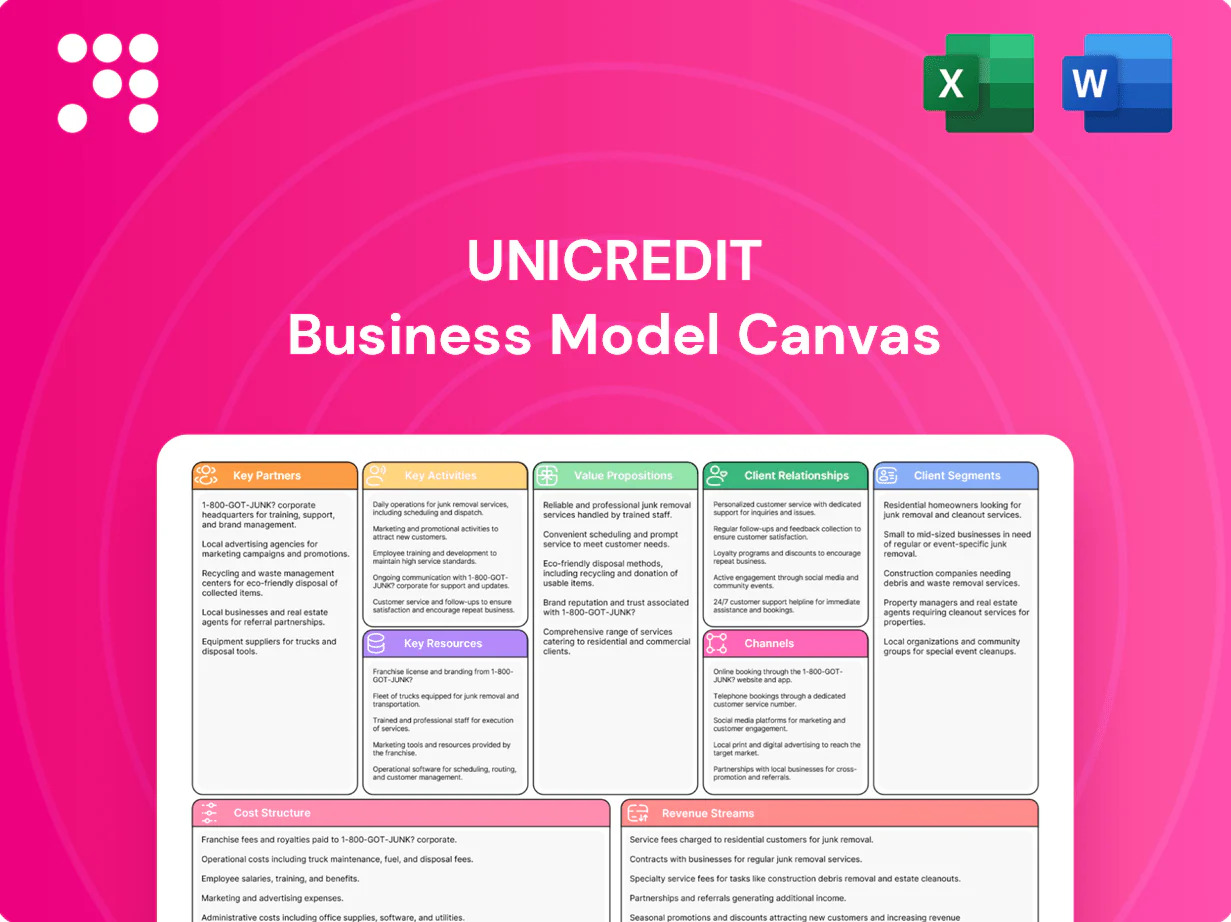
UniCredit Business Model Canvas

Business Model Canvas for a Leading European Bank - Downloadable section-by-section file
Unlock the strategic blueprint behind UniCredit with our Business Model Canvas. This concise, actionable canvas reveals customer segments, core activities, revenue streams and cost drivers that power UniCredit’s competitive edge. Download the full Word/Excel file for a section-by-section analysis ready for benchmarking, investor decks, or strategic planning.
Partnerships

Regulators and central banks
Partnership with the ECB and national regulators secures UniCredit’s banking licence and access to monetary facilities, supporting a balance sheet of over €800bn. Ongoing supervision alignment helps sustain a reported CET1 ratio above 13%, underpinning stable capital and liquidity profiles. Joint work on regulatory initiatives enables timely compliance and risk mitigation, while central bank ties bolster credibility and market confidence.
Payment networks and clearing houses
Alliances with Visa and Mastercard (each accepted in 200+ countries and territories), SEPA schemes covering 36 euro-area members, and local clearing systems enable UniCredit to offer seamless payments across Europe and globally. These partners expand card acceptance and cross-border settlement reach into 200+ markets. Co-developing solutions with networks improves authorization rates and strengthens fraud defenses, while network participation lowers unit costs at scale.

Fintech and open banking partners
APIs with fintechs accelerate innovation across onboarding, lending and analytics, enabling UniCredit to deploy modular services faster. Partnerships extend offerings such as BNPL, instant payments and PFM tools, increasing wallet share. White-label and co-branded solutions enhance customer experience and retention. Integration through open banking lowers time-to-market and customer acquisition costs.

Institutional investors and funding providers
Institutional relationships with bond investors, covered-bond buyers and repo counterparties provide UniCredit diversified multi-billion-euro funding lines, supporting liquidity and lowering wholesale costs; syndicate partners underwrite primary issuances and distribute risk while securitisations and risk-sharing deals optimise capital usage, underpinning stable funding for growth and resilience.
- Funding diversification: bonds, covered bonds, repos
- Syndicates: primary issuance support and risk distribution
- Securitisation: capital optimisation and risk transfer
- Stable access: enables growth and balance-sheet resilience
Technology and data vendors
Technology and data vendors — cloud, core banking, cybersecurity and data providers — power UniCredit’s digital operations, with global public cloud spend reaching about $600B in 2024 and driving scalable back-end modernization. Strategic vendors improve system reliability and scalability; advanced analytics partners strengthen credit scoring, AML detection and personalization, while joint roadmaps cut tech debt and accelerate transformation.
- cloud: $600B 2024
- scalability: vendor SLAs
- analytics: improved AML/credit models
- joint roadmaps: faster migration
Regulatory backing, card networks and fintechs enable pan-EU payments and capital resilience
Regulatory ties (ECB/national) secure UniCredit’s licence, access to facilities for a >€800bn balance sheet and sustain CET1 >13%. Card/payment networks (Visa/Mastercard 200+ markets; SEPA 36 members) enable pan‑European and global flows. Fintech APIs and tech vendors (global cloud spend cited ~$600B in 2024) speed product delivery and cut costs. Institutional investors and syndicates supply multi‑billion funding and capital optimisation.
| Partner type | Key figures | Primary benefit |
|---|---|---|
| Regulators | >€800bn BS; CET1 >13% | Licence, liquidity, supervision |
| Card networks/SEPA | 200+ markets; 36 members | Cross‑border payments |
| Tech vendors | $600B cloud 2024 | Scalability, analytics |
| Funding partners | Multi‑bn lines | Stable wholesale funding |
What is included in the product
 Detailed Word Document
A comprehensive UniCredit Business Model Canvas detailing all nine BMC blocks—customer segments, channels, value propositions and revenue streams—aligned to real-world operations, competitive advantages and linked SWOT insights for investor and strategic use.

 Customizable Excel Spreadsheet
High-level editable one-page snapshot of UniCredit’s business model that saves hours of formatting, streamlines boardroom discussions, and enables fast, collaborative scenario comparison and strategy alignment.
Activities

Credit underwriting and portfolio management
Risk-based pricing and prudent underwriting sustain healthy NIM and asset quality through strict credit scoring and tiered pricing models. Continuous monitoring with real-time analytics adjusts limits and provisions dynamically to reflect borrower performance and macro shifts. Sectoral and geographic diversification reduces concentration risk across corporate and retail books. Robust workout and recovery processes limit loss given default and accelerate recoveries.
Risk, compliance, and capital management
ICAAP, ILAAP and rigorous stress testing anchor resilience—UniCredit maintained a CET1 ratio of about 13.8% in 2024, well above the Basel III minima (CET1 4.5% plus buffers). Robust AML/KYC controls protect the franchise and meet supervisory expectations. Capital allocation balances growth and returns within Basel constraints, while interest-rate and FX hedging programs stabilize earnings and liquidity.

Capital markets origination and advisory
Debt and equity origination serves corporates and institutions across UniCredit’s 14 core markets, leveraging a balance sheet of over €800bn (2024). M&A advisory deepens client relationships and fee pools by driving cross‑sell into cash management and lending. Syndication spreads execution risk and widens investor access, while structured solutions deliver tailored financing and risk transfer for complex transactions.

Transaction banking and payments operations
Transaction banking and payments operations (accounts, cash management, trade finance) drive daily client flows and working capital for corporates and SMEs across UniCredit’s Europe network, supporting exporters and multinationals with FX and cross-border services.
High straight-through-processing rates (>95%) and expanding instant payments capabilities shorten settlement times and elevate client service levels, while operational excellence lowers error rates and processing costs.
Focused automation and centralized processing hubs cut cycle times and support scalable fee income streams in transaction banking.
- Accounts, cash mgmt, trade finance: daily flow engines
- STP rates: >95% — faster, cheaper processing
- Instant payments: real-time settlement for clients
- FX/cross-border: supports exporters and multinationals
- Operational excellence: fewer errors, lower costs
Digital product development and IT
- Omnichannel: mobile, web, API
- Agile delivery: faster releases/security
- Data engineering: personalization, decisioning
- Automation/AI: efficiency, better outcomes
CET1 ~13.8%, STP >95%, 10.5m users
Risk-based pricing, strict underwriting and dynamic monitoring preserve asset quality and NIM. ICAAP/ILAAP, hedging and a CET1 of ~13.8% (2024) sustain resilience. Debt/equity origination, transaction banking and >95% STP drive fee income and cash flows; digital channels serve 10.5m active users (2024).
| Metric | 2024 |
|---|---|
| CET1 | ~13.8% |
| Total assets | €800bn+ |
| Digital users | 10.5m |
| STP rate | >95% |
What You See Is What You Get
Business Model Canvas
The document you're previewing is the actual UniCredit Business Model Canvas you'll receive—no mockups or samples. Upon purchase you'll get this exact file complete and downloadable, formatted for immediate use and editing in Word and Excel. No surprises: ready to present, analyze, and customize.

Business Model Canvas for a Leading European Bank - Downloadable section-by-section file
Unlock the strategic blueprint behind UniCredit with our Business Model Canvas. This concise, actionable canvas reveals customer segments, core activities, revenue streams and cost drivers that power UniCredit’s competitive edge. Download the full Word/Excel file for a section-by-section analysis ready for benchmarking, investor decks, or strategic planning.
Partnerships
Regulators and central banks
Partnership with the ECB and national regulators secures UniCredit’s banking licence and access to monetary facilities, supporting a balance sheet of over €800bn. Ongoing supervision alignment helps sustain a reported CET1 ratio above 13%, underpinning stable capital and liquidity profiles. Joint work on regulatory initiatives enables timely compliance and risk mitigation, while central bank ties bolster credibility and market confidence.
Payment networks and clearing houses
Alliances with Visa and Mastercard (each accepted in 200+ countries and territories), SEPA schemes covering 36 euro-area members, and local clearing systems enable UniCredit to offer seamless payments across Europe and globally. These partners expand card acceptance and cross-border settlement reach into 200+ markets. Co-developing solutions with networks improves authorization rates and strengthens fraud defenses, while network participation lowers unit costs at scale.
Fintech and open banking partners
APIs with fintechs accelerate innovation across onboarding, lending and analytics, enabling UniCredit to deploy modular services faster. Partnerships extend offerings such as BNPL, instant payments and PFM tools, increasing wallet share. White-label and co-branded solutions enhance customer experience and retention. Integration through open banking lowers time-to-market and customer acquisition costs.
Institutional investors and funding providers
Institutional relationships with bond investors, covered-bond buyers and repo counterparties provide UniCredit diversified multi-billion-euro funding lines, supporting liquidity and lowering wholesale costs; syndicate partners underwrite primary issuances and distribute risk while securitisations and risk-sharing deals optimise capital usage, underpinning stable funding for growth and resilience.
- Funding diversification: bonds, covered bonds, repos
- Syndicates: primary issuance support and risk distribution
- Securitisation: capital optimisation and risk transfer
- Stable access: enables growth and balance-sheet resilience
Technology and data vendors
Technology and data vendors — cloud, core banking, cybersecurity and data providers — power UniCredit’s digital operations, with global public cloud spend reaching about $600B in 2024 and driving scalable back-end modernization. Strategic vendors improve system reliability and scalability; advanced analytics partners strengthen credit scoring, AML detection and personalization, while joint roadmaps cut tech debt and accelerate transformation.
- cloud: $600B 2024
- scalability: vendor SLAs
- analytics: improved AML/credit models
- joint roadmaps: faster migration
Regulatory backing, card networks and fintechs enable pan-EU payments and capital resilience
Regulatory ties (ECB/national) secure UniCredit’s licence, access to facilities for a >€800bn balance sheet and sustain CET1 >13%. Card/payment networks (Visa/Mastercard 200+ markets; SEPA 36 members) enable pan‑European and global flows. Fintech APIs and tech vendors (global cloud spend cited ~$600B in 2024) speed product delivery and cut costs. Institutional investors and syndicates supply multi‑billion funding and capital optimisation.
| Partner type | Key figures | Primary benefit |
|---|---|---|
| Regulators | >€800bn BS; CET1 >13% | Licence, liquidity, supervision |
| Card networks/SEPA | 200+ markets; 36 members | Cross‑border payments |
| Tech vendors | $600B cloud 2024 | Scalability, analytics |
| Funding partners | Multi‑bn lines | Stable wholesale funding |
What is included in the product
Detailed Word Document
A comprehensive UniCredit Business Model Canvas detailing all nine BMC blocks—customer segments, channels, value propositions and revenue streams—aligned to real-world operations, competitive advantages and linked SWOT insights for investor and strategic use.
Customizable Excel Spreadsheet
High-level editable one-page snapshot of UniCredit’s business model that saves hours of formatting, streamlines boardroom discussions, and enables fast, collaborative scenario comparison and strategy alignment.
Activities
Credit underwriting and portfolio management
Risk-based pricing and prudent underwriting sustain healthy NIM and asset quality through strict credit scoring and tiered pricing models. Continuous monitoring with real-time analytics adjusts limits and provisions dynamically to reflect borrower performance and macro shifts. Sectoral and geographic diversification reduces concentration risk across corporate and retail books. Robust workout and recovery processes limit loss given default and accelerate recoveries.
Risk, compliance, and capital management
ICAAP, ILAAP and rigorous stress testing anchor resilience—UniCredit maintained a CET1 ratio of about 13.8% in 2024, well above the Basel III minima (CET1 4.5% plus buffers). Robust AML/KYC controls protect the franchise and meet supervisory expectations. Capital allocation balances growth and returns within Basel constraints, while interest-rate and FX hedging programs stabilize earnings and liquidity.
Capital markets origination and advisory
Debt and equity origination serves corporates and institutions across UniCredit’s 14 core markets, leveraging a balance sheet of over €800bn (2024). M&A advisory deepens client relationships and fee pools by driving cross‑sell into cash management and lending. Syndication spreads execution risk and widens investor access, while structured solutions deliver tailored financing and risk transfer for complex transactions.
Transaction banking and payments operations
Transaction banking and payments operations (accounts, cash management, trade finance) drive daily client flows and working capital for corporates and SMEs across UniCredit’s Europe network, supporting exporters and multinationals with FX and cross-border services.
High straight-through-processing rates (>95%) and expanding instant payments capabilities shorten settlement times and elevate client service levels, while operational excellence lowers error rates and processing costs.
Focused automation and centralized processing hubs cut cycle times and support scalable fee income streams in transaction banking.
- Accounts, cash mgmt, trade finance: daily flow engines
- STP rates: >95% — faster, cheaper processing
- Instant payments: real-time settlement for clients
- FX/cross-border: supports exporters and multinationals
- Operational excellence: fewer errors, lower costs
Digital product development and IT
- Omnichannel: mobile, web, API
- Agile delivery: faster releases/security
- Data engineering: personalization, decisioning
- Automation/AI: efficiency, better outcomes
CET1 ~13.8%, STP >95%, 10.5m users
Risk-based pricing, strict underwriting and dynamic monitoring preserve asset quality and NIM. ICAAP/ILAAP, hedging and a CET1 of ~13.8% (2024) sustain resilience. Debt/equity origination, transaction banking and >95% STP drive fee income and cash flows; digital channels serve 10.5m active users (2024).
| Metric | 2024 |
|---|---|
| CET1 | ~13.8% |
| Total assets | €800bn+ |
| Digital users | 10.5m |
| STP rate | >95% |
What You See Is What You Get
Business Model Canvas
The document you're previewing is the actual UniCredit Business Model Canvas you'll receive—no mockups or samples. Upon purchase you'll get this exact file complete and downloadable, formatted for immediate use and editing in Word and Excel. No surprises: ready to present, analyze, and customize.
Original: $10.00
-65%$10.00
$3.50Description
Business Model Canvas for a Leading European Bank - Downloadable section-by-section file
Unlock the strategic blueprint behind UniCredit with our Business Model Canvas. This concise, actionable canvas reveals customer segments, core activities, revenue streams and cost drivers that power UniCredit’s competitive edge. Download the full Word/Excel file for a section-by-section analysis ready for benchmarking, investor decks, or strategic planning.
Partnerships
Regulators and central banks
Partnership with the ECB and national regulators secures UniCredit’s banking licence and access to monetary facilities, supporting a balance sheet of over €800bn. Ongoing supervision alignment helps sustain a reported CET1 ratio above 13%, underpinning stable capital and liquidity profiles. Joint work on regulatory initiatives enables timely compliance and risk mitigation, while central bank ties bolster credibility and market confidence.
Payment networks and clearing houses
Alliances with Visa and Mastercard (each accepted in 200+ countries and territories), SEPA schemes covering 36 euro-area members, and local clearing systems enable UniCredit to offer seamless payments across Europe and globally. These partners expand card acceptance and cross-border settlement reach into 200+ markets. Co-developing solutions with networks improves authorization rates and strengthens fraud defenses, while network participation lowers unit costs at scale.
Fintech and open banking partners
APIs with fintechs accelerate innovation across onboarding, lending and analytics, enabling UniCredit to deploy modular services faster. Partnerships extend offerings such as BNPL, instant payments and PFM tools, increasing wallet share. White-label and co-branded solutions enhance customer experience and retention. Integration through open banking lowers time-to-market and customer acquisition costs.
Institutional investors and funding providers
Institutional relationships with bond investors, covered-bond buyers and repo counterparties provide UniCredit diversified multi-billion-euro funding lines, supporting liquidity and lowering wholesale costs; syndicate partners underwrite primary issuances and distribute risk while securitisations and risk-sharing deals optimise capital usage, underpinning stable funding for growth and resilience.
- Funding diversification: bonds, covered bonds, repos
- Syndicates: primary issuance support and risk distribution
- Securitisation: capital optimisation and risk transfer
- Stable access: enables growth and balance-sheet resilience
Technology and data vendors
Technology and data vendors — cloud, core banking, cybersecurity and data providers — power UniCredit’s digital operations, with global public cloud spend reaching about $600B in 2024 and driving scalable back-end modernization. Strategic vendors improve system reliability and scalability; advanced analytics partners strengthen credit scoring, AML detection and personalization, while joint roadmaps cut tech debt and accelerate transformation.
- cloud: $600B 2024
- scalability: vendor SLAs
- analytics: improved AML/credit models
- joint roadmaps: faster migration
Regulatory backing, card networks and fintechs enable pan-EU payments and capital resilience
Regulatory ties (ECB/national) secure UniCredit’s licence, access to facilities for a >€800bn balance sheet and sustain CET1 >13%. Card/payment networks (Visa/Mastercard 200+ markets; SEPA 36 members) enable pan‑European and global flows. Fintech APIs and tech vendors (global cloud spend cited ~$600B in 2024) speed product delivery and cut costs. Institutional investors and syndicates supply multi‑billion funding and capital optimisation.
| Partner type | Key figures | Primary benefit |
|---|---|---|
| Regulators | >€800bn BS; CET1 >13% | Licence, liquidity, supervision |
| Card networks/SEPA | 200+ markets; 36 members | Cross‑border payments |
| Tech vendors | $600B cloud 2024 | Scalability, analytics |
| Funding partners | Multi‑bn lines | Stable wholesale funding |
What is included in the product
Detailed Word Document
A comprehensive UniCredit Business Model Canvas detailing all nine BMC blocks—customer segments, channels, value propositions and revenue streams—aligned to real-world operations, competitive advantages and linked SWOT insights for investor and strategic use.
Customizable Excel Spreadsheet
High-level editable one-page snapshot of UniCredit’s business model that saves hours of formatting, streamlines boardroom discussions, and enables fast, collaborative scenario comparison and strategy alignment.
Activities
Credit underwriting and portfolio management
Risk-based pricing and prudent underwriting sustain healthy NIM and asset quality through strict credit scoring and tiered pricing models. Continuous monitoring with real-time analytics adjusts limits and provisions dynamically to reflect borrower performance and macro shifts. Sectoral and geographic diversification reduces concentration risk across corporate and retail books. Robust workout and recovery processes limit loss given default and accelerate recoveries.
Risk, compliance, and capital management
ICAAP, ILAAP and rigorous stress testing anchor resilience—UniCredit maintained a CET1 ratio of about 13.8% in 2024, well above the Basel III minima (CET1 4.5% plus buffers). Robust AML/KYC controls protect the franchise and meet supervisory expectations. Capital allocation balances growth and returns within Basel constraints, while interest-rate and FX hedging programs stabilize earnings and liquidity.
Capital markets origination and advisory
Debt and equity origination serves corporates and institutions across UniCredit’s 14 core markets, leveraging a balance sheet of over €800bn (2024). M&A advisory deepens client relationships and fee pools by driving cross‑sell into cash management and lending. Syndication spreads execution risk and widens investor access, while structured solutions deliver tailored financing and risk transfer for complex transactions.
Transaction banking and payments operations
Transaction banking and payments operations (accounts, cash management, trade finance) drive daily client flows and working capital for corporates and SMEs across UniCredit’s Europe network, supporting exporters and multinationals with FX and cross-border services.
High straight-through-processing rates (>95%) and expanding instant payments capabilities shorten settlement times and elevate client service levels, while operational excellence lowers error rates and processing costs.
Focused automation and centralized processing hubs cut cycle times and support scalable fee income streams in transaction banking.
- Accounts, cash mgmt, trade finance: daily flow engines
- STP rates: >95% — faster, cheaper processing
- Instant payments: real-time settlement for clients
- FX/cross-border: supports exporters and multinationals
- Operational excellence: fewer errors, lower costs
Digital product development and IT
- Omnichannel: mobile, web, API
- Agile delivery: faster releases/security
- Data engineering: personalization, decisioning
- Automation/AI: efficiency, better outcomes
CET1 ~13.8%, STP >95%, 10.5m users
Risk-based pricing, strict underwriting and dynamic monitoring preserve asset quality and NIM. ICAAP/ILAAP, hedging and a CET1 of ~13.8% (2024) sustain resilience. Debt/equity origination, transaction banking and >95% STP drive fee income and cash flows; digital channels serve 10.5m active users (2024).
| Metric | 2024 |
|---|---|
| CET1 | ~13.8% |
| Total assets | €800bn+ |
| Digital users | 10.5m |
| STP rate | >95% |
What You See Is What You Get
Business Model Canvas
The document you're previewing is the actual UniCredit Business Model Canvas you'll receive—no mockups or samples. Upon purchase you'll get this exact file complete and downloadable, formatted for immediate use and editing in Word and Excel. No surprises: ready to present, analyze, and customize.











