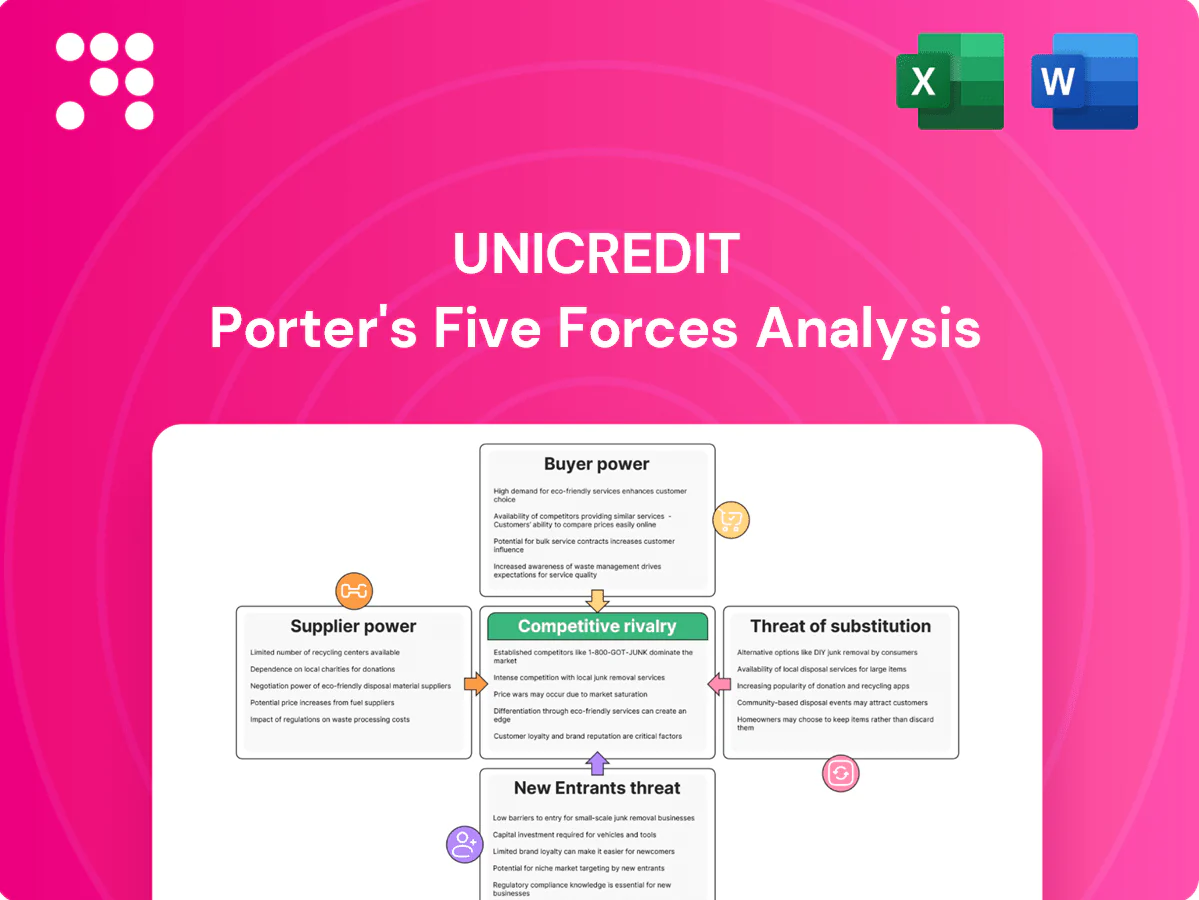
UniCredit Porter's Five Forces Analysis

From Overview to Strategy Blueprint
UniCredit faces moderate buyer power, regulatory constraints, and intense rivalry across European banking, with digital entrants and low-cost lenders posing growing threats to margins. Our snapshot highlights key pressures and strategic levers but only scratches the surface. Unlock the full Porter's Five Forces Analysis to explore UniCredit’s competitive dynamics and actionable implications in depth.
Suppliers Bargaining Power

Wholesale and interbank funding
UniCredit supplements deposits with bond issuance, covered bonds and interbank lines, representing roughly 20% of its funding mix, so spread spikes and tight credit cycles quickly increase costs and strengthen supplier leverage.
Technology and core banking vendors
Dependence on core-banking, cloud, cybersecurity and payments vendors creates high switching frictions for UniCredit, reinforcing supplier leverage. A limited pool of tier-1 providers (cloud market roughly AWS 32%, Azure 22%, GCP 10%) strengthens vendor bargaining on pricing and SLAs. Multi-vendor sourcing and in-house development can rebalance terms and lower concentration risk. EU regulatory scrutiny (DORA and intensified 2024 oversight) also shapes contract leverage.

Talent and specialist human capital
Front-office bankers, risk modellers and tech engineers are scarce, cyclically boosting wage pressure and raising recruitment costs for UniCredit, which employs roughly 74,000 people across its group (proximate 2023‑24 headcount). Competitive hiring from European banks and fintechs strengthens supplier power of talent, while long‑term incentives and internal academies reduce external dependence. Remote and nearshore hubs in CEE expand the usable talent pool and lower marginal hiring costs.

Payment networks and market utilities
Real estate and facilities services
Branch optimisation has materially reduced UniCredit’s exposure to real estate, yet prime urban sites retain pricing power; UniCredit reported a smaller retail footprint after a c.25% branch reduction since 2019, leaving ~2,000 sites by 2024. Facilities, security and cash-logistics vendors show localized oligopolies (top three often >60% share), and long-term contracts create lock-in with scale discounts, while digitisation (digital transactions >70%) lowers reliance on branches.
- branch reduction: c.25% since 2019
- remaining sites: ~2,000 (2024)
- vendor concentration: top 3 >60% in some markets
- digital transactions: >70% (2024)
Supplier power: 20% funding, digital >70%
Supplier power is medium‑high: funding costs (bond/covered ~20% of mix) and concentrated vendors raise leverage; cloud concentration (AWS 32%, Azure 22%, GCP 10%) and payment schemes limit negotiation; talent scarcity (≈74,000 headcount) and localized facilities oligopolies keep costs elevated, while digitisation (>70% digital transactions) and branch cuts (~2,000 sites) reduce some dependence.
| Metric | 2024 |
|---|---|
| Bond/covered funding | ≈20% |
| Headcount | ≈74,000 |
| Branches | ≈2,000 |
| Digital transactions | >70% |
| AWS/Azure/GCP | 32/22/10% |
| Rebates | 0.5–2% |
| Top3 facilities share | >60% |
What is included in the product
 Detailed Word Document
Tailored Porter's Five Forces analysis for UniCredit that uncovers key drivers of competition, buyer/supplier influence on pricing and profitability, and evaluates barriers to entry, substitutes, and emerging threats to market share.

 Customizable Excel Spreadsheet
One-page UniCredit Porter's Five Forces summary that clarifies competitive pressure at a glance—customize force levels with current data and export a clean spider chart ready for pitch decks or boardroom slides.
Customers Bargaining Power

Large corporates and institutions
In 2024 large corporates and institutions wield high bargaining power as multibanking relationships give them price leverage across lending, cash management and markets, forcing contested mandates and fee compression. Depth of cross-sell and balance-sheet support are key to defend margins. Tailored solutions and risk intermediation can sustain premium pricing for UniCredit when effectively deployed.
SMEs and mid-market clients
Buyer power among SMEs and mid-market clients is moderate: switching costs are higher than for large corporates, aided by relationship managers and bundled cash-management and advisory services that boost retention. Competing local banks and government-subsidised lending continue to pressure loan spreads. Digital challengers are gradually lowering frictions with faster onboarding, while SMEs remain critical given that they represent 99% of EU businesses (Eurostat).

Retail depositors and borrowers
Price transparency on rates and fees—amplified by comparison platforms—boosts customer leverage in Italy, Germany and Austria; UniCredit serves roughly 11 million retail clients and held about €280 billion in deposits in 2024. PSD2/Open Banking (effective 2018) has raised switching potential via APIs and third-party offers, though customer inertia limits churn to single-digit annual rates. Mortgage and consumer loan pricing stayed highly competitive in 2024 with typical fixed rates around 3–4%, and superior UX plus omnichannel support have reduced attrition.

Wealth management and affluent clients
Fee sensitivity among affluent UniCredit clients is high as ETFs and robo-advice scale—ETF assets topped $10 trillion by 2024—pushing price competition; however strong performance records and holistic financial planning justify advisory fees and preserve margins. Open-architecture platforms increase product comparability and switching pressure, while UniCredit’s trusted brand and discretionary mandates lower churn for high-net-worth segments.
- Fee sensitivity: high
- ETF scale: >$10tn (2024)
- Value drivers: performance, holistic planning
- Lock-in: brand + discretionary mandates
CEE regional clients
EU-level rules such as PSD2 (effective 2018) and ongoing digital finance initiatives across 27 member states are increasing transparency and portability, slowly boosting customer bargaining power, while localization and faster service remain key UniCredit differentiators.
Retail power: 11m, €280bn, rates 3-4%
In 2024 customer bargaining power is high for large corporates but moderate for SMEs; UniCredit serves ~11m retail clients with ~€280bn deposits, while SMEs (99% of EU firms) face higher switching costs. PSD2/Open Banking and comparison platforms increase price transparency; mortgage rates (~3–4% in 2024) and ETF scale (~$10tn) heighten fee sensitivity among affluent clients.
| Metric | 2024 |
|---|---|
| Retail clients | ~11m |
| Deposits | €280bn |
| ETF assets | $10tn |
| Mortgage rates | 3–4% |
What You See Is What You Get
UniCredit Porter's Five Forces Analysis
This preview shows the exact UniCredit Porter's Five Forces Analysis you'll receive immediately after purchase—no placeholders or samples. The file is fully formatted, professionally written and ready for download and use the moment you buy. What you see here is precisely what will be available to you instantly.

From Overview to Strategy Blueprint
UniCredit faces moderate buyer power, regulatory constraints, and intense rivalry across European banking, with digital entrants and low-cost lenders posing growing threats to margins. Our snapshot highlights key pressures and strategic levers but only scratches the surface. Unlock the full Porter's Five Forces Analysis to explore UniCredit’s competitive dynamics and actionable implications in depth.
Suppliers Bargaining Power
Wholesale and interbank funding
UniCredit supplements deposits with bond issuance, covered bonds and interbank lines, representing roughly 20% of its funding mix, so spread spikes and tight credit cycles quickly increase costs and strengthen supplier leverage.
Technology and core banking vendors
Dependence on core-banking, cloud, cybersecurity and payments vendors creates high switching frictions for UniCredit, reinforcing supplier leverage. A limited pool of tier-1 providers (cloud market roughly AWS 32%, Azure 22%, GCP 10%) strengthens vendor bargaining on pricing and SLAs. Multi-vendor sourcing and in-house development can rebalance terms and lower concentration risk. EU regulatory scrutiny (DORA and intensified 2024 oversight) also shapes contract leverage.
Talent and specialist human capital
Front-office bankers, risk modellers and tech engineers are scarce, cyclically boosting wage pressure and raising recruitment costs for UniCredit, which employs roughly 74,000 people across its group (proximate 2023‑24 headcount). Competitive hiring from European banks and fintechs strengthens supplier power of talent, while long‑term incentives and internal academies reduce external dependence. Remote and nearshore hubs in CEE expand the usable talent pool and lower marginal hiring costs.
Payment networks and market utilities
Real estate and facilities services
Branch optimisation has materially reduced UniCredit’s exposure to real estate, yet prime urban sites retain pricing power; UniCredit reported a smaller retail footprint after a c.25% branch reduction since 2019, leaving ~2,000 sites by 2024. Facilities, security and cash-logistics vendors show localized oligopolies (top three often >60% share), and long-term contracts create lock-in with scale discounts, while digitisation (digital transactions >70%) lowers reliance on branches.
- branch reduction: c.25% since 2019
- remaining sites: ~2,000 (2024)
- vendor concentration: top 3 >60% in some markets
- digital transactions: >70% (2024)
Supplier power: 20% funding, digital >70%
Supplier power is medium‑high: funding costs (bond/covered ~20% of mix) and concentrated vendors raise leverage; cloud concentration (AWS 32%, Azure 22%, GCP 10%) and payment schemes limit negotiation; talent scarcity (≈74,000 headcount) and localized facilities oligopolies keep costs elevated, while digitisation (>70% digital transactions) and branch cuts (~2,000 sites) reduce some dependence.
| Metric | 2024 |
|---|---|
| Bond/covered funding | ≈20% |
| Headcount | ≈74,000 |
| Branches | ≈2,000 |
| Digital transactions | >70% |
| AWS/Azure/GCP | 32/22/10% |
| Rebates | 0.5–2% |
| Top3 facilities share | >60% |
What is included in the product
Detailed Word Document
Tailored Porter's Five Forces analysis for UniCredit that uncovers key drivers of competition, buyer/supplier influence on pricing and profitability, and evaluates barriers to entry, substitutes, and emerging threats to market share.
Customizable Excel Spreadsheet
One-page UniCredit Porter's Five Forces summary that clarifies competitive pressure at a glance—customize force levels with current data and export a clean spider chart ready for pitch decks or boardroom slides.
Customers Bargaining Power
Large corporates and institutions
In 2024 large corporates and institutions wield high bargaining power as multibanking relationships give them price leverage across lending, cash management and markets, forcing contested mandates and fee compression. Depth of cross-sell and balance-sheet support are key to defend margins. Tailored solutions and risk intermediation can sustain premium pricing for UniCredit when effectively deployed.
SMEs and mid-market clients
Buyer power among SMEs and mid-market clients is moderate: switching costs are higher than for large corporates, aided by relationship managers and bundled cash-management and advisory services that boost retention. Competing local banks and government-subsidised lending continue to pressure loan spreads. Digital challengers are gradually lowering frictions with faster onboarding, while SMEs remain critical given that they represent 99% of EU businesses (Eurostat).
Retail depositors and borrowers
Price transparency on rates and fees—amplified by comparison platforms—boosts customer leverage in Italy, Germany and Austria; UniCredit serves roughly 11 million retail clients and held about €280 billion in deposits in 2024. PSD2/Open Banking (effective 2018) has raised switching potential via APIs and third-party offers, though customer inertia limits churn to single-digit annual rates. Mortgage and consumer loan pricing stayed highly competitive in 2024 with typical fixed rates around 3–4%, and superior UX plus omnichannel support have reduced attrition.
Wealth management and affluent clients
Fee sensitivity among affluent UniCredit clients is high as ETFs and robo-advice scale—ETF assets topped $10 trillion by 2024—pushing price competition; however strong performance records and holistic financial planning justify advisory fees and preserve margins. Open-architecture platforms increase product comparability and switching pressure, while UniCredit’s trusted brand and discretionary mandates lower churn for high-net-worth segments.
- Fee sensitivity: high
- ETF scale: >$10tn (2024)
- Value drivers: performance, holistic planning
- Lock-in: brand + discretionary mandates
CEE regional clients
EU-level rules such as PSD2 (effective 2018) and ongoing digital finance initiatives across 27 member states are increasing transparency and portability, slowly boosting customer bargaining power, while localization and faster service remain key UniCredit differentiators.
Retail power: 11m, €280bn, rates 3-4%
In 2024 customer bargaining power is high for large corporates but moderate for SMEs; UniCredit serves ~11m retail clients with ~€280bn deposits, while SMEs (99% of EU firms) face higher switching costs. PSD2/Open Banking and comparison platforms increase price transparency; mortgage rates (~3–4% in 2024) and ETF scale (~$10tn) heighten fee sensitivity among affluent clients.
| Metric | 2024 |
|---|---|
| Retail clients | ~11m |
| Deposits | €280bn |
| ETF assets | $10tn |
| Mortgage rates | 3–4% |
What You See Is What You Get
UniCredit Porter's Five Forces Analysis
This preview shows the exact UniCredit Porter's Five Forces Analysis you'll receive immediately after purchase—no placeholders or samples. The file is fully formatted, professionally written and ready for download and use the moment you buy. What you see here is precisely what will be available to you instantly.
Description
From Overview to Strategy Blueprint
UniCredit faces moderate buyer power, regulatory constraints, and intense rivalry across European banking, with digital entrants and low-cost lenders posing growing threats to margins. Our snapshot highlights key pressures and strategic levers but only scratches the surface. Unlock the full Porter's Five Forces Analysis to explore UniCredit’s competitive dynamics and actionable implications in depth.
Suppliers Bargaining Power
Wholesale and interbank funding
UniCredit supplements deposits with bond issuance, covered bonds and interbank lines, representing roughly 20% of its funding mix, so spread spikes and tight credit cycles quickly increase costs and strengthen supplier leverage.
Technology and core banking vendors
Dependence on core-banking, cloud, cybersecurity and payments vendors creates high switching frictions for UniCredit, reinforcing supplier leverage. A limited pool of tier-1 providers (cloud market roughly AWS 32%, Azure 22%, GCP 10%) strengthens vendor bargaining on pricing and SLAs. Multi-vendor sourcing and in-house development can rebalance terms and lower concentration risk. EU regulatory scrutiny (DORA and intensified 2024 oversight) also shapes contract leverage.
Talent and specialist human capital
Front-office bankers, risk modellers and tech engineers are scarce, cyclically boosting wage pressure and raising recruitment costs for UniCredit, which employs roughly 74,000 people across its group (proximate 2023‑24 headcount). Competitive hiring from European banks and fintechs strengthens supplier power of talent, while long‑term incentives and internal academies reduce external dependence. Remote and nearshore hubs in CEE expand the usable talent pool and lower marginal hiring costs.
Payment networks and market utilities
Real estate and facilities services
Branch optimisation has materially reduced UniCredit’s exposure to real estate, yet prime urban sites retain pricing power; UniCredit reported a smaller retail footprint after a c.25% branch reduction since 2019, leaving ~2,000 sites by 2024. Facilities, security and cash-logistics vendors show localized oligopolies (top three often >60% share), and long-term contracts create lock-in with scale discounts, while digitisation (digital transactions >70%) lowers reliance on branches.
- branch reduction: c.25% since 2019
- remaining sites: ~2,000 (2024)
- vendor concentration: top 3 >60% in some markets
- digital transactions: >70% (2024)
Supplier power: 20% funding, digital >70%
Supplier power is medium‑high: funding costs (bond/covered ~20% of mix) and concentrated vendors raise leverage; cloud concentration (AWS 32%, Azure 22%, GCP 10%) and payment schemes limit negotiation; talent scarcity (≈74,000 headcount) and localized facilities oligopolies keep costs elevated, while digitisation (>70% digital transactions) and branch cuts (~2,000 sites) reduce some dependence.
| Metric | 2024 |
|---|---|
| Bond/covered funding | ≈20% |
| Headcount | ≈74,000 |
| Branches | ≈2,000 |
| Digital transactions | >70% |
| AWS/Azure/GCP | 32/22/10% |
| Rebates | 0.5–2% |
| Top3 facilities share | >60% |
What is included in the product
Detailed Word Document
Tailored Porter's Five Forces analysis for UniCredit that uncovers key drivers of competition, buyer/supplier influence on pricing and profitability, and evaluates barriers to entry, substitutes, and emerging threats to market share.
Customizable Excel Spreadsheet
One-page UniCredit Porter's Five Forces summary that clarifies competitive pressure at a glance—customize force levels with current data and export a clean spider chart ready for pitch decks or boardroom slides.
Customers Bargaining Power
Large corporates and institutions
In 2024 large corporates and institutions wield high bargaining power as multibanking relationships give them price leverage across lending, cash management and markets, forcing contested mandates and fee compression. Depth of cross-sell and balance-sheet support are key to defend margins. Tailored solutions and risk intermediation can sustain premium pricing for UniCredit when effectively deployed.
SMEs and mid-market clients
Buyer power among SMEs and mid-market clients is moderate: switching costs are higher than for large corporates, aided by relationship managers and bundled cash-management and advisory services that boost retention. Competing local banks and government-subsidised lending continue to pressure loan spreads. Digital challengers are gradually lowering frictions with faster onboarding, while SMEs remain critical given that they represent 99% of EU businesses (Eurostat).
Retail depositors and borrowers
Price transparency on rates and fees—amplified by comparison platforms—boosts customer leverage in Italy, Germany and Austria; UniCredit serves roughly 11 million retail clients and held about €280 billion in deposits in 2024. PSD2/Open Banking (effective 2018) has raised switching potential via APIs and third-party offers, though customer inertia limits churn to single-digit annual rates. Mortgage and consumer loan pricing stayed highly competitive in 2024 with typical fixed rates around 3–4%, and superior UX plus omnichannel support have reduced attrition.
Wealth management and affluent clients
Fee sensitivity among affluent UniCredit clients is high as ETFs and robo-advice scale—ETF assets topped $10 trillion by 2024—pushing price competition; however strong performance records and holistic financial planning justify advisory fees and preserve margins. Open-architecture platforms increase product comparability and switching pressure, while UniCredit’s trusted brand and discretionary mandates lower churn for high-net-worth segments.
- Fee sensitivity: high
- ETF scale: >$10tn (2024)
- Value drivers: performance, holistic planning
- Lock-in: brand + discretionary mandates
CEE regional clients
EU-level rules such as PSD2 (effective 2018) and ongoing digital finance initiatives across 27 member states are increasing transparency and portability, slowly boosting customer bargaining power, while localization and faster service remain key UniCredit differentiators.
Retail power: 11m, €280bn, rates 3-4%
In 2024 customer bargaining power is high for large corporates but moderate for SMEs; UniCredit serves ~11m retail clients with ~€280bn deposits, while SMEs (99% of EU firms) face higher switching costs. PSD2/Open Banking and comparison platforms increase price transparency; mortgage rates (~3–4% in 2024) and ETF scale (~$10tn) heighten fee sensitivity among affluent clients.
| Metric | 2024 |
|---|---|
| Retail clients | ~11m |
| Deposits | €280bn |
| ETF assets | $10tn |
| Mortgage rates | 3–4% |
What You See Is What You Get
UniCredit Porter's Five Forces Analysis
This preview shows the exact UniCredit Porter's Five Forces Analysis you'll receive immediately after purchase—no placeholders or samples. The file is fully formatted, professionally written and ready for download and use the moment you buy. What you see here is precisely what will be available to you instantly.











