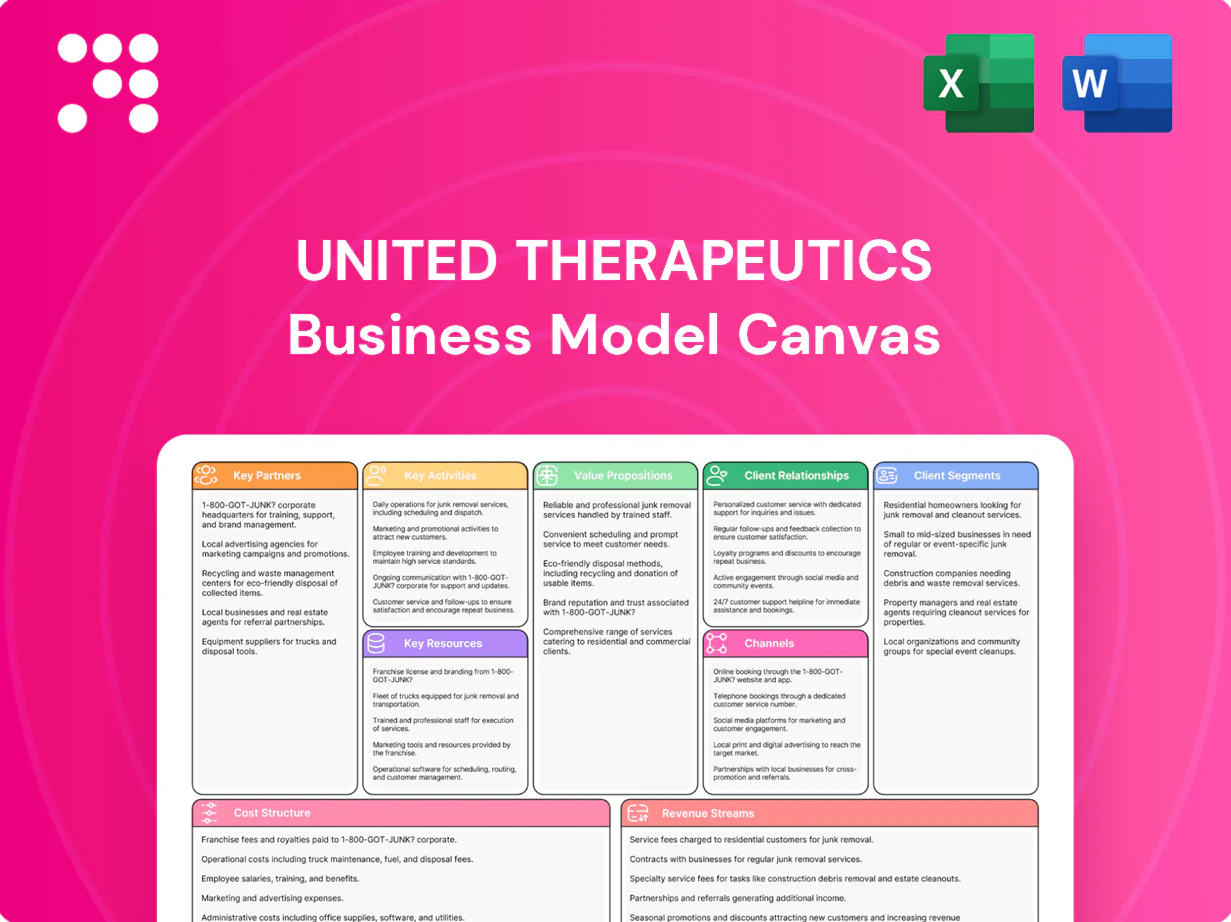
United Therapeutics Business Model Canvas

Business Model Canvas: Strategic Blueprint for a Leading Pulmonary Biotech
Unlock the full strategic blueprint behind United Therapeutics with our Business Model Canvas—concise, sector-specific insights into value propositions, revenue streams, and partnerships that drive growth; download the complete Word & Excel files to benchmark, plan, and invest with confidence.
Partnerships

Academic and clinical research consortia
Partnering with academic and clinical research consortia enables United Therapeutics to co-develop therapies and validate organ technologies with dozens of universities and teaching hospitals, accelerating protocol design and enrollment via direct access to principal investigators; shared infrastructure has cut trial setup costs and risks, contributing to a company R&D spend of about $220 million in 2024 while speeding time-to-publication through co-authorship and data sharing.
Transplant centers and organ networks
Collaborate with leading transplant programs to pilot organ manufacturing and delivery workflows, leveraging over 40,000 US transplants annually (OPTN 2023) to align clinical volume and need. Integration with UNOS organ allocation networks ensures clinical fit and logistics and enables joint protocols that de-risk first-in-human uses. Continuous feedback loops from centers refine quality, preservation times, and surgical compatibility.

Contract manufacturers and CROs
United Therapeutics leverages GMP-certified CMOs and global CROs to scale production and trials rapidly, tapping into the ~54 billion USD global CRO market (2024) for geographic reach. Outsourcing augments internal capacity during peak manufacturing and clinical phases, reducing time-to-market. Rigorous quality systems and regular audits ensure GMP/compliance standards. Flexible, milestone-linked contracts align cash burn with progress and outcomes.

Device, delivery, and digital tech partners
Copartnering on inhalation, infusion, and wearable delivery systems lets United Therapeutics accelerate PH therapies, with co-development often cutting time-to-market by 6–12 months and improving real-world adherence by ~25% via integrated sensors and data platforms.
- Device co-dev: inhalation, infusion, wearable
- Data: sensors + platforms for outcomes
- Benefit: −6–12 months to market, ~25% adherence gain
- Interoperability: hospital and home use
Payers, regulators, and patient advocacy
United Therapeutics engages regulators early—FDA priority review targets ~6 months and EMA centralized review ~210 days—to align evidence and accelerate approvals; collaborations with patient advocacy groups (eg, PAH registries such as REVEAL tracking >3,000 patients) improve trial design and access. Ongoing value dialogues with payers guide coverage/pricing decisions while real-world data programs sustain long-term adoption.
- Regulatory alignment: FDA priority review ~6 months; EMA centralized ~210 days
- Patient advocacy: PAH registries (REVEAL) >3,000 patients
- Payers: US health spend ≈18% of GDP; RWD drives adoption
40+ centers cut trials; shave 6–12m off time-to-market
Partnering with academic/clinical consortia and 40+ transplant centers accelerates organ-tech validation, lowering trial setup costs and supporting R&D spend ~$220M (2024). GMP CMOs/CROs and device co-dev shorten time-to-market 6–12 months while improving adherence ~25%. Early regulator/patient/payer engagement leverages REVEAL>3,000 and FDA priority review ~6 months.
| Partner type | Key metric | 2024 |
|---|---|---|
| Academic/clinical | Centers | 40+ |
| R&D spend | Company | $220M |
| Device co-dev | Time saving | 6–12m |
What is included in the product
 Detailed Word Document
A concise, investor-ready Business Model Canvas for United Therapeutics detailing customer segments, value propositions, channels, revenue streams, key partners and activities across the 9 BMC blocks, with competitive advantages, SWOT-linked insights and strategic implications for growth and R&D-driven commercialization.

 Customizable Excel Spreadsheet
High-level view of United Therapeutics’ business model as a pain-point reliever, condensing its R&D, manufacturing, specialty pricing, and patient support programs into editable cells for rapid problem diagnosis and strategic pivots.
Activities

Drug and device R&D
Discover, optimize, and formulate therapies for pulmonary hypertension and rare cardiopulmonary diseases, supporting a pipeline of 20+ preclinical and clinical programs as of 2024. Engineer advanced delivery modalities to improve efficacy and patient convenience, including inhaled and implantable platforms. Perform rigorous preclinical studies to de-risk candidates and accelerate IND-enabling work. File robust IP portfolios to protect innovations and commercial value.
Organ manufacturing and scale-up
United Therapeutics, via Revivicor, develops xenotransplant and bioprinting platforms to expand supply using genetically engineered pigs and 3D bioprinting; over 100,000 people were on the US transplant waitlist in 2024. Validation emphasizes quality, sterility and functional performance with GMP-ready workflows and automation. Teams prepare for FDA inspections and documented tech transfer to enable clinical-grade scale-up.

Clinical development and evidence
Design and run Phase I–IV trials across geographies to assess safety and efficacy in diverse PAH populations (prevalence ~15–50 cases per million). Generate comparative and health-economic evidence to support reimbursement and cost-effectiveness analyses for specialty therapies. Conduct long-term safety registries and publish/present results to drive guideline inclusion, referencing ESC/ERS 2022 guidance and payer decision-making.

Regulatory and quality management
Regulatory and quality management at United Therapeutics manages INDs, NDAs, BLAs and device filings globally, supporting over 15 active INDs in 2024. The team maintains a QMS, pharmacovigilance system and post-market commitments, executes FDA and international inspections with remediation, and drives harmonized compliance across US, EU and APAC to reduce regulatory risk.
- Manage INDs/NDAs/BLAs/device filings
- Maintain QMS & pharmacovigilance
- Inspections & remediation
- Global compliance harmonization
Manufacturing, supply, and market access
United Therapeutics produces APIs, finished drug products, and implantable devices at GMP-certified sites with emphasis on cost control and consistent quality, while maintaining cold-chain logistics and specialty distribution to preserve biologic integrity. The company negotiates payer reimbursement and hospital contracts to secure access, and provides clinician education plus patient onboarding and adherence support through specialty pharmacy partnerships.
- Manufacturing: APIs, drugs, devices
- Distribution: cold chain, specialty channels
- Market access: reimbursement, contracting
- Support: clinician education, patient onboarding
Advance 20+ therapies; inhaled and implantable delivery; address ~100,000 US transplant waitlist
Discover/advance 20+ preclinical/clinical therapies (2024); develop inhaled/implantable delivery; Revivicor xenotransplant & bioprinting to address 100,000 US transplant waitlist (2024); run Phase I–IV, long-term registries; manage 15+ active INDs and global QMS/compliance.
| Metric | Value |
|---|---|
| Pipeline programs (2024) | 20+ |
| US transplant waitlist (2024) | ~100,000 |
| PAH prevalence | 15–50/million |
| Active INDs (2024) | 15+ |
Delivered as Displayed
Business Model Canvas
The document you're previewing is the exact United Therapeutics Business Model Canvas you'll receive after purchase. It's not a mockup—this live preview shows the real, fully structured deliverable. After ordering you'll download the complete, editable file formatted exactly as shown.

Business Model Canvas: Strategic Blueprint for a Leading Pulmonary Biotech
Unlock the full strategic blueprint behind United Therapeutics with our Business Model Canvas—concise, sector-specific insights into value propositions, revenue streams, and partnerships that drive growth; download the complete Word & Excel files to benchmark, plan, and invest with confidence.
Partnerships
Academic and clinical research consortia
Partnering with academic and clinical research consortia enables United Therapeutics to co-develop therapies and validate organ technologies with dozens of universities and teaching hospitals, accelerating protocol design and enrollment via direct access to principal investigators; shared infrastructure has cut trial setup costs and risks, contributing to a company R&D spend of about $220 million in 2024 while speeding time-to-publication through co-authorship and data sharing.
Transplant centers and organ networks
Collaborate with leading transplant programs to pilot organ manufacturing and delivery workflows, leveraging over 40,000 US transplants annually (OPTN 2023) to align clinical volume and need. Integration with UNOS organ allocation networks ensures clinical fit and logistics and enables joint protocols that de-risk first-in-human uses. Continuous feedback loops from centers refine quality, preservation times, and surgical compatibility.
Contract manufacturers and CROs
United Therapeutics leverages GMP-certified CMOs and global CROs to scale production and trials rapidly, tapping into the ~54 billion USD global CRO market (2024) for geographic reach. Outsourcing augments internal capacity during peak manufacturing and clinical phases, reducing time-to-market. Rigorous quality systems and regular audits ensure GMP/compliance standards. Flexible, milestone-linked contracts align cash burn with progress and outcomes.
Device, delivery, and digital tech partners
Copartnering on inhalation, infusion, and wearable delivery systems lets United Therapeutics accelerate PH therapies, with co-development often cutting time-to-market by 6–12 months and improving real-world adherence by ~25% via integrated sensors and data platforms.
- Device co-dev: inhalation, infusion, wearable
- Data: sensors + platforms for outcomes
- Benefit: −6–12 months to market, ~25% adherence gain
- Interoperability: hospital and home use
Payers, regulators, and patient advocacy
United Therapeutics engages regulators early—FDA priority review targets ~6 months and EMA centralized review ~210 days—to align evidence and accelerate approvals; collaborations with patient advocacy groups (eg, PAH registries such as REVEAL tracking >3,000 patients) improve trial design and access. Ongoing value dialogues with payers guide coverage/pricing decisions while real-world data programs sustain long-term adoption.
- Regulatory alignment: FDA priority review ~6 months; EMA centralized ~210 days
- Patient advocacy: PAH registries (REVEAL) >3,000 patients
- Payers: US health spend ≈18% of GDP; RWD drives adoption
40+ centers cut trials; shave 6–12m off time-to-market
Partnering with academic/clinical consortia and 40+ transplant centers accelerates organ-tech validation, lowering trial setup costs and supporting R&D spend ~$220M (2024). GMP CMOs/CROs and device co-dev shorten time-to-market 6–12 months while improving adherence ~25%. Early regulator/patient/payer engagement leverages REVEAL>3,000 and FDA priority review ~6 months.
| Partner type | Key metric | 2024 |
|---|---|---|
| Academic/clinical | Centers | 40+ |
| R&D spend | Company | $220M |
| Device co-dev | Time saving | 6–12m |
What is included in the product
Detailed Word Document
A concise, investor-ready Business Model Canvas for United Therapeutics detailing customer segments, value propositions, channels, revenue streams, key partners and activities across the 9 BMC blocks, with competitive advantages, SWOT-linked insights and strategic implications for growth and R&D-driven commercialization.
Customizable Excel Spreadsheet
High-level view of United Therapeutics’ business model as a pain-point reliever, condensing its R&D, manufacturing, specialty pricing, and patient support programs into editable cells for rapid problem diagnosis and strategic pivots.
Activities
Drug and device R&D
Discover, optimize, and formulate therapies for pulmonary hypertension and rare cardiopulmonary diseases, supporting a pipeline of 20+ preclinical and clinical programs as of 2024. Engineer advanced delivery modalities to improve efficacy and patient convenience, including inhaled and implantable platforms. Perform rigorous preclinical studies to de-risk candidates and accelerate IND-enabling work. File robust IP portfolios to protect innovations and commercial value.
Organ manufacturing and scale-up
United Therapeutics, via Revivicor, develops xenotransplant and bioprinting platforms to expand supply using genetically engineered pigs and 3D bioprinting; over 100,000 people were on the US transplant waitlist in 2024. Validation emphasizes quality, sterility and functional performance with GMP-ready workflows and automation. Teams prepare for FDA inspections and documented tech transfer to enable clinical-grade scale-up.
Clinical development and evidence
Design and run Phase I–IV trials across geographies to assess safety and efficacy in diverse PAH populations (prevalence ~15–50 cases per million). Generate comparative and health-economic evidence to support reimbursement and cost-effectiveness analyses for specialty therapies. Conduct long-term safety registries and publish/present results to drive guideline inclusion, referencing ESC/ERS 2022 guidance and payer decision-making.
Regulatory and quality management
Regulatory and quality management at United Therapeutics manages INDs, NDAs, BLAs and device filings globally, supporting over 15 active INDs in 2024. The team maintains a QMS, pharmacovigilance system and post-market commitments, executes FDA and international inspections with remediation, and drives harmonized compliance across US, EU and APAC to reduce regulatory risk.
- Manage INDs/NDAs/BLAs/device filings
- Maintain QMS & pharmacovigilance
- Inspections & remediation
- Global compliance harmonization
Manufacturing, supply, and market access
United Therapeutics produces APIs, finished drug products, and implantable devices at GMP-certified sites with emphasis on cost control and consistent quality, while maintaining cold-chain logistics and specialty distribution to preserve biologic integrity. The company negotiates payer reimbursement and hospital contracts to secure access, and provides clinician education plus patient onboarding and adherence support through specialty pharmacy partnerships.
- Manufacturing: APIs, drugs, devices
- Distribution: cold chain, specialty channels
- Market access: reimbursement, contracting
- Support: clinician education, patient onboarding
Advance 20+ therapies; inhaled and implantable delivery; address ~100,000 US transplant waitlist
Discover/advance 20+ preclinical/clinical therapies (2024); develop inhaled/implantable delivery; Revivicor xenotransplant & bioprinting to address 100,000 US transplant waitlist (2024); run Phase I–IV, long-term registries; manage 15+ active INDs and global QMS/compliance.
| Metric | Value |
|---|---|
| Pipeline programs (2024) | 20+ |
| US transplant waitlist (2024) | ~100,000 |
| PAH prevalence | 15–50/million |
| Active INDs (2024) | 15+ |
Delivered as Displayed
Business Model Canvas
The document you're previewing is the exact United Therapeutics Business Model Canvas you'll receive after purchase. It's not a mockup—this live preview shows the real, fully structured deliverable. After ordering you'll download the complete, editable file formatted exactly as shown.
Original: $10.00
-65%$10.00
$3.50Description
Business Model Canvas: Strategic Blueprint for a Leading Pulmonary Biotech
Unlock the full strategic blueprint behind United Therapeutics with our Business Model Canvas—concise, sector-specific insights into value propositions, revenue streams, and partnerships that drive growth; download the complete Word & Excel files to benchmark, plan, and invest with confidence.
Partnerships
Academic and clinical research consortia
Partnering with academic and clinical research consortia enables United Therapeutics to co-develop therapies and validate organ technologies with dozens of universities and teaching hospitals, accelerating protocol design and enrollment via direct access to principal investigators; shared infrastructure has cut trial setup costs and risks, contributing to a company R&D spend of about $220 million in 2024 while speeding time-to-publication through co-authorship and data sharing.
Transplant centers and organ networks
Collaborate with leading transplant programs to pilot organ manufacturing and delivery workflows, leveraging over 40,000 US transplants annually (OPTN 2023) to align clinical volume and need. Integration with UNOS organ allocation networks ensures clinical fit and logistics and enables joint protocols that de-risk first-in-human uses. Continuous feedback loops from centers refine quality, preservation times, and surgical compatibility.
Contract manufacturers and CROs
United Therapeutics leverages GMP-certified CMOs and global CROs to scale production and trials rapidly, tapping into the ~54 billion USD global CRO market (2024) for geographic reach. Outsourcing augments internal capacity during peak manufacturing and clinical phases, reducing time-to-market. Rigorous quality systems and regular audits ensure GMP/compliance standards. Flexible, milestone-linked contracts align cash burn with progress and outcomes.
Device, delivery, and digital tech partners
Copartnering on inhalation, infusion, and wearable delivery systems lets United Therapeutics accelerate PH therapies, with co-development often cutting time-to-market by 6–12 months and improving real-world adherence by ~25% via integrated sensors and data platforms.
- Device co-dev: inhalation, infusion, wearable
- Data: sensors + platforms for outcomes
- Benefit: −6–12 months to market, ~25% adherence gain
- Interoperability: hospital and home use
Payers, regulators, and patient advocacy
United Therapeutics engages regulators early—FDA priority review targets ~6 months and EMA centralized review ~210 days—to align evidence and accelerate approvals; collaborations with patient advocacy groups (eg, PAH registries such as REVEAL tracking >3,000 patients) improve trial design and access. Ongoing value dialogues with payers guide coverage/pricing decisions while real-world data programs sustain long-term adoption.
- Regulatory alignment: FDA priority review ~6 months; EMA centralized ~210 days
- Patient advocacy: PAH registries (REVEAL) >3,000 patients
- Payers: US health spend ≈18% of GDP; RWD drives adoption
40+ centers cut trials; shave 6–12m off time-to-market
Partnering with academic/clinical consortia and 40+ transplant centers accelerates organ-tech validation, lowering trial setup costs and supporting R&D spend ~$220M (2024). GMP CMOs/CROs and device co-dev shorten time-to-market 6–12 months while improving adherence ~25%. Early regulator/patient/payer engagement leverages REVEAL>3,000 and FDA priority review ~6 months.
| Partner type | Key metric | 2024 |
|---|---|---|
| Academic/clinical | Centers | 40+ |
| R&D spend | Company | $220M |
| Device co-dev | Time saving | 6–12m |
What is included in the product
Detailed Word Document
A concise, investor-ready Business Model Canvas for United Therapeutics detailing customer segments, value propositions, channels, revenue streams, key partners and activities across the 9 BMC blocks, with competitive advantages, SWOT-linked insights and strategic implications for growth and R&D-driven commercialization.
Customizable Excel Spreadsheet
High-level view of United Therapeutics’ business model as a pain-point reliever, condensing its R&D, manufacturing, specialty pricing, and patient support programs into editable cells for rapid problem diagnosis and strategic pivots.
Activities
Drug and device R&D
Discover, optimize, and formulate therapies for pulmonary hypertension and rare cardiopulmonary diseases, supporting a pipeline of 20+ preclinical and clinical programs as of 2024. Engineer advanced delivery modalities to improve efficacy and patient convenience, including inhaled and implantable platforms. Perform rigorous preclinical studies to de-risk candidates and accelerate IND-enabling work. File robust IP portfolios to protect innovations and commercial value.
Organ manufacturing and scale-up
United Therapeutics, via Revivicor, develops xenotransplant and bioprinting platforms to expand supply using genetically engineered pigs and 3D bioprinting; over 100,000 people were on the US transplant waitlist in 2024. Validation emphasizes quality, sterility and functional performance with GMP-ready workflows and automation. Teams prepare for FDA inspections and documented tech transfer to enable clinical-grade scale-up.
Clinical development and evidence
Design and run Phase I–IV trials across geographies to assess safety and efficacy in diverse PAH populations (prevalence ~15–50 cases per million). Generate comparative and health-economic evidence to support reimbursement and cost-effectiveness analyses for specialty therapies. Conduct long-term safety registries and publish/present results to drive guideline inclusion, referencing ESC/ERS 2022 guidance and payer decision-making.
Regulatory and quality management
Regulatory and quality management at United Therapeutics manages INDs, NDAs, BLAs and device filings globally, supporting over 15 active INDs in 2024. The team maintains a QMS, pharmacovigilance system and post-market commitments, executes FDA and international inspections with remediation, and drives harmonized compliance across US, EU and APAC to reduce regulatory risk.
- Manage INDs/NDAs/BLAs/device filings
- Maintain QMS & pharmacovigilance
- Inspections & remediation
- Global compliance harmonization
Manufacturing, supply, and market access
United Therapeutics produces APIs, finished drug products, and implantable devices at GMP-certified sites with emphasis on cost control and consistent quality, while maintaining cold-chain logistics and specialty distribution to preserve biologic integrity. The company negotiates payer reimbursement and hospital contracts to secure access, and provides clinician education plus patient onboarding and adherence support through specialty pharmacy partnerships.
- Manufacturing: APIs, drugs, devices
- Distribution: cold chain, specialty channels
- Market access: reimbursement, contracting
- Support: clinician education, patient onboarding
Advance 20+ therapies; inhaled and implantable delivery; address ~100,000 US transplant waitlist
Discover/advance 20+ preclinical/clinical therapies (2024); develop inhaled/implantable delivery; Revivicor xenotransplant & bioprinting to address 100,000 US transplant waitlist (2024); run Phase I–IV, long-term registries; manage 15+ active INDs and global QMS/compliance.
| Metric | Value |
|---|---|
| Pipeline programs (2024) | 20+ |
| US transplant waitlist (2024) | ~100,000 |
| PAH prevalence | 15–50/million |
| Active INDs (2024) | 15+ |
Delivered as Displayed
Business Model Canvas
The document you're previewing is the exact United Therapeutics Business Model Canvas you'll receive after purchase. It's not a mockup—this live preview shows the real, fully structured deliverable. After ordering you'll download the complete, editable file formatted exactly as shown.











