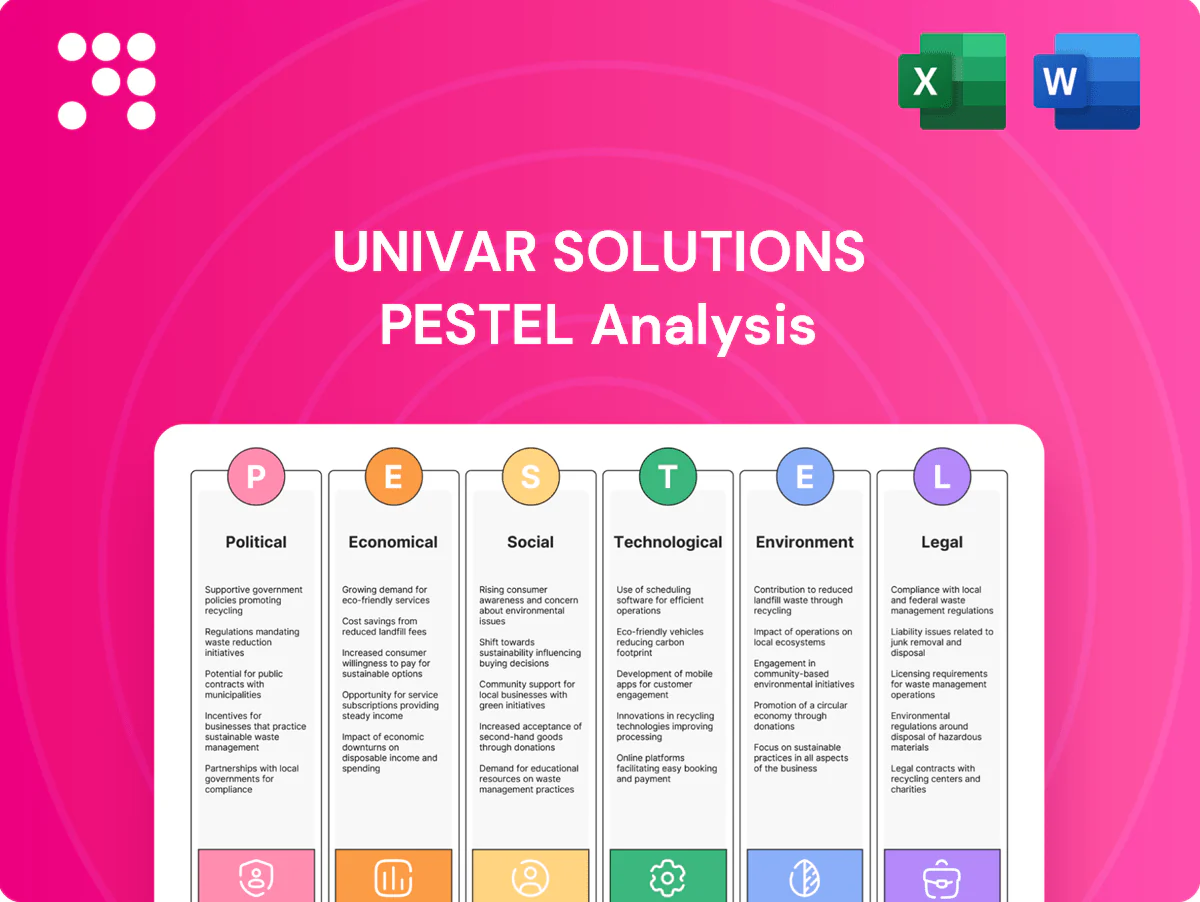
Univar Solutions PESTLE Analysis

Your Competitive Advantage Starts with This Report
Unlock strategic clarity with our PESTLE Analysis of Univar Solutions—three concise sections reveal how political, economic, social, technological, legal and environmental forces shape its trajectory. Ideal for investors and strategists, this actionable report highlights risks and growth levers. Purchase the full analysis for the complete data-driven roadmap today.
Political factors

Trade policy and tariffs
Changes in tariffs on chemicals and ingredients can shift landed costs materially, with duty swings of up to 10-20% reported in recent trade actions, compressing Univar Solutions pricing power and gross margins. Trade agreements or disputes—e.g., US-EU/China tensions—alter cross-border sourcing and customer competitiveness across a global chemicals market exceeding $1.6 trillion in exports. Univar must actively manage supplier footprints and reroute flows when duties shift, using diversification to cut exposure to single-country policy swings.
Geopolitical supply risk
Conflicts, sanctions and export controls since Russia's 2022 invasion have constrained critical chemical feedstocks and specialty ingredients used by Univar Solutions. Port and shipping disruptions can be costly—Ever Given's 2021 Suez blockage halted roughly $9.6 billion of global trade per day—while instability lifts insurance and freight premiums. Univar requires contingency sourcing and inventory buffers for sensitive categories. Robust scenario planning sustains service continuity to multi-industry customers.

Government industrial strategy
Regional reshoring and subsidies can move production closer to demand, driven by the US Inflation Reduction Act (approximately 369 billion USD) and the CHIPS and Science Act (about 52 billion USD) incentives. Incentives for clean tech and pharmaceuticals shift portfolio mix and volumes, expanding demand for specialty chemicals and distribution services. Univar can align with funded clusters to deepen supplier and customer access, while policy-driven capacity adds both growth and competitive intensity.

Public health and safety priorities
Government emphasis on worker and consumer safety raises compliance thresholds, prompting higher documentation and handling standards for distributors of industrial chemicals.
Emergency directives during crises can reprioritize chemical allocations, affecting supply chains and requiring rapid reallocation of inventory and logistics.
Univar’s technical support helps customers meet evolving standards quickly, and its strong compliance record helps preserve licenses and approvals.
- Regulatory pressure → higher compliance costs; emergency directives → supply reprioritization; technical support → faster standard adoption
Infrastructure investment
Public spending on ports, rail and roads—IIJA's $110 billion for roads and bridges plus multi‑billion port grants—directly affects Univar Solutions' logistics reliability and costs. Customs modernization (ACE processes about 98% of imports electronically) speeds hazmat border clearances, improving throughput and lowering dwell times. Project delays sustain bottlenecks and keep demurrage elevated.
- Logistics cost exposure: infrastructure funding level
- Clearance speed: ACE ~98% electronic -> faster hazmat flow
- Risk: delayed projects -> higher demurrage/detention
Tariffs 10–20%, sanctions, IRA $369B, CHIPS $52B
Tariff swings (10–20%) and trade disputes reshape landed costs and margins; sanctions since 2022 constrain feedstocks and raise freight/insurance; reshoring incentives (IRA $369B, CHIPS $52B) shift demand to specialty chemistries; infrastructure funding (IIJA $110B) and ACE (~98% electronic) affect logistics reliability.
| Metric | Value |
|---|---|
| Tariff swings | 10–20% |
| Global chemical exports | $1.6T |
| IRA | $369B |
| CHIPS | $52B |
| IIJA roads/bridges | $110B |
| ACE electronic | ~98% |
What is included in the product
 Detailed Word Document
Provides a concise PESTLE evaluation of how Political, Economic, Social, Technological, Environmental, and Legal forces uniquely impact Univar Solutions, backed by current trends and region-specific dynamics. This actionable analysis highlights risks and opportunities for executives, investors, and strategists to support scenario planning, funding pitches, and operational decision-making.

 Customizable Excel Spreadsheet
A concise, visually segmented PESTLE summary of Univar Solutions that’s easily dropped into presentations, editable for regional or business-line context, and shareable for rapid team alignment during strategic planning and risk discussions.
Economic factors

Commodity price volatility
Commodity feedstock swings drive rapid changes in purchase and sell prices, forcing margin management through surcharge mechanisms and strict inventory discipline. Univar Solutions (ticker UNVR) leverages scale and hedging practices to stabilize gross profit per unit. Volatility creates both downside risk and short-term trading opportunities for distribution players. Effective surcharges and rolling hedge coverage are critical to protect margins.
End-market cycles
End-market demand for industrial, personal care, food and pharma moves at different speeds—global GDP grew 3.1% in 2024 (IMF), so cyclicals amplify volume swings while defensives (food, pharma) smooth revenue. Univar Solutions' broad portfolio helps offset industry downturns, and tailored formulations and supply-chain services defend share during slowdowns.

Logistics and fuel costs
Freight, warehousing and energy now add roughly 5–12% to Univar Solutions delivered cost-to-serve, with diesel averaging about $3.80/gal in 2024 and spot truck rates up ~18% YoY into 2024–25 while container rates remain volatile versus 2021 peaks. Tight trucking capacity and elevated marine rates compress margins; network optimization and mode shifting can cut logistics spend 10–25%, while long-term contracts lower volatility but cap upside.

FX and interest rates
Currency swings affect Univar Solutions by changing import/export margins and translating foreign earnings into USD; with the US federal funds rate at about 5.25–5.50% in mid‑2025, higher rates increase working‑capital and inventory carrying costs. Univar’s broad global footprint allows natural hedges and periodic pricing resets, while active treasury use of forwards and swaps helps mitigate earnings variability.
- FX impact: translation and trade margins
- Interest rates: higher carrying costs at ~5.25–5.50%
- Natural hedges: global footprint enables local offsets
- Treasury: forwards/swaps reduce earnings volatility
Consolidation and M&A
Industry consolidation among chemical suppliers and distributors shifts bargaining power toward larger players, enabling Univar Solutions to leverage scale for stronger procurement terms and broader product portfolios.
Successful integration of acquisitions is critical: systems harmonization and depot rationalization determine whether projected synergies materialize or dissipate into execution costs.
Heightened antitrust scrutiny in major jurisdictions can delay deals, require divestitures, or alter strategic rationale, forcing reassessment of transaction value and timing.
- Consolidation: increases buyer power for large distributors
- Scale benefits: procurement leverage, extended portfolios
- Integration risk: IT, logistics, depot consolidation
- Regulatory: antitrust can slow/reshape transactions
Tariffs 10–20%, sanctions, IRA $369B, CHIPS $52B
Commodity feedstock volatility forces surcharge mechanisms and strict inventory discipline; Univar uses scale and hedges to stabilize per‑unit gross profit. Global GDP grew 3.1% in 2024 (IMF), so diversified end‑markets moderate volume swings. Freight/energy add ~5–12% to cost‑to‑serve and Fed funds ~5.25–5.50% mid‑2025 raise carrying costs.
| Metric | 2024/25 | Impact |
|---|---|---|
| Global GDP | 3.1% (2024) | Demand mix |
| Freight/Energy | +5–12% cost | Margin pressure |
| Diesel | $3.80/gal (2024) | Logistics cost |
| Fed funds | 5.25–5.50% (mid‑2025) | Carry cost |
Full Version Awaits
Univar Solutions PESTLE Analysis
The preview shown here is the exact document you’ll receive after purchase—fully formatted and ready to use. It contains a complete PESTLE analysis of Univar Solutions covering political, economic, social, technological, legal and environmental factors. No placeholders or teasers; you’ll be able to download the final file immediately after payment.

Your Competitive Advantage Starts with This Report
Unlock strategic clarity with our PESTLE Analysis of Univar Solutions—three concise sections reveal how political, economic, social, technological, legal and environmental forces shape its trajectory. Ideal for investors and strategists, this actionable report highlights risks and growth levers. Purchase the full analysis for the complete data-driven roadmap today.
Political factors
Trade policy and tariffs
Changes in tariffs on chemicals and ingredients can shift landed costs materially, with duty swings of up to 10-20% reported in recent trade actions, compressing Univar Solutions pricing power and gross margins. Trade agreements or disputes—e.g., US-EU/China tensions—alter cross-border sourcing and customer competitiveness across a global chemicals market exceeding $1.6 trillion in exports. Univar must actively manage supplier footprints and reroute flows when duties shift, using diversification to cut exposure to single-country policy swings.
Geopolitical supply risk
Conflicts, sanctions and export controls since Russia's 2022 invasion have constrained critical chemical feedstocks and specialty ingredients used by Univar Solutions. Port and shipping disruptions can be costly—Ever Given's 2021 Suez blockage halted roughly $9.6 billion of global trade per day—while instability lifts insurance and freight premiums. Univar requires contingency sourcing and inventory buffers for sensitive categories. Robust scenario planning sustains service continuity to multi-industry customers.
Government industrial strategy
Regional reshoring and subsidies can move production closer to demand, driven by the US Inflation Reduction Act (approximately 369 billion USD) and the CHIPS and Science Act (about 52 billion USD) incentives. Incentives for clean tech and pharmaceuticals shift portfolio mix and volumes, expanding demand for specialty chemicals and distribution services. Univar can align with funded clusters to deepen supplier and customer access, while policy-driven capacity adds both growth and competitive intensity.
Public health and safety priorities
Government emphasis on worker and consumer safety raises compliance thresholds, prompting higher documentation and handling standards for distributors of industrial chemicals.
Emergency directives during crises can reprioritize chemical allocations, affecting supply chains and requiring rapid reallocation of inventory and logistics.
Univar’s technical support helps customers meet evolving standards quickly, and its strong compliance record helps preserve licenses and approvals.
- Regulatory pressure → higher compliance costs; emergency directives → supply reprioritization; technical support → faster standard adoption
Infrastructure investment
Public spending on ports, rail and roads—IIJA's $110 billion for roads and bridges plus multi‑billion port grants—directly affects Univar Solutions' logistics reliability and costs. Customs modernization (ACE processes about 98% of imports electronically) speeds hazmat border clearances, improving throughput and lowering dwell times. Project delays sustain bottlenecks and keep demurrage elevated.
- Logistics cost exposure: infrastructure funding level
- Clearance speed: ACE ~98% electronic -> faster hazmat flow
- Risk: delayed projects -> higher demurrage/detention
Tariffs 10–20%, sanctions, IRA $369B, CHIPS $52B
Tariff swings (10–20%) and trade disputes reshape landed costs and margins; sanctions since 2022 constrain feedstocks and raise freight/insurance; reshoring incentives (IRA $369B, CHIPS $52B) shift demand to specialty chemistries; infrastructure funding (IIJA $110B) and ACE (~98% electronic) affect logistics reliability.
| Metric | Value |
|---|---|
| Tariff swings | 10–20% |
| Global chemical exports | $1.6T |
| IRA | $369B |
| CHIPS | $52B |
| IIJA roads/bridges | $110B |
| ACE electronic | ~98% |
What is included in the product
Detailed Word Document
Provides a concise PESTLE evaluation of how Political, Economic, Social, Technological, Environmental, and Legal forces uniquely impact Univar Solutions, backed by current trends and region-specific dynamics. This actionable analysis highlights risks and opportunities for executives, investors, and strategists to support scenario planning, funding pitches, and operational decision-making.
Customizable Excel Spreadsheet
A concise, visually segmented PESTLE summary of Univar Solutions that’s easily dropped into presentations, editable for regional or business-line context, and shareable for rapid team alignment during strategic planning and risk discussions.
Economic factors
Commodity price volatility
Commodity feedstock swings drive rapid changes in purchase and sell prices, forcing margin management through surcharge mechanisms and strict inventory discipline. Univar Solutions (ticker UNVR) leverages scale and hedging practices to stabilize gross profit per unit. Volatility creates both downside risk and short-term trading opportunities for distribution players. Effective surcharges and rolling hedge coverage are critical to protect margins.
End-market cycles
End-market demand for industrial, personal care, food and pharma moves at different speeds—global GDP grew 3.1% in 2024 (IMF), so cyclicals amplify volume swings while defensives (food, pharma) smooth revenue. Univar Solutions' broad portfolio helps offset industry downturns, and tailored formulations and supply-chain services defend share during slowdowns.
Logistics and fuel costs
Freight, warehousing and energy now add roughly 5–12% to Univar Solutions delivered cost-to-serve, with diesel averaging about $3.80/gal in 2024 and spot truck rates up ~18% YoY into 2024–25 while container rates remain volatile versus 2021 peaks. Tight trucking capacity and elevated marine rates compress margins; network optimization and mode shifting can cut logistics spend 10–25%, while long-term contracts lower volatility but cap upside.
FX and interest rates
Currency swings affect Univar Solutions by changing import/export margins and translating foreign earnings into USD; with the US federal funds rate at about 5.25–5.50% in mid‑2025, higher rates increase working‑capital and inventory carrying costs. Univar’s broad global footprint allows natural hedges and periodic pricing resets, while active treasury use of forwards and swaps helps mitigate earnings variability.
- FX impact: translation and trade margins
- Interest rates: higher carrying costs at ~5.25–5.50%
- Natural hedges: global footprint enables local offsets
- Treasury: forwards/swaps reduce earnings volatility
Consolidation and M&A
Industry consolidation among chemical suppliers and distributors shifts bargaining power toward larger players, enabling Univar Solutions to leverage scale for stronger procurement terms and broader product portfolios.
Successful integration of acquisitions is critical: systems harmonization and depot rationalization determine whether projected synergies materialize or dissipate into execution costs.
Heightened antitrust scrutiny in major jurisdictions can delay deals, require divestitures, or alter strategic rationale, forcing reassessment of transaction value and timing.
- Consolidation: increases buyer power for large distributors
- Scale benefits: procurement leverage, extended portfolios
- Integration risk: IT, logistics, depot consolidation
- Regulatory: antitrust can slow/reshape transactions
Tariffs 10–20%, sanctions, IRA $369B, CHIPS $52B
Commodity feedstock volatility forces surcharge mechanisms and strict inventory discipline; Univar uses scale and hedges to stabilize per‑unit gross profit. Global GDP grew 3.1% in 2024 (IMF), so diversified end‑markets moderate volume swings. Freight/energy add ~5–12% to cost‑to‑serve and Fed funds ~5.25–5.50% mid‑2025 raise carrying costs.
| Metric | 2024/25 | Impact |
|---|---|---|
| Global GDP | 3.1% (2024) | Demand mix |
| Freight/Energy | +5–12% cost | Margin pressure |
| Diesel | $3.80/gal (2024) | Logistics cost |
| Fed funds | 5.25–5.50% (mid‑2025) | Carry cost |
Full Version Awaits
Univar Solutions PESTLE Analysis
The preview shown here is the exact document you’ll receive after purchase—fully formatted and ready to use. It contains a complete PESTLE analysis of Univar Solutions covering political, economic, social, technological, legal and environmental factors. No placeholders or teasers; you’ll be able to download the final file immediately after payment.
Original: $10.00
-65%$10.00
$3.50Description
Your Competitive Advantage Starts with This Report
Unlock strategic clarity with our PESTLE Analysis of Univar Solutions—three concise sections reveal how political, economic, social, technological, legal and environmental forces shape its trajectory. Ideal for investors and strategists, this actionable report highlights risks and growth levers. Purchase the full analysis for the complete data-driven roadmap today.
Political factors
Trade policy and tariffs
Changes in tariffs on chemicals and ingredients can shift landed costs materially, with duty swings of up to 10-20% reported in recent trade actions, compressing Univar Solutions pricing power and gross margins. Trade agreements or disputes—e.g., US-EU/China tensions—alter cross-border sourcing and customer competitiveness across a global chemicals market exceeding $1.6 trillion in exports. Univar must actively manage supplier footprints and reroute flows when duties shift, using diversification to cut exposure to single-country policy swings.
Geopolitical supply risk
Conflicts, sanctions and export controls since Russia's 2022 invasion have constrained critical chemical feedstocks and specialty ingredients used by Univar Solutions. Port and shipping disruptions can be costly—Ever Given's 2021 Suez blockage halted roughly $9.6 billion of global trade per day—while instability lifts insurance and freight premiums. Univar requires contingency sourcing and inventory buffers for sensitive categories. Robust scenario planning sustains service continuity to multi-industry customers.
Government industrial strategy
Regional reshoring and subsidies can move production closer to demand, driven by the US Inflation Reduction Act (approximately 369 billion USD) and the CHIPS and Science Act (about 52 billion USD) incentives. Incentives for clean tech and pharmaceuticals shift portfolio mix and volumes, expanding demand for specialty chemicals and distribution services. Univar can align with funded clusters to deepen supplier and customer access, while policy-driven capacity adds both growth and competitive intensity.
Public health and safety priorities
Government emphasis on worker and consumer safety raises compliance thresholds, prompting higher documentation and handling standards for distributors of industrial chemicals.
Emergency directives during crises can reprioritize chemical allocations, affecting supply chains and requiring rapid reallocation of inventory and logistics.
Univar’s technical support helps customers meet evolving standards quickly, and its strong compliance record helps preserve licenses and approvals.
- Regulatory pressure → higher compliance costs; emergency directives → supply reprioritization; technical support → faster standard adoption
Infrastructure investment
Public spending on ports, rail and roads—IIJA's $110 billion for roads and bridges plus multi‑billion port grants—directly affects Univar Solutions' logistics reliability and costs. Customs modernization (ACE processes about 98% of imports electronically) speeds hazmat border clearances, improving throughput and lowering dwell times. Project delays sustain bottlenecks and keep demurrage elevated.
- Logistics cost exposure: infrastructure funding level
- Clearance speed: ACE ~98% electronic -> faster hazmat flow
- Risk: delayed projects -> higher demurrage/detention
Tariffs 10–20%, sanctions, IRA $369B, CHIPS $52B
Tariff swings (10–20%) and trade disputes reshape landed costs and margins; sanctions since 2022 constrain feedstocks and raise freight/insurance; reshoring incentives (IRA $369B, CHIPS $52B) shift demand to specialty chemistries; infrastructure funding (IIJA $110B) and ACE (~98% electronic) affect logistics reliability.
| Metric | Value |
|---|---|
| Tariff swings | 10–20% |
| Global chemical exports | $1.6T |
| IRA | $369B |
| CHIPS | $52B |
| IIJA roads/bridges | $110B |
| ACE electronic | ~98% |
What is included in the product
Detailed Word Document
Provides a concise PESTLE evaluation of how Political, Economic, Social, Technological, Environmental, and Legal forces uniquely impact Univar Solutions, backed by current trends and region-specific dynamics. This actionable analysis highlights risks and opportunities for executives, investors, and strategists to support scenario planning, funding pitches, and operational decision-making.
Customizable Excel Spreadsheet
A concise, visually segmented PESTLE summary of Univar Solutions that’s easily dropped into presentations, editable for regional or business-line context, and shareable for rapid team alignment during strategic planning and risk discussions.
Economic factors
Commodity price volatility
Commodity feedstock swings drive rapid changes in purchase and sell prices, forcing margin management through surcharge mechanisms and strict inventory discipline. Univar Solutions (ticker UNVR) leverages scale and hedging practices to stabilize gross profit per unit. Volatility creates both downside risk and short-term trading opportunities for distribution players. Effective surcharges and rolling hedge coverage are critical to protect margins.
End-market cycles
End-market demand for industrial, personal care, food and pharma moves at different speeds—global GDP grew 3.1% in 2024 (IMF), so cyclicals amplify volume swings while defensives (food, pharma) smooth revenue. Univar Solutions' broad portfolio helps offset industry downturns, and tailored formulations and supply-chain services defend share during slowdowns.
Logistics and fuel costs
Freight, warehousing and energy now add roughly 5–12% to Univar Solutions delivered cost-to-serve, with diesel averaging about $3.80/gal in 2024 and spot truck rates up ~18% YoY into 2024–25 while container rates remain volatile versus 2021 peaks. Tight trucking capacity and elevated marine rates compress margins; network optimization and mode shifting can cut logistics spend 10–25%, while long-term contracts lower volatility but cap upside.
FX and interest rates
Currency swings affect Univar Solutions by changing import/export margins and translating foreign earnings into USD; with the US federal funds rate at about 5.25–5.50% in mid‑2025, higher rates increase working‑capital and inventory carrying costs. Univar’s broad global footprint allows natural hedges and periodic pricing resets, while active treasury use of forwards and swaps helps mitigate earnings variability.
- FX impact: translation and trade margins
- Interest rates: higher carrying costs at ~5.25–5.50%
- Natural hedges: global footprint enables local offsets
- Treasury: forwards/swaps reduce earnings volatility
Consolidation and M&A
Industry consolidation among chemical suppliers and distributors shifts bargaining power toward larger players, enabling Univar Solutions to leverage scale for stronger procurement terms and broader product portfolios.
Successful integration of acquisitions is critical: systems harmonization and depot rationalization determine whether projected synergies materialize or dissipate into execution costs.
Heightened antitrust scrutiny in major jurisdictions can delay deals, require divestitures, or alter strategic rationale, forcing reassessment of transaction value and timing.
- Consolidation: increases buyer power for large distributors
- Scale benefits: procurement leverage, extended portfolios
- Integration risk: IT, logistics, depot consolidation
- Regulatory: antitrust can slow/reshape transactions
Tariffs 10–20%, sanctions, IRA $369B, CHIPS $52B
Commodity feedstock volatility forces surcharge mechanisms and strict inventory discipline; Univar uses scale and hedges to stabilize per‑unit gross profit. Global GDP grew 3.1% in 2024 (IMF), so diversified end‑markets moderate volume swings. Freight/energy add ~5–12% to cost‑to‑serve and Fed funds ~5.25–5.50% mid‑2025 raise carrying costs.
| Metric | 2024/25 | Impact |
|---|---|---|
| Global GDP | 3.1% (2024) | Demand mix |
| Freight/Energy | +5–12% cost | Margin pressure |
| Diesel | $3.80/gal (2024) | Logistics cost |
| Fed funds | 5.25–5.50% (mid‑2025) | Carry cost |
Full Version Awaits
Univar Solutions PESTLE Analysis
The preview shown here is the exact document you’ll receive after purchase—fully formatted and ready to use. It contains a complete PESTLE analysis of Univar Solutions covering political, economic, social, technological, legal and environmental factors. No placeholders or teasers; you’ll be able to download the final file immediately after payment.











