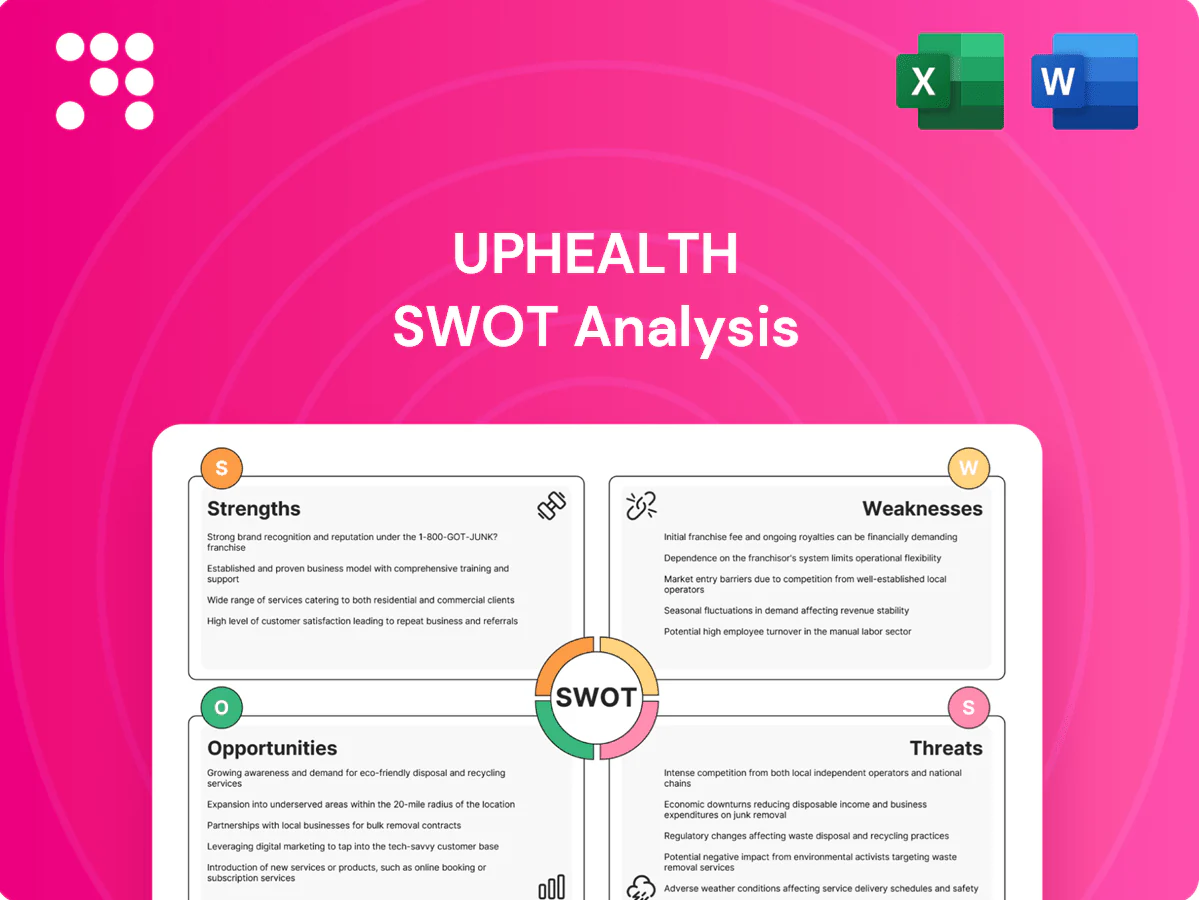
UpHealth SWOT Analysis

Go Beyond the Preview—Access the Full Strategic Report
UpHealth’s SWOT snapshot highlights robust telehealth capabilities, strategic partnerships, and scalable tech, alongside regulatory exposure and integration challenges. Our full SWOT unpacks financial context, competitive threats, and clear strategic moves to drive value. Purchase the complete, editable report (Word + Excel) to turn insights into a decisive growth or investment plan.
Strengths

Integrated digital platform
UpHealths integrated digital platform—combining telehealth, care management and analytics—creates customer stickiness and cross-sell leverage, enabling bundled sales that shorten procurement timelines. End-to-end workflow integration reduces fragmentation for providers and payers and supports use cases from virtual visits to population health. The approach aligns with a telemedicine market valued at USD 90.7 billion in 2023 (Fortune Business Insights), boosting lifetime value.
Telebehavioral health capability
Telebehavioral services target a large, undersupplied market—CDC reports about 1 in 5 U.S. adults experience mental illness—while payer coverage for telehealth has expanded since 2020, boosting reimbursement tailwinds. Specialty networks and standardized protocols improve outcomes and lower total cost of care by enabling measurement-based treatment and stepped-care models. Payers view telebehavioral platforms as efficient levers for access expansion and network adequacy, and continuous utilization data supports iterative refinement of care pathways.

Data-driven care coordination
Interoperable tools let UpHealth track patients across settings and close care gaps, supporting payer-provider alignment as nearly 40% of Medicare beneficiaries were in value-based models by 2023. Analytics help identify high-risk patients and prioritize interventions, associated with up to ~20% reductions in avoidable readmissions in coordinated-care studies. Closed-loop referrals lift completion and downstream outcomes, improving revenue capture in value arrangements.

Cost-reduction value proposition
Digital-first pathways shift care to lower-cost settings and reduce no-shows by up to 55%; remote engagements scale clinician capacity and shorten time-to-care, with RPM and telehealth linked to 25–38% reductions in admissions. Demonstrable savings improve procurement justification and renewals, and quantified ROI supports performance-based pricing models.
- Lower-cost settings: fewer facility visits, reduced utilization
- No-show reduction: up to 55%
- Admissions/readmissions: RPM/telehealth 25–38% reduction
- ROI: enables renewals and performance-based pricing
Global footprint and scalability
UpHealths presence across multiple markets diversifies revenue streams and provides real-world inputs for product localization; its cloud-native architecture enables rapid deployment and multi-tenant scaling, while international operations have built regulatory and compliance playbooks that ease entry into new regions and segments.
- Market diversification informs localization
- Cloud-native = rapid, scalable deployment
- International experience strengthens compliance
Integrated telehealth platform boosts retention, captures USD 90.7B market
UpHealths integrated platform drives customer stickiness and bundled sales, tapping a telemedicine market of USD 90.7B (2023). Telebehavioral and RPM scale access—no-shows down up to 55%, admissions down 25–38%. Interoperability and analytics support value-based care (≈40% Medicare in VBC by 2023) and can cut avoidable readmissions ~20%.
| Metric | Value | Source |
|---|---|---|
| Telemedicine market | USD 90.7B (2023) | Fortune Business Insights |
| No-show reduction | up to 55% | Peer studies |
| Admissions reduction | 25–38% | RPM/telehealth analyses |
| Medicare in VBC | ≈40% (2023) | CMS |
What is included in the product
 Detailed Word Document
Provides a concise SWOT assessment of UpHealth, highlighting internal strengths and weaknesses alongside external opportunities and threats that shape its competitive position and future growth prospects.

 Customizable Excel Spreadsheet
Delivers a concise SWOT snapshot of UpHealth to quickly pinpoint strategic pain points and prioritize remediation actions for faster decision-making and resource allocation.
Weaknesses

Reliance on reimbursement policies
Revenue hinges on telehealth coverage, coding, and parity rates that shifted after the COVID-19 public health emergency ended May 11, 2023, exposing UpHealth to policy reversals and rate changes. Post-emergency CMS and state rollbacks have narrowed eligible services and reimbursement rates. Complex, modality-specific billing and numerous CPT/HCPCS codes add client friction and lengthen implementations. State and payer variability makes forecasting unpredictable.
Competitive intensity
UpHealth faces entrenched EHR incumbents (Epic ~28% US hospital market) and large virtual-care players like Teladoc (2023 revenue ~$1.3B) plus payer-owned tech such as Optum/UnitedHealth with massive scale (Optum-level revenues measured in the hundreds of billions), so price pressure and feature parity erode differentiation. Larger rivals bundle services to win enterprise deals, squeezing margins. Without brand scale, marketing and sales efficiency can suffer, raising customer acquisition costs.

Interoperability and integration hurdles
Connecting UpHealth to diverse EHRs and data standards prolongs projects, often adding weeks to deployments. With roughly 80% of healthcare data unstructured, data quality issues limit analytics impact and clinical confidence. Custom integrations inflate costs and slow margin expansion, while ongoing maintenance burdens product and client success teams.

Security and compliance burden
Handling PHI forces heavy investment in cybersecurity and certifications; breaches risk fines, churn and reputational damage, with the healthcare sector average breach cost reported at 10.93 million dollars (IBM, 2023). Regulatory audits and evolving standards add operational drag, and UpHealths smaller balance sheet magnifies the financial and operational impact of incidents.
- High cybersecurity and compliance spend
- Average breach cost: 10.93M (IBM 2023)
- Regulatory audits create ongoing operational burden
- Smaller balance sheet increases incident risk
Capital and scale constraints
Scaling provider networks and 24/7 virtual care is capital intensive and operationally complex, with enterprise sales cycles commonly taking 6–12 months and thus straining working capital and cash flow. Limited R&D bandwidth has delayed roadmap milestones in comparable digital-health firms, raising time-to-market risk. Heavy reliance on a few strategic partners concentrates execution risk if integrations falter.
- scale-cost
- sales-cycle-6-12m
- r&d-bandwidth
- partner-dependency
Post-PHE telehealth rollback, data chaos and $10.93M breach costs squeeze margins
Revenue and margins remain exposed to post-PHE telehealth rollbacks (PHE ended May 11, 2023), creating reimbursement and forecasting risk. Market competition (Epic ~28% hospital share; large payer platforms) compresses pricing and enterprise wins. Integration complexity, poor data quality (~80% unstructured) and high cybersecurity costs (avg breach $10.93M IBM 2023) slow deployments and strain cash.
| Metric | Value |
|---|---|
| PHE end | May 11, 2023 |
| Epic US hospital share | ~28% |
| Unstructured data | ~80% |
| Avg breach cost | $10.93M (IBM 2023) |
| Sales cycle | 6–12 months |
Preview the Actual Deliverable
UpHealth SWOT Analysis
This is the actual SWOT analysis document you’ll receive upon purchase—no surprises, just professional quality. The preview below is taken directly from the full SWOT report you'll get; buying unlocks the complete, editable version. You’re viewing a live excerpt of the real file, ready to download after checkout.

Go Beyond the Preview—Access the Full Strategic Report
UpHealth’s SWOT snapshot highlights robust telehealth capabilities, strategic partnerships, and scalable tech, alongside regulatory exposure and integration challenges. Our full SWOT unpacks financial context, competitive threats, and clear strategic moves to drive value. Purchase the complete, editable report (Word + Excel) to turn insights into a decisive growth or investment plan.
Strengths
Integrated digital platform
UpHealths integrated digital platform—combining telehealth, care management and analytics—creates customer stickiness and cross-sell leverage, enabling bundled sales that shorten procurement timelines. End-to-end workflow integration reduces fragmentation for providers and payers and supports use cases from virtual visits to population health. The approach aligns with a telemedicine market valued at USD 90.7 billion in 2023 (Fortune Business Insights), boosting lifetime value.
Telebehavioral health capability
Telebehavioral services target a large, undersupplied market—CDC reports about 1 in 5 U.S. adults experience mental illness—while payer coverage for telehealth has expanded since 2020, boosting reimbursement tailwinds. Specialty networks and standardized protocols improve outcomes and lower total cost of care by enabling measurement-based treatment and stepped-care models. Payers view telebehavioral platforms as efficient levers for access expansion and network adequacy, and continuous utilization data supports iterative refinement of care pathways.
Data-driven care coordination
Interoperable tools let UpHealth track patients across settings and close care gaps, supporting payer-provider alignment as nearly 40% of Medicare beneficiaries were in value-based models by 2023. Analytics help identify high-risk patients and prioritize interventions, associated with up to ~20% reductions in avoidable readmissions in coordinated-care studies. Closed-loop referrals lift completion and downstream outcomes, improving revenue capture in value arrangements.
Cost-reduction value proposition
Digital-first pathways shift care to lower-cost settings and reduce no-shows by up to 55%; remote engagements scale clinician capacity and shorten time-to-care, with RPM and telehealth linked to 25–38% reductions in admissions. Demonstrable savings improve procurement justification and renewals, and quantified ROI supports performance-based pricing models.
- Lower-cost settings: fewer facility visits, reduced utilization
- No-show reduction: up to 55%
- Admissions/readmissions: RPM/telehealth 25–38% reduction
- ROI: enables renewals and performance-based pricing
Global footprint and scalability
UpHealths presence across multiple markets diversifies revenue streams and provides real-world inputs for product localization; its cloud-native architecture enables rapid deployment and multi-tenant scaling, while international operations have built regulatory and compliance playbooks that ease entry into new regions and segments.
- Market diversification informs localization
- Cloud-native = rapid, scalable deployment
- International experience strengthens compliance
Integrated telehealth platform boosts retention, captures USD 90.7B market
UpHealths integrated platform drives customer stickiness and bundled sales, tapping a telemedicine market of USD 90.7B (2023). Telebehavioral and RPM scale access—no-shows down up to 55%, admissions down 25–38%. Interoperability and analytics support value-based care (≈40% Medicare in VBC by 2023) and can cut avoidable readmissions ~20%.
| Metric | Value | Source |
|---|---|---|
| Telemedicine market | USD 90.7B (2023) | Fortune Business Insights |
| No-show reduction | up to 55% | Peer studies |
| Admissions reduction | 25–38% | RPM/telehealth analyses |
| Medicare in VBC | ≈40% (2023) | CMS |
What is included in the product
Detailed Word Document
Provides a concise SWOT assessment of UpHealth, highlighting internal strengths and weaknesses alongside external opportunities and threats that shape its competitive position and future growth prospects.
Customizable Excel Spreadsheet
Delivers a concise SWOT snapshot of UpHealth to quickly pinpoint strategic pain points and prioritize remediation actions for faster decision-making and resource allocation.
Weaknesses
Reliance on reimbursement policies
Revenue hinges on telehealth coverage, coding, and parity rates that shifted after the COVID-19 public health emergency ended May 11, 2023, exposing UpHealth to policy reversals and rate changes. Post-emergency CMS and state rollbacks have narrowed eligible services and reimbursement rates. Complex, modality-specific billing and numerous CPT/HCPCS codes add client friction and lengthen implementations. State and payer variability makes forecasting unpredictable.
Competitive intensity
UpHealth faces entrenched EHR incumbents (Epic ~28% US hospital market) and large virtual-care players like Teladoc (2023 revenue ~$1.3B) plus payer-owned tech such as Optum/UnitedHealth with massive scale (Optum-level revenues measured in the hundreds of billions), so price pressure and feature parity erode differentiation. Larger rivals bundle services to win enterprise deals, squeezing margins. Without brand scale, marketing and sales efficiency can suffer, raising customer acquisition costs.
Interoperability and integration hurdles
Connecting UpHealth to diverse EHRs and data standards prolongs projects, often adding weeks to deployments. With roughly 80% of healthcare data unstructured, data quality issues limit analytics impact and clinical confidence. Custom integrations inflate costs and slow margin expansion, while ongoing maintenance burdens product and client success teams.
Security and compliance burden
Handling PHI forces heavy investment in cybersecurity and certifications; breaches risk fines, churn and reputational damage, with the healthcare sector average breach cost reported at 10.93 million dollars (IBM, 2023). Regulatory audits and evolving standards add operational drag, and UpHealths smaller balance sheet magnifies the financial and operational impact of incidents.
- High cybersecurity and compliance spend
- Average breach cost: 10.93M (IBM 2023)
- Regulatory audits create ongoing operational burden
- Smaller balance sheet increases incident risk
Capital and scale constraints
Scaling provider networks and 24/7 virtual care is capital intensive and operationally complex, with enterprise sales cycles commonly taking 6–12 months and thus straining working capital and cash flow. Limited R&D bandwidth has delayed roadmap milestones in comparable digital-health firms, raising time-to-market risk. Heavy reliance on a few strategic partners concentrates execution risk if integrations falter.
- scale-cost
- sales-cycle-6-12m
- r&d-bandwidth
- partner-dependency
Post-PHE telehealth rollback, data chaos and $10.93M breach costs squeeze margins
Revenue and margins remain exposed to post-PHE telehealth rollbacks (PHE ended May 11, 2023), creating reimbursement and forecasting risk. Market competition (Epic ~28% hospital share; large payer platforms) compresses pricing and enterprise wins. Integration complexity, poor data quality (~80% unstructured) and high cybersecurity costs (avg breach $10.93M IBM 2023) slow deployments and strain cash.
| Metric | Value |
|---|---|
| PHE end | May 11, 2023 |
| Epic US hospital share | ~28% |
| Unstructured data | ~80% |
| Avg breach cost | $10.93M (IBM 2023) |
| Sales cycle | 6–12 months |
Preview the Actual Deliverable
UpHealth SWOT Analysis
This is the actual SWOT analysis document you’ll receive upon purchase—no surprises, just professional quality. The preview below is taken directly from the full SWOT report you'll get; buying unlocks the complete, editable version. You’re viewing a live excerpt of the real file, ready to download after checkout.
Original: $10.00
-65%$10.00
$3.50Description
Go Beyond the Preview—Access the Full Strategic Report
UpHealth’s SWOT snapshot highlights robust telehealth capabilities, strategic partnerships, and scalable tech, alongside regulatory exposure and integration challenges. Our full SWOT unpacks financial context, competitive threats, and clear strategic moves to drive value. Purchase the complete, editable report (Word + Excel) to turn insights into a decisive growth or investment plan.
Strengths
Integrated digital platform
UpHealths integrated digital platform—combining telehealth, care management and analytics—creates customer stickiness and cross-sell leverage, enabling bundled sales that shorten procurement timelines. End-to-end workflow integration reduces fragmentation for providers and payers and supports use cases from virtual visits to population health. The approach aligns with a telemedicine market valued at USD 90.7 billion in 2023 (Fortune Business Insights), boosting lifetime value.
Telebehavioral health capability
Telebehavioral services target a large, undersupplied market—CDC reports about 1 in 5 U.S. adults experience mental illness—while payer coverage for telehealth has expanded since 2020, boosting reimbursement tailwinds. Specialty networks and standardized protocols improve outcomes and lower total cost of care by enabling measurement-based treatment and stepped-care models. Payers view telebehavioral platforms as efficient levers for access expansion and network adequacy, and continuous utilization data supports iterative refinement of care pathways.
Data-driven care coordination
Interoperable tools let UpHealth track patients across settings and close care gaps, supporting payer-provider alignment as nearly 40% of Medicare beneficiaries were in value-based models by 2023. Analytics help identify high-risk patients and prioritize interventions, associated with up to ~20% reductions in avoidable readmissions in coordinated-care studies. Closed-loop referrals lift completion and downstream outcomes, improving revenue capture in value arrangements.
Cost-reduction value proposition
Digital-first pathways shift care to lower-cost settings and reduce no-shows by up to 55%; remote engagements scale clinician capacity and shorten time-to-care, with RPM and telehealth linked to 25–38% reductions in admissions. Demonstrable savings improve procurement justification and renewals, and quantified ROI supports performance-based pricing models.
- Lower-cost settings: fewer facility visits, reduced utilization
- No-show reduction: up to 55%
- Admissions/readmissions: RPM/telehealth 25–38% reduction
- ROI: enables renewals and performance-based pricing
Global footprint and scalability
UpHealths presence across multiple markets diversifies revenue streams and provides real-world inputs for product localization; its cloud-native architecture enables rapid deployment and multi-tenant scaling, while international operations have built regulatory and compliance playbooks that ease entry into new regions and segments.
- Market diversification informs localization
- Cloud-native = rapid, scalable deployment
- International experience strengthens compliance
Integrated telehealth platform boosts retention, captures USD 90.7B market
UpHealths integrated platform drives customer stickiness and bundled sales, tapping a telemedicine market of USD 90.7B (2023). Telebehavioral and RPM scale access—no-shows down up to 55%, admissions down 25–38%. Interoperability and analytics support value-based care (≈40% Medicare in VBC by 2023) and can cut avoidable readmissions ~20%.
| Metric | Value | Source |
|---|---|---|
| Telemedicine market | USD 90.7B (2023) | Fortune Business Insights |
| No-show reduction | up to 55% | Peer studies |
| Admissions reduction | 25–38% | RPM/telehealth analyses |
| Medicare in VBC | ≈40% (2023) | CMS |
What is included in the product
Detailed Word Document
Provides a concise SWOT assessment of UpHealth, highlighting internal strengths and weaknesses alongside external opportunities and threats that shape its competitive position and future growth prospects.
Customizable Excel Spreadsheet
Delivers a concise SWOT snapshot of UpHealth to quickly pinpoint strategic pain points and prioritize remediation actions for faster decision-making and resource allocation.
Weaknesses
Reliance on reimbursement policies
Revenue hinges on telehealth coverage, coding, and parity rates that shifted after the COVID-19 public health emergency ended May 11, 2023, exposing UpHealth to policy reversals and rate changes. Post-emergency CMS and state rollbacks have narrowed eligible services and reimbursement rates. Complex, modality-specific billing and numerous CPT/HCPCS codes add client friction and lengthen implementations. State and payer variability makes forecasting unpredictable.
Competitive intensity
UpHealth faces entrenched EHR incumbents (Epic ~28% US hospital market) and large virtual-care players like Teladoc (2023 revenue ~$1.3B) plus payer-owned tech such as Optum/UnitedHealth with massive scale (Optum-level revenues measured in the hundreds of billions), so price pressure and feature parity erode differentiation. Larger rivals bundle services to win enterprise deals, squeezing margins. Without brand scale, marketing and sales efficiency can suffer, raising customer acquisition costs.
Interoperability and integration hurdles
Connecting UpHealth to diverse EHRs and data standards prolongs projects, often adding weeks to deployments. With roughly 80% of healthcare data unstructured, data quality issues limit analytics impact and clinical confidence. Custom integrations inflate costs and slow margin expansion, while ongoing maintenance burdens product and client success teams.
Security and compliance burden
Handling PHI forces heavy investment in cybersecurity and certifications; breaches risk fines, churn and reputational damage, with the healthcare sector average breach cost reported at 10.93 million dollars (IBM, 2023). Regulatory audits and evolving standards add operational drag, and UpHealths smaller balance sheet magnifies the financial and operational impact of incidents.
- High cybersecurity and compliance spend
- Average breach cost: 10.93M (IBM 2023)
- Regulatory audits create ongoing operational burden
- Smaller balance sheet increases incident risk
Capital and scale constraints
Scaling provider networks and 24/7 virtual care is capital intensive and operationally complex, with enterprise sales cycles commonly taking 6–12 months and thus straining working capital and cash flow. Limited R&D bandwidth has delayed roadmap milestones in comparable digital-health firms, raising time-to-market risk. Heavy reliance on a few strategic partners concentrates execution risk if integrations falter.
- scale-cost
- sales-cycle-6-12m
- r&d-bandwidth
- partner-dependency
Post-PHE telehealth rollback, data chaos and $10.93M breach costs squeeze margins
Revenue and margins remain exposed to post-PHE telehealth rollbacks (PHE ended May 11, 2023), creating reimbursement and forecasting risk. Market competition (Epic ~28% hospital share; large payer platforms) compresses pricing and enterprise wins. Integration complexity, poor data quality (~80% unstructured) and high cybersecurity costs (avg breach $10.93M IBM 2023) slow deployments and strain cash.
| Metric | Value |
|---|---|
| PHE end | May 11, 2023 |
| Epic US hospital share | ~28% |
| Unstructured data | ~80% |
| Avg breach cost | $10.93M (IBM 2023) |
| Sales cycle | 6–12 months |
Preview the Actual Deliverable
UpHealth SWOT Analysis
This is the actual SWOT analysis document you’ll receive upon purchase—no surprises, just professional quality. The preview below is taken directly from the full SWOT report you'll get; buying unlocks the complete, editable version. You’re viewing a live excerpt of the real file, ready to download after checkout.











