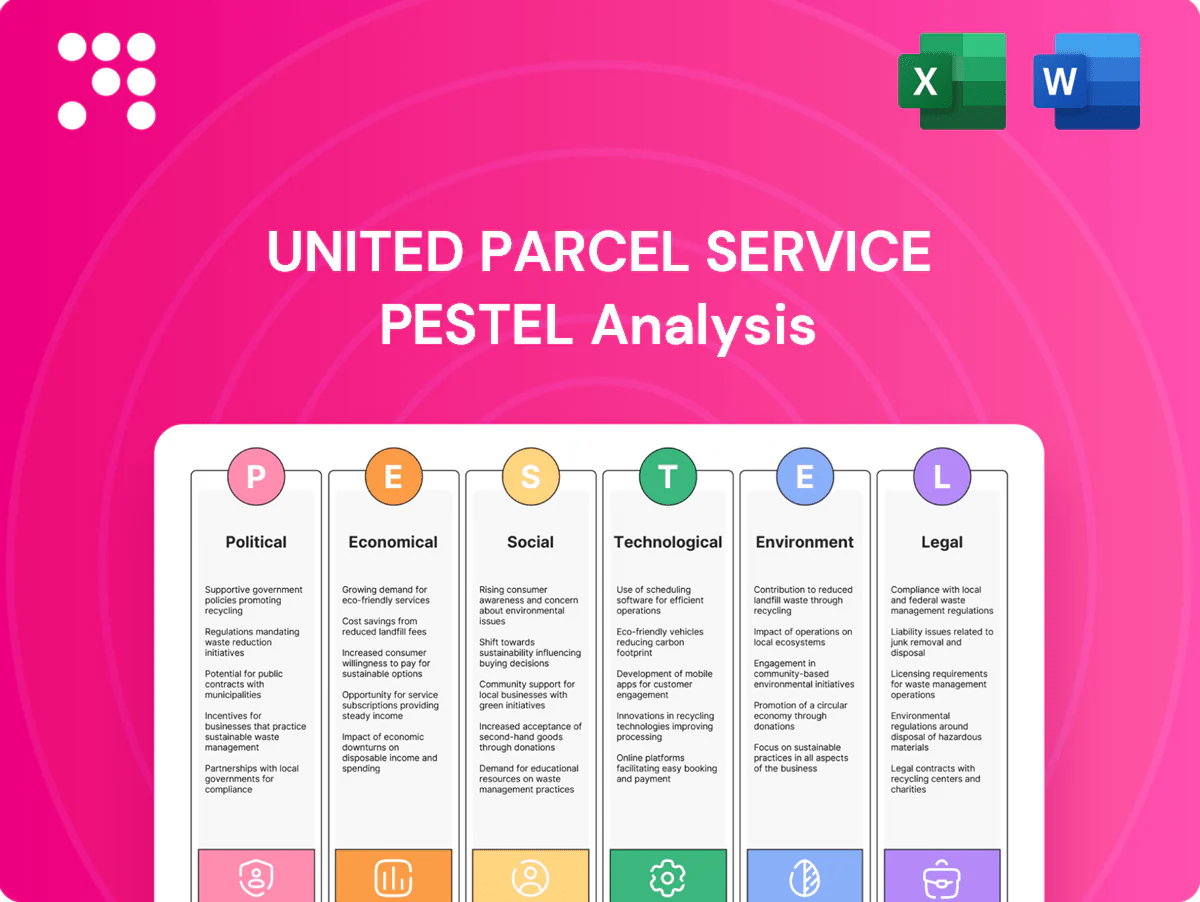
United Parcel Service PESTLE Analysis

Skip the Research. Get the Strategy.
Our PESTLE Analysis of United Parcel Service reveals how political regulations, economic cycles, social trends, technological innovation, legal risks, and environmental pressures converge on UPS’s strategy and margins. Gain targeted insights to forecast risks and spot growth levers for investors and managers. Purchase the full report for the complete, actionable breakdown.
Political factors

Trade policies and tariffs
UPS operates in 220+ countries and territories, making it highly sensitive to shifts in trade policy and tariff regimes. New trade agreements can open lanes and reduce costs, while rising protectionism increases complexity, transit times and landed costs. Geopolitical tensions often trigger sudden customs measures and documentation burdens; proactive compliance programs and diversified routing help mitigate such disruptions.
Customs and border regulations
Variations in customs procedures across 220+ countries and territories affect transit times and reliability, while uneven digitization of customs clearance creates bottlenecks; UPS must sustain robust brokerage capabilities and pristine data accuracy to avoid delays and penalties, and participation in trusted trader programs such as AEO and CTPAT provides priority handling and reduced inspections that improve throughput.

Government infrastructure spending
Public investment shapes UPS delivery speed and cargo capacity: the US Infrastructure Investment and Jobs Act totals roughly 1.2 trillion dollars, including about 110 billion for roads and bridges, directly improving transit times and freight throughput.
Underinvestment causes congestion and higher operating costs for carriers; UPS benefits when governments fund modernization and multimodal hubs that increase network efficiency.
Policy-driven green corridors and electrification pilots in the US and EU are already prompting UPS to rethink routing and fleet deployment to meet emissions targets.

Labor and transportation policy
Rules on driver hours (US HOS: 11-hour driving, 14-hour duty, 34-hour restart), aviation slots and cabotage restrictions shape UPS network efficiency; policy shifts affect fleet utilization and peak capacity, forcing dynamic scheduling and crew planning to maintain compliance.
- Engage regulators & industry bodies
- Adapt scheduling/crew planning
- Comply with HOS and slot rules
- Plan for seasonal staffing surges
Political stability and sanctions
Instability and sanctions can close markets or force rerouting, increasing transit times and costs for UPS, which serves over 220 countries and territories. Security risks raise insurance premiums and require contingency planning across UPSs ~540,000 workforce and global hubs. Robust sanctions screening and restricted-party checks are essential to avoid fines and service disruptions.
- Market closures reroute flows
- Higher insurance and security costs
- Need for regional diversification
- Mandatory sanctions and restricted-party screening
Global logistics in 220+ countries, ~540,000 staff - trade policy, customs & US HOS risk
UPS operates in 220+ countries with ~540,000 employees, making it highly sensitive to trade policy, tariffs and sanctions that can force rerouting and raise costs. Customs fragmentation and uneven digitization demand strong brokerage, AEO/CTPAT participation and sanctions screening. Public investment (US IIJA ~$1.2T; ~$110B for roads) and rules (US HOS: 11/14/34) directly affect capacity and costs.
| Metric | Value |
|---|---|
| Country reach | 220+ |
| Employees | ~540,000 |
| IIJA total / roads | $1.2T / ~$110B |
| US HOS | 11h driving / 14h duty / 34h restart |
What is included in the product
 Detailed Word Document
Explores how Political, Economic, Social, Technological, Environmental and Legal forces specifically shape United Parcel Service’s strategy and operations, with data-backed trends, forward-looking insights and actionable implications to help executives, investors and consultants identify risks, opportunities and scenario-driven responses.

 Customizable Excel Spreadsheet
A concise PESTLE summary of United Parcel Service, visually segmented and editable for region- or business-line notes, ideal for dropping into presentations or strategy packs to align teams quickly and support external risk and market-positioning discussions.
Economic factors

Global GDP and trade cycles
Parcel volumes closely follow global GDP, with the IMF projecting world growth near 3.1% in 2024 and 3.0% in 2025, and cross-border trade patterns driving international parcel flows. Economic slowdowns compress B2B shipments and lower average yields, while rebounds raise utilization and pricing power. UPS mitigates cyclicality via sector diversification and a large SMB customer base. Macroeconomic forecasting informs capacity planning and route pricing decisions.
E-commerce growth and seasonality
E-commerce growth drives residential deliveries and peak spikes—global e-commerce reached $5.7 trillion in 2024, pushing UPS to handle billions of parcels. Higher stop density boosts revenue but last-mile represents about 53% of delivery costs, pressuring margins. UPS leverages dynamic pricing, peak surcharges and capacity reservations to balance load, while peak planning and automation (advanced sortation, routing AI) are essential for margin protection.

Fuel prices and energy costs
Jet fuel and diesel volatility materially affect UPS operating expenses—fuel and fuel-related costs totaled about $10.2 billion in 2024, making energy a major cost driver. Fuel surcharges recover some costs but lag market moves, compressing margins during rapid price spikes. Continued investment in fleet efficiency and roughly 13,000 alternative-fuel/advanced-technology vehicles by 2024 reduces exposure. Active hedging programs that pre-purchase ~30% of fuel needs help stabilize cash flows.

Currency fluctuations
Multi-currency revenues and costs expose United Parcel Service to FX translation and transaction risk; operating in more than 220 countries and territories amplifies cross-currency exposure and a stronger US dollar tends to dampen reported international earnings. Local sourcing and local-currency cost bases provide natural hedges, while targeted financial hedges such as forwards and options smooth volatility for budgeting and planning.
- Multi-currency exposure: global operations in over 220 countries and territories
- Strong dollar effect: reduces reported international earnings
- Natural hedging: local costs offset currency moves
- Financial hedges: forwards/options used to stabilize cash flow
Inflation and wage dynamics
General inflation (US CPI 3.4% in 2023) raises labor, fuel, maintenance and facility costs for UPS; tight labor markets are pushing driver and sorter wages higher, especially after recent contract talks. UPS implemented a 6.9% U.S. 2024 rate increase and accelerates automation deployment to preserve margins. Contract negotiations must balance wage/cost pressures with on‑time service levels.
- Inflation: CPI 3.4% (2023)
- Rate action: 6.9% U.S. 2024 increase
- Response: automation + negotiated wage trade‑offs
Global logistics in 220+ countries, ~540,000 staff - trade policy, customs & US HOS risk
Global GDP ~3.1% (2024) and e‑commerce $5.7T (2024) drive parcel demand and peak volume; UPS counters cyclicality via sector diversification and SMB base. Fuel/fuel‑related costs ~$10.2B (2024) and ~13,000 alternative‑fuel vehicles reduce exposure while ~30% fuel hedging smooths volatility. Multi‑currency ops in 220+ countries plus a stronger USD pressure reported international revenue; 6.9% U.S. 2024 rate hike and automation offset inflationary wage/cost rises.
| Metric | Value |
|---|---|
| Global GDP (IMF) | 3.1% (2024) |
| Global e‑commerce | $5.7T (2024) |
| Fuel costs | $10.2B (2024) |
| AFV fleet | ~13,000 (2024) |
| FX footprint | 220+ countries |
| US rate increase | 6.9% (2024) |
Full Version Awaits
United Parcel Service PESTLE Analysis
The preview shown here is the exact document you’ll receive after purchase—fully formatted and ready to use. This UPS PESTLE analysis outlines political, economic, social, technological, legal, and environmental factors affecting operations and strategy. No placeholders—the finished file is ready to download after checkout.

Skip the Research. Get the Strategy.
Our PESTLE Analysis of United Parcel Service reveals how political regulations, economic cycles, social trends, technological innovation, legal risks, and environmental pressures converge on UPS’s strategy and margins. Gain targeted insights to forecast risks and spot growth levers for investors and managers. Purchase the full report for the complete, actionable breakdown.
Political factors
Trade policies and tariffs
UPS operates in 220+ countries and territories, making it highly sensitive to shifts in trade policy and tariff regimes. New trade agreements can open lanes and reduce costs, while rising protectionism increases complexity, transit times and landed costs. Geopolitical tensions often trigger sudden customs measures and documentation burdens; proactive compliance programs and diversified routing help mitigate such disruptions.
Customs and border regulations
Variations in customs procedures across 220+ countries and territories affect transit times and reliability, while uneven digitization of customs clearance creates bottlenecks; UPS must sustain robust brokerage capabilities and pristine data accuracy to avoid delays and penalties, and participation in trusted trader programs such as AEO and CTPAT provides priority handling and reduced inspections that improve throughput.
Government infrastructure spending
Public investment shapes UPS delivery speed and cargo capacity: the US Infrastructure Investment and Jobs Act totals roughly 1.2 trillion dollars, including about 110 billion for roads and bridges, directly improving transit times and freight throughput.
Underinvestment causes congestion and higher operating costs for carriers; UPS benefits when governments fund modernization and multimodal hubs that increase network efficiency.
Policy-driven green corridors and electrification pilots in the US and EU are already prompting UPS to rethink routing and fleet deployment to meet emissions targets.
Labor and transportation policy
Rules on driver hours (US HOS: 11-hour driving, 14-hour duty, 34-hour restart), aviation slots and cabotage restrictions shape UPS network efficiency; policy shifts affect fleet utilization and peak capacity, forcing dynamic scheduling and crew planning to maintain compliance.
- Engage regulators & industry bodies
- Adapt scheduling/crew planning
- Comply with HOS and slot rules
- Plan for seasonal staffing surges
Political stability and sanctions
Instability and sanctions can close markets or force rerouting, increasing transit times and costs for UPS, which serves over 220 countries and territories. Security risks raise insurance premiums and require contingency planning across UPSs ~540,000 workforce and global hubs. Robust sanctions screening and restricted-party checks are essential to avoid fines and service disruptions.
- Market closures reroute flows
- Higher insurance and security costs
- Need for regional diversification
- Mandatory sanctions and restricted-party screening
Global logistics in 220+ countries, ~540,000 staff - trade policy, customs & US HOS risk
UPS operates in 220+ countries with ~540,000 employees, making it highly sensitive to trade policy, tariffs and sanctions that can force rerouting and raise costs. Customs fragmentation and uneven digitization demand strong brokerage, AEO/CTPAT participation and sanctions screening. Public investment (US IIJA ~$1.2T; ~$110B for roads) and rules (US HOS: 11/14/34) directly affect capacity and costs.
| Metric | Value |
|---|---|
| Country reach | 220+ |
| Employees | ~540,000 |
| IIJA total / roads | $1.2T / ~$110B |
| US HOS | 11h driving / 14h duty / 34h restart |
What is included in the product
Detailed Word Document
Explores how Political, Economic, Social, Technological, Environmental and Legal forces specifically shape United Parcel Service’s strategy and operations, with data-backed trends, forward-looking insights and actionable implications to help executives, investors and consultants identify risks, opportunities and scenario-driven responses.
Customizable Excel Spreadsheet
A concise PESTLE summary of United Parcel Service, visually segmented and editable for region- or business-line notes, ideal for dropping into presentations or strategy packs to align teams quickly and support external risk and market-positioning discussions.
Economic factors
Global GDP and trade cycles
Parcel volumes closely follow global GDP, with the IMF projecting world growth near 3.1% in 2024 and 3.0% in 2025, and cross-border trade patterns driving international parcel flows. Economic slowdowns compress B2B shipments and lower average yields, while rebounds raise utilization and pricing power. UPS mitigates cyclicality via sector diversification and a large SMB customer base. Macroeconomic forecasting informs capacity planning and route pricing decisions.
E-commerce growth and seasonality
E-commerce growth drives residential deliveries and peak spikes—global e-commerce reached $5.7 trillion in 2024, pushing UPS to handle billions of parcels. Higher stop density boosts revenue but last-mile represents about 53% of delivery costs, pressuring margins. UPS leverages dynamic pricing, peak surcharges and capacity reservations to balance load, while peak planning and automation (advanced sortation, routing AI) are essential for margin protection.
Fuel prices and energy costs
Jet fuel and diesel volatility materially affect UPS operating expenses—fuel and fuel-related costs totaled about $10.2 billion in 2024, making energy a major cost driver. Fuel surcharges recover some costs but lag market moves, compressing margins during rapid price spikes. Continued investment in fleet efficiency and roughly 13,000 alternative-fuel/advanced-technology vehicles by 2024 reduces exposure. Active hedging programs that pre-purchase ~30% of fuel needs help stabilize cash flows.
Currency fluctuations
Multi-currency revenues and costs expose United Parcel Service to FX translation and transaction risk; operating in more than 220 countries and territories amplifies cross-currency exposure and a stronger US dollar tends to dampen reported international earnings. Local sourcing and local-currency cost bases provide natural hedges, while targeted financial hedges such as forwards and options smooth volatility for budgeting and planning.
- Multi-currency exposure: global operations in over 220 countries and territories
- Strong dollar effect: reduces reported international earnings
- Natural hedging: local costs offset currency moves
- Financial hedges: forwards/options used to stabilize cash flow
Inflation and wage dynamics
General inflation (US CPI 3.4% in 2023) raises labor, fuel, maintenance and facility costs for UPS; tight labor markets are pushing driver and sorter wages higher, especially after recent contract talks. UPS implemented a 6.9% U.S. 2024 rate increase and accelerates automation deployment to preserve margins. Contract negotiations must balance wage/cost pressures with on‑time service levels.
- Inflation: CPI 3.4% (2023)
- Rate action: 6.9% U.S. 2024 increase
- Response: automation + negotiated wage trade‑offs
Global logistics in 220+ countries, ~540,000 staff - trade policy, customs & US HOS risk
Global GDP ~3.1% (2024) and e‑commerce $5.7T (2024) drive parcel demand and peak volume; UPS counters cyclicality via sector diversification and SMB base. Fuel/fuel‑related costs ~$10.2B (2024) and ~13,000 alternative‑fuel vehicles reduce exposure while ~30% fuel hedging smooths volatility. Multi‑currency ops in 220+ countries plus a stronger USD pressure reported international revenue; 6.9% U.S. 2024 rate hike and automation offset inflationary wage/cost rises.
| Metric | Value |
|---|---|
| Global GDP (IMF) | 3.1% (2024) |
| Global e‑commerce | $5.7T (2024) |
| Fuel costs | $10.2B (2024) |
| AFV fleet | ~13,000 (2024) |
| FX footprint | 220+ countries |
| US rate increase | 6.9% (2024) |
Full Version Awaits
United Parcel Service PESTLE Analysis
The preview shown here is the exact document you’ll receive after purchase—fully formatted and ready to use. This UPS PESTLE analysis outlines political, economic, social, technological, legal, and environmental factors affecting operations and strategy. No placeholders—the finished file is ready to download after checkout.
Original: $10.00
-65%$10.00
$3.50Description
Skip the Research. Get the Strategy.
Our PESTLE Analysis of United Parcel Service reveals how political regulations, economic cycles, social trends, technological innovation, legal risks, and environmental pressures converge on UPS’s strategy and margins. Gain targeted insights to forecast risks and spot growth levers for investors and managers. Purchase the full report for the complete, actionable breakdown.
Political factors
Trade policies and tariffs
UPS operates in 220+ countries and territories, making it highly sensitive to shifts in trade policy and tariff regimes. New trade agreements can open lanes and reduce costs, while rising protectionism increases complexity, transit times and landed costs. Geopolitical tensions often trigger sudden customs measures and documentation burdens; proactive compliance programs and diversified routing help mitigate such disruptions.
Customs and border regulations
Variations in customs procedures across 220+ countries and territories affect transit times and reliability, while uneven digitization of customs clearance creates bottlenecks; UPS must sustain robust brokerage capabilities and pristine data accuracy to avoid delays and penalties, and participation in trusted trader programs such as AEO and CTPAT provides priority handling and reduced inspections that improve throughput.
Government infrastructure spending
Public investment shapes UPS delivery speed and cargo capacity: the US Infrastructure Investment and Jobs Act totals roughly 1.2 trillion dollars, including about 110 billion for roads and bridges, directly improving transit times and freight throughput.
Underinvestment causes congestion and higher operating costs for carriers; UPS benefits when governments fund modernization and multimodal hubs that increase network efficiency.
Policy-driven green corridors and electrification pilots in the US and EU are already prompting UPS to rethink routing and fleet deployment to meet emissions targets.
Labor and transportation policy
Rules on driver hours (US HOS: 11-hour driving, 14-hour duty, 34-hour restart), aviation slots and cabotage restrictions shape UPS network efficiency; policy shifts affect fleet utilization and peak capacity, forcing dynamic scheduling and crew planning to maintain compliance.
- Engage regulators & industry bodies
- Adapt scheduling/crew planning
- Comply with HOS and slot rules
- Plan for seasonal staffing surges
Political stability and sanctions
Instability and sanctions can close markets or force rerouting, increasing transit times and costs for UPS, which serves over 220 countries and territories. Security risks raise insurance premiums and require contingency planning across UPSs ~540,000 workforce and global hubs. Robust sanctions screening and restricted-party checks are essential to avoid fines and service disruptions.
- Market closures reroute flows
- Higher insurance and security costs
- Need for regional diversification
- Mandatory sanctions and restricted-party screening
Global logistics in 220+ countries, ~540,000 staff - trade policy, customs & US HOS risk
UPS operates in 220+ countries with ~540,000 employees, making it highly sensitive to trade policy, tariffs and sanctions that can force rerouting and raise costs. Customs fragmentation and uneven digitization demand strong brokerage, AEO/CTPAT participation and sanctions screening. Public investment (US IIJA ~$1.2T; ~$110B for roads) and rules (US HOS: 11/14/34) directly affect capacity and costs.
| Metric | Value |
|---|---|
| Country reach | 220+ |
| Employees | ~540,000 |
| IIJA total / roads | $1.2T / ~$110B |
| US HOS | 11h driving / 14h duty / 34h restart |
What is included in the product
Detailed Word Document
Explores how Political, Economic, Social, Technological, Environmental and Legal forces specifically shape United Parcel Service’s strategy and operations, with data-backed trends, forward-looking insights and actionable implications to help executives, investors and consultants identify risks, opportunities and scenario-driven responses.
Customizable Excel Spreadsheet
A concise PESTLE summary of United Parcel Service, visually segmented and editable for region- or business-line notes, ideal for dropping into presentations or strategy packs to align teams quickly and support external risk and market-positioning discussions.
Economic factors
Global GDP and trade cycles
Parcel volumes closely follow global GDP, with the IMF projecting world growth near 3.1% in 2024 and 3.0% in 2025, and cross-border trade patterns driving international parcel flows. Economic slowdowns compress B2B shipments and lower average yields, while rebounds raise utilization and pricing power. UPS mitigates cyclicality via sector diversification and a large SMB customer base. Macroeconomic forecasting informs capacity planning and route pricing decisions.
E-commerce growth and seasonality
E-commerce growth drives residential deliveries and peak spikes—global e-commerce reached $5.7 trillion in 2024, pushing UPS to handle billions of parcels. Higher stop density boosts revenue but last-mile represents about 53% of delivery costs, pressuring margins. UPS leverages dynamic pricing, peak surcharges and capacity reservations to balance load, while peak planning and automation (advanced sortation, routing AI) are essential for margin protection.
Fuel prices and energy costs
Jet fuel and diesel volatility materially affect UPS operating expenses—fuel and fuel-related costs totaled about $10.2 billion in 2024, making energy a major cost driver. Fuel surcharges recover some costs but lag market moves, compressing margins during rapid price spikes. Continued investment in fleet efficiency and roughly 13,000 alternative-fuel/advanced-technology vehicles by 2024 reduces exposure. Active hedging programs that pre-purchase ~30% of fuel needs help stabilize cash flows.
Currency fluctuations
Multi-currency revenues and costs expose United Parcel Service to FX translation and transaction risk; operating in more than 220 countries and territories amplifies cross-currency exposure and a stronger US dollar tends to dampen reported international earnings. Local sourcing and local-currency cost bases provide natural hedges, while targeted financial hedges such as forwards and options smooth volatility for budgeting and planning.
- Multi-currency exposure: global operations in over 220 countries and territories
- Strong dollar effect: reduces reported international earnings
- Natural hedging: local costs offset currency moves
- Financial hedges: forwards/options used to stabilize cash flow
Inflation and wage dynamics
General inflation (US CPI 3.4% in 2023) raises labor, fuel, maintenance and facility costs for UPS; tight labor markets are pushing driver and sorter wages higher, especially after recent contract talks. UPS implemented a 6.9% U.S. 2024 rate increase and accelerates automation deployment to preserve margins. Contract negotiations must balance wage/cost pressures with on‑time service levels.
- Inflation: CPI 3.4% (2023)
- Rate action: 6.9% U.S. 2024 increase
- Response: automation + negotiated wage trade‑offs
Global logistics in 220+ countries, ~540,000 staff - trade policy, customs & US HOS risk
Global GDP ~3.1% (2024) and e‑commerce $5.7T (2024) drive parcel demand and peak volume; UPS counters cyclicality via sector diversification and SMB base. Fuel/fuel‑related costs ~$10.2B (2024) and ~13,000 alternative‑fuel vehicles reduce exposure while ~30% fuel hedging smooths volatility. Multi‑currency ops in 220+ countries plus a stronger USD pressure reported international revenue; 6.9% U.S. 2024 rate hike and automation offset inflationary wage/cost rises.
| Metric | Value |
|---|---|
| Global GDP (IMF) | 3.1% (2024) |
| Global e‑commerce | $5.7T (2024) |
| Fuel costs | $10.2B (2024) |
| AFV fleet | ~13,000 (2024) |
| FX footprint | 220+ countries |
| US rate increase | 6.9% (2024) |
Full Version Awaits
United Parcel Service PESTLE Analysis
The preview shown here is the exact document you’ll receive after purchase—fully formatted and ready to use. This UPS PESTLE analysis outlines political, economic, social, technological, legal, and environmental factors affecting operations and strategy. No placeholders—the finished file is ready to download after checkout.











