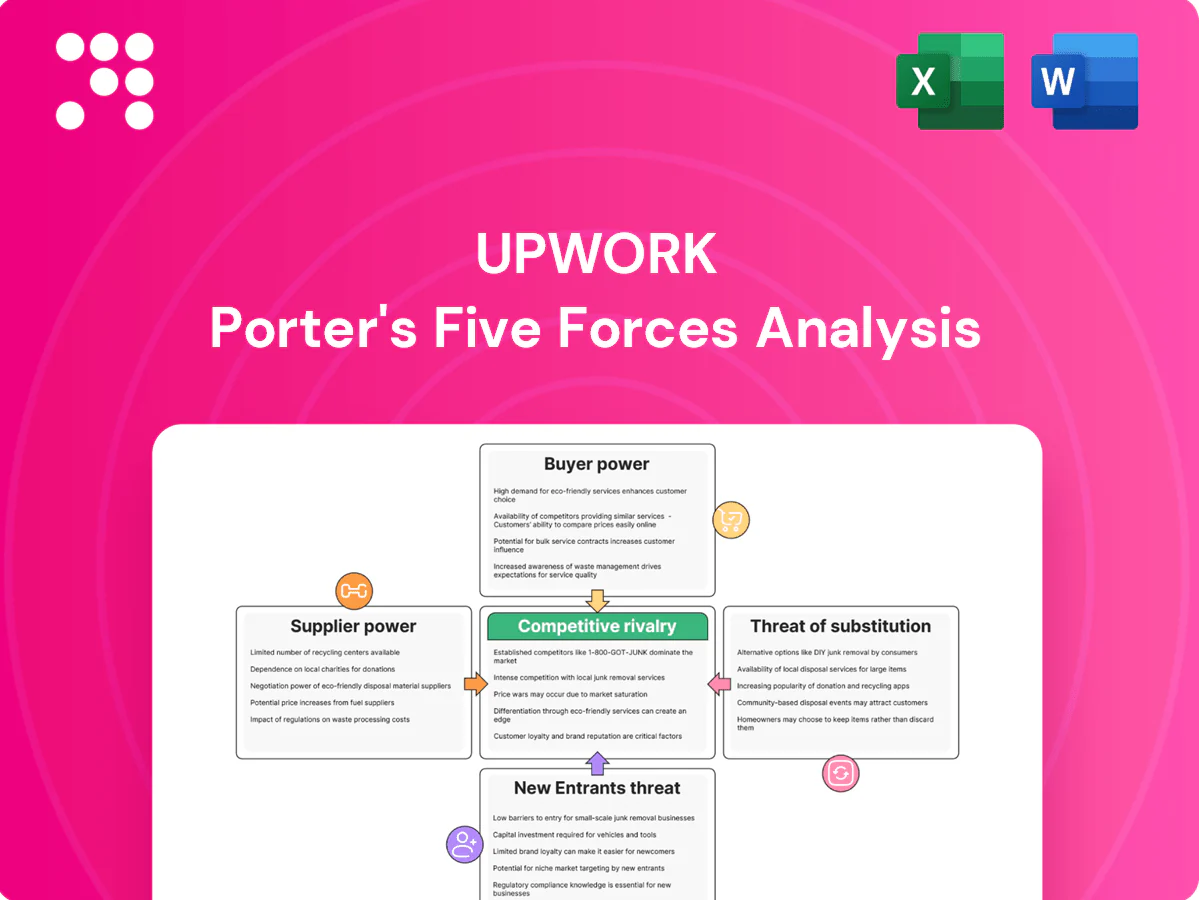
Upwork Porter's Five Forces Analysis

From Overview to Strategy Blueprint
Upwork faces moderated buyer power, intense rivalry among freelancing platforms, and growing substitute threats from in-house contracting and niche marketplaces, while supplier power and barriers to entry remain mixed; this snapshot highlights strategic pressure points for management and investors. Unlock the full Porter's Five Forces Analysis to explore force-by-force ratings, visuals, and actionable insights tailored to Upwork.
Suppliers Bargaining Power

Global freelancer supply depth
Large, diverse freelancer pools dilute individual bargaining power; Upwork reported millions of registered freelancers globally in 2024, which keeps rates for common skills competitive. Rare, niche experts can still command meaningful premiums and higher win rates. Upwork balances this via search ranking, specialized badges, Project Catalog listings and project-matching algorithms to surface scarce talent.
Multi-homing by talent
Freelancers multi-home by listing across platforms such as Fiverr, Toptal and LinkedIn, reducing dependence on Upwork and increasing supplier leverage; LinkedIn surpassed 930 million members in 2024, evidencing large alternative talent pools. Upwork counters with identity verification, Job Success Score and Project Catalog to differentiate supply. Loyalty programs and faster payouts are cited measures to curb multi-homing and retain high-value freelancers.

Switching costs for top talent
Reputation, reviews and Job Success Score create moderate switching costs for top talent: Upwork reported over 20 million registered freelancers in 2024, and elite freelancers risk losing platform-earned trust and high JSS when churning. However portfolios and client relationships can be ported externally, limiting lock-in. Upwork must boost retention via premium tiers and expanded enterprise access to protect its high-value supply.

Fee sensitivity of suppliers
Service fees and payment processing cut freelancer take-home pay on Upwork; the platform uses a 20%/10%/5% sliding service fee and offers Freelancer Plus at $14.99/month, so fee changes materially affect net earnings and mobility to rivals.
- 20%/10%/5 service-fee tiers
- Freelancer Plus $14.99/month
- Tiers tested to better align incentives and reduce churn
Dependence on platform tools
Dependence on platform tools—Workroom, time-tracking, escrow, and dispute resolution—embeds workflows that increase stickiness and reduce off-platform leakage, with continuous upgrades through 2024 reinforcing supplier reliance.
Third-party tools and direct contracts remain alternatives, so supplier bargaining power is moderated rather than eliminated, especially for top-rated freelancers with repeat clients.
Freelance marketplace sees moderate supplier power amid 20M freelancers and LinkedIn competition
Upwork faced moderate supplier power in 2024: over 20 million registered freelancers kept rates competitive, while niche experts still command premiums. Multi-homing to platforms like LinkedIn (930 million members in 2024) raises supplier leverage. Platform tools, JSS and fee tiers (20%/10%/5%) and Freelancer Plus $14.99/month increase stickiness but do not eliminate bargaining power.
| Metric | Value (2024) |
|---|---|
| Registered freelancers | Over 20 million |
| LinkedIn members | 930 million |
| Service-fee tiers | 20% / 10% / 5% |
| Freelancer Plus | $14.99 / month |
What is included in the product
 Detailed Word Document
Uncovers key drivers of competition, customer influence, and market entry risks tailored to Upwork’s platform model. Identifies disruptive substitutes, buyer/supplier bargaining power, and strategic barriers protecting Upwork’s market position.

 Customizable Excel Spreadsheet
A clear, one-sheet Porter's Five Forces for Upwork—instantly visualizes competitive pressure and client/supplier dynamics to speed strategic decisions; swap in your own data or duplicate tabs for scenario testing without macros.
Customers Bargaining Power

Abundant alternatives for clients
Clients can source talent across dozens of marketplaces and channels, increasing buyer leverage to negotiate rates and terms; Upwork reported $739.9M revenue in FY2023 and faces strong substitution. Upwork’s escrow and compliance tools provide differentiation, while 1,000+ enterprise customers and SLAs help anchor large buyers.
Price transparency and comparison
Listings, bids, and public profiles on Upwork enable rapid price discovery, with the platform connecting roughly 18 million freelancers as of 2024; clients can solicit many proposals to drive rates down. Filters and AI matching reduce search costs and time-to-hire, compressing bargaining power. Upwork must surface strong quality signals—ratings, portfolio verification, and skill tests—to defend freelancer pricing.

Switching and multi-sourcing
Clients commonly multi-source across Fiverr, LinkedIn, agencies and in-house, keeping bargaining power high and enabling price-shopping across platforms.
Low switching costs sustain pressure on fees and Upwork take-rates, which averaged about 19% in 2024, compressing marketplace margins.
Exclusive integrations and enterprise Talent Clouds raise switching frictions, while long-term contracts and Talent Cloud subscriptions improve retention and reduce churn.

Enterprise buyer leverage
High-volume enterprise buyers can demand tailored pricing and discounts; their projects attract top-rated freelancers, strengthening buyer leverage. Upwork counterbalances this by offering compliance, VMS integrations, and curated talent programs to retain large accounts. Concentration risk from a small set of big clients requires proactive account management and customized service.
- Enterprise discounts
- Top-freelancer pull
- Compliance & VMS
- Concentration risk
Quality and risk management needs
Buyers on Upwork prioritize verified talent, escrow, milestone payments and dispute resolution, which lowers procurement risk and tempers pure price bargaining; Upwork reported $1.29 billion revenue in 2024, reflecting willingness to pay for trust and safety. Certifications and managed services increasingly shift negotiations from hourly rates to outcome-based contracts and SLA-driven pricing.
- Verified talent reduces hiring risk
- Escrow/milestones limit payment exposure
- Dispute resolution strengthens buyer confidence
- Certifications/managed services move focus to outcomes
Clients wield leverage - 18M freelancers, $1.29B revenue, ~19% take-rate
Clients wield strong leverage: 18M freelancers (2024) and low switching costs enable price-shopping across channels; Upwork reported $1.29B revenue (2024) after $739.9M in FY2023. Public listings, AI matching and a ~19% take-rate compress margins, while 1,000+ enterprise customers, Talent Cloud and escrow raise switching friction and support higher-value contracts.
| Metric | Value |
|---|---|
| Freelancer pool | ~18M (2024) |
| Revenue | $1.29B (2024); $739.9M (FY2023) |
| Take-rate | ~19% (2024) |
| Enterprise customers | 1,000+ |
Full Version Awaits
Upwork Porter's Five Forces Analysis
This preview shows the exact Upwork Porter's Five Forces Analysis you'll receive—no placeholders or mockups. The document displayed is fully formatted, professionally written, and ready for immediate download and use the moment you complete your purchase. You're viewing the final deliverable; what you see here is precisely what will be available to you instantly after payment.

From Overview to Strategy Blueprint
Upwork faces moderated buyer power, intense rivalry among freelancing platforms, and growing substitute threats from in-house contracting and niche marketplaces, while supplier power and barriers to entry remain mixed; this snapshot highlights strategic pressure points for management and investors. Unlock the full Porter's Five Forces Analysis to explore force-by-force ratings, visuals, and actionable insights tailored to Upwork.
Suppliers Bargaining Power
Global freelancer supply depth
Large, diverse freelancer pools dilute individual bargaining power; Upwork reported millions of registered freelancers globally in 2024, which keeps rates for common skills competitive. Rare, niche experts can still command meaningful premiums and higher win rates. Upwork balances this via search ranking, specialized badges, Project Catalog listings and project-matching algorithms to surface scarce talent.
Multi-homing by talent
Freelancers multi-home by listing across platforms such as Fiverr, Toptal and LinkedIn, reducing dependence on Upwork and increasing supplier leverage; LinkedIn surpassed 930 million members in 2024, evidencing large alternative talent pools. Upwork counters with identity verification, Job Success Score and Project Catalog to differentiate supply. Loyalty programs and faster payouts are cited measures to curb multi-homing and retain high-value freelancers.
Switching costs for top talent
Reputation, reviews and Job Success Score create moderate switching costs for top talent: Upwork reported over 20 million registered freelancers in 2024, and elite freelancers risk losing platform-earned trust and high JSS when churning. However portfolios and client relationships can be ported externally, limiting lock-in. Upwork must boost retention via premium tiers and expanded enterprise access to protect its high-value supply.
Fee sensitivity of suppliers
Service fees and payment processing cut freelancer take-home pay on Upwork; the platform uses a 20%/10%/5% sliding service fee and offers Freelancer Plus at $14.99/month, so fee changes materially affect net earnings and mobility to rivals.
- 20%/10%/5 service-fee tiers
- Freelancer Plus $14.99/month
- Tiers tested to better align incentives and reduce churn
Dependence on platform tools
Dependence on platform tools—Workroom, time-tracking, escrow, and dispute resolution—embeds workflows that increase stickiness and reduce off-platform leakage, with continuous upgrades through 2024 reinforcing supplier reliance.
Third-party tools and direct contracts remain alternatives, so supplier bargaining power is moderated rather than eliminated, especially for top-rated freelancers with repeat clients.
Freelance marketplace sees moderate supplier power amid 20M freelancers and LinkedIn competition
Upwork faced moderate supplier power in 2024: over 20 million registered freelancers kept rates competitive, while niche experts still command premiums. Multi-homing to platforms like LinkedIn (930 million members in 2024) raises supplier leverage. Platform tools, JSS and fee tiers (20%/10%/5%) and Freelancer Plus $14.99/month increase stickiness but do not eliminate bargaining power.
| Metric | Value (2024) |
|---|---|
| Registered freelancers | Over 20 million |
| LinkedIn members | 930 million |
| Service-fee tiers | 20% / 10% / 5% |
| Freelancer Plus | $14.99 / month |
What is included in the product
Detailed Word Document
Uncovers key drivers of competition, customer influence, and market entry risks tailored to Upwork’s platform model. Identifies disruptive substitutes, buyer/supplier bargaining power, and strategic barriers protecting Upwork’s market position.
Customizable Excel Spreadsheet
A clear, one-sheet Porter's Five Forces for Upwork—instantly visualizes competitive pressure and client/supplier dynamics to speed strategic decisions; swap in your own data or duplicate tabs for scenario testing without macros.
Customers Bargaining Power
Abundant alternatives for clients
Clients can source talent across dozens of marketplaces and channels, increasing buyer leverage to negotiate rates and terms; Upwork reported $739.9M revenue in FY2023 and faces strong substitution. Upwork’s escrow and compliance tools provide differentiation, while 1,000+ enterprise customers and SLAs help anchor large buyers.
Price transparency and comparison
Listings, bids, and public profiles on Upwork enable rapid price discovery, with the platform connecting roughly 18 million freelancers as of 2024; clients can solicit many proposals to drive rates down. Filters and AI matching reduce search costs and time-to-hire, compressing bargaining power. Upwork must surface strong quality signals—ratings, portfolio verification, and skill tests—to defend freelancer pricing.
Switching and multi-sourcing
Clients commonly multi-source across Fiverr, LinkedIn, agencies and in-house, keeping bargaining power high and enabling price-shopping across platforms.
Low switching costs sustain pressure on fees and Upwork take-rates, which averaged about 19% in 2024, compressing marketplace margins.
Exclusive integrations and enterprise Talent Clouds raise switching frictions, while long-term contracts and Talent Cloud subscriptions improve retention and reduce churn.
Enterprise buyer leverage
High-volume enterprise buyers can demand tailored pricing and discounts; their projects attract top-rated freelancers, strengthening buyer leverage. Upwork counterbalances this by offering compliance, VMS integrations, and curated talent programs to retain large accounts. Concentration risk from a small set of big clients requires proactive account management and customized service.
- Enterprise discounts
- Top-freelancer pull
- Compliance & VMS
- Concentration risk
Quality and risk management needs
Buyers on Upwork prioritize verified talent, escrow, milestone payments and dispute resolution, which lowers procurement risk and tempers pure price bargaining; Upwork reported $1.29 billion revenue in 2024, reflecting willingness to pay for trust and safety. Certifications and managed services increasingly shift negotiations from hourly rates to outcome-based contracts and SLA-driven pricing.
- Verified talent reduces hiring risk
- Escrow/milestones limit payment exposure
- Dispute resolution strengthens buyer confidence
- Certifications/managed services move focus to outcomes
Clients wield leverage - 18M freelancers, $1.29B revenue, ~19% take-rate
Clients wield strong leverage: 18M freelancers (2024) and low switching costs enable price-shopping across channels; Upwork reported $1.29B revenue (2024) after $739.9M in FY2023. Public listings, AI matching and a ~19% take-rate compress margins, while 1,000+ enterprise customers, Talent Cloud and escrow raise switching friction and support higher-value contracts.
| Metric | Value |
|---|---|
| Freelancer pool | ~18M (2024) |
| Revenue | $1.29B (2024); $739.9M (FY2023) |
| Take-rate | ~19% (2024) |
| Enterprise customers | 1,000+ |
Full Version Awaits
Upwork Porter's Five Forces Analysis
This preview shows the exact Upwork Porter's Five Forces Analysis you'll receive—no placeholders or mockups. The document displayed is fully formatted, professionally written, and ready for immediate download and use the moment you complete your purchase. You're viewing the final deliverable; what you see here is precisely what will be available to you instantly after payment.
Original: $10.00
-65%$10.00
$3.50Description
From Overview to Strategy Blueprint
Upwork faces moderated buyer power, intense rivalry among freelancing platforms, and growing substitute threats from in-house contracting and niche marketplaces, while supplier power and barriers to entry remain mixed; this snapshot highlights strategic pressure points for management and investors. Unlock the full Porter's Five Forces Analysis to explore force-by-force ratings, visuals, and actionable insights tailored to Upwork.
Suppliers Bargaining Power
Global freelancer supply depth
Large, diverse freelancer pools dilute individual bargaining power; Upwork reported millions of registered freelancers globally in 2024, which keeps rates for common skills competitive. Rare, niche experts can still command meaningful premiums and higher win rates. Upwork balances this via search ranking, specialized badges, Project Catalog listings and project-matching algorithms to surface scarce talent.
Multi-homing by talent
Freelancers multi-home by listing across platforms such as Fiverr, Toptal and LinkedIn, reducing dependence on Upwork and increasing supplier leverage; LinkedIn surpassed 930 million members in 2024, evidencing large alternative talent pools. Upwork counters with identity verification, Job Success Score and Project Catalog to differentiate supply. Loyalty programs and faster payouts are cited measures to curb multi-homing and retain high-value freelancers.
Switching costs for top talent
Reputation, reviews and Job Success Score create moderate switching costs for top talent: Upwork reported over 20 million registered freelancers in 2024, and elite freelancers risk losing platform-earned trust and high JSS when churning. However portfolios and client relationships can be ported externally, limiting lock-in. Upwork must boost retention via premium tiers and expanded enterprise access to protect its high-value supply.
Fee sensitivity of suppliers
Service fees and payment processing cut freelancer take-home pay on Upwork; the platform uses a 20%/10%/5% sliding service fee and offers Freelancer Plus at $14.99/month, so fee changes materially affect net earnings and mobility to rivals.
- 20%/10%/5 service-fee tiers
- Freelancer Plus $14.99/month
- Tiers tested to better align incentives and reduce churn
Dependence on platform tools
Dependence on platform tools—Workroom, time-tracking, escrow, and dispute resolution—embeds workflows that increase stickiness and reduce off-platform leakage, with continuous upgrades through 2024 reinforcing supplier reliance.
Third-party tools and direct contracts remain alternatives, so supplier bargaining power is moderated rather than eliminated, especially for top-rated freelancers with repeat clients.
Freelance marketplace sees moderate supplier power amid 20M freelancers and LinkedIn competition
Upwork faced moderate supplier power in 2024: over 20 million registered freelancers kept rates competitive, while niche experts still command premiums. Multi-homing to platforms like LinkedIn (930 million members in 2024) raises supplier leverage. Platform tools, JSS and fee tiers (20%/10%/5%) and Freelancer Plus $14.99/month increase stickiness but do not eliminate bargaining power.
| Metric | Value (2024) |
|---|---|
| Registered freelancers | Over 20 million |
| LinkedIn members | 930 million |
| Service-fee tiers | 20% / 10% / 5% |
| Freelancer Plus | $14.99 / month |
What is included in the product
Detailed Word Document
Uncovers key drivers of competition, customer influence, and market entry risks tailored to Upwork’s platform model. Identifies disruptive substitutes, buyer/supplier bargaining power, and strategic barriers protecting Upwork’s market position.
Customizable Excel Spreadsheet
A clear, one-sheet Porter's Five Forces for Upwork—instantly visualizes competitive pressure and client/supplier dynamics to speed strategic decisions; swap in your own data or duplicate tabs for scenario testing without macros.
Customers Bargaining Power
Abundant alternatives for clients
Clients can source talent across dozens of marketplaces and channels, increasing buyer leverage to negotiate rates and terms; Upwork reported $739.9M revenue in FY2023 and faces strong substitution. Upwork’s escrow and compliance tools provide differentiation, while 1,000+ enterprise customers and SLAs help anchor large buyers.
Price transparency and comparison
Listings, bids, and public profiles on Upwork enable rapid price discovery, with the platform connecting roughly 18 million freelancers as of 2024; clients can solicit many proposals to drive rates down. Filters and AI matching reduce search costs and time-to-hire, compressing bargaining power. Upwork must surface strong quality signals—ratings, portfolio verification, and skill tests—to defend freelancer pricing.
Switching and multi-sourcing
Clients commonly multi-source across Fiverr, LinkedIn, agencies and in-house, keeping bargaining power high and enabling price-shopping across platforms.
Low switching costs sustain pressure on fees and Upwork take-rates, which averaged about 19% in 2024, compressing marketplace margins.
Exclusive integrations and enterprise Talent Clouds raise switching frictions, while long-term contracts and Talent Cloud subscriptions improve retention and reduce churn.
Enterprise buyer leverage
High-volume enterprise buyers can demand tailored pricing and discounts; their projects attract top-rated freelancers, strengthening buyer leverage. Upwork counterbalances this by offering compliance, VMS integrations, and curated talent programs to retain large accounts. Concentration risk from a small set of big clients requires proactive account management and customized service.
- Enterprise discounts
- Top-freelancer pull
- Compliance & VMS
- Concentration risk
Quality and risk management needs
Buyers on Upwork prioritize verified talent, escrow, milestone payments and dispute resolution, which lowers procurement risk and tempers pure price bargaining; Upwork reported $1.29 billion revenue in 2024, reflecting willingness to pay for trust and safety. Certifications and managed services increasingly shift negotiations from hourly rates to outcome-based contracts and SLA-driven pricing.
- Verified talent reduces hiring risk
- Escrow/milestones limit payment exposure
- Dispute resolution strengthens buyer confidence
- Certifications/managed services move focus to outcomes
Clients wield leverage - 18M freelancers, $1.29B revenue, ~19% take-rate
Clients wield strong leverage: 18M freelancers (2024) and low switching costs enable price-shopping across channels; Upwork reported $1.29B revenue (2024) after $739.9M in FY2023. Public listings, AI matching and a ~19% take-rate compress margins, while 1,000+ enterprise customers, Talent Cloud and escrow raise switching friction and support higher-value contracts.
| Metric | Value |
|---|---|
| Freelancer pool | ~18M (2024) |
| Revenue | $1.29B (2024); $739.9M (FY2023) |
| Take-rate | ~19% (2024) |
| Enterprise customers | 1,000+ |
Full Version Awaits
Upwork Porter's Five Forces Analysis
This preview shows the exact Upwork Porter's Five Forces Analysis you'll receive—no placeholders or mockups. The document displayed is fully formatted, professionally written, and ready for immediate download and use the moment you complete your purchase. You're viewing the final deliverable; what you see here is precisely what will be available to you instantly after payment.











