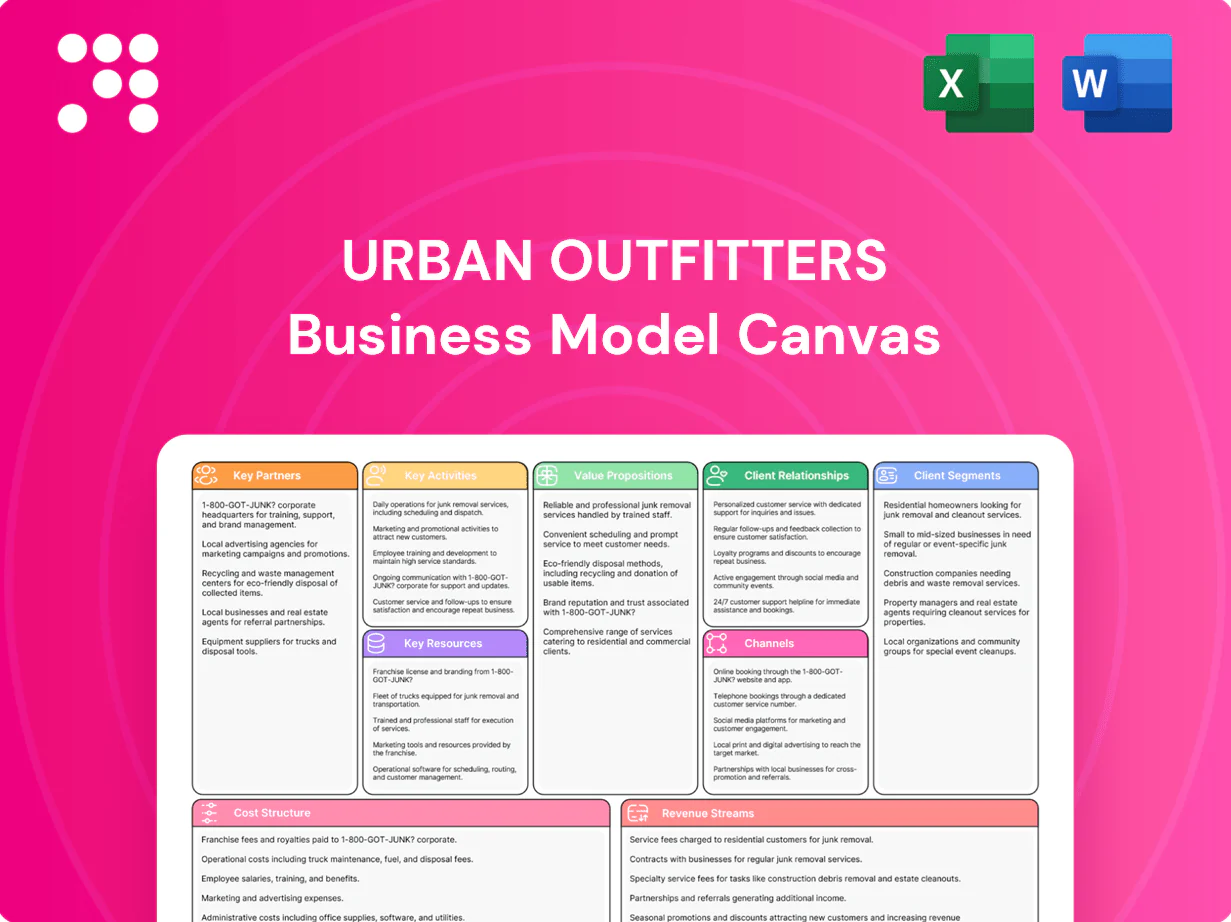
Urban Outfitters Business Model Canvas

Trend-Driven Fashion Retail Business Model Canvas for Youth-Focused Omni-Channel Growth
Discover Urban Outfitters' Business Model Canvas: a snapshot of its trend-driven value proposition, omni-channel retailing, curated private labels, and data-led merchandising that attracts younger demographics. Purchase the full Canvas to access detailed, editable Word/Excel sections for strategic benchmarking and investor-ready analysis.
Partnerships

Global suppliers and manufacturers
Strategic relationships with fabric mills, cut-and-sew factories and home‑goods producers drive speed to market and cost control, supporting Urban Outfitters’ product flow behind FY2024 net sales of about $4.5 billion. Multi‑sourcing across Asia and the Americas mitigates disruption risk and underpins frequent seasonal drops. Compliance partners enforce quality, labor and safety standards. Long‑term vendors enable exclusives and flexible minimum order quantities to match fast cycles.
Logistics, 3PL, and last-mile carriers
Distribution partners support domestic and international fulfillment for Urban Outfitters' retail and e-commerce network of over 600 stores worldwide, ensuring omnichannel inventory flow. Last-mile carriers enable fast 2-day/next-day shipping, buy-online-pickup-in-store, and streamlined returns. Freight and port partners reduce lead times and landed costs through consolidated ocean/air freight routing. Reverse logistics manage Nuuly rental returns and resale flows, closing lifecycle loops.

Designers, brands, and exclusive collaborators
Limited-edition capsules and exclusive lines create scarcity-driven urgency, supporting conversion spikes and higher ASPs; Urban Outfitters reported roughly $4.6 billion in net sales in FY2023, underscoring scale for such drops.
Partnerships with emerging designers deepen cultural relevance and campus-to-city influence, while vendor-managed design inputs shorten lead times and accelerate trend translation into sellable assortments.
Co-branded assortments expand reach into adjacent audiences and channels without diluting core brands when distribution and storytelling remain tightly controlled.

Technology, data, and payments providers
Technology, data, and payments partners power Urban Outfitters’ omnichannel play: e-commerce platforms, personalization engines and CDPs enable unified customer journeys, while payment partners provide frictionless checkout, fraud controls and BNPL options; store tech supports mobile POS, clienteling and inventory visibility, and analytics tools drive merchandising and pricing. 2024 studies show personalization can raise conversion rates by about 15%.
- e-commerce + CDP: unified customer profiles
- payments: fraud controls, BNPL, faster checkout
- store tech: mobile POS, clienteling, inventory visibility
- analytics: merchandising and dynamic pricing
Sustainability and circular-economy partners
Nuuly (launched 2019) leverages third-party cleaning, repair, and refurbishment partners to extend garment life and reduce churn, while textile-recycling and responsible-packaging vendors lower downstream environmental impact. Compliance and traceability groups provide certifications and audit support to meet evolving regulatory and consumer expectations. These partnerships strengthen brand equity among increasingly conscious shoppers.
- Nuuly launch: 2019
- Focus: cleaning, repair, refurbishment, recycling, responsible packaging
- Outcome: enhanced traceability, certifications, conscious-consumer appeal
Supplier alliances fuel $4.5B sales, 600+ stores, 2-day fulfillment, ≈15% lift
Supplier and vendor alliances drive speed-to-market and cost control, supporting ~ $4.5B net sales in FY2024. Distribution and freight partners serve 600+ stores and enable 2-day/next-day omnichannel fulfillment. Tech and payments partners power personalization (≈15% conversion lift) and BNPL. Nuuly partners (launched 2019) handle cleaning, refurbishment and recycling to boost sustainability.
| Metric | Value |
|---|---|
| FY2024 net sales | $4.5B |
| Stores | 600+ |
| Personalization lift | ≈15% |
| Nuuly launch | 2019 |
What is included in the product
 Detailed Word Document
A concise, pre-written Business Model Canvas for Urban Outfitters detailing customer segments, channels, value propositions and the nine BMC blocks with real-world operations, competitive advantages and linked SWOT insights—designed for presentations, investor discussions and strategic decision-making.

 Customizable Excel Spreadsheet
High-level view of Urban Outfitters' business model with editable cells, quickly relieving the pain of fragmented strategy documents by condensing omnichannel retail, brand portfolio, and customer segments into a single shareable snapshot for fast team alignment and decision-making.
Activities

Trend scouting and product design
In-house trend teams translate cultural signals into apparel, accessories and home assortments, producing seasonal capsules and targeting roughly 8–12 calendar-aligned drops per season. Rapid sampling and accelerated fit loops shorten cycle times to under eight weeks, enabling timely launches. Private-label development—approximately two-thirds of assortments—balances higher gross margins with distinctive exclusivity for Urban Outfitters.
Merchandising and inventory optimization
Assortment curation varies by banner, store cluster and channel, leveraging six banners as of 2024 (Urban Outfitters, Anthropologie, Free People, BHLDN, Terrain, Nuuly). Demand forecasting and allocation drive higher sell-through and lower markdowns through dynamic replenishment. Price and promo management are tied to inventory health to protect margins. Visual merchandising boosts conversion rates and basket size at store level.

Omnichannel retail operations
Store operations drive in-person discovery, fulfillment, and returns while supporting omnichannel inventory; Urban Outfitters reported roughly $4.6 billion in net sales in fiscal 2024. E-commerce delivers content, PDPs, search, and checkout optimization. BOPIS, ship-from-store, and same-day partners lift service levels and conversion. Catalogs and email cadence reinforce seasonal narratives and promotions.

Marketing, community, and brand building
Content, social, and influencer campaigns target style-centric audiences to drive discovery and conversion; Urban Outfitters, Inc. (NASDAQ: URBN) leverages creator partnerships to amplify seasonal drops across its brands. Events, workshops, and pop-ups increase foot traffic and brand affinity at the roughly 700 global retail locations in 2024. CRM programs deliver personalized messages and offers while PR and collaborations sustain buzz and product differentiation.
- Content & social: creator partnerships
- Events & pop-ups: drive traffic
- CRM: personalized offers
- PR & collabs: brand differentiation
Nuuly rental and resale operations
Subscription logistics execute pick, pack, clean, repair and re-ship workflows while assortment curation balances novelty, utility and durability to maximize utilization; data feeds drive reorder, liquidation and resale timing and customer care handles swaps, damage claims and extensions—Urban Outfitters, Inc. reported FY2024 net sales of about $4.5 billion, with Nuuly a strategic rental/resale channel.
- Logistics: pick/pack/clean/repair/re-ship
- Assortment: novelty + utility + durability
- Data: reorder, liquidation, resale signals
- Care: swaps, damages, extensions
Rapid private-label drops (≈66%) and omnichannel fulfill drive $4.6B sales
Urban Outfitters runs rapid private-label product cycles (≈66% of assortments) with 8–12 seasonal drops, sub-8-week sampling, and omnichannel fulfillment. FY2024 net sales ≈ $4.6B across ~700 stores; BOPIS, ship‑from‑store and same‑day raise conversion. Nuuly supports rental/resale logistics; CRM, creator marketing and events drive discovery and repeat purchase.
| Metric | 2024 |
|---|---|
| Net sales | $4.6B |
| Stores | ~700 |
| Private-label | ≈66% |
Preview Before You Purchase
Business Model Canvas
The document you're previewing is the actual Urban Outfitters Business Model Canvas, not a mockup—it's a live snapshot of the file you'll receive after purchase. On completion, you'll download this identical, fully editable document in Word and Excel, formatted and populated exactly as shown, ready for presentation or customization.

Trend-Driven Fashion Retail Business Model Canvas for Youth-Focused Omni-Channel Growth
Discover Urban Outfitters' Business Model Canvas: a snapshot of its trend-driven value proposition, omni-channel retailing, curated private labels, and data-led merchandising that attracts younger demographics. Purchase the full Canvas to access detailed, editable Word/Excel sections for strategic benchmarking and investor-ready analysis.
Partnerships
Global suppliers and manufacturers
Strategic relationships with fabric mills, cut-and-sew factories and home‑goods producers drive speed to market and cost control, supporting Urban Outfitters’ product flow behind FY2024 net sales of about $4.5 billion. Multi‑sourcing across Asia and the Americas mitigates disruption risk and underpins frequent seasonal drops. Compliance partners enforce quality, labor and safety standards. Long‑term vendors enable exclusives and flexible minimum order quantities to match fast cycles.
Logistics, 3PL, and last-mile carriers
Distribution partners support domestic and international fulfillment for Urban Outfitters' retail and e-commerce network of over 600 stores worldwide, ensuring omnichannel inventory flow. Last-mile carriers enable fast 2-day/next-day shipping, buy-online-pickup-in-store, and streamlined returns. Freight and port partners reduce lead times and landed costs through consolidated ocean/air freight routing. Reverse logistics manage Nuuly rental returns and resale flows, closing lifecycle loops.
Designers, brands, and exclusive collaborators
Limited-edition capsules and exclusive lines create scarcity-driven urgency, supporting conversion spikes and higher ASPs; Urban Outfitters reported roughly $4.6 billion in net sales in FY2023, underscoring scale for such drops.
Partnerships with emerging designers deepen cultural relevance and campus-to-city influence, while vendor-managed design inputs shorten lead times and accelerate trend translation into sellable assortments.
Co-branded assortments expand reach into adjacent audiences and channels without diluting core brands when distribution and storytelling remain tightly controlled.
Technology, data, and payments providers
Technology, data, and payments partners power Urban Outfitters’ omnichannel play: e-commerce platforms, personalization engines and CDPs enable unified customer journeys, while payment partners provide frictionless checkout, fraud controls and BNPL options; store tech supports mobile POS, clienteling and inventory visibility, and analytics tools drive merchandising and pricing. 2024 studies show personalization can raise conversion rates by about 15%.
- e-commerce + CDP: unified customer profiles
- payments: fraud controls, BNPL, faster checkout
- store tech: mobile POS, clienteling, inventory visibility
- analytics: merchandising and dynamic pricing
Sustainability and circular-economy partners
Nuuly (launched 2019) leverages third-party cleaning, repair, and refurbishment partners to extend garment life and reduce churn, while textile-recycling and responsible-packaging vendors lower downstream environmental impact. Compliance and traceability groups provide certifications and audit support to meet evolving regulatory and consumer expectations. These partnerships strengthen brand equity among increasingly conscious shoppers.
- Nuuly launch: 2019
- Focus: cleaning, repair, refurbishment, recycling, responsible packaging
- Outcome: enhanced traceability, certifications, conscious-consumer appeal
Supplier alliances fuel $4.5B sales, 600+ stores, 2-day fulfillment, ≈15% lift
Supplier and vendor alliances drive speed-to-market and cost control, supporting ~ $4.5B net sales in FY2024. Distribution and freight partners serve 600+ stores and enable 2-day/next-day omnichannel fulfillment. Tech and payments partners power personalization (≈15% conversion lift) and BNPL. Nuuly partners (launched 2019) handle cleaning, refurbishment and recycling to boost sustainability.
| Metric | Value |
|---|---|
| FY2024 net sales | $4.5B |
| Stores | 600+ |
| Personalization lift | ≈15% |
| Nuuly launch | 2019 |
What is included in the product
Detailed Word Document
A concise, pre-written Business Model Canvas for Urban Outfitters detailing customer segments, channels, value propositions and the nine BMC blocks with real-world operations, competitive advantages and linked SWOT insights—designed for presentations, investor discussions and strategic decision-making.
Customizable Excel Spreadsheet
High-level view of Urban Outfitters' business model with editable cells, quickly relieving the pain of fragmented strategy documents by condensing omnichannel retail, brand portfolio, and customer segments into a single shareable snapshot for fast team alignment and decision-making.
Activities
Trend scouting and product design
In-house trend teams translate cultural signals into apparel, accessories and home assortments, producing seasonal capsules and targeting roughly 8–12 calendar-aligned drops per season. Rapid sampling and accelerated fit loops shorten cycle times to under eight weeks, enabling timely launches. Private-label development—approximately two-thirds of assortments—balances higher gross margins with distinctive exclusivity for Urban Outfitters.
Merchandising and inventory optimization
Assortment curation varies by banner, store cluster and channel, leveraging six banners as of 2024 (Urban Outfitters, Anthropologie, Free People, BHLDN, Terrain, Nuuly). Demand forecasting and allocation drive higher sell-through and lower markdowns through dynamic replenishment. Price and promo management are tied to inventory health to protect margins. Visual merchandising boosts conversion rates and basket size at store level.
Omnichannel retail operations
Store operations drive in-person discovery, fulfillment, and returns while supporting omnichannel inventory; Urban Outfitters reported roughly $4.6 billion in net sales in fiscal 2024. E-commerce delivers content, PDPs, search, and checkout optimization. BOPIS, ship-from-store, and same-day partners lift service levels and conversion. Catalogs and email cadence reinforce seasonal narratives and promotions.
Marketing, community, and brand building
Content, social, and influencer campaigns target style-centric audiences to drive discovery and conversion; Urban Outfitters, Inc. (NASDAQ: URBN) leverages creator partnerships to amplify seasonal drops across its brands. Events, workshops, and pop-ups increase foot traffic and brand affinity at the roughly 700 global retail locations in 2024. CRM programs deliver personalized messages and offers while PR and collaborations sustain buzz and product differentiation.
- Content & social: creator partnerships
- Events & pop-ups: drive traffic
- CRM: personalized offers
- PR & collabs: brand differentiation
Nuuly rental and resale operations
Subscription logistics execute pick, pack, clean, repair and re-ship workflows while assortment curation balances novelty, utility and durability to maximize utilization; data feeds drive reorder, liquidation and resale timing and customer care handles swaps, damage claims and extensions—Urban Outfitters, Inc. reported FY2024 net sales of about $4.5 billion, with Nuuly a strategic rental/resale channel.
- Logistics: pick/pack/clean/repair/re-ship
- Assortment: novelty + utility + durability
- Data: reorder, liquidation, resale signals
- Care: swaps, damages, extensions
Rapid private-label drops (≈66%) and omnichannel fulfill drive $4.6B sales
Urban Outfitters runs rapid private-label product cycles (≈66% of assortments) with 8–12 seasonal drops, sub-8-week sampling, and omnichannel fulfillment. FY2024 net sales ≈ $4.6B across ~700 stores; BOPIS, ship‑from‑store and same‑day raise conversion. Nuuly supports rental/resale logistics; CRM, creator marketing and events drive discovery and repeat purchase.
| Metric | 2024 |
|---|---|
| Net sales | $4.6B |
| Stores | ~700 |
| Private-label | ≈66% |
Preview Before You Purchase
Business Model Canvas
The document you're previewing is the actual Urban Outfitters Business Model Canvas, not a mockup—it's a live snapshot of the file you'll receive after purchase. On completion, you'll download this identical, fully editable document in Word and Excel, formatted and populated exactly as shown, ready for presentation or customization.
Original: $10.00
-65%$10.00
$3.50Description
Trend-Driven Fashion Retail Business Model Canvas for Youth-Focused Omni-Channel Growth
Discover Urban Outfitters' Business Model Canvas: a snapshot of its trend-driven value proposition, omni-channel retailing, curated private labels, and data-led merchandising that attracts younger demographics. Purchase the full Canvas to access detailed, editable Word/Excel sections for strategic benchmarking and investor-ready analysis.
Partnerships
Global suppliers and manufacturers
Strategic relationships with fabric mills, cut-and-sew factories and home‑goods producers drive speed to market and cost control, supporting Urban Outfitters’ product flow behind FY2024 net sales of about $4.5 billion. Multi‑sourcing across Asia and the Americas mitigates disruption risk and underpins frequent seasonal drops. Compliance partners enforce quality, labor and safety standards. Long‑term vendors enable exclusives and flexible minimum order quantities to match fast cycles.
Logistics, 3PL, and last-mile carriers
Distribution partners support domestic and international fulfillment for Urban Outfitters' retail and e-commerce network of over 600 stores worldwide, ensuring omnichannel inventory flow. Last-mile carriers enable fast 2-day/next-day shipping, buy-online-pickup-in-store, and streamlined returns. Freight and port partners reduce lead times and landed costs through consolidated ocean/air freight routing. Reverse logistics manage Nuuly rental returns and resale flows, closing lifecycle loops.
Designers, brands, and exclusive collaborators
Limited-edition capsules and exclusive lines create scarcity-driven urgency, supporting conversion spikes and higher ASPs; Urban Outfitters reported roughly $4.6 billion in net sales in FY2023, underscoring scale for such drops.
Partnerships with emerging designers deepen cultural relevance and campus-to-city influence, while vendor-managed design inputs shorten lead times and accelerate trend translation into sellable assortments.
Co-branded assortments expand reach into adjacent audiences and channels without diluting core brands when distribution and storytelling remain tightly controlled.
Technology, data, and payments providers
Technology, data, and payments partners power Urban Outfitters’ omnichannel play: e-commerce platforms, personalization engines and CDPs enable unified customer journeys, while payment partners provide frictionless checkout, fraud controls and BNPL options; store tech supports mobile POS, clienteling and inventory visibility, and analytics tools drive merchandising and pricing. 2024 studies show personalization can raise conversion rates by about 15%.
- e-commerce + CDP: unified customer profiles
- payments: fraud controls, BNPL, faster checkout
- store tech: mobile POS, clienteling, inventory visibility
- analytics: merchandising and dynamic pricing
Sustainability and circular-economy partners
Nuuly (launched 2019) leverages third-party cleaning, repair, and refurbishment partners to extend garment life and reduce churn, while textile-recycling and responsible-packaging vendors lower downstream environmental impact. Compliance and traceability groups provide certifications and audit support to meet evolving regulatory and consumer expectations. These partnerships strengthen brand equity among increasingly conscious shoppers.
- Nuuly launch: 2019
- Focus: cleaning, repair, refurbishment, recycling, responsible packaging
- Outcome: enhanced traceability, certifications, conscious-consumer appeal
Supplier alliances fuel $4.5B sales, 600+ stores, 2-day fulfillment, ≈15% lift
Supplier and vendor alliances drive speed-to-market and cost control, supporting ~ $4.5B net sales in FY2024. Distribution and freight partners serve 600+ stores and enable 2-day/next-day omnichannel fulfillment. Tech and payments partners power personalization (≈15% conversion lift) and BNPL. Nuuly partners (launched 2019) handle cleaning, refurbishment and recycling to boost sustainability.
| Metric | Value |
|---|---|
| FY2024 net sales | $4.5B |
| Stores | 600+ |
| Personalization lift | ≈15% |
| Nuuly launch | 2019 |
What is included in the product
Detailed Word Document
A concise, pre-written Business Model Canvas for Urban Outfitters detailing customer segments, channels, value propositions and the nine BMC blocks with real-world operations, competitive advantages and linked SWOT insights—designed for presentations, investor discussions and strategic decision-making.
Customizable Excel Spreadsheet
High-level view of Urban Outfitters' business model with editable cells, quickly relieving the pain of fragmented strategy documents by condensing omnichannel retail, brand portfolio, and customer segments into a single shareable snapshot for fast team alignment and decision-making.
Activities
Trend scouting and product design
In-house trend teams translate cultural signals into apparel, accessories and home assortments, producing seasonal capsules and targeting roughly 8–12 calendar-aligned drops per season. Rapid sampling and accelerated fit loops shorten cycle times to under eight weeks, enabling timely launches. Private-label development—approximately two-thirds of assortments—balances higher gross margins with distinctive exclusivity for Urban Outfitters.
Merchandising and inventory optimization
Assortment curation varies by banner, store cluster and channel, leveraging six banners as of 2024 (Urban Outfitters, Anthropologie, Free People, BHLDN, Terrain, Nuuly). Demand forecasting and allocation drive higher sell-through and lower markdowns through dynamic replenishment. Price and promo management are tied to inventory health to protect margins. Visual merchandising boosts conversion rates and basket size at store level.
Omnichannel retail operations
Store operations drive in-person discovery, fulfillment, and returns while supporting omnichannel inventory; Urban Outfitters reported roughly $4.6 billion in net sales in fiscal 2024. E-commerce delivers content, PDPs, search, and checkout optimization. BOPIS, ship-from-store, and same-day partners lift service levels and conversion. Catalogs and email cadence reinforce seasonal narratives and promotions.
Marketing, community, and brand building
Content, social, and influencer campaigns target style-centric audiences to drive discovery and conversion; Urban Outfitters, Inc. (NASDAQ: URBN) leverages creator partnerships to amplify seasonal drops across its brands. Events, workshops, and pop-ups increase foot traffic and brand affinity at the roughly 700 global retail locations in 2024. CRM programs deliver personalized messages and offers while PR and collaborations sustain buzz and product differentiation.
- Content & social: creator partnerships
- Events & pop-ups: drive traffic
- CRM: personalized offers
- PR & collabs: brand differentiation
Nuuly rental and resale operations
Subscription logistics execute pick, pack, clean, repair and re-ship workflows while assortment curation balances novelty, utility and durability to maximize utilization; data feeds drive reorder, liquidation and resale timing and customer care handles swaps, damage claims and extensions—Urban Outfitters, Inc. reported FY2024 net sales of about $4.5 billion, with Nuuly a strategic rental/resale channel.
- Logistics: pick/pack/clean/repair/re-ship
- Assortment: novelty + utility + durability
- Data: reorder, liquidation, resale signals
- Care: swaps, damages, extensions
Rapid private-label drops (≈66%) and omnichannel fulfill drive $4.6B sales
Urban Outfitters runs rapid private-label product cycles (≈66% of assortments) with 8–12 seasonal drops, sub-8-week sampling, and omnichannel fulfillment. FY2024 net sales ≈ $4.6B across ~700 stores; BOPIS, ship‑from‑store and same‑day raise conversion. Nuuly supports rental/resale logistics; CRM, creator marketing and events drive discovery and repeat purchase.
| Metric | 2024 |
|---|---|
| Net sales | $4.6B |
| Stores | ~700 |
| Private-label | ≈66% |
Preview Before You Purchase
Business Model Canvas
The document you're previewing is the actual Urban Outfitters Business Model Canvas, not a mockup—it's a live snapshot of the file you'll receive after purchase. On completion, you'll download this identical, fully editable document in Word and Excel, formatted and populated exactly as shown, ready for presentation or customization.











