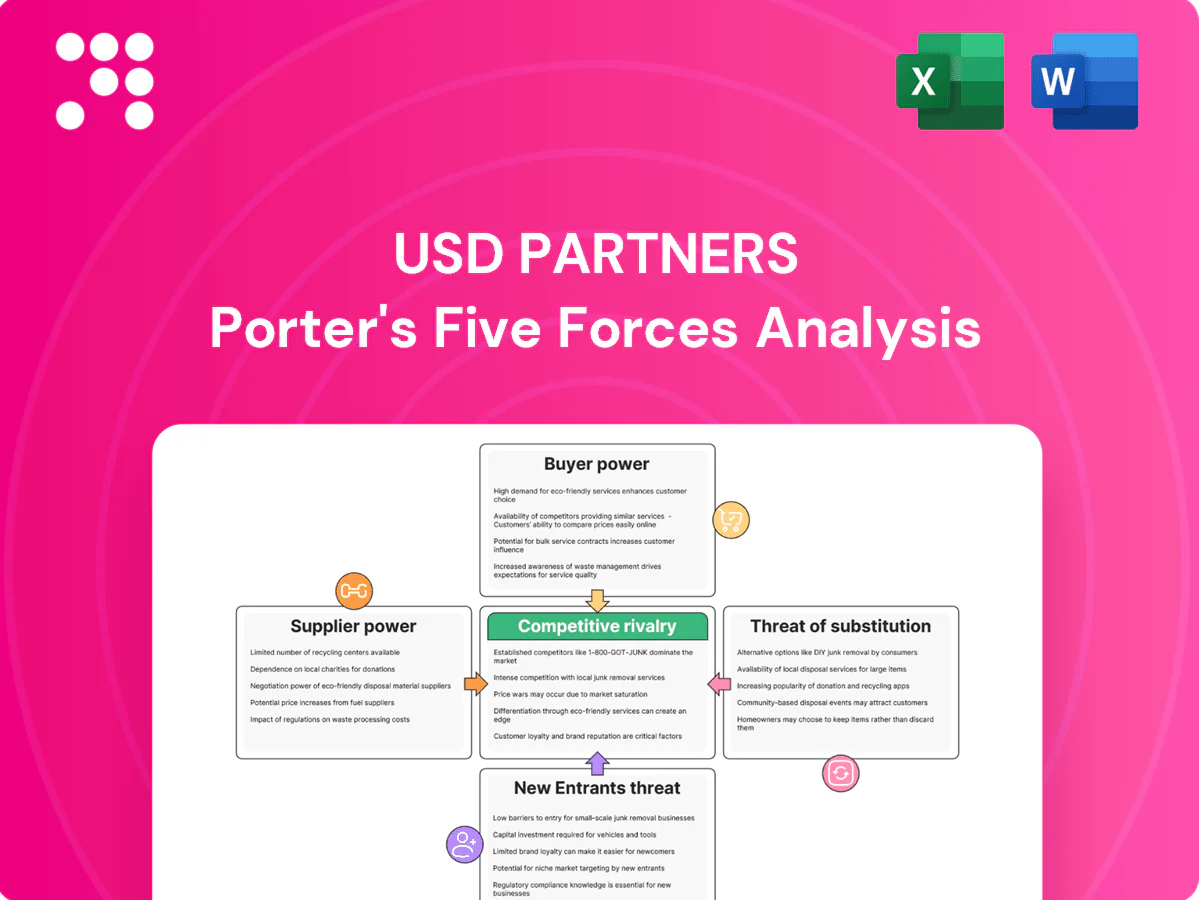
USD Partners Porter's Five Forces Analysis

Elevate Your Analysis with the Complete Porter's Five Forces Analysis
USD Partners faces moderate supplier power, regional competition, and evolving regulatory pressures that shape its margins and growth runway. This snapshot highlights key dynamics but leaves out force-level ratings and scenario analysis. Unlock the full Porter’s Five Forces Analysis for detailed ratings, charts, and actionable strategy recommendations to inform investment or planning decisions.
Suppliers Bargaining Power

Railroad access gatekeepers
Class I railroads, which move over 70% of U.S. rail freight, control mainline access, train slots and interchange terms, sharply limiting terminal optionality for USD Partners. Take‑or‑pay and service‑level contracts commonly embed escalation and fuel surcharges tied to diesel prices (U.S. average ~$3.90/gal in 2024, EIA). Periodic congestion or embargoes can reprioritize traffic away from energy units, concentrating bargaining power with rail network owners.
Specialized railcar and locomotive lessors
Crude and biofuel service requires DOT-spec tank cars and compliant locomotives sourced from a concentrated group of specialized lessors, giving suppliers notable leverage. Tight market cycles have pushed lease rates higher and availability lower, squeezing margins. Long lead times (typically 6–18 months) and strict maintenance/retrofit standards limit switching. Lessors commonly insist on longer tenors (often 5–10 years) and tighter covenants, increasing USD Partners’ fixed costs and contractual rigidity.

Land, right-of-way, and terminal services
Prime sites adjacent to producers and refiners are scarce and heavily regulated, giving landowners, port authorities, and utility providers leverage to command premium rents and connection fees. Easements and rights-of-way are costly and time-consuming to replace, increasing dependency on incumbent holders and slowing project timelines. Utilities retain regulatory ability to pass through rate increases, pressuring operating margins for terminal owners.

Construction, EPC, and maintenance vendors
Specialized track, loading rack, and safety-system work limits qualified EPC and maintenance vendors, increasing supplier bargaining power; 2024 industry reports cite multi-month backlogs that inflate costs and extend schedules, shifting execution and price risk to the operator. OEM parts and certification requirements further restrict substitution, enabling vendors to push milestone-heavy payment terms and retain leverage.
- Limited qualified vendors
- 2024: multi-month backlogs
- OEM parts/certs restrict substitution
- Milestone-heavy payment leverage
Labor and safety compliance inputs
Skilled rail operations labor with the required safety credentials is concentrated and tighter in certain basins, pushing availability constraints in 2024; training, certifications and typical shift premiums (commonly 10%–20%) raise structural labor costs. Union presence limits scheduling flexibility and can increase wage baselines. Ongoing compliance consulting and inspection contracts create recurring supplier leverage.
- Labor scarcity in key basins (2024)
- Shift premiums 10%–20%
- Recurring compliance/inspection spend
Suppliers' control, diesel $3.90/gal, scarce equipment squeeze margins
Suppliers (Class I railroads, lessors, EPCs, utilities, skilled labor) exert high bargaining power via control of mainlines, scarce tank cars/locomotives, regulated sites and certified vendors; diesel averaged ~$3.90/gal in 2024 and lease lead times 6–18 months, tightening costs and flexibility. Backlogs and shift premiums (10%–20%) further squeeze margins.
| Metric | 2024 |
|---|---|
| Class I control | >70% freight |
| Diesel price | $3.90/gal (EIA) |
| Lease lead time | 6–18 months |
| Shift premiums | 10%–20% |
| Vendor backlogs | Multi-months |
What is included in the product
 Detailed Word Document
Concise Porter's Five Forces analysis tailored to USD Partners that evaluates competitive rivalry, buyer and supplier leverage, threat of new entrants and substitutes, identifies disruptive risks and entry barriers, and provides strategic insights ready for inclusion in Word reports and investor materials.

 Customizable Excel Spreadsheet
USD Partners Porter's Five Forces one-sheet condenses competitive pressures into a clear, customizable radar view for fast, board-ready decisions; swap in your data, duplicate scenarios and integrate into reports—no complex code required.
Customers Bargaining Power

Concentrated shipper base
Producers, refiners and global trading houses control significant volumes and negotiate terminal fees and access terms, giving them strong pricing leverage over USD Partners. A small number of anchor shippers account for the majority of throughput, turning volume commitments into key bargaining chips at renewal. High customer concentration raises churn and revenue volatility risk, especially if anchors shift volumes or integrate vertically.
Alternative routing options
Shippers can switch among rail, pipeline, barge and truck, keeping USD Partners under pricing pressure. U.S. crude production averaged about 12.2 million bpd in 2024 (EIA) while rail moves under 5% of crude flows, so routing optionality gives buyers leverage. Destination flexibility and seasonal refinery turnarounds abruptly shift volumes and regional differentials, enhancing customer bargaining power.

Contract structures and terms
Long-term take-or-pay contracts blunt volume volatility but force aggressive front-end pricing negotiations, with typical tenors in 2024 ranging 3–10 years. Buyers increasingly demand service credits, minimum throughput levels, and inflation caps to limit exposure. Renewal windows are peak leverage points for customers. Early termination and re-rating clauses can materially compress midstream margins.

Quality, speed, and reliability demands
Buyers tie economics to on-time performance and unit-train cycle times, as any dwell or demurrage quickly erodes netbacks and forces price concessions; USD Partners faces pressure to avoid delays that prompt discounts. Customers routinely benchmark terminal KPIs, so superior SLAs have become table stakes rather than true differentiators.
- On-time performance drives netbacks
- Dwell/demurrage → immediate discounting
- Terminal KPIs enable buyer benchmarking
Data transparency and digital interfaces
Buyers now expect real-time tracking, inventory visibility, and EDI integration; by 2024 industry surveys show the majority of shippers prioritize these capabilities, and lack of data parity routinely triggers rate concessions of several percentage points for carriers like USD Partners.
- Real-time tracking
- Inventory visibility
- EDI integration
- Advanced analytics validate claims
- Information symmetry strengthens negotiating positions
Buyers leverage shippers: routing optionality, long take-or-pay deals pressure pricing
Customers exert strong leverage: producers/refiners/traders control majority throughput and can negotiate fees, while shippers' routing optionality (U.S. crude ~12.2 mn bpd in 2024; rail <5% of flows) keeps pricing pressured. Long-term 3–10 year take-or-pay contracts reduce volatility but drive aggressive initial pricing and onerous SLAs. Real-time tracking, inventory visibility and EDI (majority preference in 2024 surveys) are now standard buyer demands.
| Metric | 2024 |
|---|---|
| U.S. crude production | 12.2 mn bpd (EIA) |
| Rail share | <5% of crude flows |
| Contract tenor | 3–10 years |
What You See Is What You Get
USD Partners Porter's Five Forces Analysis
This USD Partners Porter’s Five Forces Analysis is the exact, professionally written document you’re previewing—fully formatted and ready to use. What you see here is the same file you’ll receive instantly after purchase, with no placeholders or samples. It contains a complete assessment of industry rivalry, buyer/supplier power, threats of entry and substitutes, and strategic implications for USD Partners.

Elevate Your Analysis with the Complete Porter's Five Forces Analysis
USD Partners faces moderate supplier power, regional competition, and evolving regulatory pressures that shape its margins and growth runway. This snapshot highlights key dynamics but leaves out force-level ratings and scenario analysis. Unlock the full Porter’s Five Forces Analysis for detailed ratings, charts, and actionable strategy recommendations to inform investment or planning decisions.
Suppliers Bargaining Power
Railroad access gatekeepers
Class I railroads, which move over 70% of U.S. rail freight, control mainline access, train slots and interchange terms, sharply limiting terminal optionality for USD Partners. Take‑or‑pay and service‑level contracts commonly embed escalation and fuel surcharges tied to diesel prices (U.S. average ~$3.90/gal in 2024, EIA). Periodic congestion or embargoes can reprioritize traffic away from energy units, concentrating bargaining power with rail network owners.
Specialized railcar and locomotive lessors
Crude and biofuel service requires DOT-spec tank cars and compliant locomotives sourced from a concentrated group of specialized lessors, giving suppliers notable leverage. Tight market cycles have pushed lease rates higher and availability lower, squeezing margins. Long lead times (typically 6–18 months) and strict maintenance/retrofit standards limit switching. Lessors commonly insist on longer tenors (often 5–10 years) and tighter covenants, increasing USD Partners’ fixed costs and contractual rigidity.
Land, right-of-way, and terminal services
Prime sites adjacent to producers and refiners are scarce and heavily regulated, giving landowners, port authorities, and utility providers leverage to command premium rents and connection fees. Easements and rights-of-way are costly and time-consuming to replace, increasing dependency on incumbent holders and slowing project timelines. Utilities retain regulatory ability to pass through rate increases, pressuring operating margins for terminal owners.
Construction, EPC, and maintenance vendors
Specialized track, loading rack, and safety-system work limits qualified EPC and maintenance vendors, increasing supplier bargaining power; 2024 industry reports cite multi-month backlogs that inflate costs and extend schedules, shifting execution and price risk to the operator. OEM parts and certification requirements further restrict substitution, enabling vendors to push milestone-heavy payment terms and retain leverage.
- Limited qualified vendors
- 2024: multi-month backlogs
- OEM parts/certs restrict substitution
- Milestone-heavy payment leverage
Labor and safety compliance inputs
Skilled rail operations labor with the required safety credentials is concentrated and tighter in certain basins, pushing availability constraints in 2024; training, certifications and typical shift premiums (commonly 10%–20%) raise structural labor costs. Union presence limits scheduling flexibility and can increase wage baselines. Ongoing compliance consulting and inspection contracts create recurring supplier leverage.
- Labor scarcity in key basins (2024)
- Shift premiums 10%–20%
- Recurring compliance/inspection spend
Suppliers' control, diesel $3.90/gal, scarce equipment squeeze margins
Suppliers (Class I railroads, lessors, EPCs, utilities, skilled labor) exert high bargaining power via control of mainlines, scarce tank cars/locomotives, regulated sites and certified vendors; diesel averaged ~$3.90/gal in 2024 and lease lead times 6–18 months, tightening costs and flexibility. Backlogs and shift premiums (10%–20%) further squeeze margins.
| Metric | 2024 |
|---|---|
| Class I control | >70% freight |
| Diesel price | $3.90/gal (EIA) |
| Lease lead time | 6–18 months |
| Shift premiums | 10%–20% |
| Vendor backlogs | Multi-months |
What is included in the product
Detailed Word Document
Concise Porter's Five Forces analysis tailored to USD Partners that evaluates competitive rivalry, buyer and supplier leverage, threat of new entrants and substitutes, identifies disruptive risks and entry barriers, and provides strategic insights ready for inclusion in Word reports and investor materials.
Customizable Excel Spreadsheet
USD Partners Porter's Five Forces one-sheet condenses competitive pressures into a clear, customizable radar view for fast, board-ready decisions; swap in your data, duplicate scenarios and integrate into reports—no complex code required.
Customers Bargaining Power
Concentrated shipper base
Producers, refiners and global trading houses control significant volumes and negotiate terminal fees and access terms, giving them strong pricing leverage over USD Partners. A small number of anchor shippers account for the majority of throughput, turning volume commitments into key bargaining chips at renewal. High customer concentration raises churn and revenue volatility risk, especially if anchors shift volumes or integrate vertically.
Alternative routing options
Shippers can switch among rail, pipeline, barge and truck, keeping USD Partners under pricing pressure. U.S. crude production averaged about 12.2 million bpd in 2024 (EIA) while rail moves under 5% of crude flows, so routing optionality gives buyers leverage. Destination flexibility and seasonal refinery turnarounds abruptly shift volumes and regional differentials, enhancing customer bargaining power.
Contract structures and terms
Long-term take-or-pay contracts blunt volume volatility but force aggressive front-end pricing negotiations, with typical tenors in 2024 ranging 3–10 years. Buyers increasingly demand service credits, minimum throughput levels, and inflation caps to limit exposure. Renewal windows are peak leverage points for customers. Early termination and re-rating clauses can materially compress midstream margins.
Quality, speed, and reliability demands
Buyers tie economics to on-time performance and unit-train cycle times, as any dwell or demurrage quickly erodes netbacks and forces price concessions; USD Partners faces pressure to avoid delays that prompt discounts. Customers routinely benchmark terminal KPIs, so superior SLAs have become table stakes rather than true differentiators.
- On-time performance drives netbacks
- Dwell/demurrage → immediate discounting
- Terminal KPIs enable buyer benchmarking
Data transparency and digital interfaces
Buyers now expect real-time tracking, inventory visibility, and EDI integration; by 2024 industry surveys show the majority of shippers prioritize these capabilities, and lack of data parity routinely triggers rate concessions of several percentage points for carriers like USD Partners.
- Real-time tracking
- Inventory visibility
- EDI integration
- Advanced analytics validate claims
- Information symmetry strengthens negotiating positions
Buyers leverage shippers: routing optionality, long take-or-pay deals pressure pricing
Customers exert strong leverage: producers/refiners/traders control majority throughput and can negotiate fees, while shippers' routing optionality (U.S. crude ~12.2 mn bpd in 2024; rail <5% of flows) keeps pricing pressured. Long-term 3–10 year take-or-pay contracts reduce volatility but drive aggressive initial pricing and onerous SLAs. Real-time tracking, inventory visibility and EDI (majority preference in 2024 surveys) are now standard buyer demands.
| Metric | 2024 |
|---|---|
| U.S. crude production | 12.2 mn bpd (EIA) |
| Rail share | <5% of crude flows |
| Contract tenor | 3–10 years |
What You See Is What You Get
USD Partners Porter's Five Forces Analysis
This USD Partners Porter’s Five Forces Analysis is the exact, professionally written document you’re previewing—fully formatted and ready to use. What you see here is the same file you’ll receive instantly after purchase, with no placeholders or samples. It contains a complete assessment of industry rivalry, buyer/supplier power, threats of entry and substitutes, and strategic implications for USD Partners.
Original: $10.00
-65%$10.00
$3.50Description
Elevate Your Analysis with the Complete Porter's Five Forces Analysis
USD Partners faces moderate supplier power, regional competition, and evolving regulatory pressures that shape its margins and growth runway. This snapshot highlights key dynamics but leaves out force-level ratings and scenario analysis. Unlock the full Porter’s Five Forces Analysis for detailed ratings, charts, and actionable strategy recommendations to inform investment or planning decisions.
Suppliers Bargaining Power
Railroad access gatekeepers
Class I railroads, which move over 70% of U.S. rail freight, control mainline access, train slots and interchange terms, sharply limiting terminal optionality for USD Partners. Take‑or‑pay and service‑level contracts commonly embed escalation and fuel surcharges tied to diesel prices (U.S. average ~$3.90/gal in 2024, EIA). Periodic congestion or embargoes can reprioritize traffic away from energy units, concentrating bargaining power with rail network owners.
Specialized railcar and locomotive lessors
Crude and biofuel service requires DOT-spec tank cars and compliant locomotives sourced from a concentrated group of specialized lessors, giving suppliers notable leverage. Tight market cycles have pushed lease rates higher and availability lower, squeezing margins. Long lead times (typically 6–18 months) and strict maintenance/retrofit standards limit switching. Lessors commonly insist on longer tenors (often 5–10 years) and tighter covenants, increasing USD Partners’ fixed costs and contractual rigidity.
Land, right-of-way, and terminal services
Prime sites adjacent to producers and refiners are scarce and heavily regulated, giving landowners, port authorities, and utility providers leverage to command premium rents and connection fees. Easements and rights-of-way are costly and time-consuming to replace, increasing dependency on incumbent holders and slowing project timelines. Utilities retain regulatory ability to pass through rate increases, pressuring operating margins for terminal owners.
Construction, EPC, and maintenance vendors
Specialized track, loading rack, and safety-system work limits qualified EPC and maintenance vendors, increasing supplier bargaining power; 2024 industry reports cite multi-month backlogs that inflate costs and extend schedules, shifting execution and price risk to the operator. OEM parts and certification requirements further restrict substitution, enabling vendors to push milestone-heavy payment terms and retain leverage.
- Limited qualified vendors
- 2024: multi-month backlogs
- OEM parts/certs restrict substitution
- Milestone-heavy payment leverage
Labor and safety compliance inputs
Skilled rail operations labor with the required safety credentials is concentrated and tighter in certain basins, pushing availability constraints in 2024; training, certifications and typical shift premiums (commonly 10%–20%) raise structural labor costs. Union presence limits scheduling flexibility and can increase wage baselines. Ongoing compliance consulting and inspection contracts create recurring supplier leverage.
- Labor scarcity in key basins (2024)
- Shift premiums 10%–20%
- Recurring compliance/inspection spend
Suppliers' control, diesel $3.90/gal, scarce equipment squeeze margins
Suppliers (Class I railroads, lessors, EPCs, utilities, skilled labor) exert high bargaining power via control of mainlines, scarce tank cars/locomotives, regulated sites and certified vendors; diesel averaged ~$3.90/gal in 2024 and lease lead times 6–18 months, tightening costs and flexibility. Backlogs and shift premiums (10%–20%) further squeeze margins.
| Metric | 2024 |
|---|---|
| Class I control | >70% freight |
| Diesel price | $3.90/gal (EIA) |
| Lease lead time | 6–18 months |
| Shift premiums | 10%–20% |
| Vendor backlogs | Multi-months |
What is included in the product
Detailed Word Document
Concise Porter's Five Forces analysis tailored to USD Partners that evaluates competitive rivalry, buyer and supplier leverage, threat of new entrants and substitutes, identifies disruptive risks and entry barriers, and provides strategic insights ready for inclusion in Word reports and investor materials.
Customizable Excel Spreadsheet
USD Partners Porter's Five Forces one-sheet condenses competitive pressures into a clear, customizable radar view for fast, board-ready decisions; swap in your data, duplicate scenarios and integrate into reports—no complex code required.
Customers Bargaining Power
Concentrated shipper base
Producers, refiners and global trading houses control significant volumes and negotiate terminal fees and access terms, giving them strong pricing leverage over USD Partners. A small number of anchor shippers account for the majority of throughput, turning volume commitments into key bargaining chips at renewal. High customer concentration raises churn and revenue volatility risk, especially if anchors shift volumes or integrate vertically.
Alternative routing options
Shippers can switch among rail, pipeline, barge and truck, keeping USD Partners under pricing pressure. U.S. crude production averaged about 12.2 million bpd in 2024 (EIA) while rail moves under 5% of crude flows, so routing optionality gives buyers leverage. Destination flexibility and seasonal refinery turnarounds abruptly shift volumes and regional differentials, enhancing customer bargaining power.
Contract structures and terms
Long-term take-or-pay contracts blunt volume volatility but force aggressive front-end pricing negotiations, with typical tenors in 2024 ranging 3–10 years. Buyers increasingly demand service credits, minimum throughput levels, and inflation caps to limit exposure. Renewal windows are peak leverage points for customers. Early termination and re-rating clauses can materially compress midstream margins.
Quality, speed, and reliability demands
Buyers tie economics to on-time performance and unit-train cycle times, as any dwell or demurrage quickly erodes netbacks and forces price concessions; USD Partners faces pressure to avoid delays that prompt discounts. Customers routinely benchmark terminal KPIs, so superior SLAs have become table stakes rather than true differentiators.
- On-time performance drives netbacks
- Dwell/demurrage → immediate discounting
- Terminal KPIs enable buyer benchmarking
Data transparency and digital interfaces
Buyers now expect real-time tracking, inventory visibility, and EDI integration; by 2024 industry surveys show the majority of shippers prioritize these capabilities, and lack of data parity routinely triggers rate concessions of several percentage points for carriers like USD Partners.
- Real-time tracking
- Inventory visibility
- EDI integration
- Advanced analytics validate claims
- Information symmetry strengthens negotiating positions
Buyers leverage shippers: routing optionality, long take-or-pay deals pressure pricing
Customers exert strong leverage: producers/refiners/traders control majority throughput and can negotiate fees, while shippers' routing optionality (U.S. crude ~12.2 mn bpd in 2024; rail <5% of flows) keeps pricing pressured. Long-term 3–10 year take-or-pay contracts reduce volatility but drive aggressive initial pricing and onerous SLAs. Real-time tracking, inventory visibility and EDI (majority preference in 2024 surveys) are now standard buyer demands.
| Metric | 2024 |
|---|---|
| U.S. crude production | 12.2 mn bpd (EIA) |
| Rail share | <5% of crude flows |
| Contract tenor | 3–10 years |
What You See Is What You Get
USD Partners Porter's Five Forces Analysis
This USD Partners Porter’s Five Forces Analysis is the exact, professionally written document you’re previewing—fully formatted and ready to use. What you see here is the same file you’ll receive instantly after purchase, with no placeholders or samples. It contains a complete assessment of industry rivalry, buyer/supplier power, threats of entry and substitutes, and strategic implications for USD Partners.











