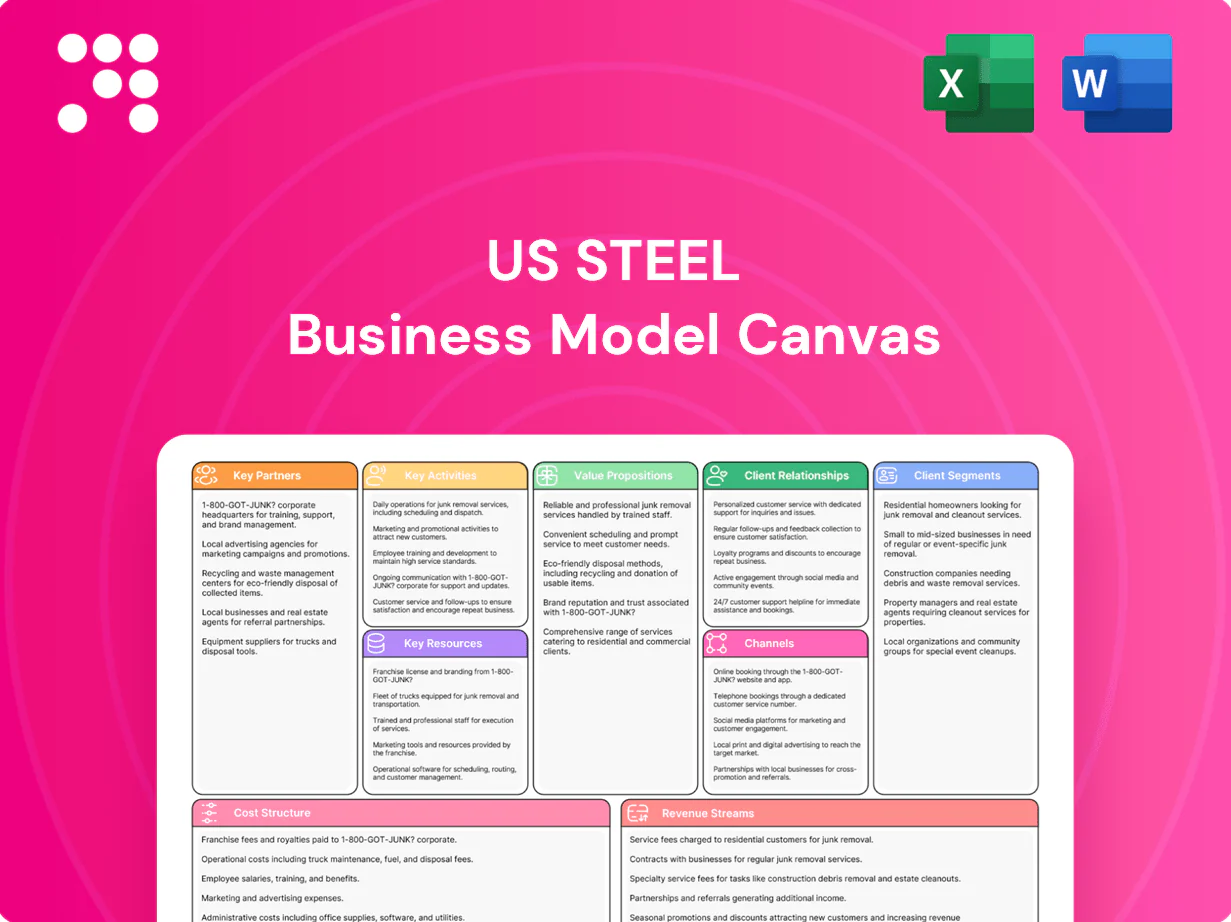
US Steel Business Model Canvas

Integrated Steelmaker Business Model Canvas: Revenue, Partners & Operational Levers
Explore US Steel's Business Model Canvas to see how its integrated assets, customer segments, and cost structure drive competitive advantage in steelmaking. This concise analysis highlights key revenue streams, partnerships, and operational levers—download the full Canvas for a detailed, editable roadmap ideal for investors, strategists, and consultants.
Partnerships

Iron ore & coke partners
Strategic sourcing and joint ventures secure consistent iron ore and metallurgical coal inputs, supporting US Steel’s ~9.5 million net tons of crude steel production in 2023. Long-term contracts stabilize volumes and pricing through cycles, often covering multi-year supplies. Technical partnerships align raw material specs with blast furnace requirements, reducing quality variance. Improved reliability minimizes production downtime and preserves margins.
Automotive OEM alliances
Program-level partnerships with Automotive OEMs co-develop grades, surface treatments and delivery schedules through multi-year sourcing agreements, often spanning 3–5 years, locking in advanced high-strength steel qualifications; joint testing and validation at OEM labs has cut time-to-approval for new models materially, while collaborative forecasting improves mill loading and logistics and supports automotive demand that represents roughly 15% of U.S. steel consumption.

Energy & tubular distributors
Energy and tubular distributors extend US Steel reach into major oil and gas basins, leveraging a US crude production backdrop of about 12.5 million bpd in 2024 and an average US rig count near 680 that year to drive OCTG and line pipe demand. Strategic inventory positioning across distributor yards supports drilling cycles and project timelines, reducing lead times for multi-month campaigns. Rigorous quality and compliance partnerships ensure API and ISO certifications for bid readiness, while co-marketing with distributors enhances competitiveness on major pipeline and well programs.

Logistics & port operators
Logistics and port partners—rail, barge, truck and terminal operators—secure reliable inbound ore and coke and outbound coil and pipe flows, with US Steel in 2024 reinforcing long‑term slots to limit peak‑season bottlenecks. Dedicated capacity and intermodal coordination reduce freight per ton and lower delivered costs, while proximity to Great Lakes and Gulf ports shortens lead times for regional customers.
- Rail: dedicated slots reduce congestion
- Barge/truck: flexible multimodal lanes
- Ports: regional proximity cuts lead times
- Intermodal: lowers freight per ton
Technology & R&D institutes
Universities and national labs support US Steel with metallurgical innovation and process optimization, informing 2024 low‑carbon pilot designs and digital twins. Joint R&Ds accelerate decarbonization pilots and plant digitalization while IP‑sharing frameworks protect proprietary steel grades. Grants and industry consortia de‑risk advanced manufacturing initiatives and scale demonstration projects.
- 2024 university/lab collaborations
- IP protection frameworks
- Grant‑backed pilots
- Consortia de‑risking
Sourcing/JVs secure inputs for ~9.5M nt steel; OEMs, oil ties & R&D drive low-carbon shift
Strategic sourcing and JVs secure iron ore/met coal for US Steel’s ~9.5M net tons crude steel (2023). OEM programs lock multi‑year specs supporting automotive demand (~15% US steel use). Energy/distributor ties leverage US crude ~12.5M bpd and ~680 rig count (2024) for OCTG/line pipe. Univ/lab R&D underpins 2024 low‑carbon pilots and digital twins.
| Partnership | Role | 2023/24 Metric |
|---|---|---|
| Sourcing/JV | Raw materials | 9.5M nt |
| OEMs | Co‑dev/ contracts | ~15% |
| Energy dist. | Market reach | 12.5M bpd/680 rigs |
What is included in the product
 Detailed Word Document
A comprehensive, pre-written Business Model Canvas for U.S. Steel detailing customer segments, channels, value propositions, key resources and activities across the 9 BMC blocks, reflecting real-world operations and strategic plans. Ideal for presentations, investor discussions and SWOT-linked competitive analysis to inform decisions.

 Customizable Excel Spreadsheet
High-level, editable Business Model Canvas for U.S. Steel that condenses complex operations, cost drivers, and customer segments into a one-page tool to streamline strategy, collaboration, and fast decision-making.
Activities

Integrated steelmaking
Integrated steelmaking at US Steel centers on large-scale operation of blast furnaces, basic oxygen furnaces and continuous casters, maintaining tight hot metal chemistry and temperature control to meet 2024 product specs. Processes target optimized yields, lower energy intensity and higher throughput through process automation and heat recovery. Rigorous safety programs and environmental compliance govern furnace and mill operations across the network.
Finishing & coating
Finishing and coating covers hot-rolled, cold-rolled, galvanized and organic-coated sheet production, with U.S. Steel processing about 5.2 million net tons of flat-rolled products in 2024. Surface quality and gauge control target tolerances for automotive and appliance specs to ensure paintability and formability. Slitting and blanking are performed to customer dimensions and tolerances, and packaging uses protective films, edge guards and skid securing to prevent transit damage.

Tubular manufacturing
Producing standard and premium welded tubulars for energy and industrial use under API 5CT specifications, US Steel performs heat treatment, threading, and coupling to API standards. Non-destructive testing—ultrasonic and magnetic particle inspection—is used to verify integrity per API requirements. Inventory management aligns deliveries with rig schedules tracked via Baker Hughes rig data and customer maintenance plans.

Mining & coke production
Upstream extraction of iron ore and on-site coke making supply furnace charge and enable burden control, supporting US Steel amid U.S. apparent steel consumption of about 82 million tonnes in 2024. Blending strategies optimize burden mix to reduce coke rates and improve yields, while contracting overburden and haul operations focuses on safety and cost per ton hauled. Emissions controls and waste management meet EPA standards and capital spending targets to limit air and water impacts.
- Iron ore & coke integration
- Blending to cut coke rate
- Contracted haul for safety
- EPA-driven emissions controls
Quality, R&D, and customer support
US Steel certifies grades and processes through rigorous lab testing and co-engineers new applications with customers, supported by field service teams that troubleshoot forming and welding; in 2024 the company emphasized digital quality controls and data analytics to reduce defect rates and speed time-to-market.
- Quality labs: centralized testing and digital records
- Co-engineering: customer partnerships for bespoke alloys
- Field service: on-site welding/forming support
- Analytics: continuous improvement via production data
Integrated steel ops target 5.2Mt flat in 2024; automation cuts coke rate
Integrated steelmaking, finishing/coating, welded tubulars and upstream ore/coke supply drive US Steel operations, targeting 5.2 Mt flat-rolled output in 2024 and aligning with ~82 Mt US apparent consumption. Emphasis on process automation, heat recovery, emissions controls and API-certified tubulars reduces coke rate and defects via digital quality analytics. Field service and co-engineering shorten time-to-market and support customer specs.
| Metric | 2024 |
|---|---|
| Flat-rolled output | 5.2 Mt |
| US apparent consumption | 82 Mt |
| CNS focus | Automation, heat recovery, emissions |
Delivered as Displayed
Business Model Canvas
The US Steel Business Model Canvas you see here is the actual deliverable, not a mockup, and reflects the exact structure and content you’ll receive after purchase. When you complete your order, you’ll get this same document in editable Word and Excel formats for immediate use. No placeholders or surprises—what’s visible in the preview is the real, full-quality file ready to present, edit, and apply.

Integrated Steelmaker Business Model Canvas: Revenue, Partners & Operational Levers
Explore US Steel's Business Model Canvas to see how its integrated assets, customer segments, and cost structure drive competitive advantage in steelmaking. This concise analysis highlights key revenue streams, partnerships, and operational levers—download the full Canvas for a detailed, editable roadmap ideal for investors, strategists, and consultants.
Partnerships
Iron ore & coke partners
Strategic sourcing and joint ventures secure consistent iron ore and metallurgical coal inputs, supporting US Steel’s ~9.5 million net tons of crude steel production in 2023. Long-term contracts stabilize volumes and pricing through cycles, often covering multi-year supplies. Technical partnerships align raw material specs with blast furnace requirements, reducing quality variance. Improved reliability minimizes production downtime and preserves margins.
Automotive OEM alliances
Program-level partnerships with Automotive OEMs co-develop grades, surface treatments and delivery schedules through multi-year sourcing agreements, often spanning 3–5 years, locking in advanced high-strength steel qualifications; joint testing and validation at OEM labs has cut time-to-approval for new models materially, while collaborative forecasting improves mill loading and logistics and supports automotive demand that represents roughly 15% of U.S. steel consumption.
Energy & tubular distributors
Energy and tubular distributors extend US Steel reach into major oil and gas basins, leveraging a US crude production backdrop of about 12.5 million bpd in 2024 and an average US rig count near 680 that year to drive OCTG and line pipe demand. Strategic inventory positioning across distributor yards supports drilling cycles and project timelines, reducing lead times for multi-month campaigns. Rigorous quality and compliance partnerships ensure API and ISO certifications for bid readiness, while co-marketing with distributors enhances competitiveness on major pipeline and well programs.
Logistics & port operators
Logistics and port partners—rail, barge, truck and terminal operators—secure reliable inbound ore and coke and outbound coil and pipe flows, with US Steel in 2024 reinforcing long‑term slots to limit peak‑season bottlenecks. Dedicated capacity and intermodal coordination reduce freight per ton and lower delivered costs, while proximity to Great Lakes and Gulf ports shortens lead times for regional customers.
- Rail: dedicated slots reduce congestion
- Barge/truck: flexible multimodal lanes
- Ports: regional proximity cuts lead times
- Intermodal: lowers freight per ton
Technology & R&D institutes
Universities and national labs support US Steel with metallurgical innovation and process optimization, informing 2024 low‑carbon pilot designs and digital twins. Joint R&Ds accelerate decarbonization pilots and plant digitalization while IP‑sharing frameworks protect proprietary steel grades. Grants and industry consortia de‑risk advanced manufacturing initiatives and scale demonstration projects.
- 2024 university/lab collaborations
- IP protection frameworks
- Grant‑backed pilots
- Consortia de‑risking
Sourcing/JVs secure inputs for ~9.5M nt steel; OEMs, oil ties & R&D drive low-carbon shift
Strategic sourcing and JVs secure iron ore/met coal for US Steel’s ~9.5M net tons crude steel (2023). OEM programs lock multi‑year specs supporting automotive demand (~15% US steel use). Energy/distributor ties leverage US crude ~12.5M bpd and ~680 rig count (2024) for OCTG/line pipe. Univ/lab R&D underpins 2024 low‑carbon pilots and digital twins.
| Partnership | Role | 2023/24 Metric |
|---|---|---|
| Sourcing/JV | Raw materials | 9.5M nt |
| OEMs | Co‑dev/ contracts | ~15% |
| Energy dist. | Market reach | 12.5M bpd/680 rigs |
What is included in the product
Detailed Word Document
A comprehensive, pre-written Business Model Canvas for U.S. Steel detailing customer segments, channels, value propositions, key resources and activities across the 9 BMC blocks, reflecting real-world operations and strategic plans. Ideal for presentations, investor discussions and SWOT-linked competitive analysis to inform decisions.
Customizable Excel Spreadsheet
High-level, editable Business Model Canvas for U.S. Steel that condenses complex operations, cost drivers, and customer segments into a one-page tool to streamline strategy, collaboration, and fast decision-making.
Activities
Integrated steelmaking
Integrated steelmaking at US Steel centers on large-scale operation of blast furnaces, basic oxygen furnaces and continuous casters, maintaining tight hot metal chemistry and temperature control to meet 2024 product specs. Processes target optimized yields, lower energy intensity and higher throughput through process automation and heat recovery. Rigorous safety programs and environmental compliance govern furnace and mill operations across the network.
Finishing & coating
Finishing and coating covers hot-rolled, cold-rolled, galvanized and organic-coated sheet production, with U.S. Steel processing about 5.2 million net tons of flat-rolled products in 2024. Surface quality and gauge control target tolerances for automotive and appliance specs to ensure paintability and formability. Slitting and blanking are performed to customer dimensions and tolerances, and packaging uses protective films, edge guards and skid securing to prevent transit damage.
Tubular manufacturing
Producing standard and premium welded tubulars for energy and industrial use under API 5CT specifications, US Steel performs heat treatment, threading, and coupling to API standards. Non-destructive testing—ultrasonic and magnetic particle inspection—is used to verify integrity per API requirements. Inventory management aligns deliveries with rig schedules tracked via Baker Hughes rig data and customer maintenance plans.
Mining & coke production
Upstream extraction of iron ore and on-site coke making supply furnace charge and enable burden control, supporting US Steel amid U.S. apparent steel consumption of about 82 million tonnes in 2024. Blending strategies optimize burden mix to reduce coke rates and improve yields, while contracting overburden and haul operations focuses on safety and cost per ton hauled. Emissions controls and waste management meet EPA standards and capital spending targets to limit air and water impacts.
- Iron ore & coke integration
- Blending to cut coke rate
- Contracted haul for safety
- EPA-driven emissions controls
Quality, R&D, and customer support
US Steel certifies grades and processes through rigorous lab testing and co-engineers new applications with customers, supported by field service teams that troubleshoot forming and welding; in 2024 the company emphasized digital quality controls and data analytics to reduce defect rates and speed time-to-market.
- Quality labs: centralized testing and digital records
- Co-engineering: customer partnerships for bespoke alloys
- Field service: on-site welding/forming support
- Analytics: continuous improvement via production data
Integrated steel ops target 5.2Mt flat in 2024; automation cuts coke rate
Integrated steelmaking, finishing/coating, welded tubulars and upstream ore/coke supply drive US Steel operations, targeting 5.2 Mt flat-rolled output in 2024 and aligning with ~82 Mt US apparent consumption. Emphasis on process automation, heat recovery, emissions controls and API-certified tubulars reduces coke rate and defects via digital quality analytics. Field service and co-engineering shorten time-to-market and support customer specs.
| Metric | 2024 |
|---|---|
| Flat-rolled output | 5.2 Mt |
| US apparent consumption | 82 Mt |
| CNS focus | Automation, heat recovery, emissions |
Delivered as Displayed
Business Model Canvas
The US Steel Business Model Canvas you see here is the actual deliverable, not a mockup, and reflects the exact structure and content you’ll receive after purchase. When you complete your order, you’ll get this same document in editable Word and Excel formats for immediate use. No placeholders or surprises—what’s visible in the preview is the real, full-quality file ready to present, edit, and apply.
Description
Integrated Steelmaker Business Model Canvas: Revenue, Partners & Operational Levers
Explore US Steel's Business Model Canvas to see how its integrated assets, customer segments, and cost structure drive competitive advantage in steelmaking. This concise analysis highlights key revenue streams, partnerships, and operational levers—download the full Canvas for a detailed, editable roadmap ideal for investors, strategists, and consultants.
Partnerships
Iron ore & coke partners
Strategic sourcing and joint ventures secure consistent iron ore and metallurgical coal inputs, supporting US Steel’s ~9.5 million net tons of crude steel production in 2023. Long-term contracts stabilize volumes and pricing through cycles, often covering multi-year supplies. Technical partnerships align raw material specs with blast furnace requirements, reducing quality variance. Improved reliability minimizes production downtime and preserves margins.
Automotive OEM alliances
Program-level partnerships with Automotive OEMs co-develop grades, surface treatments and delivery schedules through multi-year sourcing agreements, often spanning 3–5 years, locking in advanced high-strength steel qualifications; joint testing and validation at OEM labs has cut time-to-approval for new models materially, while collaborative forecasting improves mill loading and logistics and supports automotive demand that represents roughly 15% of U.S. steel consumption.
Energy & tubular distributors
Energy and tubular distributors extend US Steel reach into major oil and gas basins, leveraging a US crude production backdrop of about 12.5 million bpd in 2024 and an average US rig count near 680 that year to drive OCTG and line pipe demand. Strategic inventory positioning across distributor yards supports drilling cycles and project timelines, reducing lead times for multi-month campaigns. Rigorous quality and compliance partnerships ensure API and ISO certifications for bid readiness, while co-marketing with distributors enhances competitiveness on major pipeline and well programs.
Logistics & port operators
Logistics and port partners—rail, barge, truck and terminal operators—secure reliable inbound ore and coke and outbound coil and pipe flows, with US Steel in 2024 reinforcing long‑term slots to limit peak‑season bottlenecks. Dedicated capacity and intermodal coordination reduce freight per ton and lower delivered costs, while proximity to Great Lakes and Gulf ports shortens lead times for regional customers.
- Rail: dedicated slots reduce congestion
- Barge/truck: flexible multimodal lanes
- Ports: regional proximity cuts lead times
- Intermodal: lowers freight per ton
Technology & R&D institutes
Universities and national labs support US Steel with metallurgical innovation and process optimization, informing 2024 low‑carbon pilot designs and digital twins. Joint R&Ds accelerate decarbonization pilots and plant digitalization while IP‑sharing frameworks protect proprietary steel grades. Grants and industry consortia de‑risk advanced manufacturing initiatives and scale demonstration projects.
- 2024 university/lab collaborations
- IP protection frameworks
- Grant‑backed pilots
- Consortia de‑risking
Sourcing/JVs secure inputs for ~9.5M nt steel; OEMs, oil ties & R&D drive low-carbon shift
Strategic sourcing and JVs secure iron ore/met coal for US Steel’s ~9.5M net tons crude steel (2023). OEM programs lock multi‑year specs supporting automotive demand (~15% US steel use). Energy/distributor ties leverage US crude ~12.5M bpd and ~680 rig count (2024) for OCTG/line pipe. Univ/lab R&D underpins 2024 low‑carbon pilots and digital twins.
| Partnership | Role | 2023/24 Metric |
|---|---|---|
| Sourcing/JV | Raw materials | 9.5M nt |
| OEMs | Co‑dev/ contracts | ~15% |
| Energy dist. | Market reach | 12.5M bpd/680 rigs |
What is included in the product
Detailed Word Document
A comprehensive, pre-written Business Model Canvas for U.S. Steel detailing customer segments, channels, value propositions, key resources and activities across the 9 BMC blocks, reflecting real-world operations and strategic plans. Ideal for presentations, investor discussions and SWOT-linked competitive analysis to inform decisions.
Customizable Excel Spreadsheet
High-level, editable Business Model Canvas for U.S. Steel that condenses complex operations, cost drivers, and customer segments into a one-page tool to streamline strategy, collaboration, and fast decision-making.
Activities
Integrated steelmaking
Integrated steelmaking at US Steel centers on large-scale operation of blast furnaces, basic oxygen furnaces and continuous casters, maintaining tight hot metal chemistry and temperature control to meet 2024 product specs. Processes target optimized yields, lower energy intensity and higher throughput through process automation and heat recovery. Rigorous safety programs and environmental compliance govern furnace and mill operations across the network.
Finishing & coating
Finishing and coating covers hot-rolled, cold-rolled, galvanized and organic-coated sheet production, with U.S. Steel processing about 5.2 million net tons of flat-rolled products in 2024. Surface quality and gauge control target tolerances for automotive and appliance specs to ensure paintability and formability. Slitting and blanking are performed to customer dimensions and tolerances, and packaging uses protective films, edge guards and skid securing to prevent transit damage.
Tubular manufacturing
Producing standard and premium welded tubulars for energy and industrial use under API 5CT specifications, US Steel performs heat treatment, threading, and coupling to API standards. Non-destructive testing—ultrasonic and magnetic particle inspection—is used to verify integrity per API requirements. Inventory management aligns deliveries with rig schedules tracked via Baker Hughes rig data and customer maintenance plans.
Mining & coke production
Upstream extraction of iron ore and on-site coke making supply furnace charge and enable burden control, supporting US Steel amid U.S. apparent steel consumption of about 82 million tonnes in 2024. Blending strategies optimize burden mix to reduce coke rates and improve yields, while contracting overburden and haul operations focuses on safety and cost per ton hauled. Emissions controls and waste management meet EPA standards and capital spending targets to limit air and water impacts.
- Iron ore & coke integration
- Blending to cut coke rate
- Contracted haul for safety
- EPA-driven emissions controls
Quality, R&D, and customer support
US Steel certifies grades and processes through rigorous lab testing and co-engineers new applications with customers, supported by field service teams that troubleshoot forming and welding; in 2024 the company emphasized digital quality controls and data analytics to reduce defect rates and speed time-to-market.
- Quality labs: centralized testing and digital records
- Co-engineering: customer partnerships for bespoke alloys
- Field service: on-site welding/forming support
- Analytics: continuous improvement via production data
Integrated steel ops target 5.2Mt flat in 2024; automation cuts coke rate
Integrated steelmaking, finishing/coating, welded tubulars and upstream ore/coke supply drive US Steel operations, targeting 5.2 Mt flat-rolled output in 2024 and aligning with ~82 Mt US apparent consumption. Emphasis on process automation, heat recovery, emissions controls and API-certified tubulars reduces coke rate and defects via digital quality analytics. Field service and co-engineering shorten time-to-market and support customer specs.
| Metric | 2024 |
|---|---|
| Flat-rolled output | 5.2 Mt |
| US apparent consumption | 82 Mt |
| CNS focus | Automation, heat recovery, emissions |
Delivered as Displayed
Business Model Canvas
The US Steel Business Model Canvas you see here is the actual deliverable, not a mockup, and reflects the exact structure and content you’ll receive after purchase. When you complete your order, you’ll get this same document in editable Word and Excel formats for immediate use. No placeholders or surprises—what’s visible in the preview is the real, full-quality file ready to present, edit, and apply.











