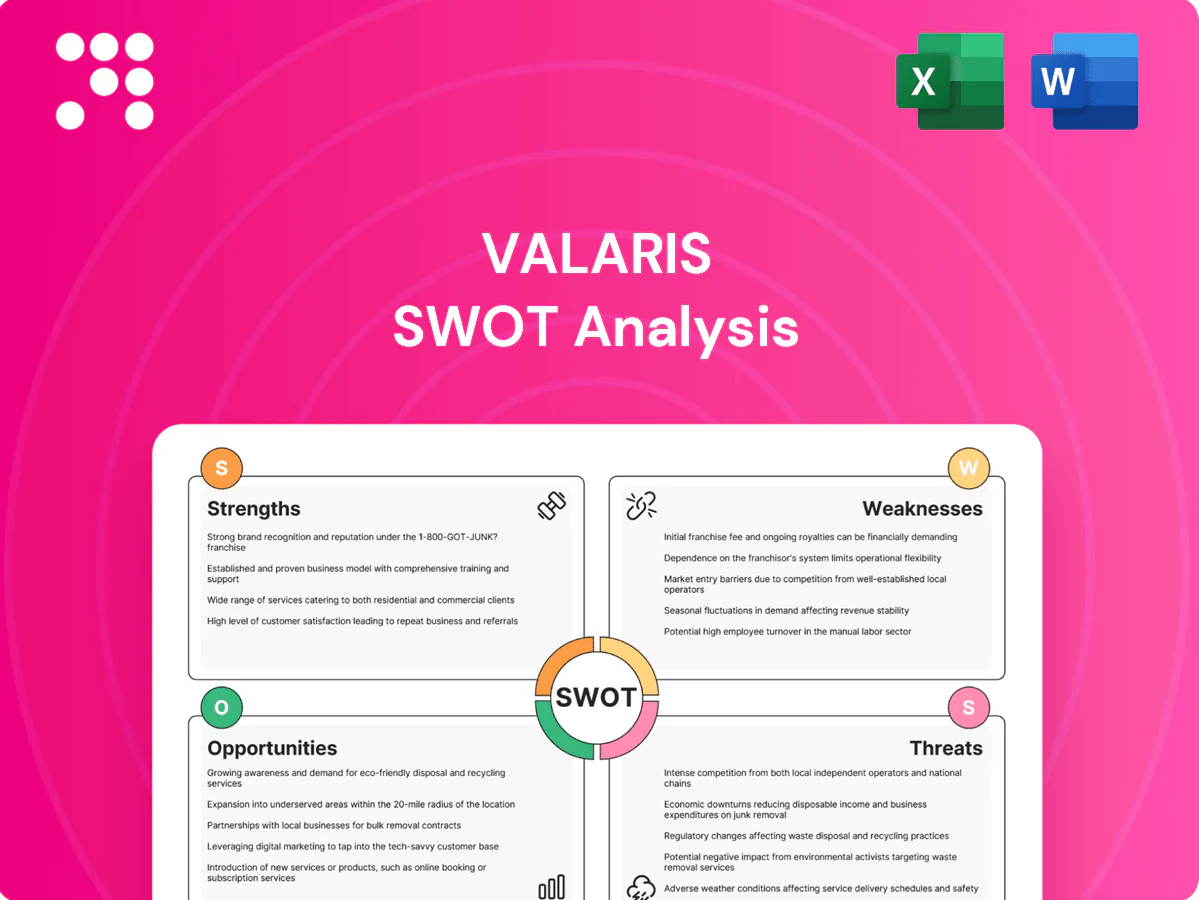
Valaris SWOT Analysis

Elevate Your Analysis with the Complete SWOT Report
Valaris faces fleet scale and deepwater expertise but navigates cyclical demand and debt pressures; our full SWOT unpacks these dynamics with financial context and strategic options. Purchase the complete, editable SWOT (Word + Excel) to access actionable insights for investment, planning, or competitive analysis.
Strengths

Diverse high-spec fleet
Valaris owns a diverse fleet of drillships, semisubmersibles and jackups, allowing precise matching of rig capability to well design and water depth; as of 2024 the company marketed a multi-class fleet enabling higher utilization across basins. High-spec units command premium dayrates—typically well above standard rigs—boosting revenue per rig and reducing reliance on any single market segment. Smooth redeployment across basins lowers idle time as demand shifts.
Global operating footprint
Valaris' presence in 20+ countries enables capture of international tenders and reduces single-country exposure. Local certifications and field experience shorten mobilization and startup timelines, supporting quicker revenue onset. A broad footprint strengthens relationships with major NOCs and IOCs, and geographic diversity helps balance seasonality and regulatory cycles across markets.

Ultra-deepwater capability
Valaris' modern drillships and harsh-environment semis unlock complex high-pressure reservoirs, supporting ultra-deepwater FIDs that industry reports showed rising in 2024. Scarcity of such assets lifts dayrates—surveys indicated ultra-deepwater rigs averaged above $250,000/day in 2024—and lengthens contract tenors, enhancing revenue visibility. Superior technical specs position Valaris for technologically demanding projects and premium contracts.

Operational and safety track record
Valaris’s strong HSE record—zero fatalities reported in 2024—helps win tenders with major operators and supports preferred-vendor status. Reliable fleet uptime (~92% in 2024) reduces non-productive time penalties and strengthens customer trust. Standardized processes and experienced crews drive consistent delivery, underpinning repeat business and a backlog of about $4.5B.
- HSE: zero fatalities (2024)
- Fleet uptime: ~92% (2024)
- Backlog: ~$4.5B
Flexible contracting strategy
Flexible contracting mixes short and multi-year charters to capture upside from rising dayrates while preserving medium-term revenue visibility; optional performance incentives and mobilization fees improve contract economics and margin capture. Stacking/reactivation playbooks allow fleet cash-flow optimization through downturns, and optional contract periods provide upside with limited downside exposure.
- Balanced tenor: hedges dayrate volatility
- Incentives: boosts realized dayrates
- Stack/reactivate: lowers cycle cash burn
- Option periods: asymmetric upside
High-spec rig fleet, ~92% uptime and $4.5B backlog drive premium dayrates
Valaris operates a diversified high-spec fleet (drillships, semisubmersibles, jackups) enabling high utilization and premium dayrates. Presence in 20+ countries with local certifications shortens mobilization and balances seasonality. Strong metrics—fleet uptime ~92%, zero fatalities (2024) and backlog ~$4.5B—support revenue visibility. Flexible contract mix and stacking/reactivation playbook preserve cash while capturing upside.
| Metric | 2024 |
|---|---|
| Fleet uptime | ~92% |
| Fatalities | 0 |
| Backlog | ~$4.5B |
| Markets | 20+ countries |
What is included in the product
 Detailed Word Document
Provides a clear SWOT framework analyzing Valaris’s internal capabilities, market strengths, operational gaps, growth opportunities, and external threats shaping its competitive position.

 Customizable Excel Spreadsheet
Provides a focused SWOT matrix that clarifies Valaris's strengths, weaknesses, opportunities, and threats for faster strategic decisions and seamless stakeholder alignment.
Weaknesses

High cyclicality to oil prices
Revenue and utilization at Valaris remain tightly linked to offshore E&P spending, with Brent oil price swings in 2024 (average ~80–85 USD/bbl) driving rapid dayrate volatility and shorter contract coverage. Downturns compress dayrates and utilization within months, while tendering lags can extend rig re-employment by quarters. Cash flows therefore show high intra-year volatility, with dayrate swings often exceeding 20–30% between peaks and troughs.
Capital-intensive fleet
Rigs are capital-intensive: heavy maintenance, periodic SPS and upgrades are required to keep units marketable, with reactivation often costing tens of millions of dollars and mobilization taking weeks to months before revenue begins. These cash outlays and high fixed costs constrain balance-sheet flexibility in downturns and amplify operating leverage, magnifying losses when utilization and dayrates fall.

Idle and stacked rigs drag
Idle cold- or warm-stacked Valaris rigs incur ongoing holding costs and face equipment degradation risk, reducing asset readiness and increasing reactivation expenses. Reactivation lead times often miss near-term tenders, limiting revenue capture and leaving customers preferring proven active rigs. The market applies a valuation overhang to stacked units until firm reactivation schedules or contracts materialize.

Concentration in offshore drilling
Valaris remains a pure-play offshore drilling contractor, with essentially 100% of 2024 revenue tied to offshore drilling, leaving limited diversification across services or geographies. This concentration raises sensitivity to regulatory shifts and energy-transition policy risks, while the revenue mix lacks countercyclical buffers, amplifying earnings volatility amid oil-price cycles.
- Revenue concentration: ~100% offshore drilling
- High exposure to regulatory/transition risk
- No countercyclical revenue streams
- Elevated earnings volatility
ESG perception challenges
ESG perception challenges: Valaris’s association with hydrocarbons narrows appeal to ESG-focused investors and some lenders, while rising disclosure and emissions targets force capital spending on monitoring and retrofit programs. Scope 1 and 2 cuts help but may not change sector-wide sentiment; customer decarbonization demands increase contract complexity and unit costs.
- Investor access: reduced
- Capex: higher for disclosures
- Scope 1/2: limited PR impact
- Customer demands: cost/complexity
Drilling cyclical — Brent ~82 USD, dayrates 20–30%
Valaris is highly cyclical with ~100% 2024 revenue tied to offshore drilling; Brent averaged ~82 USD/bbl in 2024, causing dayrate swings of 20–30% and short contract coverage. Reactivation and SPS can cost tens of millions per rig, prolonging idle-time losses. ESG perception limits some capital access and raises retrofit capex.
| Metric | 2024/2025 |
|---|---|
| Offshore revenue | ~100% |
| Brent avg (2024) | ~82 USD/bbl |
| Dayrate volatility | 20–30% |
| Reactivation cost | Tens of M USD/rig |
What You See Is What You Get
Valaris SWOT Analysis
This Valaris SWOT Analysis preview is taken directly from the full document you’ll receive upon purchase—no samples, no placeholders. The file is professional, structured, and ready to use for analysis or presentation. Buy to unlock the complete, editable report immediately.

Elevate Your Analysis with the Complete SWOT Report
Valaris faces fleet scale and deepwater expertise but navigates cyclical demand and debt pressures; our full SWOT unpacks these dynamics with financial context and strategic options. Purchase the complete, editable SWOT (Word + Excel) to access actionable insights for investment, planning, or competitive analysis.
Strengths
Diverse high-spec fleet
Valaris owns a diverse fleet of drillships, semisubmersibles and jackups, allowing precise matching of rig capability to well design and water depth; as of 2024 the company marketed a multi-class fleet enabling higher utilization across basins. High-spec units command premium dayrates—typically well above standard rigs—boosting revenue per rig and reducing reliance on any single market segment. Smooth redeployment across basins lowers idle time as demand shifts.
Global operating footprint
Valaris' presence in 20+ countries enables capture of international tenders and reduces single-country exposure. Local certifications and field experience shorten mobilization and startup timelines, supporting quicker revenue onset. A broad footprint strengthens relationships with major NOCs and IOCs, and geographic diversity helps balance seasonality and regulatory cycles across markets.
Ultra-deepwater capability
Valaris' modern drillships and harsh-environment semis unlock complex high-pressure reservoirs, supporting ultra-deepwater FIDs that industry reports showed rising in 2024. Scarcity of such assets lifts dayrates—surveys indicated ultra-deepwater rigs averaged above $250,000/day in 2024—and lengthens contract tenors, enhancing revenue visibility. Superior technical specs position Valaris for technologically demanding projects and premium contracts.
Operational and safety track record
Valaris’s strong HSE record—zero fatalities reported in 2024—helps win tenders with major operators and supports preferred-vendor status. Reliable fleet uptime (~92% in 2024) reduces non-productive time penalties and strengthens customer trust. Standardized processes and experienced crews drive consistent delivery, underpinning repeat business and a backlog of about $4.5B.
- HSE: zero fatalities (2024)
- Fleet uptime: ~92% (2024)
- Backlog: ~$4.5B
Flexible contracting strategy
Flexible contracting mixes short and multi-year charters to capture upside from rising dayrates while preserving medium-term revenue visibility; optional performance incentives and mobilization fees improve contract economics and margin capture. Stacking/reactivation playbooks allow fleet cash-flow optimization through downturns, and optional contract periods provide upside with limited downside exposure.
- Balanced tenor: hedges dayrate volatility
- Incentives: boosts realized dayrates
- Stack/reactivate: lowers cycle cash burn
- Option periods: asymmetric upside
High-spec rig fleet, ~92% uptime and $4.5B backlog drive premium dayrates
Valaris operates a diversified high-spec fleet (drillships, semisubmersibles, jackups) enabling high utilization and premium dayrates. Presence in 20+ countries with local certifications shortens mobilization and balances seasonality. Strong metrics—fleet uptime ~92%, zero fatalities (2024) and backlog ~$4.5B—support revenue visibility. Flexible contract mix and stacking/reactivation playbook preserve cash while capturing upside.
| Metric | 2024 |
|---|---|
| Fleet uptime | ~92% |
| Fatalities | 0 |
| Backlog | ~$4.5B |
| Markets | 20+ countries |
What is included in the product
Detailed Word Document
Provides a clear SWOT framework analyzing Valaris’s internal capabilities, market strengths, operational gaps, growth opportunities, and external threats shaping its competitive position.
Customizable Excel Spreadsheet
Provides a focused SWOT matrix that clarifies Valaris's strengths, weaknesses, opportunities, and threats for faster strategic decisions and seamless stakeholder alignment.
Weaknesses
High cyclicality to oil prices
Revenue and utilization at Valaris remain tightly linked to offshore E&P spending, with Brent oil price swings in 2024 (average ~80–85 USD/bbl) driving rapid dayrate volatility and shorter contract coverage. Downturns compress dayrates and utilization within months, while tendering lags can extend rig re-employment by quarters. Cash flows therefore show high intra-year volatility, with dayrate swings often exceeding 20–30% between peaks and troughs.
Capital-intensive fleet
Rigs are capital-intensive: heavy maintenance, periodic SPS and upgrades are required to keep units marketable, with reactivation often costing tens of millions of dollars and mobilization taking weeks to months before revenue begins. These cash outlays and high fixed costs constrain balance-sheet flexibility in downturns and amplify operating leverage, magnifying losses when utilization and dayrates fall.
Idle and stacked rigs drag
Idle cold- or warm-stacked Valaris rigs incur ongoing holding costs and face equipment degradation risk, reducing asset readiness and increasing reactivation expenses. Reactivation lead times often miss near-term tenders, limiting revenue capture and leaving customers preferring proven active rigs. The market applies a valuation overhang to stacked units until firm reactivation schedules or contracts materialize.
Concentration in offshore drilling
Valaris remains a pure-play offshore drilling contractor, with essentially 100% of 2024 revenue tied to offshore drilling, leaving limited diversification across services or geographies. This concentration raises sensitivity to regulatory shifts and energy-transition policy risks, while the revenue mix lacks countercyclical buffers, amplifying earnings volatility amid oil-price cycles.
- Revenue concentration: ~100% offshore drilling
- High exposure to regulatory/transition risk
- No countercyclical revenue streams
- Elevated earnings volatility
ESG perception challenges
ESG perception challenges: Valaris’s association with hydrocarbons narrows appeal to ESG-focused investors and some lenders, while rising disclosure and emissions targets force capital spending on monitoring and retrofit programs. Scope 1 and 2 cuts help but may not change sector-wide sentiment; customer decarbonization demands increase contract complexity and unit costs.
- Investor access: reduced
- Capex: higher for disclosures
- Scope 1/2: limited PR impact
- Customer demands: cost/complexity
Drilling cyclical — Brent ~82 USD, dayrates 20–30%
Valaris is highly cyclical with ~100% 2024 revenue tied to offshore drilling; Brent averaged ~82 USD/bbl in 2024, causing dayrate swings of 20–30% and short contract coverage. Reactivation and SPS can cost tens of millions per rig, prolonging idle-time losses. ESG perception limits some capital access and raises retrofit capex.
| Metric | 2024/2025 |
|---|---|
| Offshore revenue | ~100% |
| Brent avg (2024) | ~82 USD/bbl |
| Dayrate volatility | 20–30% |
| Reactivation cost | Tens of M USD/rig |
What You See Is What You Get
Valaris SWOT Analysis
This Valaris SWOT Analysis preview is taken directly from the full document you’ll receive upon purchase—no samples, no placeholders. The file is professional, structured, and ready to use for analysis or presentation. Buy to unlock the complete, editable report immediately.
Original: $10.00
-65%$10.00
$3.50Description
Elevate Your Analysis with the Complete SWOT Report
Valaris faces fleet scale and deepwater expertise but navigates cyclical demand and debt pressures; our full SWOT unpacks these dynamics with financial context and strategic options. Purchase the complete, editable SWOT (Word + Excel) to access actionable insights for investment, planning, or competitive analysis.
Strengths
Diverse high-spec fleet
Valaris owns a diverse fleet of drillships, semisubmersibles and jackups, allowing precise matching of rig capability to well design and water depth; as of 2024 the company marketed a multi-class fleet enabling higher utilization across basins. High-spec units command premium dayrates—typically well above standard rigs—boosting revenue per rig and reducing reliance on any single market segment. Smooth redeployment across basins lowers idle time as demand shifts.
Global operating footprint
Valaris' presence in 20+ countries enables capture of international tenders and reduces single-country exposure. Local certifications and field experience shorten mobilization and startup timelines, supporting quicker revenue onset. A broad footprint strengthens relationships with major NOCs and IOCs, and geographic diversity helps balance seasonality and regulatory cycles across markets.
Ultra-deepwater capability
Valaris' modern drillships and harsh-environment semis unlock complex high-pressure reservoirs, supporting ultra-deepwater FIDs that industry reports showed rising in 2024. Scarcity of such assets lifts dayrates—surveys indicated ultra-deepwater rigs averaged above $250,000/day in 2024—and lengthens contract tenors, enhancing revenue visibility. Superior technical specs position Valaris for technologically demanding projects and premium contracts.
Operational and safety track record
Valaris’s strong HSE record—zero fatalities reported in 2024—helps win tenders with major operators and supports preferred-vendor status. Reliable fleet uptime (~92% in 2024) reduces non-productive time penalties and strengthens customer trust. Standardized processes and experienced crews drive consistent delivery, underpinning repeat business and a backlog of about $4.5B.
- HSE: zero fatalities (2024)
- Fleet uptime: ~92% (2024)
- Backlog: ~$4.5B
Flexible contracting strategy
Flexible contracting mixes short and multi-year charters to capture upside from rising dayrates while preserving medium-term revenue visibility; optional performance incentives and mobilization fees improve contract economics and margin capture. Stacking/reactivation playbooks allow fleet cash-flow optimization through downturns, and optional contract periods provide upside with limited downside exposure.
- Balanced tenor: hedges dayrate volatility
- Incentives: boosts realized dayrates
- Stack/reactivate: lowers cycle cash burn
- Option periods: asymmetric upside
High-spec rig fleet, ~92% uptime and $4.5B backlog drive premium dayrates
Valaris operates a diversified high-spec fleet (drillships, semisubmersibles, jackups) enabling high utilization and premium dayrates. Presence in 20+ countries with local certifications shortens mobilization and balances seasonality. Strong metrics—fleet uptime ~92%, zero fatalities (2024) and backlog ~$4.5B—support revenue visibility. Flexible contract mix and stacking/reactivation playbook preserve cash while capturing upside.
| Metric | 2024 |
|---|---|
| Fleet uptime | ~92% |
| Fatalities | 0 |
| Backlog | ~$4.5B |
| Markets | 20+ countries |
What is included in the product
Detailed Word Document
Provides a clear SWOT framework analyzing Valaris’s internal capabilities, market strengths, operational gaps, growth opportunities, and external threats shaping its competitive position.
Customizable Excel Spreadsheet
Provides a focused SWOT matrix that clarifies Valaris's strengths, weaknesses, opportunities, and threats for faster strategic decisions and seamless stakeholder alignment.
Weaknesses
High cyclicality to oil prices
Revenue and utilization at Valaris remain tightly linked to offshore E&P spending, with Brent oil price swings in 2024 (average ~80–85 USD/bbl) driving rapid dayrate volatility and shorter contract coverage. Downturns compress dayrates and utilization within months, while tendering lags can extend rig re-employment by quarters. Cash flows therefore show high intra-year volatility, with dayrate swings often exceeding 20–30% between peaks and troughs.
Capital-intensive fleet
Rigs are capital-intensive: heavy maintenance, periodic SPS and upgrades are required to keep units marketable, with reactivation often costing tens of millions of dollars and mobilization taking weeks to months before revenue begins. These cash outlays and high fixed costs constrain balance-sheet flexibility in downturns and amplify operating leverage, magnifying losses when utilization and dayrates fall.
Idle and stacked rigs drag
Idle cold- or warm-stacked Valaris rigs incur ongoing holding costs and face equipment degradation risk, reducing asset readiness and increasing reactivation expenses. Reactivation lead times often miss near-term tenders, limiting revenue capture and leaving customers preferring proven active rigs. The market applies a valuation overhang to stacked units until firm reactivation schedules or contracts materialize.
Concentration in offshore drilling
Valaris remains a pure-play offshore drilling contractor, with essentially 100% of 2024 revenue tied to offshore drilling, leaving limited diversification across services or geographies. This concentration raises sensitivity to regulatory shifts and energy-transition policy risks, while the revenue mix lacks countercyclical buffers, amplifying earnings volatility amid oil-price cycles.
- Revenue concentration: ~100% offshore drilling
- High exposure to regulatory/transition risk
- No countercyclical revenue streams
- Elevated earnings volatility
ESG perception challenges
ESG perception challenges: Valaris’s association with hydrocarbons narrows appeal to ESG-focused investors and some lenders, while rising disclosure and emissions targets force capital spending on monitoring and retrofit programs. Scope 1 and 2 cuts help but may not change sector-wide sentiment; customer decarbonization demands increase contract complexity and unit costs.
- Investor access: reduced
- Capex: higher for disclosures
- Scope 1/2: limited PR impact
- Customer demands: cost/complexity
Drilling cyclical — Brent ~82 USD, dayrates 20–30%
Valaris is highly cyclical with ~100% 2024 revenue tied to offshore drilling; Brent averaged ~82 USD/bbl in 2024, causing dayrate swings of 20–30% and short contract coverage. Reactivation and SPS can cost tens of millions per rig, prolonging idle-time losses. ESG perception limits some capital access and raises retrofit capex.
| Metric | 2024/2025 |
|---|---|
| Offshore revenue | ~100% |
| Brent avg (2024) | ~82 USD/bbl |
| Dayrate volatility | 20–30% |
| Reactivation cost | Tens of M USD/rig |
What You See Is What You Get
Valaris SWOT Analysis
This Valaris SWOT Analysis preview is taken directly from the full document you’ll receive upon purchase—no samples, no placeholders. The file is professional, structured, and ready to use for analysis or presentation. Buy to unlock the complete, editable report immediately.











