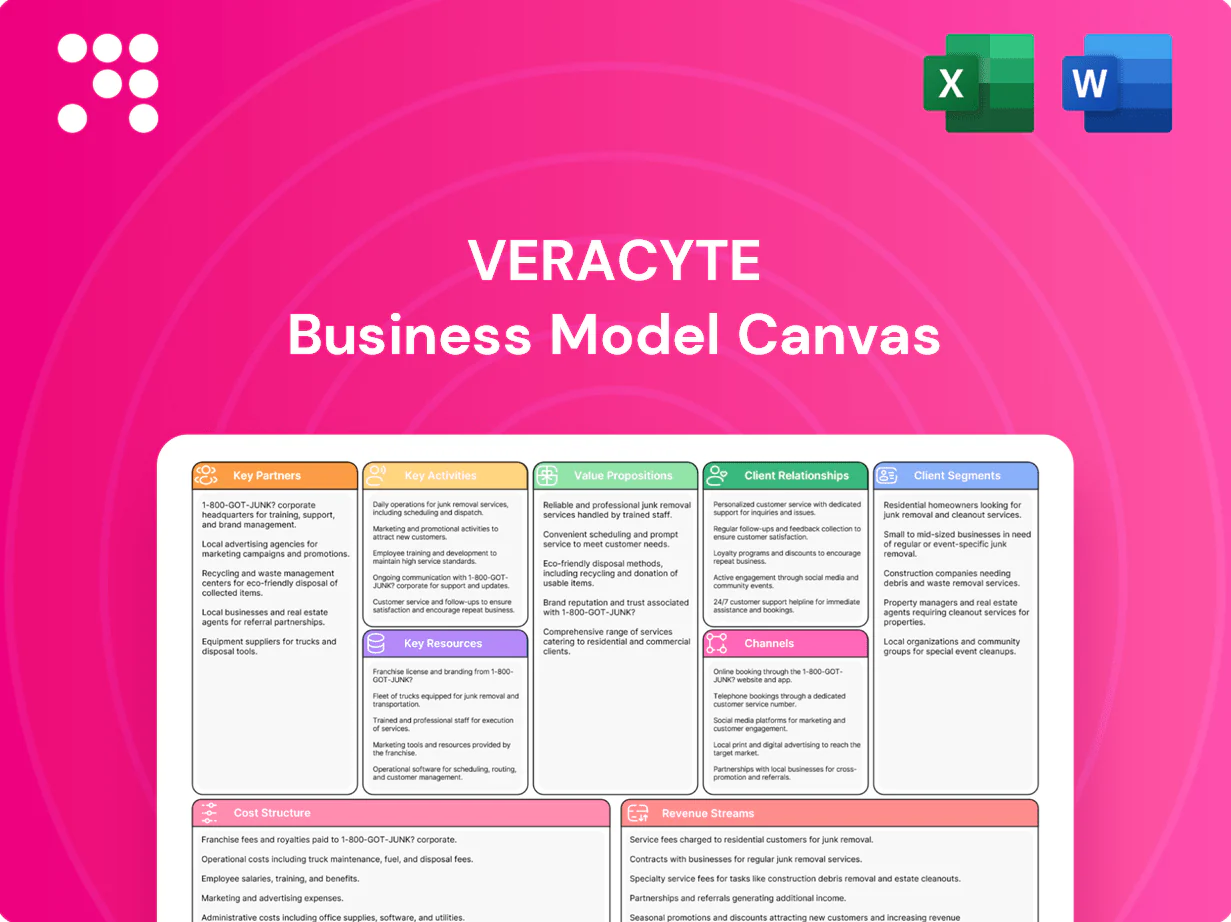
Veracyte Business Model Canvas

Unlock a diagnostics Business Model Canvas: value propositions, customers, revenue drivers
Unlock the strategic blueprint of Veracyte with a concise Business Model Canvas that maps value propositions, customer segments, and revenue drivers. See how partnerships and diagnostics scale growth and margin. Ideal for investors and strategists seeking actionable insight. Purchase the full, editable canvas to dive deeper.
Partnerships

Academic medical centers
Collaborations with leading academic medical centers provide Veracyte access to well-phenotyped cohorts and biobanks to support prospective and retrospective clinical validation for Afirma (thyroid), Percepta (lung) and Envisia (interstitial lung disease). Co-authored, peer-reviewed publications from these sites bolster clinical credibility and guideline inclusion, while IRB-backed studies and joint grants accelerate evidence generation and clinical adoption.
Hospitals and integrated delivery networks
Partnerships with hospitals and IDNs streamline sample flow, logistics and EHR/LIS connectivity with major platforms like Epic and Cerner, enabling system-level contracting to embed formularies and testing pathways. IDNs—which control roughly 70% of U.S. hospital bed capacity—use value analyses showing tests can avoid unnecessary procedures, reducing costs and improving clinician adherence and turnaround times often to under 48 hours.

Biopharma and companion diagnostics
Biopharma alliances let Veracyte co-develop companion diagnostics and stratification assays, leveraging clinical-trial samples and outcomes to refine predictive signatures; the global companion diagnostics market was about $9.6 billion in 2023, supporting joint commercialization to expand indications and reimbursement footprints, while shared data enables real-world evidence generation and potential label expansions.

Payers and health technology assessors
Engagement with commercial and government payers secures coverage and appropriate reimbursement for Veracyte diagnostics, while health economic studies provide evidence that informs medical policy decisions and payer coverage criteria.
Outcomes-based arrangements can align incentives around reducing unnecessary invasive procedures and associated costs, and early dialogue with HTA bodies improves market access and adoption in new geographies.
- Coverage agreements
- Health economic evidence
- Outcomes-based contracts
- Early HTA engagement
Distributors and reference labs (ex-US)
International distributors and reference labs extend Veracyte reach into regulated markets, using local licenses and partner networks to enter countries where direct operations would be slow or costly.
Local entities handle country-specific compliance, logistics, and payer-system navigation, reducing time-to-reimbursement and market access friction.
Rigorous tech transfers and QA programs preserve assay fidelity across sites, while co-marketing deals drive adoption without a heavy direct commercial footprint.
- Regulatory reach via partners
- Local compliance and payer navigation
- Tech transfer + QA for assay consistency
- Co-marketing to scale adoption
Academic, IDN and biopharma partnerships accelerate companion Dx, EHR integration and payer access
Academic centers supply cohorts/biobanks for validation, producing guideline-supporting publications and IRB studies.
IDN/hospital partnerships enable EHR/LIS integration (Epic/Cerner), system contracting and sample logistics, with IDNs covering ~70% of US beds and TAT often <48 hours.
Biopharma alliances drive companion diagnostics co-development; global companion diagnostics market ~11B USD (2024 est), enabling label expansions and RWE.
Payer and distributor deals secure coverage, outcomes-based contracts and local market access via tech transfer and QA.
| Partner | Role | Key metric |
|---|---|---|
| Academic centers | Validation & publications | IRB studies, cohorts |
| IDNs/hospitals | Logistics & EHR integration | ~70% US beds, TAT <48h |
| Biopharma | Companion Dx | Market ~11B USD (2024 est) |
What is included in the product
 Detailed Word Document
A comprehensive Business Model Canvas tailored to Veracyte’s diagnostics strategy, covering customer segments, channels, value propositions and revenue streams across the 9 BMC blocks with real-world operational insights and competitive advantages. Ideal for investor presentations, strategic planning and includes linked SWOT analysis to validate opportunities and risks.

 Customizable Excel Spreadsheet
Condenses Veracyte’s complex diagnostics strategy into a clean, one-page Business Model Canvas that quickly aligns R&D, commercial, and clinical teams. Shareable and editable for fast collaboration, it saves hours on structuring strategy and clarifies value propositions, revenue streams, and partnerships for boardrooms or investor reviews.
Activities

Assay R&D and platform optimization
Discovery and optimization of gene expression and genomic signatures drive clinical performance, with platform updates in 2024 targeting sensitivity and specificity gains. Analytical validation ensures reproducibility and instrument-agnostic sensitivity across labs. Iterative R&D has reduced turnaround time by up to 30% and per-test costs ~20%. Cross-indication platform work enables leverage across a pipeline of multiple diagnostic areas.
Clinical evidence generation
Prospective and retrospective studies underlie Afirma and Percepta clinical validity and utility, supported by 400+ peer-reviewed publications as of 2024. Guideline inclusion follows presentations at major meetings and journals. Health-economics analyses report substantial reductions in diagnostic surgeries and per-patient downstream savings of several thousand dollars. Post-market registries with tens of thousands of cases bolster real-world performance claims.

CLIA/CAP laboratory operations
Veracyte’s CLIA/CAP laboratory operations in 2024 maintain high-throughput genomic processing under ISO-aligned quality systems to deliver consistent results. Robust logistics track specimen collection, chain-of-custody and TAT metrics to meet clinical deadlines. Continuous QC/QA, internal controls and external proficiency testing uphold CLIA and CAP accreditation. Capacity planning aligns staffing and equipment with demand to optimize throughput and service levels.

Market access and reimbursement
Market access and reimbursement activities—coding, coverage, and contracting—create predictable payment pathways for Veracyte tests, while proactive medical policy engagement communicates evidence strength to payers. Dedicated appeals and prior-authorization support reduce provider friction and speed uptake. Pricing strategy balances demonstrated clinical value with access goals to enable margin expansion.
- coding, coverage, contracting
- medical policy engagement
- appeals & prior-auth support
- value-based pricing
Medical education and KOL engagement
MSLs deliver scientific exchange with specialists and societies, supporting adoption of Veracyte tests across clinics; training programs steer ordering, interpretation, and care pathways, driving clinical utility and repeat use. National and regional conferences showcase peer-reviewed data and case studies; advisory boards (2024: engaged 40+ KOLs) inform product roadmap and unmet needs.
- MSL scientific exchanges
- Training on ordering & interpretation
- Conference data dissemination
- Advisory boards (40+ KOLs in 2024)
Genomic signatures improve care: 400+ pubs, TAT ~30%
Discovery and optimization of genomic signatures drive clinical performance (2024: 400+ publications), with iterative R&D cutting turnaround time ~30% and per-test costs ~20%. CLIA/CAP lab operations and tens of thousands of registry cases ensure real-world validity; Afirma and Percepta supported by prospective/retrospective studies. Market-access efforts (coding, coverage, appeals) plus 40+ KOLs in 2024 enable uptake.
| Metric | 2024 Value |
|---|---|
| Publications | 400+ |
| TAT reduction | ~30% |
| Per-test cost ↓ | ~20% |
| Registry cases | tens of thousands |
| KOLs engaged | 40+ |
Preview Before You Purchase
Business Model Canvas
The preview you see is the actual Veracyte Business Model Canvas, not a mockup, and it reflects the exact content you’ll receive after purchase. When you buy, you’ll get this same professional file—complete and ready to edit, present, or share. Files are delivered in editable Word and Excel formats with all sections included.

Unlock a diagnostics Business Model Canvas: value propositions, customers, revenue drivers
Unlock the strategic blueprint of Veracyte with a concise Business Model Canvas that maps value propositions, customer segments, and revenue drivers. See how partnerships and diagnostics scale growth and margin. Ideal for investors and strategists seeking actionable insight. Purchase the full, editable canvas to dive deeper.
Partnerships
Academic medical centers
Collaborations with leading academic medical centers provide Veracyte access to well-phenotyped cohorts and biobanks to support prospective and retrospective clinical validation for Afirma (thyroid), Percepta (lung) and Envisia (interstitial lung disease). Co-authored, peer-reviewed publications from these sites bolster clinical credibility and guideline inclusion, while IRB-backed studies and joint grants accelerate evidence generation and clinical adoption.
Hospitals and integrated delivery networks
Partnerships with hospitals and IDNs streamline sample flow, logistics and EHR/LIS connectivity with major platforms like Epic and Cerner, enabling system-level contracting to embed formularies and testing pathways. IDNs—which control roughly 70% of U.S. hospital bed capacity—use value analyses showing tests can avoid unnecessary procedures, reducing costs and improving clinician adherence and turnaround times often to under 48 hours.
Biopharma and companion diagnostics
Biopharma alliances let Veracyte co-develop companion diagnostics and stratification assays, leveraging clinical-trial samples and outcomes to refine predictive signatures; the global companion diagnostics market was about $9.6 billion in 2023, supporting joint commercialization to expand indications and reimbursement footprints, while shared data enables real-world evidence generation and potential label expansions.
Payers and health technology assessors
Engagement with commercial and government payers secures coverage and appropriate reimbursement for Veracyte diagnostics, while health economic studies provide evidence that informs medical policy decisions and payer coverage criteria.
Outcomes-based arrangements can align incentives around reducing unnecessary invasive procedures and associated costs, and early dialogue with HTA bodies improves market access and adoption in new geographies.
- Coverage agreements
- Health economic evidence
- Outcomes-based contracts
- Early HTA engagement
Distributors and reference labs (ex-US)
International distributors and reference labs extend Veracyte reach into regulated markets, using local licenses and partner networks to enter countries where direct operations would be slow or costly.
Local entities handle country-specific compliance, logistics, and payer-system navigation, reducing time-to-reimbursement and market access friction.
Rigorous tech transfers and QA programs preserve assay fidelity across sites, while co-marketing deals drive adoption without a heavy direct commercial footprint.
- Regulatory reach via partners
- Local compliance and payer navigation
- Tech transfer + QA for assay consistency
- Co-marketing to scale adoption
Academic, IDN and biopharma partnerships accelerate companion Dx, EHR integration and payer access
Academic centers supply cohorts/biobanks for validation, producing guideline-supporting publications and IRB studies.
IDN/hospital partnerships enable EHR/LIS integration (Epic/Cerner), system contracting and sample logistics, with IDNs covering ~70% of US beds and TAT often <48 hours.
Biopharma alliances drive companion diagnostics co-development; global companion diagnostics market ~11B USD (2024 est), enabling label expansions and RWE.
Payer and distributor deals secure coverage, outcomes-based contracts and local market access via tech transfer and QA.
| Partner | Role | Key metric |
|---|---|---|
| Academic centers | Validation & publications | IRB studies, cohorts |
| IDNs/hospitals | Logistics & EHR integration | ~70% US beds, TAT <48h |
| Biopharma | Companion Dx | Market ~11B USD (2024 est) |
What is included in the product
Detailed Word Document
A comprehensive Business Model Canvas tailored to Veracyte’s diagnostics strategy, covering customer segments, channels, value propositions and revenue streams across the 9 BMC blocks with real-world operational insights and competitive advantages. Ideal for investor presentations, strategic planning and includes linked SWOT analysis to validate opportunities and risks.
Customizable Excel Spreadsheet
Condenses Veracyte’s complex diagnostics strategy into a clean, one-page Business Model Canvas that quickly aligns R&D, commercial, and clinical teams. Shareable and editable for fast collaboration, it saves hours on structuring strategy and clarifies value propositions, revenue streams, and partnerships for boardrooms or investor reviews.
Activities
Assay R&D and platform optimization
Discovery and optimization of gene expression and genomic signatures drive clinical performance, with platform updates in 2024 targeting sensitivity and specificity gains. Analytical validation ensures reproducibility and instrument-agnostic sensitivity across labs. Iterative R&D has reduced turnaround time by up to 30% and per-test costs ~20%. Cross-indication platform work enables leverage across a pipeline of multiple diagnostic areas.
Clinical evidence generation
Prospective and retrospective studies underlie Afirma and Percepta clinical validity and utility, supported by 400+ peer-reviewed publications as of 2024. Guideline inclusion follows presentations at major meetings and journals. Health-economics analyses report substantial reductions in diagnostic surgeries and per-patient downstream savings of several thousand dollars. Post-market registries with tens of thousands of cases bolster real-world performance claims.
CLIA/CAP laboratory operations
Veracyte’s CLIA/CAP laboratory operations in 2024 maintain high-throughput genomic processing under ISO-aligned quality systems to deliver consistent results. Robust logistics track specimen collection, chain-of-custody and TAT metrics to meet clinical deadlines. Continuous QC/QA, internal controls and external proficiency testing uphold CLIA and CAP accreditation. Capacity planning aligns staffing and equipment with demand to optimize throughput and service levels.
Market access and reimbursement
Market access and reimbursement activities—coding, coverage, and contracting—create predictable payment pathways for Veracyte tests, while proactive medical policy engagement communicates evidence strength to payers. Dedicated appeals and prior-authorization support reduce provider friction and speed uptake. Pricing strategy balances demonstrated clinical value with access goals to enable margin expansion.
- coding, coverage, contracting
- medical policy engagement
- appeals & prior-auth support
- value-based pricing
Medical education and KOL engagement
MSLs deliver scientific exchange with specialists and societies, supporting adoption of Veracyte tests across clinics; training programs steer ordering, interpretation, and care pathways, driving clinical utility and repeat use. National and regional conferences showcase peer-reviewed data and case studies; advisory boards (2024: engaged 40+ KOLs) inform product roadmap and unmet needs.
- MSL scientific exchanges
- Training on ordering & interpretation
- Conference data dissemination
- Advisory boards (40+ KOLs in 2024)
Genomic signatures improve care: 400+ pubs, TAT ~30%
Discovery and optimization of genomic signatures drive clinical performance (2024: 400+ publications), with iterative R&D cutting turnaround time ~30% and per-test costs ~20%. CLIA/CAP lab operations and tens of thousands of registry cases ensure real-world validity; Afirma and Percepta supported by prospective/retrospective studies. Market-access efforts (coding, coverage, appeals) plus 40+ KOLs in 2024 enable uptake.
| Metric | 2024 Value |
|---|---|
| Publications | 400+ |
| TAT reduction | ~30% |
| Per-test cost ↓ | ~20% |
| Registry cases | tens of thousands |
| KOLs engaged | 40+ |
Preview Before You Purchase
Business Model Canvas
The preview you see is the actual Veracyte Business Model Canvas, not a mockup, and it reflects the exact content you’ll receive after purchase. When you buy, you’ll get this same professional file—complete and ready to edit, present, or share. Files are delivered in editable Word and Excel formats with all sections included.
Original: $10.00
-65%$10.00
$3.50Description
Unlock a diagnostics Business Model Canvas: value propositions, customers, revenue drivers
Unlock the strategic blueprint of Veracyte with a concise Business Model Canvas that maps value propositions, customer segments, and revenue drivers. See how partnerships and diagnostics scale growth and margin. Ideal for investors and strategists seeking actionable insight. Purchase the full, editable canvas to dive deeper.
Partnerships
Academic medical centers
Collaborations with leading academic medical centers provide Veracyte access to well-phenotyped cohorts and biobanks to support prospective and retrospective clinical validation for Afirma (thyroid), Percepta (lung) and Envisia (interstitial lung disease). Co-authored, peer-reviewed publications from these sites bolster clinical credibility and guideline inclusion, while IRB-backed studies and joint grants accelerate evidence generation and clinical adoption.
Hospitals and integrated delivery networks
Partnerships with hospitals and IDNs streamline sample flow, logistics and EHR/LIS connectivity with major platforms like Epic and Cerner, enabling system-level contracting to embed formularies and testing pathways. IDNs—which control roughly 70% of U.S. hospital bed capacity—use value analyses showing tests can avoid unnecessary procedures, reducing costs and improving clinician adherence and turnaround times often to under 48 hours.
Biopharma and companion diagnostics
Biopharma alliances let Veracyte co-develop companion diagnostics and stratification assays, leveraging clinical-trial samples and outcomes to refine predictive signatures; the global companion diagnostics market was about $9.6 billion in 2023, supporting joint commercialization to expand indications and reimbursement footprints, while shared data enables real-world evidence generation and potential label expansions.
Payers and health technology assessors
Engagement with commercial and government payers secures coverage and appropriate reimbursement for Veracyte diagnostics, while health economic studies provide evidence that informs medical policy decisions and payer coverage criteria.
Outcomes-based arrangements can align incentives around reducing unnecessary invasive procedures and associated costs, and early dialogue with HTA bodies improves market access and adoption in new geographies.
- Coverage agreements
- Health economic evidence
- Outcomes-based contracts
- Early HTA engagement
Distributors and reference labs (ex-US)
International distributors and reference labs extend Veracyte reach into regulated markets, using local licenses and partner networks to enter countries where direct operations would be slow or costly.
Local entities handle country-specific compliance, logistics, and payer-system navigation, reducing time-to-reimbursement and market access friction.
Rigorous tech transfers and QA programs preserve assay fidelity across sites, while co-marketing deals drive adoption without a heavy direct commercial footprint.
- Regulatory reach via partners
- Local compliance and payer navigation
- Tech transfer + QA for assay consistency
- Co-marketing to scale adoption
Academic, IDN and biopharma partnerships accelerate companion Dx, EHR integration and payer access
Academic centers supply cohorts/biobanks for validation, producing guideline-supporting publications and IRB studies.
IDN/hospital partnerships enable EHR/LIS integration (Epic/Cerner), system contracting and sample logistics, with IDNs covering ~70% of US beds and TAT often <48 hours.
Biopharma alliances drive companion diagnostics co-development; global companion diagnostics market ~11B USD (2024 est), enabling label expansions and RWE.
Payer and distributor deals secure coverage, outcomes-based contracts and local market access via tech transfer and QA.
| Partner | Role | Key metric |
|---|---|---|
| Academic centers | Validation & publications | IRB studies, cohorts |
| IDNs/hospitals | Logistics & EHR integration | ~70% US beds, TAT <48h |
| Biopharma | Companion Dx | Market ~11B USD (2024 est) |
What is included in the product
Detailed Word Document
A comprehensive Business Model Canvas tailored to Veracyte’s diagnostics strategy, covering customer segments, channels, value propositions and revenue streams across the 9 BMC blocks with real-world operational insights and competitive advantages. Ideal for investor presentations, strategic planning and includes linked SWOT analysis to validate opportunities and risks.
Customizable Excel Spreadsheet
Condenses Veracyte’s complex diagnostics strategy into a clean, one-page Business Model Canvas that quickly aligns R&D, commercial, and clinical teams. Shareable and editable for fast collaboration, it saves hours on structuring strategy and clarifies value propositions, revenue streams, and partnerships for boardrooms or investor reviews.
Activities
Assay R&D and platform optimization
Discovery and optimization of gene expression and genomic signatures drive clinical performance, with platform updates in 2024 targeting sensitivity and specificity gains. Analytical validation ensures reproducibility and instrument-agnostic sensitivity across labs. Iterative R&D has reduced turnaround time by up to 30% and per-test costs ~20%. Cross-indication platform work enables leverage across a pipeline of multiple diagnostic areas.
Clinical evidence generation
Prospective and retrospective studies underlie Afirma and Percepta clinical validity and utility, supported by 400+ peer-reviewed publications as of 2024. Guideline inclusion follows presentations at major meetings and journals. Health-economics analyses report substantial reductions in diagnostic surgeries and per-patient downstream savings of several thousand dollars. Post-market registries with tens of thousands of cases bolster real-world performance claims.
CLIA/CAP laboratory operations
Veracyte’s CLIA/CAP laboratory operations in 2024 maintain high-throughput genomic processing under ISO-aligned quality systems to deliver consistent results. Robust logistics track specimen collection, chain-of-custody and TAT metrics to meet clinical deadlines. Continuous QC/QA, internal controls and external proficiency testing uphold CLIA and CAP accreditation. Capacity planning aligns staffing and equipment with demand to optimize throughput and service levels.
Market access and reimbursement
Market access and reimbursement activities—coding, coverage, and contracting—create predictable payment pathways for Veracyte tests, while proactive medical policy engagement communicates evidence strength to payers. Dedicated appeals and prior-authorization support reduce provider friction and speed uptake. Pricing strategy balances demonstrated clinical value with access goals to enable margin expansion.
- coding, coverage, contracting
- medical policy engagement
- appeals & prior-auth support
- value-based pricing
Medical education and KOL engagement
MSLs deliver scientific exchange with specialists and societies, supporting adoption of Veracyte tests across clinics; training programs steer ordering, interpretation, and care pathways, driving clinical utility and repeat use. National and regional conferences showcase peer-reviewed data and case studies; advisory boards (2024: engaged 40+ KOLs) inform product roadmap and unmet needs.
- MSL scientific exchanges
- Training on ordering & interpretation
- Conference data dissemination
- Advisory boards (40+ KOLs in 2024)
Genomic signatures improve care: 400+ pubs, TAT ~30%
Discovery and optimization of genomic signatures drive clinical performance (2024: 400+ publications), with iterative R&D cutting turnaround time ~30% and per-test costs ~20%. CLIA/CAP lab operations and tens of thousands of registry cases ensure real-world validity; Afirma and Percepta supported by prospective/retrospective studies. Market-access efforts (coding, coverage, appeals) plus 40+ KOLs in 2024 enable uptake.
| Metric | 2024 Value |
|---|---|
| Publications | 400+ |
| TAT reduction | ~30% |
| Per-test cost ↓ | ~20% |
| Registry cases | tens of thousands |
| KOLs engaged | 40+ |
Preview Before You Purchase
Business Model Canvas
The preview you see is the actual Veracyte Business Model Canvas, not a mockup, and it reflects the exact content you’ll receive after purchase. When you buy, you’ll get this same professional file—complete and ready to edit, present, or share. Files are delivered in editable Word and Excel formats with all sections included.











