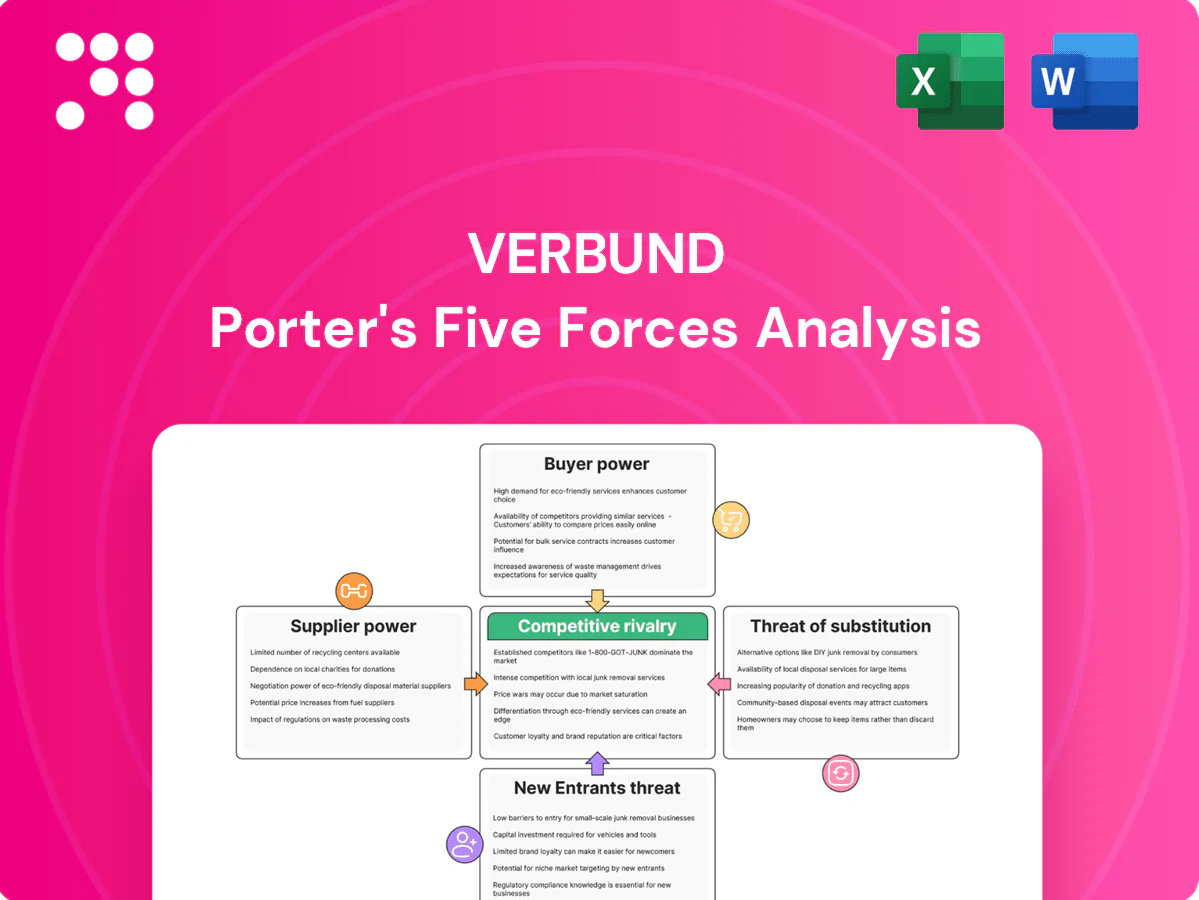
Verbund Porter's Five Forces Analysis

Elevate Your Analysis with the Complete Porter's Five Forces Analysis
Verbund faces evolving competitive dynamics driven by regulated power markets, strong supplier relationships, and moderate buyer leverage as large industrial customers negotiate rates. Renewables and storage raise the threat of substitutes while high capital requirements limit new entrants. This brief snapshot only scratches the surface—unlock the full Porter's Five Forces Analysis for actionable, consultant-grade insights on Verbund’s market position.
Suppliers Bargaining Power

Hydrology and water rights dependence
Water availability and river flow are the effective fuel for VERBUND’s hydropower; VERBUND operates roughly 9 GW of hydropower capacity, so Alpine inflows and water-rights concessions critically constrain output. Droughts and competing uses can curtail generation and raise marginal cost, as seen in low-inflow years since 2022. Long-dated concessions (many extending into the 2040s) reduce renegotiation frequency but embed state regulatory leverage over terms.
OEM and EPC concentration
Turbine, generator and HV equipment supply is dominated by a handful of global OEMs (eg Siemens Energy, GE Vernova, Mitsubishi/Hitachi), giving suppliers strong pricing and delivery leverage over Verbund. Complex refurbishment cycles and bespoke engineering raise switching costs and extend lead times. EPC capacity constraints can tighten during capex upcycles, and long-term framework contracts (multi-year) only partially mitigate supplier influence.

Grid and system service dependencies
Transmission system operators such as APG and ancillary service providers are critical for dispatch and balancing, and APG’s reported grid investments of about €1.2bn in 2024 underline their influence. Grid upgrade queues and curtailment risks can delay revenue realization and shift project timing, while strict grid codes create vendor lock-in for compliant equipment. Regulatory-set tariffs cap recoverable costs, shrinking VERBUND’s negotiating room with suppliers and TSOs.

Digital, data, and trading platforms
Market access depends on exchanges, clearing houses, and algorithmic trading infrastructure, concentrating power with platform operators and latency-sensitive vendors; dominant EMS/SCADA and cybersecurity suppliers (major players include Siemens, ABB, Schneider Electric) raise integration costs and switching frictions. Service outages or fee increases can compress margins and trigger regulatory scrutiny. Multi-vendor strategies mitigate vendor lock-in but add operational complexity and integration expense.
- Platform concentration: exchanges/clearing critical
- Key vendors: Siemens, ABB, Schneider Electric
- Risks: outages, fee hikes pressure margins
- Mitigation: multi-vendor approach increases complexity
Construction materials and logistics
- Supplier leverage: seasonal logistics bottlenecks
- Contract exposure: indexation covers price, not delay
- Regulatory pressure: local content and labour shortages
Hydrology caps output; OEM bottlenecks raise supplier leverage, APG spends €1.2bn
Suppliers exert medium-high power: hydrology and long concessions cap VERBUND’s output volatility; OEMs (Siemens Energy, GE Vernova, Mitsubishi/Hitachi) and EPCs concentrate supply and extend lead times; TSOs (APG) and platform vendors create regulatory and integration leverage. 2024 APG grid spend ~€1.2bn increases grid control.
| Metric | Value (2024) |
|---|---|
| Hydro capacity | ~9 GW |
| APG investment | €1.2bn |
| Key OEMs | Siemens, GE, Mitsubishi/Hitachi |
What is included in the product
 Detailed Word Document
Tailored Porter’s Five Forces analysis for Verbund that uncovers key drivers of competition, customer and supplier power, entry barriers, substitutes, and disruptive threats to its market share. Detailed, strategic commentary highlights pricing influence, regulatory risks, and protective dynamics that shape Verbund’s profitability and competitive positioning.

 Customizable Excel Spreadsheet
A concise, one-sheet Porter's Five Forces for Verbund that highlights supplier and buyer power, new entrant and substitute risks, and rivalry—ideal for quick strategic decisions and ready to drop into board decks or investor materials.
Customers Bargaining Power

Wholesale market exposure
In 2024 a large share of VERBUND’s output is sold into the tightly coupled Austrian‑German wholesale market, where transparent EPEX/EEX pricing and liquid order books keep competition high. Cross‑border power traders and utilities arbitrage across bidding zones, amplifying buyer leverage. VERBUND’s low‑cost hydro offers supply optionality but not unilateral pricing control; hedging programs reduce spot volatility while typically locking in realized discounts.
Industrial and corporate PPAs
Energy-intensive customers in industrial and corporate PPAs extract favorable terms on volume, tenor (commonly 5–15 years) and green attributes, often tying deals to annual volumes above 100 GWh; credit quality and flexibility clauses (gate closures, take-or-pay) serve as key bargaining chips. Guarantees of origin and sustainability branding add measurable premium yet are contested in pricing, while diversified counterparties reduce concentration risk for Verbund.

Retail customers with low switching costs
Households and SMEs can switch suppliers easily via comparison portals, driving visible churn: wholesale price spikes above €300/MWh in 2022-23 heightened price sensitivity and churn risk still elevated in 2024. Brand trust and Verbund’s green credentials improve retention but cannot remove discount-driven defections. Regulatory measures that capped pass-through in crisis periods compressed margins and limit full cost recovery.

Balancing and ancillary service buyers
In 2024 TSOs continued to procure balancing and ancillary services via transparent auctions, concentrating buyer power through standardized products and merit-order clearing; VERBUND’s flexible hydro and pumped storage frequently clear these markets but are exposed to auction price caps and rapid market-design repricing. VERBUND’s diversified hydro portfolio mitigates single-product exposure and short-term value shifts.
- 2024: TSO auctioning central to price formation
- VERBUND: flexible hydro+pumped storage competitive yet cap-exposed
- Market design changes can reprice value streams quickly
- Portfolio diversity reduces single-product risk
Cross-border interconnector influence
Cross-border interconnector influence raises customers’ bargaining power as neighbors’ generation mixes shift import/export spreads; in 2024 interconnector availability often exceeded 70%, letting buyers chase cheaper zones and compressing margins. Congestion and flow-based market coupling flip leverage quarter-to-quarter. VERBUND must optimize dispatch and hedges across zones to defend margins.
- Neighbors’ mixes → import/export spreads
- Availability >70% in 2024 → price pressure
- Congestion/flow coupling → quarterly leverage swings
- VERBUND needs cross-zone optimisation
Buyers leverage liquid AT-DE market, long PPAs and >70% interconnectors compress spreads
Buyers hold strong leverage: majority of VERBUND sales flow into the liquid AT‑DE wholesale market with transparent EPEX/EEX pricing, while cross‑border traders and TSOs (auctioning central to price formation) amplify bargaining power. Industrial PPAs capture favorable 5–15y tenors and often >100 GWh volumes; households switch easily after >€300/MWh spikes in 2022‑23. Interconnector availability >70% in 2024 compressed spreads.
| Metric | Value (2024/2022‑23) |
|---|---|
| PPA tenor | 5–15 years |
| PPA typical min volume | >100 GWh |
| Spot spike | >€300/MWh (2022‑23) |
| Interconnector avail. | >70% (2024) |
Full Version Awaits
Verbund Porter's Five Forces Analysis
This preview shows the exact Verbund Porter's Five Forces Analysis you'll receive immediately after purchase—no surprises, no placeholders. The document displayed is fully formatted, professionally written, and ready for download the moment you buy. You're looking at the final deliverable.

Elevate Your Analysis with the Complete Porter's Five Forces Analysis
Verbund faces evolving competitive dynamics driven by regulated power markets, strong supplier relationships, and moderate buyer leverage as large industrial customers negotiate rates. Renewables and storage raise the threat of substitutes while high capital requirements limit new entrants. This brief snapshot only scratches the surface—unlock the full Porter's Five Forces Analysis for actionable, consultant-grade insights on Verbund’s market position.
Suppliers Bargaining Power
Hydrology and water rights dependence
Water availability and river flow are the effective fuel for VERBUND’s hydropower; VERBUND operates roughly 9 GW of hydropower capacity, so Alpine inflows and water-rights concessions critically constrain output. Droughts and competing uses can curtail generation and raise marginal cost, as seen in low-inflow years since 2022. Long-dated concessions (many extending into the 2040s) reduce renegotiation frequency but embed state regulatory leverage over terms.
OEM and EPC concentration
Turbine, generator and HV equipment supply is dominated by a handful of global OEMs (eg Siemens Energy, GE Vernova, Mitsubishi/Hitachi), giving suppliers strong pricing and delivery leverage over Verbund. Complex refurbishment cycles and bespoke engineering raise switching costs and extend lead times. EPC capacity constraints can tighten during capex upcycles, and long-term framework contracts (multi-year) only partially mitigate supplier influence.
Grid and system service dependencies
Transmission system operators such as APG and ancillary service providers are critical for dispatch and balancing, and APG’s reported grid investments of about €1.2bn in 2024 underline their influence. Grid upgrade queues and curtailment risks can delay revenue realization and shift project timing, while strict grid codes create vendor lock-in for compliant equipment. Regulatory-set tariffs cap recoverable costs, shrinking VERBUND’s negotiating room with suppliers and TSOs.
Digital, data, and trading platforms
Market access depends on exchanges, clearing houses, and algorithmic trading infrastructure, concentrating power with platform operators and latency-sensitive vendors; dominant EMS/SCADA and cybersecurity suppliers (major players include Siemens, ABB, Schneider Electric) raise integration costs and switching frictions. Service outages or fee increases can compress margins and trigger regulatory scrutiny. Multi-vendor strategies mitigate vendor lock-in but add operational complexity and integration expense.
- Platform concentration: exchanges/clearing critical
- Key vendors: Siemens, ABB, Schneider Electric
- Risks: outages, fee hikes pressure margins
- Mitigation: multi-vendor approach increases complexity
Construction materials and logistics
- Supplier leverage: seasonal logistics bottlenecks
- Contract exposure: indexation covers price, not delay
- Regulatory pressure: local content and labour shortages
Hydrology caps output; OEM bottlenecks raise supplier leverage, APG spends €1.2bn
Suppliers exert medium-high power: hydrology and long concessions cap VERBUND’s output volatility; OEMs (Siemens Energy, GE Vernova, Mitsubishi/Hitachi) and EPCs concentrate supply and extend lead times; TSOs (APG) and platform vendors create regulatory and integration leverage. 2024 APG grid spend ~€1.2bn increases grid control.
| Metric | Value (2024) |
|---|---|
| Hydro capacity | ~9 GW |
| APG investment | €1.2bn |
| Key OEMs | Siemens, GE, Mitsubishi/Hitachi |
What is included in the product
Detailed Word Document
Tailored Porter’s Five Forces analysis for Verbund that uncovers key drivers of competition, customer and supplier power, entry barriers, substitutes, and disruptive threats to its market share. Detailed, strategic commentary highlights pricing influence, regulatory risks, and protective dynamics that shape Verbund’s profitability and competitive positioning.
Customizable Excel Spreadsheet
A concise, one-sheet Porter's Five Forces for Verbund that highlights supplier and buyer power, new entrant and substitute risks, and rivalry—ideal for quick strategic decisions and ready to drop into board decks or investor materials.
Customers Bargaining Power
Wholesale market exposure
In 2024 a large share of VERBUND’s output is sold into the tightly coupled Austrian‑German wholesale market, where transparent EPEX/EEX pricing and liquid order books keep competition high. Cross‑border power traders and utilities arbitrage across bidding zones, amplifying buyer leverage. VERBUND’s low‑cost hydro offers supply optionality but not unilateral pricing control; hedging programs reduce spot volatility while typically locking in realized discounts.
Industrial and corporate PPAs
Energy-intensive customers in industrial and corporate PPAs extract favorable terms on volume, tenor (commonly 5–15 years) and green attributes, often tying deals to annual volumes above 100 GWh; credit quality and flexibility clauses (gate closures, take-or-pay) serve as key bargaining chips. Guarantees of origin and sustainability branding add measurable premium yet are contested in pricing, while diversified counterparties reduce concentration risk for Verbund.
Retail customers with low switching costs
Households and SMEs can switch suppliers easily via comparison portals, driving visible churn: wholesale price spikes above €300/MWh in 2022-23 heightened price sensitivity and churn risk still elevated in 2024. Brand trust and Verbund’s green credentials improve retention but cannot remove discount-driven defections. Regulatory measures that capped pass-through in crisis periods compressed margins and limit full cost recovery.
Balancing and ancillary service buyers
In 2024 TSOs continued to procure balancing and ancillary services via transparent auctions, concentrating buyer power through standardized products and merit-order clearing; VERBUND’s flexible hydro and pumped storage frequently clear these markets but are exposed to auction price caps and rapid market-design repricing. VERBUND’s diversified hydro portfolio mitigates single-product exposure and short-term value shifts.
- 2024: TSO auctioning central to price formation
- VERBUND: flexible hydro+pumped storage competitive yet cap-exposed
- Market design changes can reprice value streams quickly
- Portfolio diversity reduces single-product risk
Cross-border interconnector influence
Cross-border interconnector influence raises customers’ bargaining power as neighbors’ generation mixes shift import/export spreads; in 2024 interconnector availability often exceeded 70%, letting buyers chase cheaper zones and compressing margins. Congestion and flow-based market coupling flip leverage quarter-to-quarter. VERBUND must optimize dispatch and hedges across zones to defend margins.
- Neighbors’ mixes → import/export spreads
- Availability >70% in 2024 → price pressure
- Congestion/flow coupling → quarterly leverage swings
- VERBUND needs cross-zone optimisation
Buyers leverage liquid AT-DE market, long PPAs and >70% interconnectors compress spreads
Buyers hold strong leverage: majority of VERBUND sales flow into the liquid AT‑DE wholesale market with transparent EPEX/EEX pricing, while cross‑border traders and TSOs (auctioning central to price formation) amplify bargaining power. Industrial PPAs capture favorable 5–15y tenors and often >100 GWh volumes; households switch easily after >€300/MWh spikes in 2022‑23. Interconnector availability >70% in 2024 compressed spreads.
| Metric | Value (2024/2022‑23) |
|---|---|
| PPA tenor | 5–15 years |
| PPA typical min volume | >100 GWh |
| Spot spike | >€300/MWh (2022‑23) |
| Interconnector avail. | >70% (2024) |
Full Version Awaits
Verbund Porter's Five Forces Analysis
This preview shows the exact Verbund Porter's Five Forces Analysis you'll receive immediately after purchase—no surprises, no placeholders. The document displayed is fully formatted, professionally written, and ready for download the moment you buy. You're looking at the final deliverable.
Original: $10.00
-65%$10.00
$3.50Description
Elevate Your Analysis with the Complete Porter's Five Forces Analysis
Verbund faces evolving competitive dynamics driven by regulated power markets, strong supplier relationships, and moderate buyer leverage as large industrial customers negotiate rates. Renewables and storage raise the threat of substitutes while high capital requirements limit new entrants. This brief snapshot only scratches the surface—unlock the full Porter's Five Forces Analysis for actionable, consultant-grade insights on Verbund’s market position.
Suppliers Bargaining Power
Hydrology and water rights dependence
Water availability and river flow are the effective fuel for VERBUND’s hydropower; VERBUND operates roughly 9 GW of hydropower capacity, so Alpine inflows and water-rights concessions critically constrain output. Droughts and competing uses can curtail generation and raise marginal cost, as seen in low-inflow years since 2022. Long-dated concessions (many extending into the 2040s) reduce renegotiation frequency but embed state regulatory leverage over terms.
OEM and EPC concentration
Turbine, generator and HV equipment supply is dominated by a handful of global OEMs (eg Siemens Energy, GE Vernova, Mitsubishi/Hitachi), giving suppliers strong pricing and delivery leverage over Verbund. Complex refurbishment cycles and bespoke engineering raise switching costs and extend lead times. EPC capacity constraints can tighten during capex upcycles, and long-term framework contracts (multi-year) only partially mitigate supplier influence.
Grid and system service dependencies
Transmission system operators such as APG and ancillary service providers are critical for dispatch and balancing, and APG’s reported grid investments of about €1.2bn in 2024 underline their influence. Grid upgrade queues and curtailment risks can delay revenue realization and shift project timing, while strict grid codes create vendor lock-in for compliant equipment. Regulatory-set tariffs cap recoverable costs, shrinking VERBUND’s negotiating room with suppliers and TSOs.
Digital, data, and trading platforms
Market access depends on exchanges, clearing houses, and algorithmic trading infrastructure, concentrating power with platform operators and latency-sensitive vendors; dominant EMS/SCADA and cybersecurity suppliers (major players include Siemens, ABB, Schneider Electric) raise integration costs and switching frictions. Service outages or fee increases can compress margins and trigger regulatory scrutiny. Multi-vendor strategies mitigate vendor lock-in but add operational complexity and integration expense.
- Platform concentration: exchanges/clearing critical
- Key vendors: Siemens, ABB, Schneider Electric
- Risks: outages, fee hikes pressure margins
- Mitigation: multi-vendor approach increases complexity
Construction materials and logistics
- Supplier leverage: seasonal logistics bottlenecks
- Contract exposure: indexation covers price, not delay
- Regulatory pressure: local content and labour shortages
Hydrology caps output; OEM bottlenecks raise supplier leverage, APG spends €1.2bn
Suppliers exert medium-high power: hydrology and long concessions cap VERBUND’s output volatility; OEMs (Siemens Energy, GE Vernova, Mitsubishi/Hitachi) and EPCs concentrate supply and extend lead times; TSOs (APG) and platform vendors create regulatory and integration leverage. 2024 APG grid spend ~€1.2bn increases grid control.
| Metric | Value (2024) |
|---|---|
| Hydro capacity | ~9 GW |
| APG investment | €1.2bn |
| Key OEMs | Siemens, GE, Mitsubishi/Hitachi |
What is included in the product
Detailed Word Document
Tailored Porter’s Five Forces analysis for Verbund that uncovers key drivers of competition, customer and supplier power, entry barriers, substitutes, and disruptive threats to its market share. Detailed, strategic commentary highlights pricing influence, regulatory risks, and protective dynamics that shape Verbund’s profitability and competitive positioning.
Customizable Excel Spreadsheet
A concise, one-sheet Porter's Five Forces for Verbund that highlights supplier and buyer power, new entrant and substitute risks, and rivalry—ideal for quick strategic decisions and ready to drop into board decks or investor materials.
Customers Bargaining Power
Wholesale market exposure
In 2024 a large share of VERBUND’s output is sold into the tightly coupled Austrian‑German wholesale market, where transparent EPEX/EEX pricing and liquid order books keep competition high. Cross‑border power traders and utilities arbitrage across bidding zones, amplifying buyer leverage. VERBUND’s low‑cost hydro offers supply optionality but not unilateral pricing control; hedging programs reduce spot volatility while typically locking in realized discounts.
Industrial and corporate PPAs
Energy-intensive customers in industrial and corporate PPAs extract favorable terms on volume, tenor (commonly 5–15 years) and green attributes, often tying deals to annual volumes above 100 GWh; credit quality and flexibility clauses (gate closures, take-or-pay) serve as key bargaining chips. Guarantees of origin and sustainability branding add measurable premium yet are contested in pricing, while diversified counterparties reduce concentration risk for Verbund.
Retail customers with low switching costs
Households and SMEs can switch suppliers easily via comparison portals, driving visible churn: wholesale price spikes above €300/MWh in 2022-23 heightened price sensitivity and churn risk still elevated in 2024. Brand trust and Verbund’s green credentials improve retention but cannot remove discount-driven defections. Regulatory measures that capped pass-through in crisis periods compressed margins and limit full cost recovery.
Balancing and ancillary service buyers
In 2024 TSOs continued to procure balancing and ancillary services via transparent auctions, concentrating buyer power through standardized products and merit-order clearing; VERBUND’s flexible hydro and pumped storage frequently clear these markets but are exposed to auction price caps and rapid market-design repricing. VERBUND’s diversified hydro portfolio mitigates single-product exposure and short-term value shifts.
- 2024: TSO auctioning central to price formation
- VERBUND: flexible hydro+pumped storage competitive yet cap-exposed
- Market design changes can reprice value streams quickly
- Portfolio diversity reduces single-product risk
Cross-border interconnector influence
Cross-border interconnector influence raises customers’ bargaining power as neighbors’ generation mixes shift import/export spreads; in 2024 interconnector availability often exceeded 70%, letting buyers chase cheaper zones and compressing margins. Congestion and flow-based market coupling flip leverage quarter-to-quarter. VERBUND must optimize dispatch and hedges across zones to defend margins.
- Neighbors’ mixes → import/export spreads
- Availability >70% in 2024 → price pressure
- Congestion/flow coupling → quarterly leverage swings
- VERBUND needs cross-zone optimisation
Buyers leverage liquid AT-DE market, long PPAs and >70% interconnectors compress spreads
Buyers hold strong leverage: majority of VERBUND sales flow into the liquid AT‑DE wholesale market with transparent EPEX/EEX pricing, while cross‑border traders and TSOs (auctioning central to price formation) amplify bargaining power. Industrial PPAs capture favorable 5–15y tenors and often >100 GWh volumes; households switch easily after >€300/MWh spikes in 2022‑23. Interconnector availability >70% in 2024 compressed spreads.
| Metric | Value (2024/2022‑23) |
|---|---|
| PPA tenor | 5–15 years |
| PPA typical min volume | >100 GWh |
| Spot spike | >€300/MWh (2022‑23) |
| Interconnector avail. | >70% (2024) |
Full Version Awaits
Verbund Porter's Five Forces Analysis
This preview shows the exact Verbund Porter's Five Forces Analysis you'll receive immediately after purchase—no surprises, no placeholders. The document displayed is fully formatted, professionally written, and ready for download the moment you buy. You're looking at the final deliverable.











