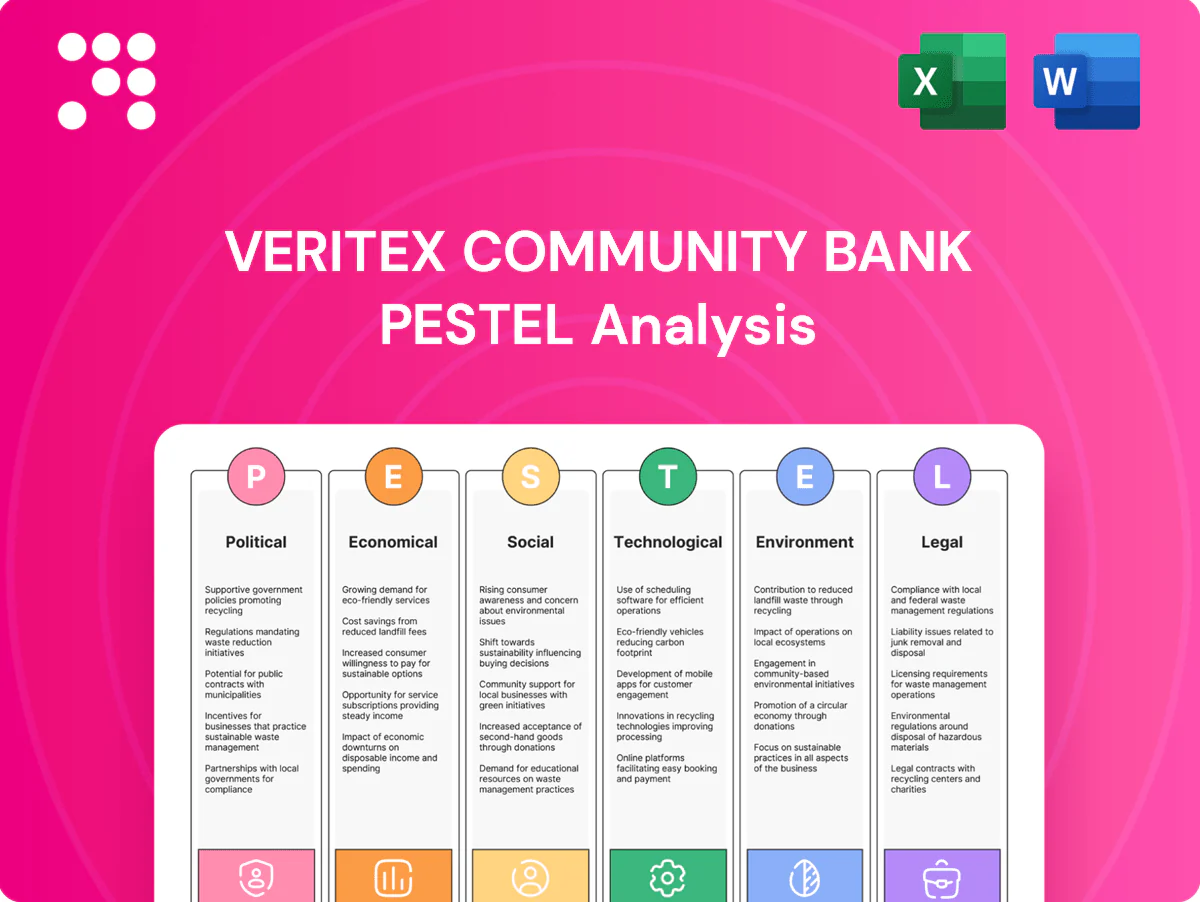
Veritex Community Bank PESTLE Analysis

Plan Smarter. Present Sharper. Compete Stronger.
Get a strategic advantage with our PESTLE Analysis of Veritex Community Bank — concise, current, and focused on the political, economic, social, technological, legal and environmental factors shaping its future. Ideal for investors, advisors, and strategists seeking actionable external insights. Purchase the full report to access detailed findings, risk assessments, and ready-to-use recommendations for immediate decision support.
Political factors

Texas policy climate
Pro-business Texas policies—backed by a $2.36 trillion state economy (BEA, 2023) and ~30 million residents (US Census est. 2024)—support community bank growth via incentives, infrastructure investment, and relatively light state-level banking regulation. Shifts in state leadership or priorities could change tax, housing or infrastructure funding and materially affect loan demand. Strong municipal ties create treasury and public finance opportunities, while local political stability aids branch expansion and SMB lending pipelines.
Federal banking oversight
Supervisory tone from the Fed, FDIC, and OCC since the 2023 regional bank failures (Silicon Valley Bank, Signature, First Republic) has tightened capital planning, examinations, and growth pacing for regional banks like Veritex. Regulators have signaled higher liquidity and interest-rate risk expectations, with stress-testing frameworks (CCAR applies to firms with assets above $100 billion) influencing portfolio choices. FDIC deposit insurance remains $250,000, and ongoing policy guidance on CRE concentration, deposit composition, and stress testing is reshaping lending and funding strategies; proposals for deposit insurance reform could raise funding costs and affect customer confidence.

CFPB consumer focus
CFPB consumer-protection priorities—rulemaking on overdraft and junk fees and heightened mortgage-servicing scrutiny—drive changes to fees, disclosures and product design for community banks like Veritex. Proposed CFPB rules in 2023–2024 signal potential compression of noninterest income from fees. Strong complaint management and fair-treatment practices reduce churn and reputational risk. Anticipating enforcement trends lowers remediation surprises and multi-million-dollar compliance hits.

Infrastructure and public spending
Federal Infrastructure Investment and Jobs Act commitments (110 billion for roads and bridges) plus ongoing state capital plans and Texas construction employment near 1.1 million (BLS 2024) catalyze SMB activity; contractors and suppliers require working capital, payroll and treasury services, while delays or funding cuts can dampen local loan demand; targeted outreach to project beneficiaries can capture deposit inflows and lending relationships.
- Federal funding scale: 110 billion roads/bridges
- Texas construction employment: ~1.1M (BLS 2024)
- Service demand: working capital, payroll, treasury
- Risk: project delays reduce loan demand
Geopolitics and energy
Global tensions drive oil and gas cycles central to Texas, where crude production was about 5.3 million barrels per day in 2023 (EIA), making regional energy swings material for local borrowers. Volatile energy prices compress cash flows and can weaken credit quality for E&P and services firms, raising concentration risk for banks with energy-linked portfolios.
- Geopolitics: direct impact on price cycles and regional activity
- Volatility: pressures borrower cash flow, credit metrics
- Sanctions/trade: disrupt equipment, logistics, exports
- Political support: sustains investment, stabilizes deposits
Texas growth, infrastructure cash, and energy swings reshape SMB lending and depositor behavior
Texas pro-business environment (state GDP $2.36T 2023; pop ~30M 2024) and $110B federal roads/bridges support SMB lending and treasury growth, while shifts in state priorities could cut loan demand. Post-2023 regional bank failures raised Fed/FDIC/OCC scrutiny, with FDIC insurance $250,000 affecting depositor behavior. Energy swings (US crude ~5.3M b/d 2023) amplify regional credit risk.
| Metric | Value |
|---|---|
| Texas GDP (2023) | $2.36T |
| Population (est 2024) | ~30M |
| Federal roads/bridges | $110B |
| FDIC insurance | $250,000 |
| US crude (2023) | ~5.3M b/d |
What is included in the product
 Detailed Word Document
Explores how Political, Economic, Social, Technological, Environmental and Legal forces uniquely impact Veritex Community Bank, with data-backed trends and region-specific regulatory context to identify risks and opportunities. Designed for executives and investors, the analysis offers forward-looking insights and concrete examples ready for inclusion in strategy documents and investor materials.

 Customizable Excel Spreadsheet
Provides a concise, visually segmented PESTLE summary of Veritex Community Bank for quick interpretation and easy insertion into presentations. Ideal for sharing across teams and adding context-specific notes during planning or client meetings.
Economic factors

Interest rate trajectory
Net interest margin for Veritex is highly sensitive to Federal Reserve policy, deposit betas and timing of asset repricing; with the federal funds target at 5.25–5.50% as of July 2025, rapid rate cuts would compress asset yields while prolonged elevated rates keep funding costs high and stress credit. Effective balance-sheet hedging and mix management (loan vs. investment composition) are critical to preserve margin. Local credit demand will reflect rate sensitivity among SMBs and consumers.
Texas growth dynamics
Texas population tops 30 million (U.S. Census Bureau 2024), and high-profile relocations such as Oracle and Tesla boost deposits, mortgage demand and commercial lending in key MSAs. Strong labor markets—employment growth outpacing many states—support consumer spending and fee income for community banks. Cyclical construction and housing activity drives CRE, C&I and builder finance exposure. Wide regional divergence across Texas MSAs mandates granular market selection.

CRE concentration risk
Veritex carries meaningful CRE exposure across office, retail and multifamily — CRE loans comprised roughly 60% of its loan portfolio in 2024 — leaving the bank sensitive to valuation resets and cap‑rate shifts that, combined with maturing loans, elevate refinancing risk and potential NPLs. Tight underwriting standards and strong sponsor quality have limited charge‑offs to low single digits recently, while strategic growth into C&I and owner‑occupied real estate aims to diversify and reduce CRE concentration risk.

Deposit competition
National banks, fintechs and money market funds bid up deposit rates, pushing retail savings yields above 4% in 2024–2025 and intensifying competition for core deposits. Veritex defends operating accounts through relationship banking and treasury services, while product innovation and disciplined pricing curb churn. Strong liquidity buffers and wholesale funding access sustain stability during stress.
- Relationship banking (defense: treasury services)
- Product innovation & pricing discipline (reduce churn)
- Liquidity buffers & wholesale access (stability in stress)
SMB cycle sensitivity
Small businesses, which employ roughly 47% of the US private workforce (SBA), are highly sensitive to costs, wages, and demand; economic slowdowns typically raise delinquencies and compress loan growth for community banks like Veritex. Advisory-led banking and cash-management services boost client stickiness, while targeted exposure to healthcare, services, and logistics enhances portfolio resilience.
- SMB sensitivity: costs, wages, demand
- Slowdown impact: higher delinquencies, lower loan growth
- Retention: advisory + cash management
- Sector focus: healthcare, services, logistics
Texas growth, infrastructure cash, and energy swings reshape SMB lending and depositor behavior
Fed funds 5.25–5.50% (Jul 2025) keeps NIM sensitive to deposit betas; prolonged high rates sustain funding costs while rapid cuts would compress yields. Texas pop >30M (2024) supports deposits and loan demand; CRE ~60% of loans (2024) raises refinancing risk. SMBs ~47% of private employment; deposit yields >4% (2024–25) intensify competition.
| Metric | Value |
|---|---|
| Fed funds (Jul 2025) | 5.25–5.50% |
| Texas pop (2024) | >30M |
| CRE share of loans (2024) | ~60% |
| SMB employment | ~47% |
| Retail deposit yields (2024–25) | >4% |
Same Document Delivered
Veritex Community Bank PESTLE Analysis
The Veritex Community Bank PESTLE Analysis preview shown here is the exact document you’ll receive after purchase—fully formatted, professionally structured, and ready to use. This is the real file, with no placeholders or teasers, and you’ll be able to download the same finished product immediately after checkout.

Plan Smarter. Present Sharper. Compete Stronger.
Get a strategic advantage with our PESTLE Analysis of Veritex Community Bank — concise, current, and focused on the political, economic, social, technological, legal and environmental factors shaping its future. Ideal for investors, advisors, and strategists seeking actionable external insights. Purchase the full report to access detailed findings, risk assessments, and ready-to-use recommendations for immediate decision support.
Political factors
Texas policy climate
Pro-business Texas policies—backed by a $2.36 trillion state economy (BEA, 2023) and ~30 million residents (US Census est. 2024)—support community bank growth via incentives, infrastructure investment, and relatively light state-level banking regulation. Shifts in state leadership or priorities could change tax, housing or infrastructure funding and materially affect loan demand. Strong municipal ties create treasury and public finance opportunities, while local political stability aids branch expansion and SMB lending pipelines.
Federal banking oversight
Supervisory tone from the Fed, FDIC, and OCC since the 2023 regional bank failures (Silicon Valley Bank, Signature, First Republic) has tightened capital planning, examinations, and growth pacing for regional banks like Veritex. Regulators have signaled higher liquidity and interest-rate risk expectations, with stress-testing frameworks (CCAR applies to firms with assets above $100 billion) influencing portfolio choices. FDIC deposit insurance remains $250,000, and ongoing policy guidance on CRE concentration, deposit composition, and stress testing is reshaping lending and funding strategies; proposals for deposit insurance reform could raise funding costs and affect customer confidence.
CFPB consumer focus
CFPB consumer-protection priorities—rulemaking on overdraft and junk fees and heightened mortgage-servicing scrutiny—drive changes to fees, disclosures and product design for community banks like Veritex. Proposed CFPB rules in 2023–2024 signal potential compression of noninterest income from fees. Strong complaint management and fair-treatment practices reduce churn and reputational risk. Anticipating enforcement trends lowers remediation surprises and multi-million-dollar compliance hits.
Infrastructure and public spending
Federal Infrastructure Investment and Jobs Act commitments (110 billion for roads and bridges) plus ongoing state capital plans and Texas construction employment near 1.1 million (BLS 2024) catalyze SMB activity; contractors and suppliers require working capital, payroll and treasury services, while delays or funding cuts can dampen local loan demand; targeted outreach to project beneficiaries can capture deposit inflows and lending relationships.
- Federal funding scale: 110 billion roads/bridges
- Texas construction employment: ~1.1M (BLS 2024)
- Service demand: working capital, payroll, treasury
- Risk: project delays reduce loan demand
Geopolitics and energy
Global tensions drive oil and gas cycles central to Texas, where crude production was about 5.3 million barrels per day in 2023 (EIA), making regional energy swings material for local borrowers. Volatile energy prices compress cash flows and can weaken credit quality for E&P and services firms, raising concentration risk for banks with energy-linked portfolios.
- Geopolitics: direct impact on price cycles and regional activity
- Volatility: pressures borrower cash flow, credit metrics
- Sanctions/trade: disrupt equipment, logistics, exports
- Political support: sustains investment, stabilizes deposits
Texas growth, infrastructure cash, and energy swings reshape SMB lending and depositor behavior
Texas pro-business environment (state GDP $2.36T 2023; pop ~30M 2024) and $110B federal roads/bridges support SMB lending and treasury growth, while shifts in state priorities could cut loan demand. Post-2023 regional bank failures raised Fed/FDIC/OCC scrutiny, with FDIC insurance $250,000 affecting depositor behavior. Energy swings (US crude ~5.3M b/d 2023) amplify regional credit risk.
| Metric | Value |
|---|---|
| Texas GDP (2023) | $2.36T |
| Population (est 2024) | ~30M |
| Federal roads/bridges | $110B |
| FDIC insurance | $250,000 |
| US crude (2023) | ~5.3M b/d |
What is included in the product
Detailed Word Document
Explores how Political, Economic, Social, Technological, Environmental and Legal forces uniquely impact Veritex Community Bank, with data-backed trends and region-specific regulatory context to identify risks and opportunities. Designed for executives and investors, the analysis offers forward-looking insights and concrete examples ready for inclusion in strategy documents and investor materials.
Customizable Excel Spreadsheet
Provides a concise, visually segmented PESTLE summary of Veritex Community Bank for quick interpretation and easy insertion into presentations. Ideal for sharing across teams and adding context-specific notes during planning or client meetings.
Economic factors
Interest rate trajectory
Net interest margin for Veritex is highly sensitive to Federal Reserve policy, deposit betas and timing of asset repricing; with the federal funds target at 5.25–5.50% as of July 2025, rapid rate cuts would compress asset yields while prolonged elevated rates keep funding costs high and stress credit. Effective balance-sheet hedging and mix management (loan vs. investment composition) are critical to preserve margin. Local credit demand will reflect rate sensitivity among SMBs and consumers.
Texas growth dynamics
Texas population tops 30 million (U.S. Census Bureau 2024), and high-profile relocations such as Oracle and Tesla boost deposits, mortgage demand and commercial lending in key MSAs. Strong labor markets—employment growth outpacing many states—support consumer spending and fee income for community banks. Cyclical construction and housing activity drives CRE, C&I and builder finance exposure. Wide regional divergence across Texas MSAs mandates granular market selection.
CRE concentration risk
Veritex carries meaningful CRE exposure across office, retail and multifamily — CRE loans comprised roughly 60% of its loan portfolio in 2024 — leaving the bank sensitive to valuation resets and cap‑rate shifts that, combined with maturing loans, elevate refinancing risk and potential NPLs. Tight underwriting standards and strong sponsor quality have limited charge‑offs to low single digits recently, while strategic growth into C&I and owner‑occupied real estate aims to diversify and reduce CRE concentration risk.
Deposit competition
National banks, fintechs and money market funds bid up deposit rates, pushing retail savings yields above 4% in 2024–2025 and intensifying competition for core deposits. Veritex defends operating accounts through relationship banking and treasury services, while product innovation and disciplined pricing curb churn. Strong liquidity buffers and wholesale funding access sustain stability during stress.
- Relationship banking (defense: treasury services)
- Product innovation & pricing discipline (reduce churn)
- Liquidity buffers & wholesale access (stability in stress)
SMB cycle sensitivity
Small businesses, which employ roughly 47% of the US private workforce (SBA), are highly sensitive to costs, wages, and demand; economic slowdowns typically raise delinquencies and compress loan growth for community banks like Veritex. Advisory-led banking and cash-management services boost client stickiness, while targeted exposure to healthcare, services, and logistics enhances portfolio resilience.
- SMB sensitivity: costs, wages, demand
- Slowdown impact: higher delinquencies, lower loan growth
- Retention: advisory + cash management
- Sector focus: healthcare, services, logistics
Texas growth, infrastructure cash, and energy swings reshape SMB lending and depositor behavior
Fed funds 5.25–5.50% (Jul 2025) keeps NIM sensitive to deposit betas; prolonged high rates sustain funding costs while rapid cuts would compress yields. Texas pop >30M (2024) supports deposits and loan demand; CRE ~60% of loans (2024) raises refinancing risk. SMBs ~47% of private employment; deposit yields >4% (2024–25) intensify competition.
| Metric | Value |
|---|---|
| Fed funds (Jul 2025) | 5.25–5.50% |
| Texas pop (2024) | >30M |
| CRE share of loans (2024) | ~60% |
| SMB employment | ~47% |
| Retail deposit yields (2024–25) | >4% |
Same Document Delivered
Veritex Community Bank PESTLE Analysis
The Veritex Community Bank PESTLE Analysis preview shown here is the exact document you’ll receive after purchase—fully formatted, professionally structured, and ready to use. This is the real file, with no placeholders or teasers, and you’ll be able to download the same finished product immediately after checkout.
Description
Plan Smarter. Present Sharper. Compete Stronger.
Get a strategic advantage with our PESTLE Analysis of Veritex Community Bank — concise, current, and focused on the political, economic, social, technological, legal and environmental factors shaping its future. Ideal for investors, advisors, and strategists seeking actionable external insights. Purchase the full report to access detailed findings, risk assessments, and ready-to-use recommendations for immediate decision support.
Political factors
Texas policy climate
Pro-business Texas policies—backed by a $2.36 trillion state economy (BEA, 2023) and ~30 million residents (US Census est. 2024)—support community bank growth via incentives, infrastructure investment, and relatively light state-level banking regulation. Shifts in state leadership or priorities could change tax, housing or infrastructure funding and materially affect loan demand. Strong municipal ties create treasury and public finance opportunities, while local political stability aids branch expansion and SMB lending pipelines.
Federal banking oversight
Supervisory tone from the Fed, FDIC, and OCC since the 2023 regional bank failures (Silicon Valley Bank, Signature, First Republic) has tightened capital planning, examinations, and growth pacing for regional banks like Veritex. Regulators have signaled higher liquidity and interest-rate risk expectations, with stress-testing frameworks (CCAR applies to firms with assets above $100 billion) influencing portfolio choices. FDIC deposit insurance remains $250,000, and ongoing policy guidance on CRE concentration, deposit composition, and stress testing is reshaping lending and funding strategies; proposals for deposit insurance reform could raise funding costs and affect customer confidence.
CFPB consumer focus
CFPB consumer-protection priorities—rulemaking on overdraft and junk fees and heightened mortgage-servicing scrutiny—drive changes to fees, disclosures and product design for community banks like Veritex. Proposed CFPB rules in 2023–2024 signal potential compression of noninterest income from fees. Strong complaint management and fair-treatment practices reduce churn and reputational risk. Anticipating enforcement trends lowers remediation surprises and multi-million-dollar compliance hits.
Infrastructure and public spending
Federal Infrastructure Investment and Jobs Act commitments (110 billion for roads and bridges) plus ongoing state capital plans and Texas construction employment near 1.1 million (BLS 2024) catalyze SMB activity; contractors and suppliers require working capital, payroll and treasury services, while delays or funding cuts can dampen local loan demand; targeted outreach to project beneficiaries can capture deposit inflows and lending relationships.
- Federal funding scale: 110 billion roads/bridges
- Texas construction employment: ~1.1M (BLS 2024)
- Service demand: working capital, payroll, treasury
- Risk: project delays reduce loan demand
Geopolitics and energy
Global tensions drive oil and gas cycles central to Texas, where crude production was about 5.3 million barrels per day in 2023 (EIA), making regional energy swings material for local borrowers. Volatile energy prices compress cash flows and can weaken credit quality for E&P and services firms, raising concentration risk for banks with energy-linked portfolios.
- Geopolitics: direct impact on price cycles and regional activity
- Volatility: pressures borrower cash flow, credit metrics
- Sanctions/trade: disrupt equipment, logistics, exports
- Political support: sustains investment, stabilizes deposits
Texas growth, infrastructure cash, and energy swings reshape SMB lending and depositor behavior
Texas pro-business environment (state GDP $2.36T 2023; pop ~30M 2024) and $110B federal roads/bridges support SMB lending and treasury growth, while shifts in state priorities could cut loan demand. Post-2023 regional bank failures raised Fed/FDIC/OCC scrutiny, with FDIC insurance $250,000 affecting depositor behavior. Energy swings (US crude ~5.3M b/d 2023) amplify regional credit risk.
| Metric | Value |
|---|---|
| Texas GDP (2023) | $2.36T |
| Population (est 2024) | ~30M |
| Federal roads/bridges | $110B |
| FDIC insurance | $250,000 |
| US crude (2023) | ~5.3M b/d |
What is included in the product
Detailed Word Document
Explores how Political, Economic, Social, Technological, Environmental and Legal forces uniquely impact Veritex Community Bank, with data-backed trends and region-specific regulatory context to identify risks and opportunities. Designed for executives and investors, the analysis offers forward-looking insights and concrete examples ready for inclusion in strategy documents and investor materials.
Customizable Excel Spreadsheet
Provides a concise, visually segmented PESTLE summary of Veritex Community Bank for quick interpretation and easy insertion into presentations. Ideal for sharing across teams and adding context-specific notes during planning or client meetings.
Economic factors
Interest rate trajectory
Net interest margin for Veritex is highly sensitive to Federal Reserve policy, deposit betas and timing of asset repricing; with the federal funds target at 5.25–5.50% as of July 2025, rapid rate cuts would compress asset yields while prolonged elevated rates keep funding costs high and stress credit. Effective balance-sheet hedging and mix management (loan vs. investment composition) are critical to preserve margin. Local credit demand will reflect rate sensitivity among SMBs and consumers.
Texas growth dynamics
Texas population tops 30 million (U.S. Census Bureau 2024), and high-profile relocations such as Oracle and Tesla boost deposits, mortgage demand and commercial lending in key MSAs. Strong labor markets—employment growth outpacing many states—support consumer spending and fee income for community banks. Cyclical construction and housing activity drives CRE, C&I and builder finance exposure. Wide regional divergence across Texas MSAs mandates granular market selection.
CRE concentration risk
Veritex carries meaningful CRE exposure across office, retail and multifamily — CRE loans comprised roughly 60% of its loan portfolio in 2024 — leaving the bank sensitive to valuation resets and cap‑rate shifts that, combined with maturing loans, elevate refinancing risk and potential NPLs. Tight underwriting standards and strong sponsor quality have limited charge‑offs to low single digits recently, while strategic growth into C&I and owner‑occupied real estate aims to diversify and reduce CRE concentration risk.
Deposit competition
National banks, fintechs and money market funds bid up deposit rates, pushing retail savings yields above 4% in 2024–2025 and intensifying competition for core deposits. Veritex defends operating accounts through relationship banking and treasury services, while product innovation and disciplined pricing curb churn. Strong liquidity buffers and wholesale funding access sustain stability during stress.
- Relationship banking (defense: treasury services)
- Product innovation & pricing discipline (reduce churn)
- Liquidity buffers & wholesale access (stability in stress)
SMB cycle sensitivity
Small businesses, which employ roughly 47% of the US private workforce (SBA), are highly sensitive to costs, wages, and demand; economic slowdowns typically raise delinquencies and compress loan growth for community banks like Veritex. Advisory-led banking and cash-management services boost client stickiness, while targeted exposure to healthcare, services, and logistics enhances portfolio resilience.
- SMB sensitivity: costs, wages, demand
- Slowdown impact: higher delinquencies, lower loan growth
- Retention: advisory + cash management
- Sector focus: healthcare, services, logistics
Texas growth, infrastructure cash, and energy swings reshape SMB lending and depositor behavior
Fed funds 5.25–5.50% (Jul 2025) keeps NIM sensitive to deposit betas; prolonged high rates sustain funding costs while rapid cuts would compress yields. Texas pop >30M (2024) supports deposits and loan demand; CRE ~60% of loans (2024) raises refinancing risk. SMBs ~47% of private employment; deposit yields >4% (2024–25) intensify competition.
| Metric | Value |
|---|---|
| Fed funds (Jul 2025) | 5.25–5.50% |
| Texas pop (2024) | >30M |
| CRE share of loans (2024) | ~60% |
| SMB employment | ~47% |
| Retail deposit yields (2024–25) | >4% |
Same Document Delivered
Veritex Community Bank PESTLE Analysis
The Veritex Community Bank PESTLE Analysis preview shown here is the exact document you’ll receive after purchase—fully formatted, professionally structured, and ready to use. This is the real file, with no placeholders or teasers, and you’ll be able to download the same finished product immediately after checkout.











