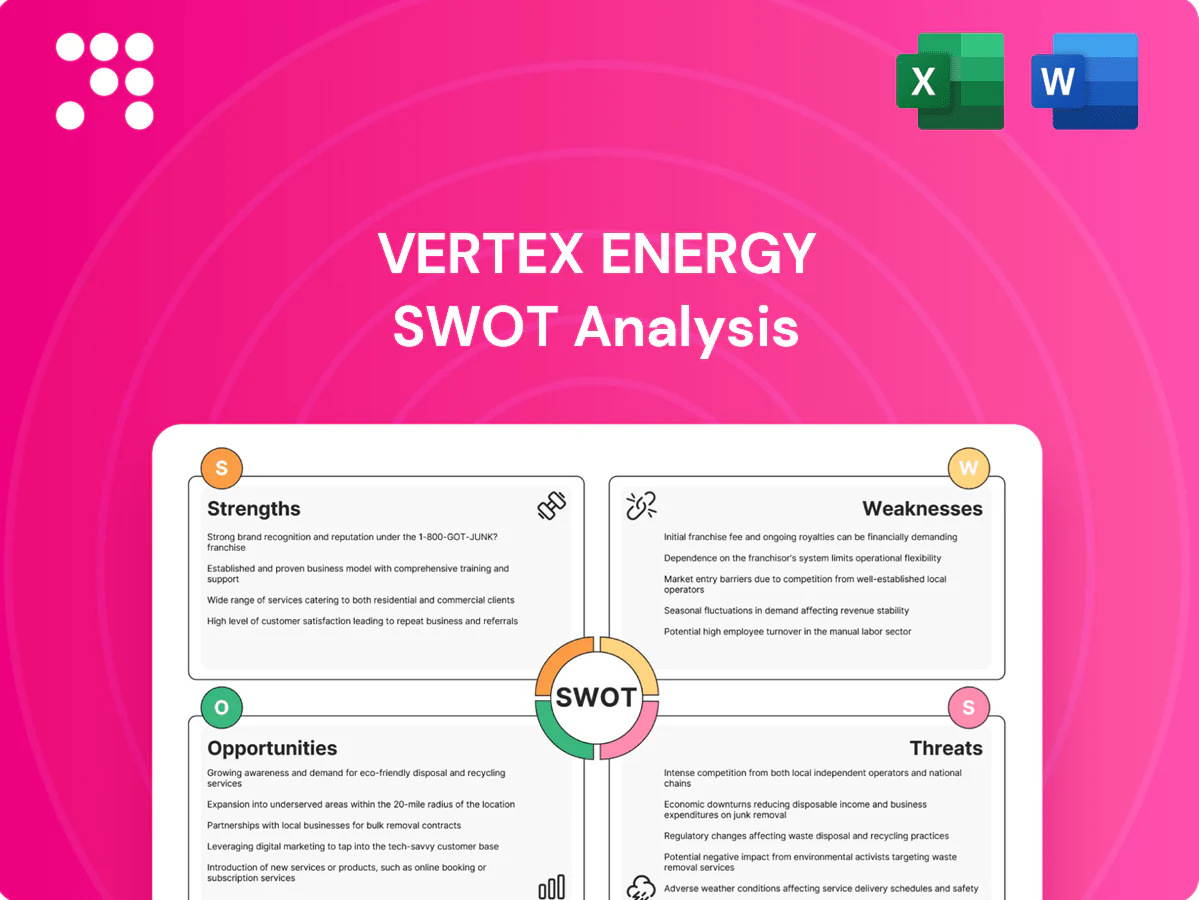
Vertex Energy SWOT Analysis

Your Strategic Toolkit Starts Here
Vertex Energy faces operational strengths in specialty refining and feedstock access but navigates volatility in oil markets and regulatory pressure; our concise SWOT highlights these dynamics and strategic levers. Want the full picture—purchase the complete SWOT to get a research-backed Word report plus an editable Excel matrix for planning and investment decisions.
Strengths

Energy-transition focus
Vertex Energy’s positioning as an energy-transition player aligns with shifting policies and capital flows such as IRA-era incentives that favor lower-carbon fuels, strengthening access to project financing and offtake partners.
Its emphasis on renewable diesel gives a clear growth vector beyond conventional refining, providing higher-margin, low-carbon product exposure attractive to fuel distributors and blenders.
The dual-track model—maintaining tolling/refining while expanding renewable diesel—can smooth cash-flow cycles, draw ESG-oriented partners, and preserve optionality into future low-carbon products like SAF and bio-based feedstocks.
Circular economy capabilities
Re-refining used motor oil and recycling waste streams give Vertex differentiated feedstock access and cost advantages by reducing reliance on virgin crude; circular services deepen customer relationships and generate recurring supply contracts. These activities can lower customers' Scope 3 intensity and bolster Vertexs brand credibility, while generating regulatory and community goodwill through demonstrated waste diversion and pollution reduction.

Integrated operations
Integrated operations across refining, re-refining and marketing (Vertex Energy, OTC: VTNR) allow margin capture along the value chain, improving feedstock logistics, utilization and product placement; vertical integration shortens cash cycles and boosts pricing power in niche recycled-fuel markets, enabling rapid pivots when market spreads shift.

Regulatory credit monetization
Renewable diesel output generates D3 RINs and LCFS credits (2024 ranges: D3 RINs roughly $0.80–$1.20/gal-eq; CA LCFS ~$100–$150/MT), materially boosting realized margins and providing cash-on-credit upside. Vertex’s ability to manage and monetize these credits in compliant markets is a financial strength that cushions weak crack spreads and enhances ROI on decarbonization capex.
- Credit revenue diversification
- Margin buffer vs crack spread volatility
- Improved payback on decarbonization capex
Asset flexibility
Asset flexibility lets Vertex process multiple hydrocarbon streams, supporting feedstock optionality and yield optimization while enabling shifts between conventional and alternative products to respond to market spreads and stabilize utilization and cash flow.
- Supports feedstock optionality
- Aids volatility navigation
- Enables opportunistic product shifts
Dual-track fuel refiner captures higher margins via renewable diesel, D3 RINs and LCFS credits
Vertex Energy (OTC: VTNR) leverages a dual-track model—conventional tolling plus renewable diesel—to stabilize cash flow and capture higher-margin low-carbon fuel demand. Renewable diesel production generates D3 RINs and CA LCFS credits that materially boost realized margins. Vertical integration and re-refining provide feedstock cost advantages and recurring waste-derived supply contracts.
| Metric | 2024 Range / Note |
|---|---|
| D3 RIN | $0.80–$1.20/gal-eq |
| CA LCFS | $100–$150/MT |
| Ticker | OTC: VTNR |
What is included in the product
 Detailed Word Document
Delivers a strategic overview of Vertex Energy’s internal and external business factors, outlining strengths, weaknesses, opportunities and threats to map its competitive position, key growth drivers, operational gaps and market risks.

 Customizable Excel Spreadsheet
Provides a concise, Vertex Energy–focused SWOT matrix to quickly align remediation, operational and growth strategies; editable format allows rapid updates as market, regulatory or feedstock conditions shift.
Weaknesses

Smaller scale
Compared with integrated majors that refine several million barrels per day (ExxonMobil ~4.3 million bpd in 2023), Vertex Energy’s much smaller footprint limits purchasing leverage and raises per‑barrel overhead, weakens bargaining power with suppliers and offtakers, and makes its capital‑market access and borrowing costs more sensitive to economic and credit cycles.
Capital intensity
Renewable diesel conversions and upgrades require significant upfront investment, often totaling tens to hundreds of millions of dollars per facility. Execution delays or cost overruns can strain liquidity and worsen leverage ratios, with industry capex overruns commonly in the mid-teens to low-30s percent range. Payback depends on sustained low-carbon fuel credit values and feedstock spreads, heightening financing and refinancing risk.

Commodity and credit volatility
Earnings at Vertex Energy remain exposed to swings in crack spreads and renewable fuel credits, with crack spread volatility and RINs rising to multi-year highs in 2023–24 and California LCFS credits averaging roughly $90–120/MT in 2024. Such volatility can compress margins quickly despite strong operations. Hedging is often imperfect or costly, raising breakeven risk. Forecasting for investors and lenders becomes more challenging as price swings widen.

Operational concentration
Operational concentration leaves Vertex reliant on a small number of refineries and terminals, so outages or reliability issues at those sites sharply raise interruption risk. Unplanned downtime can materially cut processed volumes and near-term cash flow, while scheduled maintenance turnarounds produce earnings lumpiness. Geographic concentration also amplifies exposure to regional weather events and localized market shocks.
- Dependence on key facilities
- Unplanned downtime → volume/cash flow impact
- Maintenance turnarounds cause earnings lumpiness
- Geographic/weather/regional market exposure
Feedstock constraints
Access to used cooking oil, tallow and other waste feedstocks is often regional and seasonal, causing supply shortfalls and quality variability that reduce yields and complicate processing. Intense competition from refiners and renewable diesel/biodiesel producers has driven up input costs and squeezed margins. Long-term supply contracts increasingly require price concessions or quality guarantees, raising working capital needs.
- Regional/seasonal shortages
- Quality variability lowers yields
- Competition elevates input prices
- Contracts demand concessions
Small refiner scale heightens capex, margin and liquidity risk amid volatile RIN/LCFS markets
Vertex’s small scale limits purchasing leverage versus majors (ExxonMobil ~4.3 million bpd in 2023), raising per‑barrel overhead and financing sensitivity. Renewable diesel conversions require large upfront capex with industry overruns commonly mid‑teens to low‑30s percent, stressing liquidity. Earnings remain exposed to crack spread and RIN/LCFS volatility (California LCFS ~$90–120/MT in 2024). Operational and feedstock concentration heightens outage and supply risks.
| Metric | Recent value/context |
|---|---|
| Major refiner scale | ExxonMobil ~4.3 million bpd (2023) |
| LCFS (CA) | $90–120/MT (2024) |
| Capex overrun range | Mid‑teens to low‑30s % (industry) |
| Credit volatility | RINs multi‑year highs in 2023–24 |
Preview the Actual Deliverable
Vertex Energy SWOT Analysis
This is the actual Vertex Energy SWOT analysis document you’ll receive upon purchase—no surprises, just professional quality. The preview below is taken directly from the full SWOT report you'll get; purchase unlocks the complete, editable version. You’re viewing a live excerpt of the real file, structured and ready to use after checkout.

Your Strategic Toolkit Starts Here
Vertex Energy faces operational strengths in specialty refining and feedstock access but navigates volatility in oil markets and regulatory pressure; our concise SWOT highlights these dynamics and strategic levers. Want the full picture—purchase the complete SWOT to get a research-backed Word report plus an editable Excel matrix for planning and investment decisions.
Strengths
Energy-transition focus
Vertex Energy’s positioning as an energy-transition player aligns with shifting policies and capital flows such as IRA-era incentives that favor lower-carbon fuels, strengthening access to project financing and offtake partners.
Its emphasis on renewable diesel gives a clear growth vector beyond conventional refining, providing higher-margin, low-carbon product exposure attractive to fuel distributors and blenders.
The dual-track model—maintaining tolling/refining while expanding renewable diesel—can smooth cash-flow cycles, draw ESG-oriented partners, and preserve optionality into future low-carbon products like SAF and bio-based feedstocks.
Circular economy capabilities
Re-refining used motor oil and recycling waste streams give Vertex differentiated feedstock access and cost advantages by reducing reliance on virgin crude; circular services deepen customer relationships and generate recurring supply contracts. These activities can lower customers' Scope 3 intensity and bolster Vertexs brand credibility, while generating regulatory and community goodwill through demonstrated waste diversion and pollution reduction.
Integrated operations
Integrated operations across refining, re-refining and marketing (Vertex Energy, OTC: VTNR) allow margin capture along the value chain, improving feedstock logistics, utilization and product placement; vertical integration shortens cash cycles and boosts pricing power in niche recycled-fuel markets, enabling rapid pivots when market spreads shift.
Regulatory credit monetization
Renewable diesel output generates D3 RINs and LCFS credits (2024 ranges: D3 RINs roughly $0.80–$1.20/gal-eq; CA LCFS ~$100–$150/MT), materially boosting realized margins and providing cash-on-credit upside. Vertex’s ability to manage and monetize these credits in compliant markets is a financial strength that cushions weak crack spreads and enhances ROI on decarbonization capex.
- Credit revenue diversification
- Margin buffer vs crack spread volatility
- Improved payback on decarbonization capex
Asset flexibility
Asset flexibility lets Vertex process multiple hydrocarbon streams, supporting feedstock optionality and yield optimization while enabling shifts between conventional and alternative products to respond to market spreads and stabilize utilization and cash flow.
- Supports feedstock optionality
- Aids volatility navigation
- Enables opportunistic product shifts
Dual-track fuel refiner captures higher margins via renewable diesel, D3 RINs and LCFS credits
Vertex Energy (OTC: VTNR) leverages a dual-track model—conventional tolling plus renewable diesel—to stabilize cash flow and capture higher-margin low-carbon fuel demand. Renewable diesel production generates D3 RINs and CA LCFS credits that materially boost realized margins. Vertical integration and re-refining provide feedstock cost advantages and recurring waste-derived supply contracts.
| Metric | 2024 Range / Note |
|---|---|
| D3 RIN | $0.80–$1.20/gal-eq |
| CA LCFS | $100–$150/MT |
| Ticker | OTC: VTNR |
What is included in the product
Detailed Word Document
Delivers a strategic overview of Vertex Energy’s internal and external business factors, outlining strengths, weaknesses, opportunities and threats to map its competitive position, key growth drivers, operational gaps and market risks.
Customizable Excel Spreadsheet
Provides a concise, Vertex Energy–focused SWOT matrix to quickly align remediation, operational and growth strategies; editable format allows rapid updates as market, regulatory or feedstock conditions shift.
Weaknesses
Smaller scale
Compared with integrated majors that refine several million barrels per day (ExxonMobil ~4.3 million bpd in 2023), Vertex Energy’s much smaller footprint limits purchasing leverage and raises per‑barrel overhead, weakens bargaining power with suppliers and offtakers, and makes its capital‑market access and borrowing costs more sensitive to economic and credit cycles.
Capital intensity
Renewable diesel conversions and upgrades require significant upfront investment, often totaling tens to hundreds of millions of dollars per facility. Execution delays or cost overruns can strain liquidity and worsen leverage ratios, with industry capex overruns commonly in the mid-teens to low-30s percent range. Payback depends on sustained low-carbon fuel credit values and feedstock spreads, heightening financing and refinancing risk.
Commodity and credit volatility
Earnings at Vertex Energy remain exposed to swings in crack spreads and renewable fuel credits, with crack spread volatility and RINs rising to multi-year highs in 2023–24 and California LCFS credits averaging roughly $90–120/MT in 2024. Such volatility can compress margins quickly despite strong operations. Hedging is often imperfect or costly, raising breakeven risk. Forecasting for investors and lenders becomes more challenging as price swings widen.
Operational concentration
Operational concentration leaves Vertex reliant on a small number of refineries and terminals, so outages or reliability issues at those sites sharply raise interruption risk. Unplanned downtime can materially cut processed volumes and near-term cash flow, while scheduled maintenance turnarounds produce earnings lumpiness. Geographic concentration also amplifies exposure to regional weather events and localized market shocks.
- Dependence on key facilities
- Unplanned downtime → volume/cash flow impact
- Maintenance turnarounds cause earnings lumpiness
- Geographic/weather/regional market exposure
Feedstock constraints
Access to used cooking oil, tallow and other waste feedstocks is often regional and seasonal, causing supply shortfalls and quality variability that reduce yields and complicate processing. Intense competition from refiners and renewable diesel/biodiesel producers has driven up input costs and squeezed margins. Long-term supply contracts increasingly require price concessions or quality guarantees, raising working capital needs.
- Regional/seasonal shortages
- Quality variability lowers yields
- Competition elevates input prices
- Contracts demand concessions
Small refiner scale heightens capex, margin and liquidity risk amid volatile RIN/LCFS markets
Vertex’s small scale limits purchasing leverage versus majors (ExxonMobil ~4.3 million bpd in 2023), raising per‑barrel overhead and financing sensitivity. Renewable diesel conversions require large upfront capex with industry overruns commonly mid‑teens to low‑30s percent, stressing liquidity. Earnings remain exposed to crack spread and RIN/LCFS volatility (California LCFS ~$90–120/MT in 2024). Operational and feedstock concentration heightens outage and supply risks.
| Metric | Recent value/context |
|---|---|
| Major refiner scale | ExxonMobil ~4.3 million bpd (2023) |
| LCFS (CA) | $90–120/MT (2024) |
| Capex overrun range | Mid‑teens to low‑30s % (industry) |
| Credit volatility | RINs multi‑year highs in 2023–24 |
Preview the Actual Deliverable
Vertex Energy SWOT Analysis
This is the actual Vertex Energy SWOT analysis document you’ll receive upon purchase—no surprises, just professional quality. The preview below is taken directly from the full SWOT report you'll get; purchase unlocks the complete, editable version. You’re viewing a live excerpt of the real file, structured and ready to use after checkout.
Original: $10.00
-65%$10.00
$3.50Description
Your Strategic Toolkit Starts Here
Vertex Energy faces operational strengths in specialty refining and feedstock access but navigates volatility in oil markets and regulatory pressure; our concise SWOT highlights these dynamics and strategic levers. Want the full picture—purchase the complete SWOT to get a research-backed Word report plus an editable Excel matrix for planning and investment decisions.
Strengths
Energy-transition focus
Vertex Energy’s positioning as an energy-transition player aligns with shifting policies and capital flows such as IRA-era incentives that favor lower-carbon fuels, strengthening access to project financing and offtake partners.
Its emphasis on renewable diesel gives a clear growth vector beyond conventional refining, providing higher-margin, low-carbon product exposure attractive to fuel distributors and blenders.
The dual-track model—maintaining tolling/refining while expanding renewable diesel—can smooth cash-flow cycles, draw ESG-oriented partners, and preserve optionality into future low-carbon products like SAF and bio-based feedstocks.
Circular economy capabilities
Re-refining used motor oil and recycling waste streams give Vertex differentiated feedstock access and cost advantages by reducing reliance on virgin crude; circular services deepen customer relationships and generate recurring supply contracts. These activities can lower customers' Scope 3 intensity and bolster Vertexs brand credibility, while generating regulatory and community goodwill through demonstrated waste diversion and pollution reduction.
Integrated operations
Integrated operations across refining, re-refining and marketing (Vertex Energy, OTC: VTNR) allow margin capture along the value chain, improving feedstock logistics, utilization and product placement; vertical integration shortens cash cycles and boosts pricing power in niche recycled-fuel markets, enabling rapid pivots when market spreads shift.
Regulatory credit monetization
Renewable diesel output generates D3 RINs and LCFS credits (2024 ranges: D3 RINs roughly $0.80–$1.20/gal-eq; CA LCFS ~$100–$150/MT), materially boosting realized margins and providing cash-on-credit upside. Vertex’s ability to manage and monetize these credits in compliant markets is a financial strength that cushions weak crack spreads and enhances ROI on decarbonization capex.
- Credit revenue diversification
- Margin buffer vs crack spread volatility
- Improved payback on decarbonization capex
Asset flexibility
Asset flexibility lets Vertex process multiple hydrocarbon streams, supporting feedstock optionality and yield optimization while enabling shifts between conventional and alternative products to respond to market spreads and stabilize utilization and cash flow.
- Supports feedstock optionality
- Aids volatility navigation
- Enables opportunistic product shifts
Dual-track fuel refiner captures higher margins via renewable diesel, D3 RINs and LCFS credits
Vertex Energy (OTC: VTNR) leverages a dual-track model—conventional tolling plus renewable diesel—to stabilize cash flow and capture higher-margin low-carbon fuel demand. Renewable diesel production generates D3 RINs and CA LCFS credits that materially boost realized margins. Vertical integration and re-refining provide feedstock cost advantages and recurring waste-derived supply contracts.
| Metric | 2024 Range / Note |
|---|---|
| D3 RIN | $0.80–$1.20/gal-eq |
| CA LCFS | $100–$150/MT |
| Ticker | OTC: VTNR |
What is included in the product
Detailed Word Document
Delivers a strategic overview of Vertex Energy’s internal and external business factors, outlining strengths, weaknesses, opportunities and threats to map its competitive position, key growth drivers, operational gaps and market risks.
Customizable Excel Spreadsheet
Provides a concise, Vertex Energy–focused SWOT matrix to quickly align remediation, operational and growth strategies; editable format allows rapid updates as market, regulatory or feedstock conditions shift.
Weaknesses
Smaller scale
Compared with integrated majors that refine several million barrels per day (ExxonMobil ~4.3 million bpd in 2023), Vertex Energy’s much smaller footprint limits purchasing leverage and raises per‑barrel overhead, weakens bargaining power with suppliers and offtakers, and makes its capital‑market access and borrowing costs more sensitive to economic and credit cycles.
Capital intensity
Renewable diesel conversions and upgrades require significant upfront investment, often totaling tens to hundreds of millions of dollars per facility. Execution delays or cost overruns can strain liquidity and worsen leverage ratios, with industry capex overruns commonly in the mid-teens to low-30s percent range. Payback depends on sustained low-carbon fuel credit values and feedstock spreads, heightening financing and refinancing risk.
Commodity and credit volatility
Earnings at Vertex Energy remain exposed to swings in crack spreads and renewable fuel credits, with crack spread volatility and RINs rising to multi-year highs in 2023–24 and California LCFS credits averaging roughly $90–120/MT in 2024. Such volatility can compress margins quickly despite strong operations. Hedging is often imperfect or costly, raising breakeven risk. Forecasting for investors and lenders becomes more challenging as price swings widen.
Operational concentration
Operational concentration leaves Vertex reliant on a small number of refineries and terminals, so outages or reliability issues at those sites sharply raise interruption risk. Unplanned downtime can materially cut processed volumes and near-term cash flow, while scheduled maintenance turnarounds produce earnings lumpiness. Geographic concentration also amplifies exposure to regional weather events and localized market shocks.
- Dependence on key facilities
- Unplanned downtime → volume/cash flow impact
- Maintenance turnarounds cause earnings lumpiness
- Geographic/weather/regional market exposure
Feedstock constraints
Access to used cooking oil, tallow and other waste feedstocks is often regional and seasonal, causing supply shortfalls and quality variability that reduce yields and complicate processing. Intense competition from refiners and renewable diesel/biodiesel producers has driven up input costs and squeezed margins. Long-term supply contracts increasingly require price concessions or quality guarantees, raising working capital needs.
- Regional/seasonal shortages
- Quality variability lowers yields
- Competition elevates input prices
- Contracts demand concessions
Small refiner scale heightens capex, margin and liquidity risk amid volatile RIN/LCFS markets
Vertex’s small scale limits purchasing leverage versus majors (ExxonMobil ~4.3 million bpd in 2023), raising per‑barrel overhead and financing sensitivity. Renewable diesel conversions require large upfront capex with industry overruns commonly mid‑teens to low‑30s percent, stressing liquidity. Earnings remain exposed to crack spread and RIN/LCFS volatility (California LCFS ~$90–120/MT in 2024). Operational and feedstock concentration heightens outage and supply risks.
| Metric | Recent value/context |
|---|---|
| Major refiner scale | ExxonMobil ~4.3 million bpd (2023) |
| LCFS (CA) | $90–120/MT (2024) |
| Capex overrun range | Mid‑teens to low‑30s % (industry) |
| Credit volatility | RINs multi‑year highs in 2023–24 |
Preview the Actual Deliverable
Vertex Energy SWOT Analysis
This is the actual Vertex Energy SWOT analysis document you’ll receive upon purchase—no surprises, just professional quality. The preview below is taken directly from the full SWOT report you'll get; purchase unlocks the complete, editable version. You’re viewing a live excerpt of the real file, structured and ready to use after checkout.











