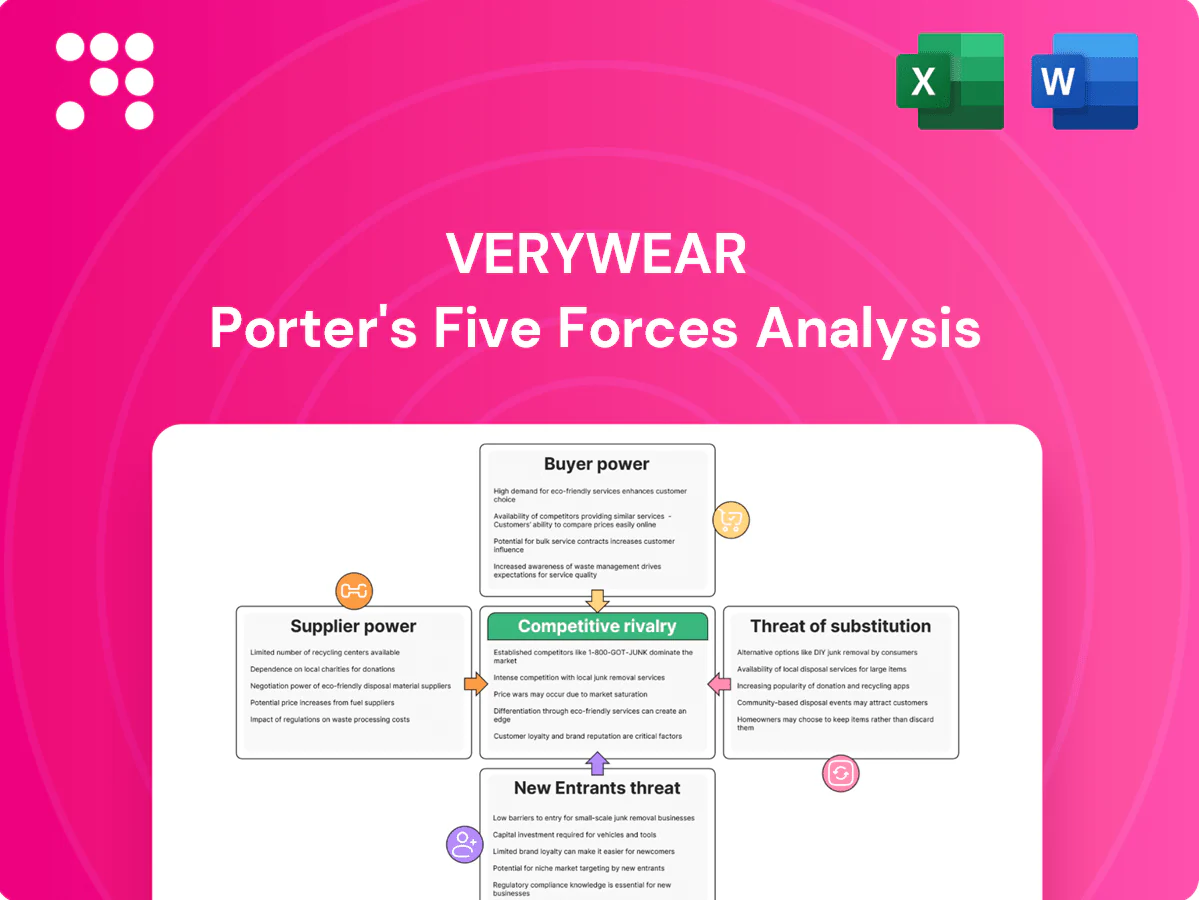
Verywear Porter's Five Forces Analysis

From Overview to Strategy Blueprint
Verywear faces moderate buyer power, concentrated supplier risks, niche rivalry, manageable entry barriers, and evolving substitute threats that together shape margins and growth.
This brief snapshot only scratches the surface—unlock the full Porter's Five Forces Analysis to explore Verywear’s competitive dynamics, market pressures, and strategic advantages in detail.
Get consultant-grade visuals, force-by-force ratings, and ready-to-use Word/Excel deliverables to inform investment or strategic decisions today.
Suppliers Bargaining Power

Diverse global sourcing base
Garment suppliers are numerous across Asia, Eastern Europe and North Africa, keeping switching options open and unit costs competitive; China, Vietnam and Bangladesh still account for well over half of global apparel exports in 2024. Verywear can dual-source core categories to limit overreliance on any single factory and tighten procurement leverage. This breadth generally moderates supplier power, but peak-season capacity constraints still give top-tier vendors notable short-term leverage.
Brand and fabric dependencies
Verywear's proprietary labels (Cevimod, Devianne, Magvet, Stanford) lower reliance on third-party brands but critical fabric mills and trims suppliers still create chokepoints. In 2024 specialized materials and unique washes heightened supplier leverage, particularly in long-lead categories like outerwear and denim. Vendor consolidation for quality control can inadvertently raise the bargaining power of selected partners.

Input cost volatility
Volatility in cotton and polyester feedstocks plus freight lets suppliers pass on hikes; container spot rates plunged from pandemic peaks near $20,000 to about $1,500–2,000 by 2024, while ICE Cotton futures swung roughly 20–30% in 2023–24. Hedging and forwards blunt spikes but do not eliminate short-term shocks. Currency moves can change landed costs by several percentage points. Suppliers with stronger balance sheets absorb margin pressure and gain bargaining power.

Compliance and ESG requirements
Heightened labor, traceability, and sustainability standards have narrowed Verywears eligible vendor pool, increasing supplier leverage as compliant factories command premiums and longer-term commitments. Audit, certification, and remediation costs shift negotiating power toward vetted suppliers who absorb compliance hurdles. Nearshoring for speed-to-market further limits supplier options and raises supplier bargaining power.
- narrower vendor pool
- premiums & longer contracts
- audit/certification costs shift power
- nearshoring increases supplier leverage
Switching and development costs
Changing vendors requires sampling ($200–$2,000 per style), fit approvals, MOQ renegotiations (typical apparel MOQs 500–2,000 units) and tooling (often $5k–$50k), creating clear frictions and 4–12 week onboarding. Complex styles and tailored fits raise onboarding time/costs, strengthening supplier leverage. Basics have lower switching costs, keeping supplier power low; fashion-forward capsules boost supplier know‑how and negotiating position.
- Sampling cost: $200–$2,000
- MOQ: 500–2,000 units
- Tooling: $5k–$50k
- Onboarding: 4–12 weeks
Moderate supplier power amid diversified Asian, Eastern European and North African sourcing
Supplier power is moderate: diversified Asian/Eastern European/North African supply keeps prices competitive but top vendors gain short-term leverage in peak seasons. Specialized mills, compliance-ready factories and nearshoring raise supplier bargaining, while apparel basics retain low switching costs. Input/freight volatility and compliance premiums can shift costs quickly, boosting suppliers with stronger balance sheets.
| Metric | Value |
|---|---|
| China/Vietnam/Bangladesh export share (2024) | ~55% |
| Container spot rate (2024) | $1,500–$2,000 |
| ICE Cotton futures swing (2023–24) | 20–30% |
| Sampling / MOQ / Tooling / Onboarding | $200–2,000 · 500–2,000 units · $5k–50k · 4–12 weeks |
What is included in the product
 Detailed Word Document
Concise Porter's Five Forces analysis for Verywear uncovering competitive rivalry, buyer and supplier power, threat of substitutes and new entrants, plus emergent disruptors and pricing pressures to inform strategic and investor decisions.

 Customizable Excel Spreadsheet
A concise one-sheet Porter's Five Forces for Verywear—visual spider chart and editable pressure levels let teams instantly spot strategic threats, tweak scenarios for new entrants or regulations, and copy clean slides into decks without macros or finance expertise.
Customers Bargaining Power

Abundant alternatives
Customers face abundant alternatives—fast fashion, specialty chains, department stores, supermarkets and online marketplaces—within a global apparel market of about $1.5 trillion in 2024, with e-commerce ~23% of sales. Low switching costs drive price sensitivity and frequent comparison shopping. Wide availability erodes loyalty; Verywear’s multi-brand assortment must differentiate on value and curated selection to retain shoppers.
Price transparency online
Digital comparisons and promotions compress margins as 69% of UK shoppers compare prices online and The Very Group, with roughly £2.7bn annual retail sales, faces intense price visibility.
Platform reach lets Very segment offers and optimize pricing, but informed shoppers still bargain-hunt across channels.
Regular clearance and markdown cadence trains waiting behavior; data-driven personalization can partially offset pure price pressure by improving conversion and AOV.

Fashion volatility
Trends shift quickly, giving buyers clout through selective demand; apparel markdowns ran around 30% in 2023–24, transferring cost to retailers when styles miss. Speed-to-market (fast-fashion leaders 2–4 week cycles vs traditional 12+ weeks) and test-and-repeat models blunt this buyer edge. Verywear's broad style and price coverage cushions assortment risk by enabling higher overall sell-through.

Loyalty and financing levers
Loyalty, memberships and BNPL at The Very Group lock in repeat spend by raising perceived switching costs and raising customer lifetime value; industry BNPL volumes in the UK reached multi‑billion levels by 2023, boosting platform stickiness. These tools lower buyer power but create higher service and returns expectations; missed SLAs quickly reverse leverage back to customers.
- Memberships: increase retention and repeat frequency
- BNPL: drives conversion and basket size
- Higher expectations: faster shipping, lenient returns
- SLA failures: shift bargaining power to buyers
Returns and fit expectations
Free or easy returns boost buyer bargaining power and raise fulfillment costs; online apparel return rates were about 25% in 2024 with average return handling costs around $18, while in-store returns averaged ~8%, lowering buyer leverage. Better fit accuracy, consistent sizing and richer product content cut returns; in-store try-on reduces uncertainty versus pure-play e-commerce. Hybrid return policies can lift conversion while protecting margins.
- 2024 online return rate ~25%
- In-store return rate ~8%
- Avg return cost ~$18
- Hybrid policies reduce returns 5–7 ppt
Ecommerce growth and 25% return rates force apparel retailers to personalize and speed up
Customers have high bargaining power: abundant channels, low switching costs and strong price transparency (e-commerce ~23% of $1.5T apparel market in 2024) pressure margins. Loyalty tools (memberships, BNPL) raise CLV but increase service expectations; 2024 online returns ~25% (avg cost ~$18) further transfer cost to retailers. Verywear must differentiate assortment, speed and personalization to retain buyers.
| Metric | Value (Year) |
|---|---|
| Global apparel market | $1.5T (2024) |
| E‑commerce share | 23% (2024) |
| The Very Group sales | £2.7bn (~2023–24) |
| Online return rate | 25% (2024) |
| Avg return cost | $18 |
Full Version Awaits
Verywear Porter's Five Forces Analysis
This preview shows the exact Verywear Porter's Five Forces Analysis you'll receive after purchase—no placeholders or mockups. The file is fully formatted, professionally written, and ready for immediate download and use. What you see here is precisely what you’ll get.

From Overview to Strategy Blueprint
Verywear faces moderate buyer power, concentrated supplier risks, niche rivalry, manageable entry barriers, and evolving substitute threats that together shape margins and growth.
This brief snapshot only scratches the surface—unlock the full Porter's Five Forces Analysis to explore Verywear’s competitive dynamics, market pressures, and strategic advantages in detail.
Get consultant-grade visuals, force-by-force ratings, and ready-to-use Word/Excel deliverables to inform investment or strategic decisions today.
Suppliers Bargaining Power
Diverse global sourcing base
Garment suppliers are numerous across Asia, Eastern Europe and North Africa, keeping switching options open and unit costs competitive; China, Vietnam and Bangladesh still account for well over half of global apparel exports in 2024. Verywear can dual-source core categories to limit overreliance on any single factory and tighten procurement leverage. This breadth generally moderates supplier power, but peak-season capacity constraints still give top-tier vendors notable short-term leverage.
Brand and fabric dependencies
Verywear's proprietary labels (Cevimod, Devianne, Magvet, Stanford) lower reliance on third-party brands but critical fabric mills and trims suppliers still create chokepoints. In 2024 specialized materials and unique washes heightened supplier leverage, particularly in long-lead categories like outerwear and denim. Vendor consolidation for quality control can inadvertently raise the bargaining power of selected partners.
Input cost volatility
Volatility in cotton and polyester feedstocks plus freight lets suppliers pass on hikes; container spot rates plunged from pandemic peaks near $20,000 to about $1,500–2,000 by 2024, while ICE Cotton futures swung roughly 20–30% in 2023–24. Hedging and forwards blunt spikes but do not eliminate short-term shocks. Currency moves can change landed costs by several percentage points. Suppliers with stronger balance sheets absorb margin pressure and gain bargaining power.
Compliance and ESG requirements
Heightened labor, traceability, and sustainability standards have narrowed Verywears eligible vendor pool, increasing supplier leverage as compliant factories command premiums and longer-term commitments. Audit, certification, and remediation costs shift negotiating power toward vetted suppliers who absorb compliance hurdles. Nearshoring for speed-to-market further limits supplier options and raises supplier bargaining power.
- narrower vendor pool
- premiums & longer contracts
- audit/certification costs shift power
- nearshoring increases supplier leverage
Switching and development costs
Changing vendors requires sampling ($200–$2,000 per style), fit approvals, MOQ renegotiations (typical apparel MOQs 500–2,000 units) and tooling (often $5k–$50k), creating clear frictions and 4–12 week onboarding. Complex styles and tailored fits raise onboarding time/costs, strengthening supplier leverage. Basics have lower switching costs, keeping supplier power low; fashion-forward capsules boost supplier know‑how and negotiating position.
- Sampling cost: $200–$2,000
- MOQ: 500–2,000 units
- Tooling: $5k–$50k
- Onboarding: 4–12 weeks
Moderate supplier power amid diversified Asian, Eastern European and North African sourcing
Supplier power is moderate: diversified Asian/Eastern European/North African supply keeps prices competitive but top vendors gain short-term leverage in peak seasons. Specialized mills, compliance-ready factories and nearshoring raise supplier bargaining, while apparel basics retain low switching costs. Input/freight volatility and compliance premiums can shift costs quickly, boosting suppliers with stronger balance sheets.
| Metric | Value |
|---|---|
| China/Vietnam/Bangladesh export share (2024) | ~55% |
| Container spot rate (2024) | $1,500–$2,000 |
| ICE Cotton futures swing (2023–24) | 20–30% |
| Sampling / MOQ / Tooling / Onboarding | $200–2,000 · 500–2,000 units · $5k–50k · 4–12 weeks |
What is included in the product
Detailed Word Document
Concise Porter's Five Forces analysis for Verywear uncovering competitive rivalry, buyer and supplier power, threat of substitutes and new entrants, plus emergent disruptors and pricing pressures to inform strategic and investor decisions.
Customizable Excel Spreadsheet
A concise one-sheet Porter's Five Forces for Verywear—visual spider chart and editable pressure levels let teams instantly spot strategic threats, tweak scenarios for new entrants or regulations, and copy clean slides into decks without macros or finance expertise.
Customers Bargaining Power
Abundant alternatives
Customers face abundant alternatives—fast fashion, specialty chains, department stores, supermarkets and online marketplaces—within a global apparel market of about $1.5 trillion in 2024, with e-commerce ~23% of sales. Low switching costs drive price sensitivity and frequent comparison shopping. Wide availability erodes loyalty; Verywear’s multi-brand assortment must differentiate on value and curated selection to retain shoppers.
Price transparency online
Digital comparisons and promotions compress margins as 69% of UK shoppers compare prices online and The Very Group, with roughly £2.7bn annual retail sales, faces intense price visibility.
Platform reach lets Very segment offers and optimize pricing, but informed shoppers still bargain-hunt across channels.
Regular clearance and markdown cadence trains waiting behavior; data-driven personalization can partially offset pure price pressure by improving conversion and AOV.
Fashion volatility
Trends shift quickly, giving buyers clout through selective demand; apparel markdowns ran around 30% in 2023–24, transferring cost to retailers when styles miss. Speed-to-market (fast-fashion leaders 2–4 week cycles vs traditional 12+ weeks) and test-and-repeat models blunt this buyer edge. Verywear's broad style and price coverage cushions assortment risk by enabling higher overall sell-through.
Loyalty and financing levers
Loyalty, memberships and BNPL at The Very Group lock in repeat spend by raising perceived switching costs and raising customer lifetime value; industry BNPL volumes in the UK reached multi‑billion levels by 2023, boosting platform stickiness. These tools lower buyer power but create higher service and returns expectations; missed SLAs quickly reverse leverage back to customers.
- Memberships: increase retention and repeat frequency
- BNPL: drives conversion and basket size
- Higher expectations: faster shipping, lenient returns
- SLA failures: shift bargaining power to buyers
Returns and fit expectations
Free or easy returns boost buyer bargaining power and raise fulfillment costs; online apparel return rates were about 25% in 2024 with average return handling costs around $18, while in-store returns averaged ~8%, lowering buyer leverage. Better fit accuracy, consistent sizing and richer product content cut returns; in-store try-on reduces uncertainty versus pure-play e-commerce. Hybrid return policies can lift conversion while protecting margins.
- 2024 online return rate ~25%
- In-store return rate ~8%
- Avg return cost ~$18
- Hybrid policies reduce returns 5–7 ppt
Ecommerce growth and 25% return rates force apparel retailers to personalize and speed up
Customers have high bargaining power: abundant channels, low switching costs and strong price transparency (e-commerce ~23% of $1.5T apparel market in 2024) pressure margins. Loyalty tools (memberships, BNPL) raise CLV but increase service expectations; 2024 online returns ~25% (avg cost ~$18) further transfer cost to retailers. Verywear must differentiate assortment, speed and personalization to retain buyers.
| Metric | Value (Year) |
|---|---|
| Global apparel market | $1.5T (2024) |
| E‑commerce share | 23% (2024) |
| The Very Group sales | £2.7bn (~2023–24) |
| Online return rate | 25% (2024) |
| Avg return cost | $18 |
Full Version Awaits
Verywear Porter's Five Forces Analysis
This preview shows the exact Verywear Porter's Five Forces Analysis you'll receive after purchase—no placeholders or mockups. The file is fully formatted, professionally written, and ready for immediate download and use. What you see here is precisely what you’ll get.
Original: $10.00
-65%$10.00
$3.50Description
From Overview to Strategy Blueprint
Verywear faces moderate buyer power, concentrated supplier risks, niche rivalry, manageable entry barriers, and evolving substitute threats that together shape margins and growth.
This brief snapshot only scratches the surface—unlock the full Porter's Five Forces Analysis to explore Verywear’s competitive dynamics, market pressures, and strategic advantages in detail.
Get consultant-grade visuals, force-by-force ratings, and ready-to-use Word/Excel deliverables to inform investment or strategic decisions today.
Suppliers Bargaining Power
Diverse global sourcing base
Garment suppliers are numerous across Asia, Eastern Europe and North Africa, keeping switching options open and unit costs competitive; China, Vietnam and Bangladesh still account for well over half of global apparel exports in 2024. Verywear can dual-source core categories to limit overreliance on any single factory and tighten procurement leverage. This breadth generally moderates supplier power, but peak-season capacity constraints still give top-tier vendors notable short-term leverage.
Brand and fabric dependencies
Verywear's proprietary labels (Cevimod, Devianne, Magvet, Stanford) lower reliance on third-party brands but critical fabric mills and trims suppliers still create chokepoints. In 2024 specialized materials and unique washes heightened supplier leverage, particularly in long-lead categories like outerwear and denim. Vendor consolidation for quality control can inadvertently raise the bargaining power of selected partners.
Input cost volatility
Volatility in cotton and polyester feedstocks plus freight lets suppliers pass on hikes; container spot rates plunged from pandemic peaks near $20,000 to about $1,500–2,000 by 2024, while ICE Cotton futures swung roughly 20–30% in 2023–24. Hedging and forwards blunt spikes but do not eliminate short-term shocks. Currency moves can change landed costs by several percentage points. Suppliers with stronger balance sheets absorb margin pressure and gain bargaining power.
Compliance and ESG requirements
Heightened labor, traceability, and sustainability standards have narrowed Verywears eligible vendor pool, increasing supplier leverage as compliant factories command premiums and longer-term commitments. Audit, certification, and remediation costs shift negotiating power toward vetted suppliers who absorb compliance hurdles. Nearshoring for speed-to-market further limits supplier options and raises supplier bargaining power.
- narrower vendor pool
- premiums & longer contracts
- audit/certification costs shift power
- nearshoring increases supplier leverage
Switching and development costs
Changing vendors requires sampling ($200–$2,000 per style), fit approvals, MOQ renegotiations (typical apparel MOQs 500–2,000 units) and tooling (often $5k–$50k), creating clear frictions and 4–12 week onboarding. Complex styles and tailored fits raise onboarding time/costs, strengthening supplier leverage. Basics have lower switching costs, keeping supplier power low; fashion-forward capsules boost supplier know‑how and negotiating position.
- Sampling cost: $200–$2,000
- MOQ: 500–2,000 units
- Tooling: $5k–$50k
- Onboarding: 4–12 weeks
Moderate supplier power amid diversified Asian, Eastern European and North African sourcing
Supplier power is moderate: diversified Asian/Eastern European/North African supply keeps prices competitive but top vendors gain short-term leverage in peak seasons. Specialized mills, compliance-ready factories and nearshoring raise supplier bargaining, while apparel basics retain low switching costs. Input/freight volatility and compliance premiums can shift costs quickly, boosting suppliers with stronger balance sheets.
| Metric | Value |
|---|---|
| China/Vietnam/Bangladesh export share (2024) | ~55% |
| Container spot rate (2024) | $1,500–$2,000 |
| ICE Cotton futures swing (2023–24) | 20–30% |
| Sampling / MOQ / Tooling / Onboarding | $200–2,000 · 500–2,000 units · $5k–50k · 4–12 weeks |
What is included in the product
Detailed Word Document
Concise Porter's Five Forces analysis for Verywear uncovering competitive rivalry, buyer and supplier power, threat of substitutes and new entrants, plus emergent disruptors and pricing pressures to inform strategic and investor decisions.
Customizable Excel Spreadsheet
A concise one-sheet Porter's Five Forces for Verywear—visual spider chart and editable pressure levels let teams instantly spot strategic threats, tweak scenarios for new entrants or regulations, and copy clean slides into decks without macros or finance expertise.
Customers Bargaining Power
Abundant alternatives
Customers face abundant alternatives—fast fashion, specialty chains, department stores, supermarkets and online marketplaces—within a global apparel market of about $1.5 trillion in 2024, with e-commerce ~23% of sales. Low switching costs drive price sensitivity and frequent comparison shopping. Wide availability erodes loyalty; Verywear’s multi-brand assortment must differentiate on value and curated selection to retain shoppers.
Price transparency online
Digital comparisons and promotions compress margins as 69% of UK shoppers compare prices online and The Very Group, with roughly £2.7bn annual retail sales, faces intense price visibility.
Platform reach lets Very segment offers and optimize pricing, but informed shoppers still bargain-hunt across channels.
Regular clearance and markdown cadence trains waiting behavior; data-driven personalization can partially offset pure price pressure by improving conversion and AOV.
Fashion volatility
Trends shift quickly, giving buyers clout through selective demand; apparel markdowns ran around 30% in 2023–24, transferring cost to retailers when styles miss. Speed-to-market (fast-fashion leaders 2–4 week cycles vs traditional 12+ weeks) and test-and-repeat models blunt this buyer edge. Verywear's broad style and price coverage cushions assortment risk by enabling higher overall sell-through.
Loyalty and financing levers
Loyalty, memberships and BNPL at The Very Group lock in repeat spend by raising perceived switching costs and raising customer lifetime value; industry BNPL volumes in the UK reached multi‑billion levels by 2023, boosting platform stickiness. These tools lower buyer power but create higher service and returns expectations; missed SLAs quickly reverse leverage back to customers.
- Memberships: increase retention and repeat frequency
- BNPL: drives conversion and basket size
- Higher expectations: faster shipping, lenient returns
- SLA failures: shift bargaining power to buyers
Returns and fit expectations
Free or easy returns boost buyer bargaining power and raise fulfillment costs; online apparel return rates were about 25% in 2024 with average return handling costs around $18, while in-store returns averaged ~8%, lowering buyer leverage. Better fit accuracy, consistent sizing and richer product content cut returns; in-store try-on reduces uncertainty versus pure-play e-commerce. Hybrid return policies can lift conversion while protecting margins.
- 2024 online return rate ~25%
- In-store return rate ~8%
- Avg return cost ~$18
- Hybrid policies reduce returns 5–7 ppt
Ecommerce growth and 25% return rates force apparel retailers to personalize and speed up
Customers have high bargaining power: abundant channels, low switching costs and strong price transparency (e-commerce ~23% of $1.5T apparel market in 2024) pressure margins. Loyalty tools (memberships, BNPL) raise CLV but increase service expectations; 2024 online returns ~25% (avg cost ~$18) further transfer cost to retailers. Verywear must differentiate assortment, speed and personalization to retain buyers.
| Metric | Value (Year) |
|---|---|
| Global apparel market | $1.5T (2024) |
| E‑commerce share | 23% (2024) |
| The Very Group sales | £2.7bn (~2023–24) |
| Online return rate | 25% (2024) |
| Avg return cost | $18 |
Full Version Awaits
Verywear Porter's Five Forces Analysis
This preview shows the exact Verywear Porter's Five Forces Analysis you'll receive after purchase—no placeholders or mockups. The file is fully formatted, professionally written, and ready for immediate download and use. What you see here is precisely what you’ll get.











