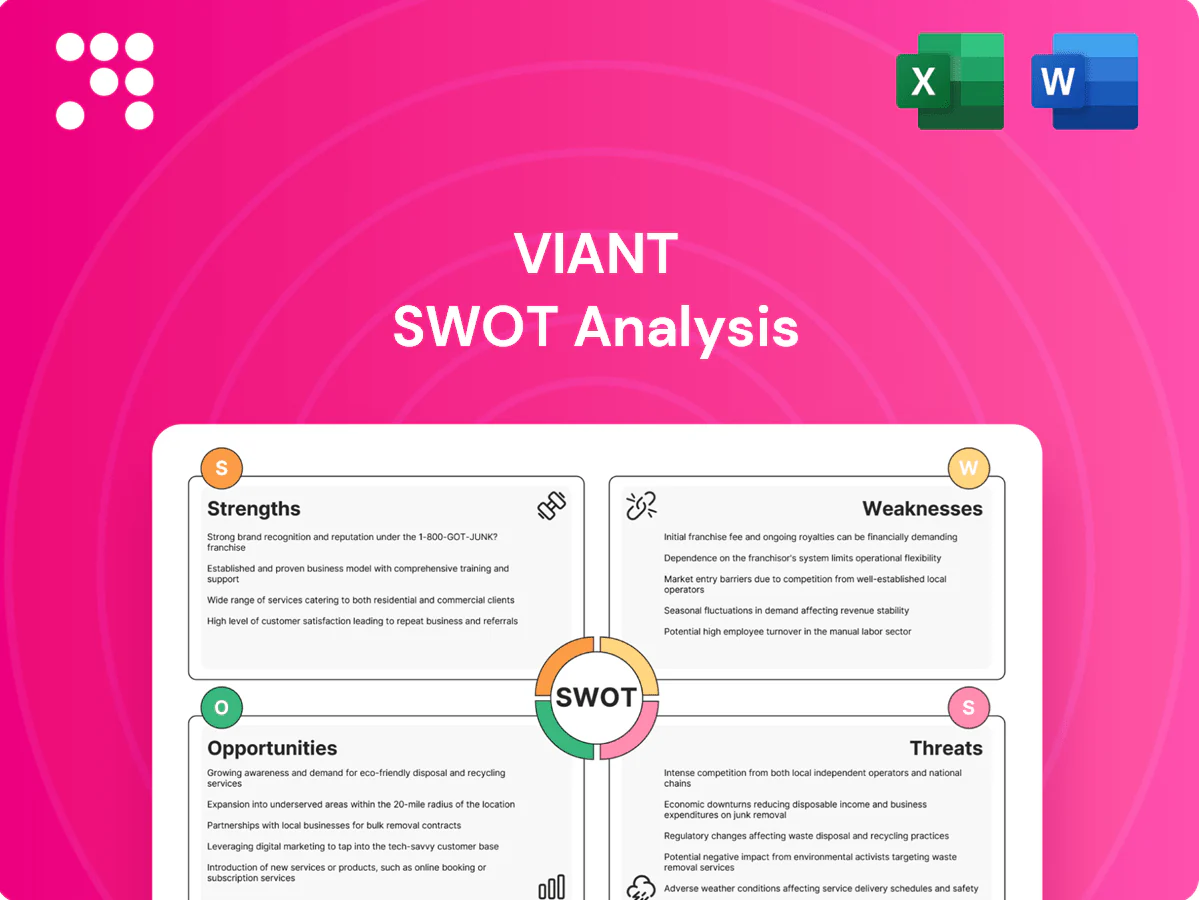
Viant SWOT Analysis

Elevate Your Analysis with the Complete SWOT Report
Our Viant SWOT analysis distills the company’s competitive advantages, operational risks, market opportunities, and strategic gaps into a concise, actionable overview. It highlights growth drivers, regulatory and tech threats, and practical implications for investors and strategists. Want the full picture with detailed evidence and editable tools? Purchase the complete SWOT report—Word and Excel deliverables included to support planning and investment decisions.
Strengths

Omnichannel ad platform
Adelphic supports CTV, mobile, desktop and display, enabling unified planning and activation across channels; in 2024 CTV adoption accelerated, with industry spend rising materially and driving cross-device buys. A single workflow reduces fragmentation and can cut agency operational costs—clients report efficiency gains of roughly 15–20%. Cross-channel reach improves frequency control and campaign ROAS (industry studies cite ROAS uplifts near 10–15%), increasing platform stickiness and upsell potential.
Household identity graph
Viant’s household identity graph links devices and screens to real people with privacy-aware resolution, improving targeting accuracy, reach deduplication and attribution for advertisers; CTV penetration reached about 83% of US households in 2024 (Insider Intelligence), where household decisioning dominates. Strong deterministic household identity gives Viant a performance edge versus cookie-based rivals as third-party cookie reliability declines.

Measurement and attribution
Built-in measurement closes the loop from exposure to outcomes, enabling Viant to link campaign impressions to conversions and revenue. Unified reporting across channels simplifies incrementality and MMM/MTA workflows, reducing fragmentation for analysts. Strong proof of performance supports renewals and budget allocation, appealing to data-driven marketers and procurement teams.

Cloud-native scalability
Cloud-native scalability enables Viant to rapidly scale across data volumes and traffic spikes, accelerating feature deployment and integrations with data partners and clean rooms and reducing infrastructure friction to shorten innovation cycles while improving reliability for enterprise buyers.
- Scalability
- Faster deployments
- Partner integrations
- Enterprise reliability
Agency and brand focus
Viant’s platform is purpose-built for professional buyers, optimizing workflow efficiency with advanced controls, deep analytics, and service layers that resonate strongly with agency users; this specialization supports stable, long-term enterprise relationships and predictable spend. Focusing on agencies typically yields higher ARPU and improved retention due to multi-year contracts and integrated campaign management.
- Agency-centric UX and workflow
- Advanced analytics and controls
- Enterprise multi-year commitments
- Higher ARPU and retention
Unified workflow trims agency ops 15–20%, lifts ROAS; CTV ~83% reach
Unified cross-channel workflow reduces agency ops costs ~15–20% and drives ROAS uplifts ~10–15%, increasing stickiness. Household identity graph boosts targeting as CTV reached ~83% US households in 2024 (Insider Intelligence), improving deduplication vs cookie-based rivals. Cloud-native scale and agency-focused UX support faster deployments, integrations and multi-year enterprise deals.
| Metric | Value |
|---|---|
| CTV US household reach (2024) | ~83% |
| Agency ops cost reduction | 15–20% |
| ROAS uplift | 10–15% |
What is included in the product
 Detailed Word Document
Provides a concise SWOT analysis of Viant, mapping its digital advertising and identity solutions strengths, operational weaknesses, market growth opportunities in cookieless advertising, and external threats from regulatory shifts and competitive pressure.

 Customizable Excel Spreadsheet
Delivers a concise, Viant-specific SWOT matrix that quickly surfaces strategic gaps and growth opportunities, streamlining decision-making and stakeholder alignment.
Weaknesses

Intense competitive set
Viant faces giants like The Trade Desk (TTD reported about $3.7B revenue in 2024), Alphabet and Amazon and entrenched walled gardens that together control over 50% of US digital ad spend in 2024. Competitors bundle inventory, first‑party data and measurement tools to compress pricing and margins. Viant must continually reinforce differentiation via identity and measurement, which lengthens sales cycles versus incumbents.
Exposure to privacy shifts
Relying on identity resolution exposes Viant to evolving regulations and platform policy shifts: Apple ATT drove average IDFA opt-in rates to around 25%, reducing mobile addressability. Chrome's third-party cookie deprecation, delayed into late 2024 with phased tests through 2025, further threatens cross‑site matching. Compliance and engineering rework have forced double-digit percentage reallocations of developer resources, raising costs and risking data loss and client churn.

Ad spend cyclicality
Macro slowdowns and budget freezes directly reduce programmatic volumes, and Viant’s exposure to high-beta sectors like retail and travel can amplify month-to-month revenue swings, making forecasting in uncertain cycles more difficult; with substantial fixed platform and data costs, profitability can compress rapidly as utilization falls.

Limited brand awareness
Viant’s brand lags mega-platforms—Google and Meta captured roughly 50% of US digital ad spend in 2024—reducing recognition among non-technical buyers.
This lower visibility can hinder RFP inclusion and slow enterprise expansion, constraining revenue growth and scale.
Marketing and partner advocacy must compensate while sales enablement proves clear, fast ROI to close enterprise deals.
- Lower RFP inclusion risk
- Needs stronger partner advocacy
- Sales enablement must show rapid ROI
Partner and data dependencies
Viant's performance relies heavily on external data providers, SSPs and measurement ecosystems, making targeting and reporting vulnerable when partners change contracts or policies. Integration overhead across varied vendor APIs raises operational risk and increases time-to-market for product updates. Concentration among a few vendors creates single points of failure that can disrupt campaigns and measurement continuity.
- Partner reliance: external data/SSP/measurement
- Contract/policy risk: impacts targeting & reporting
- Integration overhead: higher ops risk
- Vendor concentration: single point of failure
Ad tech squeezed by giants, ID privacy shifts and single-vendor concentration risk
Viant competes with giants (TTD ~$3.7B 2024; Google+Meta ~50% US ad spend 2024), pressuring pricing and margins. Identity reliance faces regulation/platform shifts (IDFA opt‑in ~25%; Chrome cookie deprecation tests through 2025), raising dev costs and churn. Vendor concentration and external data/SSP dependence create single points of failure and integration overhead.
| Metric | Value |
|---|---|
| TTD 2024 rev | $3.7B |
| IDFA opt‑in | ~25% |
| Google+Meta US share | ~50% |
Preview Before You Purchase
Viant SWOT Analysis
This is the actual SWOT analysis document you’ll receive upon purchase—no surprises, just professional quality. The preview below is taken directly from the full SWOT report you'll get; purchase unlocks the entire in-depth, editable version. You’re viewing a live preview of the same file that becomes available after checkout.

Elevate Your Analysis with the Complete SWOT Report
Our Viant SWOT analysis distills the company’s competitive advantages, operational risks, market opportunities, and strategic gaps into a concise, actionable overview. It highlights growth drivers, regulatory and tech threats, and practical implications for investors and strategists. Want the full picture with detailed evidence and editable tools? Purchase the complete SWOT report—Word and Excel deliverables included to support planning and investment decisions.
Strengths
Omnichannel ad platform
Adelphic supports CTV, mobile, desktop and display, enabling unified planning and activation across channels; in 2024 CTV adoption accelerated, with industry spend rising materially and driving cross-device buys. A single workflow reduces fragmentation and can cut agency operational costs—clients report efficiency gains of roughly 15–20%. Cross-channel reach improves frequency control and campaign ROAS (industry studies cite ROAS uplifts near 10–15%), increasing platform stickiness and upsell potential.
Household identity graph
Viant’s household identity graph links devices and screens to real people with privacy-aware resolution, improving targeting accuracy, reach deduplication and attribution for advertisers; CTV penetration reached about 83% of US households in 2024 (Insider Intelligence), where household decisioning dominates. Strong deterministic household identity gives Viant a performance edge versus cookie-based rivals as third-party cookie reliability declines.
Measurement and attribution
Built-in measurement closes the loop from exposure to outcomes, enabling Viant to link campaign impressions to conversions and revenue. Unified reporting across channels simplifies incrementality and MMM/MTA workflows, reducing fragmentation for analysts. Strong proof of performance supports renewals and budget allocation, appealing to data-driven marketers and procurement teams.
Cloud-native scalability
Cloud-native scalability enables Viant to rapidly scale across data volumes and traffic spikes, accelerating feature deployment and integrations with data partners and clean rooms and reducing infrastructure friction to shorten innovation cycles while improving reliability for enterprise buyers.
- Scalability
- Faster deployments
- Partner integrations
- Enterprise reliability
Agency and brand focus
Viant’s platform is purpose-built for professional buyers, optimizing workflow efficiency with advanced controls, deep analytics, and service layers that resonate strongly with agency users; this specialization supports stable, long-term enterprise relationships and predictable spend. Focusing on agencies typically yields higher ARPU and improved retention due to multi-year contracts and integrated campaign management.
- Agency-centric UX and workflow
- Advanced analytics and controls
- Enterprise multi-year commitments
- Higher ARPU and retention
Unified workflow trims agency ops 15–20%, lifts ROAS; CTV ~83% reach
Unified cross-channel workflow reduces agency ops costs ~15–20% and drives ROAS uplifts ~10–15%, increasing stickiness. Household identity graph boosts targeting as CTV reached ~83% US households in 2024 (Insider Intelligence), improving deduplication vs cookie-based rivals. Cloud-native scale and agency-focused UX support faster deployments, integrations and multi-year enterprise deals.
| Metric | Value |
|---|---|
| CTV US household reach (2024) | ~83% |
| Agency ops cost reduction | 15–20% |
| ROAS uplift | 10–15% |
What is included in the product
Detailed Word Document
Provides a concise SWOT analysis of Viant, mapping its digital advertising and identity solutions strengths, operational weaknesses, market growth opportunities in cookieless advertising, and external threats from regulatory shifts and competitive pressure.
Customizable Excel Spreadsheet
Delivers a concise, Viant-specific SWOT matrix that quickly surfaces strategic gaps and growth opportunities, streamlining decision-making and stakeholder alignment.
Weaknesses
Intense competitive set
Viant faces giants like The Trade Desk (TTD reported about $3.7B revenue in 2024), Alphabet and Amazon and entrenched walled gardens that together control over 50% of US digital ad spend in 2024. Competitors bundle inventory, first‑party data and measurement tools to compress pricing and margins. Viant must continually reinforce differentiation via identity and measurement, which lengthens sales cycles versus incumbents.
Exposure to privacy shifts
Relying on identity resolution exposes Viant to evolving regulations and platform policy shifts: Apple ATT drove average IDFA opt-in rates to around 25%, reducing mobile addressability. Chrome's third-party cookie deprecation, delayed into late 2024 with phased tests through 2025, further threatens cross‑site matching. Compliance and engineering rework have forced double-digit percentage reallocations of developer resources, raising costs and risking data loss and client churn.
Ad spend cyclicality
Macro slowdowns and budget freezes directly reduce programmatic volumes, and Viant’s exposure to high-beta sectors like retail and travel can amplify month-to-month revenue swings, making forecasting in uncertain cycles more difficult; with substantial fixed platform and data costs, profitability can compress rapidly as utilization falls.
Limited brand awareness
Viant’s brand lags mega-platforms—Google and Meta captured roughly 50% of US digital ad spend in 2024—reducing recognition among non-technical buyers.
This lower visibility can hinder RFP inclusion and slow enterprise expansion, constraining revenue growth and scale.
Marketing and partner advocacy must compensate while sales enablement proves clear, fast ROI to close enterprise deals.
- Lower RFP inclusion risk
- Needs stronger partner advocacy
- Sales enablement must show rapid ROI
Partner and data dependencies
Viant's performance relies heavily on external data providers, SSPs and measurement ecosystems, making targeting and reporting vulnerable when partners change contracts or policies. Integration overhead across varied vendor APIs raises operational risk and increases time-to-market for product updates. Concentration among a few vendors creates single points of failure that can disrupt campaigns and measurement continuity.
- Partner reliance: external data/SSP/measurement
- Contract/policy risk: impacts targeting & reporting
- Integration overhead: higher ops risk
- Vendor concentration: single point of failure
Ad tech squeezed by giants, ID privacy shifts and single-vendor concentration risk
Viant competes with giants (TTD ~$3.7B 2024; Google+Meta ~50% US ad spend 2024), pressuring pricing and margins. Identity reliance faces regulation/platform shifts (IDFA opt‑in ~25%; Chrome cookie deprecation tests through 2025), raising dev costs and churn. Vendor concentration and external data/SSP dependence create single points of failure and integration overhead.
| Metric | Value |
|---|---|
| TTD 2024 rev | $3.7B |
| IDFA opt‑in | ~25% |
| Google+Meta US share | ~50% |
Preview Before You Purchase
Viant SWOT Analysis
This is the actual SWOT analysis document you’ll receive upon purchase—no surprises, just professional quality. The preview below is taken directly from the full SWOT report you'll get; purchase unlocks the entire in-depth, editable version. You’re viewing a live preview of the same file that becomes available after checkout.
Original: $10.00
-65%$10.00
$3.50Description
Elevate Your Analysis with the Complete SWOT Report
Our Viant SWOT analysis distills the company’s competitive advantages, operational risks, market opportunities, and strategic gaps into a concise, actionable overview. It highlights growth drivers, regulatory and tech threats, and practical implications for investors and strategists. Want the full picture with detailed evidence and editable tools? Purchase the complete SWOT report—Word and Excel deliverables included to support planning and investment decisions.
Strengths
Omnichannel ad platform
Adelphic supports CTV, mobile, desktop and display, enabling unified planning and activation across channels; in 2024 CTV adoption accelerated, with industry spend rising materially and driving cross-device buys. A single workflow reduces fragmentation and can cut agency operational costs—clients report efficiency gains of roughly 15–20%. Cross-channel reach improves frequency control and campaign ROAS (industry studies cite ROAS uplifts near 10–15%), increasing platform stickiness and upsell potential.
Household identity graph
Viant’s household identity graph links devices and screens to real people with privacy-aware resolution, improving targeting accuracy, reach deduplication and attribution for advertisers; CTV penetration reached about 83% of US households in 2024 (Insider Intelligence), where household decisioning dominates. Strong deterministic household identity gives Viant a performance edge versus cookie-based rivals as third-party cookie reliability declines.
Measurement and attribution
Built-in measurement closes the loop from exposure to outcomes, enabling Viant to link campaign impressions to conversions and revenue. Unified reporting across channels simplifies incrementality and MMM/MTA workflows, reducing fragmentation for analysts. Strong proof of performance supports renewals and budget allocation, appealing to data-driven marketers and procurement teams.
Cloud-native scalability
Cloud-native scalability enables Viant to rapidly scale across data volumes and traffic spikes, accelerating feature deployment and integrations with data partners and clean rooms and reducing infrastructure friction to shorten innovation cycles while improving reliability for enterprise buyers.
- Scalability
- Faster deployments
- Partner integrations
- Enterprise reliability
Agency and brand focus
Viant’s platform is purpose-built for professional buyers, optimizing workflow efficiency with advanced controls, deep analytics, and service layers that resonate strongly with agency users; this specialization supports stable, long-term enterprise relationships and predictable spend. Focusing on agencies typically yields higher ARPU and improved retention due to multi-year contracts and integrated campaign management.
- Agency-centric UX and workflow
- Advanced analytics and controls
- Enterprise multi-year commitments
- Higher ARPU and retention
Unified workflow trims agency ops 15–20%, lifts ROAS; CTV ~83% reach
Unified cross-channel workflow reduces agency ops costs ~15–20% and drives ROAS uplifts ~10–15%, increasing stickiness. Household identity graph boosts targeting as CTV reached ~83% US households in 2024 (Insider Intelligence), improving deduplication vs cookie-based rivals. Cloud-native scale and agency-focused UX support faster deployments, integrations and multi-year enterprise deals.
| Metric | Value |
|---|---|
| CTV US household reach (2024) | ~83% |
| Agency ops cost reduction | 15–20% |
| ROAS uplift | 10–15% |
What is included in the product
Detailed Word Document
Provides a concise SWOT analysis of Viant, mapping its digital advertising and identity solutions strengths, operational weaknesses, market growth opportunities in cookieless advertising, and external threats from regulatory shifts and competitive pressure.
Customizable Excel Spreadsheet
Delivers a concise, Viant-specific SWOT matrix that quickly surfaces strategic gaps and growth opportunities, streamlining decision-making and stakeholder alignment.
Weaknesses
Intense competitive set
Viant faces giants like The Trade Desk (TTD reported about $3.7B revenue in 2024), Alphabet and Amazon and entrenched walled gardens that together control over 50% of US digital ad spend in 2024. Competitors bundle inventory, first‑party data and measurement tools to compress pricing and margins. Viant must continually reinforce differentiation via identity and measurement, which lengthens sales cycles versus incumbents.
Exposure to privacy shifts
Relying on identity resolution exposes Viant to evolving regulations and platform policy shifts: Apple ATT drove average IDFA opt-in rates to around 25%, reducing mobile addressability. Chrome's third-party cookie deprecation, delayed into late 2024 with phased tests through 2025, further threatens cross‑site matching. Compliance and engineering rework have forced double-digit percentage reallocations of developer resources, raising costs and risking data loss and client churn.
Ad spend cyclicality
Macro slowdowns and budget freezes directly reduce programmatic volumes, and Viant’s exposure to high-beta sectors like retail and travel can amplify month-to-month revenue swings, making forecasting in uncertain cycles more difficult; with substantial fixed platform and data costs, profitability can compress rapidly as utilization falls.
Limited brand awareness
Viant’s brand lags mega-platforms—Google and Meta captured roughly 50% of US digital ad spend in 2024—reducing recognition among non-technical buyers.
This lower visibility can hinder RFP inclusion and slow enterprise expansion, constraining revenue growth and scale.
Marketing and partner advocacy must compensate while sales enablement proves clear, fast ROI to close enterprise deals.
- Lower RFP inclusion risk
- Needs stronger partner advocacy
- Sales enablement must show rapid ROI
Partner and data dependencies
Viant's performance relies heavily on external data providers, SSPs and measurement ecosystems, making targeting and reporting vulnerable when partners change contracts or policies. Integration overhead across varied vendor APIs raises operational risk and increases time-to-market for product updates. Concentration among a few vendors creates single points of failure that can disrupt campaigns and measurement continuity.
- Partner reliance: external data/SSP/measurement
- Contract/policy risk: impacts targeting & reporting
- Integration overhead: higher ops risk
- Vendor concentration: single point of failure
Ad tech squeezed by giants, ID privacy shifts and single-vendor concentration risk
Viant competes with giants (TTD ~$3.7B 2024; Google+Meta ~50% US ad spend 2024), pressuring pricing and margins. Identity reliance faces regulation/platform shifts (IDFA opt‑in ~25%; Chrome cookie deprecation tests through 2025), raising dev costs and churn. Vendor concentration and external data/SSP dependence create single points of failure and integration overhead.
| Metric | Value |
|---|---|
| TTD 2024 rev | $3.7B |
| IDFA opt‑in | ~25% |
| Google+Meta US share | ~50% |
Preview Before You Purchase
Viant SWOT Analysis
This is the actual SWOT analysis document you’ll receive upon purchase—no surprises, just professional quality. The preview below is taken directly from the full SWOT report you'll get; purchase unlocks the entire in-depth, editable version. You’re viewing a live preview of the same file that becomes available after checkout.











