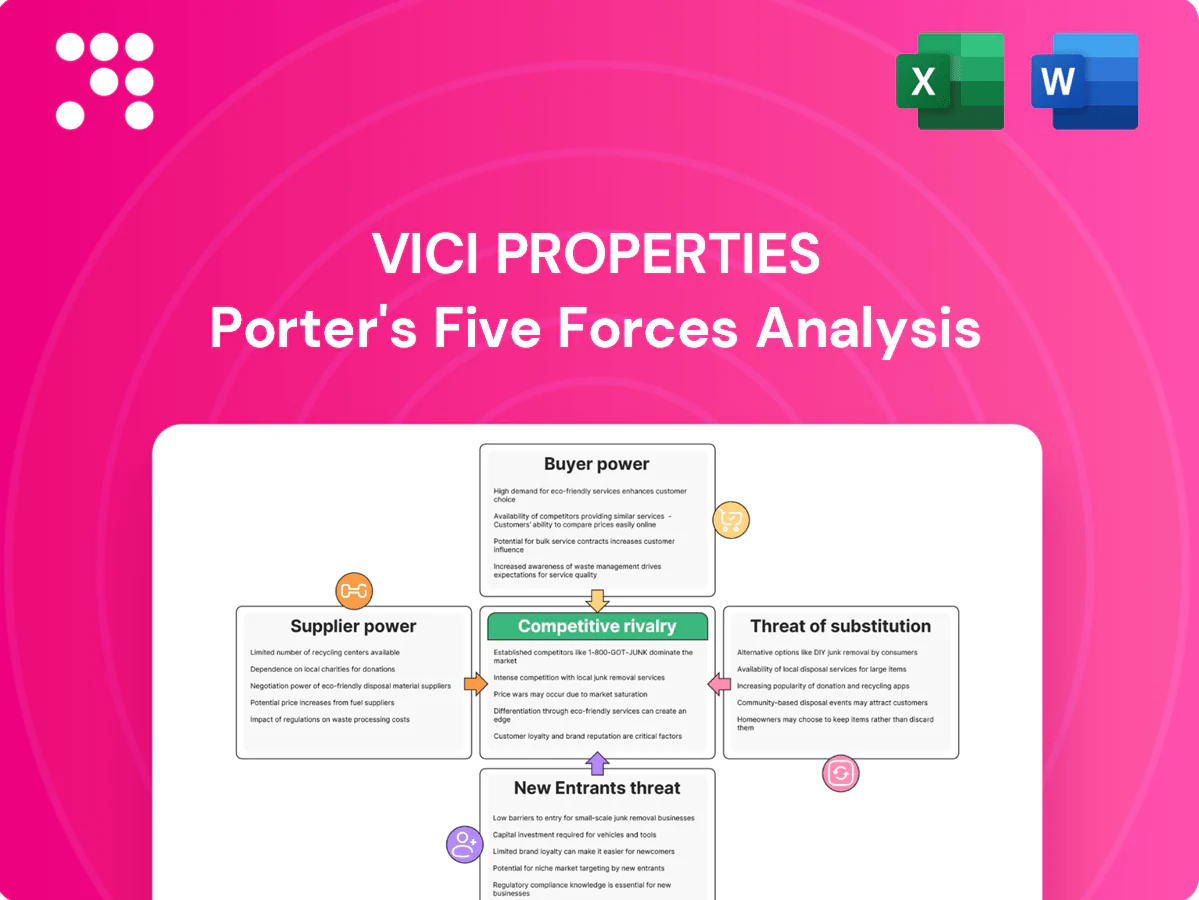
VICI Properties Porter's Five Forces Analysis

Don't Miss the Bigger Picture
VICI Properties faces moderate buyer power, high competitive pressure from diversified REITs, limited supplier leverage, low threat of new entrants, and manageable substitutes given unique experiential assets. This snapshot only scratches the surface. Unlock the full Porter's Five Forces Analysis to explore VICI’s strategic risks and opportunities in detail.
Suppliers Bargaining Power

Concentrated capital providers
Access to low-cost debt and equity is critical for accretive acquisitions; with the federal funds rate near 5.25–5.50% in 2024, rising rates give lenders and bond investors more leverage on covenants and pricing. VICI’s scale, S&P index inclusion and investment-grade positioning diversify capital sources and moderate supplier power. Relationship banking and unsecured debt platforms further reduce reliance on any single lender.
Construction and development contractors
For expansions or redevelopment, specialized contractors and materials can exercise pricing power during tight cycles and 2024 saw elevated scheduling pressures and material lead times that amplify switching costs for VICI.
VICI mitigates exposure via tenant-led triple-net leases that shift many capex and construction overruns to operators, yet project concentration in core markets like Las Vegas and New York risks pinch if local capacity tightens.

Regulators and licensing bodies
Regulators and licensing bodies act as a quasi-supplier of permission, with suitability determinations gating VICI’s right to operate and transact. Regulatory timelines and imposed conditions often reshape deal pacing and structure, and jurisdictional variability preserves significant authority leverage. VICI’s established compliance record reduces friction, but licensing delays or added conditions can erode closing certainty and pricing.

Property owners and sellers
In 2024 legacy casino owners still control the sale-leaseback pipeline, and in hot markets sellers push stronger pricing and tighter lease terms, often lifting cap rates for trophy assets. VICI competes with speed, certainty of close and in-house capacity to underwrite large, complex portfolios, shortening deal timelines. High-profile trophy assets frequently go to auction, increasing seller bargaining power.
- 2024: sellers drive pricing on trophy assets
- VICI advantage: rapid execution & complex-portfolio underwriting
- Auction risk: raises seller leverage
Triple-net service vendors
Operational vendors for maintenance and insurance drive property-level costs, but triple-net leases shift these expenses to tenants, reducing direct supplier leverage over VICI. Elevated vendor inflation (around 4–6% in 2024) can still compress tenant coverage ratios and weaken perceived credit, indirectly affecting rent resilience. VICI actively monitors vendor ecosystems and contract terms to protect cash flows and rent collection.
- Vendor inflation 2024: ~4–6%
- Triple-net leases: tenant bears O&M and insurance
- Monitoring focus: vendor contracts, service concentration, cost pass-through
Fed 5.25-5.50%, vendor inflation 4-6%
Supplier power is moderate: capital markets tightened with the fed funds rate ~5.25–5.50% in 2024, but VICI’s scale, S&P index inclusion and investment-grade access diversify lenders. Triple-net leases shift O&M and insurance to tenants, limiting vendor leverage despite ~4–6% vendor inflation in 2024. Local contractor concentration in Las Vegas/New York can spike switching costs for redevelopment.
| Metric | 2024 | Impact |
|---|---|---|
| Fed funds rate | 5.25–5.50% | Higher financing cost, lender leverage |
| Vendor inflation | 4–6% | Pressure on tenant coverage ratios |
| Lease structure | Triple-net | Shifts O&M risk to tenants |
What is included in the product
 Detailed Word Document
Tailored Porter's Five Forces analysis for VICI Properties that uncovers key drivers of competition, buyer and supplier influence on pricing and profitability, barriers protecting incumbency, and disruptive threats or substitutes that could erode market share.

 Customizable Excel Spreadsheet
A concise one-sheet Porter's Five Forces for VICI Properties that visualizes competitive pressure with an instant spider chart and customizable scores—ready to drop into decks or adapt for different market scenarios without complex tools.
Customers Bargaining Power

Tenant concentration among mega-operators
Large tenants such as Caesars Entertainment, VICI’s largest renter, exert negotiation leverage on new leases given their scale, market share and operating synergies. Most VICI leases are long‑term, CPI‑linked triple‑net arrangements, which limits midterm pricing pressure on rent cash flows. Renewal and extension talks still enable tenants to extract scale economics. VICI’s post‑2022 diversification moves, including the MGM Growth Properties merger, reduce single‑tenant dependency over time.
Limited alternative landlords
There are effectively two scaled gaming REITs—VICI and GLPI—limiting tenant options and curbing buyer power; VICI held a portfolio of just over 60 gaming, hospitality and entertainment assets by 2024. Tenants seeking sale-leaseback capital face a short list of credible counterparties, which softens rent pressure and allows VICI to secure stronger lease covenants. Occasional private-equity plays and direct lenders can widen options sporadically.

Mission-critical nature of assets
Casino real estate is mission-critical to tenant cash flow, and VICI owned 71 gaming, hospitality and entertainment properties in 2024, which reduces operators willingness to risk lease defaults. High replacement costs, often exceeding $500 million per major resort, and strict regulatory siting/license constraints tie operators to locations. This lowers tenant bargaining power over occupancy and rent. Tenants prioritize stability to protect gaming licenses and brand equity.

Credit profile sensitivity
Tenants prioritize predictable rent to protect coverage ratios and credit ratings; VICI’s underwriting ties rent to property-level EBITDAR to preserve affordability and coverage consistency, supporting its ~99% portfolio occupancy reported in 2023. This risk-sensitive approach reduces contentious lease renegotiations, though macro stress can trigger amendment or asset-level support requests.
Embedded escalators and long durations
- 20–40 year terms
- Contracted escalators
- Pass-throughs: taxes, insurance, maintenance
- ~99% occupancy (2024)
- Leverage pre-transaction
CPI-linked NNN leases (20-40 years) and ~99% occupancy cap tenant leverage
Large tenants like Caesars exert pre-signing leverage, but VICI’s long-term CPI-linked NNN leases (20–40 years), EBITDAR-aligned rents and ~99% occupancy in 2023–24 limit tenant bargaining power; high replacement costs and regulatory constraints further reduce exit options.
| Metric | Value |
|---|---|
| Occupancy | ~99% (2023–24) |
| Lease terms | 20–40 years |
| Portfolio | 71 properties (2024) |
Preview Before You Purchase
VICI Properties Porter's Five Forces Analysis
This preview shows the exact VICI Properties Porter's Five Forces Analysis you'll receive immediately after purchase—no surprises or placeholders. The document displayed is the full, professionally formatted analysis ready for download and use the moment you buy. You're looking at the actual deliverable and will get instant access to this same file upon payment.

Don't Miss the Bigger Picture
VICI Properties faces moderate buyer power, high competitive pressure from diversified REITs, limited supplier leverage, low threat of new entrants, and manageable substitutes given unique experiential assets. This snapshot only scratches the surface. Unlock the full Porter's Five Forces Analysis to explore VICI’s strategic risks and opportunities in detail.
Suppliers Bargaining Power
Concentrated capital providers
Access to low-cost debt and equity is critical for accretive acquisitions; with the federal funds rate near 5.25–5.50% in 2024, rising rates give lenders and bond investors more leverage on covenants and pricing. VICI’s scale, S&P index inclusion and investment-grade positioning diversify capital sources and moderate supplier power. Relationship banking and unsecured debt platforms further reduce reliance on any single lender.
Construction and development contractors
For expansions or redevelopment, specialized contractors and materials can exercise pricing power during tight cycles and 2024 saw elevated scheduling pressures and material lead times that amplify switching costs for VICI.
VICI mitigates exposure via tenant-led triple-net leases that shift many capex and construction overruns to operators, yet project concentration in core markets like Las Vegas and New York risks pinch if local capacity tightens.
Regulators and licensing bodies
Regulators and licensing bodies act as a quasi-supplier of permission, with suitability determinations gating VICI’s right to operate and transact. Regulatory timelines and imposed conditions often reshape deal pacing and structure, and jurisdictional variability preserves significant authority leverage. VICI’s established compliance record reduces friction, but licensing delays or added conditions can erode closing certainty and pricing.
Property owners and sellers
In 2024 legacy casino owners still control the sale-leaseback pipeline, and in hot markets sellers push stronger pricing and tighter lease terms, often lifting cap rates for trophy assets. VICI competes with speed, certainty of close and in-house capacity to underwrite large, complex portfolios, shortening deal timelines. High-profile trophy assets frequently go to auction, increasing seller bargaining power.
- 2024: sellers drive pricing on trophy assets
- VICI advantage: rapid execution & complex-portfolio underwriting
- Auction risk: raises seller leverage
Triple-net service vendors
Operational vendors for maintenance and insurance drive property-level costs, but triple-net leases shift these expenses to tenants, reducing direct supplier leverage over VICI. Elevated vendor inflation (around 4–6% in 2024) can still compress tenant coverage ratios and weaken perceived credit, indirectly affecting rent resilience. VICI actively monitors vendor ecosystems and contract terms to protect cash flows and rent collection.
- Vendor inflation 2024: ~4–6%
- Triple-net leases: tenant bears O&M and insurance
- Monitoring focus: vendor contracts, service concentration, cost pass-through
Fed 5.25-5.50%, vendor inflation 4-6%
Supplier power is moderate: capital markets tightened with the fed funds rate ~5.25–5.50% in 2024, but VICI’s scale, S&P index inclusion and investment-grade access diversify lenders. Triple-net leases shift O&M and insurance to tenants, limiting vendor leverage despite ~4–6% vendor inflation in 2024. Local contractor concentration in Las Vegas/New York can spike switching costs for redevelopment.
| Metric | 2024 | Impact |
|---|---|---|
| Fed funds rate | 5.25–5.50% | Higher financing cost, lender leverage |
| Vendor inflation | 4–6% | Pressure on tenant coverage ratios |
| Lease structure | Triple-net | Shifts O&M risk to tenants |
What is included in the product
Detailed Word Document
Tailored Porter's Five Forces analysis for VICI Properties that uncovers key drivers of competition, buyer and supplier influence on pricing and profitability, barriers protecting incumbency, and disruptive threats or substitutes that could erode market share.
Customizable Excel Spreadsheet
A concise one-sheet Porter's Five Forces for VICI Properties that visualizes competitive pressure with an instant spider chart and customizable scores—ready to drop into decks or adapt for different market scenarios without complex tools.
Customers Bargaining Power
Tenant concentration among mega-operators
Large tenants such as Caesars Entertainment, VICI’s largest renter, exert negotiation leverage on new leases given their scale, market share and operating synergies. Most VICI leases are long‑term, CPI‑linked triple‑net arrangements, which limits midterm pricing pressure on rent cash flows. Renewal and extension talks still enable tenants to extract scale economics. VICI’s post‑2022 diversification moves, including the MGM Growth Properties merger, reduce single‑tenant dependency over time.
Limited alternative landlords
There are effectively two scaled gaming REITs—VICI and GLPI—limiting tenant options and curbing buyer power; VICI held a portfolio of just over 60 gaming, hospitality and entertainment assets by 2024. Tenants seeking sale-leaseback capital face a short list of credible counterparties, which softens rent pressure and allows VICI to secure stronger lease covenants. Occasional private-equity plays and direct lenders can widen options sporadically.
Mission-critical nature of assets
Casino real estate is mission-critical to tenant cash flow, and VICI owned 71 gaming, hospitality and entertainment properties in 2024, which reduces operators willingness to risk lease defaults. High replacement costs, often exceeding $500 million per major resort, and strict regulatory siting/license constraints tie operators to locations. This lowers tenant bargaining power over occupancy and rent. Tenants prioritize stability to protect gaming licenses and brand equity.
Credit profile sensitivity
Tenants prioritize predictable rent to protect coverage ratios and credit ratings; VICI’s underwriting ties rent to property-level EBITDAR to preserve affordability and coverage consistency, supporting its ~99% portfolio occupancy reported in 2023. This risk-sensitive approach reduces contentious lease renegotiations, though macro stress can trigger amendment or asset-level support requests.
Embedded escalators and long durations
- 20–40 year terms
- Contracted escalators
- Pass-throughs: taxes, insurance, maintenance
- ~99% occupancy (2024)
- Leverage pre-transaction
CPI-linked NNN leases (20-40 years) and ~99% occupancy cap tenant leverage
Large tenants like Caesars exert pre-signing leverage, but VICI’s long-term CPI-linked NNN leases (20–40 years), EBITDAR-aligned rents and ~99% occupancy in 2023–24 limit tenant bargaining power; high replacement costs and regulatory constraints further reduce exit options.
| Metric | Value |
|---|---|
| Occupancy | ~99% (2023–24) |
| Lease terms | 20–40 years |
| Portfolio | 71 properties (2024) |
Preview Before You Purchase
VICI Properties Porter's Five Forces Analysis
This preview shows the exact VICI Properties Porter's Five Forces Analysis you'll receive immediately after purchase—no surprises or placeholders. The document displayed is the full, professionally formatted analysis ready for download and use the moment you buy. You're looking at the actual deliverable and will get instant access to this same file upon payment.
Description
Don't Miss the Bigger Picture
VICI Properties faces moderate buyer power, high competitive pressure from diversified REITs, limited supplier leverage, low threat of new entrants, and manageable substitutes given unique experiential assets. This snapshot only scratches the surface. Unlock the full Porter's Five Forces Analysis to explore VICI’s strategic risks and opportunities in detail.
Suppliers Bargaining Power
Concentrated capital providers
Access to low-cost debt and equity is critical for accretive acquisitions; with the federal funds rate near 5.25–5.50% in 2024, rising rates give lenders and bond investors more leverage on covenants and pricing. VICI’s scale, S&P index inclusion and investment-grade positioning diversify capital sources and moderate supplier power. Relationship banking and unsecured debt platforms further reduce reliance on any single lender.
Construction and development contractors
For expansions or redevelopment, specialized contractors and materials can exercise pricing power during tight cycles and 2024 saw elevated scheduling pressures and material lead times that amplify switching costs for VICI.
VICI mitigates exposure via tenant-led triple-net leases that shift many capex and construction overruns to operators, yet project concentration in core markets like Las Vegas and New York risks pinch if local capacity tightens.
Regulators and licensing bodies
Regulators and licensing bodies act as a quasi-supplier of permission, with suitability determinations gating VICI’s right to operate and transact. Regulatory timelines and imposed conditions often reshape deal pacing and structure, and jurisdictional variability preserves significant authority leverage. VICI’s established compliance record reduces friction, but licensing delays or added conditions can erode closing certainty and pricing.
Property owners and sellers
In 2024 legacy casino owners still control the sale-leaseback pipeline, and in hot markets sellers push stronger pricing and tighter lease terms, often lifting cap rates for trophy assets. VICI competes with speed, certainty of close and in-house capacity to underwrite large, complex portfolios, shortening deal timelines. High-profile trophy assets frequently go to auction, increasing seller bargaining power.
- 2024: sellers drive pricing on trophy assets
- VICI advantage: rapid execution & complex-portfolio underwriting
- Auction risk: raises seller leverage
Triple-net service vendors
Operational vendors for maintenance and insurance drive property-level costs, but triple-net leases shift these expenses to tenants, reducing direct supplier leverage over VICI. Elevated vendor inflation (around 4–6% in 2024) can still compress tenant coverage ratios and weaken perceived credit, indirectly affecting rent resilience. VICI actively monitors vendor ecosystems and contract terms to protect cash flows and rent collection.
- Vendor inflation 2024: ~4–6%
- Triple-net leases: tenant bears O&M and insurance
- Monitoring focus: vendor contracts, service concentration, cost pass-through
Fed 5.25-5.50%, vendor inflation 4-6%
Supplier power is moderate: capital markets tightened with the fed funds rate ~5.25–5.50% in 2024, but VICI’s scale, S&P index inclusion and investment-grade access diversify lenders. Triple-net leases shift O&M and insurance to tenants, limiting vendor leverage despite ~4–6% vendor inflation in 2024. Local contractor concentration in Las Vegas/New York can spike switching costs for redevelopment.
| Metric | 2024 | Impact |
|---|---|---|
| Fed funds rate | 5.25–5.50% | Higher financing cost, lender leverage |
| Vendor inflation | 4–6% | Pressure on tenant coverage ratios |
| Lease structure | Triple-net | Shifts O&M risk to tenants |
What is included in the product
Detailed Word Document
Tailored Porter's Five Forces analysis for VICI Properties that uncovers key drivers of competition, buyer and supplier influence on pricing and profitability, barriers protecting incumbency, and disruptive threats or substitutes that could erode market share.
Customizable Excel Spreadsheet
A concise one-sheet Porter's Five Forces for VICI Properties that visualizes competitive pressure with an instant spider chart and customizable scores—ready to drop into decks or adapt for different market scenarios without complex tools.
Customers Bargaining Power
Tenant concentration among mega-operators
Large tenants such as Caesars Entertainment, VICI’s largest renter, exert negotiation leverage on new leases given their scale, market share and operating synergies. Most VICI leases are long‑term, CPI‑linked triple‑net arrangements, which limits midterm pricing pressure on rent cash flows. Renewal and extension talks still enable tenants to extract scale economics. VICI’s post‑2022 diversification moves, including the MGM Growth Properties merger, reduce single‑tenant dependency over time.
Limited alternative landlords
There are effectively two scaled gaming REITs—VICI and GLPI—limiting tenant options and curbing buyer power; VICI held a portfolio of just over 60 gaming, hospitality and entertainment assets by 2024. Tenants seeking sale-leaseback capital face a short list of credible counterparties, which softens rent pressure and allows VICI to secure stronger lease covenants. Occasional private-equity plays and direct lenders can widen options sporadically.
Mission-critical nature of assets
Casino real estate is mission-critical to tenant cash flow, and VICI owned 71 gaming, hospitality and entertainment properties in 2024, which reduces operators willingness to risk lease defaults. High replacement costs, often exceeding $500 million per major resort, and strict regulatory siting/license constraints tie operators to locations. This lowers tenant bargaining power over occupancy and rent. Tenants prioritize stability to protect gaming licenses and brand equity.
Credit profile sensitivity
Tenants prioritize predictable rent to protect coverage ratios and credit ratings; VICI’s underwriting ties rent to property-level EBITDAR to preserve affordability and coverage consistency, supporting its ~99% portfolio occupancy reported in 2023. This risk-sensitive approach reduces contentious lease renegotiations, though macro stress can trigger amendment or asset-level support requests.
Embedded escalators and long durations
- 20–40 year terms
- Contracted escalators
- Pass-throughs: taxes, insurance, maintenance
- ~99% occupancy (2024)
- Leverage pre-transaction
CPI-linked NNN leases (20-40 years) and ~99% occupancy cap tenant leverage
Large tenants like Caesars exert pre-signing leverage, but VICI’s long-term CPI-linked NNN leases (20–40 years), EBITDAR-aligned rents and ~99% occupancy in 2023–24 limit tenant bargaining power; high replacement costs and regulatory constraints further reduce exit options.
| Metric | Value |
|---|---|
| Occupancy | ~99% (2023–24) |
| Lease terms | 20–40 years |
| Portfolio | 71 properties (2024) |
Preview Before You Purchase
VICI Properties Porter's Five Forces Analysis
This preview shows the exact VICI Properties Porter's Five Forces Analysis you'll receive immediately after purchase—no surprises or placeholders. The document displayed is the full, professionally formatted analysis ready for download and use the moment you buy. You're looking at the actual deliverable and will get instant access to this same file upon payment.











