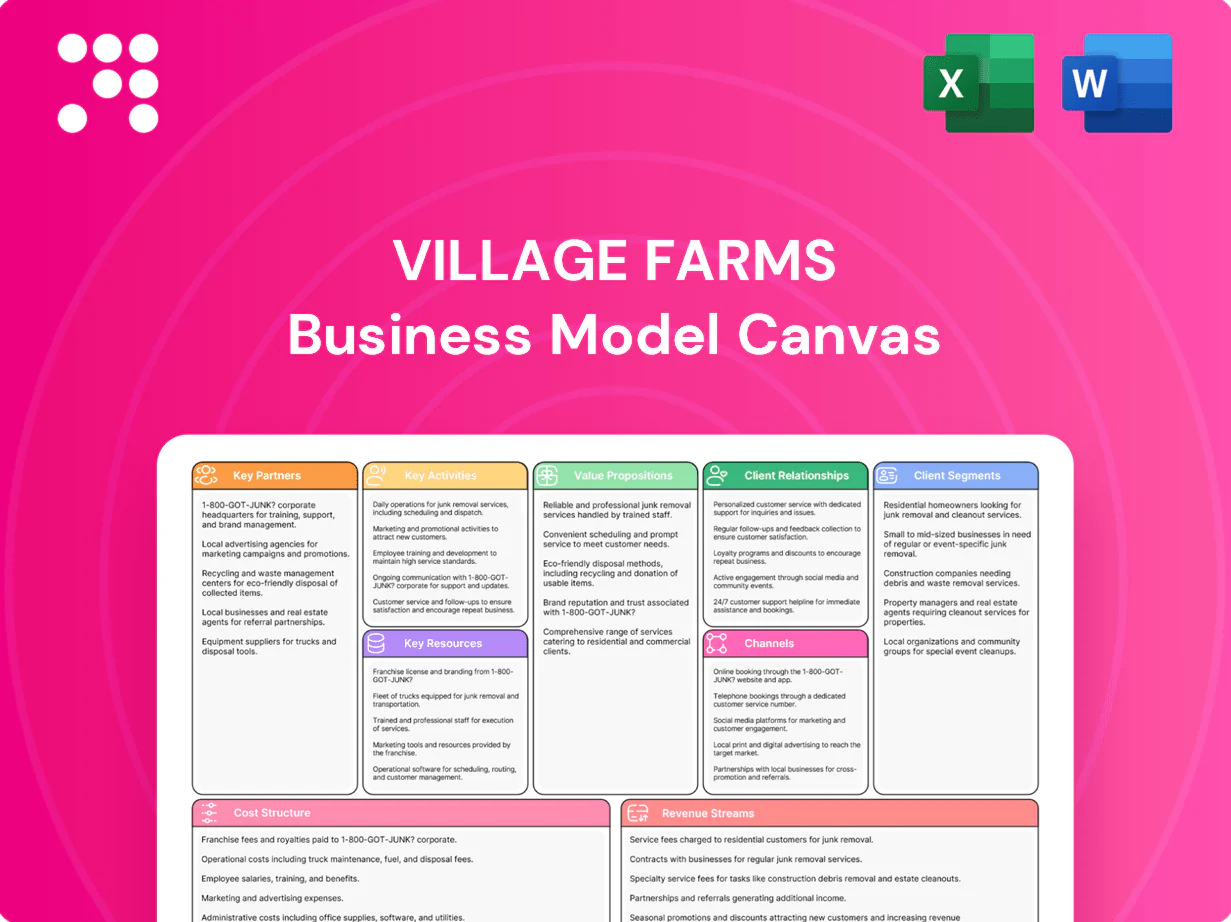
Village Farms Business Model Canvas

Unlock the strategic business model canvas for greenhouse-grown agri and cannabis operators
Unlock the full strategic blueprint behind Village Farms's business model. This concise Business Model Canvas maps value propositions, key partners, revenue streams and cost drivers to show how the company scales and defends market share. Ideal for investors, strategists, and founders—download the complete, editable canvas for actionable insights.
Partnerships

Grocery retailers & wholesalers
Strategic contracts with major supermarket chains and produce distributors secure consistent off‑take for Village Farms tomatoes, cucumbers, and peppers, enabling predictable harvest scheduling and revenue visibility. Joint planning with retail partners improves category management, promotions, and shelf availability through synchronized promotions and inventory flow. Long-term relationships stabilize pricing and volumes across seasons, reducing margin volatility and enabling capital planning.
Provincial boards & dispensaries
Pure Sunfarms partners with provincial cannabis boards and retail dispensaries to ensure compliant distribution across all 13 Canadian jurisdictions. Allocation planning and SKU rotations are coordinated with provincial demand profiles and shelf-space agreements. These partnerships provide national reach and regulatory assurance for Village Farms’ branded products.

E‑commerce & marketplaces
Balanced Health Botanicals sells CBD via owned DTC sites and compliant marketplaces, expanding reach beyond brick-and-mortar channels.
Partnerships with payment processors, age/ID verification vendors and 3PLs streamline compliance and fulfillment, reducing failed transactions and chargebacks.
In 2024 e‑commerce accounted for about 15% of US retail spend, helping diversify Balanced Health Botanicals’ distribution and customer acquisition.

Input & technology suppliers
Alliances with seed/genetics providers, substrate vendors, nutrient companies, and climate-control tech firms boost Village Farms yields and crop consistency, with industry reports showing controlled-environment partnerships can raise yields 20–30% and shorten cycles 10–15% (2024 data). Energy providers and renewable partners lower cost volatility; on-site solar and PPA programs can cut energy spend by up to 25%.
- Yield uplift: 20–30%
- Cycle reduction: 10–15%
- Energy cost cut: up to 25%
- Joint trials: faster scale-up, quality gains
Logistics & co‑packing partners
Cold-chain carriers and 3PLs ensure Village Farms preserves freshness and regulatory compliance across borders, supporting export of perishables and controlled-environment produce.
Co-packers enable format expansion and surge capacity for seasonal spikes, allowing flexible SKU launches and rapid scale without capital-intensive facilities.
Reliable logistics partners reduce spoilage, shorten lead times, and minimize stockouts, improving inventory turns and customer service levels.
- Tag: logistics
- Tag: co-packing
- Tag: cold-chain
- Tag: spoilage-reduction
Retail contracts secure revenue; tech partners boost yields 20–30%
Retail/distributor contracts secure predictable off‑take and revenue. 2024 e‑commerce ~15% US retail spend, widening DTC. Tech/seed/energy partners raise yields 20–30%, cut cycles 10–15% and energy up to 25% (2024).
| Partnership | Impact | 2024 metric |
|---|---|---|
| Retail/distributors | Off‑take/revenue visibility | Stable volumes |
| Tech/inputs | Yield/cycle/energy | Yields +20–30% / Cycles -10–15% / Energy -25% |
| E‑comm/3PL | Reach/compliance | E‑comm ~15% |
What is included in the product
 Detailed Word Document
A comprehensive, pre-written Business Model Canvas tailored to Village Farms’ greenhouse-grown produce and cannabis segments, covering customer segments, channels, value propositions, key activities, resources, partners, cost structure and revenue streams with real-world operational insights. Ideal for investor presentations and funding discussions, it links SWOT analysis to each BMC block and supports validation using company data.

 Customizable Excel Spreadsheet
High-level, editable Business Model Canvas for Village Farms that quickly surfaces core operations, revenue drivers, and cost pain points for focused decision-making. Perfect for boardrooms or teams, it saves hours of structuring analysis and enables fast comparisons, collaboration, and strategic fixes.
Activities

Controlled‑environment cultivation
Operating advanced greenhouses for 365‑day premium produce is core, yielding up to 30% higher output versus open‑field through precise climate control, CO2 enrichment and automated irrigation; integrated pest management typically cuts pesticide applications by ~50% while stabilizing quality. The same rigorous environmental controls and GMP/GPP compliance are applied to cannabis cultivation under strict regulatory standards.
Processing & quality assurance
Sorting, packaging, and labeling enforce retailer grade specs and lot-level traceability; as of 2024 Village Farms aligns packaging controls with GFSI-benchmarked standards and retailer KPIs. Rigorous QA, laboratory testing, and seed-to-sale traceability meet FSMA food-safety rules and state cannabis traceability mandates in 2024. Continuous process improvements and lean QA programs target waste and return reductions quarter-over-quarter.

Branding & commercialization
Managing Pure Sunfarms and CBD brands builds consumer pull through recognizable product signals and consistent quality, leveraging Village Farms' over 1 million sq ft greenhouse cultivation footprint to ensure supply reliability.
Targeted pricing, promotions, and category insights drive retailer performance by optimizing shelf velocity and margin metrics at point of sale.
Active portfolio management aligns SKUs with regional demand, rationalizing SKUs and tailoring formats to provincial and export market preferences.

R&D and product innovation
Village Farms R&D focuses on breeding/genetics, formulation, and new formats to differentiate offerings, with trials refining potency, flavor, and shelf life; data-driven insights prioritize the pipeline in a US legal cannabis market that exceeded 30 billion in sales in 2024.
- Breeding/genetics-driven differentiation
- Formulation + formats (edibles, vapes, pre-rolls)
- Trials refine potency, flavor, shelf life
- Data-led pipeline prioritization
Regulatory compliance & licensing
Maintaining licenses across US and Canada is continuous as rules evolve; Canada legalized adult-use in 2018 and federal/provincial regimes still drive updates through 2024. Seed-to-sale tracking and routine audits ensure inventory transparency and help meet regulator demands. Robust compliance safeguards market access and preserves brand trust and retail partnerships.
- Continuous licensing across US/Canada
- Seed-to-sale tracking and audits
- Protects market access and brand trust
30% higher yields, ~50% less pesticides from 1,000,000 sq ft greenhouses
Operate 1,000,000 sq ft of climate‑controlled greenhouses delivering up to 30% higher yields and ~50% lower pesticide use; GMP/GFSI aligned packaging and seed‑to‑sale traceability (2024) ensure retailer specs. Manage Pure Sunfarms/CBD brands to secure supply and shelf velocity; US legal cannabis market >$30B in 2024. R&D/genetics, formulation and licensing upkeep across US/Canada sustain pipeline and market access.
| Metric | 2024 value |
|---|---|
| Greenhouse area | 1,000,000 sq ft |
| Yield uplift | up to 30% |
| US cannabis market | >$30B |
| Packaging standard | GFSI (2024) |
Delivered as Displayed
Business Model Canvas
The Village Farms Business Model Canvas you’re previewing is the actual deliverable, not a sample or mockup. When you purchase, you’ll receive this same document—complete and editable—formatted for immediate use. No surprises: what you see is what you’ll download.

Unlock the strategic business model canvas for greenhouse-grown agri and cannabis operators
Unlock the full strategic blueprint behind Village Farms's business model. This concise Business Model Canvas maps value propositions, key partners, revenue streams and cost drivers to show how the company scales and defends market share. Ideal for investors, strategists, and founders—download the complete, editable canvas for actionable insights.
Partnerships
Grocery retailers & wholesalers
Strategic contracts with major supermarket chains and produce distributors secure consistent off‑take for Village Farms tomatoes, cucumbers, and peppers, enabling predictable harvest scheduling and revenue visibility. Joint planning with retail partners improves category management, promotions, and shelf availability through synchronized promotions and inventory flow. Long-term relationships stabilize pricing and volumes across seasons, reducing margin volatility and enabling capital planning.
Provincial boards & dispensaries
Pure Sunfarms partners with provincial cannabis boards and retail dispensaries to ensure compliant distribution across all 13 Canadian jurisdictions. Allocation planning and SKU rotations are coordinated with provincial demand profiles and shelf-space agreements. These partnerships provide national reach and regulatory assurance for Village Farms’ branded products.
E‑commerce & marketplaces
Balanced Health Botanicals sells CBD via owned DTC sites and compliant marketplaces, expanding reach beyond brick-and-mortar channels.
Partnerships with payment processors, age/ID verification vendors and 3PLs streamline compliance and fulfillment, reducing failed transactions and chargebacks.
In 2024 e‑commerce accounted for about 15% of US retail spend, helping diversify Balanced Health Botanicals’ distribution and customer acquisition.
Input & technology suppliers
Alliances with seed/genetics providers, substrate vendors, nutrient companies, and climate-control tech firms boost Village Farms yields and crop consistency, with industry reports showing controlled-environment partnerships can raise yields 20–30% and shorten cycles 10–15% (2024 data). Energy providers and renewable partners lower cost volatility; on-site solar and PPA programs can cut energy spend by up to 25%.
- Yield uplift: 20–30%
- Cycle reduction: 10–15%
- Energy cost cut: up to 25%
- Joint trials: faster scale-up, quality gains
Logistics & co‑packing partners
Cold-chain carriers and 3PLs ensure Village Farms preserves freshness and regulatory compliance across borders, supporting export of perishables and controlled-environment produce.
Co-packers enable format expansion and surge capacity for seasonal spikes, allowing flexible SKU launches and rapid scale without capital-intensive facilities.
Reliable logistics partners reduce spoilage, shorten lead times, and minimize stockouts, improving inventory turns and customer service levels.
- Tag: logistics
- Tag: co-packing
- Tag: cold-chain
- Tag: spoilage-reduction
Retail contracts secure revenue; tech partners boost yields 20–30%
Retail/distributor contracts secure predictable off‑take and revenue. 2024 e‑commerce ~15% US retail spend, widening DTC. Tech/seed/energy partners raise yields 20–30%, cut cycles 10–15% and energy up to 25% (2024).
| Partnership | Impact | 2024 metric |
|---|---|---|
| Retail/distributors | Off‑take/revenue visibility | Stable volumes |
| Tech/inputs | Yield/cycle/energy | Yields +20–30% / Cycles -10–15% / Energy -25% |
| E‑comm/3PL | Reach/compliance | E‑comm ~15% |
What is included in the product
Detailed Word Document
A comprehensive, pre-written Business Model Canvas tailored to Village Farms’ greenhouse-grown produce and cannabis segments, covering customer segments, channels, value propositions, key activities, resources, partners, cost structure and revenue streams with real-world operational insights. Ideal for investor presentations and funding discussions, it links SWOT analysis to each BMC block and supports validation using company data.
Customizable Excel Spreadsheet
High-level, editable Business Model Canvas for Village Farms that quickly surfaces core operations, revenue drivers, and cost pain points for focused decision-making. Perfect for boardrooms or teams, it saves hours of structuring analysis and enables fast comparisons, collaboration, and strategic fixes.
Activities
Controlled‑environment cultivation
Operating advanced greenhouses for 365‑day premium produce is core, yielding up to 30% higher output versus open‑field through precise climate control, CO2 enrichment and automated irrigation; integrated pest management typically cuts pesticide applications by ~50% while stabilizing quality. The same rigorous environmental controls and GMP/GPP compliance are applied to cannabis cultivation under strict regulatory standards.
Processing & quality assurance
Sorting, packaging, and labeling enforce retailer grade specs and lot-level traceability; as of 2024 Village Farms aligns packaging controls with GFSI-benchmarked standards and retailer KPIs. Rigorous QA, laboratory testing, and seed-to-sale traceability meet FSMA food-safety rules and state cannabis traceability mandates in 2024. Continuous process improvements and lean QA programs target waste and return reductions quarter-over-quarter.
Branding & commercialization
Managing Pure Sunfarms and CBD brands builds consumer pull through recognizable product signals and consistent quality, leveraging Village Farms' over 1 million sq ft greenhouse cultivation footprint to ensure supply reliability.
Targeted pricing, promotions, and category insights drive retailer performance by optimizing shelf velocity and margin metrics at point of sale.
Active portfolio management aligns SKUs with regional demand, rationalizing SKUs and tailoring formats to provincial and export market preferences.
R&D and product innovation
Village Farms R&D focuses on breeding/genetics, formulation, and new formats to differentiate offerings, with trials refining potency, flavor, and shelf life; data-driven insights prioritize the pipeline in a US legal cannabis market that exceeded 30 billion in sales in 2024.
- Breeding/genetics-driven differentiation
- Formulation + formats (edibles, vapes, pre-rolls)
- Trials refine potency, flavor, shelf life
- Data-led pipeline prioritization
Regulatory compliance & licensing
Maintaining licenses across US and Canada is continuous as rules evolve; Canada legalized adult-use in 2018 and federal/provincial regimes still drive updates through 2024. Seed-to-sale tracking and routine audits ensure inventory transparency and help meet regulator demands. Robust compliance safeguards market access and preserves brand trust and retail partnerships.
- Continuous licensing across US/Canada
- Seed-to-sale tracking and audits
- Protects market access and brand trust
30% higher yields, ~50% less pesticides from 1,000,000 sq ft greenhouses
Operate 1,000,000 sq ft of climate‑controlled greenhouses delivering up to 30% higher yields and ~50% lower pesticide use; GMP/GFSI aligned packaging and seed‑to‑sale traceability (2024) ensure retailer specs. Manage Pure Sunfarms/CBD brands to secure supply and shelf velocity; US legal cannabis market >$30B in 2024. R&D/genetics, formulation and licensing upkeep across US/Canada sustain pipeline and market access.
| Metric | 2024 value |
|---|---|
| Greenhouse area | 1,000,000 sq ft |
| Yield uplift | up to 30% |
| US cannabis market | >$30B |
| Packaging standard | GFSI (2024) |
Delivered as Displayed
Business Model Canvas
The Village Farms Business Model Canvas you’re previewing is the actual deliverable, not a sample or mockup. When you purchase, you’ll receive this same document—complete and editable—formatted for immediate use. No surprises: what you see is what you’ll download.
Description
Unlock the strategic business model canvas for greenhouse-grown agri and cannabis operators
Unlock the full strategic blueprint behind Village Farms's business model. This concise Business Model Canvas maps value propositions, key partners, revenue streams and cost drivers to show how the company scales and defends market share. Ideal for investors, strategists, and founders—download the complete, editable canvas for actionable insights.
Partnerships
Grocery retailers & wholesalers
Strategic contracts with major supermarket chains and produce distributors secure consistent off‑take for Village Farms tomatoes, cucumbers, and peppers, enabling predictable harvest scheduling and revenue visibility. Joint planning with retail partners improves category management, promotions, and shelf availability through synchronized promotions and inventory flow. Long-term relationships stabilize pricing and volumes across seasons, reducing margin volatility and enabling capital planning.
Provincial boards & dispensaries
Pure Sunfarms partners with provincial cannabis boards and retail dispensaries to ensure compliant distribution across all 13 Canadian jurisdictions. Allocation planning and SKU rotations are coordinated with provincial demand profiles and shelf-space agreements. These partnerships provide national reach and regulatory assurance for Village Farms’ branded products.
E‑commerce & marketplaces
Balanced Health Botanicals sells CBD via owned DTC sites and compliant marketplaces, expanding reach beyond brick-and-mortar channels.
Partnerships with payment processors, age/ID verification vendors and 3PLs streamline compliance and fulfillment, reducing failed transactions and chargebacks.
In 2024 e‑commerce accounted for about 15% of US retail spend, helping diversify Balanced Health Botanicals’ distribution and customer acquisition.
Input & technology suppliers
Alliances with seed/genetics providers, substrate vendors, nutrient companies, and climate-control tech firms boost Village Farms yields and crop consistency, with industry reports showing controlled-environment partnerships can raise yields 20–30% and shorten cycles 10–15% (2024 data). Energy providers and renewable partners lower cost volatility; on-site solar and PPA programs can cut energy spend by up to 25%.
- Yield uplift: 20–30%
- Cycle reduction: 10–15%
- Energy cost cut: up to 25%
- Joint trials: faster scale-up, quality gains
Logistics & co‑packing partners
Cold-chain carriers and 3PLs ensure Village Farms preserves freshness and regulatory compliance across borders, supporting export of perishables and controlled-environment produce.
Co-packers enable format expansion and surge capacity for seasonal spikes, allowing flexible SKU launches and rapid scale without capital-intensive facilities.
Reliable logistics partners reduce spoilage, shorten lead times, and minimize stockouts, improving inventory turns and customer service levels.
- Tag: logistics
- Tag: co-packing
- Tag: cold-chain
- Tag: spoilage-reduction
Retail contracts secure revenue; tech partners boost yields 20–30%
Retail/distributor contracts secure predictable off‑take and revenue. 2024 e‑commerce ~15% US retail spend, widening DTC. Tech/seed/energy partners raise yields 20–30%, cut cycles 10–15% and energy up to 25% (2024).
| Partnership | Impact | 2024 metric |
|---|---|---|
| Retail/distributors | Off‑take/revenue visibility | Stable volumes |
| Tech/inputs | Yield/cycle/energy | Yields +20–30% / Cycles -10–15% / Energy -25% |
| E‑comm/3PL | Reach/compliance | E‑comm ~15% |
What is included in the product
Detailed Word Document
A comprehensive, pre-written Business Model Canvas tailored to Village Farms’ greenhouse-grown produce and cannabis segments, covering customer segments, channels, value propositions, key activities, resources, partners, cost structure and revenue streams with real-world operational insights. Ideal for investor presentations and funding discussions, it links SWOT analysis to each BMC block and supports validation using company data.
Customizable Excel Spreadsheet
High-level, editable Business Model Canvas for Village Farms that quickly surfaces core operations, revenue drivers, and cost pain points for focused decision-making. Perfect for boardrooms or teams, it saves hours of structuring analysis and enables fast comparisons, collaboration, and strategic fixes.
Activities
Controlled‑environment cultivation
Operating advanced greenhouses for 365‑day premium produce is core, yielding up to 30% higher output versus open‑field through precise climate control, CO2 enrichment and automated irrigation; integrated pest management typically cuts pesticide applications by ~50% while stabilizing quality. The same rigorous environmental controls and GMP/GPP compliance are applied to cannabis cultivation under strict regulatory standards.
Processing & quality assurance
Sorting, packaging, and labeling enforce retailer grade specs and lot-level traceability; as of 2024 Village Farms aligns packaging controls with GFSI-benchmarked standards and retailer KPIs. Rigorous QA, laboratory testing, and seed-to-sale traceability meet FSMA food-safety rules and state cannabis traceability mandates in 2024. Continuous process improvements and lean QA programs target waste and return reductions quarter-over-quarter.
Branding & commercialization
Managing Pure Sunfarms and CBD brands builds consumer pull through recognizable product signals and consistent quality, leveraging Village Farms' over 1 million sq ft greenhouse cultivation footprint to ensure supply reliability.
Targeted pricing, promotions, and category insights drive retailer performance by optimizing shelf velocity and margin metrics at point of sale.
Active portfolio management aligns SKUs with regional demand, rationalizing SKUs and tailoring formats to provincial and export market preferences.
R&D and product innovation
Village Farms R&D focuses on breeding/genetics, formulation, and new formats to differentiate offerings, with trials refining potency, flavor, and shelf life; data-driven insights prioritize the pipeline in a US legal cannabis market that exceeded 30 billion in sales in 2024.
- Breeding/genetics-driven differentiation
- Formulation + formats (edibles, vapes, pre-rolls)
- Trials refine potency, flavor, shelf life
- Data-led pipeline prioritization
Regulatory compliance & licensing
Maintaining licenses across US and Canada is continuous as rules evolve; Canada legalized adult-use in 2018 and federal/provincial regimes still drive updates through 2024. Seed-to-sale tracking and routine audits ensure inventory transparency and help meet regulator demands. Robust compliance safeguards market access and preserves brand trust and retail partnerships.
- Continuous licensing across US/Canada
- Seed-to-sale tracking and audits
- Protects market access and brand trust
30% higher yields, ~50% less pesticides from 1,000,000 sq ft greenhouses
Operate 1,000,000 sq ft of climate‑controlled greenhouses delivering up to 30% higher yields and ~50% lower pesticide use; GMP/GFSI aligned packaging and seed‑to‑sale traceability (2024) ensure retailer specs. Manage Pure Sunfarms/CBD brands to secure supply and shelf velocity; US legal cannabis market >$30B in 2024. R&D/genetics, formulation and licensing upkeep across US/Canada sustain pipeline and market access.
| Metric | 2024 value |
|---|---|
| Greenhouse area | 1,000,000 sq ft |
| Yield uplift | up to 30% |
| US cannabis market | >$30B |
| Packaging standard | GFSI (2024) |
Delivered as Displayed
Business Model Canvas
The Village Farms Business Model Canvas you’re previewing is the actual deliverable, not a sample or mockup. When you purchase, you’ll receive this same document—complete and editable—formatted for immediate use. No surprises: what you see is what you’ll download.











