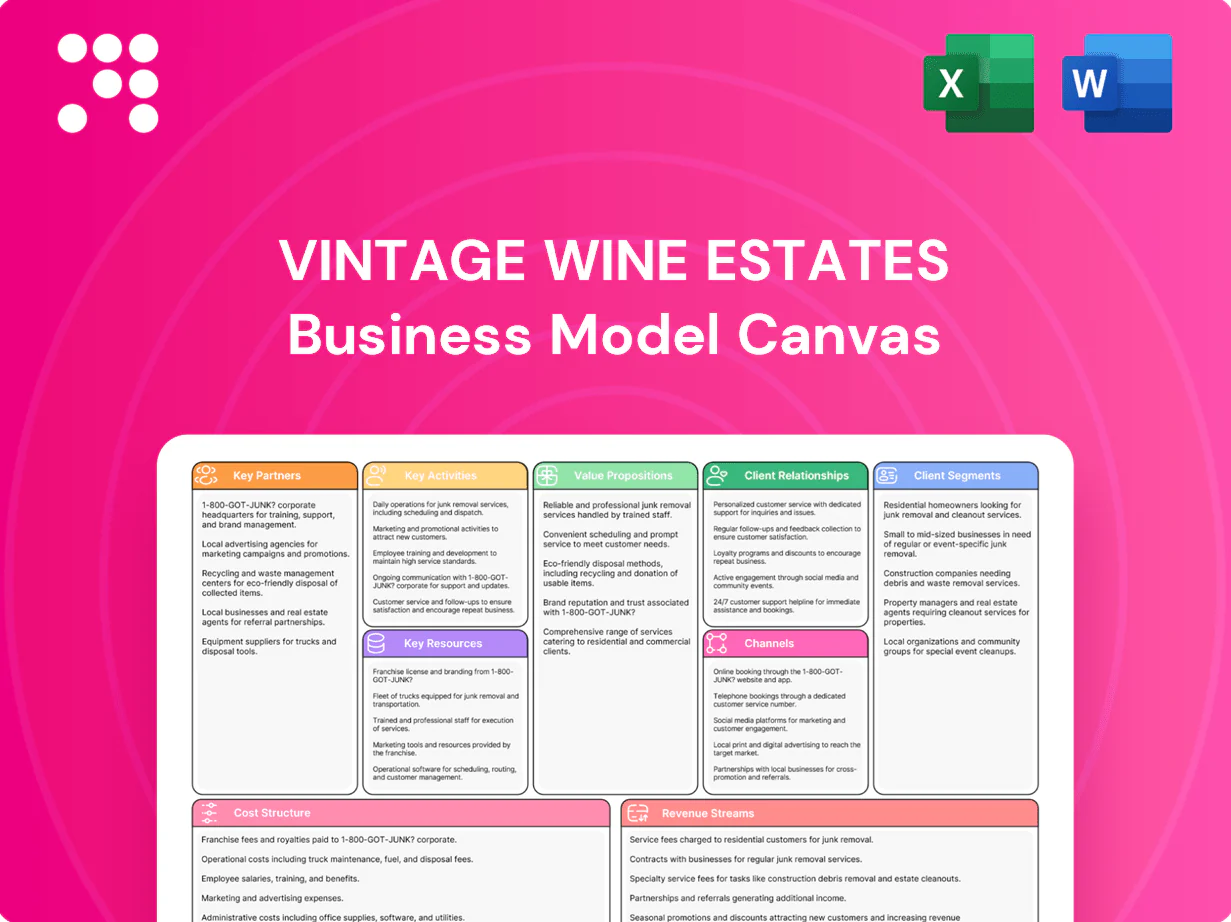
Vintage Wine Estates Business Model Canvas

Wine Estate Business Model Canvas: Strategic Snapshot for Scaling & Partnerships
Explore Vintage Wine Estates’s strategic DNA with our concise Business Model Canvas summary—covering value propositions, distribution channels, and revenue streams. This snapshot reveals how the company scales brands and leverages partnerships. Purchase the full Canvas for a section-by-section toolkit in Word and Excel to guide investment or strategic planning.
Partnerships

Growers & Vineyard Alliances
Contracted growers supplement estate fruit and ensure vintage diversification across multiple appellations. Long-term sourcing agreements (multi-year contracts) stabilize input quality and pricing and reduce vintage risk. Regional partners expand our footprint across Napa, Sonoma, Oregon, and Washington. Joint viticulture practices align on sustainability metrics and yield management best practices.
Distributor & Wholesaler Networks
National and regional distributors secure on- and off-premise placement at scale, tapping into the US wine market valued at roughly $74 billion in 2023. Portfolio programming drives volume across price tiers, aligning entry, core and premium SKUs to maximize shelf and menu velocity. Data-sharing with distributors improves demand planning and promotional ROI. Strategic alignment enables timely new brand launches and seasonal pushes.

Retail & eCommerce Platforms
Partnerships with grocery, club, specialty retail and marketplaces expand distribution and discovery for Vintage Wine Estates, crucial as Amazon accounted for about 38% of US e-commerce sales in 2024. Co-op marketing deals raise shelf presence and clicks-to-cart, driving measurable incremental sales through shared promotional budgets. Exclusive SKUs and bundles create differentiation and better per-unit economics. Shared analytics enable region-level pricing and assortment refinement.

Hospitality & On-Premise Accounts
- On-premise value share 2024: 34% (IWSR)
- BTG velocity lift: ~15–25%
- Events drive higher trial-to-repeat conversion
- Feedback used for style and packaging adjustments
M&A, Finance & Logistics Partners
Advisors source acquisitions and structure roll-ups of brands and vineyards, aligning deal economics and earn-outs to preserve brand equity; lenders and lessors supply working capital plus barrel and equipment financing to smooth vintage cashflow and capex cycles. 3PLs, cold-chain carriers and compliance firms secure efficient, compliant distribution; technology partners scale OMS, DTC and CRM operations.
- Advisors: deal origination & structuring
- Lenders/lessors: working capital, barrel & equipment finance
- 3PLs & cold-chain: distribution & compliance
- Tech: OMS, DTC, CRM scalability
Contract growers, distributors and on‑premise partners stabilize vintage risk and enable roll‑ups
Contract growers, distributors, retail and on‑premise partners secure supply, placement and brand discovery, stabilizing vintage risk and scaling DTC/wholesale. 2024 on‑premise value share 34% and Amazon held ~38% of US e‑commerce; national distributors and 3PLs lift SKU velocity and compliance. Financial partners provide working capital, barrel finance and M&A advisory to enable roll‑ups.
| Partner | Role | 2024 metric |
|---|---|---|
| Growers | Supply diversity | Multi‑appellation sourcing |
| Distributors | Placement | US wine market ~$74B (2023) |
| On‑premise | Discovery | 34% value share (2024) |
| E‑commerce | Reach | Amazon ~38% of US e‑commerce (2024) |
What is included in the product
 Detailed Word Document
A comprehensive Business Model Canvas for Vintage Wine Estates detailing the nine BMC blocks—customer segments, value propositions, channels, customer relationships, revenue streams, key resources, key activities, key partnerships, and cost structure—aligned with real-world operations, competitive advantages, and linked SWOT/strategic insights; ideal for investor presentations, financing discussions, and strategic decision-making.

 Customizable Excel Spreadsheet
High-level snapshot of Vintage Wine Estates’ business model that quickly surfaces distribution, brand, and margin pain points for faster decision-making. Shareable, editable canvas saves hours of analysis and aligns teams for strategic pivots or M&A readiness.
Activities

Brand Acquisition & Integration
Identify established labels with loyal followings and margin potential, leveraging Vintage Wine Estates' portfolio of over 40 premium brands to prioritize targets with strong DTC and on-premise traction. Conduct due diligence on vineyards, inventory, and channel fit using SKU-level margin analysis and inventory aging reports. Integrate supply chains, systems, and sales coverage rapidly to realize cost and service synergies through SKU rationalization and shared services.
Viticulture & Winemaking
Manage over 20 estate vineyards and grower relationships across multiple AVAs to balance quality and cost, supporting a portfolio of 30+ brands; optimize contracts and yield targets to control COGS. Execute fermentation, aging, blending and bottling to hit target profiles for ~500,000 cases annually (2024). Maintain certifications and compliance across AVAs and regulatory regimes. Innovate with new varietals, package formats and sustainable practices to reduce inputs and improve margins.

DTC Growth & Experience
Operate 30 wineries and 25 tasting rooms to drive higher-margin DTC revenue across clubs and eCommerce, with DTC representing about 40% of Vintage Wine Estates sales in 2024. Personalize offers using CRM and behavioral data to increase club conversion and lifetime value. Curate events, allocations and limited releases to justify premium pricing and scarcity-driven demand. Continuously test site flows, raise AOV and conversion, and boost retention via loyalty perks and targeted reactivation.

Trade Marketing & Sales Enablement
Develop 3-tier pricing ladders, seasonal promotions and POS for retail and on-premise; train distributor reps and key accounts on brand story and pairing; run holiday and category-set programming; monitor depletion velocity weekly and pivot in-market tactics within 4–6 weeks to optimize sell-through.
- Pricing tiers: 3
- POS per account: 2–4
- Depletion review: weekly
- In-market pivot: 4–6 weeks
Supply Chain & Compliance
Supply Chain & Compliance forecasts demand to align procurement of glass, cork, labels and barrels, schedules bottling and warehousing to minimize carrying costs, and enforces multi-state regulatory and DTC shipping rules in 2024.
QA protocols ensure lot traceability and recall readiness, integrating cellar-to-consumer tracking and TTB/State compliance checks to protect margins and brand integrity.
- Demand forecasting — raw material alignment
- Bottling cadence — lower carrying costs
- Regulatory coverage — 50-state/DTC
- QA & traceability — recall readiness
Acquire premium wine labels, rationalize SKUs, protect 40% DTC margins
Identify and acquire premium labels with strong DTC/on-prem traction, using SKU margin and aging analysis to prioritize integrations. Operate 30 wineries, 25 tasting rooms and ~20 vineyards to produce ~500,000 cases (2024), with DTC ~40% of sales, optimizing costs via SKU rationalization and shared services. Manage supply chain, QA and 50-state DTC compliance to protect margins and brand integrity.
| Metric | 2024 |
|---|---|
| Cases Produced | ~500,000 |
| DTC % Sales | ~40% |
| Wineries / Tasting Rooms | 30 / 25 |
| Vineyards | ~20+ |
Delivered as Displayed
Business Model Canvas
The Vintage Wine Estates Business Model Canvas previewed here is the exact deliverable—not a mockup or sample—and shows real content from the final file. When you purchase, you’ll receive this same complete document instantly, formatted and ready to use. Files are provided in Word and Excel for editing and presentation. No surprises—what you see is what you get.

Wine Estate Business Model Canvas: Strategic Snapshot for Scaling & Partnerships
Explore Vintage Wine Estates’s strategic DNA with our concise Business Model Canvas summary—covering value propositions, distribution channels, and revenue streams. This snapshot reveals how the company scales brands and leverages partnerships. Purchase the full Canvas for a section-by-section toolkit in Word and Excel to guide investment or strategic planning.
Partnerships
Growers & Vineyard Alliances
Contracted growers supplement estate fruit and ensure vintage diversification across multiple appellations. Long-term sourcing agreements (multi-year contracts) stabilize input quality and pricing and reduce vintage risk. Regional partners expand our footprint across Napa, Sonoma, Oregon, and Washington. Joint viticulture practices align on sustainability metrics and yield management best practices.
Distributor & Wholesaler Networks
National and regional distributors secure on- and off-premise placement at scale, tapping into the US wine market valued at roughly $74 billion in 2023. Portfolio programming drives volume across price tiers, aligning entry, core and premium SKUs to maximize shelf and menu velocity. Data-sharing with distributors improves demand planning and promotional ROI. Strategic alignment enables timely new brand launches and seasonal pushes.
Retail & eCommerce Platforms
Partnerships with grocery, club, specialty retail and marketplaces expand distribution and discovery for Vintage Wine Estates, crucial as Amazon accounted for about 38% of US e-commerce sales in 2024. Co-op marketing deals raise shelf presence and clicks-to-cart, driving measurable incremental sales through shared promotional budgets. Exclusive SKUs and bundles create differentiation and better per-unit economics. Shared analytics enable region-level pricing and assortment refinement.
Hospitality & On-Premise Accounts
- On-premise value share 2024: 34% (IWSR)
- BTG velocity lift: ~15–25%
- Events drive higher trial-to-repeat conversion
- Feedback used for style and packaging adjustments
M&A, Finance & Logistics Partners
Advisors source acquisitions and structure roll-ups of brands and vineyards, aligning deal economics and earn-outs to preserve brand equity; lenders and lessors supply working capital plus barrel and equipment financing to smooth vintage cashflow and capex cycles. 3PLs, cold-chain carriers and compliance firms secure efficient, compliant distribution; technology partners scale OMS, DTC and CRM operations.
- Advisors: deal origination & structuring
- Lenders/lessors: working capital, barrel & equipment finance
- 3PLs & cold-chain: distribution & compliance
- Tech: OMS, DTC, CRM scalability
Contract growers, distributors and on‑premise partners stabilize vintage risk and enable roll‑ups
Contract growers, distributors, retail and on‑premise partners secure supply, placement and brand discovery, stabilizing vintage risk and scaling DTC/wholesale. 2024 on‑premise value share 34% and Amazon held ~38% of US e‑commerce; national distributors and 3PLs lift SKU velocity and compliance. Financial partners provide working capital, barrel finance and M&A advisory to enable roll‑ups.
| Partner | Role | 2024 metric |
|---|---|---|
| Growers | Supply diversity | Multi‑appellation sourcing |
| Distributors | Placement | US wine market ~$74B (2023) |
| On‑premise | Discovery | 34% value share (2024) |
| E‑commerce | Reach | Amazon ~38% of US e‑commerce (2024) |
What is included in the product
Detailed Word Document
A comprehensive Business Model Canvas for Vintage Wine Estates detailing the nine BMC blocks—customer segments, value propositions, channels, customer relationships, revenue streams, key resources, key activities, key partnerships, and cost structure—aligned with real-world operations, competitive advantages, and linked SWOT/strategic insights; ideal for investor presentations, financing discussions, and strategic decision-making.
Customizable Excel Spreadsheet
High-level snapshot of Vintage Wine Estates’ business model that quickly surfaces distribution, brand, and margin pain points for faster decision-making. Shareable, editable canvas saves hours of analysis and aligns teams for strategic pivots or M&A readiness.
Activities
Brand Acquisition & Integration
Identify established labels with loyal followings and margin potential, leveraging Vintage Wine Estates' portfolio of over 40 premium brands to prioritize targets with strong DTC and on-premise traction. Conduct due diligence on vineyards, inventory, and channel fit using SKU-level margin analysis and inventory aging reports. Integrate supply chains, systems, and sales coverage rapidly to realize cost and service synergies through SKU rationalization and shared services.
Viticulture & Winemaking
Manage over 20 estate vineyards and grower relationships across multiple AVAs to balance quality and cost, supporting a portfolio of 30+ brands; optimize contracts and yield targets to control COGS. Execute fermentation, aging, blending and bottling to hit target profiles for ~500,000 cases annually (2024). Maintain certifications and compliance across AVAs and regulatory regimes. Innovate with new varietals, package formats and sustainable practices to reduce inputs and improve margins.
DTC Growth & Experience
Operate 30 wineries and 25 tasting rooms to drive higher-margin DTC revenue across clubs and eCommerce, with DTC representing about 40% of Vintage Wine Estates sales in 2024. Personalize offers using CRM and behavioral data to increase club conversion and lifetime value. Curate events, allocations and limited releases to justify premium pricing and scarcity-driven demand. Continuously test site flows, raise AOV and conversion, and boost retention via loyalty perks and targeted reactivation.
Trade Marketing & Sales Enablement
Develop 3-tier pricing ladders, seasonal promotions and POS for retail and on-premise; train distributor reps and key accounts on brand story and pairing; run holiday and category-set programming; monitor depletion velocity weekly and pivot in-market tactics within 4–6 weeks to optimize sell-through.
- Pricing tiers: 3
- POS per account: 2–4
- Depletion review: weekly
- In-market pivot: 4–6 weeks
Supply Chain & Compliance
Supply Chain & Compliance forecasts demand to align procurement of glass, cork, labels and barrels, schedules bottling and warehousing to minimize carrying costs, and enforces multi-state regulatory and DTC shipping rules in 2024.
QA protocols ensure lot traceability and recall readiness, integrating cellar-to-consumer tracking and TTB/State compliance checks to protect margins and brand integrity.
- Demand forecasting — raw material alignment
- Bottling cadence — lower carrying costs
- Regulatory coverage — 50-state/DTC
- QA & traceability — recall readiness
Acquire premium wine labels, rationalize SKUs, protect 40% DTC margins
Identify and acquire premium labels with strong DTC/on-prem traction, using SKU margin and aging analysis to prioritize integrations. Operate 30 wineries, 25 tasting rooms and ~20 vineyards to produce ~500,000 cases (2024), with DTC ~40% of sales, optimizing costs via SKU rationalization and shared services. Manage supply chain, QA and 50-state DTC compliance to protect margins and brand integrity.
| Metric | 2024 |
|---|---|
| Cases Produced | ~500,000 |
| DTC % Sales | ~40% |
| Wineries / Tasting Rooms | 30 / 25 |
| Vineyards | ~20+ |
Delivered as Displayed
Business Model Canvas
The Vintage Wine Estates Business Model Canvas previewed here is the exact deliverable—not a mockup or sample—and shows real content from the final file. When you purchase, you’ll receive this same complete document instantly, formatted and ready to use. Files are provided in Word and Excel for editing and presentation. No surprises—what you see is what you get.
Original: $10.00
-65%$10.00
$3.50Description
Wine Estate Business Model Canvas: Strategic Snapshot for Scaling & Partnerships
Explore Vintage Wine Estates’s strategic DNA with our concise Business Model Canvas summary—covering value propositions, distribution channels, and revenue streams. This snapshot reveals how the company scales brands and leverages partnerships. Purchase the full Canvas for a section-by-section toolkit in Word and Excel to guide investment or strategic planning.
Partnerships
Growers & Vineyard Alliances
Contracted growers supplement estate fruit and ensure vintage diversification across multiple appellations. Long-term sourcing agreements (multi-year contracts) stabilize input quality and pricing and reduce vintage risk. Regional partners expand our footprint across Napa, Sonoma, Oregon, and Washington. Joint viticulture practices align on sustainability metrics and yield management best practices.
Distributor & Wholesaler Networks
National and regional distributors secure on- and off-premise placement at scale, tapping into the US wine market valued at roughly $74 billion in 2023. Portfolio programming drives volume across price tiers, aligning entry, core and premium SKUs to maximize shelf and menu velocity. Data-sharing with distributors improves demand planning and promotional ROI. Strategic alignment enables timely new brand launches and seasonal pushes.
Retail & eCommerce Platforms
Partnerships with grocery, club, specialty retail and marketplaces expand distribution and discovery for Vintage Wine Estates, crucial as Amazon accounted for about 38% of US e-commerce sales in 2024. Co-op marketing deals raise shelf presence and clicks-to-cart, driving measurable incremental sales through shared promotional budgets. Exclusive SKUs and bundles create differentiation and better per-unit economics. Shared analytics enable region-level pricing and assortment refinement.
Hospitality & On-Premise Accounts
- On-premise value share 2024: 34% (IWSR)
- BTG velocity lift: ~15–25%
- Events drive higher trial-to-repeat conversion
- Feedback used for style and packaging adjustments
M&A, Finance & Logistics Partners
Advisors source acquisitions and structure roll-ups of brands and vineyards, aligning deal economics and earn-outs to preserve brand equity; lenders and lessors supply working capital plus barrel and equipment financing to smooth vintage cashflow and capex cycles. 3PLs, cold-chain carriers and compliance firms secure efficient, compliant distribution; technology partners scale OMS, DTC and CRM operations.
- Advisors: deal origination & structuring
- Lenders/lessors: working capital, barrel & equipment finance
- 3PLs & cold-chain: distribution & compliance
- Tech: OMS, DTC, CRM scalability
Contract growers, distributors and on‑premise partners stabilize vintage risk and enable roll‑ups
Contract growers, distributors, retail and on‑premise partners secure supply, placement and brand discovery, stabilizing vintage risk and scaling DTC/wholesale. 2024 on‑premise value share 34% and Amazon held ~38% of US e‑commerce; national distributors and 3PLs lift SKU velocity and compliance. Financial partners provide working capital, barrel finance and M&A advisory to enable roll‑ups.
| Partner | Role | 2024 metric |
|---|---|---|
| Growers | Supply diversity | Multi‑appellation sourcing |
| Distributors | Placement | US wine market ~$74B (2023) |
| On‑premise | Discovery | 34% value share (2024) |
| E‑commerce | Reach | Amazon ~38% of US e‑commerce (2024) |
What is included in the product
Detailed Word Document
A comprehensive Business Model Canvas for Vintage Wine Estates detailing the nine BMC blocks—customer segments, value propositions, channels, customer relationships, revenue streams, key resources, key activities, key partnerships, and cost structure—aligned with real-world operations, competitive advantages, and linked SWOT/strategic insights; ideal for investor presentations, financing discussions, and strategic decision-making.
Customizable Excel Spreadsheet
High-level snapshot of Vintage Wine Estates’ business model that quickly surfaces distribution, brand, and margin pain points for faster decision-making. Shareable, editable canvas saves hours of analysis and aligns teams for strategic pivots or M&A readiness.
Activities
Brand Acquisition & Integration
Identify established labels with loyal followings and margin potential, leveraging Vintage Wine Estates' portfolio of over 40 premium brands to prioritize targets with strong DTC and on-premise traction. Conduct due diligence on vineyards, inventory, and channel fit using SKU-level margin analysis and inventory aging reports. Integrate supply chains, systems, and sales coverage rapidly to realize cost and service synergies through SKU rationalization and shared services.
Viticulture & Winemaking
Manage over 20 estate vineyards and grower relationships across multiple AVAs to balance quality and cost, supporting a portfolio of 30+ brands; optimize contracts and yield targets to control COGS. Execute fermentation, aging, blending and bottling to hit target profiles for ~500,000 cases annually (2024). Maintain certifications and compliance across AVAs and regulatory regimes. Innovate with new varietals, package formats and sustainable practices to reduce inputs and improve margins.
DTC Growth & Experience
Operate 30 wineries and 25 tasting rooms to drive higher-margin DTC revenue across clubs and eCommerce, with DTC representing about 40% of Vintage Wine Estates sales in 2024. Personalize offers using CRM and behavioral data to increase club conversion and lifetime value. Curate events, allocations and limited releases to justify premium pricing and scarcity-driven demand. Continuously test site flows, raise AOV and conversion, and boost retention via loyalty perks and targeted reactivation.
Trade Marketing & Sales Enablement
Develop 3-tier pricing ladders, seasonal promotions and POS for retail and on-premise; train distributor reps and key accounts on brand story and pairing; run holiday and category-set programming; monitor depletion velocity weekly and pivot in-market tactics within 4–6 weeks to optimize sell-through.
- Pricing tiers: 3
- POS per account: 2–4
- Depletion review: weekly
- In-market pivot: 4–6 weeks
Supply Chain & Compliance
Supply Chain & Compliance forecasts demand to align procurement of glass, cork, labels and barrels, schedules bottling and warehousing to minimize carrying costs, and enforces multi-state regulatory and DTC shipping rules in 2024.
QA protocols ensure lot traceability and recall readiness, integrating cellar-to-consumer tracking and TTB/State compliance checks to protect margins and brand integrity.
- Demand forecasting — raw material alignment
- Bottling cadence — lower carrying costs
- Regulatory coverage — 50-state/DTC
- QA & traceability — recall readiness
Acquire premium wine labels, rationalize SKUs, protect 40% DTC margins
Identify and acquire premium labels with strong DTC/on-prem traction, using SKU margin and aging analysis to prioritize integrations. Operate 30 wineries, 25 tasting rooms and ~20 vineyards to produce ~500,000 cases (2024), with DTC ~40% of sales, optimizing costs via SKU rationalization and shared services. Manage supply chain, QA and 50-state DTC compliance to protect margins and brand integrity.
| Metric | 2024 |
|---|---|
| Cases Produced | ~500,000 |
| DTC % Sales | ~40% |
| Wineries / Tasting Rooms | 30 / 25 |
| Vineyards | ~20+ |
Delivered as Displayed
Business Model Canvas
The Vintage Wine Estates Business Model Canvas previewed here is the exact deliverable—not a mockup or sample—and shows real content from the final file. When you purchase, you’ll receive this same complete document instantly, formatted and ready to use. Files are provided in Word and Excel for editing and presentation. No surprises—what you see is what you get.











