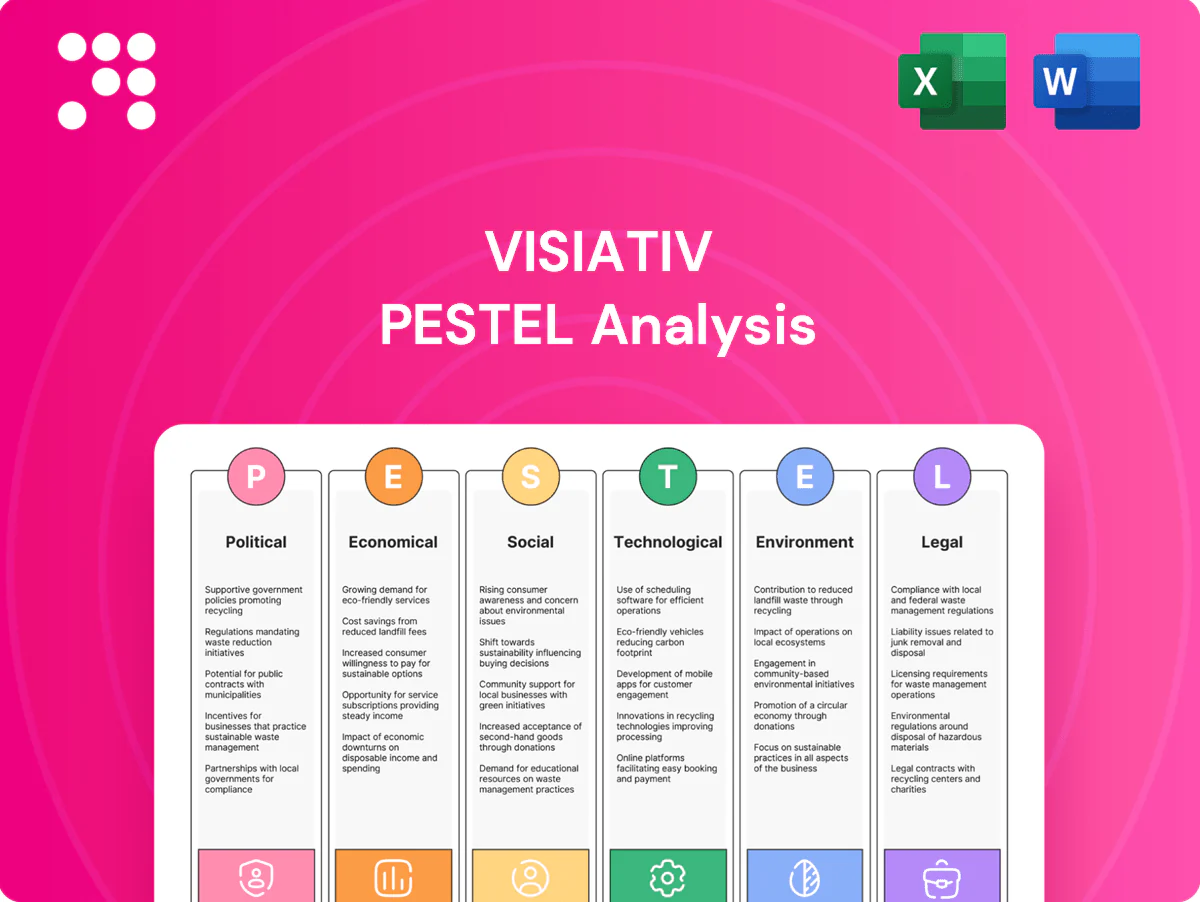
Visiativ PESTLE Analysis

Skip the Research. Get the Strategy.
Our PESTLE analysis for Visiativ reveals how political, economic, social, technological, legal and environmental forces shape its strategy and growth prospects. Ideal for investors and strategists, it turns external trends into actionable insight. Purchase the full report to download the complete, editable analysis now.
Political factors

EU digital sovereignty
EU digital sovereignty—driven by the Data Act, Digital Markets/Services rules and GAIA‑X—encourages data residency and favors local cloud/PLM suppliers, shaping vendor selection for public buyers. Visiativ can leverage a trusted‑cloud stance within the Dassault Systèmes ecosystem to compete for EU and sectoral deals. GAIA‑X counted roughly 400+ organizations by 2024, opening public/quasi‑public tenders. Ongoing shifts in standards will require continued compliance investment.
Public funding for SME digitalization
France and EU programmes like the EU Digital Europe Programme (€7.5bn 2021-27) and France’s €39.4bn RRF allocation create grants and tax-credit pathways to drive SME Industry 4.0 and CAD/PLM uptake; Visiativ can package solutions to match funding criteria and shorten sales cycles. Reliance on public programmes adds budgeting and tender-timing risk, while policy shifts toward cybersecurity or AI require rapid portfolio agility.

Geopolitical supply chain and partner exposure
Sanctions, trade frictions and vendor export controls can disrupt access to software components and support models, forcing rework for affected modules. Dependency on global hyperscalers — which held roughly 66% of the cloud market in 2024 (Synergy Research) — may prompt public clients to reassess suppliers. Visiativ must diversify hosting options and maintain tested continuity plans, since political tensions also compress multinational SME investment timing.

Regional industrial policies
EU Fit for 55 (55% GHG cut by 2030) and France 2030 (€54bn) drive reindustrialization and net‑zero manufacturing, boosting demand for PLM and digital twins (digital twin market ~US$10.5bn in 2023). Visiativ can sell productivity+decarbonization value; cluster initiatives and chambers open channels; public procurement (≈14% EU GDP) requires measurable outcomes and certifications.
- Reindustrialization funding: France 2030 €54bn
- Digital twin market: US$10.5bn (2023)
- EU target: −55% GHG by 2030
- Public procurement ≈14% of EU GDP; demands measurable outcomes
Procurement and localization requirements
Public and para‑public buyers increasingly demand local presence, native‑language materials and compliance proofs; this favors vendors with European operations. Visiativ’s established European footprint strengthens bids for contracts aligned with national digitalization priorities; EU public procurement totals roughly €2 trillion (~14% of GDP). Localizing training and support improves award odds but increases delivery costs when duplicated across markets.
- local_presence
- €2T_public_procurement
- localization_costs
EU digital-sovereignty boosts local PLM adoption; public tenders now require decarbonization metrics
EU digital-sovereignty rules and GAIA‑X (400+ orgs by 2024) favor local/cloud-compliant PLM suppliers; Visiativ can leverage Dassault Systèmes trust to win public deals. France/EU funding (France 2030 €54bn; Digital Europe €7.5bn) boosts SME CAD/PLM uptake but adds tender timing risk. Public procurement ≈€2T (~14% GDP) demands measurable decarbonization outcomes (Fit for 55: −55% by 2030).
| Metric | Value |
|---|---|
| GAIA‑X participants | 400+ (2024) |
| Digital Europe | €7.5bn (2021‑27) |
| France 2030 | €54bn |
| Public procurement | €2T (~14% GDP) |
What is included in the product
 Detailed Word Document
Provides a data-backed PESTLE review of Visiativ—political, economic, social, technological, environmental and legal forces—highlighting region- and industry-specific risks and opportunities with forward-looking insights, actionable sub-points, and clean formatting for executives, investors and strategists.

 Customizable Excel Spreadsheet
Clean, visually segmented PESTLE summary tailored to Visiativ that speeds meeting prep and supports quick alignment across teams. Easily editable and exportable for presentations or client reports, reducing prep time and simplifying external risk discussions.
Economic factors

SME IT spending cycles
Visiativ’s SME market is highly sensitive to interest rates, energy costs and credit availability, and given that SMEs represent 99.8% of EU enterprises and provide 66.6% of jobs (Eurostat 2022), funding cycles materially affect demand.
Tight credit or higher rates commonly delay transformation programs, whereas targeted subsidies and clear ROI evidence accelerate procurement and project starts.
Structuring offers as SaaS with transparent payback timelines improves board approval, while flexible financing and modular scopes lower churn and protect lifetime value.
Recurring vs project revenue mix
Visiativ’s shift from integration‑heavy projects toward ARR (subscriptions and managed services) stabilizes cash flow and reduces revenue volatility, while maintenance and platform fees bolster valuation resilience. Sustained ARR growth requires expanded customer success and adoption services to curb churn and increase lifetime value. Nonetheless, project backlog remains critical to near‑term utilization and margin performance.

Talent costs and productivity
Competition for consultants, developers and CAD/PLM experts drives wage pressure—Hired 2024 reported roughly 8% YoY base pay growth for software engineers, tightening margins for service firms like Visiativ. Nearshore mixes and delivery accelerators (outsourcing plus reusable components) help protect margins and shorten timelines. Knowledge reuse via templates and accelerators boosts gross margin by improving billable productivity. Ongoing macro wage inflation risks compressing pricing power without clear value differentiation.

M&A and consolidation dynamics
IT services and VAR ecosystems are consolidating, shifting channel power and pressuring pricing; Visiativ can pursue bolt‑on acquisitions in cyber, AI and cloud CAD to upsell its base while cautious of integration risk and goodwill impairment after deals that often exceed market multiples in 2024.
- Consolidation raises price pressure
- Acquisitions enable capability upsell
- Integration and goodwill risks
- Competitor roll‑ups drive vertical discounting
Currency and international exposure
Non-euro revenues and costs expose Visiativ to FX volatility that affected margins in 2024 as EUR/USD averaged about 1.09, requiring active hedging and euro‑denominated contracts to stabilize reported results and protect EBITDA. Cross‑border projects add travel and compliance costs while pricing localization must reflect local purchasing power and tax regimes to preserve competitiveness.
- FX: EUR/USD avg 2024 ~1.09
- Hedging: euro contracts reduce translation risk
- Cross‑border: added travel/compliance expenses
- Pricing: must adapt to local purchasing power and taxes
EU digital-sovereignty boosts local PLM adoption; public tenders now require decarbonization metrics
Visiativ revenue mix shifts to ARR reduce volatility; maintenance/platform fees and 2024 ARR growth target (company guidance) improve valuation resilience.
SME demand is rate‑sensitive: SMEs = 99.8% EU firms, 66.6% jobs (Eurostat 2022); EUR/USD 2024 avg ~1.09 adds FX risk requiring hedges.
Wage pressure (software pay +8% YoY 2024) and consolidation compress margins; acquisitions offer upsell but raise integration/goodwill risk.
| Metric | 2024 |
|---|---|
| EUR/USD avg | ~1.09 |
| EU SMEs share | 99.8% firms, 66.6% jobs |
| SW engineer pay growth | ~+8% YoY |
| ARR focus | Raised share of revenues (guidance) |
Full Version Awaits
Visiativ PESTLE Analysis
The preview shown here is the exact Visiativ PESTLE document you’ll receive after purchase—fully formatted and ready to use. This screenshot reflects the final content, layout and structure with no placeholders or edits. After payment you’ll instantly download the identical, professionally structured file.

Skip the Research. Get the Strategy.
Our PESTLE analysis for Visiativ reveals how political, economic, social, technological, legal and environmental forces shape its strategy and growth prospects. Ideal for investors and strategists, it turns external trends into actionable insight. Purchase the full report to download the complete, editable analysis now.
Political factors
EU digital sovereignty
EU digital sovereignty—driven by the Data Act, Digital Markets/Services rules and GAIA‑X—encourages data residency and favors local cloud/PLM suppliers, shaping vendor selection for public buyers. Visiativ can leverage a trusted‑cloud stance within the Dassault Systèmes ecosystem to compete for EU and sectoral deals. GAIA‑X counted roughly 400+ organizations by 2024, opening public/quasi‑public tenders. Ongoing shifts in standards will require continued compliance investment.
Public funding for SME digitalization
France and EU programmes like the EU Digital Europe Programme (€7.5bn 2021-27) and France’s €39.4bn RRF allocation create grants and tax-credit pathways to drive SME Industry 4.0 and CAD/PLM uptake; Visiativ can package solutions to match funding criteria and shorten sales cycles. Reliance on public programmes adds budgeting and tender-timing risk, while policy shifts toward cybersecurity or AI require rapid portfolio agility.
Geopolitical supply chain and partner exposure
Sanctions, trade frictions and vendor export controls can disrupt access to software components and support models, forcing rework for affected modules. Dependency on global hyperscalers — which held roughly 66% of the cloud market in 2024 (Synergy Research) — may prompt public clients to reassess suppliers. Visiativ must diversify hosting options and maintain tested continuity plans, since political tensions also compress multinational SME investment timing.
Regional industrial policies
EU Fit for 55 (55% GHG cut by 2030) and France 2030 (€54bn) drive reindustrialization and net‑zero manufacturing, boosting demand for PLM and digital twins (digital twin market ~US$10.5bn in 2023). Visiativ can sell productivity+decarbonization value; cluster initiatives and chambers open channels; public procurement (≈14% EU GDP) requires measurable outcomes and certifications.
- Reindustrialization funding: France 2030 €54bn
- Digital twin market: US$10.5bn (2023)
- EU target: −55% GHG by 2030
- Public procurement ≈14% of EU GDP; demands measurable outcomes
Procurement and localization requirements
Public and para‑public buyers increasingly demand local presence, native‑language materials and compliance proofs; this favors vendors with European operations. Visiativ’s established European footprint strengthens bids for contracts aligned with national digitalization priorities; EU public procurement totals roughly €2 trillion (~14% of GDP). Localizing training and support improves award odds but increases delivery costs when duplicated across markets.
- local_presence
- €2T_public_procurement
- localization_costs
EU digital-sovereignty boosts local PLM adoption; public tenders now require decarbonization metrics
EU digital-sovereignty rules and GAIA‑X (400+ orgs by 2024) favor local/cloud-compliant PLM suppliers; Visiativ can leverage Dassault Systèmes trust to win public deals. France/EU funding (France 2030 €54bn; Digital Europe €7.5bn) boosts SME CAD/PLM uptake but adds tender timing risk. Public procurement ≈€2T (~14% GDP) demands measurable decarbonization outcomes (Fit for 55: −55% by 2030).
| Metric | Value |
|---|---|
| GAIA‑X participants | 400+ (2024) |
| Digital Europe | €7.5bn (2021‑27) |
| France 2030 | €54bn |
| Public procurement | €2T (~14% GDP) |
What is included in the product
Detailed Word Document
Provides a data-backed PESTLE review of Visiativ—political, economic, social, technological, environmental and legal forces—highlighting region- and industry-specific risks and opportunities with forward-looking insights, actionable sub-points, and clean formatting for executives, investors and strategists.
Customizable Excel Spreadsheet
Clean, visually segmented PESTLE summary tailored to Visiativ that speeds meeting prep and supports quick alignment across teams. Easily editable and exportable for presentations or client reports, reducing prep time and simplifying external risk discussions.
Economic factors
SME IT spending cycles
Visiativ’s SME market is highly sensitive to interest rates, energy costs and credit availability, and given that SMEs represent 99.8% of EU enterprises and provide 66.6% of jobs (Eurostat 2022), funding cycles materially affect demand.
Tight credit or higher rates commonly delay transformation programs, whereas targeted subsidies and clear ROI evidence accelerate procurement and project starts.
Structuring offers as SaaS with transparent payback timelines improves board approval, while flexible financing and modular scopes lower churn and protect lifetime value.
Recurring vs project revenue mix
Visiativ’s shift from integration‑heavy projects toward ARR (subscriptions and managed services) stabilizes cash flow and reduces revenue volatility, while maintenance and platform fees bolster valuation resilience. Sustained ARR growth requires expanded customer success and adoption services to curb churn and increase lifetime value. Nonetheless, project backlog remains critical to near‑term utilization and margin performance.
Talent costs and productivity
Competition for consultants, developers and CAD/PLM experts drives wage pressure—Hired 2024 reported roughly 8% YoY base pay growth for software engineers, tightening margins for service firms like Visiativ. Nearshore mixes and delivery accelerators (outsourcing plus reusable components) help protect margins and shorten timelines. Knowledge reuse via templates and accelerators boosts gross margin by improving billable productivity. Ongoing macro wage inflation risks compressing pricing power without clear value differentiation.
M&A and consolidation dynamics
IT services and VAR ecosystems are consolidating, shifting channel power and pressuring pricing; Visiativ can pursue bolt‑on acquisitions in cyber, AI and cloud CAD to upsell its base while cautious of integration risk and goodwill impairment after deals that often exceed market multiples in 2024.
- Consolidation raises price pressure
- Acquisitions enable capability upsell
- Integration and goodwill risks
- Competitor roll‑ups drive vertical discounting
Currency and international exposure
Non-euro revenues and costs expose Visiativ to FX volatility that affected margins in 2024 as EUR/USD averaged about 1.09, requiring active hedging and euro‑denominated contracts to stabilize reported results and protect EBITDA. Cross‑border projects add travel and compliance costs while pricing localization must reflect local purchasing power and tax regimes to preserve competitiveness.
- FX: EUR/USD avg 2024 ~1.09
- Hedging: euro contracts reduce translation risk
- Cross‑border: added travel/compliance expenses
- Pricing: must adapt to local purchasing power and taxes
EU digital-sovereignty boosts local PLM adoption; public tenders now require decarbonization metrics
Visiativ revenue mix shifts to ARR reduce volatility; maintenance/platform fees and 2024 ARR growth target (company guidance) improve valuation resilience.
SME demand is rate‑sensitive: SMEs = 99.8% EU firms, 66.6% jobs (Eurostat 2022); EUR/USD 2024 avg ~1.09 adds FX risk requiring hedges.
Wage pressure (software pay +8% YoY 2024) and consolidation compress margins; acquisitions offer upsell but raise integration/goodwill risk.
| Metric | 2024 |
|---|---|
| EUR/USD avg | ~1.09 |
| EU SMEs share | 99.8% firms, 66.6% jobs |
| SW engineer pay growth | ~+8% YoY |
| ARR focus | Raised share of revenues (guidance) |
Full Version Awaits
Visiativ PESTLE Analysis
The preview shown here is the exact Visiativ PESTLE document you’ll receive after purchase—fully formatted and ready to use. This screenshot reflects the final content, layout and structure with no placeholders or edits. After payment you’ll instantly download the identical, professionally structured file.
Original: $10.00
-65%$10.00
$3.50Description
Skip the Research. Get the Strategy.
Our PESTLE analysis for Visiativ reveals how political, economic, social, technological, legal and environmental forces shape its strategy and growth prospects. Ideal for investors and strategists, it turns external trends into actionable insight. Purchase the full report to download the complete, editable analysis now.
Political factors
EU digital sovereignty
EU digital sovereignty—driven by the Data Act, Digital Markets/Services rules and GAIA‑X—encourages data residency and favors local cloud/PLM suppliers, shaping vendor selection for public buyers. Visiativ can leverage a trusted‑cloud stance within the Dassault Systèmes ecosystem to compete for EU and sectoral deals. GAIA‑X counted roughly 400+ organizations by 2024, opening public/quasi‑public tenders. Ongoing shifts in standards will require continued compliance investment.
Public funding for SME digitalization
France and EU programmes like the EU Digital Europe Programme (€7.5bn 2021-27) and France’s €39.4bn RRF allocation create grants and tax-credit pathways to drive SME Industry 4.0 and CAD/PLM uptake; Visiativ can package solutions to match funding criteria and shorten sales cycles. Reliance on public programmes adds budgeting and tender-timing risk, while policy shifts toward cybersecurity or AI require rapid portfolio agility.
Geopolitical supply chain and partner exposure
Sanctions, trade frictions and vendor export controls can disrupt access to software components and support models, forcing rework for affected modules. Dependency on global hyperscalers — which held roughly 66% of the cloud market in 2024 (Synergy Research) — may prompt public clients to reassess suppliers. Visiativ must diversify hosting options and maintain tested continuity plans, since political tensions also compress multinational SME investment timing.
Regional industrial policies
EU Fit for 55 (55% GHG cut by 2030) and France 2030 (€54bn) drive reindustrialization and net‑zero manufacturing, boosting demand for PLM and digital twins (digital twin market ~US$10.5bn in 2023). Visiativ can sell productivity+decarbonization value; cluster initiatives and chambers open channels; public procurement (≈14% EU GDP) requires measurable outcomes and certifications.
- Reindustrialization funding: France 2030 €54bn
- Digital twin market: US$10.5bn (2023)
- EU target: −55% GHG by 2030
- Public procurement ≈14% of EU GDP; demands measurable outcomes
Procurement and localization requirements
Public and para‑public buyers increasingly demand local presence, native‑language materials and compliance proofs; this favors vendors with European operations. Visiativ’s established European footprint strengthens bids for contracts aligned with national digitalization priorities; EU public procurement totals roughly €2 trillion (~14% of GDP). Localizing training and support improves award odds but increases delivery costs when duplicated across markets.
- local_presence
- €2T_public_procurement
- localization_costs
EU digital-sovereignty boosts local PLM adoption; public tenders now require decarbonization metrics
EU digital-sovereignty rules and GAIA‑X (400+ orgs by 2024) favor local/cloud-compliant PLM suppliers; Visiativ can leverage Dassault Systèmes trust to win public deals. France/EU funding (France 2030 €54bn; Digital Europe €7.5bn) boosts SME CAD/PLM uptake but adds tender timing risk. Public procurement ≈€2T (~14% GDP) demands measurable decarbonization outcomes (Fit for 55: −55% by 2030).
| Metric | Value |
|---|---|
| GAIA‑X participants | 400+ (2024) |
| Digital Europe | €7.5bn (2021‑27) |
| France 2030 | €54bn |
| Public procurement | €2T (~14% GDP) |
What is included in the product
Detailed Word Document
Provides a data-backed PESTLE review of Visiativ—political, economic, social, technological, environmental and legal forces—highlighting region- and industry-specific risks and opportunities with forward-looking insights, actionable sub-points, and clean formatting for executives, investors and strategists.
Customizable Excel Spreadsheet
Clean, visually segmented PESTLE summary tailored to Visiativ that speeds meeting prep and supports quick alignment across teams. Easily editable and exportable for presentations or client reports, reducing prep time and simplifying external risk discussions.
Economic factors
SME IT spending cycles
Visiativ’s SME market is highly sensitive to interest rates, energy costs and credit availability, and given that SMEs represent 99.8% of EU enterprises and provide 66.6% of jobs (Eurostat 2022), funding cycles materially affect demand.
Tight credit or higher rates commonly delay transformation programs, whereas targeted subsidies and clear ROI evidence accelerate procurement and project starts.
Structuring offers as SaaS with transparent payback timelines improves board approval, while flexible financing and modular scopes lower churn and protect lifetime value.
Recurring vs project revenue mix
Visiativ’s shift from integration‑heavy projects toward ARR (subscriptions and managed services) stabilizes cash flow and reduces revenue volatility, while maintenance and platform fees bolster valuation resilience. Sustained ARR growth requires expanded customer success and adoption services to curb churn and increase lifetime value. Nonetheless, project backlog remains critical to near‑term utilization and margin performance.
Talent costs and productivity
Competition for consultants, developers and CAD/PLM experts drives wage pressure—Hired 2024 reported roughly 8% YoY base pay growth for software engineers, tightening margins for service firms like Visiativ. Nearshore mixes and delivery accelerators (outsourcing plus reusable components) help protect margins and shorten timelines. Knowledge reuse via templates and accelerators boosts gross margin by improving billable productivity. Ongoing macro wage inflation risks compressing pricing power without clear value differentiation.
M&A and consolidation dynamics
IT services and VAR ecosystems are consolidating, shifting channel power and pressuring pricing; Visiativ can pursue bolt‑on acquisitions in cyber, AI and cloud CAD to upsell its base while cautious of integration risk and goodwill impairment after deals that often exceed market multiples in 2024.
- Consolidation raises price pressure
- Acquisitions enable capability upsell
- Integration and goodwill risks
- Competitor roll‑ups drive vertical discounting
Currency and international exposure
Non-euro revenues and costs expose Visiativ to FX volatility that affected margins in 2024 as EUR/USD averaged about 1.09, requiring active hedging and euro‑denominated contracts to stabilize reported results and protect EBITDA. Cross‑border projects add travel and compliance costs while pricing localization must reflect local purchasing power and tax regimes to preserve competitiveness.
- FX: EUR/USD avg 2024 ~1.09
- Hedging: euro contracts reduce translation risk
- Cross‑border: added travel/compliance expenses
- Pricing: must adapt to local purchasing power and taxes
EU digital-sovereignty boosts local PLM adoption; public tenders now require decarbonization metrics
Visiativ revenue mix shifts to ARR reduce volatility; maintenance/platform fees and 2024 ARR growth target (company guidance) improve valuation resilience.
SME demand is rate‑sensitive: SMEs = 99.8% EU firms, 66.6% jobs (Eurostat 2022); EUR/USD 2024 avg ~1.09 adds FX risk requiring hedges.
Wage pressure (software pay +8% YoY 2024) and consolidation compress margins; acquisitions offer upsell but raise integration/goodwill risk.
| Metric | 2024 |
|---|---|
| EUR/USD avg | ~1.09 |
| EU SMEs share | 99.8% firms, 66.6% jobs |
| SW engineer pay growth | ~+8% YoY |
| ARR focus | Raised share of revenues (guidance) |
Full Version Awaits
Visiativ PESTLE Analysis
The preview shown here is the exact Visiativ PESTLE document you’ll receive after purchase—fully formatted and ready to use. This screenshot reflects the final content, layout and structure with no placeholders or edits. After payment you’ll instantly download the identical, professionally structured file.











