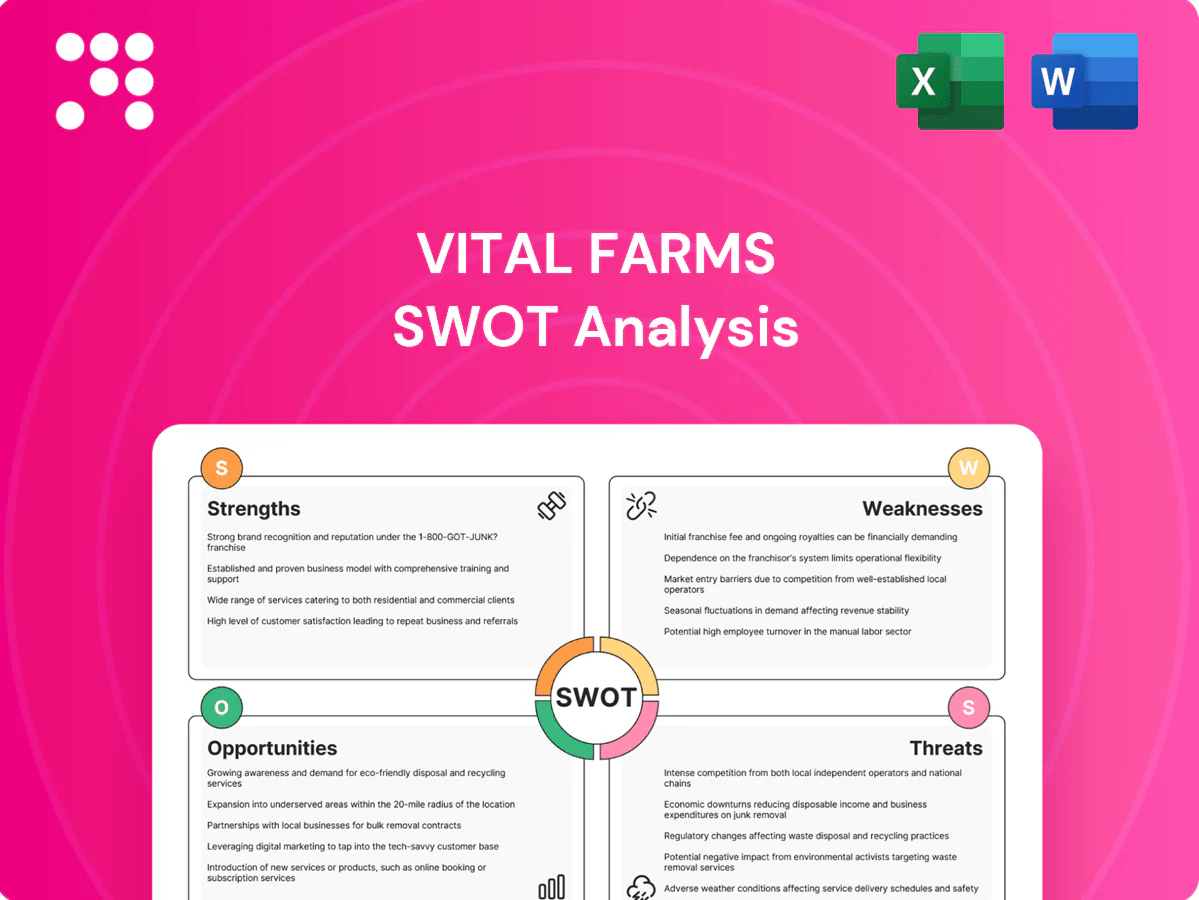
Vital Farms SWOT Analysis

Go Beyond the Preview—Access the Full Strategic Report
Vital Farms blends premium branding and ethical sourcing with strong retail distribution, but faces margin pressure and supply complexity. This quick SWOT outlines core strengths, weaknesses, opportunities and threats to guide investors and strategists. For deeper financial context, scenario analysis, and actionable recommendations, purchase the full report. The complete package includes editable Word and Excel deliverables for planning and pitching.
Strengths

Leader in pasture-raised eggs
Recognized brand authority in ethically sourced, pasture-raised eggs gives Vital Farms (Nasdaq: VITL) pricing power and trust among consumers. Clear differentiation versus cage-free and conventional eggs resonates with growing conscious shoppers. Category leadership secures shelf space, merchandising and retailer partnerships. Standards and third-party certification create a defensible moat and credibility.
Robust small-farm network
Distributed supply from over 1,000 family farms reduces single-source risk and supports scalability. Contracting with farms under strict welfare protocols ensures consistency and farm-level traceability and underpins Vital Farms' 100% pasture-raised claim. The model aligns incentives around quality, animal welfare, and long-term partnerships, strengthening the company’s authenticity narrative.

Nationwide retail distribution
Nationwide placement in 10,000+ retail doors increases visibility and drives repeat purchase, supporting brand frequency across major grocers. Broad ACV coverage gives volume leverage in processing, logistics, and marketing, lowering per-unit costs as scale grows. Strong retailer relationships enable new product placement and cross-selling (for example butter), and scale helps defend shelf space against emerging brands.

Premium brand and pricing
Vital Farms' premium brand equity supports materially higher ASPs and margins versus conventional eggs, with company net sales of $343.8 million in FY2024 reflecting strong pricing power and mix. Packaging, certifications (pasture-raised, non-GMO), and storytelling reinforce perceived value; consumers prioritizing transparency and welfare show lower price elasticity, helping Vital Farms absorb commodity cost volatility.
- Higher ASPs/margins
- Certifications bolster trust
- Lower price elasticity
- Buffers commodity swings
Mission-driven sustainability
Mission-driven sustainability—clear purpose around animal welfare and regenerative practices—deepens customer loyalty, attracts talent and capital, and serves as Vital Farms’ strategic north star since its 2018 IPO; ESG alignment opens doors with large retailers seeking sustainability leaders and enables partnerships, certifications, and impact reporting.
- public since 2018
- ESG-driven retailer partnerships
- certifications & impact reporting
Pasture-raised leader: 1,000+ farms, 10,000+ doors, $343.8M FY2024
Vital Farms (Nasdaq: VITL) leverages recognized pasture‑raised branding, certifications (pasture‑raised, non‑GMO) and mission-driven ESG to command premium pricing and trust. Distributed network of 1,000+ family farms ensures traceability and scalability. Nationwide placement in 10,000+ retail doors drives repeat purchase; FY2024 net sales were $343.8 million. Public since 2018, enabling capital for growth.
| Metric | Figure |
|---|---|
| FY2024 Net Sales | $343.8M |
| Retail Doors | 10,000+ |
| Family Farms | 1,000+ |
| Public | Since 2018 |
What is included in the product
 Detailed Word Document
Analyzes Vital Farms’s competitive position by outlining its core strengths, operational weaknesses, market opportunities, and external threats shaping strategic decisions.

 Customizable Excel Spreadsheet
Provides a concise SWOT matrix for Vital Farms that quickly highlights strengths, weaknesses, opportunities and threats, enabling faster strategic alignment and stakeholder-ready summaries.
Weaknesses

High cost structure
Pasture-raised standards demand more land, labor and feed per dozen, inflating unit costs relative to conventional producers and constraining gross margin flexibility. Premium pricing narrows Vital Farms addressable market in economic downturns, reducing volume resilience. Margin pressure intensifies when feed or input prices spike, while higher cost-to-serve limits promotional flexibility and product experimentation.
Supply scalability constraints
Expanding pasture-raised capacity depends on recruiting farms, land availability, and farmer training, and ramp-up timelines are materially longer than conventional or cage-free systems. Strict biosecurity and adherence to pasture standards slow onboarding and limit rapid scale. These constraints create growth bottlenecks and increase the risk of periodic stockouts. Operational scalability remains a core weakness for Vital Farms.

Category concentration in eggs
Vital Farms depends heavily on shell-egg sales, leaving revenue tied to egg category cycles and pricing swings. Its butter and other dairy adjacencies remain small and face different competitive dynamics and margin profiles. Limited product diversification raises exposure to demand downturns or avian disease events. This concentration reduces resilience to supply shocks and market volatility.

Sensitivity to feed and freight
Vital Farms faces direct exposure to grain price swings—corn futures traded intermittently above 6 dollars per bushel in 2024—pushing cost of goods sold higher while logistics and cold‑chain complexities lift transportation expenses. Hedging cushions short shocks but is imperfect against prolonged spikes, and passing higher costs to consumers risks dampening volume growth in price‑sensitive channels.
- Feed-price exposure: corn >6 $/bu (2024)
- Higher transit/cold-chain costs
- Hedging limited for prolonged spikes
- Cost pass-through can reduce volumes
Premium-accessibility tradeoff
Brand positioning emphasizes premium ethics, which can alienate price-sensitive shoppers and limits appeal in value-focused channels.
Penetration in supermarket value tiers and discount grocers remains harder, and promotional discounting risks diluting brand equity and margins.
This dynamic can slow household penetration expansion and constrain volume-driven growth.
- premium-price sensitivity
- limited value-channel presence
- promo risk to brand equity
- slower household penetration
High unit costs, feed volatility and egg-revenue concentration squeeze margins and scale
Pasture-raised model inflates unit costs, narrowing margins and premium pricing shrinks addressable market in downturns. Scale is constrained by farm recruitment, land availability and biosecurity, lengthening ramps and raising stockout risk. Revenue concentration in shell eggs plus feed exposure (corn >6 $/bu in 2024) and higher cold-chain costs increase earnings volatility.
| Weakness | Metric | 2024 datapoint |
|---|---|---|
| Unit cost premium | Cost per dozen vs conventional | ~20–40% higher |
| Feed exposure | Corn price | >6 $/bu |
| Revenue concentration | Shell-egg share of sales | Majority of revenue |
Same Document Delivered
Vital Farms SWOT Analysis
This is the actual Vital Farms SWOT analysis document you’ll receive upon purchase—no surprises, just professional quality. The preview below is taken directly from the full SWOT report you'll get; buying unlocks the complete, editable version. You’re viewing a live preview of the real file and will have immediate access after checkout.

Go Beyond the Preview—Access the Full Strategic Report
Vital Farms blends premium branding and ethical sourcing with strong retail distribution, but faces margin pressure and supply complexity. This quick SWOT outlines core strengths, weaknesses, opportunities and threats to guide investors and strategists. For deeper financial context, scenario analysis, and actionable recommendations, purchase the full report. The complete package includes editable Word and Excel deliverables for planning and pitching.
Strengths
Leader in pasture-raised eggs
Recognized brand authority in ethically sourced, pasture-raised eggs gives Vital Farms (Nasdaq: VITL) pricing power and trust among consumers. Clear differentiation versus cage-free and conventional eggs resonates with growing conscious shoppers. Category leadership secures shelf space, merchandising and retailer partnerships. Standards and third-party certification create a defensible moat and credibility.
Robust small-farm network
Distributed supply from over 1,000 family farms reduces single-source risk and supports scalability. Contracting with farms under strict welfare protocols ensures consistency and farm-level traceability and underpins Vital Farms' 100% pasture-raised claim. The model aligns incentives around quality, animal welfare, and long-term partnerships, strengthening the company’s authenticity narrative.
Nationwide retail distribution
Nationwide placement in 10,000+ retail doors increases visibility and drives repeat purchase, supporting brand frequency across major grocers. Broad ACV coverage gives volume leverage in processing, logistics, and marketing, lowering per-unit costs as scale grows. Strong retailer relationships enable new product placement and cross-selling (for example butter), and scale helps defend shelf space against emerging brands.
Premium brand and pricing
Vital Farms' premium brand equity supports materially higher ASPs and margins versus conventional eggs, with company net sales of $343.8 million in FY2024 reflecting strong pricing power and mix. Packaging, certifications (pasture-raised, non-GMO), and storytelling reinforce perceived value; consumers prioritizing transparency and welfare show lower price elasticity, helping Vital Farms absorb commodity cost volatility.
- Higher ASPs/margins
- Certifications bolster trust
- Lower price elasticity
- Buffers commodity swings
Mission-driven sustainability
Mission-driven sustainability—clear purpose around animal welfare and regenerative practices—deepens customer loyalty, attracts talent and capital, and serves as Vital Farms’ strategic north star since its 2018 IPO; ESG alignment opens doors with large retailers seeking sustainability leaders and enables partnerships, certifications, and impact reporting.
- public since 2018
- ESG-driven retailer partnerships
- certifications & impact reporting
Pasture-raised leader: 1,000+ farms, 10,000+ doors, $343.8M FY2024
Vital Farms (Nasdaq: VITL) leverages recognized pasture‑raised branding, certifications (pasture‑raised, non‑GMO) and mission-driven ESG to command premium pricing and trust. Distributed network of 1,000+ family farms ensures traceability and scalability. Nationwide placement in 10,000+ retail doors drives repeat purchase; FY2024 net sales were $343.8 million. Public since 2018, enabling capital for growth.
| Metric | Figure |
|---|---|
| FY2024 Net Sales | $343.8M |
| Retail Doors | 10,000+ |
| Family Farms | 1,000+ |
| Public | Since 2018 |
What is included in the product
Detailed Word Document
Analyzes Vital Farms’s competitive position by outlining its core strengths, operational weaknesses, market opportunities, and external threats shaping strategic decisions.
Customizable Excel Spreadsheet
Provides a concise SWOT matrix for Vital Farms that quickly highlights strengths, weaknesses, opportunities and threats, enabling faster strategic alignment and stakeholder-ready summaries.
Weaknesses
High cost structure
Pasture-raised standards demand more land, labor and feed per dozen, inflating unit costs relative to conventional producers and constraining gross margin flexibility. Premium pricing narrows Vital Farms addressable market in economic downturns, reducing volume resilience. Margin pressure intensifies when feed or input prices spike, while higher cost-to-serve limits promotional flexibility and product experimentation.
Supply scalability constraints
Expanding pasture-raised capacity depends on recruiting farms, land availability, and farmer training, and ramp-up timelines are materially longer than conventional or cage-free systems. Strict biosecurity and adherence to pasture standards slow onboarding and limit rapid scale. These constraints create growth bottlenecks and increase the risk of periodic stockouts. Operational scalability remains a core weakness for Vital Farms.
Category concentration in eggs
Vital Farms depends heavily on shell-egg sales, leaving revenue tied to egg category cycles and pricing swings. Its butter and other dairy adjacencies remain small and face different competitive dynamics and margin profiles. Limited product diversification raises exposure to demand downturns or avian disease events. This concentration reduces resilience to supply shocks and market volatility.
Sensitivity to feed and freight
Vital Farms faces direct exposure to grain price swings—corn futures traded intermittently above 6 dollars per bushel in 2024—pushing cost of goods sold higher while logistics and cold‑chain complexities lift transportation expenses. Hedging cushions short shocks but is imperfect against prolonged spikes, and passing higher costs to consumers risks dampening volume growth in price‑sensitive channels.
- Feed-price exposure: corn >6 $/bu (2024)
- Higher transit/cold-chain costs
- Hedging limited for prolonged spikes
- Cost pass-through can reduce volumes
Premium-accessibility tradeoff
Brand positioning emphasizes premium ethics, which can alienate price-sensitive shoppers and limits appeal in value-focused channels.
Penetration in supermarket value tiers and discount grocers remains harder, and promotional discounting risks diluting brand equity and margins.
This dynamic can slow household penetration expansion and constrain volume-driven growth.
- premium-price sensitivity
- limited value-channel presence
- promo risk to brand equity
- slower household penetration
High unit costs, feed volatility and egg-revenue concentration squeeze margins and scale
Pasture-raised model inflates unit costs, narrowing margins and premium pricing shrinks addressable market in downturns. Scale is constrained by farm recruitment, land availability and biosecurity, lengthening ramps and raising stockout risk. Revenue concentration in shell eggs plus feed exposure (corn >6 $/bu in 2024) and higher cold-chain costs increase earnings volatility.
| Weakness | Metric | 2024 datapoint |
|---|---|---|
| Unit cost premium | Cost per dozen vs conventional | ~20–40% higher |
| Feed exposure | Corn price | >6 $/bu |
| Revenue concentration | Shell-egg share of sales | Majority of revenue |
Same Document Delivered
Vital Farms SWOT Analysis
This is the actual Vital Farms SWOT analysis document you’ll receive upon purchase—no surprises, just professional quality. The preview below is taken directly from the full SWOT report you'll get; buying unlocks the complete, editable version. You’re viewing a live preview of the real file and will have immediate access after checkout.
Original: $10.00
-65%$10.00
$3.50Description
Go Beyond the Preview—Access the Full Strategic Report
Vital Farms blends premium branding and ethical sourcing with strong retail distribution, but faces margin pressure and supply complexity. This quick SWOT outlines core strengths, weaknesses, opportunities and threats to guide investors and strategists. For deeper financial context, scenario analysis, and actionable recommendations, purchase the full report. The complete package includes editable Word and Excel deliverables for planning and pitching.
Strengths
Leader in pasture-raised eggs
Recognized brand authority in ethically sourced, pasture-raised eggs gives Vital Farms (Nasdaq: VITL) pricing power and trust among consumers. Clear differentiation versus cage-free and conventional eggs resonates with growing conscious shoppers. Category leadership secures shelf space, merchandising and retailer partnerships. Standards and third-party certification create a defensible moat and credibility.
Robust small-farm network
Distributed supply from over 1,000 family farms reduces single-source risk and supports scalability. Contracting with farms under strict welfare protocols ensures consistency and farm-level traceability and underpins Vital Farms' 100% pasture-raised claim. The model aligns incentives around quality, animal welfare, and long-term partnerships, strengthening the company’s authenticity narrative.
Nationwide retail distribution
Nationwide placement in 10,000+ retail doors increases visibility and drives repeat purchase, supporting brand frequency across major grocers. Broad ACV coverage gives volume leverage in processing, logistics, and marketing, lowering per-unit costs as scale grows. Strong retailer relationships enable new product placement and cross-selling (for example butter), and scale helps defend shelf space against emerging brands.
Premium brand and pricing
Vital Farms' premium brand equity supports materially higher ASPs and margins versus conventional eggs, with company net sales of $343.8 million in FY2024 reflecting strong pricing power and mix. Packaging, certifications (pasture-raised, non-GMO), and storytelling reinforce perceived value; consumers prioritizing transparency and welfare show lower price elasticity, helping Vital Farms absorb commodity cost volatility.
- Higher ASPs/margins
- Certifications bolster trust
- Lower price elasticity
- Buffers commodity swings
Mission-driven sustainability
Mission-driven sustainability—clear purpose around animal welfare and regenerative practices—deepens customer loyalty, attracts talent and capital, and serves as Vital Farms’ strategic north star since its 2018 IPO; ESG alignment opens doors with large retailers seeking sustainability leaders and enables partnerships, certifications, and impact reporting.
- public since 2018
- ESG-driven retailer partnerships
- certifications & impact reporting
Pasture-raised leader: 1,000+ farms, 10,000+ doors, $343.8M FY2024
Vital Farms (Nasdaq: VITL) leverages recognized pasture‑raised branding, certifications (pasture‑raised, non‑GMO) and mission-driven ESG to command premium pricing and trust. Distributed network of 1,000+ family farms ensures traceability and scalability. Nationwide placement in 10,000+ retail doors drives repeat purchase; FY2024 net sales were $343.8 million. Public since 2018, enabling capital for growth.
| Metric | Figure |
|---|---|
| FY2024 Net Sales | $343.8M |
| Retail Doors | 10,000+ |
| Family Farms | 1,000+ |
| Public | Since 2018 |
What is included in the product
Detailed Word Document
Analyzes Vital Farms’s competitive position by outlining its core strengths, operational weaknesses, market opportunities, and external threats shaping strategic decisions.
Customizable Excel Spreadsheet
Provides a concise SWOT matrix for Vital Farms that quickly highlights strengths, weaknesses, opportunities and threats, enabling faster strategic alignment and stakeholder-ready summaries.
Weaknesses
High cost structure
Pasture-raised standards demand more land, labor and feed per dozen, inflating unit costs relative to conventional producers and constraining gross margin flexibility. Premium pricing narrows Vital Farms addressable market in economic downturns, reducing volume resilience. Margin pressure intensifies when feed or input prices spike, while higher cost-to-serve limits promotional flexibility and product experimentation.
Supply scalability constraints
Expanding pasture-raised capacity depends on recruiting farms, land availability, and farmer training, and ramp-up timelines are materially longer than conventional or cage-free systems. Strict biosecurity and adherence to pasture standards slow onboarding and limit rapid scale. These constraints create growth bottlenecks and increase the risk of periodic stockouts. Operational scalability remains a core weakness for Vital Farms.
Category concentration in eggs
Vital Farms depends heavily on shell-egg sales, leaving revenue tied to egg category cycles and pricing swings. Its butter and other dairy adjacencies remain small and face different competitive dynamics and margin profiles. Limited product diversification raises exposure to demand downturns or avian disease events. This concentration reduces resilience to supply shocks and market volatility.
Sensitivity to feed and freight
Vital Farms faces direct exposure to grain price swings—corn futures traded intermittently above 6 dollars per bushel in 2024—pushing cost of goods sold higher while logistics and cold‑chain complexities lift transportation expenses. Hedging cushions short shocks but is imperfect against prolonged spikes, and passing higher costs to consumers risks dampening volume growth in price‑sensitive channels.
- Feed-price exposure: corn >6 $/bu (2024)
- Higher transit/cold-chain costs
- Hedging limited for prolonged spikes
- Cost pass-through can reduce volumes
Premium-accessibility tradeoff
Brand positioning emphasizes premium ethics, which can alienate price-sensitive shoppers and limits appeal in value-focused channels.
Penetration in supermarket value tiers and discount grocers remains harder, and promotional discounting risks diluting brand equity and margins.
This dynamic can slow household penetration expansion and constrain volume-driven growth.
- premium-price sensitivity
- limited value-channel presence
- promo risk to brand equity
- slower household penetration
High unit costs, feed volatility and egg-revenue concentration squeeze margins and scale
Pasture-raised model inflates unit costs, narrowing margins and premium pricing shrinks addressable market in downturns. Scale is constrained by farm recruitment, land availability and biosecurity, lengthening ramps and raising stockout risk. Revenue concentration in shell eggs plus feed exposure (corn >6 $/bu in 2024) and higher cold-chain costs increase earnings volatility.
| Weakness | Metric | 2024 datapoint |
|---|---|---|
| Unit cost premium | Cost per dozen vs conventional | ~20–40% higher |
| Feed exposure | Corn price | >6 $/bu |
| Revenue concentration | Shell-egg share of sales | Majority of revenue |
Same Document Delivered
Vital Farms SWOT Analysis
This is the actual Vital Farms SWOT analysis document you’ll receive upon purchase—no surprises, just professional quality. The preview below is taken directly from the full SWOT report you'll get; buying unlocks the complete, editable version. You’re viewing a live preview of the real file and will have immediate access after checkout.











