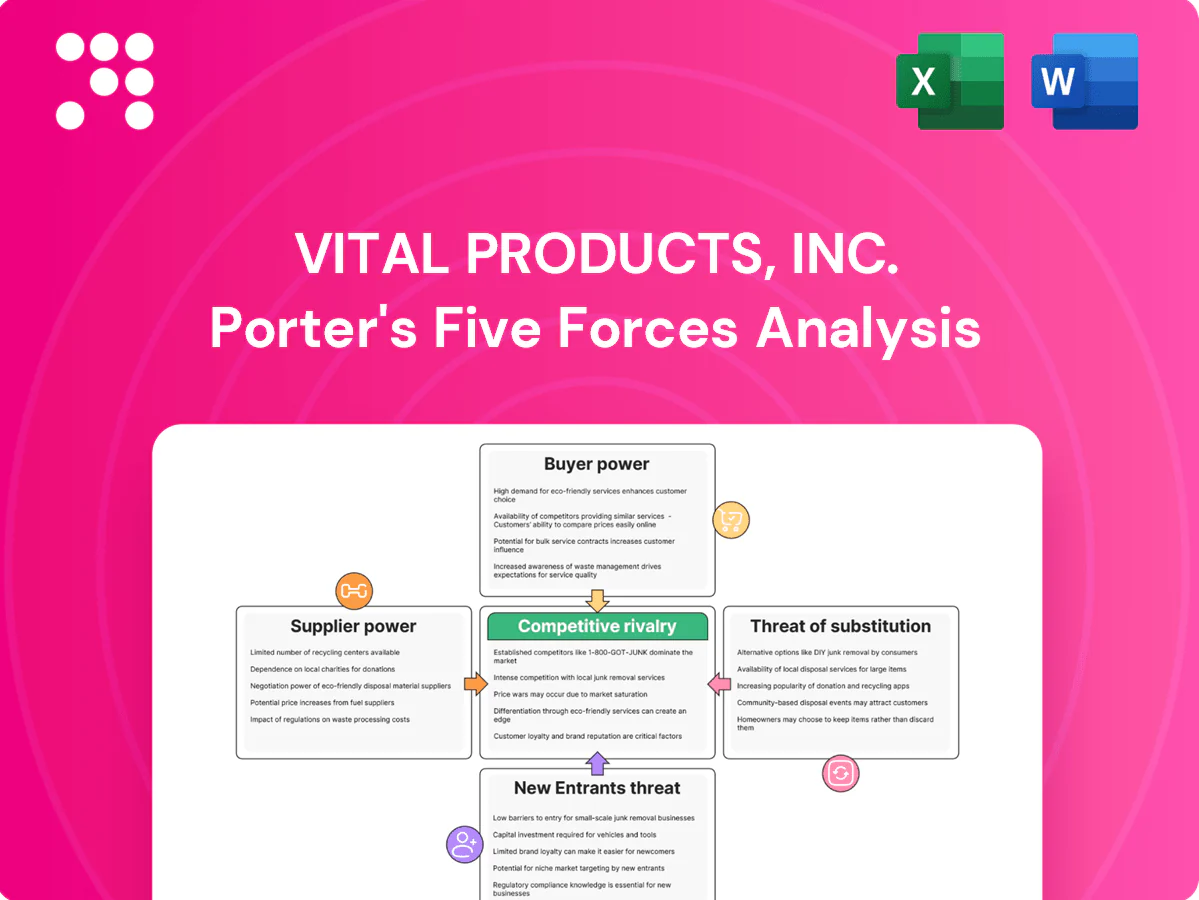
Vital Products, Inc. Porter's Five Forces Analysis

From Overview to Strategy Blueprint
Vital Products, Inc. faces intense competitive rivalry and growing substitute threats, while buyer leverage and supplier influence vary across product lines; entry barriers are moderate but innovation raises disruption risk. This brief snapshot only scratches the surface. Unlock the full Porter's Five Forces Analysis to explore Vital Products, Inc.’s competitive dynamics, market pressures, and strategic advantages in detail.
Suppliers Bargaining Power

Concentrated resin and sheet sources
Core inputs (PET, PVC, HIPS, PP) are sourced from a concentrated supplier base, with the global plastic resin market valued at roughly $600 billion in 2024, amplifying supplier leverage. Medical-grade and cleanroom-compliant grades further shrink approved vendors, enabling price pass-throughs and allocation in shortages. Dual-sourcing and global procurement lower but do not eliminate exposure.
Price volatility in polymers and energy
Resin and energy costs are highly cyclical—Brent crude averaged about $86/bbl in 2024 and North American resin spot prices swung roughly ±15% year-over-year—so supplier disruptions, outages, or geopolitics can rapidly raise input costs. Suppliers can impose index-linked surcharges adding 3–8% that immediately ripple through thermoforming pricing. Long-term contracts and index-based pricing have helped stabilize margins, while Vital must keep agile quoting and hedging to manage short-term spikes.

Specialized tooling and equipment dependency
Mold bases, aluminum tooling and thermoforming lines come from niche OEMs and specialized toolmakers, and in 2024 OEM concentration remained high in these segments, amplifying supplier influence. Long lead times and bespoke designs increase switching frictions and lock-in. Robust preventive maintenance schedules and spare-part inventories are critical to prevent downtime-based leverage. Preferred-tooling partnerships can trade price concessions for higher reliability and faster service.

Quality and compliance requirements
Medical and electronics packaging for Vital Products requires tight tolerances, biocompatibility and full traceability (UDI/FDA), so suppliers with ISO 13485 or USP Class VI certification command higher leverage due to audit readiness. Nonconformance risks (recalls, FDA actions) force buyers to limit qualified sources, increasing supplier bargaining power on regulated SKUs.
- Key tags: ISO 13485, USP Class VI, UDI/FDA
- Impact: fewer suppliers = higher price/leverage
Logistics and sustainability constraints
Freight capacity tightness and longer lead times in 2024 pushed firms to favor suppliers with stable rPET access; rPET commanded a 10–30% premium versus virgin PET, constraining input choices. ESG rules and buyer mandates reduced PVC use and prioritized PCR, narrowing supplier pools and boosting bargaining power for certified recycled-content suppliers. Nearshoring rose ~18% in 2023–24, lowering transit risk but limiting price competition.
- Freight: tighter capacity, longer lead times
- rPET: 10–30% premium in 2024
- ESG: PVC restricted, PCR favored
- Certified recyclers: higher leverage
- Nearshoring: ~18% increase, less price pressure
High supplier power: resin concentration, rPET premiums and certification keep pricing leverage
Supplier bargaining power is high: concentrated resin and tooling vendors, medical-grade certifications, and rPET premiums (10–30% in 2024) limit switching and enable index-linked surcharges; Brent averaged $86/bbl and the global resin market was ≈$600B in 2024. Nearshoring (+18% 2023–24) lowers transit risk but cuts supplier competition, while long lead times and certification needs maintain leverage.
| Metric | 2024 |
|---|---|
| Brent | $86/bbl |
| Resin market | $600B |
| rPET premium | 10–30% |
| Nearshoring change | +18% |
What is included in the product
 Detailed Word Document
Tailored for Vital Products, Inc., this Porter's Five Forces overview uncovers competitive drivers, buyer and supplier power, threats from substitutes and new entrants, and strategic barriers that protect incumbent margins while highlighting disruptive forces and market entry risks.

 Customizable Excel Spreadsheet
One-sheet Porter's Five Forces for Vital Products, Inc. that pinpoints competitive pressures and pain points—customizable, slide-ready, and designed for quick strategic fixes by non-finance teams.
Customers Bargaining Power

Large, sophisticated buyers
Large medical device, electronics and CPG buyers run competitive bids and vendor scorecards, driving procurement consolidation and benchmarking across suppliers. Their scale creates sustained price pressure and strict service-level demands, with industry multi-year contracts commonly including 2–5% annual cost-down clauses. Vital must differentiate on quality, innovation and integrated services rather than price to protect margins.
Switching costs tied to tooling
Custom tooling and validation create moderate switching costs, with tooling typically costing $50,000–$250,000 per part and lead times of weeks to months. In medical, requalification and sterilization validation often take 3–12 months and can exceed $100,000, raising friction and lowering buyer power. In consumer goods switching is easier, increasing buyer leverage. Tooling ownership terms materially affect renewal dynamics and asset recovery.

Demand for speed and customization
Buyers at Vital Products push for rapid prototyping and short lead times because 68% of procurement managers in a 2024 industry survey ranked speed and customization as top buying criteria. Vendors that compress design-to-production cycles win preferential contracts and higher margins, which tempers pure price negotiations. However, service failures prompt rapid dual-sourcing, raising churn and compliance costs.

Sustainability and compliance expectations
Buyers increasingly demand recyclable materials, PCR content and reduced packaging, and as of 2024 tightening REACH and Green Deal measures plus expanding EPR and PFAS scrutiny make compliance a procurement differentiator; Vital Products can leverage demonstrated compliance capability to strengthen bargaining position and swap sustainability solutions for price resilience.
- Buyers: specify PCR, reduced packaging
- Regulation 2024: stricter REACH/Green Deal, rising EPR/PFAS focus
- Vital: compliance = negotiating chip
Bundled services increase stickiness
Bundled contract packaging, assembly, and fulfillment increasingly embed Vital Products into buyer operations, raising operational dependency and reducing willingness to switch; 2024 industry surveys report continued growth in integrated outsourcing across CPG and pharma supply chains. Performance-based KPIs maintain pressure on cost efficiency, keeping buyers focused on outcomes. Bundling shifts procurement conversations toward total cost of ownership rather than unit price, strengthening retention.
- Integration: deeper operational ties
- Switching cost: higher reluctance
- KPIs: persistent cost pressure
- TCO: procurement focus shifts
Buyers force 2-5% cuts - suppliers match quality, speed and compliance
Large buyers exert strong price and service pressure via competitive bids and 2–5% annual cost-down clauses, forcing Vital to compete on quality, innovation and integrated services. Tooling ($50,000–$250,000) and medical requalification (3–12 months, >$100,000) create moderate switching costs, while 68% of procurement managers in 2024 prioritize speed, and sustainability/regulatory compliance (REACH, EPR, PFAS) strengthens negotiation leverage.
| Metric | 2024 Value |
|---|---|
| Annual cost-down clauses | 2–5% |
| Tooling cost | $50,000–$250,000 |
| Medical requalification | 3–12 months; >$100,000 |
| Speed priority (procurement) | 68% |
Same Document Delivered
Vital Products, Inc. Porter's Five Forces Analysis
This preview shows the exact document you'll receive immediately after purchase—no surprises, no placeholders. The Vital Products, Inc. Porter's Five Forces Analysis evaluates supplier power, buyer power, competitive rivalry, threat of substitutes, and barriers to entry. It highlights strategic risks and opportunities with concise implications for pricing, differentiation, and market positioning to inform valuation and decision-making.

From Overview to Strategy Blueprint
Vital Products, Inc. faces intense competitive rivalry and growing substitute threats, while buyer leverage and supplier influence vary across product lines; entry barriers are moderate but innovation raises disruption risk. This brief snapshot only scratches the surface. Unlock the full Porter's Five Forces Analysis to explore Vital Products, Inc.’s competitive dynamics, market pressures, and strategic advantages in detail.
Suppliers Bargaining Power
Concentrated resin and sheet sources
Core inputs (PET, PVC, HIPS, PP) are sourced from a concentrated supplier base, with the global plastic resin market valued at roughly $600 billion in 2024, amplifying supplier leverage. Medical-grade and cleanroom-compliant grades further shrink approved vendors, enabling price pass-throughs and allocation in shortages. Dual-sourcing and global procurement lower but do not eliminate exposure.
Price volatility in polymers and energy
Resin and energy costs are highly cyclical—Brent crude averaged about $86/bbl in 2024 and North American resin spot prices swung roughly ±15% year-over-year—so supplier disruptions, outages, or geopolitics can rapidly raise input costs. Suppliers can impose index-linked surcharges adding 3–8% that immediately ripple through thermoforming pricing. Long-term contracts and index-based pricing have helped stabilize margins, while Vital must keep agile quoting and hedging to manage short-term spikes.
Specialized tooling and equipment dependency
Mold bases, aluminum tooling and thermoforming lines come from niche OEMs and specialized toolmakers, and in 2024 OEM concentration remained high in these segments, amplifying supplier influence. Long lead times and bespoke designs increase switching frictions and lock-in. Robust preventive maintenance schedules and spare-part inventories are critical to prevent downtime-based leverage. Preferred-tooling partnerships can trade price concessions for higher reliability and faster service.
Quality and compliance requirements
Medical and electronics packaging for Vital Products requires tight tolerances, biocompatibility and full traceability (UDI/FDA), so suppliers with ISO 13485 or USP Class VI certification command higher leverage due to audit readiness. Nonconformance risks (recalls, FDA actions) force buyers to limit qualified sources, increasing supplier bargaining power on regulated SKUs.
- Key tags: ISO 13485, USP Class VI, UDI/FDA
- Impact: fewer suppliers = higher price/leverage
Logistics and sustainability constraints
Freight capacity tightness and longer lead times in 2024 pushed firms to favor suppliers with stable rPET access; rPET commanded a 10–30% premium versus virgin PET, constraining input choices. ESG rules and buyer mandates reduced PVC use and prioritized PCR, narrowing supplier pools and boosting bargaining power for certified recycled-content suppliers. Nearshoring rose ~18% in 2023–24, lowering transit risk but limiting price competition.
- Freight: tighter capacity, longer lead times
- rPET: 10–30% premium in 2024
- ESG: PVC restricted, PCR favored
- Certified recyclers: higher leverage
- Nearshoring: ~18% increase, less price pressure
High supplier power: resin concentration, rPET premiums and certification keep pricing leverage
Supplier bargaining power is high: concentrated resin and tooling vendors, medical-grade certifications, and rPET premiums (10–30% in 2024) limit switching and enable index-linked surcharges; Brent averaged $86/bbl and the global resin market was ≈$600B in 2024. Nearshoring (+18% 2023–24) lowers transit risk but cuts supplier competition, while long lead times and certification needs maintain leverage.
| Metric | 2024 |
|---|---|
| Brent | $86/bbl |
| Resin market | $600B |
| rPET premium | 10–30% |
| Nearshoring change | +18% |
What is included in the product
Detailed Word Document
Tailored for Vital Products, Inc., this Porter's Five Forces overview uncovers competitive drivers, buyer and supplier power, threats from substitutes and new entrants, and strategic barriers that protect incumbent margins while highlighting disruptive forces and market entry risks.
Customizable Excel Spreadsheet
One-sheet Porter's Five Forces for Vital Products, Inc. that pinpoints competitive pressures and pain points—customizable, slide-ready, and designed for quick strategic fixes by non-finance teams.
Customers Bargaining Power
Large, sophisticated buyers
Large medical device, electronics and CPG buyers run competitive bids and vendor scorecards, driving procurement consolidation and benchmarking across suppliers. Their scale creates sustained price pressure and strict service-level demands, with industry multi-year contracts commonly including 2–5% annual cost-down clauses. Vital must differentiate on quality, innovation and integrated services rather than price to protect margins.
Switching costs tied to tooling
Custom tooling and validation create moderate switching costs, with tooling typically costing $50,000–$250,000 per part and lead times of weeks to months. In medical, requalification and sterilization validation often take 3–12 months and can exceed $100,000, raising friction and lowering buyer power. In consumer goods switching is easier, increasing buyer leverage. Tooling ownership terms materially affect renewal dynamics and asset recovery.
Demand for speed and customization
Buyers at Vital Products push for rapid prototyping and short lead times because 68% of procurement managers in a 2024 industry survey ranked speed and customization as top buying criteria. Vendors that compress design-to-production cycles win preferential contracts and higher margins, which tempers pure price negotiations. However, service failures prompt rapid dual-sourcing, raising churn and compliance costs.
Sustainability and compliance expectations
Buyers increasingly demand recyclable materials, PCR content and reduced packaging, and as of 2024 tightening REACH and Green Deal measures plus expanding EPR and PFAS scrutiny make compliance a procurement differentiator; Vital Products can leverage demonstrated compliance capability to strengthen bargaining position and swap sustainability solutions for price resilience.
- Buyers: specify PCR, reduced packaging
- Regulation 2024: stricter REACH/Green Deal, rising EPR/PFAS focus
- Vital: compliance = negotiating chip
Bundled services increase stickiness
Bundled contract packaging, assembly, and fulfillment increasingly embed Vital Products into buyer operations, raising operational dependency and reducing willingness to switch; 2024 industry surveys report continued growth in integrated outsourcing across CPG and pharma supply chains. Performance-based KPIs maintain pressure on cost efficiency, keeping buyers focused on outcomes. Bundling shifts procurement conversations toward total cost of ownership rather than unit price, strengthening retention.
- Integration: deeper operational ties
- Switching cost: higher reluctance
- KPIs: persistent cost pressure
- TCO: procurement focus shifts
Buyers force 2-5% cuts - suppliers match quality, speed and compliance
Large buyers exert strong price and service pressure via competitive bids and 2–5% annual cost-down clauses, forcing Vital to compete on quality, innovation and integrated services. Tooling ($50,000–$250,000) and medical requalification (3–12 months, >$100,000) create moderate switching costs, while 68% of procurement managers in 2024 prioritize speed, and sustainability/regulatory compliance (REACH, EPR, PFAS) strengthens negotiation leverage.
| Metric | 2024 Value |
|---|---|
| Annual cost-down clauses | 2–5% |
| Tooling cost | $50,000–$250,000 |
| Medical requalification | 3–12 months; >$100,000 |
| Speed priority (procurement) | 68% |
Same Document Delivered
Vital Products, Inc. Porter's Five Forces Analysis
This preview shows the exact document you'll receive immediately after purchase—no surprises, no placeholders. The Vital Products, Inc. Porter's Five Forces Analysis evaluates supplier power, buyer power, competitive rivalry, threat of substitutes, and barriers to entry. It highlights strategic risks and opportunities with concise implications for pricing, differentiation, and market positioning to inform valuation and decision-making.
Original: $10.00
-65%$10.00
$3.50Description
From Overview to Strategy Blueprint
Vital Products, Inc. faces intense competitive rivalry and growing substitute threats, while buyer leverage and supplier influence vary across product lines; entry barriers are moderate but innovation raises disruption risk. This brief snapshot only scratches the surface. Unlock the full Porter's Five Forces Analysis to explore Vital Products, Inc.’s competitive dynamics, market pressures, and strategic advantages in detail.
Suppliers Bargaining Power
Concentrated resin and sheet sources
Core inputs (PET, PVC, HIPS, PP) are sourced from a concentrated supplier base, with the global plastic resin market valued at roughly $600 billion in 2024, amplifying supplier leverage. Medical-grade and cleanroom-compliant grades further shrink approved vendors, enabling price pass-throughs and allocation in shortages. Dual-sourcing and global procurement lower but do not eliminate exposure.
Price volatility in polymers and energy
Resin and energy costs are highly cyclical—Brent crude averaged about $86/bbl in 2024 and North American resin spot prices swung roughly ±15% year-over-year—so supplier disruptions, outages, or geopolitics can rapidly raise input costs. Suppliers can impose index-linked surcharges adding 3–8% that immediately ripple through thermoforming pricing. Long-term contracts and index-based pricing have helped stabilize margins, while Vital must keep agile quoting and hedging to manage short-term spikes.
Specialized tooling and equipment dependency
Mold bases, aluminum tooling and thermoforming lines come from niche OEMs and specialized toolmakers, and in 2024 OEM concentration remained high in these segments, amplifying supplier influence. Long lead times and bespoke designs increase switching frictions and lock-in. Robust preventive maintenance schedules and spare-part inventories are critical to prevent downtime-based leverage. Preferred-tooling partnerships can trade price concessions for higher reliability and faster service.
Quality and compliance requirements
Medical and electronics packaging for Vital Products requires tight tolerances, biocompatibility and full traceability (UDI/FDA), so suppliers with ISO 13485 or USP Class VI certification command higher leverage due to audit readiness. Nonconformance risks (recalls, FDA actions) force buyers to limit qualified sources, increasing supplier bargaining power on regulated SKUs.
- Key tags: ISO 13485, USP Class VI, UDI/FDA
- Impact: fewer suppliers = higher price/leverage
Logistics and sustainability constraints
Freight capacity tightness and longer lead times in 2024 pushed firms to favor suppliers with stable rPET access; rPET commanded a 10–30% premium versus virgin PET, constraining input choices. ESG rules and buyer mandates reduced PVC use and prioritized PCR, narrowing supplier pools and boosting bargaining power for certified recycled-content suppliers. Nearshoring rose ~18% in 2023–24, lowering transit risk but limiting price competition.
- Freight: tighter capacity, longer lead times
- rPET: 10–30% premium in 2024
- ESG: PVC restricted, PCR favored
- Certified recyclers: higher leverage
- Nearshoring: ~18% increase, less price pressure
High supplier power: resin concentration, rPET premiums and certification keep pricing leverage
Supplier bargaining power is high: concentrated resin and tooling vendors, medical-grade certifications, and rPET premiums (10–30% in 2024) limit switching and enable index-linked surcharges; Brent averaged $86/bbl and the global resin market was ≈$600B in 2024. Nearshoring (+18% 2023–24) lowers transit risk but cuts supplier competition, while long lead times and certification needs maintain leverage.
| Metric | 2024 |
|---|---|
| Brent | $86/bbl |
| Resin market | $600B |
| rPET premium | 10–30% |
| Nearshoring change | +18% |
What is included in the product
Detailed Word Document
Tailored for Vital Products, Inc., this Porter's Five Forces overview uncovers competitive drivers, buyer and supplier power, threats from substitutes and new entrants, and strategic barriers that protect incumbent margins while highlighting disruptive forces and market entry risks.
Customizable Excel Spreadsheet
One-sheet Porter's Five Forces for Vital Products, Inc. that pinpoints competitive pressures and pain points—customizable, slide-ready, and designed for quick strategic fixes by non-finance teams.
Customers Bargaining Power
Large, sophisticated buyers
Large medical device, electronics and CPG buyers run competitive bids and vendor scorecards, driving procurement consolidation and benchmarking across suppliers. Their scale creates sustained price pressure and strict service-level demands, with industry multi-year contracts commonly including 2–5% annual cost-down clauses. Vital must differentiate on quality, innovation and integrated services rather than price to protect margins.
Switching costs tied to tooling
Custom tooling and validation create moderate switching costs, with tooling typically costing $50,000–$250,000 per part and lead times of weeks to months. In medical, requalification and sterilization validation often take 3–12 months and can exceed $100,000, raising friction and lowering buyer power. In consumer goods switching is easier, increasing buyer leverage. Tooling ownership terms materially affect renewal dynamics and asset recovery.
Demand for speed and customization
Buyers at Vital Products push for rapid prototyping and short lead times because 68% of procurement managers in a 2024 industry survey ranked speed and customization as top buying criteria. Vendors that compress design-to-production cycles win preferential contracts and higher margins, which tempers pure price negotiations. However, service failures prompt rapid dual-sourcing, raising churn and compliance costs.
Sustainability and compliance expectations
Buyers increasingly demand recyclable materials, PCR content and reduced packaging, and as of 2024 tightening REACH and Green Deal measures plus expanding EPR and PFAS scrutiny make compliance a procurement differentiator; Vital Products can leverage demonstrated compliance capability to strengthen bargaining position and swap sustainability solutions for price resilience.
- Buyers: specify PCR, reduced packaging
- Regulation 2024: stricter REACH/Green Deal, rising EPR/PFAS focus
- Vital: compliance = negotiating chip
Bundled services increase stickiness
Bundled contract packaging, assembly, and fulfillment increasingly embed Vital Products into buyer operations, raising operational dependency and reducing willingness to switch; 2024 industry surveys report continued growth in integrated outsourcing across CPG and pharma supply chains. Performance-based KPIs maintain pressure on cost efficiency, keeping buyers focused on outcomes. Bundling shifts procurement conversations toward total cost of ownership rather than unit price, strengthening retention.
- Integration: deeper operational ties
- Switching cost: higher reluctance
- KPIs: persistent cost pressure
- TCO: procurement focus shifts
Buyers force 2-5% cuts - suppliers match quality, speed and compliance
Large buyers exert strong price and service pressure via competitive bids and 2–5% annual cost-down clauses, forcing Vital to compete on quality, innovation and integrated services. Tooling ($50,000–$250,000) and medical requalification (3–12 months, >$100,000) create moderate switching costs, while 68% of procurement managers in 2024 prioritize speed, and sustainability/regulatory compliance (REACH, EPR, PFAS) strengthens negotiation leverage.
| Metric | 2024 Value |
|---|---|
| Annual cost-down clauses | 2–5% |
| Tooling cost | $50,000–$250,000 |
| Medical requalification | 3–12 months; >$100,000 |
| Speed priority (procurement) | 68% |
Same Document Delivered
Vital Products, Inc. Porter's Five Forces Analysis
This preview shows the exact document you'll receive immediately after purchase—no surprises, no placeholders. The Vital Products, Inc. Porter's Five Forces Analysis evaluates supplier power, buyer power, competitive rivalry, threat of substitutes, and barriers to entry. It highlights strategic risks and opportunities with concise implications for pricing, differentiation, and market positioning to inform valuation and decision-making.











