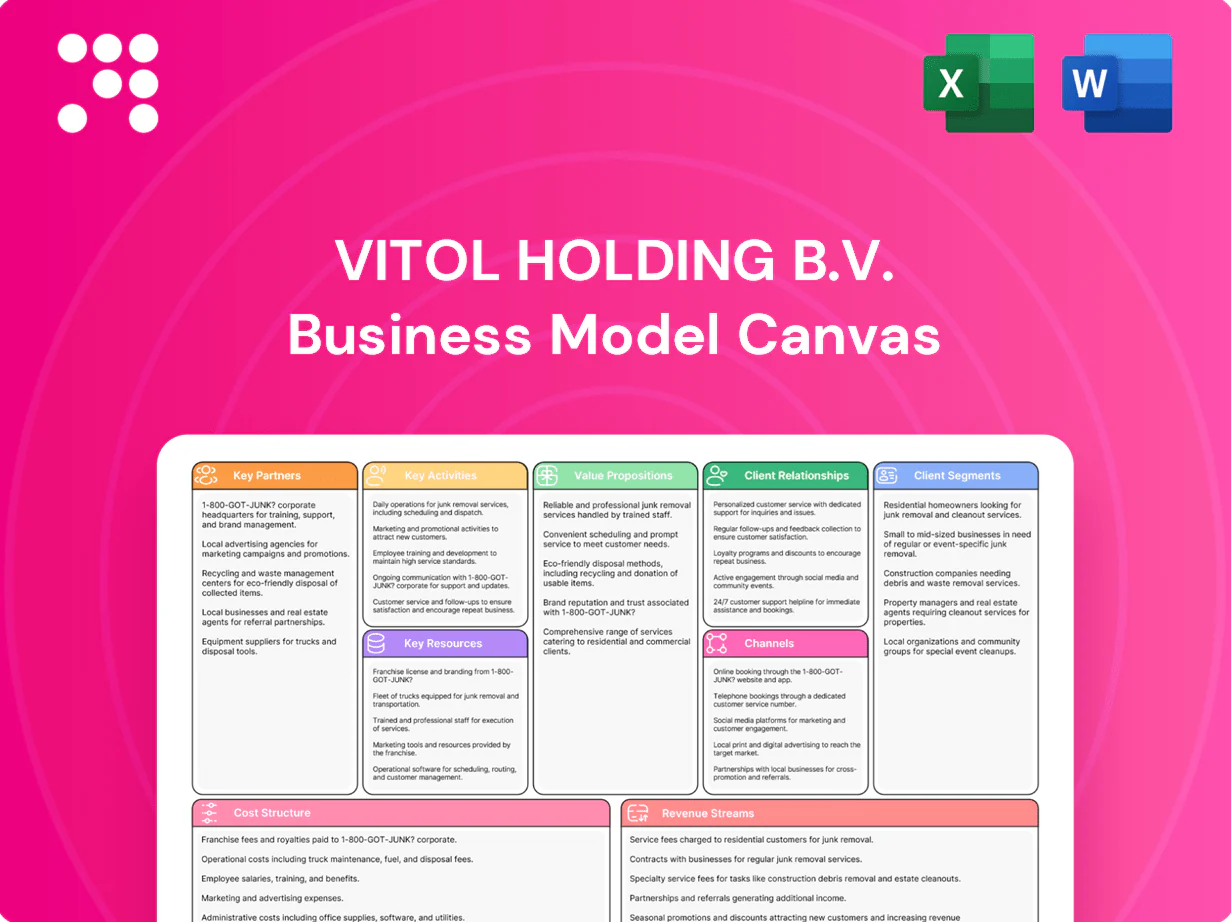
Vitol Holding B.V. Business Model Canvas

Unlock a global trading powerhouse's Business Model Canvas and strategic revenue levers
Unlock the full strategic blueprint behind Vitol Holding B.V.’s Business Model Canvas. This concise, expert breakdown reveals value propositions, key partnerships, and revenue levers that drive scale and resilience. Download the full Word/Excel canvas to benchmark strategy, inform investments, and adapt proven tactics.
Partnerships

National oil companies
Partnering with national oil companies secures upstream supply and long-term offtake, underpinning Vitol’s ~7 million barrels per day trading footprint. These relationships enable tailored term contracts and operational alignment with state priorities, often including guaranteed volumes and pricing collars. Joint initiatives cover logistics optimization and co-investment in local infrastructure such as terminals and pipelines. They also deliver geopolitical diversification of supply across producing regions.
Independent producers
Vitol partners with independent producers to secure flexible crude and product supply, leveraging its scale as a trader handling about 7 million barrels per day in 2023. Partners gain market access plus financing and hedging solutions tailored to their cashflow cycles. Structured deals synchronize production with market demand windows, reducing price and storage risk. Over time these ties form blended supply portfolios spanning key regions.

Refineries and terminals
Vitol, operating in over 40 countries, uses refineries and terminals to strengthen optionality and blending strategies, enabling optimized product slates and margin capture. Shared infrastructure and partnered terminals improve turnaround resilience and arbitrage capture across regions. Capacity leasing and JV investments deepen integration along the chain and underpin reliable delivery for global customers.

Shipping and logistics firms
Charterers, shipowners and logistics providers enable Vitol to move crude and products reliably, securing tonnage across VLCCs to coastal barges and rail-truck intermodal links; Vitol reported revenues of $505 billion in 2023 and handles roughly 7 million barrels per day of physical and trading flows, with partnerships optimizing routes and managing marine risk to improve cost efficiency and on-time performance.
- Secure tonnage: VLCCs to barges
- Route optimization: lower voyage costs
- Risk management: charter & insurance
- Intermodal links: rail-truck integration
Financial and risk counterparties
Banks, insurers and clearing houses provide trade finance and hedging capacity that underpins Vitol’s global flows; Vitol reported $505 billion in sales in 2023, highlighting the scale dependent on these counterparties. Structured credit and inventory financing unlock working capital, while derivatives counterparties enable price, basis and FX risk management, supporting scalable, capital-efficient trading.
- Banks: trade finance lines
- Insurers: credit/transport cover
- Clearing houses: collateral netting
- Structured credit: working capital
- Derivatives: price/basis/FX hedges
Trading network secures 7m bpd and $505bn revenue
Partnerships with national oil companies secure term offtake and upstream supply supporting Vitol’s ~7 million bpd footprint (2023). Deals with independents add flexible volumes plus financing and hedging. Logistics partners (VLCCs to barges) and terminals enable delivery optionality; banks/insurers provide trade finance and derivatives cover. Vitol revenue $505bn (2023); operating in 40+ countries (2024).
| Metric | Value | Year |
|---|---|---|
| Sales | $505bn | 2023 |
| Trading flow | ~7m bpd | 2023 |
| Countries | 40+ | 2024 |
What is included in the product
 Detailed Word Document
A concise Business Model Canvas for Vitol Holding B.V. outlining customer segments, channels, key partners and value propositions centered on global energy trading, logistics and risk management; organized into 9 BMC blocks with strategic insights, competitive advantages and SWOT-linked opportunities for investors and analysts.

 Customizable Excel Spreadsheet
High-level view of Vitol Holding B.V.’s business model with editable cells, clarifying trading flows, asset positions, and revenue drivers to speed strategic decisions and reduce analysis time.
Activities

Physical trading
Buying, selling and scheduling crude, products, LPG, LNG, coal, metals and carbon across spot and term markets, with Vitol trading roughly 7 million barrels per day (2024) and ~6,000 staff worldwide. The activity centers on arbitrage, blending and quality optimization to capture margin. Execution requires nomination accuracy, real-time logistics and freight optimization. It links producers and consumers globally across integrated supply chains.
Asset optimization
Vitol optimizes terminals, refineries, power and upstream stakes to align throughput, storage and processing with market spreads, adjusting flows to capture refining and trading margins. Turnaround planning and coordinated maintenance minimize downtime and preserve crack spreads. Optimization across cycles drives margin capture and resilience as the world’s largest independent energy trader.

Risk management
Vitol hedges market exposures using futures, options and structured products to support trading of roughly 7 million barrels per day. Credit, counterparty and operational risks are monitored continuously with centralized reporting and daily exposure limits. Regular scenario and stress testing calibrate position limits and capital allocation. Robust controls ensure compliance with regulations and internal policy frameworks.

Logistics and shipping
Vitol coordinates vessels, pipelines, rail and trucking to meet tight delivery windows; voyage planning, demurrage control and laytime management protect margins while blending and quality assurance ensure specs compliance and end-to-end visibility tools track flows. Vitol reported $505bn revenue in 2023, reflecting scale and logistics leverage.
- Scheduling: integrated vessel/pipeline/rail/truck
- Margin protection: voyage planning, demurrage, laytime
- Quality: blending & QA
- Visibility: real-time flow tracking
Customer solutions
Vitol provides supply contracts, financing and bespoke risk solutions, structuring offtake, prepay and inventory deals to align with client cash cycles while offering energy management to balance price and volume risks; long-term relationships are anchored in reliability and transparency.
- Supply contracts + financing
- Offtake/prepay/inventory alignment
- Energy management: price vs volume
- Long-term reliability & transparency
Global energy trading: 7m bpd
Buying, selling and scheduling crude, products, LPG, LNG, coal, metals and carbon across spot and term markets, trading ~7 million bpd (2024) with ~6,000 staff; arbitrage, blending and logistics capture margins. Asset optimization (terminals, refineries, upstream) aligns throughput to spreads; hedging via futures/options manages exposures. Credit controls, real-time tracking and voyage planning preserve crack spreads and delivery reliability.
| Metric | Value |
|---|---|
| Throughput | ~7m bpd (2024) |
| Staff | ~6,000 |
| Revenue | $505bn (2023) |
Delivered as Displayed
Business Model Canvas
The Business Model Canvas previewed here for Vitol Holding B.V. is the actual deliverable, not a mockup. When you purchase, you’ll receive this exact file—complete, editable, and formatted—ready in Word and Excel. No placeholders or missing sections: what you see is what you’ll download and use.

Unlock a global trading powerhouse's Business Model Canvas and strategic revenue levers
Unlock the full strategic blueprint behind Vitol Holding B.V.’s Business Model Canvas. This concise, expert breakdown reveals value propositions, key partnerships, and revenue levers that drive scale and resilience. Download the full Word/Excel canvas to benchmark strategy, inform investments, and adapt proven tactics.
Partnerships
National oil companies
Partnering with national oil companies secures upstream supply and long-term offtake, underpinning Vitol’s ~7 million barrels per day trading footprint. These relationships enable tailored term contracts and operational alignment with state priorities, often including guaranteed volumes and pricing collars. Joint initiatives cover logistics optimization and co-investment in local infrastructure such as terminals and pipelines. They also deliver geopolitical diversification of supply across producing regions.
Independent producers
Vitol partners with independent producers to secure flexible crude and product supply, leveraging its scale as a trader handling about 7 million barrels per day in 2023. Partners gain market access plus financing and hedging solutions tailored to their cashflow cycles. Structured deals synchronize production with market demand windows, reducing price and storage risk. Over time these ties form blended supply portfolios spanning key regions.
Refineries and terminals
Vitol, operating in over 40 countries, uses refineries and terminals to strengthen optionality and blending strategies, enabling optimized product slates and margin capture. Shared infrastructure and partnered terminals improve turnaround resilience and arbitrage capture across regions. Capacity leasing and JV investments deepen integration along the chain and underpin reliable delivery for global customers.
Shipping and logistics firms
Charterers, shipowners and logistics providers enable Vitol to move crude and products reliably, securing tonnage across VLCCs to coastal barges and rail-truck intermodal links; Vitol reported revenues of $505 billion in 2023 and handles roughly 7 million barrels per day of physical and trading flows, with partnerships optimizing routes and managing marine risk to improve cost efficiency and on-time performance.
- Secure tonnage: VLCCs to barges
- Route optimization: lower voyage costs
- Risk management: charter & insurance
- Intermodal links: rail-truck integration
Financial and risk counterparties
Banks, insurers and clearing houses provide trade finance and hedging capacity that underpins Vitol’s global flows; Vitol reported $505 billion in sales in 2023, highlighting the scale dependent on these counterparties. Structured credit and inventory financing unlock working capital, while derivatives counterparties enable price, basis and FX risk management, supporting scalable, capital-efficient trading.
- Banks: trade finance lines
- Insurers: credit/transport cover
- Clearing houses: collateral netting
- Structured credit: working capital
- Derivatives: price/basis/FX hedges
Trading network secures 7m bpd and $505bn revenue
Partnerships with national oil companies secure term offtake and upstream supply supporting Vitol’s ~7 million bpd footprint (2023). Deals with independents add flexible volumes plus financing and hedging. Logistics partners (VLCCs to barges) and terminals enable delivery optionality; banks/insurers provide trade finance and derivatives cover. Vitol revenue $505bn (2023); operating in 40+ countries (2024).
| Metric | Value | Year |
|---|---|---|
| Sales | $505bn | 2023 |
| Trading flow | ~7m bpd | 2023 |
| Countries | 40+ | 2024 |
What is included in the product
Detailed Word Document
A concise Business Model Canvas for Vitol Holding B.V. outlining customer segments, channels, key partners and value propositions centered on global energy trading, logistics and risk management; organized into 9 BMC blocks with strategic insights, competitive advantages and SWOT-linked opportunities for investors and analysts.
Customizable Excel Spreadsheet
High-level view of Vitol Holding B.V.’s business model with editable cells, clarifying trading flows, asset positions, and revenue drivers to speed strategic decisions and reduce analysis time.
Activities
Physical trading
Buying, selling and scheduling crude, products, LPG, LNG, coal, metals and carbon across spot and term markets, with Vitol trading roughly 7 million barrels per day (2024) and ~6,000 staff worldwide. The activity centers on arbitrage, blending and quality optimization to capture margin. Execution requires nomination accuracy, real-time logistics and freight optimization. It links producers and consumers globally across integrated supply chains.
Asset optimization
Vitol optimizes terminals, refineries, power and upstream stakes to align throughput, storage and processing with market spreads, adjusting flows to capture refining and trading margins. Turnaround planning and coordinated maintenance minimize downtime and preserve crack spreads. Optimization across cycles drives margin capture and resilience as the world’s largest independent energy trader.
Risk management
Vitol hedges market exposures using futures, options and structured products to support trading of roughly 7 million barrels per day. Credit, counterparty and operational risks are monitored continuously with centralized reporting and daily exposure limits. Regular scenario and stress testing calibrate position limits and capital allocation. Robust controls ensure compliance with regulations and internal policy frameworks.
Logistics and shipping
Vitol coordinates vessels, pipelines, rail and trucking to meet tight delivery windows; voyage planning, demurrage control and laytime management protect margins while blending and quality assurance ensure specs compliance and end-to-end visibility tools track flows. Vitol reported $505bn revenue in 2023, reflecting scale and logistics leverage.
- Scheduling: integrated vessel/pipeline/rail/truck
- Margin protection: voyage planning, demurrage, laytime
- Quality: blending & QA
- Visibility: real-time flow tracking
Customer solutions
Vitol provides supply contracts, financing and bespoke risk solutions, structuring offtake, prepay and inventory deals to align with client cash cycles while offering energy management to balance price and volume risks; long-term relationships are anchored in reliability and transparency.
- Supply contracts + financing
- Offtake/prepay/inventory alignment
- Energy management: price vs volume
- Long-term reliability & transparency
Global energy trading: 7m bpd
Buying, selling and scheduling crude, products, LPG, LNG, coal, metals and carbon across spot and term markets, trading ~7 million bpd (2024) with ~6,000 staff; arbitrage, blending and logistics capture margins. Asset optimization (terminals, refineries, upstream) aligns throughput to spreads; hedging via futures/options manages exposures. Credit controls, real-time tracking and voyage planning preserve crack spreads and delivery reliability.
| Metric | Value |
|---|---|
| Throughput | ~7m bpd (2024) |
| Staff | ~6,000 |
| Revenue | $505bn (2023) |
Delivered as Displayed
Business Model Canvas
The Business Model Canvas previewed here for Vitol Holding B.V. is the actual deliverable, not a mockup. When you purchase, you’ll receive this exact file—complete, editable, and formatted—ready in Word and Excel. No placeholders or missing sections: what you see is what you’ll download and use.
Description
Unlock a global trading powerhouse's Business Model Canvas and strategic revenue levers
Unlock the full strategic blueprint behind Vitol Holding B.V.’s Business Model Canvas. This concise, expert breakdown reveals value propositions, key partnerships, and revenue levers that drive scale and resilience. Download the full Word/Excel canvas to benchmark strategy, inform investments, and adapt proven tactics.
Partnerships
National oil companies
Partnering with national oil companies secures upstream supply and long-term offtake, underpinning Vitol’s ~7 million barrels per day trading footprint. These relationships enable tailored term contracts and operational alignment with state priorities, often including guaranteed volumes and pricing collars. Joint initiatives cover logistics optimization and co-investment in local infrastructure such as terminals and pipelines. They also deliver geopolitical diversification of supply across producing regions.
Independent producers
Vitol partners with independent producers to secure flexible crude and product supply, leveraging its scale as a trader handling about 7 million barrels per day in 2023. Partners gain market access plus financing and hedging solutions tailored to their cashflow cycles. Structured deals synchronize production with market demand windows, reducing price and storage risk. Over time these ties form blended supply portfolios spanning key regions.
Refineries and terminals
Vitol, operating in over 40 countries, uses refineries and terminals to strengthen optionality and blending strategies, enabling optimized product slates and margin capture. Shared infrastructure and partnered terminals improve turnaround resilience and arbitrage capture across regions. Capacity leasing and JV investments deepen integration along the chain and underpin reliable delivery for global customers.
Shipping and logistics firms
Charterers, shipowners and logistics providers enable Vitol to move crude and products reliably, securing tonnage across VLCCs to coastal barges and rail-truck intermodal links; Vitol reported revenues of $505 billion in 2023 and handles roughly 7 million barrels per day of physical and trading flows, with partnerships optimizing routes and managing marine risk to improve cost efficiency and on-time performance.
- Secure tonnage: VLCCs to barges
- Route optimization: lower voyage costs
- Risk management: charter & insurance
- Intermodal links: rail-truck integration
Financial and risk counterparties
Banks, insurers and clearing houses provide trade finance and hedging capacity that underpins Vitol’s global flows; Vitol reported $505 billion in sales in 2023, highlighting the scale dependent on these counterparties. Structured credit and inventory financing unlock working capital, while derivatives counterparties enable price, basis and FX risk management, supporting scalable, capital-efficient trading.
- Banks: trade finance lines
- Insurers: credit/transport cover
- Clearing houses: collateral netting
- Structured credit: working capital
- Derivatives: price/basis/FX hedges
Trading network secures 7m bpd and $505bn revenue
Partnerships with national oil companies secure term offtake and upstream supply supporting Vitol’s ~7 million bpd footprint (2023). Deals with independents add flexible volumes plus financing and hedging. Logistics partners (VLCCs to barges) and terminals enable delivery optionality; banks/insurers provide trade finance and derivatives cover. Vitol revenue $505bn (2023); operating in 40+ countries (2024).
| Metric | Value | Year |
|---|---|---|
| Sales | $505bn | 2023 |
| Trading flow | ~7m bpd | 2023 |
| Countries | 40+ | 2024 |
What is included in the product
Detailed Word Document
A concise Business Model Canvas for Vitol Holding B.V. outlining customer segments, channels, key partners and value propositions centered on global energy trading, logistics and risk management; organized into 9 BMC blocks with strategic insights, competitive advantages and SWOT-linked opportunities for investors and analysts.
Customizable Excel Spreadsheet
High-level view of Vitol Holding B.V.’s business model with editable cells, clarifying trading flows, asset positions, and revenue drivers to speed strategic decisions and reduce analysis time.
Activities
Physical trading
Buying, selling and scheduling crude, products, LPG, LNG, coal, metals and carbon across spot and term markets, with Vitol trading roughly 7 million barrels per day (2024) and ~6,000 staff worldwide. The activity centers on arbitrage, blending and quality optimization to capture margin. Execution requires nomination accuracy, real-time logistics and freight optimization. It links producers and consumers globally across integrated supply chains.
Asset optimization
Vitol optimizes terminals, refineries, power and upstream stakes to align throughput, storage and processing with market spreads, adjusting flows to capture refining and trading margins. Turnaround planning and coordinated maintenance minimize downtime and preserve crack spreads. Optimization across cycles drives margin capture and resilience as the world’s largest independent energy trader.
Risk management
Vitol hedges market exposures using futures, options and structured products to support trading of roughly 7 million barrels per day. Credit, counterparty and operational risks are monitored continuously with centralized reporting and daily exposure limits. Regular scenario and stress testing calibrate position limits and capital allocation. Robust controls ensure compliance with regulations and internal policy frameworks.
Logistics and shipping
Vitol coordinates vessels, pipelines, rail and trucking to meet tight delivery windows; voyage planning, demurrage control and laytime management protect margins while blending and quality assurance ensure specs compliance and end-to-end visibility tools track flows. Vitol reported $505bn revenue in 2023, reflecting scale and logistics leverage.
- Scheduling: integrated vessel/pipeline/rail/truck
- Margin protection: voyage planning, demurrage, laytime
- Quality: blending & QA
- Visibility: real-time flow tracking
Customer solutions
Vitol provides supply contracts, financing and bespoke risk solutions, structuring offtake, prepay and inventory deals to align with client cash cycles while offering energy management to balance price and volume risks; long-term relationships are anchored in reliability and transparency.
- Supply contracts + financing
- Offtake/prepay/inventory alignment
- Energy management: price vs volume
- Long-term reliability & transparency
Global energy trading: 7m bpd
Buying, selling and scheduling crude, products, LPG, LNG, coal, metals and carbon across spot and term markets, trading ~7 million bpd (2024) with ~6,000 staff; arbitrage, blending and logistics capture margins. Asset optimization (terminals, refineries, upstream) aligns throughput to spreads; hedging via futures/options manages exposures. Credit controls, real-time tracking and voyage planning preserve crack spreads and delivery reliability.
| Metric | Value |
|---|---|
| Throughput | ~7m bpd (2024) |
| Staff | ~6,000 |
| Revenue | $505bn (2023) |
Delivered as Displayed
Business Model Canvas
The Business Model Canvas previewed here for Vitol Holding B.V. is the actual deliverable, not a mockup. When you purchase, you’ll receive this exact file—complete, editable, and formatted—ready in Word and Excel. No placeholders or missing sections: what you see is what you’ll download and use.











