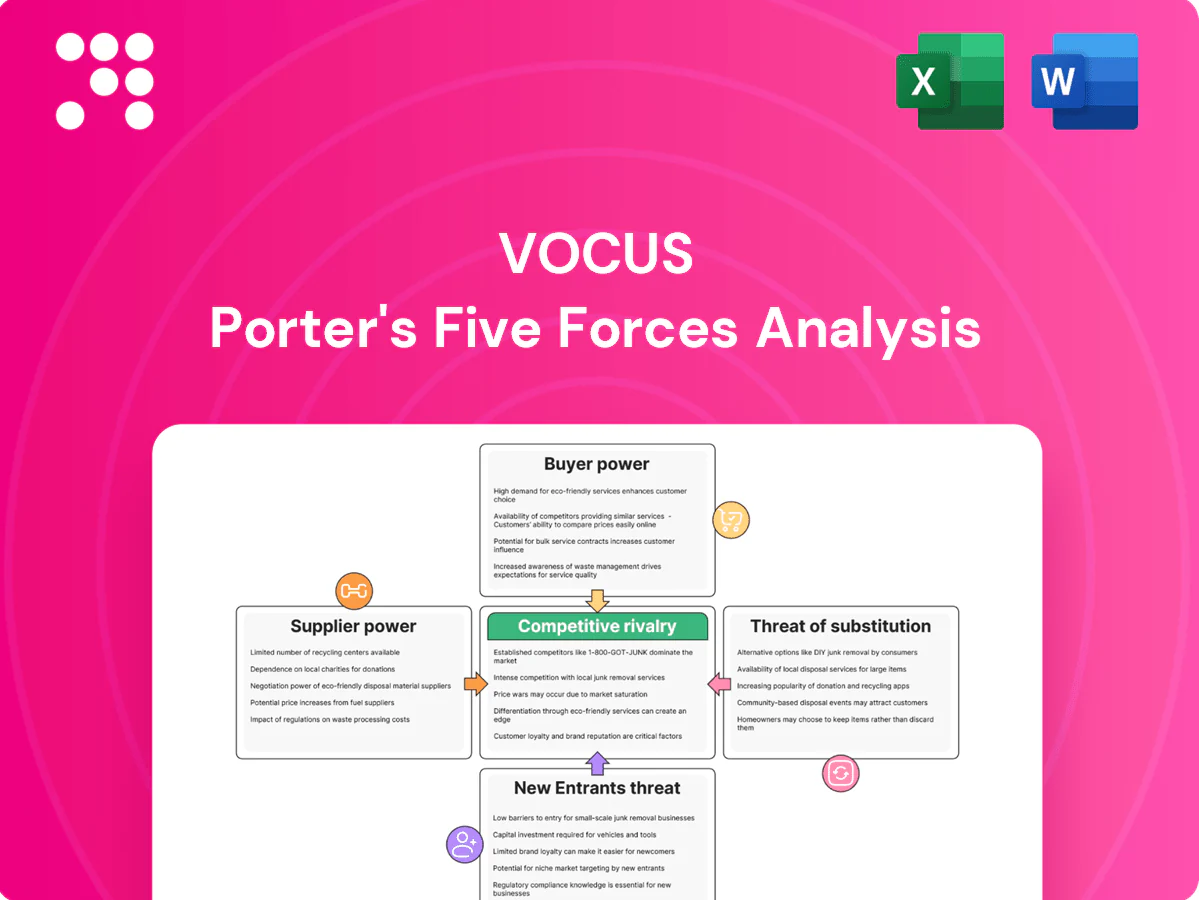
Vocus Porter's Five Forces Analysis

Elevate Your Analysis with the Complete Porter's Five Forces Analysis
Understanding the competitive landscape for Vocus is crucial for any strategic decision. Our Porter's Five Forces analysis dissects the power of buyers and suppliers, the threat of new entrants and substitutes, and the intensity of rivalry within Vocus's market. This comprehensive overview provides a foundational understanding of the forces that shape Vocus's profitability and strategic options.
The complete report reveals the real forces shaping Vocus’s industry—from supplier influence to threat of new entrants. Gain actionable insights to drive smarter decision-making.
Suppliers Bargaining Power

Specialized Fiber Optic Equipment Providers
Vocus's reliance on specialized fiber optic equipment from a select group of global manufacturers grants these suppliers considerable leverage. The essential nature of high-quality fiber and advanced networking hardware for Vocus's infrastructure means suppliers of cutting-edge or proprietary technologies can command significant pricing power, particularly during major network build-outs.
For example, Telstra InfraCo's collaboration with Prysmian to boost optical cable production in Australia underscores the specialized and often concentrated nature of these supply chains. This specialization limits Vocus's alternatives, potentially increasing supplier bargaining power.
Data Centre and Energy Suppliers
Vocus's reliance on extensive fiber networks and data centers means significant demand for energy and specialized infrastructure. While energy markets offer some supplier choice, the fixed location of data centers can grant specific energy providers or landlords considerable bargaining power. For instance, in 2024, the average wholesale electricity price in Australia saw fluctuations, impacting operational costs for data centers.
The critical need for uninterrupted, high-quality power and cooling solutions restricts Vocus's agility in switching these essential suppliers. This dependency can lead to less favorable contract terms if a supplier holds a dominant position in a particular region where Vocus operates its facilities. The capital expenditure required to build new data centers and the long lead times for securing power infrastructure further solidify the suppliers' leverage.

Skilled Labor and Technical Expertise
Vocus's reliance on skilled labor, particularly for its fiber optic networks, significantly impacts supplier bargaining power. The need for specialized engineers, technicians, and cybersecurity professionals in Australia and New Zealand means that talent scarcity can empower these workers and their employers.
This scarcity translates directly into higher labor costs for Vocus, as companies compete for limited expertise. For instance, the Australian Bureau of Statistics reported in 2023 that demand for ICT professionals continued to outstrip supply, a trend likely to persist.

Software and Technology Vendors
Software and technology vendors hold considerable bargaining power over Vocus. Vocus relies on a range of software for critical functions like network operations, customer management, and cybersecurity. If a vendor provides essential, deeply integrated, or uniquely capable software, their leverage increases significantly.
This is particularly true for specialized network management or cybersecurity platforms where switching costs can be high. For instance, in 2024, the global cybersecurity market was projected to reach over $200 billion, highlighting the specialized and often indispensable nature of these solutions. Vendors of proprietary operating systems or core network infrastructure software can command higher prices or dictate terms due to the difficulty and expense of replacing these systems.
- High switching costs: Replacing deeply integrated software can incur substantial migration and retraining expenses for Vocus.
- Proprietary technology: Vendors offering unique or patented software solutions face less direct competition, enhancing their power.
- Concentrated market: In certain software segments, a few dominant vendors can exert considerable influence over pricing and terms.
- Criticality of software: The essential nature of software for Vocus's operations means disruptions from vendor changes can be severe.
Subsea Cable System Partners
Vocus's reliance on a limited number of partners for its international subsea cable systems grants these entities significant bargaining power. The immense capital expenditure and specialized technical expertise required for cable maintenance, upgrades, and new deployments mean that few entities can participate, concentrating power among them. For instance, major telecommunications carriers and consortiums often dictate terms due to the sheer scale of these projects and the essential nature of their involvement.
The bargaining power of subsea cable system partners is amplified by the high switching costs for Vocus. Once a partnership is established for a particular cable route, the investment in shared infrastructure and operational agreements makes it difficult and expensive to change partners. This can translate into partners demanding more favorable pricing or contract terms, impacting Vocus's profitability on these ventures.
- High Capital Investment: Subsea cable projects can cost hundreds of millions of dollars, limiting the pool of potential partners and increasing the leverage of existing ones.
- Technical Specialization: The complex engineering and operational knowledge required for subsea cables means partners with this expertise are in high demand.
- Limited Number of Suppliers: The global market for subsea cable construction and maintenance is dominated by a handful of specialized companies and consortiums.
- Essential Nature of Partnerships: Vocus requires these partners for critical functions like network upgrades and repairs, giving partners leverage in negotiations.
Critical Suppliers Dictate Terms for Vocus's Network Future
Suppliers of specialized fiber optic equipment and advanced networking hardware hold significant bargaining power over Vocus due to the essential nature of these components for network infrastructure. The limited number of global manufacturers capable of producing cutting-edge or proprietary technologies means Vocus has few alternatives, allowing these suppliers to influence pricing, especially during major network expansion projects.
Similarly, Vocus's reliance on specific software for critical operations like network management and cybersecurity grants considerable leverage to vendors. High switching costs associated with deeply integrated or proprietary systems, coupled with the criticality of these solutions, empower software providers to dictate terms and pricing. For instance, the global cybersecurity market's projected growth to over $200 billion in 2024 highlights the indispensable and specialized nature of these software vendors.
| Supplier Category | Factors Influencing Bargaining Power | Impact on Vocus | Example/Data Point (2024) |
|---|---|---|---|
| Fiber Optic Equipment Manufacturers | Proprietary technology, limited suppliers, high switching costs | Increased equipment costs, potential delays in network build-outs | Concentrated market for advanced optical cables |
| Software & Technology Vendors | Criticality of software, high switching costs, proprietary solutions | Higher licensing fees, potential for unfavorable contract terms | Global cybersecurity market projected over $200 billion |
| Subsea Cable System Partners | High capital investment, technical specialization, limited participants | Negotiating power over pricing and operational terms for international connectivity | Few global consortiums dominate subsea cable construction and maintenance |
What is included in the product
 Detailed Word Document
This Porter's Five Forces analysis provides a comprehensive examination of the competitive landscape for Vocus, detailing the intensity of rivalry, buyer and supplier power, threat of new entrants, and the impact of substitutes.

 Customizable Excel Spreadsheet
Easily identify and mitigate competitive threats with a visual breakdown of industry power dynamics.
Gain a strategic advantage by pinpointing vulnerabilities and opportunities within the Vocus market landscape.
Customers Bargaining Power

Enterprise and Government Clients
Vocus's core clientele comprises large enterprises and government bodies, entities that require substantial bandwidth and often commit to lengthy service agreements. These significant customers wield moderate bargaining power, a consequence of their reliance on dependable connectivity, their capacity to negotiate bespoke service packages, and the substantial revenue potential tied to securing their business.
The strategic acquisition of TPG Telecom's Enterprise, Government and Wholesale fixed operations by Vocus in 2024 bolstered its presence in this crucial market segment. This move extended Vocus's network footprint to encompass roughly 20,000 commercial buildings, solidifying its position to serve these high-value clients.
Wholesale Partners
Wholesale partners, like smaller internet service providers, buy significant amounts of network capacity from Vocus. Their ability to negotiate favorable terms is often moderate, depending on how many other wholesale network providers are available and how much demand they can collectively represent. For instance, if a significant number of smaller ISPs can band together, their collective purchasing power increases.
Vocus's substantial investment in its fiber network, including recent strategic acquisitions that expanded its reach, provides a strong competitive advantage. This extensive infrastructure makes Vocus a more attractive and often necessary partner, which can help to temper the bargaining power of these wholesale customers by limiting their viable alternatives.

Switching Costs and Service Reliability
For Vocus's business and government clients, the cost and complexity of switching telecommunications providers are significant deterrents. These switching costs can include substantial expenses for migrating data, reconfiguring network infrastructure, and the potential for operational disruption or downtime. For instance, a large enterprise might face hundreds of thousands of dollars in IT labor and equipment upgrades to transition to a new network, making the decision to switch a major undertaking.
Vocus's emphasis on service reliability, particularly for high-bandwidth and secure connectivity solutions, further solidifies customer loyalty and diminishes customer bargaining power. When a business relies on Vocus for mission-critical operations, the risk associated with a service interruption during a provider switch becomes a major concern. This focus on dependable service delivery makes customers less likely to explore alternative providers, especially when the perceived benefits of switching do not outweigh the potential risks and costs.

Service Differentiation and Customization
Vocus's strategy of offering highly differentiated and customized connectivity solutions, such as high-capacity and secure bespoke networks, directly curtails customer bargaining power. This focus on unique, high-value services makes it difficult for customers to switch to competitors who cannot match these specific offerings.
Following its acquisition of TPG Telecom, Vocus significantly expanded its network footprint and service portfolio. This integration allows Vocus to offer a more comprehensive suite of products, from fibre to mobile, which further solidifies its competitive advantage and reduces the leverage customers have to demand lower prices or better terms.
- Differentiated Services: Vocus provides specialized, high-capacity, and secure connectivity, limiting customer options for comparable alternatives.
- Network Expansion: The integration with TPG Telecom in 2021 enhanced Vocus's network reach and service breadth, increasing its value proposition.
- Customization: Bespoke solutions tailored to specific client needs reduce the ease with which customers can find substitute providers.
Competitive Alternatives and Price Sensitivity
Even with Vocus's efforts to create customer loyalty through high switching costs, the bargaining power of customers remains a significant factor. This pressure intensifies when comparable services are available from competitors, or when price becomes a primary consideration for consumers. In the Australian telecommunications landscape, the presence of major players such as Telstra, Optus, and TPG Telecom ensures that customers have choices, inherently fostering a degree of price sensitivity.
The competitive nature of the Australian telco market means that customers can leverage alternative providers to negotiate better terms. For instance, while Vocus might offer bundled services, a customer could compare these with standalone offerings from competitors, potentially finding a more cost-effective solution. This dynamic forces Vocus to remain competitive on pricing to retain its customer base.
- Competitive Landscape: The Australian telecommunications market is characterized by the presence of established providers like Telstra, Optus, and TPG Telecom, offering customers a range of choices.
- Price Sensitivity: Despite Vocus's efforts to increase switching costs, customers in this market exhibit a degree of price sensitivity, actively comparing offerings.
- Impact on Vocus: The availability of alternatives and customer price sensitivity necessitate that Vocus maintain competitive pricing strategies to avoid customer attrition.
Network Strength Moderates Customer Bargaining Power
Vocus's large enterprise and government clients possess moderate bargaining power due to their significant revenue contribution and the complexity of switching providers. The 2024 acquisition of TPG Telecom's fixed operations, expanding Vocus's network to 20,000 commercial buildings, strengthens its position. However, the competitive Australian market, featuring players like Telstra and Optus, maintains customer price sensitivity, compelling Vocus to offer competitive pricing.
Wholesale partners also exert moderate bargaining power, influenced by the availability of alternative network providers and their collective demand. Vocus's extensive fiber network, a result of strategic investments and acquisitions, mitigates this by limiting viable alternatives. The high switching costs for enterprise clients, including migration expenses and potential operational disruption, further reduce their leverage.
Vocus's strategy of providing differentiated, customized solutions, like high-capacity secure networks, inherently limits customer bargaining power by making it difficult for competitors to match these specific offerings. This focus on unique, high-value services, coupled with the extensive network reach achieved through the TPG integration, solidifies Vocus's competitive advantage and reduces customer leverage.
| Customer Segment | Bargaining Power Level | Key Influencing Factors |
|---|---|---|
| Large Enterprises & Government | Moderate | High revenue potential, significant switching costs, reliance on Vocus's network, availability of customized solutions. |
| Wholesale Partners (ISPs) | Moderate | Network capacity volume, availability of alternative wholesale providers, potential for collective bargaining. |
Preview Before You Purchase
Vocus Porter's Five Forces Analysis
This preview showcases the complete Vocus Porter's Five Forces Analysis, offering a comprehensive examination of the competitive landscape. The document displayed here is the exact, professionally formatted analysis you’ll receive immediately after purchase, ensuring no surprises. You're looking at the actual deliverable, ready for your immediate use and strategic planning.

Elevate Your Analysis with the Complete Porter's Five Forces Analysis
Understanding the competitive landscape for Vocus is crucial for any strategic decision. Our Porter's Five Forces analysis dissects the power of buyers and suppliers, the threat of new entrants and substitutes, and the intensity of rivalry within Vocus's market. This comprehensive overview provides a foundational understanding of the forces that shape Vocus's profitability and strategic options.
The complete report reveals the real forces shaping Vocus’s industry—from supplier influence to threat of new entrants. Gain actionable insights to drive smarter decision-making.
Suppliers Bargaining Power
Specialized Fiber Optic Equipment Providers
Vocus's reliance on specialized fiber optic equipment from a select group of global manufacturers grants these suppliers considerable leverage. The essential nature of high-quality fiber and advanced networking hardware for Vocus's infrastructure means suppliers of cutting-edge or proprietary technologies can command significant pricing power, particularly during major network build-outs.
For example, Telstra InfraCo's collaboration with Prysmian to boost optical cable production in Australia underscores the specialized and often concentrated nature of these supply chains. This specialization limits Vocus's alternatives, potentially increasing supplier bargaining power.
Data Centre and Energy Suppliers
Vocus's reliance on extensive fiber networks and data centers means significant demand for energy and specialized infrastructure. While energy markets offer some supplier choice, the fixed location of data centers can grant specific energy providers or landlords considerable bargaining power. For instance, in 2024, the average wholesale electricity price in Australia saw fluctuations, impacting operational costs for data centers.
The critical need for uninterrupted, high-quality power and cooling solutions restricts Vocus's agility in switching these essential suppliers. This dependency can lead to less favorable contract terms if a supplier holds a dominant position in a particular region where Vocus operates its facilities. The capital expenditure required to build new data centers and the long lead times for securing power infrastructure further solidify the suppliers' leverage.
Skilled Labor and Technical Expertise
Vocus's reliance on skilled labor, particularly for its fiber optic networks, significantly impacts supplier bargaining power. The need for specialized engineers, technicians, and cybersecurity professionals in Australia and New Zealand means that talent scarcity can empower these workers and their employers.
This scarcity translates directly into higher labor costs for Vocus, as companies compete for limited expertise. For instance, the Australian Bureau of Statistics reported in 2023 that demand for ICT professionals continued to outstrip supply, a trend likely to persist.
Software and Technology Vendors
Software and technology vendors hold considerable bargaining power over Vocus. Vocus relies on a range of software for critical functions like network operations, customer management, and cybersecurity. If a vendor provides essential, deeply integrated, or uniquely capable software, their leverage increases significantly.
This is particularly true for specialized network management or cybersecurity platforms where switching costs can be high. For instance, in 2024, the global cybersecurity market was projected to reach over $200 billion, highlighting the specialized and often indispensable nature of these solutions. Vendors of proprietary operating systems or core network infrastructure software can command higher prices or dictate terms due to the difficulty and expense of replacing these systems.
- High switching costs: Replacing deeply integrated software can incur substantial migration and retraining expenses for Vocus.
- Proprietary technology: Vendors offering unique or patented software solutions face less direct competition, enhancing their power.
- Concentrated market: In certain software segments, a few dominant vendors can exert considerable influence over pricing and terms.
- Criticality of software: The essential nature of software for Vocus's operations means disruptions from vendor changes can be severe.
Subsea Cable System Partners
Vocus's reliance on a limited number of partners for its international subsea cable systems grants these entities significant bargaining power. The immense capital expenditure and specialized technical expertise required for cable maintenance, upgrades, and new deployments mean that few entities can participate, concentrating power among them. For instance, major telecommunications carriers and consortiums often dictate terms due to the sheer scale of these projects and the essential nature of their involvement.
The bargaining power of subsea cable system partners is amplified by the high switching costs for Vocus. Once a partnership is established for a particular cable route, the investment in shared infrastructure and operational agreements makes it difficult and expensive to change partners. This can translate into partners demanding more favorable pricing or contract terms, impacting Vocus's profitability on these ventures.
- High Capital Investment: Subsea cable projects can cost hundreds of millions of dollars, limiting the pool of potential partners and increasing the leverage of existing ones.
- Technical Specialization: The complex engineering and operational knowledge required for subsea cables means partners with this expertise are in high demand.
- Limited Number of Suppliers: The global market for subsea cable construction and maintenance is dominated by a handful of specialized companies and consortiums.
- Essential Nature of Partnerships: Vocus requires these partners for critical functions like network upgrades and repairs, giving partners leverage in negotiations.
Critical Suppliers Dictate Terms for Vocus's Network Future
Suppliers of specialized fiber optic equipment and advanced networking hardware hold significant bargaining power over Vocus due to the essential nature of these components for network infrastructure. The limited number of global manufacturers capable of producing cutting-edge or proprietary technologies means Vocus has few alternatives, allowing these suppliers to influence pricing, especially during major network expansion projects.
Similarly, Vocus's reliance on specific software for critical operations like network management and cybersecurity grants considerable leverage to vendors. High switching costs associated with deeply integrated or proprietary systems, coupled with the criticality of these solutions, empower software providers to dictate terms and pricing. For instance, the global cybersecurity market's projected growth to over $200 billion in 2024 highlights the indispensable and specialized nature of these software vendors.
| Supplier Category | Factors Influencing Bargaining Power | Impact on Vocus | Example/Data Point (2024) |
|---|---|---|---|
| Fiber Optic Equipment Manufacturers | Proprietary technology, limited suppliers, high switching costs | Increased equipment costs, potential delays in network build-outs | Concentrated market for advanced optical cables |
| Software & Technology Vendors | Criticality of software, high switching costs, proprietary solutions | Higher licensing fees, potential for unfavorable contract terms | Global cybersecurity market projected over $200 billion |
| Subsea Cable System Partners | High capital investment, technical specialization, limited participants | Negotiating power over pricing and operational terms for international connectivity | Few global consortiums dominate subsea cable construction and maintenance |
What is included in the product
Detailed Word Document
This Porter's Five Forces analysis provides a comprehensive examination of the competitive landscape for Vocus, detailing the intensity of rivalry, buyer and supplier power, threat of new entrants, and the impact of substitutes.
Customizable Excel Spreadsheet
Easily identify and mitigate competitive threats with a visual breakdown of industry power dynamics.
Gain a strategic advantage by pinpointing vulnerabilities and opportunities within the Vocus market landscape.
Customers Bargaining Power
Enterprise and Government Clients
Vocus's core clientele comprises large enterprises and government bodies, entities that require substantial bandwidth and often commit to lengthy service agreements. These significant customers wield moderate bargaining power, a consequence of their reliance on dependable connectivity, their capacity to negotiate bespoke service packages, and the substantial revenue potential tied to securing their business.
The strategic acquisition of TPG Telecom's Enterprise, Government and Wholesale fixed operations by Vocus in 2024 bolstered its presence in this crucial market segment. This move extended Vocus's network footprint to encompass roughly 20,000 commercial buildings, solidifying its position to serve these high-value clients.
Wholesale Partners
Wholesale partners, like smaller internet service providers, buy significant amounts of network capacity from Vocus. Their ability to negotiate favorable terms is often moderate, depending on how many other wholesale network providers are available and how much demand they can collectively represent. For instance, if a significant number of smaller ISPs can band together, their collective purchasing power increases.
Vocus's substantial investment in its fiber network, including recent strategic acquisitions that expanded its reach, provides a strong competitive advantage. This extensive infrastructure makes Vocus a more attractive and often necessary partner, which can help to temper the bargaining power of these wholesale customers by limiting their viable alternatives.
Switching Costs and Service Reliability
For Vocus's business and government clients, the cost and complexity of switching telecommunications providers are significant deterrents. These switching costs can include substantial expenses for migrating data, reconfiguring network infrastructure, and the potential for operational disruption or downtime. For instance, a large enterprise might face hundreds of thousands of dollars in IT labor and equipment upgrades to transition to a new network, making the decision to switch a major undertaking.
Vocus's emphasis on service reliability, particularly for high-bandwidth and secure connectivity solutions, further solidifies customer loyalty and diminishes customer bargaining power. When a business relies on Vocus for mission-critical operations, the risk associated with a service interruption during a provider switch becomes a major concern. This focus on dependable service delivery makes customers less likely to explore alternative providers, especially when the perceived benefits of switching do not outweigh the potential risks and costs.
Service Differentiation and Customization
Vocus's strategy of offering highly differentiated and customized connectivity solutions, such as high-capacity and secure bespoke networks, directly curtails customer bargaining power. This focus on unique, high-value services makes it difficult for customers to switch to competitors who cannot match these specific offerings.
Following its acquisition of TPG Telecom, Vocus significantly expanded its network footprint and service portfolio. This integration allows Vocus to offer a more comprehensive suite of products, from fibre to mobile, which further solidifies its competitive advantage and reduces the leverage customers have to demand lower prices or better terms.
- Differentiated Services: Vocus provides specialized, high-capacity, and secure connectivity, limiting customer options for comparable alternatives.
- Network Expansion: The integration with TPG Telecom in 2021 enhanced Vocus's network reach and service breadth, increasing its value proposition.
- Customization: Bespoke solutions tailored to specific client needs reduce the ease with which customers can find substitute providers.
Competitive Alternatives and Price Sensitivity
Even with Vocus's efforts to create customer loyalty through high switching costs, the bargaining power of customers remains a significant factor. This pressure intensifies when comparable services are available from competitors, or when price becomes a primary consideration for consumers. In the Australian telecommunications landscape, the presence of major players such as Telstra, Optus, and TPG Telecom ensures that customers have choices, inherently fostering a degree of price sensitivity.
The competitive nature of the Australian telco market means that customers can leverage alternative providers to negotiate better terms. For instance, while Vocus might offer bundled services, a customer could compare these with standalone offerings from competitors, potentially finding a more cost-effective solution. This dynamic forces Vocus to remain competitive on pricing to retain its customer base.
- Competitive Landscape: The Australian telecommunications market is characterized by the presence of established providers like Telstra, Optus, and TPG Telecom, offering customers a range of choices.
- Price Sensitivity: Despite Vocus's efforts to increase switching costs, customers in this market exhibit a degree of price sensitivity, actively comparing offerings.
- Impact on Vocus: The availability of alternatives and customer price sensitivity necessitate that Vocus maintain competitive pricing strategies to avoid customer attrition.
Network Strength Moderates Customer Bargaining Power
Vocus's large enterprise and government clients possess moderate bargaining power due to their significant revenue contribution and the complexity of switching providers. The 2024 acquisition of TPG Telecom's fixed operations, expanding Vocus's network to 20,000 commercial buildings, strengthens its position. However, the competitive Australian market, featuring players like Telstra and Optus, maintains customer price sensitivity, compelling Vocus to offer competitive pricing.
Wholesale partners also exert moderate bargaining power, influenced by the availability of alternative network providers and their collective demand. Vocus's extensive fiber network, a result of strategic investments and acquisitions, mitigates this by limiting viable alternatives. The high switching costs for enterprise clients, including migration expenses and potential operational disruption, further reduce their leverage.
Vocus's strategy of providing differentiated, customized solutions, like high-capacity secure networks, inherently limits customer bargaining power by making it difficult for competitors to match these specific offerings. This focus on unique, high-value services, coupled with the extensive network reach achieved through the TPG integration, solidifies Vocus's competitive advantage and reduces customer leverage.
| Customer Segment | Bargaining Power Level | Key Influencing Factors |
|---|---|---|
| Large Enterprises & Government | Moderate | High revenue potential, significant switching costs, reliance on Vocus's network, availability of customized solutions. |
| Wholesale Partners (ISPs) | Moderate | Network capacity volume, availability of alternative wholesale providers, potential for collective bargaining. |
Preview Before You Purchase
Vocus Porter's Five Forces Analysis
This preview showcases the complete Vocus Porter's Five Forces Analysis, offering a comprehensive examination of the competitive landscape. The document displayed here is the exact, professionally formatted analysis you’ll receive immediately after purchase, ensuring no surprises. You're looking at the actual deliverable, ready for your immediate use and strategic planning.
Original: $10.00
-65%$10.00
$3.50Description
Elevate Your Analysis with the Complete Porter's Five Forces Analysis
Understanding the competitive landscape for Vocus is crucial for any strategic decision. Our Porter's Five Forces analysis dissects the power of buyers and suppliers, the threat of new entrants and substitutes, and the intensity of rivalry within Vocus's market. This comprehensive overview provides a foundational understanding of the forces that shape Vocus's profitability and strategic options.
The complete report reveals the real forces shaping Vocus’s industry—from supplier influence to threat of new entrants. Gain actionable insights to drive smarter decision-making.
Suppliers Bargaining Power
Specialized Fiber Optic Equipment Providers
Vocus's reliance on specialized fiber optic equipment from a select group of global manufacturers grants these suppliers considerable leverage. The essential nature of high-quality fiber and advanced networking hardware for Vocus's infrastructure means suppliers of cutting-edge or proprietary technologies can command significant pricing power, particularly during major network build-outs.
For example, Telstra InfraCo's collaboration with Prysmian to boost optical cable production in Australia underscores the specialized and often concentrated nature of these supply chains. This specialization limits Vocus's alternatives, potentially increasing supplier bargaining power.
Data Centre and Energy Suppliers
Vocus's reliance on extensive fiber networks and data centers means significant demand for energy and specialized infrastructure. While energy markets offer some supplier choice, the fixed location of data centers can grant specific energy providers or landlords considerable bargaining power. For instance, in 2024, the average wholesale electricity price in Australia saw fluctuations, impacting operational costs for data centers.
The critical need for uninterrupted, high-quality power and cooling solutions restricts Vocus's agility in switching these essential suppliers. This dependency can lead to less favorable contract terms if a supplier holds a dominant position in a particular region where Vocus operates its facilities. The capital expenditure required to build new data centers and the long lead times for securing power infrastructure further solidify the suppliers' leverage.
Skilled Labor and Technical Expertise
Vocus's reliance on skilled labor, particularly for its fiber optic networks, significantly impacts supplier bargaining power. The need for specialized engineers, technicians, and cybersecurity professionals in Australia and New Zealand means that talent scarcity can empower these workers and their employers.
This scarcity translates directly into higher labor costs for Vocus, as companies compete for limited expertise. For instance, the Australian Bureau of Statistics reported in 2023 that demand for ICT professionals continued to outstrip supply, a trend likely to persist.
Software and Technology Vendors
Software and technology vendors hold considerable bargaining power over Vocus. Vocus relies on a range of software for critical functions like network operations, customer management, and cybersecurity. If a vendor provides essential, deeply integrated, or uniquely capable software, their leverage increases significantly.
This is particularly true for specialized network management or cybersecurity platforms where switching costs can be high. For instance, in 2024, the global cybersecurity market was projected to reach over $200 billion, highlighting the specialized and often indispensable nature of these solutions. Vendors of proprietary operating systems or core network infrastructure software can command higher prices or dictate terms due to the difficulty and expense of replacing these systems.
- High switching costs: Replacing deeply integrated software can incur substantial migration and retraining expenses for Vocus.
- Proprietary technology: Vendors offering unique or patented software solutions face less direct competition, enhancing their power.
- Concentrated market: In certain software segments, a few dominant vendors can exert considerable influence over pricing and terms.
- Criticality of software: The essential nature of software for Vocus's operations means disruptions from vendor changes can be severe.
Subsea Cable System Partners
Vocus's reliance on a limited number of partners for its international subsea cable systems grants these entities significant bargaining power. The immense capital expenditure and specialized technical expertise required for cable maintenance, upgrades, and new deployments mean that few entities can participate, concentrating power among them. For instance, major telecommunications carriers and consortiums often dictate terms due to the sheer scale of these projects and the essential nature of their involvement.
The bargaining power of subsea cable system partners is amplified by the high switching costs for Vocus. Once a partnership is established for a particular cable route, the investment in shared infrastructure and operational agreements makes it difficult and expensive to change partners. This can translate into partners demanding more favorable pricing or contract terms, impacting Vocus's profitability on these ventures.
- High Capital Investment: Subsea cable projects can cost hundreds of millions of dollars, limiting the pool of potential partners and increasing the leverage of existing ones.
- Technical Specialization: The complex engineering and operational knowledge required for subsea cables means partners with this expertise are in high demand.
- Limited Number of Suppliers: The global market for subsea cable construction and maintenance is dominated by a handful of specialized companies and consortiums.
- Essential Nature of Partnerships: Vocus requires these partners for critical functions like network upgrades and repairs, giving partners leverage in negotiations.
Critical Suppliers Dictate Terms for Vocus's Network Future
Suppliers of specialized fiber optic equipment and advanced networking hardware hold significant bargaining power over Vocus due to the essential nature of these components for network infrastructure. The limited number of global manufacturers capable of producing cutting-edge or proprietary technologies means Vocus has few alternatives, allowing these suppliers to influence pricing, especially during major network expansion projects.
Similarly, Vocus's reliance on specific software for critical operations like network management and cybersecurity grants considerable leverage to vendors. High switching costs associated with deeply integrated or proprietary systems, coupled with the criticality of these solutions, empower software providers to dictate terms and pricing. For instance, the global cybersecurity market's projected growth to over $200 billion in 2024 highlights the indispensable and specialized nature of these software vendors.
| Supplier Category | Factors Influencing Bargaining Power | Impact on Vocus | Example/Data Point (2024) |
|---|---|---|---|
| Fiber Optic Equipment Manufacturers | Proprietary technology, limited suppliers, high switching costs | Increased equipment costs, potential delays in network build-outs | Concentrated market for advanced optical cables |
| Software & Technology Vendors | Criticality of software, high switching costs, proprietary solutions | Higher licensing fees, potential for unfavorable contract terms | Global cybersecurity market projected over $200 billion |
| Subsea Cable System Partners | High capital investment, technical specialization, limited participants | Negotiating power over pricing and operational terms for international connectivity | Few global consortiums dominate subsea cable construction and maintenance |
What is included in the product
Detailed Word Document
This Porter's Five Forces analysis provides a comprehensive examination of the competitive landscape for Vocus, detailing the intensity of rivalry, buyer and supplier power, threat of new entrants, and the impact of substitutes.
Customizable Excel Spreadsheet
Easily identify and mitigate competitive threats with a visual breakdown of industry power dynamics.
Gain a strategic advantage by pinpointing vulnerabilities and opportunities within the Vocus market landscape.
Customers Bargaining Power
Enterprise and Government Clients
Vocus's core clientele comprises large enterprises and government bodies, entities that require substantial bandwidth and often commit to lengthy service agreements. These significant customers wield moderate bargaining power, a consequence of their reliance on dependable connectivity, their capacity to negotiate bespoke service packages, and the substantial revenue potential tied to securing their business.
The strategic acquisition of TPG Telecom's Enterprise, Government and Wholesale fixed operations by Vocus in 2024 bolstered its presence in this crucial market segment. This move extended Vocus's network footprint to encompass roughly 20,000 commercial buildings, solidifying its position to serve these high-value clients.
Wholesale Partners
Wholesale partners, like smaller internet service providers, buy significant amounts of network capacity from Vocus. Their ability to negotiate favorable terms is often moderate, depending on how many other wholesale network providers are available and how much demand they can collectively represent. For instance, if a significant number of smaller ISPs can band together, their collective purchasing power increases.
Vocus's substantial investment in its fiber network, including recent strategic acquisitions that expanded its reach, provides a strong competitive advantage. This extensive infrastructure makes Vocus a more attractive and often necessary partner, which can help to temper the bargaining power of these wholesale customers by limiting their viable alternatives.
Switching Costs and Service Reliability
For Vocus's business and government clients, the cost and complexity of switching telecommunications providers are significant deterrents. These switching costs can include substantial expenses for migrating data, reconfiguring network infrastructure, and the potential for operational disruption or downtime. For instance, a large enterprise might face hundreds of thousands of dollars in IT labor and equipment upgrades to transition to a new network, making the decision to switch a major undertaking.
Vocus's emphasis on service reliability, particularly for high-bandwidth and secure connectivity solutions, further solidifies customer loyalty and diminishes customer bargaining power. When a business relies on Vocus for mission-critical operations, the risk associated with a service interruption during a provider switch becomes a major concern. This focus on dependable service delivery makes customers less likely to explore alternative providers, especially when the perceived benefits of switching do not outweigh the potential risks and costs.
Service Differentiation and Customization
Vocus's strategy of offering highly differentiated and customized connectivity solutions, such as high-capacity and secure bespoke networks, directly curtails customer bargaining power. This focus on unique, high-value services makes it difficult for customers to switch to competitors who cannot match these specific offerings.
Following its acquisition of TPG Telecom, Vocus significantly expanded its network footprint and service portfolio. This integration allows Vocus to offer a more comprehensive suite of products, from fibre to mobile, which further solidifies its competitive advantage and reduces the leverage customers have to demand lower prices or better terms.
- Differentiated Services: Vocus provides specialized, high-capacity, and secure connectivity, limiting customer options for comparable alternatives.
- Network Expansion: The integration with TPG Telecom in 2021 enhanced Vocus's network reach and service breadth, increasing its value proposition.
- Customization: Bespoke solutions tailored to specific client needs reduce the ease with which customers can find substitute providers.
Competitive Alternatives and Price Sensitivity
Even with Vocus's efforts to create customer loyalty through high switching costs, the bargaining power of customers remains a significant factor. This pressure intensifies when comparable services are available from competitors, or when price becomes a primary consideration for consumers. In the Australian telecommunications landscape, the presence of major players such as Telstra, Optus, and TPG Telecom ensures that customers have choices, inherently fostering a degree of price sensitivity.
The competitive nature of the Australian telco market means that customers can leverage alternative providers to negotiate better terms. For instance, while Vocus might offer bundled services, a customer could compare these with standalone offerings from competitors, potentially finding a more cost-effective solution. This dynamic forces Vocus to remain competitive on pricing to retain its customer base.
- Competitive Landscape: The Australian telecommunications market is characterized by the presence of established providers like Telstra, Optus, and TPG Telecom, offering customers a range of choices.
- Price Sensitivity: Despite Vocus's efforts to increase switching costs, customers in this market exhibit a degree of price sensitivity, actively comparing offerings.
- Impact on Vocus: The availability of alternatives and customer price sensitivity necessitate that Vocus maintain competitive pricing strategies to avoid customer attrition.
Network Strength Moderates Customer Bargaining Power
Vocus's large enterprise and government clients possess moderate bargaining power due to their significant revenue contribution and the complexity of switching providers. The 2024 acquisition of TPG Telecom's fixed operations, expanding Vocus's network to 20,000 commercial buildings, strengthens its position. However, the competitive Australian market, featuring players like Telstra and Optus, maintains customer price sensitivity, compelling Vocus to offer competitive pricing.
Wholesale partners also exert moderate bargaining power, influenced by the availability of alternative network providers and their collective demand. Vocus's extensive fiber network, a result of strategic investments and acquisitions, mitigates this by limiting viable alternatives. The high switching costs for enterprise clients, including migration expenses and potential operational disruption, further reduce their leverage.
Vocus's strategy of providing differentiated, customized solutions, like high-capacity secure networks, inherently limits customer bargaining power by making it difficult for competitors to match these specific offerings. This focus on unique, high-value services, coupled with the extensive network reach achieved through the TPG integration, solidifies Vocus's competitive advantage and reduces customer leverage.
| Customer Segment | Bargaining Power Level | Key Influencing Factors |
|---|---|---|
| Large Enterprises & Government | Moderate | High revenue potential, significant switching costs, reliance on Vocus's network, availability of customized solutions. |
| Wholesale Partners (ISPs) | Moderate | Network capacity volume, availability of alternative wholesale providers, potential for collective bargaining. |
Preview Before You Purchase
Vocus Porter's Five Forces Analysis
This preview showcases the complete Vocus Porter's Five Forces Analysis, offering a comprehensive examination of the competitive landscape. The document displayed here is the exact, professionally formatted analysis you’ll receive immediately after purchase, ensuring no surprises. You're looking at the actual deliverable, ready for your immediate use and strategic planning.











