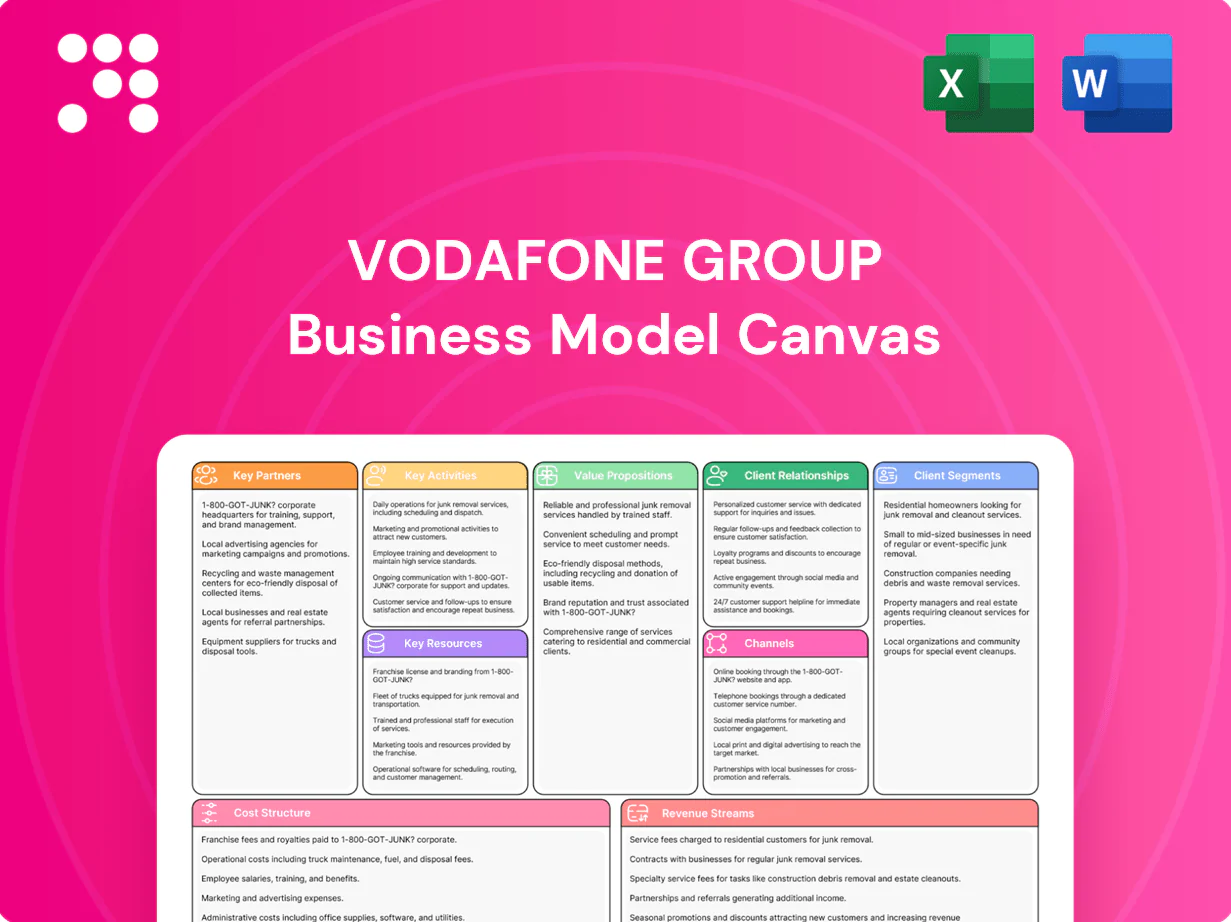
Vodafone Group Business Model Canvas

Unlock the telecom group's strategic blueprint with our concise Business Model Canvas snapshot
Unlock Vodafone Group's strategic blueprint with our concise Business Model Canvas summary. This snapshot outlines value propositions, key partners, revenue streams and growth levers in clear, actionable terms. Ready to benchmark or build strategies? Purchase the full editable Canvas in Word and Excel for a section-by-section deep dive.
Partnerships

Network equipment vendors (e.g., Ericsson, Nokia)
Vodafone relies on strategic suppliers like Ericsson and Nokia for radio, core and transport gear to deploy and upgrade 4G/5G and fibre; its FY2024 capex was about €6.7bn, largely directed to network rollout. Joint roadmaps secure cutting-edge features and preferential pricing. Co-investment and managed services accelerate time-to-market and lower operational risk. Multi-vendor diversification across more than two suppliers boosts resilience and bargaining power.
Tower companies and infrastructure sharing
Partnerships with towercos and RAN-sharing peers cut Vodafone’s deployment capex by around 30%, accelerating coverage expansion and enabling faster rural roll-outs. Site leasing, passive sharing and joint energy services improve unit economics and lower opex per site. These agreements support meeting rural coverage obligations while maintaining service quality, with staged network modernization and coordinated upgrade plans to optimise returns.

Cloud hyperscalers and SaaS providers
Alliances with AWS, Microsoft and Google enable Vodafone to deploy cloud-native core, edge compute and enterprise solutions. Co-sell arrangements expand reach into corporate IT budgets via partners holding roughly 64% of the 2024 cloud market. Integrations power IoT, analytics and security across Vodafone's 100m+ connected devices. Joint innovation labs fast-track vertical use cases and monetization.

Content and media partners
Bundling TV, music and sports drives subscriber growth and retention; in 2024 Vodafone expanded bundled streaming offers across key markets. Wholesale content deals enable tiered packages that lift ARPU. Carrier billing reduces payment friction and failed transactions. Co-marketing with content partners strengthens brand affinity and cuts churn.
- Bundling
- Wholesale deals
- Carrier billing
- Co-marketing
IoT device makers and module OEMs
Device partners ensure cross-generation compatibility across NB-IoT, LTE-M and 5G, while pre-certified modules cut enterprise deployment time and integration risk; Vodafone reported c.135 million IoT connections by 2024, underlining scale. Joint reference designs reduce BOM and integration costs, accelerating adoption across automotive, utilities and smart cities.
- compatibility: NB-IoT, LTE-M, 5G
- speed: pre-certified modules shorten rollouts
- cost: joint reference designs lower unit costs
- reach: ~135m Vodafone IoT connections (2024)
Partners slash deployment capex ~30%, fuel cloud reach and 135m IoT
Vodafone partners with Ericsson, Nokia and towercos to deploy 4G/5G and fibre (FY2024 capex €6.7bn); sharing deals cut deployment capex ~30%. Cloud alliances (AWS, Microsoft, Google) tap ~64% of the 2024 cloud market and enable enterprise services. Device and IoT partners support ~135m connections (2024), accelerating vertical monetization.
| Metric | 2024 |
|---|---|
| Capex | €6.7bn |
| Deployment saving (towerco/RAN share) | ~30% |
| Cloud market share via partners | ~64% |
| IoT connections | ~135m |
What is included in the product
 Detailed Word Document
A comprehensive Vodafone Group Business Model Canvas detailing customer segments, channels, value propositions, key activities, resources, partners, cost structure and revenue streams across 9 blocks; reflects real-world operations, highlights competitive advantages and linked SWOT insights, and is ideal for presentations, investor discussions and strategic decision-making.

 Customizable Excel Spreadsheet
High-level Vodafone Group Business Model Canvas that relieves pain by mapping key value propositions, channels and revenue streams into an editable one-page snapshot for fast strategy alignment.
Activities

Network deployment and optimization
Planning and rolling out 5G, fiber and backhaul is central to Vodafone Group, which invested approximately €5.2bn in network capex in 2024 to expand coverage and capacity. Continuous optimization—software upgrades, edge routing and traffic engineering—reduces latency and boosts throughput, improving SLA attainment by several percentage points. Spectrum refarming and small-cell densification raise capacity in urban hotspots, while energy management and site modernization target double-digit reductions in opex from efficiency gains.
Customer acquisition and retention
Marketing, targeted pricing and promotions drive subscriber growth across consumer and enterprise segments, supporting Vodafone’s roughly 300 million mobile connections in 2024 and group service revenue near €36bn in FY2024. Loyalty programs and bundled fixed-mobile-broadband offers reduce churn and raise ARPU and lifetime value. Data-driven segmentation and AI refine offers, lifting conversion rates, while omnichannel sales — retail, digital and partner channels — ensure broad market access.

Enterprise solution design and delivery
Vodafone architects IoT, cloud, SD-WAN and security solutions for businesses, supporting over 200 million IoT connections by 2024 and enterprise-grade SLAs (up to 99.99% availability) to ensure service continuity. Integration and managed services tailor outcomes by industry, with vertical-specific bundles and metrics tied to SLAs. Professional services handle migration and lifecycle management, while co-creation with clients accelerates deployment of vertical use cases.

Platform and product development
Platform and product development focuses on digital apps, self-care portals and APIs to enhance UX; network APIs and edge platforms are expanding developer ecosystems while iterative product management aligns features to measurable customer feedback; compliance and security are embedded across the software lifecycle. Vodafone Group employs c.95,000 people (2024).
- Digital apps & self-care: improved UX
- Network APIs & edge: new developer ecosystems
- Iterative PM: feature–customer alignment
- Security & compliance: lifecycle integration
Regulatory and spectrum management
Active engagement with regulators secures spectrum and shapes policies; Vodafone reported FY2024 service revenue of €33.1bn, underpinning continued spectrum bids and regulatory lobbying in key markets.
Compliance with licensing, privacy, and security requirements is critical, with routine audits and reporting maintaining market access and customer trust.
Participation in standards bodies such as 3GPP and GSMA influences technology evolution and interoperability.
- Regulatory engagement: spectrum bids, policy shaping
- Compliance: licensing, privacy, security audits
- Standards: 3GPP, GSMA participation
- Reporting: audits to retain market access
Capex €5.2bn expands networks; group revenue €33.1bn
Planning and rolling out 5G, fiber and backhaul drove c.€5.2bn network capex in 2024, expanding coverage and capacity. Marketing, bundles and AI targeting supported ~300m mobile connections and group service revenue of €33.1bn in FY2024. Enterprise activities backed ~200m IoT connections and managed services; Vodafone employed c.95,000 people in 2024.
| Metric | 2024 |
|---|---|
| Network capex | €5.2bn |
| Service revenue | €33.1bn |
| Mobile connections | ~300m |
| IoT connections | ~200m |
| Employees | ~95,000 |
What You See Is What You Get
Business Model Canvas
This preview shows the actual Vodafone Group Business Model Canvas you’ll receive—not a mockup. It’s the exact, fully structured deliverable with real content across customer segments, value propositions, channels, revenue streams and key resources. After purchase you’ll get this same editable file, ready to present and use.

Unlock the telecom group's strategic blueprint with our concise Business Model Canvas snapshot
Unlock Vodafone Group's strategic blueprint with our concise Business Model Canvas summary. This snapshot outlines value propositions, key partners, revenue streams and growth levers in clear, actionable terms. Ready to benchmark or build strategies? Purchase the full editable Canvas in Word and Excel for a section-by-section deep dive.
Partnerships
Network equipment vendors (e.g., Ericsson, Nokia)
Vodafone relies on strategic suppliers like Ericsson and Nokia for radio, core and transport gear to deploy and upgrade 4G/5G and fibre; its FY2024 capex was about €6.7bn, largely directed to network rollout. Joint roadmaps secure cutting-edge features and preferential pricing. Co-investment and managed services accelerate time-to-market and lower operational risk. Multi-vendor diversification across more than two suppliers boosts resilience and bargaining power.
Tower companies and infrastructure sharing
Partnerships with towercos and RAN-sharing peers cut Vodafone’s deployment capex by around 30%, accelerating coverage expansion and enabling faster rural roll-outs. Site leasing, passive sharing and joint energy services improve unit economics and lower opex per site. These agreements support meeting rural coverage obligations while maintaining service quality, with staged network modernization and coordinated upgrade plans to optimise returns.
Cloud hyperscalers and SaaS providers
Alliances with AWS, Microsoft and Google enable Vodafone to deploy cloud-native core, edge compute and enterprise solutions. Co-sell arrangements expand reach into corporate IT budgets via partners holding roughly 64% of the 2024 cloud market. Integrations power IoT, analytics and security across Vodafone's 100m+ connected devices. Joint innovation labs fast-track vertical use cases and monetization.
Content and media partners
Bundling TV, music and sports drives subscriber growth and retention; in 2024 Vodafone expanded bundled streaming offers across key markets. Wholesale content deals enable tiered packages that lift ARPU. Carrier billing reduces payment friction and failed transactions. Co-marketing with content partners strengthens brand affinity and cuts churn.
- Bundling
- Wholesale deals
- Carrier billing
- Co-marketing
IoT device makers and module OEMs
Device partners ensure cross-generation compatibility across NB-IoT, LTE-M and 5G, while pre-certified modules cut enterprise deployment time and integration risk; Vodafone reported c.135 million IoT connections by 2024, underlining scale. Joint reference designs reduce BOM and integration costs, accelerating adoption across automotive, utilities and smart cities.
- compatibility: NB-IoT, LTE-M, 5G
- speed: pre-certified modules shorten rollouts
- cost: joint reference designs lower unit costs
- reach: ~135m Vodafone IoT connections (2024)
Partners slash deployment capex ~30%, fuel cloud reach and 135m IoT
Vodafone partners with Ericsson, Nokia and towercos to deploy 4G/5G and fibre (FY2024 capex €6.7bn); sharing deals cut deployment capex ~30%. Cloud alliances (AWS, Microsoft, Google) tap ~64% of the 2024 cloud market and enable enterprise services. Device and IoT partners support ~135m connections (2024), accelerating vertical monetization.
| Metric | 2024 |
|---|---|
| Capex | €6.7bn |
| Deployment saving (towerco/RAN share) | ~30% |
| Cloud market share via partners | ~64% |
| IoT connections | ~135m |
What is included in the product
Detailed Word Document
A comprehensive Vodafone Group Business Model Canvas detailing customer segments, channels, value propositions, key activities, resources, partners, cost structure and revenue streams across 9 blocks; reflects real-world operations, highlights competitive advantages and linked SWOT insights, and is ideal for presentations, investor discussions and strategic decision-making.
Customizable Excel Spreadsheet
High-level Vodafone Group Business Model Canvas that relieves pain by mapping key value propositions, channels and revenue streams into an editable one-page snapshot for fast strategy alignment.
Activities
Network deployment and optimization
Planning and rolling out 5G, fiber and backhaul is central to Vodafone Group, which invested approximately €5.2bn in network capex in 2024 to expand coverage and capacity. Continuous optimization—software upgrades, edge routing and traffic engineering—reduces latency and boosts throughput, improving SLA attainment by several percentage points. Spectrum refarming and small-cell densification raise capacity in urban hotspots, while energy management and site modernization target double-digit reductions in opex from efficiency gains.
Customer acquisition and retention
Marketing, targeted pricing and promotions drive subscriber growth across consumer and enterprise segments, supporting Vodafone’s roughly 300 million mobile connections in 2024 and group service revenue near €36bn in FY2024. Loyalty programs and bundled fixed-mobile-broadband offers reduce churn and raise ARPU and lifetime value. Data-driven segmentation and AI refine offers, lifting conversion rates, while omnichannel sales — retail, digital and partner channels — ensure broad market access.
Enterprise solution design and delivery
Vodafone architects IoT, cloud, SD-WAN and security solutions for businesses, supporting over 200 million IoT connections by 2024 and enterprise-grade SLAs (up to 99.99% availability) to ensure service continuity. Integration and managed services tailor outcomes by industry, with vertical-specific bundles and metrics tied to SLAs. Professional services handle migration and lifecycle management, while co-creation with clients accelerates deployment of vertical use cases.
Platform and product development
Platform and product development focuses on digital apps, self-care portals and APIs to enhance UX; network APIs and edge platforms are expanding developer ecosystems while iterative product management aligns features to measurable customer feedback; compliance and security are embedded across the software lifecycle. Vodafone Group employs c.95,000 people (2024).
- Digital apps & self-care: improved UX
- Network APIs & edge: new developer ecosystems
- Iterative PM: feature–customer alignment
- Security & compliance: lifecycle integration
Regulatory and spectrum management
Active engagement with regulators secures spectrum and shapes policies; Vodafone reported FY2024 service revenue of €33.1bn, underpinning continued spectrum bids and regulatory lobbying in key markets.
Compliance with licensing, privacy, and security requirements is critical, with routine audits and reporting maintaining market access and customer trust.
Participation in standards bodies such as 3GPP and GSMA influences technology evolution and interoperability.
- Regulatory engagement: spectrum bids, policy shaping
- Compliance: licensing, privacy, security audits
- Standards: 3GPP, GSMA participation
- Reporting: audits to retain market access
Capex €5.2bn expands networks; group revenue €33.1bn
Planning and rolling out 5G, fiber and backhaul drove c.€5.2bn network capex in 2024, expanding coverage and capacity. Marketing, bundles and AI targeting supported ~300m mobile connections and group service revenue of €33.1bn in FY2024. Enterprise activities backed ~200m IoT connections and managed services; Vodafone employed c.95,000 people in 2024.
| Metric | 2024 |
|---|---|
| Network capex | €5.2bn |
| Service revenue | €33.1bn |
| Mobile connections | ~300m |
| IoT connections | ~200m |
| Employees | ~95,000 |
What You See Is What You Get
Business Model Canvas
This preview shows the actual Vodafone Group Business Model Canvas you’ll receive—not a mockup. It’s the exact, fully structured deliverable with real content across customer segments, value propositions, channels, revenue streams and key resources. After purchase you’ll get this same editable file, ready to present and use.
Description
Unlock the telecom group's strategic blueprint with our concise Business Model Canvas snapshot
Unlock Vodafone Group's strategic blueprint with our concise Business Model Canvas summary. This snapshot outlines value propositions, key partners, revenue streams and growth levers in clear, actionable terms. Ready to benchmark or build strategies? Purchase the full editable Canvas in Word and Excel for a section-by-section deep dive.
Partnerships
Network equipment vendors (e.g., Ericsson, Nokia)
Vodafone relies on strategic suppliers like Ericsson and Nokia for radio, core and transport gear to deploy and upgrade 4G/5G and fibre; its FY2024 capex was about €6.7bn, largely directed to network rollout. Joint roadmaps secure cutting-edge features and preferential pricing. Co-investment and managed services accelerate time-to-market and lower operational risk. Multi-vendor diversification across more than two suppliers boosts resilience and bargaining power.
Tower companies and infrastructure sharing
Partnerships with towercos and RAN-sharing peers cut Vodafone’s deployment capex by around 30%, accelerating coverage expansion and enabling faster rural roll-outs. Site leasing, passive sharing and joint energy services improve unit economics and lower opex per site. These agreements support meeting rural coverage obligations while maintaining service quality, with staged network modernization and coordinated upgrade plans to optimise returns.
Cloud hyperscalers and SaaS providers
Alliances with AWS, Microsoft and Google enable Vodafone to deploy cloud-native core, edge compute and enterprise solutions. Co-sell arrangements expand reach into corporate IT budgets via partners holding roughly 64% of the 2024 cloud market. Integrations power IoT, analytics and security across Vodafone's 100m+ connected devices. Joint innovation labs fast-track vertical use cases and monetization.
Content and media partners
Bundling TV, music and sports drives subscriber growth and retention; in 2024 Vodafone expanded bundled streaming offers across key markets. Wholesale content deals enable tiered packages that lift ARPU. Carrier billing reduces payment friction and failed transactions. Co-marketing with content partners strengthens brand affinity and cuts churn.
- Bundling
- Wholesale deals
- Carrier billing
- Co-marketing
IoT device makers and module OEMs
Device partners ensure cross-generation compatibility across NB-IoT, LTE-M and 5G, while pre-certified modules cut enterprise deployment time and integration risk; Vodafone reported c.135 million IoT connections by 2024, underlining scale. Joint reference designs reduce BOM and integration costs, accelerating adoption across automotive, utilities and smart cities.
- compatibility: NB-IoT, LTE-M, 5G
- speed: pre-certified modules shorten rollouts
- cost: joint reference designs lower unit costs
- reach: ~135m Vodafone IoT connections (2024)
Partners slash deployment capex ~30%, fuel cloud reach and 135m IoT
Vodafone partners with Ericsson, Nokia and towercos to deploy 4G/5G and fibre (FY2024 capex €6.7bn); sharing deals cut deployment capex ~30%. Cloud alliances (AWS, Microsoft, Google) tap ~64% of the 2024 cloud market and enable enterprise services. Device and IoT partners support ~135m connections (2024), accelerating vertical monetization.
| Metric | 2024 |
|---|---|
| Capex | €6.7bn |
| Deployment saving (towerco/RAN share) | ~30% |
| Cloud market share via partners | ~64% |
| IoT connections | ~135m |
What is included in the product
Detailed Word Document
A comprehensive Vodafone Group Business Model Canvas detailing customer segments, channels, value propositions, key activities, resources, partners, cost structure and revenue streams across 9 blocks; reflects real-world operations, highlights competitive advantages and linked SWOT insights, and is ideal for presentations, investor discussions and strategic decision-making.
Customizable Excel Spreadsheet
High-level Vodafone Group Business Model Canvas that relieves pain by mapping key value propositions, channels and revenue streams into an editable one-page snapshot for fast strategy alignment.
Activities
Network deployment and optimization
Planning and rolling out 5G, fiber and backhaul is central to Vodafone Group, which invested approximately €5.2bn in network capex in 2024 to expand coverage and capacity. Continuous optimization—software upgrades, edge routing and traffic engineering—reduces latency and boosts throughput, improving SLA attainment by several percentage points. Spectrum refarming and small-cell densification raise capacity in urban hotspots, while energy management and site modernization target double-digit reductions in opex from efficiency gains.
Customer acquisition and retention
Marketing, targeted pricing and promotions drive subscriber growth across consumer and enterprise segments, supporting Vodafone’s roughly 300 million mobile connections in 2024 and group service revenue near €36bn in FY2024. Loyalty programs and bundled fixed-mobile-broadband offers reduce churn and raise ARPU and lifetime value. Data-driven segmentation and AI refine offers, lifting conversion rates, while omnichannel sales — retail, digital and partner channels — ensure broad market access.
Enterprise solution design and delivery
Vodafone architects IoT, cloud, SD-WAN and security solutions for businesses, supporting over 200 million IoT connections by 2024 and enterprise-grade SLAs (up to 99.99% availability) to ensure service continuity. Integration and managed services tailor outcomes by industry, with vertical-specific bundles and metrics tied to SLAs. Professional services handle migration and lifecycle management, while co-creation with clients accelerates deployment of vertical use cases.
Platform and product development
Platform and product development focuses on digital apps, self-care portals and APIs to enhance UX; network APIs and edge platforms are expanding developer ecosystems while iterative product management aligns features to measurable customer feedback; compliance and security are embedded across the software lifecycle. Vodafone Group employs c.95,000 people (2024).
- Digital apps & self-care: improved UX
- Network APIs & edge: new developer ecosystems
- Iterative PM: feature–customer alignment
- Security & compliance: lifecycle integration
Regulatory and spectrum management
Active engagement with regulators secures spectrum and shapes policies; Vodafone reported FY2024 service revenue of €33.1bn, underpinning continued spectrum bids and regulatory lobbying in key markets.
Compliance with licensing, privacy, and security requirements is critical, with routine audits and reporting maintaining market access and customer trust.
Participation in standards bodies such as 3GPP and GSMA influences technology evolution and interoperability.
- Regulatory engagement: spectrum bids, policy shaping
- Compliance: licensing, privacy, security audits
- Standards: 3GPP, GSMA participation
- Reporting: audits to retain market access
Capex €5.2bn expands networks; group revenue €33.1bn
Planning and rolling out 5G, fiber and backhaul drove c.€5.2bn network capex in 2024, expanding coverage and capacity. Marketing, bundles and AI targeting supported ~300m mobile connections and group service revenue of €33.1bn in FY2024. Enterprise activities backed ~200m IoT connections and managed services; Vodafone employed c.95,000 people in 2024.
| Metric | 2024 |
|---|---|
| Network capex | €5.2bn |
| Service revenue | €33.1bn |
| Mobile connections | ~300m |
| IoT connections | ~200m |
| Employees | ~95,000 |
What You See Is What You Get
Business Model Canvas
This preview shows the actual Vodafone Group Business Model Canvas you’ll receive—not a mockup. It’s the exact, fully structured deliverable with real content across customer segments, value propositions, channels, revenue streams and key resources. After purchase you’ll get this same editable file, ready to present and use.











