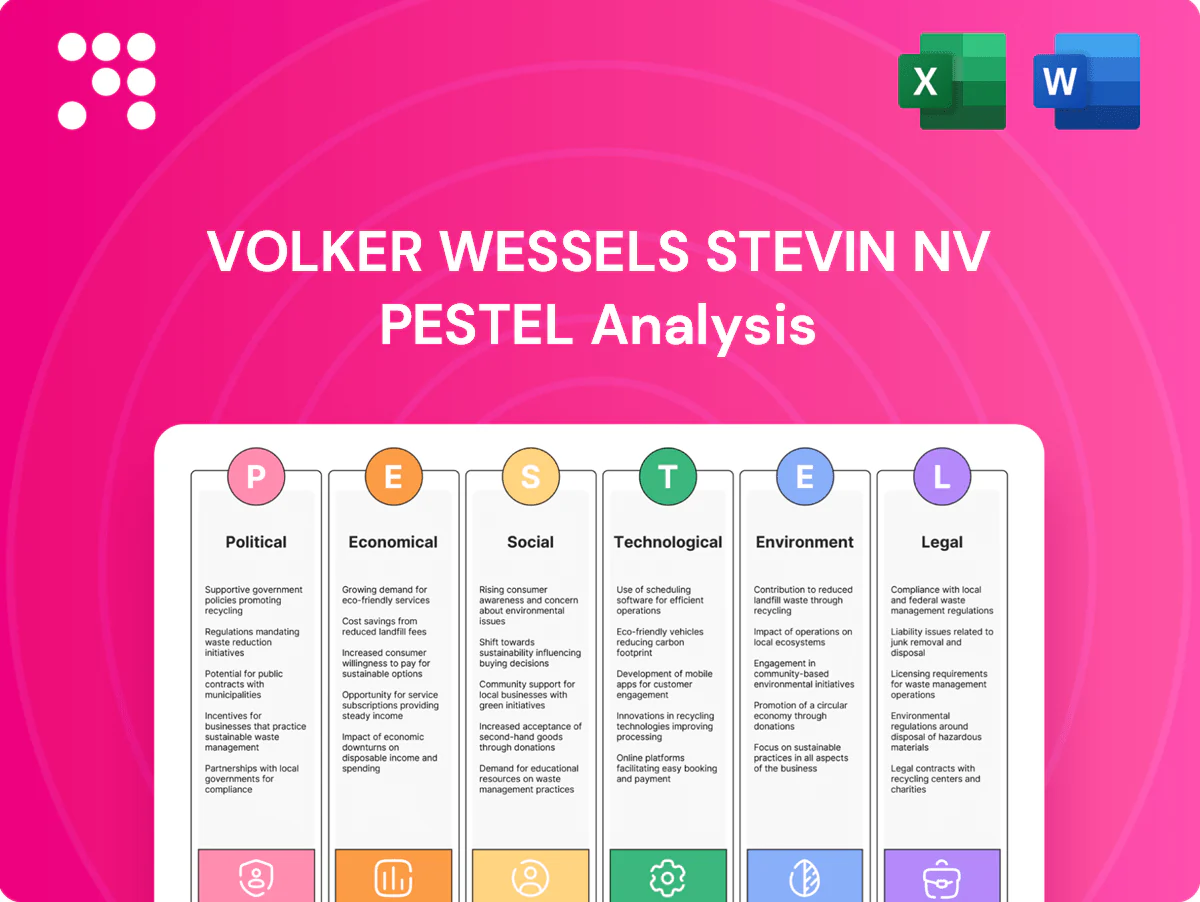
Volker Wessels Stevin NV PESTLE Analysis

Your Shortcut to Market Insight Starts Here
Stay ahead with our PESTLE analysis of Volker Wessels Stevin NV, revealing the political, economic and environmental forces shaping its prospects. Use these strategic insights to spot risks and growth opportunities. Purchase the full report for a detailed, actionable breakdown today.
Political factors

Public infrastructure agendas
National and EU infrastructure priorities — backed by the EU’s NextGenerationEU package of €806.9bn and 2021–2027 cohesion funds ~€373bn — sustain pipelines across roads, rail, energy and telecom; post‑election budget shifts can accelerate or defer projects, while VolkerWessels’ decentralized units align locally and proactive PPP engagement improves multi‑year revenue visibility.
PPP and procurement policy
EU public procurement amounts to roughly €2 trillion annually, so PPP and tender rules materially shape margins and risk transfer for VolkerWessels Stevin NV. Stricter selection criteria increasingly favor integrated delivery and lifecycle capability, benefiting firms with design–build–maintain models. The company’s performance‑based approach aligns with these contracts, and transparent bidding plus early contractor involvement have been shown to improve win rates and reduce claims.

Permitting and planning regimes
Lengthy zoning and environmental approvals under the Omgevingswet (in force 1 January 2022) can delay project starts and tie up working capital for VolkerWessels Stevin; municipal processing remains decentralized across 342 Dutch municipalities (2023), creating schedule variance. Early engagement with stakeholders and regulators reduces permitting risk. Digital permitting via the Digitaal Stelsel Omgevingswet (DSO) is being deployed and where adopted can compress timelines.

Energy transition incentives
Energy transition incentives—driven by the EU 42.5% renewables-by-2030 target and the European Green Deal Investment Plan (mobilising about €1 trillion to 2030)—expand VolkerWessels Stevin NVs addressable markets via subsidies for renewables, grids and EV charging; EU CEF2 funding (~€33.7bn for 2021–2027) and modal-shift rail support underpin civil-works demand, while midstream subsidy changes can swing project economics, making balanced segment exposure key to lowering policy concentration risk.
- EU renewables target: 42.5% by 2030
- Green Deal investments: ~€1 trillion to 2030
- CEF2 budget (2021–2027): ~€33.7bn
- Balanced exposure reduces policy concentration risk
Geopolitical supply risks
Trade frictions and sanctions (notably EU measures since 2022) continue to reshape sourcing and inflate input costs for steel, asphalt and heavy equipment, while political instability in key corridors periodically disrupts cross-border logistics; logistics rates have eased from 2021 peaks but remain volatile. Volker Wessels Stevin mitigates shocks via stronger local supplier networks and contractual price-escalation clauses to protect margins.
- Geopolitical sanctions: EU measures since 2022 affecting metal flows
- Logistics volatility: container and freight rates remain unstable vs 2021 peaks
- Mitigation: local suppliers reduce exposure
- Contracts: price escalation clauses preserve margins
EU/NL infrastructure funding surge: NextGenerationEU pipelines, procurement & renewables push
EU/NL infrastructure prioritization (NextGenerationEU €806.9bn; cohesion ~€373bn) secures multi‑year pipelines; electoral budget shifts can accelerate or delay projects. Procurement (~€2tn/yr) and PPP rules favor integrated delivery, aiding VolkerWessels Stevin. Sanctions/logistics volatility push local sourcing and escalation clauses; renewables targets (42.5% by 2030) expand opportunities.
| Metric | Value |
|---|---|
| NextGenerationEU | €806.9bn |
| Cohesion (2021‑27) | ~€373bn |
| EU procurement | ~€2tn/yr |
| Renewables target | 42.5% by 2030 |
What is included in the product
 Detailed Word Document
Explores how Political, Economic, Social, Technological, Environmental and Legal forces uniquely affect Volker Wessels Stevin NV, with data-backed, region- and industry-specific insights to identify risks and opportunities for executives, consultants and investors, and includes forward-looking points for scenario planning and strategic action.

 Customizable Excel Spreadsheet
A concise, visually segmented PESTLE summary for Volker Wessels Stevin NV that’s easy to drop into presentations, editable for local context, and ideal for aligning teams and guiding external risk discussions during planning sessions.
Economic factors

Interest rates and capex
Higher rates (ECB deposit rate about 4.00% in July 2025) raise client financing costs and have delayed private real estate starts across the Netherlands, reducing residential development volumes. Public capex has been more resilient but can be rephased by governments. VolkerWessels' strong balance sheet and selective bidding help preserve returns through cycles, while early payment milestones support cash flow in high-rate environments.
Inflation and cost pass-through
Material and labor cost pressures remain key for VolkerWessels Stevin as euro‑area inflation eased to about 2.4% in mid‑2024 but input volatility persists; tender pricing must reflect higher baseline input costs. Indexation and escalation clauses are critical in long‑duration contracts to protect margins. Centralized procurement secures volumes and hedges price swings, while lean execution and modular methods limit on‑site exposure and labor intensity.

Housing and urban demand
Structural housing shortages in the Netherlands — estimated at roughly 300,000 homes — sustain residential activity and insulate VolkerWessels Stevin NV from short cycles; Dutch urbanization is about 75% (Eurostat 2023). Urban regeneration and mixed-use projects, driven by municipal programmes and brownfield redevelopments, create integrated development opportunities. Affordability pressures shift demand toward mid-market and social housing, while lifecycle services (maintenance, FM) provide recurring revenue beyond one-off builds.

Labor market tightness
Skilled trades shortages raise wage pressure and schedule risk for VolkerWessels Stevin NV, prompting targeted apprenticeships and vocational school partnerships to secure talent pipelines. Adoption of BIM and prefabrication boosts productivity, offsetting headcount limits and lowering on-site delays. Diversifying subcontractors reduces single-source dependency and mitigates delivery risk.
- Skilled shortages → higher wages, schedule risk
- Apprenticeships & school partnerships → pipeline security
- Productivity tools (BIM, prefabrication) → offset headcount
- Subcontractor diversification → dependency reduction
Supply chain resilience
Supply chain resilience for VolkerWessels Stevin NV is critical as global shocks continue to affect cement, steel, bitumen and equipment semiconductors; container rates eased to roughly USD 1,200–1,500/FEU in 2024 versus pandemic peaks, lowering some logistics cost volatility. Dual sourcing and local inventories have limited disruption, while early procurement tied to design freeze cuts delay risk; data-driven demand planning improved material fill rates in 2024.
- Dual sourcing
- Local inventories
- Early procurement at design freeze
- Data-driven demand planning
EU/NL infrastructure funding surge: NextGenerationEU pipelines, procurement & renewables push
Higher ECB rates (~4.00% July 2025) raise financing costs and slow private starts; public capex resilient but rephasing risk exists. Input inflation eased to ~2.4% (mid‑2024) yet material volatility persists; housing shortage (~300,000 homes) supports steady residential demand. Supply-chain logistic costs eased (container USD 1,200–1,500/FEU 2024), aiding margins.
| Metric | Value |
|---|---|
| ECB deposit rate | ~4.00% (Jul 2025) |
| Euro‑area inflation | ~2.4% (mid‑2024) |
| Dutch housing gap | ~300,000 homes |
| Container rates | USD 1,200–1,500/FEU (2024) |
What You See Is What You Get
Volker Wessels Stevin NV PESTLE Analysis
The preview shown here is the exact Volker Wessels Stevin NV PESTLE Analysis you’ll receive after purchase—fully formatted and ready to use. The layout, content, and structure visible are identical to the downloadable file. No placeholders or teasers—this is the final, professionally structured document.

Your Shortcut to Market Insight Starts Here
Stay ahead with our PESTLE analysis of Volker Wessels Stevin NV, revealing the political, economic and environmental forces shaping its prospects. Use these strategic insights to spot risks and growth opportunities. Purchase the full report for a detailed, actionable breakdown today.
Political factors
Public infrastructure agendas
National and EU infrastructure priorities — backed by the EU’s NextGenerationEU package of €806.9bn and 2021–2027 cohesion funds ~€373bn — sustain pipelines across roads, rail, energy and telecom; post‑election budget shifts can accelerate or defer projects, while VolkerWessels’ decentralized units align locally and proactive PPP engagement improves multi‑year revenue visibility.
PPP and procurement policy
EU public procurement amounts to roughly €2 trillion annually, so PPP and tender rules materially shape margins and risk transfer for VolkerWessels Stevin NV. Stricter selection criteria increasingly favor integrated delivery and lifecycle capability, benefiting firms with design–build–maintain models. The company’s performance‑based approach aligns with these contracts, and transparent bidding plus early contractor involvement have been shown to improve win rates and reduce claims.
Permitting and planning regimes
Lengthy zoning and environmental approvals under the Omgevingswet (in force 1 January 2022) can delay project starts and tie up working capital for VolkerWessels Stevin; municipal processing remains decentralized across 342 Dutch municipalities (2023), creating schedule variance. Early engagement with stakeholders and regulators reduces permitting risk. Digital permitting via the Digitaal Stelsel Omgevingswet (DSO) is being deployed and where adopted can compress timelines.
Energy transition incentives
Energy transition incentives—driven by the EU 42.5% renewables-by-2030 target and the European Green Deal Investment Plan (mobilising about €1 trillion to 2030)—expand VolkerWessels Stevin NVs addressable markets via subsidies for renewables, grids and EV charging; EU CEF2 funding (~€33.7bn for 2021–2027) and modal-shift rail support underpin civil-works demand, while midstream subsidy changes can swing project economics, making balanced segment exposure key to lowering policy concentration risk.
- EU renewables target: 42.5% by 2030
- Green Deal investments: ~€1 trillion to 2030
- CEF2 budget (2021–2027): ~€33.7bn
- Balanced exposure reduces policy concentration risk
Geopolitical supply risks
Trade frictions and sanctions (notably EU measures since 2022) continue to reshape sourcing and inflate input costs for steel, asphalt and heavy equipment, while political instability in key corridors periodically disrupts cross-border logistics; logistics rates have eased from 2021 peaks but remain volatile. Volker Wessels Stevin mitigates shocks via stronger local supplier networks and contractual price-escalation clauses to protect margins.
- Geopolitical sanctions: EU measures since 2022 affecting metal flows
- Logistics volatility: container and freight rates remain unstable vs 2021 peaks
- Mitigation: local suppliers reduce exposure
- Contracts: price escalation clauses preserve margins
EU/NL infrastructure funding surge: NextGenerationEU pipelines, procurement & renewables push
EU/NL infrastructure prioritization (NextGenerationEU €806.9bn; cohesion ~€373bn) secures multi‑year pipelines; electoral budget shifts can accelerate or delay projects. Procurement (~€2tn/yr) and PPP rules favor integrated delivery, aiding VolkerWessels Stevin. Sanctions/logistics volatility push local sourcing and escalation clauses; renewables targets (42.5% by 2030) expand opportunities.
| Metric | Value |
|---|---|
| NextGenerationEU | €806.9bn |
| Cohesion (2021‑27) | ~€373bn |
| EU procurement | ~€2tn/yr |
| Renewables target | 42.5% by 2030 |
What is included in the product
Detailed Word Document
Explores how Political, Economic, Social, Technological, Environmental and Legal forces uniquely affect Volker Wessels Stevin NV, with data-backed, region- and industry-specific insights to identify risks and opportunities for executives, consultants and investors, and includes forward-looking points for scenario planning and strategic action.
Customizable Excel Spreadsheet
A concise, visually segmented PESTLE summary for Volker Wessels Stevin NV that’s easy to drop into presentations, editable for local context, and ideal for aligning teams and guiding external risk discussions during planning sessions.
Economic factors
Interest rates and capex
Higher rates (ECB deposit rate about 4.00% in July 2025) raise client financing costs and have delayed private real estate starts across the Netherlands, reducing residential development volumes. Public capex has been more resilient but can be rephased by governments. VolkerWessels' strong balance sheet and selective bidding help preserve returns through cycles, while early payment milestones support cash flow in high-rate environments.
Inflation and cost pass-through
Material and labor cost pressures remain key for VolkerWessels Stevin as euro‑area inflation eased to about 2.4% in mid‑2024 but input volatility persists; tender pricing must reflect higher baseline input costs. Indexation and escalation clauses are critical in long‑duration contracts to protect margins. Centralized procurement secures volumes and hedges price swings, while lean execution and modular methods limit on‑site exposure and labor intensity.
Housing and urban demand
Structural housing shortages in the Netherlands — estimated at roughly 300,000 homes — sustain residential activity and insulate VolkerWessels Stevin NV from short cycles; Dutch urbanization is about 75% (Eurostat 2023). Urban regeneration and mixed-use projects, driven by municipal programmes and brownfield redevelopments, create integrated development opportunities. Affordability pressures shift demand toward mid-market and social housing, while lifecycle services (maintenance, FM) provide recurring revenue beyond one-off builds.
Labor market tightness
Skilled trades shortages raise wage pressure and schedule risk for VolkerWessels Stevin NV, prompting targeted apprenticeships and vocational school partnerships to secure talent pipelines. Adoption of BIM and prefabrication boosts productivity, offsetting headcount limits and lowering on-site delays. Diversifying subcontractors reduces single-source dependency and mitigates delivery risk.
- Skilled shortages → higher wages, schedule risk
- Apprenticeships & school partnerships → pipeline security
- Productivity tools (BIM, prefabrication) → offset headcount
- Subcontractor diversification → dependency reduction
Supply chain resilience
Supply chain resilience for VolkerWessels Stevin NV is critical as global shocks continue to affect cement, steel, bitumen and equipment semiconductors; container rates eased to roughly USD 1,200–1,500/FEU in 2024 versus pandemic peaks, lowering some logistics cost volatility. Dual sourcing and local inventories have limited disruption, while early procurement tied to design freeze cuts delay risk; data-driven demand planning improved material fill rates in 2024.
- Dual sourcing
- Local inventories
- Early procurement at design freeze
- Data-driven demand planning
EU/NL infrastructure funding surge: NextGenerationEU pipelines, procurement & renewables push
Higher ECB rates (~4.00% July 2025) raise financing costs and slow private starts; public capex resilient but rephasing risk exists. Input inflation eased to ~2.4% (mid‑2024) yet material volatility persists; housing shortage (~300,000 homes) supports steady residential demand. Supply-chain logistic costs eased (container USD 1,200–1,500/FEU 2024), aiding margins.
| Metric | Value |
|---|---|
| ECB deposit rate | ~4.00% (Jul 2025) |
| Euro‑area inflation | ~2.4% (mid‑2024) |
| Dutch housing gap | ~300,000 homes |
| Container rates | USD 1,200–1,500/FEU (2024) |
What You See Is What You Get
Volker Wessels Stevin NV PESTLE Analysis
The preview shown here is the exact Volker Wessels Stevin NV PESTLE Analysis you’ll receive after purchase—fully formatted and ready to use. The layout, content, and structure visible are identical to the downloadable file. No placeholders or teasers—this is the final, professionally structured document.
Description
Your Shortcut to Market Insight Starts Here
Stay ahead with our PESTLE analysis of Volker Wessels Stevin NV, revealing the political, economic and environmental forces shaping its prospects. Use these strategic insights to spot risks and growth opportunities. Purchase the full report for a detailed, actionable breakdown today.
Political factors
Public infrastructure agendas
National and EU infrastructure priorities — backed by the EU’s NextGenerationEU package of €806.9bn and 2021–2027 cohesion funds ~€373bn — sustain pipelines across roads, rail, energy and telecom; post‑election budget shifts can accelerate or defer projects, while VolkerWessels’ decentralized units align locally and proactive PPP engagement improves multi‑year revenue visibility.
PPP and procurement policy
EU public procurement amounts to roughly €2 trillion annually, so PPP and tender rules materially shape margins and risk transfer for VolkerWessels Stevin NV. Stricter selection criteria increasingly favor integrated delivery and lifecycle capability, benefiting firms with design–build–maintain models. The company’s performance‑based approach aligns with these contracts, and transparent bidding plus early contractor involvement have been shown to improve win rates and reduce claims.
Permitting and planning regimes
Lengthy zoning and environmental approvals under the Omgevingswet (in force 1 January 2022) can delay project starts and tie up working capital for VolkerWessels Stevin; municipal processing remains decentralized across 342 Dutch municipalities (2023), creating schedule variance. Early engagement with stakeholders and regulators reduces permitting risk. Digital permitting via the Digitaal Stelsel Omgevingswet (DSO) is being deployed and where adopted can compress timelines.
Energy transition incentives
Energy transition incentives—driven by the EU 42.5% renewables-by-2030 target and the European Green Deal Investment Plan (mobilising about €1 trillion to 2030)—expand VolkerWessels Stevin NVs addressable markets via subsidies for renewables, grids and EV charging; EU CEF2 funding (~€33.7bn for 2021–2027) and modal-shift rail support underpin civil-works demand, while midstream subsidy changes can swing project economics, making balanced segment exposure key to lowering policy concentration risk.
- EU renewables target: 42.5% by 2030
- Green Deal investments: ~€1 trillion to 2030
- CEF2 budget (2021–2027): ~€33.7bn
- Balanced exposure reduces policy concentration risk
Geopolitical supply risks
Trade frictions and sanctions (notably EU measures since 2022) continue to reshape sourcing and inflate input costs for steel, asphalt and heavy equipment, while political instability in key corridors periodically disrupts cross-border logistics; logistics rates have eased from 2021 peaks but remain volatile. Volker Wessels Stevin mitigates shocks via stronger local supplier networks and contractual price-escalation clauses to protect margins.
- Geopolitical sanctions: EU measures since 2022 affecting metal flows
- Logistics volatility: container and freight rates remain unstable vs 2021 peaks
- Mitigation: local suppliers reduce exposure
- Contracts: price escalation clauses preserve margins
EU/NL infrastructure funding surge: NextGenerationEU pipelines, procurement & renewables push
EU/NL infrastructure prioritization (NextGenerationEU €806.9bn; cohesion ~€373bn) secures multi‑year pipelines; electoral budget shifts can accelerate or delay projects. Procurement (~€2tn/yr) and PPP rules favor integrated delivery, aiding VolkerWessels Stevin. Sanctions/logistics volatility push local sourcing and escalation clauses; renewables targets (42.5% by 2030) expand opportunities.
| Metric | Value |
|---|---|
| NextGenerationEU | €806.9bn |
| Cohesion (2021‑27) | ~€373bn |
| EU procurement | ~€2tn/yr |
| Renewables target | 42.5% by 2030 |
What is included in the product
Detailed Word Document
Explores how Political, Economic, Social, Technological, Environmental and Legal forces uniquely affect Volker Wessels Stevin NV, with data-backed, region- and industry-specific insights to identify risks and opportunities for executives, consultants and investors, and includes forward-looking points for scenario planning and strategic action.
Customizable Excel Spreadsheet
A concise, visually segmented PESTLE summary for Volker Wessels Stevin NV that’s easy to drop into presentations, editable for local context, and ideal for aligning teams and guiding external risk discussions during planning sessions.
Economic factors
Interest rates and capex
Higher rates (ECB deposit rate about 4.00% in July 2025) raise client financing costs and have delayed private real estate starts across the Netherlands, reducing residential development volumes. Public capex has been more resilient but can be rephased by governments. VolkerWessels' strong balance sheet and selective bidding help preserve returns through cycles, while early payment milestones support cash flow in high-rate environments.
Inflation and cost pass-through
Material and labor cost pressures remain key for VolkerWessels Stevin as euro‑area inflation eased to about 2.4% in mid‑2024 but input volatility persists; tender pricing must reflect higher baseline input costs. Indexation and escalation clauses are critical in long‑duration contracts to protect margins. Centralized procurement secures volumes and hedges price swings, while lean execution and modular methods limit on‑site exposure and labor intensity.
Housing and urban demand
Structural housing shortages in the Netherlands — estimated at roughly 300,000 homes — sustain residential activity and insulate VolkerWessels Stevin NV from short cycles; Dutch urbanization is about 75% (Eurostat 2023). Urban regeneration and mixed-use projects, driven by municipal programmes and brownfield redevelopments, create integrated development opportunities. Affordability pressures shift demand toward mid-market and social housing, while lifecycle services (maintenance, FM) provide recurring revenue beyond one-off builds.
Labor market tightness
Skilled trades shortages raise wage pressure and schedule risk for VolkerWessels Stevin NV, prompting targeted apprenticeships and vocational school partnerships to secure talent pipelines. Adoption of BIM and prefabrication boosts productivity, offsetting headcount limits and lowering on-site delays. Diversifying subcontractors reduces single-source dependency and mitigates delivery risk.
- Skilled shortages → higher wages, schedule risk
- Apprenticeships & school partnerships → pipeline security
- Productivity tools (BIM, prefabrication) → offset headcount
- Subcontractor diversification → dependency reduction
Supply chain resilience
Supply chain resilience for VolkerWessels Stevin NV is critical as global shocks continue to affect cement, steel, bitumen and equipment semiconductors; container rates eased to roughly USD 1,200–1,500/FEU in 2024 versus pandemic peaks, lowering some logistics cost volatility. Dual sourcing and local inventories have limited disruption, while early procurement tied to design freeze cuts delay risk; data-driven demand planning improved material fill rates in 2024.
- Dual sourcing
- Local inventories
- Early procurement at design freeze
- Data-driven demand planning
EU/NL infrastructure funding surge: NextGenerationEU pipelines, procurement & renewables push
Higher ECB rates (~4.00% July 2025) raise financing costs and slow private starts; public capex resilient but rephasing risk exists. Input inflation eased to ~2.4% (mid‑2024) yet material volatility persists; housing shortage (~300,000 homes) supports steady residential demand. Supply-chain logistic costs eased (container USD 1,200–1,500/FEU 2024), aiding margins.
| Metric | Value |
|---|---|
| ECB deposit rate | ~4.00% (Jul 2025) |
| Euro‑area inflation | ~2.4% (mid‑2024) |
| Dutch housing gap | ~300,000 homes |
| Container rates | USD 1,200–1,500/FEU (2024) |
What You See Is What You Get
Volker Wessels Stevin NV PESTLE Analysis
The preview shown here is the exact Volker Wessels Stevin NV PESTLE Analysis you’ll receive after purchase—fully formatted and ready to use. The layout, content, and structure visible are identical to the downloadable file. No placeholders or teasers—this is the final, professionally structured document.











